Disclosure: As an Amazon Associate, topratedkitchenware.com earns from qualifying purchases. Links on this page are affiliate links; they cost you nothing extra. Prices and availability change often, so check the current Amazon listing before you buy.
Asking is an electric kettle worth it sounds like a question about a small appliance, but it is really a question about your household’s relationship with boiling water. An electric kettle — the cordless jug on a powered base that boils water for tea, coffee, instant food, and cooking, then switches itself off — is either one of the hardest-working objects you own or a counter ornament gathering dust, and the difference is decided almost entirely by how often your household boils water and what you currently use instead. This verdict concerns the everyday kettle, not the gooseneck specialist of pour-over coffee, whose worth is judged on different grounds in its own cluster.
The short answer: worth it if you boil water daily or near-daily, if your mornings run on hot drinks, if you cook with pans that could start at a boil, or if a stovetop kettle’s supervision is a genuine friction in your house. Not worth it if you boil water a few times a month, if your counter has no safe home for another powered base, or if the stovetop ritual is itself one of your pleasures. For the large middle of households, the answer is yes, and usually emphatically: few appliances convert so modest a purchase into so much daily time, safety, and convenience.
Key Takeaways
- Worth is a frequency calculation: the more often you boil, the more decisively the kettle pays for its counter space.
- What you actually buy is unattended speed — boiling that switches itself off — plus consistency, versatility, and boil-dry safety.
- The real costs beyond money are counter space, a descaling habit, boiling noise, and the respect a jug of scalding water demands.
- Three profiles gain the most: hot-drink households, families, and cooks. Three should skip: rare boilers, the truly counter-poor, and stovetop romantics.
- If you buy, buy by fit — material, capacity, and the preset question — using the tiers qualitatively rather than chasing the flagship.
What You Actually Get
Strip the marketing away and an electric kettle delivers four concrete things. The first is time, returned in two currencies: the minutes of a faster boil, and the much larger sum of attention you no longer spend watching a hob. A stovetop kettle holds a person loosely hostage until it boils; an electric kettle releases you the moment you click the switch, and across several boils a day that release compounds into something households genuinely feel. The second is consistency. The kettle reaches the same rolling boil and stops at the same point every time, and temperature-control models extend that reliability below boiling for delicate teas, so drinks taste as they should on tired mornings as reliably as on careful ones.
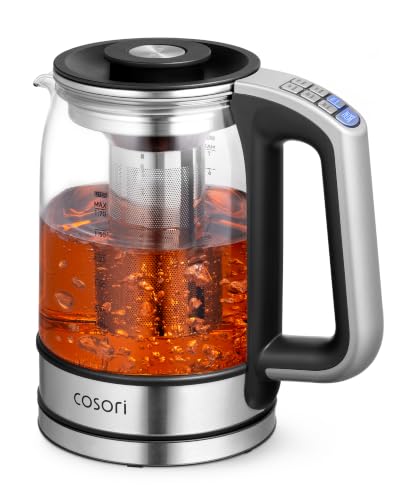
The third is safety of a specific, practical kind. Automatic shut-off removes the forgotten boil; boil-dry protection removes the empty-kettle disaster; the cordless jug removes the trailing flex and the lit burner from the simple act of making tea. The fourth is versatility, the quiet giant of the four. The same appliance that makes the morning round also starts the pasta water at a boil, hydrates the couscous and noodles, fills the hot water bottle, warms the bottle in its bowl, and supplies a dozen small hot-water tasks through the day. Most appliances are bought for a job; the kettle is bought for a utility, like the tap or the hob itself, and utilities are judged by how invisible their reliability becomes. That is what you get: boiling water as a household utility, on demand, without supervision. The models that deliver it in this cluster’s reference set — the COSORI electric kettle as all-rounder, the Cuisinart PerfecTemp kettle for control, the Hamilton Beach electric kettle for volume, the Amazon Basics kettle at the entry tier, the Ovente glass kettle for visibility, and the Mueller electric kettle in compact steel — differ in fit, not in this core delivery.
In this guide
The Real Costs Beyond Money
The kettle’s purchase tier is the least interesting of its costs. The real ledger is paid in space, upkeep, noise, and care. Space first: a kettle and its powered base occupy a permanent patch of counter and a socket, in the one room where both are always contested. In a generous kitchen that cost is trivial; in a small flat it can be the deciding factor, and it should be measured honestly, in the actual spot the kettle would live, before any purchase. Upkeep second: the descale. Hard water will crust the kettle’s floor on a schedule indifferent to your enthusiasm, and the appliance’s speed and taste depend on somebody removing that crust regularly — a small chore, made smaller by the routine in how to clean an electric kettle, but a permanent one.
Noise third: a kettle at a rolling boil is loud enough to matter in a studio flat or a sleeping house, and designs vary in how much they broadcast it. Care fourth, and most serious: a kettle concentrates the kitchen’s most common scald hazard into a handheld jug. The appliance’s cut-outs protect against forgetfulness, not against a knocked jug, a snagged cord, an overfilled boil spitting from the spout, or steam taken carelessly in the face. Owning one worthily means placing it back from edges, filling it between its marks, keeping its powered base dry and away from the sink’s splash, and teaching the household to treat it with stove-level respect. None of these costs is hidden, and none is unreasonable — but a household unwilling to pay the upkeep and care costs in particular should count that honestly against the purchase.
Who It Pays Off For
The Hot-Drink Household
If your kitchen’s day is punctuated by tea and coffee — a round on waking, a cafetière mid-morning, tea through the afternoon, a last drink at night — the kettle pays for itself in convenience so quickly that the question answers itself. You gain the unattended boil at the exact moments your hands and attention are busiest, consistency in every cup, and an appliance every member of the household and every guest can operate without instruction. For this profile the only real decision is specification: presets if your teas run delicate, glass if you like to see the water, steel if the house is hard on objects. The worth case here is the strongest in this entire article.
The Family Kitchen
Families boil water the way they breathe: drinks in waves, instant foods for children, pans to start, bottles and hot water bottles in season. The kettle’s payoff is measured in friction removed from the busiest room at the busiest hours, and in the safety of cut-outs that forgive exhausted, distracted adults. The family profile should buy capacity and toughness — the Hamilton Beach pattern — and should treat placement as part of the purchase: a kettle a climbing child can reach is a cost no convenience repays. Properly placed and sized, the family kettle is usually the last appliance anyone in the house would surrender.
The Cook
Cooks underestimate the kettle until they own one, because its value to them is not drinks at all. It is the pan that starts at a rolling boil instead of a cold crawl, the grains hydrated instantly, the stock and blanching water ready on the click. In a cooking household the kettle joins the stove team, and its worth is measured across every meal rather than every mug. If you cook most days, the kettle’s versatility argument alone clears the bar, and the drinks are a bonus.
Who Should Skip It
The Rare Boiler
If boiling water happens in your house a few times a month — a guest’s tea, an occasional recipe — a pan or a stovetop kettle you already own does the job, and a powered base would spend its life as counter clutter with a cord. Worth follows frequency with unusual honesty in this category, and the rare boiler is the clearest skip. Your money and your counter both have better uses.
The Truly Counter-Poor
Some kitchens cannot safely house another appliance: no dry, flat, back-from-the-edge spot near a socket that is not already doing duty. In that kitchen the kettle’s space cost is not an inconvenience but a safety compromise, and the right answer is to skip it until the kitchen changes. A compact model like the Mueller electric kettle shrinks the footprint, but it cannot invent a safe home where none exists.
The Stovetop Romantic
Some people love the stovetop kettle: its whistle, its ritual, its independence from sockets and switches, its survival of power cuts. If that pleasure is real and daily for you, an electric kettle is not an upgrade; it is a replacement of something you enjoy by something you merely use. Skip it without needing a better reason. Appliances should serve the life you have, not the one a catalogue imagines.
Strengths and Trade-Offs of Owning One
Strengths of ownership
- Daily time and attention returned by a boil that needs no supervision and switches itself off.
- Consistent water for drinks, and — on preset models — for delicate teas that boiling water would scorch.
- A second career in the kitchen’s cooking, from pan-starting to instant foods, that multiplies the appliance’s working day.
- Ownership without burden: no consumables or filters, one maintenance task, and tiers that forgive a modest budget.
Trade-offs of ownership
- A permanent claim on counter space and a socket, which small kitchens feel keenly.
- A descaling obligation for the life of the appliance, heavier in hard-water areas.
- A handheld concentration of scalding water and steam that demands placement and habits worthy of it.
- Total dependence on electricity and a single talent: it boils water, superbly, and does nothing else.
The formal, itemised version of this ledger is in electric kettle pros and cons; the summary here is enough for the verdict. The strengths accrue with use and the trade-offs are mostly fixed at purchase, which is why frequency decides everything: heavy use inflates the strengths against static costs, and light use leaves the costs standing alone.
Alternatives to Consider
The stovetop kettle is the principal alternative, and for some households the right one: it works in a power cut, lives on the hob rather than the counter, involves no electrics to fail, and carries the ritual many people love. Its costs are supervision and the absence of shut-off and boil-dry protection. The microwave is the improviser’s alternative for a single mug — adequate occasionally, uneven and occasionally risky with superheated water, and no system at all for rounds of drinks or cooking water. The gooseneck kettle is not really an alternative but a different tool: if your hot-water life centres on pour-over coffee, its precision is the point and its slowness for family rounds is irrelevant, as the best gooseneck kettles for pour-over coffee shows. And the temperature-control or smart kettle is the upgrade path rather than an alternative, extending the everyday kettle with presets and, in some designs, connectivity — surveyed in the best electric kettles with temperature control — worth its tier only when the drinks justify it.
How to Get the Most Value If You Buy
If the verdict lands on buying, value is maximised by fit and by habits. Fit first: match capacity to your largest regular boil and minimum fill to your smallest; match material to your water and your handling — glass for visibility and easy scale-watching, steel for toughness, the entry tier without shame for light duty; and answer the preset question from your tea shelf, not from the showroom. The six reference models map those choices concretely.

COSORI Electric Kettle
The balanced default: glass visibility, a wide mouth that makes descaling easy, and simple controls. The value pick for a household with no special demands. Tier: mid. Check price on Amazon.
Cuisinart PerfecTemp Kettle
The value pick only where its value exists: in a household drinking delicate teas daily, its presets return pleasure in every cup. Elsewhere its premium tier is the classic overbuy. Tier: premium. Check price on Amazon.

Hamilton Beach Electric Kettle
The volume pick: family capacity and steel toughness for the highest boil counts, where cost per boil falls fastest. Tier: mid. Check price on Amazon.

Amazon Basics Kettle
The low-commitment pick: for renters, students, and the undecided, its entry tier converts the worth question into a cheap experiment with the essentials intact. Tier: entry. Check price on Amazon.
Ovente Glass Kettle
The pleasure pick: glass theatre and early scale visibility for the drinker who enjoys the ritual. Tier: entry to mid. Check price on Amazon.

Mueller Electric Kettle
The space-saver’s pick: compact steel for the small kitchen that still boils daily. Tier: entry to mid. Check price on Amazon.
Habits second, because they decide whether the purchase stays worth it. Fill between the marks and never past the maximum. Keep the powered base dry and placed safely from the start. Descale on a calendar rhythm, using how to clean an electric kettle as the method, so the kettle’s third year performs like its first. Boil fresh water for the day’s first drinks. An owner who keeps those four habits extracts the full value this article has been counting; an owner who keeps none of them will conclude, wrongly, that the kettle was not worth it.
The Arithmetic of a Boil, in Plain Words
Worth calculations fail when they stay abstract, so consider the texture of a single day with and without the kettle. Without it, each hot drink begins with a pan or a stovetop kettle, a wait in the kitchen’s vicinity, and a small allocation of attention that cannot be spent elsewhere until the water boils; cooking begins with cold pans and their slow climb; the hot water bottle waits on the hob’s pleasure. With it, each of those events shrinks to a fill, a click, and a return to whatever you were doing, with the water announcing its readiness by being ready whenever you come back. No single instance is dramatic. The drama is in the multiplication: several boils a day, across the weeks and seasons of a household’s life, each returning a few minutes and a small unit of attention, and removing a few chances for a forgotten hob to become a story. Households that have made the switch rarely describe the kettle as fast. They describe the kitchen as calmer, which is the same fact felt from the inside.
Against that accumulation, set the costs in the same concrete currency. The counter patch is paid once, in a single rearrangement, and then forgotten. The descale is paid in a few unattended minutes on a rhythm, and buys back the kettle’s full speed each time. The care habits — filling between the marks, respecting the steam, keeping the base dry — are paid in the first fortnight, after which they are simply how the household handles the appliance, as automatic as closing a fridge. Priced in attention rather than in money, the kettle is one of the few purchases whose running costs fall as its benefits compound, and that unusual shape is the deepest reason the worth verdict lands where it does for most households.
A Year of Ownership, Honestly Imagined
Project the purchase forward a year and the worth question answers itself in narrative. In the first week the kettle is a novelty that gets commented on; by the first month it has a permanent home, a household rhythm, and at least one convert who swore the stovetop was fine. Somewhere in the early months comes the first descale, which either becomes the calendar habit this article recommends — after which the kettle effectively stops ageing in any way its owners can perceive — or is postponed until the boil slows, teaching the same lesson at a slightly higher price in patience. By the year’s end the appliance has boiled water hundreds upon hundreds of times, started uncounted pans, filled bottles and bowls and mugs beyond tally, and asked in return for a patch of counter, a socket, and a handful of descales. Few objects in a home can present accounts like that. The households for whom the year reads differently are the ones this article has already named: the rare boilers, whose kettle sits idle enough to be resented as clutter, and the households that never gave it a safe home or a descale, whose disappointment belongs to the placement and the care rather than to the appliance.
The Second-Kettle Question
A surprising number of households, having settled the first kettle’s worth, ask whether a second is worth it — for the home office, the spare room, the workshop, or the bedroom floor of a large house. The worth logic is the same frequency test applied to the second location: a desk worker who makes drinks through the day will use a second kettle as faithfully as the first, and the entry tier exists precisely to make that experiment inexpensive; a guest room used four weekends a year will not repay even an entry kettle, and a tray with the main kettle carried through will serve better. The second-kettle question is worth raising here because it reveals the principle in its purest form. Nobody asks whether a second kettle is worth it as an object; they ask whether the boiling in that place is frequent enough to deserve its own appliance. Frequency, again, is the whole question — for the first kettle, the second, and every tier and badge in between.
Upgrading, Downgrading, and the Tier Question
Worth also hides inside the tier decision, and it cuts in both directions. The household that buys the entry tier and boils twelve times a day has not saved money wisely; it has bought a starter appliance for a flagship workload, and will likely buy twice — the classic false economy this category punishes. The household that buys the premium tier for two boils a day of black tea has made the opposite error, purchasing control it will never exercise. The mid tier is where most households’ worth arithmetic peaks, because its improvements — build, lid, gauge, mouth, pour — are the ones exercised at every single boil, while the premium tier’s improvements are exercised only by the drinks that need them. None of this requires a single price to understand, which is why this article has argued in tiers throughout: worth is a relationship between a household’s habits and an appliance’s strengths, and it can be judged honestly in those terms before any listing is opened. When the listing is opened — check price on Amazon, confirm the current version, and weigh it against the tier logic here — the money should be the last thing decided, not the first.
What Owners Say a Year Later
The most reliable worth evidence is retrospective, and it has a distinctive shape in this category. Owners who bought by frequency and fit describe the kettle the way they describe the tap: not at all, because it has dissolved into the household’s infrastructure, noticed only in its absence — the holiday cottage without one, the week a fuse or a failure interrupts it, when the whole household discovers how many small events the appliance was silently carrying. Owners who bought by badge, by bargain, or by somebody else’s household describe a more complicated object: the too-big jug, the unused panel, the glass in the knock-prone kitchen, each a small daily reminder that worth was a matching problem all along. The lesson for the reader standing before the purchase is therefore unusually actionable. You do not need to predict the kettle’s quality, which the category has standardised; you need to predict your own mornings, which you already know. Answer the frequency question honestly, place the appliance safely, descale it on a rhythm, and the year-later verdict takes care of itself.
The Worth of Small Safety
One strand of the worth case deserves isolation, because it is easy to undervalue until the day it matters. A household with an electric kettle has removed, permanently, a class of small domestic risks: the pan boiled dry by a ringing phone, the hob left lit under an empty kettle by a tired parent, the drink delayed until somebody could stand watch over a stove. The appliance’s automatic shut-off and boil-dry protection are not features in the showroom sense; they are the quiet abolition of those scenarios, renewed at every boil without being thought about. Set against them honestly is the hazard the kettle itself carries — the full jug of scalding water, the breath of steam — which placement and habit govern. The exchange, for most households, is favourable: a set of forgetfulness risks that no amount of care could fully remove, traded for a set of handling risks that ordinary care removes almost entirely. Households with the most distraction in them — young children, elderly relatives, busy mornings, demanding jobs — gain the most from that exchange, and it is no accident that they are also the households that boil the most water. Frequency and safety, the two strongest strands of the worth case, turn out to be the same households wearing two descriptions.
When the Answer Changes
Worth is not a verdict delivered once; households change, and the honest article should map the border crossings. The kettle becomes worth it when a household’s boiling crosses from occasional to daily — a new tea habit, a baby, a home-working life, a cook’s growing ambition — and many households discover the crossing only in retrospect, having bought the kettle on a hunch and found it absorbed into every day. It stops being worth its place when the reverse happens: children leave, habits simplify, the counter must be cleared for a smaller life, and then the right move is to pass the kettle on, as this category’s appliances pass gracefully between owners after one honest descale and a tested shut-off. It also changes its specification as life changes: the compact jug of the solo years gives way to the family workhorse, which gives way in time to the light, clear-gauged kettle that kinder hands require. None of this is indecision. It is the worth question being answered correctly at each stage, by the only evidence that ever mattered — how much boiling water this household, in this chapter, actually lives on.
The Counterfactual Kitchen
Test the worth claim by imagining its opposite in detail. Remove the kettle from a household that boils daily and watch the substitutes assemble themselves: a pan that must be watched, a hob occupied by water while dinner waits for a ring, a microwave pressed into service mug by mug with its uneven results, drinks quietly not made because the boil was a errand rather than a click. None of these is a hardship in isolation, and households managed for centuries without the appliance, which is exactly why the rare boilers in this article are told to skip it without a qualm. But for the daily household the counterfactual is a tax levied on every morning, every meal, and every small comfort of the day, and it is levied in the currency modern households are shortest of, which is unbroken attention. The kettle’s worth is the abolition of that tax. Priced against a modest appliance tier and a patch of counter, the abolition is, for most households that boil, one of the best bargains in the entire kitchen — and the counterfactual is the cleanest way to see it, because value is always clearest in the moment the thing providing it is imagined away.
The Gifts and Inheritance Test
One last piece of evidence, of the kind worth verdicts should collect. Kettles are among the most gifted and most inherited of appliances: they leave for university in September, arrive with the first flat’s essentials, and pass from a parent’s counter to a child’s without ceremony or instruction manuals changing hands. Objects earn that traffic only when their worth is legible to everyone — when the giver knows it will be used, the receiver knows how to use it, and the thing itself asks nothing arcane of either. The electric kettle passes this test as completely as any appliance made, and a reader still hesitating over the category might borrow the test directly: if you would give one, gladly and without explanation, to a person whose mornings you know well, then the worth question for a household like theirs — and very possibly like yours — has already been answered by your own judgement, and the checklist below is a formality. Formality or not, complete it honestly; it has the last word in this article, as it should in the purchase.
Is an Electric Kettle Worth It? The Verdict With the Conditions Attached
Pull the whole argument together and the verdict has a shape worth stating plainly, because a worth-it article that will not commit is no use to anyone. For a household that boils water daily, an electric kettle is worth it — not marginally, not fashionably, but in the settled way that the tap and the hob are worth it, as infrastructure the household will organise itself around within a month and miss within a day of its absence. For a household that boils weekly, it is not worth it, and the same infrastructure logic acquits the pan and the stovetop kettle without argument. Between those poles the decision checklist arbitrates, and its master question — how often, honestly, do you boil? — deserves the reader’s most truthful answer, because every other consideration in this article is a refinement of it. Buy by that answer, fit the appliance to your drinks and your counter, keep its base dry and its floor descaled, and the kettle will spend years proving the verdict right one unremarkable, perfect boil at a time.
Three Households, Three Answers
Abstract verdicts persuade less than kitchens, so here are the article’s profiles wearing real clothes. The first household boils from dawn to bedtime: school drinks, work drinks, pans at dinner, bottles at night. For them the kettle is not worth it in the way a luxury is worth it; it is worth it in the way running water is worth it, and their only live questions are capacity and build. The second household boils twice a day, morning drinks for two adults, in a small flat where the counter already negotiates between a coffee machine and a chopping board. For them the answer is yes but conditional: a compact kettle, honestly sized, in the one safe spot the kitchen can offer — and if that spot does not exist, the honest answer flips to no until the kitchen changes. The third household boils on Sundays, for a pot of tea taken slowly, and loves the stovetop kettle that has served it for years. For them the answer is no, cheerfully, and this article’s whole apparatus of profiles and checklists exists to protect exactly that no from the suspicion that they are missing something. They are not. Worth was never a property of the kettle; it is a property of the match, and all three households have made it correctly by the same test.
And the Answer for the Kitchen Itself
There is a final, quieter way to frame the purchase, from the kitchen’s point of view rather than the drinker’s. Every kitchen has a small set of load-bearing appliances whose absence would reorganise the room’s whole day, and a larger set of guests — tools that visit the counter for a task and return to cupboards. The electric kettle, in a boiling household, is load-bearing: mornings route around its spot, recipes assume its speed, and guests help themselves through it without asking where anything is. Load-bearing appliances justify their space, their socket, and their modest upkeep almost by definition, because the room is quite literally built around their reliability. Guest appliances must argue for every outing. If your boiling is daily, the kettle belongs to the first set and the worth question was settled by your kitchen’s architecture before this article began; if your boiling is rare, it belongs to the second, and a pan you already own has seniority. Decide which set your kettle would join, and you have decided the purchase.
The Small Print of the Verdict
Every verdict in this article carries conditions, and intellectual honesty requires collecting them in one place. The yes assumes a kettle matched to the household — right size, right material, controls the drinks justify — because a mismatched kettle can be not worth it in a house where a matched one would have been infrastructure. The yes assumes a safe home for the appliance: a dry, stable, reachable spot where a full jug of boiling water is an ordinary object rather than an accident in waiting. The yes assumes the descale will actually happen, on some rhythm, by somebody, because the worth arithmetic of a neglected kettle decays with its boil. And the yes assumes the household’s boiling is a living habit rather than a phase it is about to leave behind. None of these conditions is onerous, and most households satisfy them without noticing. But a reader who cannot honestly tick them should let the verdict soften accordingly — to a compact model, to a delayed purchase, or to a cheerful no — because a worth-it judgement is only as good as the conditions it was reached under, and this article would rather be conditionally right than unconditionally quoted.
The Renter’s, Student’s and Traveller’s Versions
The verdict bends, without breaking, for households in temporary chapters. The renter in a furnished flat may already have a kettle, and the worth question becomes whether it deserves replacing: if it boils, shuts off, and descaled back to honesty under the routine in this cluster’s cleaning guide, it does not, whatever its badge; if its shut-off is doubtful or its lid will not stay shut, replacement is not consumption but safety, and the entry tier settles it. The student, boiling in a shared kitchen at hours the household never sees, is among the strongest yes cases in this article, provided the kettle’s home is a shelf or a room rather than a contested counter, and provided the house agrees the descale rota before the first term ends. The traveller and the second-home owner face the question in duplicate and should answer it by nights spent rather than by symmetry: a kettle earns its place where the household actually sleeps and wakes, and the occasional home can share, borrow, or make do with the stove it already has. Temporary chapters do not weaken the frequency rule; they merely ask it in a different tense.
Finally, notice what the checklist cannot capture and should not pretend to: the small, unquantifiable pleasure of a kitchen that answers quickly. A household that boils often and owns a good kettle lives with a background sense that hot water is simply available — for the unexpected guest, the sudden recipe, the cold evening, the child who needs a warm drink now rather than eventually. That readiness is the kettle’s deepest product, the one no specification lists and no tier names, and it is why owners defend the appliance out of proportion to its size and price. If your household boils daily, you are not really deciding whether to buy a jug that heats water. You are deciding whether that readiness is worth a patch of counter and a descale habit, and for most households that have ever lived with it, the question answers itself the first week the kettle is gone.
So the article ends where it began, with frequency — but with the term now loaded with everything the intervening sections have put into it: the mornings, the pans, the guests, the descales, the quiet safety of a boil that switches itself off. Count your boils for one ordinary week before you decide, and count them honestly, including the ones you did not make because the water was too much trouble. That second number, the suppressed demand, is the one most households forget to include, and it is often the number that turns a hesitant maybe into the clearest yes in the whole kitchen.
The Decision Checklist
Answer honestly, yes or no. Do you boil water on most days? Does your household drink hot drinks in rounds rather than singles? Do you cook with pans that could start at a boil? Is watching a stovetop kettle a real friction in your mornings? Do you have a dry, safe, permanent counter spot near a socket? Are you willing to descale on a simple schedule? Would automatic shut-off forgive real habits in your house — distraction, exhaustion, children, guests? If most of your answers are yes, the kettle is worth it, and the remaining work is only specification, for which the electric kettle buying guide and the shortlist in the best electric kettle guide are the next reads. If most are no, skip it in good conscience and spend the counter on something your household will actually use. The checklist’s rule of thumb: frequency is the master question, and the first answer usually predicts all the others.
The Fridge-Door Tally: Testing the Case Before You Buy
Borrow, rent, or simulate before you commit if you possibly can, and run the electric kettle through your real week rather than an imagined improved version of it. Keep a plain tally of uses for a month, on paper on the fridge if necessary, because the honest count of actual uses is the number every value judgement secretly depends on. Note what each use replaced: a purchase, a chore done by hand, another appliance’s time, or nothing at all because the job would simply not have happened. Record the minutes the electric kettle saves or costs across a whole session, including setup and cleaning, since value lives in the full cycle and not in the headline moment.
Write down the uses that felt like genuine pleasure rather than mere efficiency, because enjoyment is a legitimate return and pretending otherwise distorts the arithmetic. Ask who else in the household benefits and who merely tolerates the storage, the noise, or the counter space, and count those votes without weighting your own twice. Where a shortlist names specific examples, such as COSORI Electric Kettle, run these same checks against that listing line by line rather than assuming the general verdict transfers unchanged. Apply the identical test to Cuisinart PerfecTemp Kettle as well, on the same day and under the same conditions, because a fair comparison needs one ruler rather than two moods.
- Tally real uses for one full month
- Log what each use actually replaced
- Count full-cycle minutes including cleaning
- Give the space a vote in the decision
- Imagine a breakdown in year two
- Set a decision deadline with a default
If Hamilton Beach Electric Kettle is also in contention, give it the same worksheet and let the three sets of answers sit side by side before anyone reaches for a checkout button. Consider the space as a cost with a rent of its own: a electric kettle that earns its footprint weekly is a different proposition from one that squats on it monthly. Think about the season ticket question: whether your interest is a durable habit or a project-shaped enthusiasm that will fade when the project ends. Compare against the honest alternative, which is usually doing the job with what you already own, slowly and imperfectly, rather than against doing it not at all.
Imagine the electric kettle breaking in year two and ask whether you would replace it immediately, eventually, or never, since that imagined answer is the cleanest verdict available before buying. Factor in the learning period without resenting it, but do not let a promise of future ease excuse a present that your tally says is not working. Notice whether you keep finding new jobs for it or keep finding excuses to use it, because the difference between those two patterns is the difference between value and clutter. Give the decision a deadline and a default: if the tally has not persuaded you by that date, the answer is no for now, and no is a complete decision rather than a failure.
Revisit the question if your household, space, or routine changes materially, because worth is a property of a match between product and life, not of the product alone. Write the sentence that would make it worth it, in advance and in numbers you can check, so the verdict comes from evidence you gathered rather than from mood at the checkout. Count the accessories you would genuinely buy alongside it as part of the commitment, since a product that only works with extras is really the bundle, sized as such. Ask whether the same money and space spent on your current setup, on better ingredients, storage, or a repair, would beat the improvement the electric kettle promises.
Talk to your future self at the spring clean: will this be in the used-weekly group, the stored hopefully group, or the why-do-we-own-this group, and what in the tally supports that guess? Accept that a narrow, wholehearted yes for one weekly job is worth more than a broad, lukewarm yes across ten occasional ones. Close the question by deciding what happens to the tool or appliance it replaces, because keeping both forever is often the hidden cost that tips a fair yes into a no. Whatever the category, photograph your intended spot with the neighbouring items in place, because a picture exposes crowding that measurements alone politely ignore.
Keep every measurement, tally, and note from these checks in one place, ideally with the receipt, so the next decision in this category starts from your evidence rather than from scratch. Involve the household early where the product is shared, since a decision everyone helped measure is a decision nobody relitigates at the first inconvenience. Prefer the option that fits your existing routine with the fewest new habits, because each new habit is a small tax collected every single day. Be wary of solving a storage problem by creating a carrying problem, since distance between storage and use is where good equipment goes to be forgotten.
Frequently Asked Questions
Is an electric kettle worth it for one person?
Usually yes, if that one person boils daily. A solo drinker gains the same unattended speed and consistency as a family, and a compact kettle sized to the habit — the Mueller pattern — keeps the space and capacity costs proportionate. The solo case fails only when boiling is occasional: a person who makes a hot drink twice a week is a rare boiler in a household of one, and a pan serves them honestly. Judge by your own frequency, not by your household size.
Does an electric kettle save money compared with the stove?
It can, modestly, by heating only the water in the jug, directly, and stopping at the boil instead of warming a hob and a pan beyond the moment of readiness. The saving is real but small, and it depends on the user’s habits: a kettle habitually overfilled and reboiled spends its advantage, while honest filling keeps it. Treat any saving as a pleasant side effect rather than the reason to buy; the kettle’s worth case rests on time, attention, and convenience, which are worth more than the arithmetic.
How long will an electric kettle last if I buy one?
Long enough that longevity is rarely the deciding factor, provided it is descaled and not abused. The honest variables are build tier, water hardness, and care: an entry kettle in daily hard-water service without descaling has the shortest life, and a mid-tier kettle descaled on schedule serves for years. The usual endings are a tired switch, a loose lid, or scale damage mistaken for old age. Buy the tier your household will keep, maintain it simply, and the appliance will outlast the question of whether it was worth it.
Is a temperature-control kettle worth the extra tier?
For a household that drinks green, white, or delicate teas most days, yes: presets deliver the right water at a press, consistently, and the difference is tasteable in every cup. For a household whose drinks all want a rolling boil — black tea, coffee, cooking water — the extra tier buys a panel that will gather dust, and the same money is better spent on build quality in a simple kettle. The feature’s worth is entirely a property of your tea shelf.
What if I already own a stovetop kettle?
Then your question is narrower: is the supervision costing you anything? If your stovetop kettle boils while you happily do something nearby, and its ritual pleases you, the electric version adds little. If you regularly find yourself waiting on it, forgetting it, or working around a lit hob in a busy kitchen, the electric kettle’s shut-off and speed solve a real problem and the two can coexist — the stovetop kept for power cuts and pleasure, the electric for the daily rounds. Many households end up exactly there.
Are electric kettles safe enough for a house with children?
They are as safe as their placement, and no safer. The shut-off and boil-dry protections are genuine, but the jug still holds scalding water, the spout still breathes steam, and a cord can still be pulled. In a house with small children the kettle must live back from edges, out of reach, with its cord routed short and safe, and be treated as a stove-zone object. Households that can guarantee that placement use kettles safely every day; households that cannot should let that fact weigh honestly in the decision.
Related Reading
Decide the specification next in the electric kettle buying guide, compare the models in electric kettle reviews, or browse the best electric kettles for tea if the tea shelf drove your answer.