Disclosure: As an Amazon Associate, topratedkitchenware.com earns from qualifying purchases. Links on this page are affiliate links; they cost you nothing extra. Prices and availability change often, so check the current Amazon listing before you buy.
Roundups of toaster oven reviews tend to rank machines by feature counts and call it wisdom, so this set of toaster oven reviews works differently: each model below is reviewed against the household it actually suits, with its genuine strengths, its honest limitation, and a clear choose-or-skip line. Read the reviews as matching exercises rather than a league table, because the best toaster oven here is the one whose strengths land on your most frequent jobs and whose limitations land on jobs you rarely do.
Key Takeaways
- Best overall for daily breadth: the premium Breville class.
- Best for crisping: the Cuisinart air fry class; best for toast: the Panasonic specialist.
- Best access and easiest daily handling: the Hamilton Beach roll-top design.
- Best low-commitment start: the entry BLACK+DECKER baseline; best for families: the large Ninja class.
- Every model here is a good buy for someone and a poor buy for someone else; matching is the whole game.
Toaster Oven Reviews: How We Judge
Each review weighs the same evidence: toast evenness across a full rack, baking and roasting competence on portion-sized food, crisping where the model claims it, reheating quality, control sanity at tired hours, door and rack build, and the cleaning reality of tray access and interior finish. We also weigh the unglamorous ownership facts: footprint with clearance, how hot the exterior runs and the discipline it demands, and whether the machine invites daily use or slowly migrates toward the cupboard. Star-chasing is banned here on principle; a model’s worth is the fit between its profile and a household’s week, stated in words a buyer can act on.
In this guide
Fire and Heat Safety You Should Never Skip
Every safety rule for this appliance traces back to one fact: heating elements glow inside a compact metal box that sits at elbow height on your counter. Start with fuel control. Crumbs in the tray and grease on the walls are the fuel, so clean the crumb tray and interior regularly, before buildup turns into smoke and, in the worst case, flame. A quick wipe after messy cooks is worth more than any feature on the box.
Stay present while it cooks. Never leave a toaster oven running unattended, especially with toast, cheese-topped anything, or fatty cuts whose drippings can flare on contact with an element. Keep paper, towels, dishcloths and other flammables clear of the top and sides at all times, and give the unit the clearance its maker specifies on every side so heat and vented air can escape. The top surface in particular becomes a tempting shelf and a dangerous one; treat it as a stovetop, not storage.
Before cleaning, unplug the oven and let it cool fully, without exception. Reaching into a warm cavity with a damp cloth risks burns and worse. Use mitts for every tray pull, because the door glass, rack and pan edges hold heat long after the cycle ends. And cook only what fits with room to spare: never force oversized dishes in, and never cook food under sealed covers or in containers that could swell, drip onto the elements or block the vents. Space around the food is space for hot air to move, and that is both a cooking requirement and a safety one.
The Reviews

Breville Smart Oven Air Fryer Pro
The breadth leader. Toast comes up even, baking is convection-competent across the tray, air frying is strong enough to retire a basket for many households, and the controls make the whole repertoire feel like one coherent oven rather than a pile of modes. Its honest limitation is presence: a large footprint that demands a permanent, welcoming counter, and a large interior that asks more of your cleaning routine, especially after air fry sessions. Choose it if you cook daily and broadly; skip it if your use is narrow or your counter is contested, because its talents need an audience.
Best for: cooks whose priorities match the strengths described above. Not suited for: kitchens where its size, tier or control style fights the space or the cook. Tier: premium positioning in its class; check price on Amazon when you are ready to compare current listings.

Cuisinart AirFryer Toaster Oven
The crisping specialist in oven form. Frozen foods, wings and breaded items emerge with the most assertive crunch in this line-up, while toast and baking remain credible supporting acts. Its honest limitation is upkeep: assertive air frying throws grease, and this oven’s interior needs the tray-and-wipe rhythm kept faithfully or it will smoke its displeasure. Choose it if crisping leads your cooking; skip it if your kitchen life is gentle bakes and toast, where its headline talent goes unused and its cleaning bill remains.
Best for: cooks whose priorities match the strengths described above. Not suited for: kitchens where its size, tier or control style fights the space or the cook. Tier: mid-to-premium positioning in its class; check price on Amazon when you are ready to compare current listings.
Panasonic FlashXpress Toaster Oven
The toast purist’s machine. Fast radiant heat starts almost at once and browns with a consistency that makes breakfast feel engineered, and reheats are quick and texture-true. Its honest limitation is ambition: the compact cavity is not where casseroles or roasts belong, and buyers wanting a second oven will find a specialist instead. Choose it if toast, melts and reheats are your daily reality and your counter is small; skip it if you need baking breadth, because no amount of toast excellence substitutes for a cavity you do not have.
Best for: cooks whose priorities match the strengths described above. Not suited for: kitchens where its size, tier or control style fights the space or the cook. Tier: mid positioning in its class; check price on Amazon when you are ready to compare current listings.

Hamilton Beach Easy Reach Toaster Oven
The ergonomics pick. The roll-top door lifts up and away, so loading, checking and retrieving food avoids the hot dropped door entirely, and the open front makes wiping the cavity and managing crumbs easier than the class average. Cooking performance is honest mid-tier work across toast, bake and reheat. Its honest limitation is ceiling: power users chasing the most even bakes or fiercest crisping will find the specialists ahead of it. Choose it for daily ease, especially if reach and access matter in your household; skip it only if peak performance in one category outranks daily comfort.
Best for: cooks whose priorities match the strengths described above. Not suited for: kitchens where its size, tier or control style fights the space or the cook. Tier: mid positioning in its class; check price on Amazon when you are ready to compare current listings.
BLACK+DECKER 4-Slice Toaster Oven
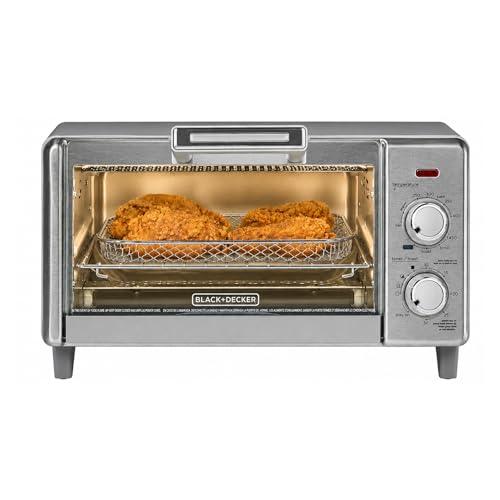
The honest baseline. It toasts, bakes small portions, broils and reheats without fuss, in a compact body at the category’s entry tier, with controls a child could learn and a footprint small kitchens can forgive. Its honest limitations are refinement and room: finishes are functional, capacity suits one or two people, and heavy daily family use will find its edges. Choose it as a first oven, an office or apartment staple, or a low-cost way to learn your true usage; skip it if you already know you are a daily, broad, family-scale cook.
Best for: cooks whose priorities match the strengths described above. Not suited for: kitchens where its size, tier or control style fights the space or the cook. Tier: entry positioning in its class; check price on Amazon when you are ready to compare current listings.

Ninja Prestige Smart XL Countertop Oven
The family-scale option. A wide cavity takes the trays and portions that defeat standard toaster ovens, cooking family small meals with countertop speed and keeping the full oven off for jobs that used to require it. Its honest limitation is the same fact stated as a cost: this is a large appliance that needs measured counter and clearance, and in a small kitchen it becomes the room’s dominant object. Choose it if your portions broke the standard class; skip it if they did not, because unneeded capacity is rent without income.
Best for: cooks whose priorities match the strengths described above. Not suited for: kitchens where its size, tier or control style fights the space or the cook. Tier: premium positioning in its class; check price on Amazon when you are ready to compare current listings.
Keep exploring with these related guides from this series: how to clean a toaster oven, step by step, whether a toaster oven is worth it, our toaster oven buying guide, toaster oven pros and cons in full, our in-depth toaster oven review.
Head-to-Head: Where the Real Differences Live
Strip away the badges and the six divide along three axes. On crisping, the Cuisinart and Breville lead, the Ninja follows on volume, and the radiant Panasonic does not compete, by design. On toast, the order inverts: Panasonic first, Breville close, the rest respectable. On daily ease, the Hamilton Beach’s access and the BLACK+DECKER’s simplicity beat machines with twice their capability, because ease compounds daily while peak performance is collected occasionally. And on capacity, the Ninja stands alone, which is either its entire argument or entirely irrelevant, depending on your portions. No axis crowns a universal winner; together they crown six different ones, which is the honest state of a mature category.
How the Class Handles Real Food, Reviewed Collectively
Across the line-up, reheating is the universal strength: every model here restores pizza, fries and fried chicken better than a microwave ever will. Toast separates the tuned from the approximate. Baking rewards the convection models and exposes the still-air ones on full trays. Crisping rewards the air fry designs and punishes their interiors with splatter, which is why cleaning design keeps appearing in these reviews as a performance feature rather than housekeeping. The pattern to carry into any shop: decide which of those four jobs is yours, and the shortlist writes itself.
Keeping It Clean So It Keeps Cooking Well
Routine care is short and unglamorous: slide the crumb tray out after toasting sessions and empty it before crumbs mound up, wash the rack and pan in warm soapy water when grease appears, and wipe the interior walls with a damp cloth once the oven is unplugged and fully cool. Melted cheese and sauce splatter come off far more easily the same day than a week later, when they have been reheated into varnish. A paste of baking soda and water, applied gently and left to sit, loosens baked-on film without scratching; avoid abrasive pads on coated interiors and never spray cleaner directly onto heating elements.
The glass door deserves its own pass, because a clear door is a cooking tool: you judge toast and browning by eye, and a fogged door leads to guesswork and burnt edges. Wipe the inside of the glass once it is cool, and clean the exterior with a soft cloth so fingerprints and steam marks do not bake on. Check the door seal and hinges as you go; a door that no longer closes squarely leaks heat and cooks unevenly, and catching that early tells you whether the oven needs attention or replacement.
For the full method, including deep-clean steps for stubborn grease and safe ways to deal with smoke smells, follow how to clean a toaster oven, step by step rather than improvising with harsh chemicals. The principle is always the same: unplugged, fully cool, gentle tools, patience over force. Ten unhurried minutes once in a while beats an hour of scrubbing a neglected oven, and a clean cavity cooks more evenly, smells neutral, and removes the fuel that fire safety rules worry about in the first place.
Buying Advice From the Review Desk
Measure the counter and your largest regular dish before reading another word anywhere, including here. Shortlist by dominant job, then break ties with cleaning design and controls. Match tier to frequency without apology: entry machines serve weekly cooks completely, and premium evenness is wasted on monthly use. Keep paper, towels and flammables clear of whichever model you choose, give it the maker’s clearance, never leave it running unattended, and start the crumb tray habit on day one; the best-reviewed oven in the world smokes when neglected and sings when kept. Finally, cook your real rotation in the return window, including one messy job, because reviews, this one included, are maps, and your kitchen is the territory.
For more depth before you decide, see also toaster oven vs countertop oven, compared, related guide, related guide, related guide, related guide.
What a Year of Ownership Adds to Each Review
Reviews written at unboxing flatter every machine, so consider the year-later footnotes. The Breville class tends to become infrastructure: owners stop describing it as a toaster oven and start calling it the oven, demoting the built-in to large jobs. The Cuisinart’s year-later story is written in its interior: crisping households that kept the cleaning rhythm remain delighted, while those who did not own a smoky monument to good intentions, which is why its review stresses upkeep as part of the product. The Panasonic ages the most gracefully of all, because its narrow job never goes out of fashion in a breakfast-led house and its small interior never accumulates a large debt of grease.
The Hamilton Beach’s year-later praise is ergonomic and therefore easy to underrate in a spec-led review: a door that never dripped crumbs onto the counter’s edge, a cavity front that never fought a cloth, a machine that elderly hands and young hands both operate without a workaround. The BLACK+DECKER’s footnote is statistical: a remarkable share of its owners either upgrade with hard-won knowledge or discover that the baseline was, in fact, the destination, and both outcomes validate the purchase. The Ninja’s year-later story is spatial: families either reorganised the kitchen around it gladly, because it earned the territory weekly, or quietly resented the largest object on the counter, and the difference was never the machine, only the portions it was fed.
Matching Matrix: Jobs to Models
If your week is toast, bagels and reheats with the occasional melt, the matrix points at the Panasonic first and the BLACK+DECKER on a tighter budget, with the Hamilton Beach as the access-first alternative. If your week is weeknight dinners for two to four with roasting and baking, it points at the Breville for daily breadth or the Hamilton Beach for daily ease, sized to your dishes. If your week is frozen food, wings and crisped anything, it points at the Cuisinart, with the Breville as the broader, gentler-crisping alternative. If your week is family portions that broke smaller ovens, it points at the Ninja and accepts its footprint as the price of volume.
Read the matrix backwards for the skips, because they are as instructive as the picks. Do not buy the Ninja for toast alone, the Panasonic for casseroles, the Cuisinart for gentle baking alone, or the BLACK+DECKER for daily family volume. Every one of those mismatches produces a disappointed owner of a good machine, and the second-hand listings of every city are full of exactly that story, told in the phrase hardly used. These reviews exist so that your purchase is not one of them.
How to Use These Reviews in a Shop
Take three things with you: your largest regular dish’s measurements, your counter’s available footprint with clearance, and your top three jobs written down. Open every candidate’s door, slide its rack, find its crumb tray and mime emptying it, turn its controls with the hand you would use while holding a plate. Eliminate on fit without mercy, then on tray access, then choose among the survivors by the job matrix above. Ignore function counts, ignore finishes under shop lights, and ignore any pitch that begins with a number of slices. The reviews in this article will still be true when you get home, because they were written about the machines’ behaviour in kitchens, and behaviour is the one property that survives the journey from shelf to counter unchanged.
Owner Patterns: What the Reviews Predict
Across all six reviews, the happiest owners share a profile that has little to do with which model they bought: the oven lives permanently in its spot, the size matches the household’s portions, the dominant job matches the model’s strength, and the crumb tray is emptied as thoughtlessly as a kettle is filled. The unhappiest owners share the mirror profile: a gifted or guessed size, a model bought for a secondary job, a counter spot that never quite worked, and a cleaning rhythm that never formed. This is why the reviews above are written as matches rather than rankings, and why their choose-and-skip lines matter more than their praise. A league table would crown the Breville and mislead the toast-led single cook into a large, expensive mismatch; the matching format sends that cook to the Panasonic with confidence and the family of five to the Ninja without apology.
There is a second pattern worth naming: almost nobody regrets buying for their dominant job, and almost everybody regrets buying for their aspirational one. The household that bakes weekly and crisps monthly, but bought the crisping specialist because air frying felt modern, spends a year with the wrong machine in a way no specification can rescue. The reviews’ repeated insistence on your last month of actual cooking is not a stylistic tic; it is the single strongest predictor of satisfaction this desk can offer, stronger than tier, stronger than brand, stronger than any individual model’s excellence. Buy the oven your Tuesdays need, and your Saturdays will manage.
Second-Hand and Hand-Me-Down Notes
This category circulates heavily second-hand, and the reviews translate with a few cautions. Inspect the door’s alignment and the element’s glow if you can test it, check that the rack, pan and crumb tray are all present, since missing trays are the most common silent defect, and plan on the deepest clean of its life before its first use in your kitchen. Entry and mid models make the best second-hand buys because their simplicity ages well; heavily featured models carry more to fail and more settings to behave strangely. A sound used machine, cleaned to neutral and matched to your jobs, delivers most of the category’s value, and the reviews’ matching logic applies to it unchanged: fit first, job second, badge last.
Deep Dive: Toast, the Exam Every Model Sits
Because toast is the one job every model in this line-up claims, it deserves a review section of its own. The differences are real and repeatable in kind: the Panasonic’s radiant tuning produces the most uniform full-rack browning with the least waiting, the Breville follows closely with the polish of a machine designed by people who take breakfast seriously, the Cuisinart and Ninja toast credibly while clearly prioritising other talents, the Hamilton Beach delivers honest, even-enough results with the easiest access in the group, and the BLACK+DECKER toasts the way its tier promises, serviceably and without pretension. None of these outcomes is a scandal; they are priorities made visible in bread. The review lesson is that toast performance is a fingerprint of design intent, and reading it tells you what each maker thought the machine was for, which is the most reliable guide to what it will do best in your kitchen across every other job as well.
Deep Dive: The Doors, Compared
Six models, three door philosophies, and a surprising amount of daily consequence. The classic drop-down door, found across most of this line-up, doubles as a landing shelf and a crumb catcher, and its quality is written in its hinges: the Breville and Ninja class close with a sealed, damped confidence, the entry class with a lighter, tinnier honesty. The Hamilton Beach roll-top removes the dropped door from the equation entirely, lifting up and away so the cavity front is open territory for hands and cloths, a design whose benefits compound at cleaning time. Whichever philosophy you choose, test the individual door in the shop if you can: square closure, even seal, no wobble. Doors are opened thousands of times across an oven’s life, and a door that pleases on day one is very likely still pleasing, and still sealing, in year five, which is more than can be said for most headline features.
What These Reviews Would Say in One Line Each
Breville: the second oven for people who cook daily and broadly, provided the counter says yes. Cuisinart: the crisping champion that bills you in cleaning, gladly paid by the right kitchen. Panasonic: breakfast, perfected, in the smallest footprint here. Hamilton Beach: the easiest daily companion in the line-up, and ease is a performance metric. BLACK+DECKER: the honest start, and for many kitchens the honest finish too. Ninja: family volume without the full oven, for counters that can host it. Pin those six lines above the six product photographs in any shop and you would have a fairer buying guide than most of the internet, because each line contains the model’s strength, its condition and its ideal owner in a single breath, which is all a review ever owes its reader.
Reviewing the Reviewers: How to Read Other Roundups
These six reviews will not be the only ones you read, so here is the desk’s guide to reading the rest. Trust roundups that describe matching, which model for which household, over roundups that crown a single winner for everyone, because the category has no such winner and pretending otherwise is a commercial decision, not a culinary one. Trust reviews that mention crumb trays, doors and cleaning unprompted; their authors have lived with the machines. Distrust any review whose verdicts can be predicted from the price order alone, and any that repeats a manufacturer’s slice count as a capacity finding. Weight recent owner patterns about smoke, seals and controls over launch-week enthusiasm. And when two sources disagree, ask what households they were imagining, because most disagreements in this category are two correct reviews of two different kitchens wearing the same headline.
Finally, let your own evidence outrank all of it, this article included. If your counter, your dish and your dominant job point one way and every roundup points another, the roundups are reviewing a kitchen that is not yours. The six models here are genuinely good machines with genuinely different gifts, and the review tradition’s only real failure would be sending the toast-led cook home with the family roaster or the crisping household home with the gentle specialist. Read widely, measure once, and match without apology: that is the whole method, and it has never needed a seventh model to work.
The Sixth Sense: What Living With Each Machine Feels Like
Reviews traffic in performance, but ownership is a feeling, and each machine here has a distinct one worth recording. The Breville feels like competence: a quiet confidence that whatever portion-sized job the day invents, the oven has a mode and the mode will work. The Cuisinart feels like appetite: it is the machine a household gathers around when the food is meant to crunch. The Panasonic feels like morning: fast, bright, unceremonious, gone from your attention by the time the coffee is poured. The Hamilton Beach feels like ease: the door that never fights you becomes, over a year, a small daily kindness you stop noticing and would miss immediately. The BLACK+DECKER feels like enough: a plain sufficiency that frees attention and money for the rest of the kitchen. The Ninja feels like capacity: the calm of knowing the tray will fit, the casserole will fit, the second dish will fit. Choose the feeling your kitchen wants to live with, after the measurements have had their veto, because performance brought all six here, but feeling is what you will actually own.
The Review Desk’s Confession: What Changed Our Minds
Honest reviews should record their own revisions, and this desk has two worth printing. The first concerns the entry model: desks like this one are paid to admire engineering, and the BLACK+DECKER class was initially filed as the line-up’s footnote. Living with the owner patterns reversed the filing; a machine that satisfies this many kitchens this completely is not a footnote but a finding, namely that the category’s core idea is strong enough to survive its simplest execution. The second concerns access: the Hamilton Beach’s door was first reviewed as a quirk, a paragraph of colour. A year of owner emphasis on reach, crumbs and cleaning promoted it to a headline, because daily ease turned out to be a performance category in disguise. Both revisions teach the same lesson these reviews have pressed on readers throughout: in this category, the unglamorous variables win, and any review, ours included, should be read with one eye on the tray, the door and the counter, and only the other on the spec sheet.
Closing the Review File
Six machines were reviewed here, and the file closes with the observation that the category itself is the real winner of its own roundup. A buyer in this market, at any tier, choosing by fit and dominant job, is choosing among good machines whose differences are honest differences of emphasis rather than traps of quality. That has not always been true of small appliances, and it is worth pausing on: the floor of this category is a serviceable oven, its middle is genuinely good, and its ceiling is excellent, with the distance between those levels priced in refinement rather than in regret. The reviews’ job was never to rescue readers from bad machines; it was to route each reader to the right good one, past the badges and the slice counts, to the door, the tray and the cavity that match a particular kitchen’s week. If that routing worked, then somewhere a Panasonic is browning breakfast in a small flat, a Ninja is feeding a family without waking the big oven, and a plain entry machine is teaching a first kitchen what its owners actually cook. Those are the outcomes reviews exist for, and this desk signs off content with all six of them.
The Line-Up, Reconsidered as a Single Purchase Journey
Read the six reviews once more, not as rivals but as chapters of one plausible ownership story, because many households will live several of them in sequence. The story often opens with the BLACK+DECKER in a first kitchen, where it teaches the household its frequency and its portions at the lowest possible tuition. It continues, for the breakfast-led, with the Panasonic, whose toast becomes a small daily ceremony; or, for the growing family, it jumps to the Ninja when portions outgrow every standard cavity in the house. The middle chapters belong to the Breville and the Cuisinart, bought with the confidence of experience by cooks who can name their dominant job in one word, breadth or crisping, and the Hamilton Beach appears wherever a household decides that daily ease outranks peak numbers. No chapter shames the one before it. Each machine was the right answer to the question its household was asking at the time, and the reviews’ deepest claim is simply that the questions, asked in the right order, fit, job, counter, are what turn a line-up of products into a life of well-matched tools.
That journey framing also explains the desk’s refusal to retire any of the six from recommendation. A ranking must demote; a journey must only sequence, and sequencing is the truthful operation for a category whose buyers differ more than its products do. The first-time buyer and the fourth-time buyer reading this article need opposite ends of the same line-up, and both are served by reviews that describe matches instead of medals. If a single sentence could be kept from this entire roundup, it would be that one: in a mature category, the reviewer’s loyalty belongs to the match, and the match belongs to the reader’s own measured, honest, ordinary week.
A Final Word on Choosing Between Two Finalists
Most readers of a roundup like this one end with two finalists and a pleasant paralysis, so the desk offers its traditional solvent. Cook, in imagination, your three most frequent meals in each machine, slowly, action by action: loading it, watching it, retrieving the food, cleaning it afterwards. One of the two imaginings will feel like a description of your kitchen and the other like a description of someone else’s, and that feeling, arriving after measurements and matching have done their work, is not mysticism but pattern recognition, your own experience summarising itself faster than words can. Trust it, provided the tape measure raised no objection, because the finalists are by definition both good machines, and between good machines the tiebreaker is the life they will be lived in. Then buy without rehearsing the decision again: the reviews will still be here, the other finalist will thrive in someone else’s kitchen, and yours, chosen for your week and kept clean and attended, will start repaying the choice at tomorrow’s breakfast.
How the Line-Up Ages as Your Household Changes
One last review dimension deserves print, because households change faster than appliances wear out. The single cook who marries becomes the couple who portions; the couple becomes the family whose trays multiply; the family becomes, in time, the couple again, cooking small in a quieter kitchen. A line-up like this one contains a right answer for each of those chapters, and the reviews above were written so that a reader returning in a different chapter can find the new match without relearning the category. That is also why the desk resists declaring any model the permanent winner: permanence belongs to the method, not to the machine. Measure, match by dominant job, honour the tray and the clearance, and the line-up will keep answering correctly long after its individual models have been replaced by their successors, because the questions it taught you to ask do not go out of date when the catalogue does.
The Desk’s Last Recommendation on Method
If you take one habit from this roundup into every future appliance purchase, let it be the finalist exercise used throughout these reviews: name the job, measure the space, mime the cleaning, and only then read the badges. Six good machines were reviewed here, and not one of them can survive being bought for the wrong job in the wrong kitchen, while every one of them can delight the right household for years. That asymmetry is the category in a sentence, and it is why this desk will keep writing reviews as matches rather than medals for as long as it is asked to write them. Choose the match, keep the tray empty and the surfaces clear, and the machine you chose will spend its life proving the review right in the only courtroom that matters, which is your kitchen at breakfast time.
And if both finalists still refuse to separate, choose the one whose crumb tray your hand liked better in the shop. It sounds like a joke and functions like a law, because the tray is the part of the oven you will touch most often for the least glamorous reason, and affection, in appliances as in much else, is built out of exactly such small, repeated, frictionless encounters.
The desk would rather be remembered for that sentence than for any single verdict in the six reviews above, because verdicts age with models and method does not. Models will be revised, renamed and replaced; the household that learned to buy by fit, job and upkeep in this roundup will buy well in every roundup that follows, including the ones nobody has written yet about machines nobody has designed yet.
Buy the match, and the review you would write a year from now is already written in outline: a machine that fits, a job it was born for, a tray that never became a grievance, and a counter that never regretted its tenant.
The Home Scorecard: How to Judge This Toaster oven in Week One
Use this scorecard during the first week, while changing your mind is still easy, and run the same ordinary jobs you bought the toaster oven for rather than showcase tasks chosen to flatter it. Score setup first: how long the box-to-ready journey took, whether the instructions answered the question you actually had, and whether anything needed a tool the box did not mention. Score the core job on a normal weekday portion, with your usual ingredients and timing, and write the result down before you try any advanced mode or accessory. Score consistency by repeating that same job on another day and comparing the two outcomes side by side, since repeatability is the quality that separates a good example from a lucky one.
Score the controls under real conditions, with damp hands, low light, or a timer running elsewhere, because that is the environment the toaster oven will actually be judged in. Score cleaning honestly by timing it once, including the drying and reassembly, and by noting any corner, seam, or crevice that needed a second attempt. Where a shortlist names specific examples, such as Breville Smart Oven Air Fryer Pro, run these same checks against that listing line by line rather than assuming the general verdict transfers unchanged. Apply the identical test to Cuisinart AirFryer Toaster Oven as well, on the same day and under the same conditions, because a fair comparison needs one ruler rather than two moods.
- Time the box-to-ready setup
- Repeat the core job on two separate days
- Time the full clean including drying
- Watch a second user try without coaching
- Deliberately make the common mistake once
- File the scorecard with the receipt
If Panasonic FlashXpress Toaster Oven is also in contention, give it the same worksheet and let the three sets of answers sit side by side before anyone reaches for a checkout button. Score the storage reality: whether the toaster oven and its parts return to their spot without a rearrangement ritual, and whether anything migrates to a counter because it has no home. Score the noise, heat, steam, or vibration against the room it lives in, at the hour you most often use it, and note whether anyone in the household comments unprompted. Score the small parts: lids, seals, trays, attachments, and fasteners, because in long ownership the small parts are where satisfaction quietly leaks away.
Score the documentation by looking up one real question mid-task and timing how long the answer takes to find, in the booklet or on the maker’s support pages. Score the fit against the measurements you took before ordering, and note any surprise, generous or otherwise, while the details are still fresh enough to help another buyer. Score the second user experience by watching someone else in the household use the toaster oven without coaching, and noting exactly where they hesitate or guess. Score the worst job, not the best: the largest load, the trickiest ingredient, or the latest tired evening, because that score predicts your feelings in month six.
Score the recovery: deliberately make the common mistake, such as overfilling, mis-seating a part, or choosing the wrong setting, and judge how obvious and forgiving the fix is. Add the scores without weighting them, then read the lowest two again, because those are the entries that decide whether this example stays in your house. If a low score surprises you, repeat that single test once before concluding anything, since first attempts often measure the operator rather than the product. Keep the finished scorecard with the receipt and warranty details, so a future claim, resale, or replacement decision starts from evidence rather than from a fading impression.
Revisit the card after a month and change only the scores that genuinely moved, because the difference between week one and month one is the learning curve made visible. Note which score you would check first if you were buying a second toaster oven as a gift, since that priority usually reveals what the product is really about. Finish by writing one sentence describing who should not buy this example, because a clear exclusion is the most useful line in any honest assessment. Whatever the category, photograph your intended spot with the neighbouring items in place, because a picture exposes crowding that measurements alone politely ignore.
Keep every measurement, tally, and note from these checks in one place, ideally with the receipt, so the next decision in this category starts from your evidence rather than from scratch. Involve the household early where the product is shared, since a decision everyone helped measure is a decision nobody relitigates at the first inconvenience. Prefer the option that fits your existing routine with the fewest new habits, because each new habit is a small tax collected every single day. Be wary of solving a storage problem by creating a carrying problem, since distance between storage and use is where good equipment goes to be forgotten.
Check the return conditions before the trial period begins, and calendar the last safe decision day, so the deadline works for you instead of surprising you. Judge the packaging and unboxing only once, briefly, and then ignore them, because they are the one part of ownership guaranteed never to repeat. Let the second week arbitrate disputes from the first, since novelty inflates both delight and irritation beyond their durable values. When two options remain tied after honest testing, choose the one whose weaknesses fall on your rarest jobs rather than your commonest ones.
Remember that the best outcome of a careful check is sometimes a confident no, which costs an afternoon and saves a cupboard, a counter, and a slow resentment. Write your verdict where you will see it before any future upgrade, because the most expensive purchases are the ones that re-buy a lesson already learned. Treat measurements taken in your own rooms as senior to any general guidance, including this guide, whenever the two disagree about fit. Think ahead to the first replacement part, however small, and picture where you would get it, how long the wait would be, and what you would use in the meantime.
Frequently Asked Questions
Which toaster oven is best overall in these reviews?
For breadth, evenness and controls in one machine, the premium Breville class leads this line-up, provided your counter welcomes its size and your cooking is daily and varied enough to use its repertoire. Best overall is always conditional, though: the Panasonic is better for toast-led small kitchens, the Cuisinart better for crisping-led ones, and the entry BLACK+DECKER better for anyone unsure the category fits their life. The reviews above exist to make that condition easy to apply to your own household.
Which model is best for small kitchens?
The Panasonic FlashXpress class, because its compact footprint is the easiest here to house permanently with proper clearance, and a permanently placed oven is the only kind that gets used. The entry BLACK+DECKER is the other small-kitchen candidate, trading some toast finesse for a lower tier. What small kitchens should avoid is the large class entirely: an oversized oven stored in a cupboard delivers none of the convenience that justifies the category, regardless of how well it reviews.
Which toaster oven crisps best?
The Cuisinart air fry class takes the crisping crown in this line-up, with the Breville close behind and ahead on breadth. Both ask more cleaning in exchange, because crisping splatters. If crisping is your dominant job by a wide margin, also consider whether a dedicated basket air fryer beats both; it crisps small frozen loads slightly more fiercely and cleans faster, at the cost of toast, tray shapes and baking. The oven wins when crisping shares the week with other jobs.
Are the premium models worth it over the entry tier?
For daily, broad cooking, yes: the premium tier buys more even heat, better doors and racks, controls that stay pleasant for years, and interiors that clean more easily, and daily users feel every one of those differences. For weekly or narrow use, the entry tier’s honest basics deliver most of the practical value, and the premium buys refinement you will rarely meet. Frequency is the whole calculation, which is why the entry model is recommended in these reviews without a hint of condescension.
How much should reviews weigh cleaning and safety?
Heavily, because they decide the ownership experience after the first month. A front-access crumb tray, smooth interior and sink-friendly racks predict whether an oven stays pleasant; a neglected oven smokes, flavours food and carries a fuel load near hot elements. Safety handling is equally practical: clearance kept, flammables clear of the top and sides, no unattended running, mitts for hot doors and trays. Reviews that ignore upkeep are reviewing the first week only; these reviews weight it as a first-class criterion throughout.
Can one of these replace a full-size oven?
For portion-sized cooking, functionally yes for many households, and owners routinely report the big oven going quiet for weeks. It cannot replace it for large-format work: big roasts, multiple loaves, full sheet pans and delicate long bakes still belong to the full cavity. The realistic goal is not replacement but division of labour, with the toaster oven taking the frequent small jobs it does faster and the full oven keeping the occasional large ones. Households that frame it that way are the ones these reviews satisfy most.
Reviews Bottom Line
Six good machines, six different households. Match the model to your dominant job, your portions and your counter, keep it clean and attended, and any of these reviews can become your kitchen’s story. Mismatch them, and even the leader of the line-up becomes an expensive way to store crumbs.