Disclosure: topratedkitchenware.com is reader-supported. When you buy through links on our site, we may earn an affiliate commission from Amazon and other retailers, at no extra cost to you.
Where to buy
The six sinks below are the verified picks behind this guide to the best slim rim kitchen sinks — all undermount designs, because the slimmest rim of all is the one that disappears under the countertop entirely. Each name links to its Amazon listing, where you can check the latest price on Amazon, confirm dimensions, rim and cut-out details, and read the newest owner feedback. If you want the cleanest flush profile in a standard size, start here: Check on Amazon.
- cozhao 30 Inch Undermount Kitchen Sink, 18 Gauge 304 Stainless Steel
- MAYESAR 28 Inch Undermount Kitchen Sink, 16 Gauge, 28 x 18
- KRAUS KWU110-32 32 Inch Undermount Workstation Sink with Ledge
- KRAUS KHU100-32 32 Inch 16 Gauge Undermount Kitchen Sink
- Oxwiser 30×18 Inch Undermount Sink Set, 16 Gauge, 5 Item Bundle
- Delironexu 30 Inch Undermount Kitchen Sink, 18 Gauge, Drain Kit
Read the full guide ↓
The rim of a sink is the frame you look at and wipe around every single day, and for a growing number of remodels the best slim rim kitchen sinks are the ones that make that frame nearly vanish. A traditional drop-in sink sits on the counter with a raised lip that catches crumbs, traps a line of grime against its seal and visually chops the countertop into pieces. A slim rim design answers all three complaints: the visible edge shrinks to almost nothing, the counter reads as one continuous surface, and a sponge sweeps straight from the worktop into the bowl without climbing a curb. The purest form of the idea is the undermount, where the rim is bonded beneath the counter and the only edge you see is the countertop material itself, finished to a clean reveal.
Every pick in this guide is an undermount for exactly that reason, spanning 28 to 32 inches and three steel gauges, so the slim-rim decision becomes about size, bowl design and budget rather than about compromising the look. Along the way we explain the three rim reveals (positive, zero and negative), what a slim profile demands from your countertop material, and the cleaning and durability realities that brochures skip. If your counter run is short and every inch of visible worktop matters, you will find this guide pairs well with our research on Best Small Kitchen Sinks, where the same flush thinking is applied to compact kitchens.
Key Takeaways
- “Slim rim” reaches its logical end in an undermount: the flange hides under the counter, leaving no raised lip to catch crumbs or break the counter line.
- The reveal you choose — a sliver of rim showing, dead flush, or the counter slightly overhanging — changes cleaning effort and how forgiving the install is.
- Slim rim profiles need a solid countertop (stone, quartz, solid surface); they are not a laminate-counter solution without special systems.
- All six picks are stainless single bowls from 28 to 32 inches, so slim-rim shopping does not force a size compromise.
- Gauge still matters: 16 gauge picks (MAYESAR, KRAUS KWU110-32, KRAUS KHU100-32, Oxwiser) feel more substantial than the 18 gauge value picks.
- The slim look is maintained at the seal line: a neat silicone joint, wiped weekly, is what keeps a flush install looking new.
In this guide
Quick Picks
| Pick | Badge | Why it stands out | |
|---|---|---|---|
| cozhao 30 Inch Undermount Sink | Best Overall Slim Profile | 30 inch, 18 gauge 304 stainless, handmade modern lines, drain assembly included | Check on Amazon |
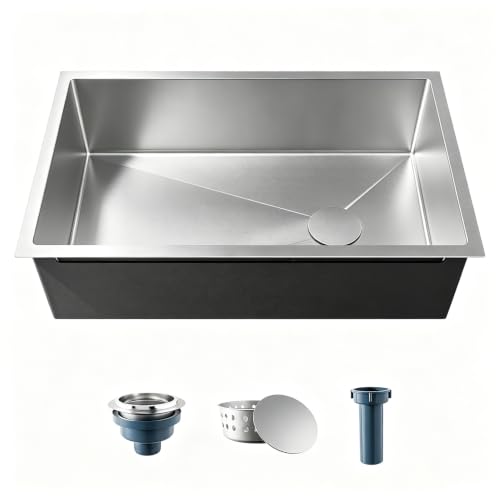
| MAYESAR 28 Inch Undermount Sink | Best for Small Counters | 28 x 18 inch, 16 gauge, 9 inch deep, brushed finish, round corners | Check on Amazon |
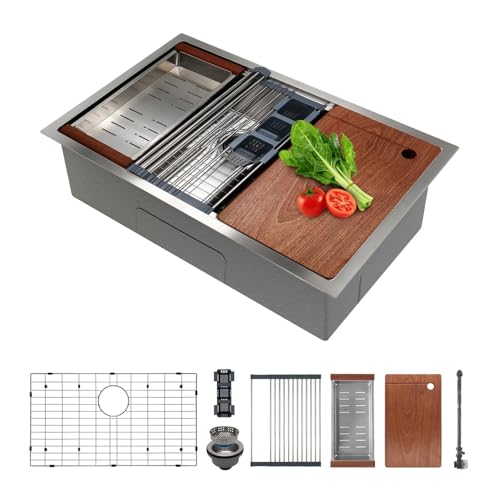
| KRAUS KWU110-32 | Best Workstation | 32 inch, 16 gauge TRU16 steel, integrated ledge, cutting board and roll-up rack included | Check on Amazon |
| KRAUS KHU100-32 | Best Large Slim Rim | 32 inch, 16 gauge TRU16 steel, rounded corners, channel grooves, NoiseDefend pads | Check on Amazon |
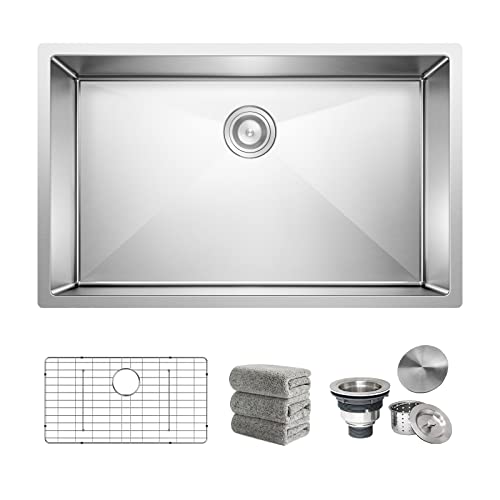
| Oxwiser 30×18 Sink Set | Best Complete Bundle | 30 x 18 inch, 16 gauge, 5 item bundle with bottom grid, drain assembly, drain cap and towel | Check on Amazon |
| Delironexu 30 Inch Undermount Sink | Best Value Slim Rim | 30 x 18 x 9 inch, 18 gauge, handmade brushed design, drain kit included | Check on Amazon |
How These Picks Were Chosen
This guide is research-led: specifications were verified through the Amazon Creators API pool, and every ASIN, title and image here comes from that verified data — no catalogue numbers from memory, no stock photos of sinks that are not the sink. We then read owner feedback in aggregate, looking for the complaints that recur around rim profiles: seal-line staining, chipped counter edges at the cut-out, water sitting on the reveal, and installers struggling with warped flanges.
The screening rule for this keyword was the rim itself. A pick had to deliver a genuinely slim visible profile, which in practice means an undermount flange designed to sit flat and true under the counter — a flange that rocks or bows cannot hold a clean, even reveal. Within that rule we kept a spread of sizes (28, 30, 32 inches), gauges (16 and 18) and price tiers expressed qualitatively, from the bundle-complete Oxwiser to the value-led Delironexu, because slim-rim intent shows up in modest remodels as often as in flagship ones. Sound behaviour was a secondary screen; readers who rank quietness first can go deeper with our guide to Best Sound Deadened Kitchen Sinks, and two picks here carry dedicated NoiseDefend padding.
One honesty note: a slim rim is a partnership between sink and countertop. The same sink can look surgically flush in quartz and slightly soft in a handmade solid-wood top, because the counter edge finish does half the visual work. The reviews below therefore talk about the sink’s side of the bargain — flange quality, bowl geometry, finish — and the buying guide covers the countertop side.
The 6 Best Slim Rim Kitchen Sinks

cozhao 30 Inch Undermount Kitchen Sink — 18 Gauge 304 Stainless Steel
Badge: Best Overall Slim Profile
Strengths
- Handmade modern bowl with crisp lines that suit the flush, architectural look slim-rim buyers are after.
- Proper 304 stainless steel at a value-tier position, with the drain assembly included.
- Standard 30 inch footprint — the slim profile does not cost you bowl size.
Trade-offs
- 18 gauge steel is livelier than 16 gauge: more flex and brightness of sound under heavy pans.
- Squared handmade corners need deliberate wiping to stay pristine.
- No bottom grid in the box; most owners will add one.
Mini spec box
- Size: 30 inch width, undermount (hidden flange, slim visible rim)
- Material / gauge: 304 stainless steel, 18 gauge
- Bowl: single bowl, handmade modern design
- Included: drain assembly
The cozhao earns the top slim-rim slot by pairing the look with the right fundamentals. Its handmade construction gives the bowl the tight, tailored geometry that flush installations show off — when a sink sits with its rim hidden and its walls dropping straight from the counter cut-out, sloppy geometry is exposed, and this bowl’s modern lines hold up to that scrutiny. In a quartz or stone top cut to a zero or slight positive reveal, the effect is the one in the design magazines: counter, then bowl, nothing in between.
As a working sink it is a standard 30 inch single bowl, which means the style decision costs nothing functionally. Sheet pans lie flat, a stockpot stands for filling, and the included drain assembly removes the classic budget-sink ambush where the strainer is a separate purchase discovered at install time. The 304 alloy specification is the quiet assurance underneath the styling — corrosion resistance is the property a sink cannot fake, and it is present here.
The limitation is the gauge, and it is the familiar one: 18 gauge steel flexes and rings more than the 16 gauge picks below, and a household that lands cast iron into the bowl daily will feel and hear the difference. A bottom grid — which most slim-rim owners buy anyway to protect the floor’s finish — damps much of the practical downside. For a style-led remodel in a normally busy kitchen, this is the balanced buy; for a hard-use family kitchen, step to the 16 gauge options and keep the same flush look.
Best for: style-led remodels wanting a flush, rimless look at a sensible tier / Not suited for: the heaviest-use households, who should take the same look in 16 gauge

MAYESAR 28 Inch Undermount Kitchen Sink — 16 Gauge, 28 x 18
Badge: Best for Small Counters
Strengths
- 28 x 18 inch size brings the flush slim-rim look to cabinets and counter runs that cannot take 30 inches.
- Full 16 gauge steel — no durability discount for the smaller size.
- 9 inch depth and round corners keep a compact bowl easy to live with and quick to clean.
Trade-offs
- Largest sheet pans wash at a slight angle rather than flat.
- Brushed finish shows water spots a little more readily than satin finishes.
- Two-person wash-up is cosy at this width.
Mini spec box
- Size: 28 x 18 inch, undermount (hidden flange, slim visible rim)
- Material / gauge: stainless steel, 16 gauge
- Bowl: single bowl, 9 inch deep, handmade
- Finish: brushed, round corner design
Small kitchens have the most to gain from a slim rim, because a raised drop-in lip consumes visual and physical counter space they cannot spare — and the MAYESAR is how a compact kitchen gets the flush look without a durability asterisk. At 28 x 18 inches it fits the narrower cabinets common in older homes, condos and galley layouts, while its 16 gauge steel matches the build of sinks a full size up. The rim disappears under the counter, the worktop reads as one unbroken plane, and a small kitchen immediately looks calmer and larger.
The bowl design shows the same no-compromise thinking. Nine inches of depth contains faucet spray and stacks a real wash-up load — small sinks fail when they are shallow, splashing the very counters they were meant to streamline — and the round corners sweep clean in one pass, which matters more, not less, when the bowl is compact and every corner is in daily use. The brushed finish is honest working clothing: it will show water spotting between wipes, as brushed finishes do, and in exchange it hides the fine scratching that a small, busy bowl accumulates.
Choose it when the cabinet tape measure rules out 30 inches, or when a short counter run makes the flush profile worth more than two inches of bowl. Do not choose it as a money-saving substitute in a kitchen that fits a 30 — the saving is small and the width is missed at holiday scale. Within its brief, though, it is the complete article: slim rim, full gauge, real depth.
Best for: compact kitchens, condos and galley layouts wanting a flush look in a narrower cabinet / Not suited for: wide cabinets with heavy sheet-pan washing, where a 30 or 32 inch bowl serves better

KRAUS KWU110-32 — 32 Inch Undermount Workstation Sink
Badge: Best Workstation
Strengths
- Slim undermount profile outside, workstation inside: the integrated ledge holds the included cutting board and roll-up rack over the bowl.
- 16 gauge TRU16 steel with NoiseDefend soundproofing keeps a big bowl civilised.
- 32 inch width takes sheet pans and roasters flat.
Trade-offs
- Needs a wide cabinet, typically 36 inch, to install.
- The ledge ecosystem rewards using the matching accessories.
- Large bowl uses more water for small jobs unless you work over the ledge or use a basin.
Mini spec box
- Size: 32 inch width, undermount (hidden flange, slim visible rim)
- Material / gauge: TRU16 stainless steel, 16 gauge
- Bowl: single bowl with integrated ledge
- Included: cutting board and roll-up drying rack; NoiseDefend soundproofing
The KWU110-32 answers the one fair objection to slim-rim undermounts — that a flush, featureless bowl is a purely visual upgrade — by hiding its party trick inside the bowl. From the counter, it is all slim profile: no lip, no frame, just the counter edge and the drop into steel. At working height, the integrated ledge running the bowl’s length takes the included cutting board and roll-up rack, so prep, rinsing and draining happen over the sink while the counter stays as clear as the design photos promise.
That combination is more than the sum of its parts. The slim rim gives you back the counter perimeter that a drop-in flange would occupy; the ledge then gives you a second working tier inside the bowl itself. In a kitchen where the run is long enough for a 32 inch sink but the cook still fights for prep space — most kitchens, honestly — the two features compound. The fundamentals hold the idea up: 16 gauge TRU16 steel so the wide floor does not drum, and NoiseDefend padding so the big hollow box does not announce every rinse to the whole house, a point our Best Sound Proof Kitchen Sinks research singles out in this model.
The gates are cabinet width and buy-in. A 36 inch class cabinet is the usual requirement, and the ledge only earns its keep if you actually prep over the sink; a household that never would is better served by the plain-bowled KHU100-32 below, which keeps the same slim rim and steel in a simpler bowl. For cooks who will use it, this is the most complete slim-rim package in the guide.
Best for: keen cooks with wide cabinets who want a flush look plus genuine prep function / Not suited for: narrower cabinets, or households that prefer a completely plain bowl

KRAUS KHU100-32 — 32 Inch 16 Gauge Undermount Sink
Badge: Best Large Slim Rim
Strengths
- Maximum bowl with minimum frame: 32 inches of uninterrupted single bowl under a flush counter edge.
- Rounded corners and channel grooves keep a large bowl fast to clean and quick to drain.
- 16 gauge TRU16 steel with NoiseDefend pads — the proven KHU100 recipe at full width.
Trade-offs
- No ledge or bundled accessories — deliberately simple.
- Wide-cabinet requirement, as with any 32 inch undermount.
- Big-bowl water use for small soak jobs; a basin inside solves it.
Mini spec box
- Size: 32 inch width, undermount (hidden flange, slim visible rim)
- Material / gauge: TRU16 stainless steel, 16 gauge
- Bowl: single bowl, rounded corners
- Features: channel grooves for draining, NoiseDefend soundproofing pads
If the slim-rim idea appeals in its purest form — the biggest possible bowl wearing the smallest possible frame — the KHU100-32 is the pick. There is no ledge, no accessory system, no visual event at all: a 32 inch single bowl in 16 gauge TRU16 steel, mounted so the countertop edge is the only rim you ever see. Roasting pans lie flat, the whole evening’s wash-up fits at once, and from standing height the kitchen reads as counter, then water, then steel. It is the minimalist’s large sink.
The details that keep a big plain bowl pleasant are present and correct. Rounded corners mean the large perimeter wipes clean without a grit trap anywhere; channel grooves pressed into the floor move water to the drain so the wide floor dries instead of spotting; NoiseDefend pads keep the acoustics proportionate — large unpadded bowls are the loudest fixtures in a home, and this one is engineered against it. The stainless itself is the grade and gauge the category’s best sellers are built on, a point worth confirming against the wider field in our Best Ss Kitchen Sinks roundup.
The choice between this and the KWU110-32 is a philosophy question, not a quality one: ledge or no ledge, same steel, same slim rim, same cabinet demand. Pick the workstation if you prep over the sink; pick this if your bowl is for washing and you want nothing in it that you did not put there. Either way, verify the cabinet minimum and the counter material before ordering — flush profiles are unforgiving of laminate tops and undersized bases.
Best for: large households wanting maximum plain bowl volume with a flush, frame-free look / Not suited for: anyone wanting workstation accessories, or cabinets below the stated minimum

Oxwiser 30×18 Inch Undermount Sink Set — 16 Gauge, 5 Item Bundle
Badge: Best Complete Bundle
Strengths
- The slim-rim sink plus everything it needs in one box: bottom grid, drain assembly, drain cap and towel.
- 16 gauge steel at 30 x 18 inches — the mainstream size and gauge, complete.
- The included grid protects the bowl floor from day one, preserving the finish the flush look shows off.
Trade-offs
- Bundle value depends on using the accessories; a grid is not to every cook’s taste.
- Single bowl, no ledge — a classic format, not a workstation.
- Confirm the grid and drain sizes if you later add a disposer or accessories from other brands.
Mini spec box
- Size: 30 x 18 inch, undermount (hidden flange, slim visible rim)
- Material / gauge: stainless steel, 16 gauge
- Bowl: single bowl
- Included: 5 item bundle — sink, bottom grid, drain assembly, drain cap, towel
Most sink purchases are secretly two or three purchases: the sink, then the grid and drain assembly discovered at checkout or, worse, at installation. The Oxwiser set refuses that game. The box holds the 30 x 18 inch, 16 gauge undermount sink and the four things it needs — bottom grid, drain assembly, drain cap and a towel — so the flush slim-rim install can be planned, priced and completed in one decision. For a remodel juggling a dozen trades and timelines, that completeness has real value beyond the parts themselves.
The sink underneath the bundle is the right sink to bundle: the mainstream 30 inch single bowl in full 16 gauge steel, undermount-flanged for the hidden-rim look this guide is about. The grid deserves its headline role — it suspends heavy pans off the bowl floor, lets water run beneath draining dishes, and absorbs the daily micro-impacts that dull a finish. In a slim-rim kitchen, where the eye travels unbroken from counter into bowl, the bowl’s finish is part of the design; the grid is what keeps it that way. Stainless care specifics, including how grids and finishes interact over years, are covered in our Best Ss Kitchen Sinks Scratching guide.
The honest caveat is preference, not quality: some cooks dislike washing around a grid and will lift it out for big jobs, which is fine — it is an accessory, not a fixture. If you know you will never use one, price the bare-sink picks against this set on equal terms. For everyone else, this is the lowest-friction route to a complete, flush, protected sink.
Best for: remodels that want the sink, grid and drain solved in a single purchase / Not suited for: cooks who dislike bottom grids or want a workstation ledge

Delironexu 30 Inch Undermount Kitchen Sink — 18 Gauge, Drain Kit Included
Badge: Best Value Slim Rim
Strengths
- The flush undermount look at the value end of the group, in a full 30 x 18 x 9 inch bowl.
- Handmade design with brushed finish reads tailored, not budget.
- Drain kit included; the listing is explicit that no additional accessories are bundled, so expectations are clean.
Trade-offs
- 18 gauge steel — lighter and livelier than the 16 gauge picks.
- No grid or rack included; budget for a grid if you want floor protection.
- Brushed handmade surfaces need regular wiping to look their best.
Mini spec box
- Size: 30 x 18 x 9 inch, undermount (hidden flange, slim visible rim)
- Material / gauge: stainless steel, 18 gauge
- Bowl: single bowl, handmade design, brushed finish
- Included: drain kit (no additional accessories)
The Delironexu is the proof that the slim-rim look is a mounting decision, not a budget tier. It undermounts like everything in this guide, hides its flange under the counter, and presents the same clean reveal as sinks positioned well above it — while sitting at the value end of the group. The handmade bowl with its brushed finish even leans into the tailored aesthetic, and the full dimensions (30 x 18 inches, 9 inches deep) mean the value is taken out of the steel gauge and the accessory box, not out of the sink’s size or usefulness.
That is the right place for a value pick to economise, provided the buyer understands the exchange. Eighteen gauge steel will flex a little under a full stockpot, sound brighter under the faucet, and ask for a grid to protect its floor across the years. The listing’s honesty helps: it states plainly that the drain kit is included and no additional accessories are, so the total project cost can be figured exactly. Add a grid to the cart and the comparison with 16 gauge bare sinks becomes the real decision.
For rentals being upgraded properly, first remodels, and kitchens where the countertop budget rightly ate the money — a flush sink in a beautiful stone top beats a heavy-gauge sink in a tired one — this is the smart allocation. Heavy-use family kitchens that can stretch should still step up to 16 gauge and keep the identical look.
Best for: value-led remodels, rental upgrades and countertop-first budgets wanting the flush look / Not suited for: hard-use households that will feel the lighter gauge daily
Comparison Table
| Pick | Size | Material / gauge | Standout trait | |
|---|---|---|---|---|
| cozhao Undermount 30 | 30 inch | 304 stainless, 18 gauge | Crisp handmade profile, drain included | Check on Amazon |
| MAYESAR Undermount 28 | 28 x 18 inch | Stainless, 16 gauge | Compact size, 9 inch depth | Check on Amazon |
| KRAUS KWU110-32 | 32 inch | Stainless TRU16, 16 gauge | Workstation ledge, board + rack | Check on Amazon |
| KRAUS KHU100-32 | 32 inch | Stainless TRU16, 16 gauge | Largest plain bowl, NoiseDefend | Check on Amazon |
| Oxwiser Set 30 | 30 x 18 inch | Stainless, 16 gauge | Complete 5 item bundle | Check on Amazon |
| Delironexu Undermount 30 | 30 x 18 x 9 inch | Stainless, 18 gauge | Value flush profile, drain kit | Check on Amazon |
How to Choose a Slim Rim Kitchen Sink
Start with the countertop, because slim rim is a system. A hidden-flange undermount needs a counter whose cut edge can be finished and sealed — quartz, granite, solid surface and properly sealed solid wood qualify; standard laminate does not, because its core cannot live at a wet cut edge. If your remodel keeps a laminate top, your slim-rim route is a low-profile drop-in instead, and none of this guide’s undermounts should be forced into that job. Confirm the material conversation with your fabricator before ordering the sink, not after.
Next, choose the reveal — the relationship between the counter cut-out and the bowl. A positive reveal shows a sliver of the sink’s rim as a deliberate design line; it is the most forgiving to install and the easiest to seal, at the cost of a small ledge that can hold moisture. A zero reveal cuts the counter exactly to the bowl wall, giving the purest flush look and demanding the most precise fabrication. A negative reveal lets the counter overhang the bowl slightly, hiding the seal line entirely and making wipe-in easiest, while putting the counter edge itself in harm’s way if the material chips. For most homes, a slight positive or zero reveal in stone is the sweet spot; discuss all three with the fabricator using your chosen sink’s template.
Then size and gauge as usual: 28 inches for tight cabinets, 30 for the mainstream, 32 for wide runs and big pans; 16 gauge as the durable default, 18 gauge as the considered value choice. Finally, look at the flange itself when the sink arrives — it should be flat, even and free of bow along its whole perimeter, because the flange is the foundation of the reveal. A flange that rocks on a flat surface goes back, however inconvenient the return feels; installers cannot seal their way out of warped steel. Broader stainless selection context, including the misspelt-but-mighty back catalogue, lives in our Best Stainles Steel Kitchen Sinks guide.
How to Install and Care for a Slim Rim Sink
Installation overview. Undermount slim-rim installs are fabricator work in stone: the counter is cut to the sink’s template at the chosen reveal, the edge is finished, and the sink is bonded with silicone and mechanically supported with clips, rails or a cradle — never adhesive alone. The flange must sit dead flat around the full perimeter so the reveal reads even from above; any gap telegraphs instantly in a flush design. Sealant should form a continuous, neat bead: squeeze-out wiped immediately, because cured silicone smeared across a reveal is the one blemish a slim-rim kitchen cannot hide. Leave the assembly to cure fully before hanging a disposer or loading the bowl.
Daily care. The slim rim’s great daily gift is the wipe: crumbs and water sweep straight off the counter into the bowl with no lip in the way — use it, and dry the reveal line as you go. Weekly, run a cloth along the seal joint to lift the biofilm that forms at any wet silicone line, and check the joint for gaps or lifting; a sound seal is both the look and the waterproofing. In the bowl, rinse after heavy use, avoid steel wool and undiluted bleach on stainless, and keep a grid in place if your sink has one.
Troubleshooting. Problem: a dark line develops along the seal → it is usually surface biofilm on the silicone; clean with a soft brush and mild detergent, and if the seal itself is lifting or cracked, have it cut out and re-beaded before moisture reaches the cabinet. Problem: water sits on a positive reveal instead of running into the bowl → wipe it as part of the routine and check the counter’s slope near the cut-out with the installer if it pools persistently. Problem: the counter edge at the cut-out chips → small chips in stone can be filled and polished by a fabricator; prevent repeats by avoiding metal pan impacts on the edge, the one vulnerable point of any flush install.
Slim Rim vs Drop-In vs Farmhouse: Reading the Three Profiles
It helps to place the slim rim among its rivals. The drop-in is the forgiving all-rounder: it installs from above into almost any counter, its flange covers cut-out sins, and its raised lip — the very thing slim-rim buyers are fleeing — also protects the counter edge and contains splashes. Choose it for laminate counters, DIY installs and maximum tolerance. The farmhouse or apron-front sink makes the opposite statement to the slim rim: the sink is the visual event, a broad front panel that demands a purpose-built cabinet and becomes the kitchen’s focal point, with ergonomics some cooks love (you stand closer to the bowl) and a price in cabinet work others do not.
The slim rim sits at the quiet end of the spectrum: the sink disappears so the countertop — often the most expensive surface in the room — becomes the continuous visual plane. It is the profile of kitchens designed around materials rather than fixtures. Its costs are real but specific: solid countertops only, fabrication precision, and a seal line to maintain. None of those is a reason to avoid it; they are simply the terms, and this guide’s picks are the sinks that hold up their side of them.
Keeping the Flush Look for a Decade
A slim-rim installation ages at three points, and all three are manageable. The seal line ages first — silicone in a wet joint has a service life, and planning to re-bead it when it dulls, lifts or stains (rather than when it leaks) keeps both the look and the waterproofing intact. The counter edge ages second: the cut edge at a zero or negative reveal takes pan knocks, and a fabricator’s chip repair is a minor visit if arranged early rather than after a crack runs. The bowl finish ages third and slowest, governed by grid use and grit discipline — rinse sandy pan bottoms, lift cast iron rather than sliding it, and the brushed or satin surface settles into an even patina instead of a scratch map.
What does not age is the underlying decision. Cabinets, counters and bowls in this size and gauge class are decade-scale fixtures, and the flush profile has been the direction of kitchen design for long enough that it no longer reads as a trend. Choose the reveal carefully, install it flat, maintain the seal — the slim rim will still look current when the faucet has been replaced twice. It is a quiet kind of luxury, the sort that never asks for attention and never dates, in any kitchen, at any size, for many years of daily use.
Slim Rim Sinks in Open-Plan Kitchens: Sight Lines and Sound
The slim rim’s rise tracks the rise of the open-plan kitchen, and the connection is visual before it is practical. In a kitchen that shares its space with dining and living areas, the sink zone is on permanent display, and a raised drop-in lip with its shadow line and grime-prone seal reads as clutter from across the room. A flush undermount removes that visual noise entirely: from a seated sight line you see counter, faucet and nothing else, which is why interior photography of open-plan homes almost never shows a lipped sink. If your kitchen is watched as much as it is worked in, the profile is doing interior-design labour every hour of the day.
Sound is the second open-plan consideration, and it cuts the other way if you choose carelessly. A thin, unpadded bowl in a hard-surfaced open space broadcasts wash-up noise into the living area, which is why the picks in this guide with dedicated sound padding — the KRAUS models with their NoiseDefend systems — earn special attention from open-plan households, and why gauge matters beyond dent resistance: thicker steel is inherently deader under impact and running water. Pairing a slim visual profile with a padded 16 gauge bowl gives the open-plan kitchen both halves of discretion, unseen and unheard. The faucet completes the acoustic picture; a laminar, non-aerated stream at sensible pressure is noticeably quieter than a splashing jet in a steel bowl, and it splashes less onto the reveal you are trying to keep pristine.
There is also a hosting rhythm to consider. Open-plan entertaining means dishes migrate visibly, and a deep single bowl under a flush rim hides a remarkable amount of mid-party evidence below the counter line — plates and pans stacked in the bowl simply disappear from the room’s sight lines in a way they never do on a lipped sink’s raised stage. Cooks who entertain in the same space they live in consistently rate this concealment among the flush profile’s most practical gifts, ahead of the wipe-in convenience that sells the idea in the showroom.
Common Buying Mistakes
- Ordering an undermount for a laminate counter. The cut edge of standard laminate cannot live in a wet reveal; slim rim needs stone, quartz, solid surface or sealed timber.
- Skipping the reveal conversation. Positive, zero and negative reveals look and clean differently; if you do not choose, the fabricator’s default chooses for you.
- Accepting a bowed flange. The reveal can only be as even as the flange beneath it. Check flatness on delivery and return a warped sink.
- Letting adhesive do the whole job. Undermounts need mechanical support as well as sealant, especially with a disposer hanging below.
- Neglecting the seal line. The neat silicone joint is the waterproofing and the look; a weekly wipe and timely re-beading keep both.
- Buying the look in the wrong gauge for your household. Slim rim is a profile, not a build quality — heavy-use kitchens should still insist on 16 gauge.
Final Recommendation
For the mainstream slim-rim remodel, the cozhao 30 Inch Undermount Sink delivers the flush, frame-free look in the standard size with the drain assembly included — the cleanest route from decision to done. If your kitchen works harder, take the same profile in 16 gauge: the Oxwiser set for one-box completeness, or the KRAUS KWU110-32 if a wide cabinet lets you add the workstation ledge to the invisible rim. Compact kitchens should take the MAYESAR 28 without hesitation, and value-led projects the Delironexu, adding a grid to protect the finish. Whichever pick you land on, settle the countertop material and the reveal with your fabricator first — in slim-rim kitchens, the install is half the product.
Frequently Asked Questions
What does “slim rim” mean on a kitchen sink?
It means the visible frame where the sink meets the counter is reduced to the minimum. On drop-in sinks it is a thin, low flange; on undermounts — the form used by every pick in this guide — the rim is hidden beneath the countertop entirely, so the only edge you see is the finished edge of the counter itself.
Can I install a slim rim undermount sink in a laminate countertop?
Not with standard laminate: the exposed core at the cut-out cannot withstand constant water. Slim-rim undermounts belong in quartz, granite, solid surface or properly sealed solid wood. For laminate, choose a low-profile drop-in design instead, which keeps its protective flange on top of the surface.
What is a reveal, and which one should I choose?
The reveal is how the counter cut-out aligns with the bowl: positive shows a sliver of rim, zero is dead flush, negative lets the counter overhang slightly. Zero and slight positive reveals are the most popular for stone counters — zero for the purest look, slight positive for the easiest sealing and most forgiving install. Decide it with your fabricator using the sink’s template.
Are slim rim sinks harder to clean?
The daily experience is actually easier — there is no lip, so crumbs and water sweep straight into the bowl. The one added task is the seal line: wipe the silicone joint weekly and re-bead it when it ages, since that joint is both the finish line and the waterproofing.
Does a slim rim change what size sink I should buy?
No — size is still governed by cabinet width and your largest cookware. Slim rim changes the profile, not the dimensions: this guide’s picks span 28, 30 and 32 inches for exactly that reason. Measure the cabinet, run the pan diagonal test, then choose the profile.
Will the counter edge chip where it meets the bowl?
Stone and quartz edges at a cut-out can chip if struck hard by a pan rim, which is the standing trade-off of flush designs. Normal care — not swinging cast iron across the edge — keeps it a non-issue for most households, and small chips are repairable by a fabricator. A slight positive reveal also keeps a sliver of steel between pans and the edge.
Can I replace a slim rim sink later without replacing the countertop?
Usually, provided the replacement matches the existing cut-out’s dimensions and reveal. Undermount cut-outs are made to the original sink’s template, so a future sink must share its footprint and bowl position closely, or the counter edge will show gaps or insufficient overlap. This is a genuine argument for choosing a mainstream size — 28, 30 or 32 inches, as in this guide — because standard footprints keep your future replacement options wide open. Keep the original template paperwork with your remodel documents; a fabricator can work from it years later to confirm a match before you order anything.
Do slim rim sinks need special support?
They need proper undermount support, which is standard practice rather than anything exotic: mechanical clips, rails or a cradle carrying the sink’s weight, with silicone as the seal rather than the structure. This matters most with a garbage disposer adding weight and vibration below the bowl.