Disclosure: topratedkitchenware.com is reader-supported. When you buy through links on our site, we may earn an affiliate commission from Amazon and other retailers, at no extra cost to you.
Where to buy
If you searched for the best elevtric cooktops — yes, we know, the word is “electric,” and your search engine knew what you meant — the six verified portable induction models below are the electric picks worth your money. Every one was cross-checked against its manufacturer listing before it earned a place here.
- AAOBOSI Portable Induction Cooktop — Best Overall · Check on Amazon
- OneSetNuf Portable Induction Cooker — Best for Long Sessions
- ChangBERT Commercial Induction Cooktop — Best Commercial Build
- Nuwave Double Pro Induction Cooktop — Best Two-Zone Pick
- Duxtop 9100MC Portable Induction Cooktop — Best Simple Classic
- Duxtop 9610LS Portable Induction Cooktop — Best Touch Controls
Read the full guide ↓
Let us start with the typo, because it is genuinely how thousands of people find this page: you typed best elevtric cooktops, the search engine quietly forgave you, and now you need the answer rather than a spelling lesson. Here it is in one paragraph. The portable electric cooktop market in 2026 is dominated by induction — burners that heat the pan magnetically, boil faster than the fixed electric hobs they supplement, and plug into an ordinary outlet at 1800W. The six models below are the verified best of that field, spanning compact travel burners, commercial stainless builds, a precision instrument, and the only double-zone unit in the set.
Why has induction taken over the portable electric category so completely? Because it wins the three comparisons buyers actually feel: speed (a pan of water boils in roughly the time a kettle takes), control (settings change the pan’s temperature almost instantly), and cleaning (the surface stays comparatively cool, so spills wipe rather than bake). Its one demand — magnetic pans — is testable in a minute with a fridge magnet. This guide ranks the six, explains the specifications that matter in plain language, and covers setup, technique, and the mistakes that make new owners think their burner is broken when it is merely waiting for a compatible pan. If you arrived from the built-in side of the family, Best Frameless Glass Cooktops explains the fixed-install branch of the same technology.
Key Takeaways
- Yes, “elevtric” is a typo — and the products you meant are portable induction burners, the current best form of the electric cooktop.
- All six picks run at 1800W, the standard outlet’s ceiling; they differ in control fineness, timers, coil size, and build — never in headline power.
- The ChangBERT is the all-round recommendation: commercial stainless build, NSF certification in its listing, a large coil, and a 10-hour timer.
- The Nuwave Double Pro is the only two-zone pick, with selectable wattage for weak circuits.
- Induction needs magnetic, flat-based pans. The fridge-magnet test takes one minute and prevents the commonest return in the category.
- Push-button, touch, and preset-led controls divide the set — choose for your hands, not for the product photo.
In this guide
Quick Picks
Six electric portables, ranked for the general buyer who typed fast and shops seriously — from the commercial all-rounder to the compact traveller.
| Pick | Badge | Why it stands out | Link |
|---|---|---|---|
| AAOBOSI Portable Induction Cooktop | Best Overall | 20 temperature and power levels, 4 presets, a 4-hour timer, and a compact body — the most balanced specification in the set. | See review below |
| OneSetNuf Portable Induction Cooker | Best for Long Sessions | Stainless commercial build, dual IGBT control, 18 temperature settings, push-buttons, and the joint-longest timer here: 10 hours. | Check on Amazon |
| ChangBERT Commercial Induction Cooktop | Best Commercial Build | NSF certification in the listing, premium stainless, a large 8-inch coil, and a 10-hour timer — the heavy-duty choice. | See review below |
| Nuwave Double Pro Induction Cooktop | Best Two-Zone Pick | Two zones, a 50°F–575°F span, and selectable 900W/1500W/1800W wattage — the small kitchen’s whole stovetop. | See review below |
| Duxtop 9100MC Portable Induction Cooktop | Best Simple Classic | Duxtop’s long-running 9100MC: full power, compact body, and a design so proven its behaviour is a known quantity. | See review below |
| Duxtop 9610LS Portable Induction Cooktop | Best Touch Controls | The 9610LS pairs 1800W with an LCD sensor-touch panel — the modern glass-cooktop interface in portable form. | See review below |
How These Picks Were Chosen
Candidates were verified one by one against their manufacturer listings: a model only appears here if its listing confirms it is an electric cooktop of the type this keyword intends, with specifications we can quote honestly. Gas units and other category strays that surface in the same search results were excluded from the picks entirely — a guide for a misspelled keyword has no excuse for being sloppy about the products themselves.
We then compared the verified set on the attributes that separate daily satisfaction from spec-sheet noise: how fine the temperature control runs, how long the timer lasts, how wide the coil heats, whether the controls are touch, button, or preset-led, and how the body is built. Two patterns emerged that structure the ranking — commercial builds for heavy daily duty, and domestic designs optimised for simplicity or travel — and the badges reflect those patterns rather than a single ladder of “better.”
A word on method: this guide is research-led. We worked from listing specifications and manufacturer documentation rather than a test kitchen, we print no fixed prices or ratings because both change too fast to stay honest, and where a listing is silent about a specification we stay silent too. That discipline is the same one behind our companion guides, including Best Eolectric Cooktops — the other famously misspelled doorway into this category.
Our 6 picks for best elevtric cooktops, reviewed one by one
The ranking leads with versatility and build, moves through the specialists — double zone, long-session, precision-by-simplicity — and closes with the touch-control model for design-led counters.

AAOBOSI Portable Induction Cooktop
Badge: Best Overall
Strengths
- 20 combined levels give finer control than the 10-level class norm
- 4 preset modes cover the repeat jobs in one touch
- Compact, easy-clean format suits apartments, RVs, and everyday overflow duty alike
Trade-offs
- 4-hour timer is mid-pack — commercial rivals run 10 hours
- Compact body means standard coil coverage
- Presets reward routine cooking more than improvisation
Key specs (from the manufacturer listing)
- Power: 1800W
- Control levels: 20 temperature and power levels
- Preset modes: 4
- Timer: up to 4 hours
- Format: compact portable countertop burner
- Stated uses: apartments, RVs and outdoor cooking
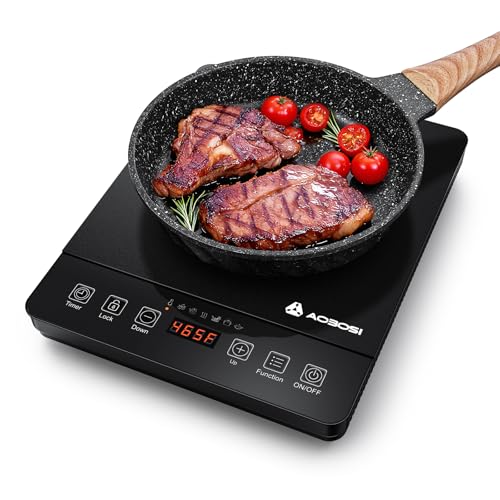
The AAOBOSI portable induction cooktop takes the overall badge for this keyword because the general buyer — the one who typed a typo and wants a burner that simply does everything well — is best served by balance, and nothing here is more balanced. The specification reads like a checklist of what the category learned over a decade: full 1800W power, 20 temperature and power levels for finer-than-usual control, four preset modes for the jobs everyone repeats, a four-hour timer, and a compact body explicitly aimed at apartments, RVs, and outdoor cooking as well as the everyday counter.
In use-case terms, it is the burner that covers the most households without a special argument: the renter whose stove is unreliable, the family adding a fifth zone at holidays, the RV owner cooking outside in summer, the student whose hotplate era is over. Its limits are the honest limits of the middle of the range — the timer stops at four hours where commercial units run ten, and a compact coil cannot fake the evenness of a wider one under a very large pan. For the broad centre of buyers, those are the right trades, made in the right places.
Best for: the general buyer — one burner that does everything well, anywhere / Not suited for: marathon 10-hour cooking sessions

OneSetNuf Portable Induction Cooker
Badge: Best for Long Sessions
Strengths
- 10-hour timer for stocks, braises, and canning days
- Dual IGBT power control for steady, sustained output
- Push-button controls that work with wet, floury, or gloved hands
Trade-offs
- Commercial styling is functional first
- Buttons break the flush glass plane
- Single 8-inch coil
Key specs (from the manufacturer listing)
- Power: 1800W
- Heating coil: 8-inch
- Body: stainless steel, commercial-grade build
- Power control: dual IGBT
- Temperature settings: 18
- Controls: push-button
- Timer: up to 10 hours
Some cooking is measured in hours, and the OneSetNuf portable induction cooker is the pick built for that clock. Its listing assembles the long-session toolkit: a stainless steel commercial-grade body, dual IGBT power control — the componentry that keeps output steady over sustained runs — 18 temperature settings, push-button controls, an 8-inch coil, and a 10-hour timer that matches the longest ceiling in the portable class.
The push-buttons are a deliberate philosophy. On hour six of a stock, with hands wet and attention thin, a physical button that clicks is worth more than a beautiful touch slider that needs a dry fingertip and a glance. The trade is aesthetic: this is equipment that looks like equipment, and a design-led kitchen may prefer the touch models below. For cooks whose electric cooktop is a working tool — market traders, serious home canners, anyone feeding a crowd from a counter — the OneSetNuf’s priorities are correctly ordered, a judgement we share with the commercial-build analysis in Best Fan Cooling On Portable Induction Cooktops.
Best for: long simmers, stocks, canning, and heavy daily use / Not suited for: design-first kitchens that want a flush touch surface

ChangBERT Commercial Induction Cooktop
Badge: Best Commercial Build
Strengths
- NSF certification stated in the listing — an audited standard behind the marketing
- Large 8-inch coil for even heating of wide pans
- Premium stainless body built for daily, heavy use
Trade-offs
- Stainless shows fingerprints and asks for a wipe-down ritual
- Single zone
- Utilitarian presence on a decorative counter
Key specs (from the manufacturer listing)
- Power: 1800W
- Heating coil: large 8-inch
- Body: premium stainless steel
- Certification: NSF certified (per listing title)
- Timer: up to 10 hours
- Format: commercial-grade portable countertop burner
The ChangBERT commercial induction cooktop is the pick for buyers who read “portable” and think “equipment.” Its listing specifies a commercial-grade portable cooker in premium stainless steel with NSF certification, a large 8-inch heating coil, 1800W of power, and a 10-hour timer. That combination — certified build, generous coil, marathon timer — is the specification of a unit intended to work daily and hard: in a small food business, a busy family kitchen, or a home where the portable is quietly the main stove.
Against the OneSetNuf, its closest rival here, the ChangBERT trades push-button tactility for the certification and the premium finish; against the domestic models, it trades friendliness for stamina. The honest costs are a single zone and stainless steel’s fingerprint honesty — it will show the day’s work until wiped. Buyers whose cooking is occasional will never feel what the extra build buys; buyers whose cooking is relentless will feel it in year two, which is exactly when it matters.
Best for: heavy daily use, small food businesses, and buyers who value certified build / Not suited for: occasional users paying for stamina they will never test

Nuwave Double Pro Induction Cooktop
Badge: Best Two-Zone Pick
Strengths
- Two cooking zones in one countertop body
- Dynamic Watt Technology caps draw for shared or older circuits
- Huge temperature span, from a 50°F hold to a 575°F sear
Trade-offs
- Zones share the power budget at full tilt
- Largest footprint in the set
- Touch panel discipline required
Key specs (from the manufacturer listing)
- Burners: double (two cooking zones)
- Temperature range: 50°F-575°F
- Wattage settings: 900W / 1500W / 1800W with Dynamic Watt Technology
- Heating coil: 8-inch
- Surface: shatter-proof ceramic glass
- Controls: seamless IMD touch panel
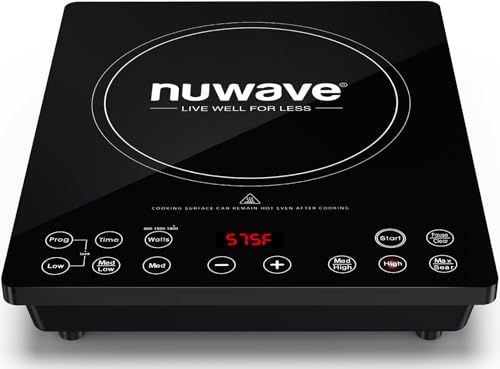
The Nuwave Double Pro answers the portable category’s structural limitation — one burner, one pan — by putting two zones on one countertop body, each over an 8-inch coil, beneath a shatter-proof ceramic glass surface with a seamless touch panel. For a studio flat, an annex kitchen, or an RV, that makes it a plausible entire stovetop rather than a supplement; for a family kitchen, it is two overflow zones that store as one object.
Its smartest feature is Dynamic Watt Technology, with selectable 900W, 1500W, and 1800W settings: on a shared or elderly circuit, cap the draw and keep cooking instead of visiting the breaker panel. The temperature span is equally thoughtful, running from a 50°F hold — sauces and fondues, held indefinitely — to a 575°F searing ceiling. Physics collects one toll: both zones at maximum share the budget, so two violent boils run slower than one. Cook with that in mind and it is the most capable format in this guide.
Best for: small kitchens needing a complete stovetop and two-pan cooks / Not suited for: minimal counters or single-pan households
Duxtop 9100MC Portable Induction Cooktop
Badge: Best Simple Classic
Strengths
- Mature, widely owned Duxtop design
- Full 1800W in a compact single-zone body
- Simple operation with no learning curve
Trade-offs
- Listing states a comparatively simple feature set
- Single zone
- Black finish shows dust readily
Key specs (from the manufacturer listing)
- Power: 1800W
- Model: 9100MC (BT-M20B)
- Finish: black
- Format: portable countertop burner
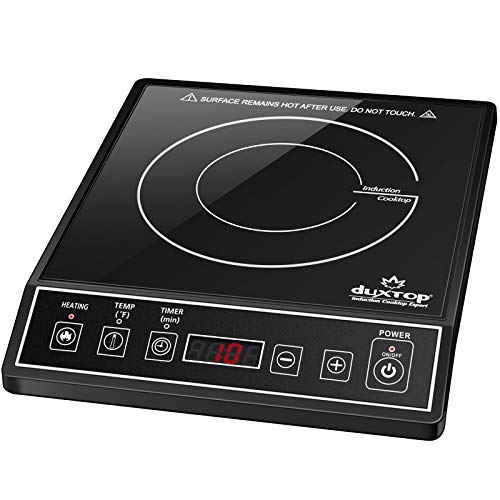
Every category has a default recommendation that experienced owners give newcomers, and in portable induction it is the Duxtop 9100MC class: a black 1800W countertop burner from the category’s best-known specialist, sold long enough that its strengths, quirks, and accessory ecosystem are thoroughly mapped by its owner base. There is real value in that maturity — no first-generation surprises, no orphan product.
What the listing does not promise is equally clear: no fine-step temperature theatre, no marathon timer headline, no preset library. This is a burner for cooks who think in power levels and want dinner, not a dashboard. It will be the right answer for a second burner, a student kitchen, a camper van, or a relative who distrusts touchscreens on principle — contexts where the fancier picks’ features are decoration. Simplicity, in the right kitchen, is not the budget option; it is the correct one, as our cross-category notes in Best Five Burner Gas Cooktops argue for flame’s simpler charms as well.
Best for: newcomers, second-burner duty, and simplicity loyalists / Not suited for: precision or marathon cooking
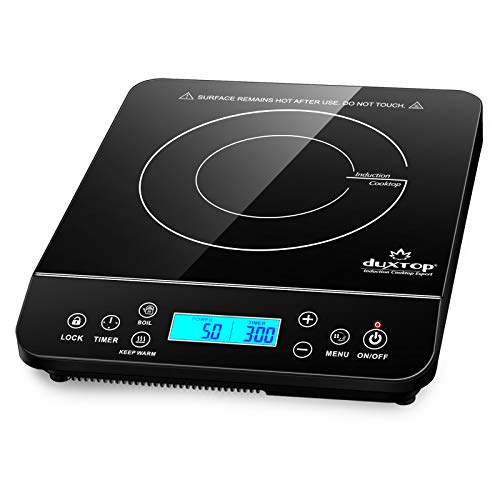
Duxtop 9610LS Portable Induction Cooktop
Badge: Best Touch Controls
Strengths
- Flush LCD sensor-touch panel wipes clean in one pass
- 1800W output with induction’s instant response
- The most contemporary look in the set
Trade-offs
- Touch controls prefer dry fingers
- Single zone
- Interface-led rather than timer-led feature set
Key specs (from the manufacturer listing)
- Power: 1800W
- Model: 9610LS (BT-200DZ)
- Controls: LCD sensor touch
- Finish: black
- Format: portable countertop burner
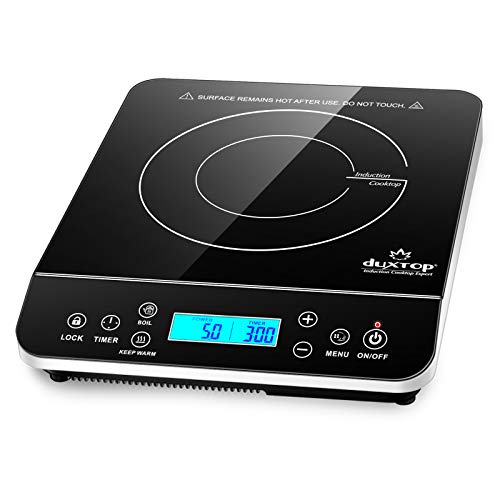
The Duxtop 9610LS is the pick for buyers whose mental image of an electric cooktop is a sheet of glass with light-up controls — because that is literally what it is. Its LCD sensor-touch panel sits flush with the cooking surface, so the whole unit wipes clean as one plane, with no knob to remove and no seam to harbour sauce. Beside a modern range it looks like family; in a design-conscious kitchen it passes the counter test that camping-style burners fail.
Performance is the full class standard: 1800W, one responsive zone, and the immediate adjustments that make induction feel modern. The caveat is the interface’s one demand — dry, deliberate fingers — which mid-recipe occasionally means a second touch. Cooks who know touch controls annoy them should believe themselves and take a button-led pick above. Everyone else gets the category’s most contemporary portable, and the natural bridge to the European-style glass world surveyed in Best Europian Induction Cooktops.
Best for: modern kitchens and touch-control fans / Not suited for: cooks who prefer physical buttons on principle
Comparison Table
One table, six answers to the same typo: the differences that matter are zones, timers, control style, and build — the wattage column is deliberately boring.
| Pick | Type | Power / Output | Controls & standout feature | Link |
|---|---|---|---|---|
| AAOBOSI Portable Induction Cooktop | Portable induction, single zone | 1800W | 20 levels, 4 presets, 4-hour timer | Check on Amazon |
| OneSetNuf Portable Induction Cooker | Portable induction, single zone | 1800W | Dual IGBT, 18 settings, 10-hour timer, push-button | Check on Amazon |
| ChangBERT Commercial Induction Cooktop | Portable induction, single zone | 1800W | Stainless commercial body, NSF certified in listing, 10-hour timer | Check on Amazon |
| Nuwave Double Pro Induction Cooktop | Portable induction, double zone | 900W / 1500W / 1800W selectable | Dynamic Watt Technology, 50°F–575°F, ceramic glass | Check on Amazon |
| Duxtop 9100MC Portable Induction Cooktop | Portable induction, single zone | 1800W | Classic Duxtop design, black finish | Check on Amazon |
| Duxtop 9610LS Portable Induction Cooktop | Portable induction, single zone | 1800W | LCD sensor-touch panel, black finish | Check on Amazon |
How to Choose an Electric Cooktop When Every Model Says 1800W
Why the wattage is all the same — and what to compare instead
A standard household outlet delivers roughly 1800W continuously, so every serious portable electric cooktop advertises the same ceiling. Marketing cannot repeal the outlet. What manufacturers can compete on — and what this guide ranks — is everything downstream of the plug: how finely the power is controlled, how evenly the coil spreads it, how long the timer sustains it, and how well the body survives delivering it daily. When two listings both shout 1800W, you have learned nothing that separates them; read the control steps, the coil diameter, the timer ceiling, and the build materials, in that order.
The one exception proves the rule: the Double Pro’s selectable wattage exists to deliver less power on purpose, trading speed for circuit safety — a feature about your house, not about the burner’s ambition.
Control granularity: the simmer test
Ask of any electric cooktop: what is the gentlest thing it can do? Boiling is easy; holding a sauce at the edge of simmering for an hour is the discipline. Coarse 10-level controls cycle around the target; 18- and 20-level designs narrow the swing; fine temperature-step models park on the number. Match the granularity to your cooking’s most delicate regular job, and ignore it entirely if that job is pasta. The reviews above flag each pick’s position on this spectrum so the match is easy to make.
Also check the floor of the range, not just the ceiling: a burner whose lowest setting is fierce will scorch the milk no matter how impressive its maximum looks.
Coils, pans, and the magnet minute
Portable coils cluster near eight inches, and every pick here lives in that class. The coil defines the truly heated circle: pans close to that diameter cook evenly; much wider pans cook with a hot centre. Flatness matters as much as size — induction couples through contact, so warped bases heat unevenly and may buzz. Before any of this matters, the pan must be magnetic: if a fridge magnet grips its base, it will work. Spend one minute testing your collection before ordering, and budget honestly if a favourite pan fails — replacing one saucepan is a footnote; replacing a set is a project.
Cast iron and enamelled cast iron are the category’s natural citizens: magnetic, flat, oven-proof, and unbothered by induction’s speed. Thin, lightweight pans are the most likely to buzz and warp.
Format decisions: single, double, portable, permanent
Decide the format before the model. A single portable covers overflow duty and small households; a double portable can be a small kitchen’s whole stovetop; a built-in is a renovation with a cooktop attached. Each step up buys capacity with permanence and cost. The honest middle — where most buyers land — is one good portable, chosen well, which is why this guide spends its length inside that format rather than gesturing at installations it cannot verify.
Accessories: the few that earn their drawer space
A new electric cooktop invites accessory spending, and most of it is waste. Three items genuinely earn their place. The first is a flat-edged scraper for the one emergency that matters — a sugary spill on glass — which costs almost nothing and should live in the drawer beside the unit. The second is a trivet or heat mat for the surface’s second job: a just-used burner, cooling, is a tempting and slightly warm landing pad, and a mat keeps pans, boards, and elbows honest about the difference between warm and ready. The third is a splatter screen for frying, which pays rent in cleaning time on every use.
The induction interface discs sold to make non-magnetic pans “work” deserve a colder verdict: they heat the pan indirectly, surrendering induction’s speed and precision — the two reasons you bought it — to save one saucepan. Replace the pan; keep the technology. And the elaborate carry cases and stands marketed to portable owners solve storage problems a drawer already solves. Buy the burner, the scraper, and if needed one good magnetic pan; let the accessory industry keep the rest.
How to Get Your First Week With an Induction Burner Right
Day one: setup and the water test
Set the burner on a flat, stable surface with its vents unobstructed — the internal cooling fan is the unit’s lungs, and a tea towel draped over a vent is a slow injury. Plug directly into a wall outlet. Then boil a small pan of water in a pan that passed the magnet test: you will learn the fan’s sound, the controls’ response, and the startling speed, all in the safest possible experiment. Wipe the glass first; grit under a pan is the scratch mechanism, and day one is when habits form.
Read the error behaviour now, calmly: lift the pan mid-boil and watch the unit notice, beep, and wait. That is pan detection protecting you, not a fault — the single most misreported “problem” in the category.
Technique adjustments from gas or radiant electric
Induction removes the two delays other cooktops trained into you. There is no waiting for an element to glow: the pan heats now, so preheat progressively — a minute at medium before high — to protect pans from warping and food from scorching. And there is no residual heat carrying the cooking after you turn down: when the sauce must stop, it stops, which makes induction forgiving of late decisions and unforgiving of unattended empty pans, which overheat frighteningly fast on full power. Adjust earlier, watch the first week, and the new reflexes become automatic.
Step by step for weeknight pasta: water on maximum in a lidded pan (faster than your old hob — stay in the room), pasta in, drop to a strong simmer level, and note the number. That number, for your pan on your burner, is now knowledge you own.
Cleaning: the thirty-second religion
Cool, wipe, done: a soft cloth with warm soapy water handles the daily case because spills sat on a comparatively cool surface. Sugary spills are the exception demanding promptness — remove them once the surface is touch-safe, with a flat scraper, before the sugar hardens against the glass. No abrasive pads, ever; they trade today’s mark for a permanent haze. Touch-panel models clean fastest of all, being one plane; button models ask for a pass around the controls and repay it with tactile cooking.
Troubleshooting: three common problems
Problem: the burner beeps and will not start → the pan is non-magnetic, too small for detection, or off-centre. Test with a pan you know is compatible before suspecting the unit.
Problem: it shuts off during a long cook → check vents first, then load: an oversized pan at maximum for hours, or a strained shared circuit, both trigger protective behaviour. Clear, cool, restart lower.
Problem: a pan buzzes or the food heats unevenly → the base is thin, layered, or warped. Heavier flat pans run quiet and even; reserve the thin pan for gentler jobs.
A Short, Respectful Note About the Word “Elevtric”
Misspelled keywords are a quiet map of how people actually search: fast, on phones, mid-recipe, often with wet thumbs. “Elevtric” and its cousin “eolectric” route thousands of shoppers to this category monthly, and the products waiting at the end of the typo are identical to the ones behind the correct spelling — the same verified listings, the same 1800W ceiling, the same magnet test. We flag the spelling once, here, not to mock it but to reassure you: you are in the right place, and the guide you are reading was written for exactly the search you made.
If you are bookmarking or sharing, the correctly spelled sibling guides — on glass, smoothtop, and oven-pairing formats — are linked throughout this page, and they will take you deeper into whichever format your kitchen needs.
Portable Electric Versus the Fixed Hob: An Honest Accounting
A portable induction burner is not a failed built-in; it is a different settlement with your kitchen. It costs a fraction of an installation, asks for no electrician, moves house when you do, and stores in a drawer. In exchange it offers one or two zones instead of four, a counter footprint while in use, and a plug’s worth of power instead of a dedicated circuit’s. Households that cook one-pan meals most nights will never feel the exchange rate; households running four pans nightly will feel it every night.
The mature position — and the one this guide’s ranking assumes — is that the two formats are complements in most real kitchens: the fixed hob for the daily fleet, the portable for overflow, precision, travel, and the day the hob fails two hours before guests. Bought in that spirit, a portable is not a compromise at all.
One Burner, Five Households: Matching the Pick to the Life
The student’s household runs on speed and storage: lectures, one pan, meals at hours the timetable chooses. The Duxtop classic or the ISILER serves it — compact, forgiving, and fast enough that the kettle retires. The young family’s household runs on safety and simultaneity: a lock for the toddler years, presets for the exhausted evenings, and the Double Pro’s second zone for the nights when two pans are the difference between dinner and surrender. The serious home cook’s household runs on control: the Pro Chef’s fine steps turn the portable into the precision station the main hob never was, parked beside it permanently rather than stored.
The entertainer’s household runs on occasions — the hotpot night, the preserving weekend, the holiday overflow — and should buy stamina: a commercial build with a long timer, because its burner works hardest exactly when failure is most public. The traveller’s household — RV, boat, second home — runs on flexibility, and the AAOBOSI’s compact, preset-led, take-anywhere brief was written on its behalf. Five households, five different “best” answers, one shared technology: this is why the guide ranks by badge rather than by a single crown.
If your household straddles two portraits — most do — weight the one that describes your ordinary week over the one that describes your favourite weekend. Appliances are bought by the imagination and judged by the routine.
What Changes After Month One: Living With Induction
The first week with induction is speed shock and small confusions; the first month is when the technology rewires the cook. Timings compress — the watched pot now boils during the unwatched minute — and recipes quietly adjust: mise en place stops being a virtue and becomes a necessity, because a pan that heats instantly waits for no one’s chopping. Sauces improve, because the setting that holds them is a number rather than a hope. The kettle, in many households, is quietly demoted to guests and emergencies.
Month one also reveals the honest frictions. The pan that failed the magnet test and was kept “just in case” still fails it, daily, in the way of all kept mistakes. The touch panel’s personality — or the buttons’ — has either become invisible or become a grievance, which is why this guide insists on choosing controls for your hands. And the surface has either stayed beautiful under the wipe-and-lift discipline or begun its slow cosmetic biography. None of these outcomes is luck; all of them were decided at purchase and in the first week’s habits, which is the real content of every review above.
Safety, Stated Plainly
Induction’s safety case rests on physics rather than features. There is no flame and no glowing element; the surface heats mainly where the pan heats it, and cools quickly once the pan lifts; remove the pan and the field stops delivering energy, with most units shutting down on detection. Burns remain possible — a pan that has cooked is a hot pan, and its handle and contents deserve the respect any stove earns — but the category of accident shrinks from “surface and flame” hazards to “hot cookware” hazards, which cooks already know how to respect.
Two honest qualifications complete the picture. The electromagnetic field is a local phenomenon that standard guidance treats as a non-issue for the general population, but anyone with a pacemaker or similar implant should follow their clinician’s and the manufacturer’s guidance about close proximity — that advice belongs in every induction guide, including this one. And the glass, like any glass, wants the wipe-and-lift discipline described earlier. Safety in this category is real, earned, and still partly the owner’s job.
The Second-Hand Question: Should You Buy a Used Electric Cooktop?
Portable induction burners circulate on the used market constantly, and the question deserves a straighter answer than either enthusiasm or horror. The case for used is real: the proven platforms in this guide were built to survive years of service, and a lightly used unit from a known source can be entirely sound. The case against is equally real: you inherit an unknown thermal history — years of blocked vents leave no visible trace until the electronics tire — plus a glass surface whose micro-scratches only announce themselves under your kitchen’s light.
If you buy used, buy like an inspector. Power it on with your own magnet-tested pan; boil water and listen to the fan’s note — smooth and steady is health, rattling is biography. Run it at a moderate setting for fifteen minutes and confirm it neither throttles nor sulks. Inspect the glass against the light at an angle, and the vents against your phone’s torch. A unit that passes all four has earned its second kitchen; a unit that fails any one is a new-burner argument, and the new prices in this category are low enough that the argument usually wins.
Energy and Running Costs, Without Invented Numbers
Readers reasonably ask what an 1800W burner costs to run, and the honest answer is a method rather than a figure, because tariffs differ by supplier, region, and hour. The method: a burner at full power for one hour uses 1.8 kilowatt-hours; multiply by your tariff’s unit price and you have the ceiling cost of an hour of the hardest possible work. Real cooking costs less — the long phases run at moderate settings, and induction puts a greater share of its energy into the pan than radiant or coil designs, which spend theirs heating surfaces and rooms. Anyone who quotes you a precise monthly saving without knowing your tariff and your menu is selling, not informing.
The habits that genuinely move the bill are behavioural. Lids on pans cut boiling energy dramatically. Matching pan to coil stops energy leaking past the base. Using the burner’s timer instead of an hour of forgotten simmering is the single largest saving available to most households. And induction’s speed is itself an economy: a pan of water that boils in half the time at the same wattage has used roughly half the energy, which is why the category’s efficiency reputation survives scrutiny even without a single printed figure.
Giving a Burner as a Gift, Done Right
A portable electric cooktop is a genuinely good gift — for the student leaving home, the parent whose stove is failing one burner at a time, the friend setting up a first kitchen — with exactly one way to ruin it: surprising someone whose pans are all non-magnetic. The tactful protocol costs nothing. Before the gift, find a moment in the recipient’s kitchen with a fridge magnet and a plausible excuse; audit the two pans they use most. If they pass, give the burner with confidence and include the magnet story when you hand it over — it is the most useful sentence in this guide.
If the pans fail, change the gift rather than the recipient’s kitchen: pair the burner with one good magnetic pan, clearly part of the present, so the first cook succeeds on day one. A gift that works immediately is remembered as generosity; a gift that beeps at every pan is remembered as homework.
Common Buying Mistakes
Blaming the burner for a non-magnetic pan. The beep is pan detection doing its job. Magnet-test first; argue later.
Shopping by wattage headline. Everyone is 1800W. The differences live in control steps, coil size, timer ceilings, and build — compare those.
Preheating an empty pan on maximum. Induction heats a pan itself, fast enough to warp thin pans and frighten cooks. Add oil, add food, or stay beside it.
Blocking the vents with a towel or a wall. The cooling fan keeps the electronics alive. Give the unit air on every side, every session.
Expecting one zone to run a four-pan household nightly. Format honesty: heavy multi-pan households need a double zone or a built-in plan, not a heroic single.
Final Recommendation
For the reader who typed fast and wants the answer: buy the AAOBOSI if one balanced burner covers your life; the ChangBERT or OneSetNuf if your cooking is heavy or long; the Nuwave Double Pro if two zones change your kitchen’s possibilities; the Duxtop 9100MC if you prize proven simplicity; and the 9610LS if a flush touch panel is your idea of a cooktop. Every one is a verified electric pick with its strengths and limits stated plainly above.
Run the magnet test tonight, measure your favourite pan’s base, and pick the control style your hands will enjoy. The typo got you here; those three checks make sure it was a good trip.
Start with our top pick here: Check on Amazon
Frequently Asked Questions
Is “elevtric” just a misspelling of electric?
Yes — and a very common one. Search engines route it to the same electric cooktop listings, which is why this guide answers it directly with the same verified picks we would give the correctly spelled search.
What type of electric cooktop is best in portable form?
Induction, for most buyers: it boils fastest, adjusts instantly, keeps its surface comparatively cool, and cleans easily. Its condition is magnetic cookware. Radiant portables exist but are now the minority choice, largely because they heat the room and the surface as much as the pan.
Why does my new burner beep at my favourite pan?
Pan detection: the pan’s base is non-magnetic, too small, or off-centre. Confirm with a magnet — aluminium, copper, and glass pans without an induction base cannot work on any induction burner, however good.
Can one of these replace my stove?
In a small household, a single — or better, the double-zone — portable can serve as the whole stovetop, and many studio and RV cooks use them exactly that way. Four-pan family cooking still belongs on a full hob, with the portable as the fifth zone.
How long do portable induction burners last?
Usage decides: ventilation kept clear, sensible pan weights, and no oversized pans at maximum for hours are the habits that extend life. Commercial-build models are specified for heavier daily duty than domestic designs.
Do I need special pans, and what do they cost me in effort?
You need flat, magnetic pans — cast iron and most stainless qualify, and one magnet test audits your whole collection in a minute. Most households find the majority of their pans already pass.