Disclosure: topratedkitchenware.com is reader-supported. When you buy through links on our site, we may earn an affiliate commission from Amazon and other retailers, at no extra cost to you.
Where to buy
The quickest route to each recommendation is below. Linked picks go straight to their Amazon listing, where you can check on Amazon for the current details before you buy. Picks labeled prose-only are discussed in full for comparison and carry no purchase link in this guide, for the honesty reasons explained in their reviews and source notes. Read the full guide ↓ for the reasoning, the comparisons and the buying advice before you decide.
- Crock-Pot Oval Manual Slow Cooker 7-Quart — Best Walmart Shelf Classic
- Hamilton Beach 6 Quart Slow Cooker — Best All-Round Shelf Pick
- Crock-Pot Programmable Slow Cooker 8-Quart — Best for Big-Box Batch Shopping
- Crock-Pot Programmable Slow Cooker with MyTime 7-Quart — Best Programmable Shelf Pick
- Cosori Rice Cooker 10 Cup with Slow Cook — Best Multi-Role Shelf Pick
- Aroma Housewares ARC-150SB Digital Multicooker — Best Grain-Led Shelf Pick
Shoppers searching for the best slow cookers at walmart are planning a trip as much as a purchase: the big-box shelf is where slow cookers are lifted, compared side by side and carried home the same day. This guide is built for that trip. The six verified picks — the manual oval Crock-Pot, the Hamilton Beach standard, the big programmable Crock-Pot, the MyTime model and the two multicookers — are the name-brand machines a Walmart shopper will recognize from the aisle and the marketplace listings, and all six are linked to their Amazon listings here so the in-store and online comparisons can happen in one read.
A necessary honesty note before the picks: this guide verifies products, not store stock. Walmart’s shelves and online marketplace vary by location and week, and no guide can promise what your store holds today. What it can do — what this one does — is arm you with the exact models, capacities and features to look for, the questions to ask in the aisle, and the checks to run on any unit, at Walmart or anywhere, before it goes in the cart.
The structure follows the trip: picks first with the details you will compare on boxes, then a buying guide for the big-box context — sizes on the shelf, seasonal displays, marketplace-versus-store distinctions — a how-to for first cooks and care, and answers to the questions Walmart slow-cooker shoppers ask most.
Key Takeaways
- This guide verifies the machines, not your store’s stock — use the model names and capacities here as your aisle checklist.
- All six verified picks are linked, spanning the manual, programmable and multi-role machines a big-box shopper will meet.
- In the aisle, the winning checks are physical: lift the crock, seat the lid, measure the footprint against your cupboard.
- Distinguish Walmart’s own shelf stock from third-party marketplace listings online — model numbers are the ground truth.
- Six quarts is the shelf’s center of gravity; 7 and 8 quarts appear as family and seasonal sizes.
In this guide
Quick Picks
All six verified picks for best slow cookers at walmart at a glance. Linked picks carry a purchase link; prose-only picks are labeled and explained in their full reviews below.
| Pick | Badge | Capacity / Role (verified) | Link |
|---|---|---|---|
| Crock-Pot Oval Manual Slow Cooker 7-Quart | Best Walmart Shelf Classic | 7 quart, serves 8+ people (per the verified listing title) | Check on Amazon |
| Hamilton Beach 6 Quart Slow Cooker | Best All-Round Shelf Pick | 6 quart | Check on Amazon |
| Crock-Pot Programmable Slow Cooker 8-Quart | Best for Big-Box Batch Shopping | 8 quart, for 10+ people (per the verified listing title) | Check on Amazon |
| Crock-Pot Programmable Slow Cooker with MyTime 7-Quart | Best Programmable Shelf Pick | 7 quart, feeds 9+ (per the verified listing title) | Check on Amazon |
| Cosori Rice Cooker 10 Cup with Slow Cook | Best Multi-Role Shelf Pick | 10 cup uncooked / 20 cup cooked (per the verified listing title) | Check on Amazon |
| Aroma Housewares ARC-150SB Digital Multicooker | Best Grain-Led Shelf Pick | 20 cup cooked / 10 cup uncooked (per the verified listing title) | Check on Amazon |
How These Picks Were Chosen
Every pick was verified against its Amazon listing through the Creators API on 2026-11-20; model numbers, capacities and features in this guide come from those verified titles, so the names you read here are the names to match on a box or a marketplace page. No Walmart pricing, stock or availability is claimed anywhere in this guide, because none was verified — the guide’s job is product truth that travels to any retailer.
Selection favored the machines that define the big-box shelf: the Crock-Pot and Hamilton Beach stoneware lines that anchor the category in American mass retail, the programmable tier above them, and the multicookers that big-box stores increasingly shelve beside them. Research-led throughout, with no hands-on or in-store claims invented — where the guide describes the aisle, it describes the checks to perform, not a visit it pretends to have made.
Badges are trip-friendly: shelf classic, all-round pick, batch pick, programmable pick — labels a shopper can hold in mind while standing in front of forty feet of cookers.
The 6 Best slow cookers at walmart

Crock-Pot Oval Manual Slow Cooker 7-Quart
Badge: Best Walmart Shelf Classic
Strengths
- Manual High, Low and Warm settings — nothing to program, nothing to fail
- Oval stoneware shape fits whole chickens and roasts the way recipes expect
- Removable crock goes to the table and into the sink or dishwasher routine easily
Trade-offs
- No timer, so the switch to Warm happens when you make it happen
- Seven quarts is more cooker than small households need for everyday meals
- Manual models reward cooks who are home near the end of the cooking window
Key specs (from the verified listing)
- Capacity: 7 quart, serves 8+ people (per the verified listing title)
- Settings: High, Low and Warm
- Crock: removable oval stoneware
- Finish: stainless steel
The oval manual Crock-Pot is the archetype — the machine the word slow cooker still brings to mind. A removable oval stoneware crock, a stainless steel housing and a control that offers High, Low and Warm: that is the entire interface, and generations of recipes were written against exactly this tool. The 7-quart capacity, which the maker rates for eight or more people, swallows a whole chicken or a generous pork shoulder with room for the vegetables around it, and the oval footprint is why — long cuts lie flat instead of curling up the sides of a round pot.
Manual control is a philosophy as much as a feature set. There is no countdown to mis-set and no electronics to age out; the cook decides, and the machine obeys. Stoneware holds heat evenly and keeps food warm at the table after the base is switched off, and because the crock lifts out, leftovers can be served, stored and reheated with less decanting. What you give up is automation: nobody flips this cooker to Warm at hour eight if the house is empty, so recipe choice and timing stay the cook’s responsibility.
On the big-box shelf, the manual oval Crock-Pot is the incumbent: the machine generations of Walmart shoppers have carried home, at the family size the aisle is organized around — if you buy one cooker on the trip, this is the shape of the default.
The honest limitation is absence of a timer. Households whose days are long and unpredictable often end up overcooking delicate dishes in manual machines, and for them a programmable model is not a luxury but the difference between dinner and a salvage operation.
Best for: families who cook whole chickens, roasts and stews on a predictable schedule / Not suited for: households away all day who need an automatic switch to Warm

Hamilton Beach 6 Quart Slow Cooker
Badge: Best All-Round Shelf Pick
Strengths
- Three settings keep operation genuinely simple — there is almost nothing to learn
- Stoneware crock and glass lid are both dishwasher-safe, so cleanup is not a project
- The 6-quart size is the most recipe-compatible capacity in this guide
Trade-offs
- No programmable timer, so it will not switch itself to Warm on a schedule
- No locking lid mentioned in the verified listing, which makes transport less secure
- Manual control means long workdays need a recipe timed to the settings, not to your return hour
Key specs (from the verified listing)
- Capacity: 6 quart
- Cooking settings: 3 settings (per the verified listing title)
- Crock: dishwasher-safe stoneware
- Lid: glass
- Finish: silver
- Model: 33665G (per the verified listing title)
The Hamilton Beach is the slow cooker reduced to its essentials: a stoneware crock, a glass lid and three cooking settings. That restraint is exactly its appeal. There is no menu to scroll, no program to set incorrectly and no app between you and dinner. You load the crock, turn the control, and the machine does the one job it was built for. For households that cook the same rotation of soups, stews, pulled meats and bean dishes, that simplicity is not a compromise — it is the feature.
The 6-quart stoneware crock is the size most American slow-cooker recipes are written for, which matters more than any electronic extra. Recipes assume a vessel that is half to two-thirds full, and a 6-quart crock hits that window for a family chicken, a mid-size pork shoulder or a double batch of chili. The crock and lid both go in the dishwasher according to the verified listing, and stoneware moves from cooker base to table without looking out of place, which quietly encourages serving from the crock instead of dirtying another dish.
On the big-box shelf, the Hamilton Beach is the standard-size alternative with the cleanup edge: its dishwasher-safe crock and glass lid are the features to verify hands-on in the aisle, where their practical value is easiest to feel.
The honest limitation is timing discipline: with no programmable countdown in the verified feature set, a recipe that finishes at hour six will sit cooking until you get home at hour nine unless you choose recipes built for longer, gentler windows or use the Warm setting thoughtfully within safe limits.
Best for: home cooks who want the standard size and the simplest possible operation / Not suited for: cooks who need a programmable timer to finish dinner unattended
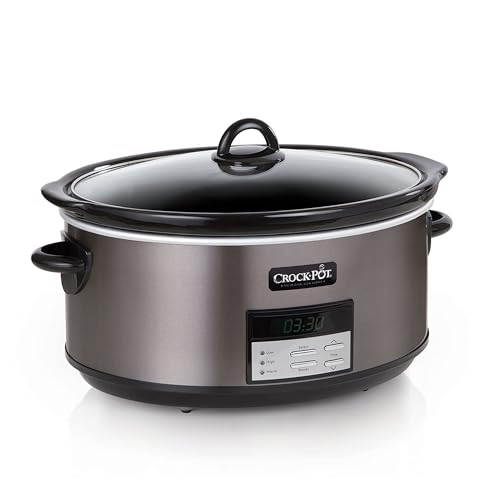
Crock-Pot Programmable Slow Cooker 8-Quart
Badge: Best for Big-Box Batch Shopping
Strengths
- The largest capacity in this guide — built for crowds, batch cooking and big roasts
- Digital timer up to 20 hours with an automatic switch to Warm
- Dishwasher-safe stoneware pot and lid keep cleanup proportionate to the size
Trade-offs
- An 8-quart crock is heavy when full and demands real counter and cupboard space
- Small meals underfill it, and underfilled slow cookers cook faster and less evenly
- Black stainless shows fingerprints more readily than plain finishes
Key specs (from the verified listing)
- Capacity: 8 quart, for 10+ people (per the verified listing title)
- Timer: digital, up to 20 hours
- Warm: auto warm setting
- Pot and lid: dishwasher-safe stoneware pot and lid
- Finish: black stainless steel
This is the big-batch end of the slow-cooker spectrum. An 8-quart stoneware pot rated by the maker for gatherings of ten or more changes what slow cooking is for: not just weeknight dinner, but the holiday ham, the game-day chili, the double batch of soup destined for the freezer. The verified listing pairs that capacity with a digital timer that runs up to 20 hours and then shifts to an auto warm setting, which is the combination large-format cooking actually needs, because big roasts and dense stews run long.
The black stainless finish gives the machine a more finished, appliance-grade look than the basic white or silver crocks of a generation ago, which matters for a cooker this size because it will live on the counter rather than in a cupboard for many owners. Both the stoneware pot and the lid are dishwasher-safe per the listing, a detail that sounds minor until you are facing an 8-quart pot crusted with baked-on beans. In daily use the experience is straightforward: set the time, set the level, and let the timer handle the transition to Warm.
On the big-box shelf, the 8-quart appears with the seasonal and entertaining displays, and its programmable timer is the feature that justifies its shelf space: batch and holiday shoppers should test its weight in the aisle, full-crock lifts imagined honestly.
The honest limitation is proportion: for a household of one or two cooking modest meals, this cooker is simply too much vessel. Food spread thin across an oversized crock cooks differently, storage is a genuine puzzle in small kitchens, and the full pot is a serious lift.
Best for: crowd cooks, batch cookers and holiday hosts / Not suited for: small households cooking small nightly meals
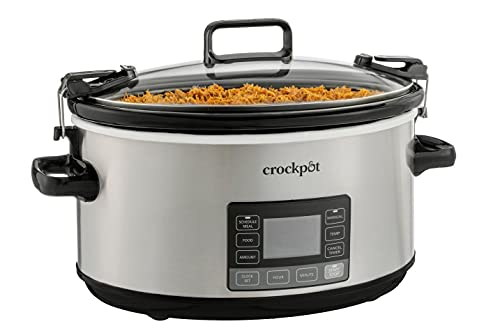
Crock-Pot Programmable Slow Cooker with MyTime 7-Quart
Badge: Best Programmable Shelf Pick
Strengths
- MyTime technology adjusts cooking toward your chosen mealtime, per the verified listing
- Locking Cook & Carry lid makes potlucks and transport realistic
- Seven quarts feeds nine or more, per the maker — family and gathering scale
Trade-offs
- Self-adjusting cooking asks you to trust the machine’s judgment over a fixed recipe time
- Locking lids must be unlatched for serving and for steam release at the table
- More electronics than a manual cooker, with more to learn on day one
Key specs (from the verified listing)
- Capacity: 7 quart, feeds 9+ (per the verified listing title)
- Technology: MyTime, which adjusts cooking (per the verified listing title)
- Lid: Cook & Carry locking lid
- Finish: stainless steel
The MyTime Crock-Pot tries to solve the oldest slow-cooker problem: recipes end when they end, but dinner happens when the family gets home. Its namesake technology, as the verified listing describes it, adjusts cooking toward the mealtime you set, rather than running a fixed countdown and hoping. For households whose evenings slide by an hour in either direction, that flexibility is more valuable than any extra setting, because it attacks the real failure mode of slow cooking — food that peaked at five and is tired by seven.
The second headline is the Cook & Carry locking lid. Slow cookers are natural potluck machines trapped by sloshing lids; a lid that locks for transport turns the 7-quart crock — rated by the maker to feed nine or more — into something you can actually take to the gathering it was sized for. The stainless steel finish and programmable format keep it firmly in the modern camp. In exchange you accept a machine that makes decisions: cooks who think in exact recipe hours sometimes find an adjusting cooker harder to predict, and the first few meals are partly an exercise in learning how it interprets your schedule.
On the big-box shelf, the MyTime is the step-up story: a locking lid you can click shut in the aisle and a scheduling idea you either need or do not — the trip should settle which, because returns are easier decided before purchase.
The honest limitation is that intelligence cuts both ways. If you prefer a cooker that does exactly what a dial says and nothing more, the MyTime’s adjustments will feel like interference, and a manual model will make you happier for less complexity.
Best for: households with unpredictable evenings and potlucks to transport / Not suited for: cooks who want a machine that never adjusts anything on its own

Cosori Rice Cooker 10 Cup with Slow Cook
Badge: Best Multi-Role Shelf Pick
Strengths
- Fuzzy-logic control adjusts cooking in a way fixed timers cannot
- Slow cook is one of many verified functions, alongside sauté and steaming
- Ceramic-coated inner pot and a stainless steel steamer basket are both listed features
Trade-offs
- A rice-cooker vessel is tall and round, not the wide oval shape roasts and whole chickens prefer
- Eighteen functions mean menus and decisions — the opposite of a one-dial appliance
- Ceramic coatings reward gentle utensils and hand care more than stoneware does
Key specs (from the verified listing)
- Capacity: 10 cup uncooked / 20 cup cooked (per the verified listing title)
- Control: fuzzy logic
- Functions: 18-in-1, including sauté and slow cook
- Inner pot: ceramic coating, non-stick
- Keep warm and delay timer: 24H (per the verified listing title)
- Accessory: stainless steel steamer basket
The Cosori arrives in this guide from a different direction: it is a fuzzy-logic rice cooker whose verified function list includes slow cooking, sautéing and steaming among its 18-in-1 programs. That breadth is the argument for it. A kitchen that cooks rice several times a week and slow cooks occasionally may rationally prefer one intelligent machine to two single-purpose ones, and the ceramic-coated inner pot plus stainless steel steamer basket in the listing make the multi-function claim concrete rather than decorative.
Fuzzy logic is the technical heart of the machine: instead of blasting at one fixed power until a timer ends, the cooker senses and adjusts through the cycle, which is how it handles grains so well and how its slow-cook program aims for steadier results than a basic on-off element. The 24-hour keep warm and delay timer listed in the title suit planned cooking — load in the morning, eat in the evening. The shape, though, remains a rice cooker’s shape: deep and round, excellent for soups, curries, steel-cut oats and braises that are mostly liquid, less natural for a flat roast or a whole bird.
On the big-box shelf, the Cosori sits where rice cookers meet slow cookers, and its eighteen functions reward the shopper who reads the box’s role list carefully — slow cook is verified there, alongside sauté and steaming.
The honest limitation is identity: if slow cooking is your main event and you cook roasts and large cuts often, a dedicated oval stoneware crock serves that food better, and eighteen programs will feel like clutter rather than capability.
Best for: grain-centered households that will use many functions weekly / Not suited for: roast-first cooks who want a wide oval crock and one-dial operation

Aroma Housewares ARC-150SB Digital Multicooker
Badge: Best Grain-Led Shelf Pick
Strengths
- Three verified roles in one machine: rice cooker, slow cooker and food steamer
- The largest cooked-grain capacity in this guide, suited to big households
- Stainless steel exterior wipes clean and suits most kitchens
Trade-offs
- Rice-led design means a round, deep pot rather than an oval stoneware crock
- Digital multi-mode controls are more involved than a manual dial
- At full grain capacity it is a large appliance to store
Key specs (from the verified listing)
- Capacity: 20 cup cooked / 10 cup uncooked (per the verified listing title)
- Roles: digital rice cooker, slow cooker and food steamer (per the verified listing title)
- Exterior: stainless steel
- Model: ARC-150SB
- Color: black
Aroma built its name on rice cookers, and the ARC-150SB stretches that platform into three verified roles: digital rice cooker, slow cooker and food steamer. The capacity headline — 20 cups cooked from 10 cups uncooked — tells you who this machine courts: large families, meal preppers and anyone whose gatherings run on rice. As a slow cooker it handles the saucy, liquid-based end of the repertoire — soups, curries, beans, pulled chicken in sauce — with the convenience of a digital control panel shared across its modes.
The stainless steel exterior is practical as much as visual: it shrugs off the splashes and steam of a working kitchen and wipes down in seconds. Where the Aroma differs most from the Crock-Pot and Hamilton Beach stoneware machines is the cooking vessel and the cooking feel. A rice-led pot is deep rather than wide, so ingredients stack instead of spreading, and browning or arranging large cuts is not its natural act. Owners who think of it as a grain-and-stew station tend to love it; owners who expected an oval roaster tend to drift back to stoneware.
On the big-box shelf, the Aroma is the grain aisle’s ambassador: twenty cups cooked is a headline a big family can evaluate on the spot, with its slow-cooker and steamer roles making it the consolidation buy of the trip.
The honest limitation is the same shape story: whole chickens, racks and flat roasts sit awkwardly in a deep round pot, so if your slow cooking centers on large whole cuts, a dedicated oval crock remains the better tool.
Best for: large, rice-centered households that also steam and slow cook / Not suited for: cooks whose slow cooking centers on large whole cuts
Comparison Table
| Pick | Badge | Capacity / Role (verified) | Control style | Link |
|---|---|---|---|---|
| Crock-Pot Oval Manual Slow Cooker 7-Quart | Best Walmart Shelf Classic | 7 quart, serves 8+ people (per the verified listing title) | Manual High / Low / Warm | Check on Amazon |
| Hamilton Beach 6 Quart Slow Cooker | Best All-Round Shelf Pick | 6 quart | 3 settings, manual-style | Check on Amazon |
| Crock-Pot Programmable Slow Cooker 8-Quart | Best for Big-Box Batch Shopping | 8 quart, for 10+ people (per the verified listing title) | Digital timer up to 20 hours, auto warm | Check on Amazon |
| Crock-Pot Programmable Slow Cooker with MyTime 7-Quart | Best Programmable Shelf Pick | 7 quart, feeds 9+ (per the verified listing title) | Programmable, MyTime adjusts cooking | Check on Amazon |
| Cosori Rice Cooker 10 Cup with Slow Cook | Best Multi-Role Shelf Pick | 10 cup uncooked / 20 cup cooked (per the verified listing title) | Fuzzy logic, 18-in-1 programs | Check on Amazon |
| Aroma Housewares ARC-150SB Digital Multicooker | Best Grain-Led Shelf Pick | 20 cup cooked / 10 cup uncooked (per the verified listing title) | Digital multi-mode | Check on Amazon |
How to Choose a Slow Cooker at Walmart (or Any Big-Box Store)
Shop by model number, not by shelf position
Big-box shelves are merchandised, not ranked: eye-level is a negotiation, not a verdict. Carry the shortlist from this guide — the model names and capacities in the picks above — and match boxes to it. Online, the same discipline separates Walmart’s own listings from third-party marketplace sellers using similar names; the model number and the verified capacity are the ground truth in both worlds. Readers comparison-shopping across retailers can pair this guide with Best Slow Cookers Australia for range differences and Best Slow Cookers Buy for the general purchase framework.
Run the three physical checks in the aisle
First, lift the crock out and imagine it full — stoneware plus stew is a two-handed carry, and the 8-quart deserves an honest rehearsal. Second, seat and lift the lid; on the MyTime, work the locking mechanism until it is muscle memory. Third, picture the footprint: measure your cupboard shelf or counter corner at home before the trip, and compare against the box dimensions in the aisle. These checks cannot be run on a product photo, which is the entire advantage of the store — use it.
Read the seasonal display with a cool head
Big-box slow-cooker displays swell around holidays and game season, when the big capacities and giftable finishes take the endcaps. Seasonal prominence is not a quality signal, and seasonal urgency is not a sizing argument: the 8-quart bought for one holiday must still earn its cupboard in March. Let your household’s weekly menu outvote the calendar. The value framework in Best Slow Cookers Canada applies across borders, and brand-tier questions are worked through in Best Slow Cookers Caphalon.
Decide the controls question before the cart
The shelf’s real fork is manual versus programmable versus multi-role, and it is a household question, not a price question. Predictable schedules point to the manual classics; long workdays point to a timer; grain-centered kitchens point to the multicookers. Decide in the aisle with your actual week in mind, because the wrong philosophy at a good price is still the wrong cooker — a point the test-method guide Best Slow Cookers Consumer Reports style shoppers will recognize, and the cooks-illustrated companion shelf in Best Slow Cookers Cooks Illustrated extends.
How to Use and Care for a Big-Box Slow Cooker: First Cook to Weekly Routine
Whether the cooker came home from Walmart or a courier, the first-week routine is the same — and it decides whether the machine becomes infrastructure or clutter.
- Unbox completely and wash the crock and lid in warm soapy water before the first cook; retail dust and packing residue have no place in dinner.
- Run a water-only heat cycle for a short stretch to burn off new-appliance smells with the kitchen ventilated, then let the crock cool gradually.
- Choose a forgiving first recipe — a soup or a shoulder — at proper fill, and keep the receipt-era notes: setting, hours, result.
- Serve from the crock, cool leftovers in shallow containers, and wash the stoneware once it nears room temperature to protect it from thermal shock.
- Store with the lid seated and the cord managed; a cooker stored accessibly gets used, and use is the whole point of the purchase.
- Register the product or keep the paperwork with the manual if that is your household’s habit — warranty questions are cheapest answered from a folder, not a memory.
Troubleshooting
Problem: the new cooker smells on first use Normal for heating elements and finishes. A ventilated water cycle and one strongly flavored first stew usually retire it; persistent chemical smells are a return-window conversation, not a cooking problem.
Problem: the lid seems loose compared to the display model Slow-cooker lids rest rather than seal — a gentle rock is typical and steam does the sealing in use. A lid that visibly gaps or a locking lid that will not latch is a defect: exchange it while the trip is recent.
Problem: the crock sticks despite being non-stick or glazed Sauces reduce onto hot stoneware at the edges. Soak warm, use a soft sponge, and grease or line for sticky, sugary dishes next time.
Store shelf versus online marketplace: buying the same cooker two ways
The same model can reach you from a Walmart shelf, from Walmart’s own online stock, or from a third-party marketplace seller on Walmart’s site — three routes with different return desks and sometimes different box contents. The model number is your anchor across all three: match it character for character against the verified titles in this guide, and be wary of lookalike listings that borrow a famous name for a different capacity.
The shelf route’s advantage is the physical checks in the buying guide — weight, lid, footprint. The online route’s advantage is range and reviews at scale. Wise shoppers use both: handle in the aisle, decide with the full information, and buy through whichever route serves the household — the Amazon links in this guide exist so that comparison is one click rather than a second trip.
The big-box ecosystem: liners, cookbooks and replacement crocks
Mass retailers stock the slow-cooker ecosystem alongside the machines: liner bags for cleanup-free cooking, recipe collections tuned to standard sizes, and — valuable years later — replacement crocks and lids for the major lines. That ecosystem is a genuine argument for the mainstream picks in this guide: a Hamilton Beach or Crock-Pot bought today is a machine whose wear parts remain findable, which is a form of longevity no specification sheet lists.
Use the ecosystem selectively. Liners suit sticky, cheesy, hard-to-scrub dishes and potluck transport more than everyday stews; an extra crock earns its shelf only in households that cook back-to-back batches. The ecosystem should serve the cooking, not become a second hobby beside it.
Planning the trip: a big-box slow-cooker checklist
Before the trip: measure the cupboard shelf or counter corner where the cooker will live — height with the lid on, width with handles, depth with the cord’s bend. Photograph your current cooker’s footprint if you are replacing one, and write down the three numbers that define your shortlist: capacity, control style and the one feature your household actually needs, whether that is a timer, a locking lid or a dishwasher-safe crock. Shoppers who arrive with those numbers written down buy cookers; shoppers who arrive with a vague intention buy displays.
In the aisle: work the shortlist physically. Lift each candidate’s crock. Seat each lid. If a model is displayed powered or assembled, work its controls with the same confidence you will need at seven in the morning. Compare the box’s model number and capacity against your list character by character — the shelf’s lookalike models differ by exactly the digits shoppers skim. Check what is in the box: some models include serving tools or a recipe booklet, most do not, and none of it should be assumed from a photograph.
At the decision: apply the household tests from this guide. Does this size fill properly with your weekly menu? Does this control style match your schedule’s predictability? Can you carry this crock full, in your kitchen, on your tiredest day? Three yeses make a purchase; a no makes a note for the online comparison you will finish at home — where the linked listings in this guide wait with the same verified facts, no fluorescent lighting required.
After the trip: the first month with a big-box cooker
The first month decides whether a slow cooker becomes infrastructure. Week one belongs to calibration: one forgiving stew, one water check if you are methodical, notes on the recipe card. Week two repeats a success — repetition is not boredom, it is the sound of a routine forming — and adds one new dish at the same fill and setting family. By week three, most households know their machine’s pace, their crock’s honest capacity for their own appetites, and the two or three dishes that will carry the season.
Week four is for the ecosystem, used selectively: the cookbook that matches your size, the liners if your menu runs sticky, the spare crock only if back-to-back cooking has actually happened. Big-box stores make the ecosystem easy to buy; the discipline is buying it in response to use rather than in anticipation of a fantasy. The cooker that earns accessories through service is a tool. The cooker buried under anticipatory accessories is a project.
And keep the paperwork through the first month at least — receipt, model number, the box’s end panel if storage allows. Returns and warranty claims are the unglamorous tail of every appliance purchase, and they are cheapest in the window when the trip is still recent. After the month, file the manual where your household files such things, with your recipe cards and their notes in front of it: by then, the notes are the manual that matters.
Beyond the cooker aisle: building the whole slow-cooking kit in one trip
The slow cooker is the anchor purchase, but the trip can quietly assemble the whole practice around it. From the grocery side: the dried beans, lentils, barley and canned tomatoes that form the slow pantry, bought at big-box economics; the freezer containers that turn batch cooking into a system; a kitchen thermometer, the one tool this guide’s safety advice depends on. From the kitchen side: a sturdy ladle that fits the crock, a cutting board that handles a whole chicken, and — only if your menu runs sticky — the liners that make cleanup a non-event on the dishes that need them.
Resist completing the kit in a single sweep of enthusiasm. The disciplined version buys the anchor and the pantry, cooks for a month, and lets the routine itself file the requisitions: the household that discovers it batch-cooks weekly earns the extra containers; the one that transports monthly earns the locking-lid upgrade conversation; the one that cooks beans constantly earns the bigger bean bag. Equipment bought in response to demonstrated use is a kit; equipment bought in anticipation is a storage problem with receipts.
There is a satisfaction proper to the one-trip anchor, though, and this guide does not begrudge it: a cooker, a bag of beans, a chicken and a plan, carried out to the car in one cart, can genuinely change a household’s dinners by the following week. Big-box retail at its best is exactly that — the whole beginning, available at once, at prices a family can act on. The checklist in this guide exists to make sure the beginning is the right one: right model, right size, right controls, verified before the cart ever rolls.
Price tags, rollbacks and the discipline of the aisle
Big-box pricing has its own theater — rollback tags, clearance endcaps, seasonal bundles — and this guide’s standing rule against printing prices turns out to be a shopper’s advantage as well as an editorial one: it forces the comparison onto the durable variables. A rollback on the wrong size is not a saving; a plain price on the right model, verified against the checklist you carried in, usually is. The disciplined aisle shopper compares machines to criteria first and tags second, and treats every promotion as a question — why this model, why now — rather than as an instruction.
Bundles deserve the same cool eye. A cooker packaged with liners, tools or a recipe collection is a good buy exactly when the household would have bought those items anyway at their honest value; otherwise the bundle is a way of paying for the privilege of storing things. The checklist discipline from this guide’s trip-planning section settles most bundle questions in seconds: if it is not on the list the routine wrote, it is not a saving, whatever the tag’s arithmetic claims.
None of this argues against enjoying a genuine bargain on the right machine — the picks in this guide are mainstream models precisely because mainstream models are the ones big-box economics serves best. It argues only for sequence: model, size, controls, verification — then price. Shoppers who keep that order leave with cookers. Shoppers who reverse it leave with stories.
Common Buying Mistakes
- Letting shelf position or an endcap display choose the size, instead of your household’s weekly menu.
- Skipping the aisle checks — crock weight, lid fit, footprint — that are the whole advantage of buying in person.
- Matching a marketplace listing by product photo instead of model number, and receiving a different capacity than intended.
- Buying the seasonal giant for one holiday and storing it, resentfully, for the other fifty weeks.
- Discarding the box and paperwork in the parking lot of enthusiasm; the return window is part of the purchase, and it closes on schedule.
Final Recommendation
If the trip ends with one cooker, make it the manual oval Crock-Pot — check on Amazon — the shelf classic at family size. Cleanup-first households should take the Hamilton Beach — check on Amazon — and hosts who batch at scale should commit to the 8-quart programmable — check on Amazon — after the honest lift test in the aisle.
However the trip ends, end it by model number and by menu, not by display. The machines in this guide are verified; the rest is your kitchen’s arithmetic — and it is arithmetic worth doing once, well.
Frequently Asked Questions
Does this guide guarantee Walmart stocks these models?
No — and any guide that promises a specific store’s stock should be distrusted. This guide verifies the products themselves, with model names and capacities to match in store or online; availability varies by location and week.
Why are the links in a Walmart guide to Amazon?
Because this site’s buying guides link verified listings on Amazon, where the tag and listing can be checked centrally. Use them as the comparison baseline — model, capacity, features — wherever you ultimately buy.
What should I check on a slow cooker in the store?
Lift the crock and imagine it full, seat and work the lid (including any locking mechanism), and compare the footprint to the cupboard measurements you brought. Those three checks are the in-person advantage — use them.
Is a marketplace listing the same as Walmart’s own stock?
Not necessarily. Third-party sellers list on Walmart’s site alongside Walmart’s own inventory. Match the model number exactly and note who the seller is before assuming identical contents or return terms.
What size dominates the big-box shelf?
Six quarts is the center of gravity, with 7- and 8-quart family and seasonal sizes around it — the same ladder as this guide’s picks. Buy the rung your weekly menu fills properly.
When is the best time to buy at a big-box store?
Slow cookers feature heavily in autumn and holiday promotions, but the right time is when your household’s size and control decisions are settled. A well-chosen cooker at a plain price out-saves a poorly chosen one on promotion.


