Disclosure: topratedkitchenware.com is reader-supported. When you buy through links on our site, we may earn an affiliate commission from Amazon and other retailers, at no extra cost to you.
Where to buy
The fastest way to shop this roundup is to start with the six models below, each listed with a direct product link so you can check the latest price on Amazon and confirm the current configuration before you order. Newer can opener designs sell in several color and bundle variants, and listings change more often than the underlying hardware does, so a thirty-second check on the product page is worth it. Our six picks are: the bella Electric Can Opener for a clean one-touch countertop design, the Famawo USB-C Rechargeable Electric Can Opener for cordless smooth-edge cutting, the Amazon Basics 3-In-1 Electric Can Opener for multi-tool value, the Cuisinart Deluxe Electric Can Opener CCO-50BKN for a proven single-touch mechanism, the Hamilton Beach Smooth Touch Electric Can Opener for tall and pop-top cans, and the Canslab Ultrablade PRO Electric Can Opener for handsfree side cutting with smart auto stop. If you want the single most representative example of where this category is heading, start with the bella Electric Can Opener — Check on Amazon, then read the full guide below before deciding.
Read the full guide ↓
Introduction: What Counts as New in a Very Old Appliance
Shoppers searching for the best new can openers are usually not looking for a museum piece with a crank. They want to know what has actually changed in a category that, for decades, barely changed at all. The honest answer is that the cutting wheel itself is mature technology, but almost everything around it has moved: power sources, edge style, lid handling, and how much hand strength the whole job demands. The best new can openers reflect that shift. The newest designs in this roundup are rechargeable over USB-C, cut along the side of the rim so the lid comes away with a smooth edge, stop on their own when the cut is finished, and hold the removed lid on a magnet so it never drops into the food. Alongside them sit refined versions of the classic countertop format — single-touch levers, magnetic lid holders, and bodies shaped to swallow extra-tall cans — which earn their place because the underlying designs have been debugged by years of production.
That mix matters, because “new” can mislead in both directions. A brand-new model with a clever shape may still struggle with a dented rim, while an older countertop design may open every can in your pantry without drama for years. This guide therefore treats novelty as a feature to be weighed, not a trophy to be awarded automatically. We look at what each design does differently, who that difference genuinely helps, and where the trade-offs hide: charging cables versus countertop cords, side cuts versus top cuts, compact bodies versus tall-can clearance. If your current opener skips, leaves metal slivers, or demands a grip your hands no longer enjoy giving, the six models below cover every sensible direction you could upgrade in — and the buying guide and how-to sections after the reviews will help you maintain whichever one you choose so it keeps cutting cleanly instead of slowly chewing rims.
Key Takeaways
- The biggest genuine advances are USB-C rechargeable power, side cutting that leaves a smooth edge, automatic stop, and magnetic lid holding — not raw cutting power.
- Countertop plug-in models like the Cuisinart and Hamilton Beach remain the most forgiving choice for extra-tall cans and daily heavy use.
- Cordless models like the Famawo and Canslab sit on top of the can and store in a drawer, which suits small kitchens and anyone avoiding counter clutter.
- Smooth-edge side cuts reduce the sharp-rim problem, but the lid separates differently and takes a short learning curve.
- Every pick here is electric; if your hands tire or your grip is unreliable, that motorized assistance is the real upgrade, whatever the model year.
- Match the opener to your cans first — tall, pop-top, and rim condition matter more than styling.
In this guide
Quick Picks
| Pick | Badge | Format | Standout trait from its listing | Link |
|---|---|---|---|---|
| bella Electric Can Opener | Best Overall New Design | Countertop electric, one-touch | Automatic one-touch operation in a soft Oatmilk finish | Check on Amazon |
| Famawo Electric Can Opener | Best Cordless Newcomer | USB-C rechargeable, sits on can | Smooth edge, one-touch operation, magnetic lid hold, fits most can sizes | Check on Amazon |
| Amazon Basics 3-In-1 Electric Can Opener | Best Multi-Tool Value | Countertop electric, 50W | Combines can opener, bottle opener, and knife sharpener with stainless steel blade | Check on Amazon |
| Cuisinart Deluxe Electric Can Opener | Best Proven Countertop | Countertop electric, single-touch | Single-touch automatic operation, magnetic lid holder, removable activation lever | Check on Amazon |
| Hamilton Beach Smooth Touch | Best for Tall and Pop-Top Cans | Countertop electric, push-down lever | Opens all standard, extra-tall, and pop-top cans; black and chrome finish | Check on Amazon |
| Canslab Ultrablade PRO | Best for Seniors and Arthritis | USB rechargeable, cordless, wall mountable | Handsfree side cut with smooth edge, smart auto stop, designed for seniors with arthritis | Check on Amazon |
How These Picks Were Chosen
This is a research-led roundup, not a hands-on lab test, and we want to be plain about that. We built the shortlist from current manufacturer listings and verified product data, then compared the six models on the attributes that actually separate modern can openers: power source and what it means for placement, cutting position and the edge it leaves, how the lid is handled after the cut, the range of can sizes the design accepts, and how much hand effort the operating cycle requires from start to finish. Every product name, feature, and specification mentioned in the reviews below comes from that model’s own listing — where a listing does not state a specification, we leave it out rather than guessing, which is why some mini spec boxes are shorter than others.
We also weighted the mix deliberately. A roundup of only brand-new releases would be a worse guide than a roundup of the best current options, because can openers are bought to solve a daily annoyance, not to win a design award. So the list pairs genuinely new formats — USB-C rechargeable, auto-stopping, side-cutting — with mature countertop designs whose mechanisms have long production histories. Where a newer feature creates a new chore, we say so: a rechargeable opener that is flat when you need it has failed at its one job, and a side-cut lid behaves differently in the trash and on the counter than a top-cut lid. Readers comparing this category with adjacent ones may also find our coverage of Best One Touch Can Openers useful, since single-press operation is the thread running through most of this list. Finally, we applied two standing editorial rules throughout: no fixed prices, because listing prices move constantly, and no invented performance numbers, because a can opener either completes the cut cleanly or it does not, and that is best judged by design and mechanism rather than by decimals.
The 6 Best New Can Openers

bella Electric Can Opener
Badge: Best Overall New Design
Strengths
- Automatic one-touch operation keeps the hand effort to a single press.
- Countertop format stays put during the cut, with no balancing on the can.
- The Oatmilk finish suits kitchens that have moved away from black plastic appliances.
Trade-offs
- Its listing is sparing with technical detail compared with rivals here.
- A countertop footprint is permanent counter space, unlike drawer-stored cordless models.
- No side-cut smooth-edge claim, so expect a conventional top-cut lid.
Mini spec box
- Type: Electric can opener
- Operation: Automatic, one-touch
- Color: Oatmilk
The bella represents the direction mainstream countertop openers have taken: keep the stable, plug-in, stand-up format that households already trust, and simplify the interaction until it is a single touch. For most kitchens that is exactly the right kind of new. There is no battery to manage, no app, no charging ritual — you set the can in place, press, and the automatic cycle does the gripping, turning, and cutting that a manual crank used to demand from your wrist. That makes it a comfortable default recommendation for anyone replacing a worn-out opener and wanting the replacement to feel modern without feeling experimental.
Its honest limitation is documentation rather than performance: the listing tells you less about the mechanism than, say, the Hamilton Beach or Cuisinart listings do, so buyers who like to compare cutter style, lid handling, and can-size range in fine detail will find fewer answers here. The styling also cuts both ways — the soft Oatmilk finish looks intentional in a light, modern kitchen and slightly stranded in a stainless-heavy one. Neither point stops it being the most balanced starting point in this roundup, particularly for households that open cans daily and want the job to disappear into the background of cooking rather than become a small event each time.
Best for: Most households wanting a modern, simple countertop opener / Not suited for: Buyers who want a cordless drawer-stored model or a side-cut smooth edge

Famawo Electric Can Opener (USB-C Rechargeable)
Badge: Best Cordless Newcomer
Strengths
- USB-C rechargeable, so it charges from the same cables already in most kitchens.
- Smooth-edge cutting reduces the sharp rim a top cut leaves behind.
- Magnetic lid hold keeps the removed lid out of the food.
Trade-offs
- A rechargeable battery is one more charge level to keep an eye on.
- The listing promises it fits most can sizes, which is not the same as every can size.
- Sit-on-top designs need the can held steady on some surfaces.
Mini spec box
- Type: Electric can opener, automatic
- Power: USB-C rechargeable
- Operation: One-touch
- Cut: Smooth edge
- Lid handling: Magnetic lid hold
The Famawo is the clearest example in this roundup of the new cordless pattern: a compact unit that sits on top of the can, travels around the rim under its own power, and then goes back in a drawer. The USB-C detail sounds minor until you compare it with older rechargeable gadgets that each demanded their own proprietary cable; charging from a standard cable you already own removes the most common way these tools end up abandoned. One-touch operation and the magnetic lid hold complete a cycle designed to involve your hands as little as possible — position, press, lift the lid away on the magnet.
It is positioned by its maker as an easy kitchen gadget for seniors, and the design logic supports that: no crank, no squeezing, no sharp separated lid to fish out of a can of tomatoes. The limitations are the honest ones for the format. “Fits most can sizes” leaves a minority of oversized or unusually shaped cans to another tool, and any rechargeable appliance can be caught empty at the wrong moment if it lives in a drawer and its charge is forgotten for months. Households that open cans several times a day may also simply prefer a countertop unit that is always ready. For everyone else — small kitchens, occasional can use, anyone who hates counter clutter — this is the new format working exactly as intended. Readers whose priority is specifically that single-press experience across formats should also see Best One Touch Can Openers for a deeper comparison.
Best for: Small kitchens, drawer storage, and anyone who wants a smooth edge without a cord / Not suited for: Very heavy daily use or oversized commercial cans
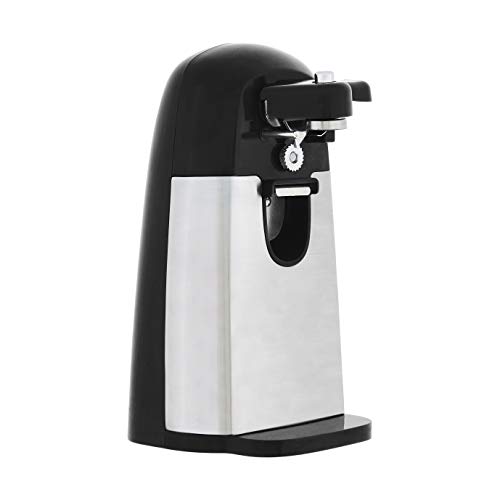
Amazon Basics 3-In-1 Electric Can Opener
Badge: Best Multi-Tool Value
Strengths
- Three tools in one footprint: can opener, bottle opener, and knife sharpener.
- Stainless steel blade and a magnetic lid holder cover the core jobs properly.
- Countertop stability with a stated 50W motor.
Trade-offs
- Multi-function designs ask you to keep one appliance for three occasional jobs.
- Black finish only, per its listing, in a roundup with softer options.
- The knife sharpener is a convenience feature, not a replacement for proper sharpening.
Mini spec box
- Type: Electric can opener, 3-in-1
- Power: 50W
- Blade: Stainless steel
- Extras: Bottle opener, knife sharpener, magnetic lid holder
- Color: Black
Not every advance in this category is electronic. The Amazon Basics 3-In-1 makes its case on consolidation: one countertop appliance that opens cans, pops bottle caps, and offers a knife sharpener, in a sleek black body with a magnetic lid holder and a stainless steel blade. For a small kitchen or a first apartment, replacing two or three drawer items with one plugged-in unit is a genuinely practical form of progress, and the stated 50W motor puts it in the normal working range for countertop openers — enough torque for standard cans without any drama.
The trade-off is the classic multi-tool one. If you already own a good sharpener and never open crown-cap bottles, two thirds of the pitch is wasted on you, and a single-purpose model may serve you better. The sharpener in particular should be treated as a touch-up convenience for everyday knives, not as a substitute for a whetstone or a dedicated sharpener for knives you care about. Judged purely as a can opener, though, the fundamentals are all present — motorized cutting, magnetic lid control, countertop stability — and the extra functions cost you nothing in the core job. It is the value anchor of this list, in the qualitative sense: a lower-cost design in its class that does not skip the features that matter.
Best for: First kitchens, small counters, and anyone who likes one appliance doing several jobs / Not suited for: Knife enthusiasts expecting a serious sharpener, or buyers wanting a cordless model

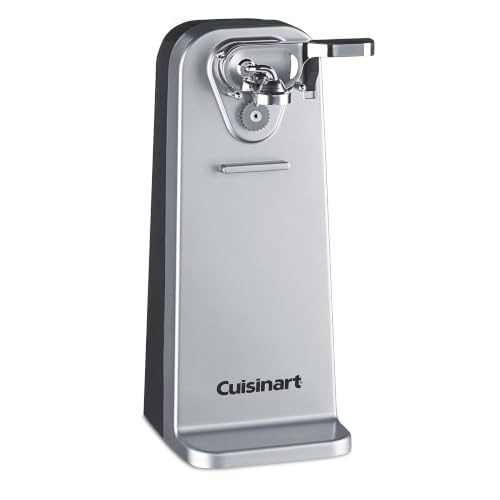
Cuisinart Deluxe Electric Can Opener CCO-50BKN
Badge: Best Proven Countertop
Strengths
- Single-touch automatic operation from a long-established countertop design.
- Removable activation lever makes the cutting area easier to clean.
- Magnetic lid holder keeps the lid controlled at the end of the cut.
Trade-offs
- A mature design, so it lacks newer tricks like USB-C charging or side cutting.
- Countertop footprint, like all stand-up models here.
- Black finish is the listed configuration in this roundup.
Mini spec box
- Type: Electric automatic can opener
- Model: CCO-50BKN
- Operation: Single-touch automatic
- Lid handling: Magnetic lid holder
- Cleaning: Removable activation lever
- Color: Black
Every “best new” list needs an honesty check, and the Cuisinart CCO-50BKN is ours. It is not a radical new format; it is a mature countertop design that keeps appearing in current roundups because the mechanism is sorted. Single-touch automatic operation means the press of the lever starts a cycle that grips, cuts, and holds the lid magnetically, and the removable activation lever addresses the complaint that eventually kills many countertop openers — dried food building up around the cutter where you cannot reach it. Being able to remove the lever assembly for washing is a longevity feature disguised as a cleaning feature.
Cuisinart positions this model for seniors, and the logic is the same as with the newer cordless designs: the machine supplies the force, so the user’s hands mostly position and steady. What you give up versus the newest models is the smooth-edge side cut and cordless storage; what you gain is a design with a long track record and no battery to manage. If your priority is a countertop opener that simply works every day with minimal fuss, this remains the benchmark the newcomers have to beat — and for shoppers comparing countertop formats specifically, our guide to Best Countertop Electric Can Openers goes further into placement and sizing. In this roundup it earns its place not by being the newest object here, but by being the one whose newness has already been tested by time.
Best for: Daily users who want a proven, cleanable countertop mechanism / Not suited for: Buyers specifically wanting a rechargeable or smooth-edge side-cut model

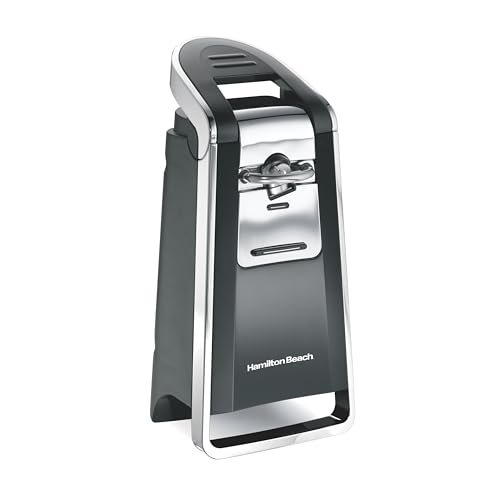
Hamilton Beach Smooth Touch Electric Can Opener 76606AG
Badge: Best for Tall and Pop-Top Cans
Strengths
- Explicitly opens all standard, extra-tall, and pop-top cans.
- Easy push-down lever suits hands that dislike small controls.
- Black and chrome finish fits traditional stainless kitchens.
Trade-offs
- Tall-can clearance means a taller body on the counter.
- A lever design still asks for a firm downward press to start.
- No cordless or rechargeable option in this model.
Mini spec box
- Type: Electric can opener
- Model: 76606AG
- Operation: Easy push-down lever
- Can range: Standard, extra-tall, and pop-top cans
- Finish: Black and chrome
The Hamilton Beach Smooth Touch answers the most practical question in this category: will it open the cans I actually buy? Its listing is unusually explicit — all standard cans, extra-tall cans, and pop-top cans — and that breadth is why it belongs in a current roundup even though the format is classic countertop. Tall cans of tomatoes or stock are where compact openers, manual and electric alike, tend to wobble or refuse, and a body designed with that clearance from the start removes a whole category of frustration. The push-down lever is also a considered choice: a large, obvious control that asks for one downward motion rather than a squeeze or a twist.
The Smooth Touch name points at the other half of its pitch, a cut intended to leave the can easier to handle than the jagged rims older openers produced. Its limitations are mostly about size and placement: clearance for extra-tall cans means a taller appliance, and like every countertop model it wants a permanent home near an outlet. Households that mostly open small standard cans may not need that height and could reclaim the space with a cordless model instead. But for mixed pantries — and especially for anyone who has ever balanced a tall can against a struggling opener over the sink — this is the safe, capable choice, and it pairs naturally with the countertop-focused advice in Best Counter Top Electric Can Openers.
Best for: Mixed pantries with tall cans, and anyone who opens pop-top cans with limited grip / Not suited for: Minimalist counters or buyers wanting drawer storage

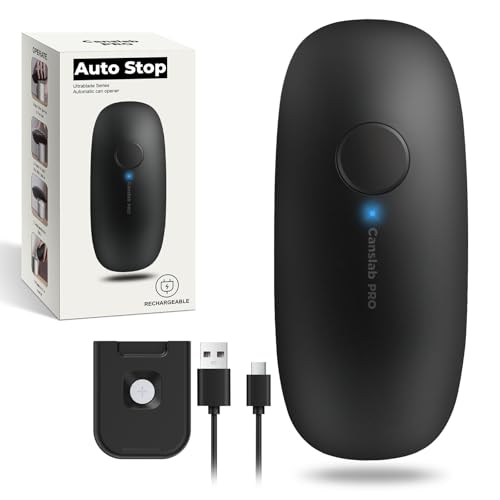
Canslab Ultrablade PRO Electric Can Opener
Badge: Best for Seniors and Arthritis
Strengths
- Handsfree side cut leaves a smooth edge and removes hand force from the job.
- Smart auto stop ends the cycle on its own when the cut completes.
- USB rechargeable and cordless, with a wall-mountable design for storage.
Trade-offs
- Designed around standard cans; unusual sizes are not its stated strength.
- Rechargeable format means charge awareness, as with the Famawo.
- Feature-rich designs have more behavior to learn than a simple lever model.
Mini spec box
- Type: Electric can opener, automatic
- Power: USB rechargeable, cordless
- Cut: Side cut, smooth edge, handsfree
- Control: Smart auto stop
- Storage: Wall mountable
- Color: Black
The Canslab Ultrablade PRO is the most feature-forward model in this roundup, and its features all point the same direction: removing the human hand from the hard parts of the job. It is explicitly built as an automatic opener for seniors with arthritis — handsfree side cutting does the work, the smooth edge removes the sharp rim from the equation, and smart auto stop means you do not have to judge when the cut is done or hold anything while it finishes. Add USB recharging, cordless operation, and a wall-mountable body, and you have the clearest statement of where this category’s design energy is going.
That focus deserves one honest caveat: a specialist tool is a specialist tool. The Canslab is designed around the standard cans of a home pantry, and its listing does not make the tall-can promises the Hamilton Beach makes, so households regularly opening oversized cans should weigh that. There is also a small learning curve — placing a sit-on-top opener, trusting the auto stop, lifting the side-cut lid away — that a lever model does not ask of you. For its intended user, though, those are trivial costs against the benefit: opening a can becomes a button press instead of a grip test. Shoppers whose main concern is reduced hand strength will also want to compare the models gathered in Best Disabled Persons Can Openers, where ease of operation is the primary filter rather than one factor among many.
Best for: Seniors, arthritis, and anyone who wants the most automated cycle available / Not suited for: Oversized-can households or buyers who prefer a permanently plugged-in countertop unit
Comparison Table
| Model | Format | Power | Cut / edge | Lid handling | Link |
|---|---|---|---|---|---|
| bella Electric Can Opener | Countertop | Plug-in electric | Conventional cut | Automatic one-touch cycle | Check on Amazon |
| Famawo Electric Can Opener | Sits on can | USB-C rechargeable | Smooth edge | Magnetic lid hold | Check on Amazon |
| Amazon Basics 3-In-1 | Countertop | Plug-in electric, 50W | Stainless steel blade | Magnetic lid holder | Check on Amazon |
| Cuisinart CCO-50BKN | Countertop | Plug-in electric | Conventional cut | Magnetic lid holder, removable lever | Check on Amazon |
| Hamilton Beach Smooth Touch | Countertop, tall-can body | Plug-in electric | Smooth Touch cut | Push-down lever cycle | Check on Amazon |
| Canslab Ultrablade PRO | Sits on can, wall mountable | USB rechargeable | Side cut, smooth edge | Handsfree with smart auto stop | Check on Amazon |
How to Choose the Right New Can Opener
Start with the cans, not the opener. Take a honest inventory of your pantry: if most of your cans are standard sizes with a few tall tomato or stock cans mixed in, clearance and stability matter, and a countertop model like the Hamilton Beach or Cuisinart will feel effortless. If your cans are mostly standard and your counter is already crowded, a sit-on-top cordless model returns the counter space and stores in a drawer. The second decision is the edge. A conventional top cut separates the lid inside the rim and can leave a sharper edge on the can; a side cut separates at the rim itself and leaves a smooth edge you can run a finger near with far less caution, at the cost of a lid that behaves slightly differently and a mechanism you should keep clean so it keeps tracking the rim accurately.
Third, think about hands — yours, now and in a few years. Every model here is electric because the motor is the accessibility feature: it replaces grip strength and wrist torque with a press. Within that, rank the controls by how they ask for that press. A large push-down lever suits a palm or the heel of a hand. A one-touch button suits a single finger. A handsfree auto-stop cycle suits hands that should not be holding anything steady at all. Fourth, decide your tolerance for charging. Rechargeable models are wonderful until they are empty; if your household opens cans daily and hates maintenance rituals, plug-in countertop models remove that variable entirely, while occasional users will never notice a monthly top-up charge. Readers who know a manual opener is off the table but are unsure between assisted formats will find the hand-focused comparison in Best Quality Heavy Duty Hand Can Openers a useful contrast point for what hand operation actually demands.
Finally, weigh cleanability, because it predicts lifespan better than any other trait. Food spray reaches the cutter area on every design; the question is whether you can reach it back. Removable levers, accessible cutting wheels, and bodies that wipe down without seams trapping residue all extend the years before an opener starts skipping. Novelty should be the tiebreaker, not the foundation: choose the format that fits your cans, hands, and counter first, then let newer features like USB-C charging, auto stop, and magnetic lid holding decide between the finalists. That ordering is how you end up with an opener that still feels like an upgrade in year three, not just in week one.
How to Use, Clean, and Troubleshoot a Modern Electric Can Opener
Using a countertop electric opener well is mostly about the first two seconds. Set the can on a flat surface, lift the lever, seat the cutting wheel on the rim so the can hangs or stands squarely as the design intends, then press and let the machine take the strain — do not push the can around the turn or lift it mid-cycle. With a sit-on-top cordless model, center the unit on the lid, start the cycle, and keep a light hand nearby without gripping; the opener walks the rim itself, and holding it tightly actually fights the mechanism. When the cut completes, lift the lid away with the magnet or by its edge, and check the rim once with your eyes before reaching in with a spoon.
Cleaning is where these appliances are won or lost. Wipe the cutter area after messy cans — tomato and tuna residue are the usual culprits — and wash removable parts like the Cuisinart’s activation lever as the maker directs. Never immerse a countertop or rechargeable body in water; a damp cloth and an old toothbrush around the wheel do the work. Dry the cutting wheel before storage so it does not spot with rust, and for rechargeable models, top the charge up when the motor starts sounding lazy rather than running the battery flat and forgetting it in a drawer.
Troubleshooting follows a short pattern. Problem: the opener skips or stalls partway around → check for a dented rim, reseat the can squarely, and clean dried food off the cutting wheel before trying again. Problem: the lid falls into the food → the magnet or lid holder was not engaged, usually because the can was lifted or tilted at the end of the cut; keep the can level until you lift the lid clear. Problem: a cordless model stops mid-can → the charge is low; recharge fully, and note that forcing a sit-on-top unit around by hand can damage the very gears you bought it for. If a plug-in model hums without turning, unplug it, inspect the wheel for a trapped metal sliver, and clear it with a brush — never with a fingertip.
What “New” Actually Changed: Side Cuts, Auto Stop, and USB-C
It is worth being precise about the three changes that genuinely separate current designs from the openers of twenty years ago, because marketing blurs them together. The side cut is a mechanical change: instead of slicing the lid inside the rim, the wheel splits the seam at the rim, so the lid lifts off whole and the can’s edge is the rolled rim rather than a cut sheet edge. That is why smooth-edge models feel safer around children and why the lids can sometimes be rested back on the can as a temporary cover. Auto stop is an electronic change: the opener senses or times the completed revolution and ends the cycle itself, which removes the overrun that used to chew rims when a user held the lever too long. USB-C recharging is an ecosystem change: the opener joins the same charging world as your phone, so the cable is never the reason the tool dies.
None of these changes makes an opener cut “better” in the simple sense — a sharp wheel on a true rim has always cut well. What they change is everything around the cut: safety, effort, storage, and forgiveness for imperfect cans and imperfect hands. That is also why older countertop designs remain competitive. Their cutting is the same mature mechanism; they simply ask a little more of the user at the margins. When you read any roundup in this category, including this one, translate every “new” claim into which margin it improves, and the right choice for your kitchen usually becomes obvious. If cordless freedom is the margin you care about most, the dedicated roundup at Best Cordless Can Openers compares that format on its own terms.
Countertop or Cordless: Placing the Opener in a Real Kitchen
The format decision deserves its own moment because it is the one you will live with daily. A countertop opener is infrastructure: always plugged in, always in the same place, ready in one second, and stable enough for tall cans. Its cost is a permanent patch of counter and a cord to manage. A cordless sit-on-top opener is a tool: it lives in a drawer, comes out for the job, and leaves no trace, but it asks you to manage a battery and to give the can a stable surface while the unit walks the rim. Renters and small kitchens tend to love the tool; busy family kitchens tend to love the infrastructure. Households that cook for someone with limited mobility often end up with the countertop model at the main prep area regardless of size, because predictability beats cleverness when the user is tired or sore.
There is also a hybrid worth considering within this list: the Canslab’s wall-mountable design tries to give cordless storage a fixed home, so the opener is findable and chargeable in one spot without owning counter space. Whichever format you choose, place it near where cans are actually opened — over the trash or beside the prep sink — because the best opener is the one that is already where the dripping lid needs to go.
Safety and Storage Habits That Make a New Opener Last
A can opener is one of the few kitchen tools that routinely produces a piece of sharp metal waste, so the habits around it matter as much as the model you buy. Build a simple routine: open the can over the counter where you will set the lid down, never over the pot the contents are heading into, and move the separated lid straight to the trash or recycling with the magnet, a fork, or a folded paper towel rather than your fingertips. If children help in the kitchen, smooth-edge side-cut models lower the stakes of that routine considerably, because the lid and the can rim are both missing the razor edge a top cut leaves. Even then, treat the removed lid as the sharpest object in the room until it is in the bin, and press it down inside the trash rather than leaving it balanced on top where the next person to push rubbish down will meet it.
Storage shapes lifespan, too. Countertop models should live far enough from the stove that cooking grease does not film over the cutting wheel — airborne grease plus canned-food residue is the mixture that eventually makes wheels skip. Cordless models belong in a dry drawer, ideally in the same spot every time, with their charging cable kept in that drawer rather than migrating around the house; a rechargeable tool you can find, with its cable, at a known charge level, is a tool that gets used. Wall mounting, as the Canslab offers, solves the findability problem even more directly if you have a suitable patch of wall near the prep area. Whatever the format, store the opener dry: putting a sit-on-top unit away with a damp wheel is how small rust spots start, and a spotted wheel is a skipping wheel waiting for its moment.
One more habit separates owners who love these appliances for years from owners who replace them annually: open the occasional problem can by hand position, not by force. Dented rims, rimmed cans with heavy seams, and cans that have been dropped all challenge the tracking of any electric opener. Slow down, seat the can deliberately, and if the wheel will not track after two honest attempts, switch to a backup manual opener for that one can instead of leaning on the electric model until something bends. The newest openers are better engineered than their ancestors, but they are still small geared machines, and treating the rare bad can as a special case is the cheapest maintenance you will ever do.
Common Buying Mistakes
The most common mistake is buying novelty in the wrong order: choosing the newest format before checking it against your cans, then discovering your tall stock cans wobble under a compact sit-on-top unit. The second is ignoring the lid. Buyers compare cutting and forget that every opened can produces a loose, sharp-edged lid that has to go somewhere; magnetic holding and smooth edges are not garnish, they are the safety system. Third, shoppers overlook cleanability and then blame the motor a year later when a gummed-up wheel starts skipping. Fourth, rechargeable models get bought for daily heavy use in households that know they will never remember to charge them — be honest about your habits. Finally, do not buy a multi-tool for functions you will not use, and do not reject a mature design like the Cuisinart or Hamilton Beach purely for its age; in this category, age often means the failure modes have already been engineered out.
Final Recommendation
For most kitchens, start with the bella Electric Can Opener: it captures the modern one-touch countertop experience in its simplest form. If your priorities are a smooth edge, drawer storage, and the least hand involvement possible, choose the Canslab Ultrablade PRO instead, with the Famawo as its close cordless alternative. Households built around tall cans should go straight to the Hamilton Beach Smooth Touch, value shoppers to the Amazon Basics 3-In-1, and anyone who wants the most proven mechanism on the counter to the Cuisinart CCO-50BKN. Every one of the six removes the crank from your life; the differences are about your cans, your counter, and your hands — in that order.
One last piece of advice applies to whichever of the six you choose: spend the first week paying attention to the two moments this guide kept returning to — how the can seats at the start of the cut, and how the lid leaves at the end of it. Those two moments are where every model in this category either earns trust or loses it, and each design here handles them slightly differently. Once your hands have learned your opener’s particular routine, the appliance disappears into the background of cooking, which is precisely what a good can opener is supposed to do.
Frequently Asked Questions
Are newer can openers actually better than older countertop models?
They are better at specific things: smooth edges, cordless storage, automatic stopping, and reduced hand effort. The core cutting mechanism is mature in both generations, which is why proven countertop models like the Cuisinart and Hamilton Beach still earn places in a current roundup. Choose by which improvements match your needs, not by release order.
What is the difference between a side cut and a top cut?
A top cut slices the lid just inside the rim, leaving the cut edge on the can. A side cut splits the seam at the rim itself, so the lid lifts away whole and the can keeps its rolled, smooth edge. Side-cut lids can often rest back on the can as a loose cover, while top-cut lids drop neatly into the can if you are not careful.
How long do rechargeable can openers hold a charge?
It varies by model and by how many cans you open, and listings differ in what they promise, so check the specific product page for the model you choose. The practical habit matters more than the number: recharge when the motor first sounds slower, keep the cable with the opener, and a cordless model will be ready whenever an occasional-use kitchen needs it.
Can an electric opener handle pop-top cans?
Yes, and some are designed with them in mind — the Hamilton Beach in this list explicitly covers pop-top cans, which is useful when a pull ring snaps off and leaves you with a sealed can. Seat the can carefully, since a damaged rim gives the wheel less to grip, and let the machine complete its cycle without tilting the can.
How do I stop lids falling into the food?
Use the lid handling the design provides: keep the can level at the end of the cut and lift the lid away with the magnetic holder rather than shaking it free. Side-cut models reduce the problem further because the lid separates at the rim and lifts off whole instead of dropping inward.
Do I still need a manual can opener as a backup?
A simple manual opener in a drawer is cheap insurance for power outages and for the one oddly shaped can an electric model refuses. It does not need to be your daily tool — and if hand strength is the reason you bought an electric model, treat the manual backup as an emergency option for someone else in the household to use, not as your own fallback.