Disclosure: topratedkitchenware.com is reader-supported. When you buy through links on our site, we may earn an affiliate commission from Amazon and other retailers, at no extra cost to you.
Where to buy
All six of the best vacuum sealers CNET readers ask about are sold through Amazon, where you can verify every claim in this guide against the live listing in one click — which is exactly the habit this article recommends. Our top recommendation is the UPRUBE Vacuum Sealer, 95kPa, 9-in-1 with Digital Timer — Check on Amazon — and here is the full shortlist:
- ROUUO Vacuum Sealer, 95kpa with Pulse Mode and Drip Tray
- Bonsenkitchen Vacuum Sealer Machine, Silver
- Chef Preserve Compact Vacuum Sealer with 30 Reusable Bags
- VACLER Vacuum Sealer Machine, 6-in-1 Smart Modes
- FoodSaver Mini Handheld Vacuum Sealer, Cordless
Read the full guide ↓ for how we translated tech-review testing logic into kitchen reality — and for the questions a lab score cannot answer about your household.
Anyone searching for the best vacuum sealers cnet has covered is really asking a two-part question: which machines do the big tech reviewers rate, and should their rating decide my purchase? Tech outlets test vacuum sealers the way they test everything — standardized foods, repeated trials, timed cycles, seals checked after storage — and that discipline is genuinely valuable. It catches weak vacuums, inconsistent seals, and machines that fade across a session. But a lab ranking compresses a machine into a score, and your kitchen is not a lab: your foods are wetter or more delicate, your sessions are longer or shorter, your counter is smaller, and your tolerance for fiddly controls is entirely your own. This guide to the best vacuum sealers cnet-style shoppers should consider takes the lab mindset seriously — verified specifications, stated figures only, no invented claims — and then re-ranks six verified machines by the criteria a score cannot capture.
A transparency note before the picks: we do not reproduce any outlet’s scores here, and we do not claim any of these machines won a specific test. What we can do — and did — is verify each machine against its current listing data, compare the stated specifications honestly, and explain which design choices tend to survive standardized testing and daily use alike. Readers who like comparing methodologies will also enjoy Best Vacuum Sealers Consumer Reports, where the testing philosophy is similar but the weighting leans harder toward long-term reliability and cost of ownership.
Key Takeaways
- Lab testing is excellent at exposing weak vacuum strength and inconsistent seals — the two failures that matter most — so take its methods seriously and its single-number scores lightly.
- Stated figures you can verify beat adjectives: in this list, the UPRUBE and ROUUO both state 95kPa-class vacuum, and the UPRUBE adds a stated 12L/min draw speed.
- The UPRUBE is our top pick: the most complete stated specification in the guide — dry, moist, and pulse modes, digital timer, cutter and bag storage, a 10 ft roll included.
- Pulse mode is the feature lab tests undervalue and delicate-food cooks overvalue correctly: it decides results on fish, berries, and baked goods.
- Handhelds score poorly on bulk tests and brilliantly in real small kitchens; two picks here serve that reality instead of apologizing for it.
- Whatever a roundup says, confirm the current listing before buying — models are revised, bundles change, and the listing is the only specification that ships.
- The two-step method in this guide — clear the lab floor on verified facts, then re-rank by your own kitchen — transfers to every appliance category you will ever research, and it is the difference between reading reviews and being read by them.
In this guide
Quick Picks
| Pick | Badge | Standout detail from the listing | Link |
|---|---|---|---|
| ROUUO Vacuum Sealer 95kpa | Best for Power Users | 95kpa, 230W, pulse mode, removable drip tray, built-in bag storage and cutter, 3 rolls and 10 bags | Check on Amazon |
| Bonsenkitchen Vacuum Sealer | Best Value | Multiple modes, external vacuum system, compact silver body, 5 bags included | Check on Amazon |
| UPRUBE Vacuum Sealer 95kPa | Best Overall | 9-in-1, 12L/min, 135W, digital timer, dry/moist/pulse modes, cutter and bag storage, 10 ft roll | Check on Amazon |
| Chef Preserve Compact | Best Handheld System | Handheld portable sealer with 30 reusable vacuum bags included | Check on Amazon |
| VACLER Vacuum Sealer | Most Versatile | 6-in-1 smart modes including Rice, Wet and Dry; bag cutter; 20 bags and vacuum hose included | Check on Amazon |
| FoodSaver Mini Handheld | Best for Small Daily Jobs | Cordless handheld with marinate setting and charging dock | Check on Amazon |
How These Picks Were Chosen
This guide is research-led and proud of it, because for this keyword the research discipline is the point. Every machine below was verified against its current listing data: exact product name, stated vacuum or power figures where given, named modes, and box contents. Where a listing states a number — 95kPa, 230W, 12L/min, 135W — we print it and attribute it to the listing. Where a listing is silent, we say nothing and invent nothing. That standard, applied strictly, already eliminates a surprising share of the noise in this category, where marketing adjectives routinely impersonate specifications.
We then ranked with a hybrid scorecard: half lab logic (vacuum strength, mode coverage for wet and dry work, seal-session endurance features like drip trays and bag storage), half kitchen logic (footprint, control style, consumable system, included starter supplies). The result deliberately includes two handhelds in a six-machine list — a choice a pure lab ranking would rarely make — because the most common real-world outcome for an over-bought countertop machine is disuse, and a guide that ignores that outcome is optimizing for the test bench, not the reader. Use-case guides on this site take the same hybrid approach further: Best Vacuum Sealers For Fish ranks almost entirely on wet, delicate performance, while Best Vacuum Sealers For Europe Sous Vide starts from the electrical and travel questions a lab never asks.
One more methodological honesty note: vacuum figures across brands are not measured under one universal standard, so treat stated numbers as comparable within a listing’s own claims and as rough guides across brands. The differences that reliably matter — pulse or no pulse, moist mode or not, tray or no tray — are design facts, and those are what this ranking is built on.
The 6 Best Vacuum Sealers CNET-Style Shoppers Should Verify

ROUUO Vacuum Sealer 95kpa with Pulse Mode
Badge: Best for Power Users
Strengths
- The strongest stated power figure in this guide, 230W, paired with a 95kpa vacuum rating.
- Pulse mode for operator-controlled stops — the feature that protects delicate and wet foods.
- Removable drip tray, built-in bag storage and cutter, and the joint-largest starter kit here: 3 rolls and 10 bags.
Trade-offs
- Manual control means the operator is part of the system; careless pulsing under-vacuums bags.
- Over-specified for households sealing a few bags a month.
- Younger accessory ecosystem than the legacy brands.
Mini spec box
- Type: external countertop vacuum sealer
- Vacuum: 95kpa (as stated in listing)
- Power: 230W (as stated in listing)
- Modes: dry/moist, pulse mode
- Features: built-in bag storage and cutter, removable drip tray
- Included: 3 bag rolls and 10 bags
In lab terms, the ROUUO is the machine with the most testable claims, and it makes them where they count. A strong vacuum shows up in testing as tight, flat bags and seals formed over smooth film; the ROUUO’s stated 95kpa pull is built for exactly that. Session testing is where the removable drip tray earns its keep: run twenty bags of marinated product through a tray-less machine and the later seals are formed in an increasingly contaminated channel, a degradation a good test protocol catches and a spec sheet never mentions. The ROUUO is designed against that failure mode, and its included rolls and bags mean the out-of-box testing a careful buyer does at home starts on proper film.
In kitchen terms, the pulse mode is the headline. Standardized tests seal standardized foods, but your food is not standardized: the tray of soft fish, the berries, the frosted cake slices. Pulse control converts those from gamble to routine, because you — watching the actual food — decide the stopping point. The cost is engagement; this is the least set-and-forget machine in the guide. Power users, bulk processors, and anyone whose sealing skews wet and delicate will find that trade heavily in their favor. Everyone else should honestly ask whether they will use the control they are paying for.
Best for: bulk and wet-food sealing, delicate items, engaged operators / Not suited for: one-touch minimalists and very light users
Bonsenkitchen Vacuum Sealer Machine
Badge: Best Value
Strengths
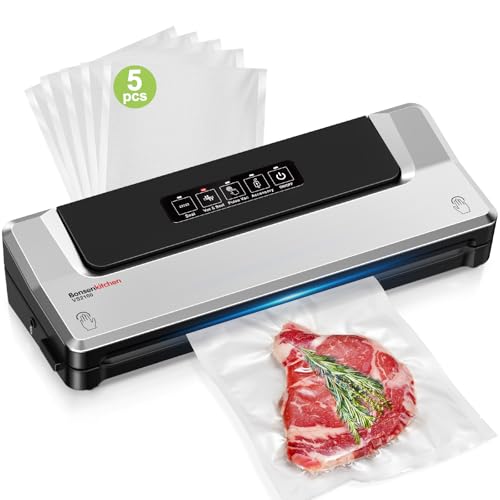
- A genuine countertop heat sealer — external vacuum system, multiple modes — at the value end of this list.
- Compact silver body suits small counters and modern kitchens.
- Positioned for meal prep and sous-vide as well as storage, covering the three main home jobs.
Trade-offs
- Modes are described generally in the listing rather than itemized, so verify the current listing’s mode list before buying.
- Only 5 bags included — the smallest starter supply here.
- No stated vacuum or power figures to compare against the leaders.
Mini spec box
- Type: external vacuum system, compact countertop
- Modes: multiple modes for meal prep
- Finish: silver
- Included: 5 vacuum bags
- Uses: kitchen food storage and sous-vide
The Bonsenkitchen is the control group of this guide — the machine that shows what the category’s value tier actually delivers, and the honest answer is: the essentials, without the instrumentation. It vacuum-seals with an external system, offers multiple modes for meal prep, and handles storage and sous-vide work in a compact body. For a household whose sealing is portioning Sunday’s prep and freezing the occasional bargain, that is not a stripped-down experience; it is the whole experience, at a friendlier tier.
Where a test-driven buyer should pause is verification. The listing speaks in general terms — multiple modes, longer freshness — rather than the itemized specifications the UPRUBE and ROUUO provide. That does not make the machine worse; it makes the buyer’s homework more important. Check the current listing for the exact mode list and what film it uses, budget for rolls immediately since only five bags are included, and lean on technique — headspace, dry seal zones, pre-frozen wet items — to carry the jobs a pulse mode would automate elsewhere. Judged as a value proposition rather than a specification sheet, it earns its place.
Best for: budget buyers, meal preppers, small kitchens wanting a real heat sealer / Not suited for: spec-driven buyers or heavy bulk sessions

UPRUBE Vacuum Sealer, 95kPa, 9-in-1
Badge: Best Overall
Strengths
- The most completely stated specification here: 95kPa vacuum, 12L/min draw speed, 135W power.
- Dry, moist, and pulse modes — the full control trio in one machine.
- Digital timer for repeatable cycles, plus cutter, bag storage, and a 10 ft roll included.
Trade-offs
- Nine functions mean a learning curve before operation feels effortless.
- Stated power is below the ROUUO’s, though vacuum ratings match.
- Feature depth is wasted on households that only seal dry goods.
Mini spec box
- Type: external countertop vacuum sealer
- Vacuum: 95kPa (as stated in listing)
- Speed: 12L/min (as stated in listing)
- Power: 135W (as stated in listing)
- Modes: dry / moist / pulse, 9-in-1 functions
- Features: digital timer, easy-tear cutter, bag storage
- Included: 10 ft bag roll
The UPRUBE tops this guide because it is the machine a test lab and a home cook can agree on. The lab side gets numbers — and not just a vacuum figure, but a draw speed, the specification that translates directly into session time and into how quickly a bag’s air is gone before liquid can migrate. The cook side gets the mode trio that covers the real range of kitchen work: dry for the pantry, moist for the marinated and juicy, pulse for everything fragile. And both sides get the digital timer, an underrated feature that turns a good cycle into a repeatable cycle — the difference between a machine that performed well once and a process that performs well every week.
The workstation details hold up the same way. Cutter and bag storage at the machine, a full roll in the box: the UPRUBE arrives as a system rather than a device awaiting accessories. Its compromises are real but mild — a stated power figure below the ROUUO’s (with equal vacuum, a reminder that watts are not the whole story), and a function count that asks the owner to spend one session learning the controls. For the reader this keyword attracts — someone who reads reviews, compares specifications, and wants the considered choice — that learning session is not a cost. It is the hobby. The gentle end of its range is also why it anchors our thinking on crushable foods in Best Vacuum Sealers For Energyball.
Best for: specification-minded buyers, mixed heavy and delicate work, repeatable weekly processes / Not suited for: buyers who want a single button and nothing else

Chef Preserve Compact Vacuum Sealer
Badge: Best Handheld System
Strengths
- Thirty reusable bags included — the most generous and most economical consumable system in the guide.
- Handheld and portable: no counter footprint, travels anywhere, works in drawers and small kitchens.
- Resealable system matches how food is actually used — open, take some, vacuum again.
Trade-offs
- No heat seal and no roll compatibility; it lives entirely in its reusable valve-bag format.
- Not a bulk-session tool.
- For the very longest freezer storage, a welded heat seal remains the reference standard.
Mini spec box
- Type: handheld vacuum sealer
- Included: 30 reusable vacuum bags
- Format: compact, portable
Every lab ranking of vacuum sealers has a blind spot shaped exactly like this machine. Test it on bulk throughput and it finishes last; test it on the life of a small household and it wins going away. The Chef Preserve’s system — a handheld unit drawing air from reusable valve bags — eliminates the two frictions that kill sealing habits: hauling out a countertop machine for a wedge of cheese, and spending a fresh bag every time a package is opened. Thirty reusable bags in the box means the system is complete on arrival, and the bags’ reusability makes the running cost the lowest in this guide by a wide margin.
The honest boundaries are structural. There is no heat weld here, so the absolute longest freezer storage still belongs to the countertop machines, and there is no roll to cut when an oversized item appears. But notice how much of a real kitchen’s sealing lives inside this machine’s kingdom: deli meat, cheese, produce, leftovers, portioned snacks, tonight’s marinade. A test score cannot see that kingdom. Your kitchen can — and if it is most of your sealing life, this “last-place lab finisher” is your first-place machine.
Best for: small households, frequent small jobs, reusable-bag economy, travel and second kitchens / Not suited for: bulk processing or roll-bag users

VACLER Vacuum Sealer Machine, 6-in-1 Smart Modes
Badge: Most Versatile
Strengths
- Six smart modes with named settings for Rice, Wet, and Dry — the broadest named mode coverage in the guide.
- Twenty bags and a vacuum hose included: bags and accessory-container work from day one.
- Automatic compact design keeps operation simple while covering many food types.
Trade-offs
- Smart modes are programs, not manual control — no pulse-style feathering for the most delicate items.
- Compact body gives less working room than full-size stations.
- Mode names need a little translation to your own foods at first.
Mini spec box
- Type: external countertop vacuum sealer
- Modes: 6-in-1 smart modes (Rice, Wet, Dry named in listing)
- Included: bag cutter, 20 bags, vacuum hose
- Operation: automatic
The VACLER is what happens when a designer reads the lab results and asks a different question: not “how strong is the vacuum” but “how many distinct foods can one machine handle without the user thinking?” Six smart modes is the answer it ships. The named modes are instructive — Rice for the dry-staple work that fills pantries, Wet for the saucy and marinated jobs that break naive sealers, Dry for the standard run — and the automatic operation means the machine, not a tired cook at bag twenty, keeps the cycles consistent. Consistency across a session is precisely what repeated-trial testing rewards, and the VACLER is built to be consistent.
The included vacuum hose widens the test the machine can pass: with compatible containers, it handles the jar-and-canister work that bag-only machines fail entirely, and twenty included bags is a starter supply with real depth. Its ceiling is control — when a food is so delicate that only a human watching it can call the stop, a program, however smart, is guessing. For the broad middle of home sealing, though, the VACLER’s bet on modes over manual control is well placed, and households that seal a little of everything will feel the benefit weekly. The same mode logic is what our delicate-food guide leans on in Best Vacuum Sealers For Baked Foods, where choosing the gentle program is most of the craft.
Best for: mixed households sealing pantry, fridge, and freezer foods with minimal fuss / Not suited for: manual-control enthusiasts
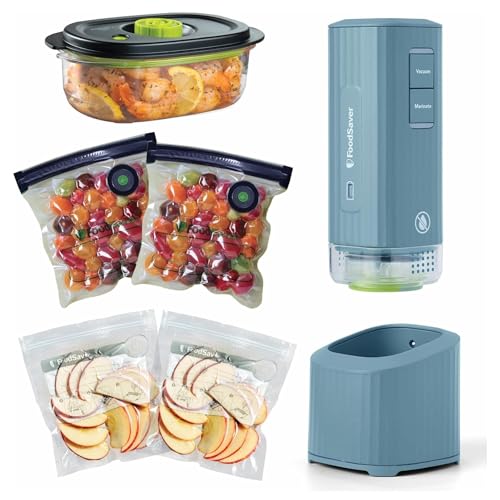
FoodSaver Mini Handheld Vacuum Sealer
Badge: Best for Small Daily Jobs
Strengths
- Cordless with a charging dock — the lowest-friction sealing in the guide; it lives where the food is.
- Marinate setting turns a passive hour into an active, vacuum-assisted process.
- Backed by the category’s benchmark brand, in a blue handheld format for freezer, storage, sous vide, and meal prep.
Trade-offs
- Reusable valve bags only — no heat sealing, no rolls.
- Not a bulk tool; long sessions belong to countertop machines.
- Per-bag cost of the reusable format exceeds roll film, offset by reuse.
Mini spec box
- Type: handheld vacuum sealer
- Power: cordless, rechargeable, with charging dock
- Special feature: marinate setting
- Color: blue
If the Chef Preserve is the handheld as a system, the FoodSaver Mini is the handheld as an appliance — from the brand that defined the category, with the polish that implies. The charging dock is the detail that matters: the Mini is always charged, always in its place, always a ten-second answer to “this cheese should be sealed.” Cordless operation means it works at the fridge door, the counter, or the table where the groceries are being unpacked, and that mobility is a feature no countertop machine can patch in later.
The marinate setting gives it a second identity. Vacuum-assisted marinating is one of the few sealer functions that changes dinner tonight rather than storage next month, and having it in a grab-and-go handheld makes it a weeknight tool instead of a weekend project. Its limits are the handheld limits — a closed bag format, no welded seals, no bulk sessions — stated plainly so the right buyer finds it: the cook whose sealing life is small, frequent, and daily. In a lab that would be a footnote. In a kitchen, it is most of the story, which is rather the point of this entire guide.
Best for: daily small jobs, marinating, small kitchens, FoodSaver loyalists / Not suited for: bulk freezer packing
Comparison Table
| Pick | Type | Stated figures / key features | Included extras | Link |
|---|---|---|---|---|
| ROUUO | External countertop | 95kpa, 230W, pulse, drip tray, bag storage + cutter | 3 rolls & 10 bags | Check on Amazon |
| Bonsenkitchen | External countertop, compact | Multiple modes, external vacuum system | 5 bags | Check on Amazon |
| UPRUBE | External countertop | 95kPa, 12L/min, 135W, 9-in-1, digital timer, dry/moist/pulse | 10 ft roll | Check on Amazon |
| Chef Preserve | Handheld | Portable, reusable valve bags | 30 reusable bags | Check on Amazon |
| VACLER | External countertop | 6-in-1 smart modes (Rice, Wet, Dry), bag cutter | 20 bags, vacuum hose | Check on Amazon |
| FoodSaver Mini | Handheld, cordless | Marinate setting, charging dock | Reusable-bag system | Check on Amazon |
How to Choose Using Test Logic — Without Being Ruled by It
Steal the lab’s criteria, not its conclusion. Good testing asks: How strong and consistent is the vacuum? Do seals survive storage? Does performance fade across a session? Does the machine handle wet food? Ask those same questions of your own shortlist, then weight the answers by your kitchen. A household sealing mostly dry goods can demote the wet-food criterion that a lab weights heavily; a fish household should promote it above everything.
Demand stated specifications. The healthiest habit a review reader can build is preferring numbers and named features over adjectives. In this guide, two machines state 95kPa-class vacuum and one states its draw speed and power alongside; others compete on design and brand instead. Neither approach is automatically right — but only one of them can be checked, and checkable claims deserve the benefit of the doubt.
Price the system, not the machine. Testing rarely dwells on consumables, yet ownership cost lives there: rolls versus pre-cut bags versus reusable systems, and how much film the box includes. The Chef Preserve’s thirty reusable bags and the ROUUO’s rolls-plus-bags bundle change first-year cost more than most spec differences change performance.
Score the starter kit as part of the product. Reviewers unbox what you unbox, and the difference between a machine that arrives with a full roll, a cutter’s worth of bags, and a hose — and one that arrives nearly bare — is the difference between a first week of learning and a first week of waiting for a second order. In this guide the ROUUO and VACLER ship the deepest kits among the countertop machines and the Chef Preserve ships the deepest handheld kit; count that depth as a feature, because your first twenty seals are where habits — good or bad — are formed.
Match the control style to the cook. Pulse and timers reward engaged cooks; smart modes and one-touch cycles reward busy ones. A lab cannot measure your patience. Be honest about it, because the best-tested machine you stop using loses to the adequate machine you reach for daily — the oldest result in all of consumer research, and the one no score reports.
How to Run Your Own Kitchen Test, Step by Step
- Seal the same food three ways. In your first week, seal identical portions of a dry good, a plain protein, and something wet or delicate. You are building your own baseline for what each mode does.
- Inspect every seal. Look for an even band with no channels, then tug gently. Note which mode produced which result — on the bag, in marker.
- Run a mini session. Seal ten bags back to back and compare the tenth seal with the first. Any fade tells you your machine’s comfortable pace.
- Freeze and check. After a week in the freezer, examine the bags: vacuum held, no frost creeping in, no puffed packages. That is the only storage test that matters.
- Test the awkward job. Deliberately try the food you most feared — the marinated, the crumbly, the sharp-boned — using the techniques in this guide. A machine that passes your worst job has passed your test.
Troubleshooting. Problem: seals pass fresh but fail frozen → suspect a channel across the seal or a pinhole; double-seal and pad sharp edges. Problem: wet food floods the channel → pre-freeze until firm, switch to moist or pulse, add headspace. Problem: results vary bag to bag → your seating or pace is drifting; slow down, flatten each bag mouth, and let the machine finish each cycle fully before opening.
What Lab Testing Cannot Tell You
Testing standardizes food, and your food refuses to standardize. It cannot know that your household seals mostly leftovers in ones and twos, that your freezer is a chest in the garage, that your counter fits exactly one appliance and a cutting board, or that the person sealing is a teenager learning to cook. It cannot price your time, your storage, or your patience for cleaning a drip channel. None of that makes testing useless — it makes it incomplete, a floor rather than a verdict. The machines in this guide were chosen to clear that floor on verifiable grounds, and then ranked by the second, un-testable half of the decision. Readers who apply the same two-step logic to any roundup — including the ones behind Best Vacuum Sealers For Clothes and other niche uses — will buy well no matter whose scores they start from.
Inside a Standardized Test: What Reviewers Actually Do
Understanding the method helps you discount the score intelligently. A typical serious test seals the same foods across every machine — a dry good, a plain protein, something wet, something delicate — and repeats each trial so luck averages out. Bags are checked immediately for seal quality and vacuum tightness, then stored and checked again later, because a seal that fails on day nine is a failure the first inspection cannot see. Testers time cycles, count failures, and note how performance changes across a session, which is how drip trays, duty cycles, and bag-seating design quietly influence results that get reported as simple rankings. Some outlets also weigh the cost of bags and the availability of the format, and the best ones revisit categories as models are revised.
The method’s strengths are real: repetition exposes inconsistency, and inconsistency is the true enemy in this category — a machine that seals beautifully seven times in ten is worse than a machine that seals well ten times in ten. Its weaknesses are equally structural. Test foods are chosen to be comparable, which means they are chosen to be ordinary; the marinated, the sharp-boned, the oddly shaped — your foods — appear rarely. Sessions are run by professionals whose technique is expert and unhurried, which flatters machines with fiddly seating and punishes none of the sloppiness that fills real kitchens at 7 p.m. And storage checks run on editorial calendars, not on the six-month horizon of a hunting freezer. Read scores as evidence about consistency under controlled conditions — valuable evidence — and then ask the uncontrolled questions yourself.
Reading a Sealer Listing Like a Reviewer
Reviewers develop a reflex you can borrow: translate every sentence of a listing into either a verifiable fact or a decoration, and keep only the facts. “95kPa vacuum” is a fact — checkable, comparable within limits. “Powerful suction” is a decoration. “Pulse mode” is a fact with mechanical consequences you can reason about; “smart technology” is a decoration until the listing names what it does, as the VACLER’s does by naming its Rice, Wet, and Dry modes. Box contents are facts with dollar values: three rolls and ten bags is a different purchase from five bags, even on identical machines. Dimensions and storage style are facts that decide whether the machine lives on your counter. Warranty and brand history are facts about the company standing behind the weld.
Apply the reflex to this guide’s own comparison table and you will see the field sort itself: machines competing on stated numbers (UPRUBE, ROUUO), machines competing on named programs (VACLER), machines competing on system design (the two handhelds), and machines competing on price-to-essentials (Bonsenkitchen). None of those strategies is dishonest — but they answer different questions, and the reviewer’s habit of naming which question a product answers is the single most transferable skill in consumer research. It works on every category you will ever buy, long after this particular sealer decision is a freezer full of well-kept food.
Ownership Over Years: The Test Nobody Runs
Ownership also has a rhythm tests never capture: the machine’s busiest month is not its average month. A sealer loafing through spring is suddenly running the autumn harvest, the holiday bulk shop, and the January soup season back to back. Buy and maintain for the peak, and the average takes care of itself — keep a spare roll before the peak, clean the channel after it, and the machine that a reviewer tested for a week becomes the machine your household trusts for years.
The longest test is the one you conduct involuntarily: years of ownership. Its results are written in gasket condition, in whether the vacuum channel still cleans easily, in whether bags for your machine are still sold, and in whether the brand still answers for its products. This is the quiet argument for established names in a category — not that their seals are magically better, but that their consumables and support persist. It is also the argument for simple care: wipe the channel, store the lid unlatched where the design prefers it, keep film dry, and give the seal bar its pauses. A mid-tier machine maintained for a decade will out-seal a flagship neglected for two years, every time, in every kitchen — the least publishable and most reliable finding in this entire article.
A Note on Star Ratings and Review Counts
Shoppers arriving from a search results page often ask why this guide never quotes the rating summaries attached to product listings. The reason is methodological, and it is the same reason careful outlets treat those numbers cautiously: a rating average mixes verified and unverified owners, early and late production runs, correct and incorrect usage, and expectations set by very different prices — and it changes constantly as new reviews arrive. A number that moves cannot anchor a durable buying guide. What can anchor one is the verifiable structure used here: stated specifications, named features, box contents, and design logic that you can check today and re-check on the day you order. Read owner reviews for the stories — the recurring complaint, the clever workaround, the failure that shows up three times — because patterns in stories are data. Just do not let a single averaged digit, frozen at the moment someone screenshotted it, outrank the evidence you can verify with your own eyes.
Common Buying Mistakes
- Buying the top score for a different kitchen. A winner crowned on bulk throughput may be wrong for a reseal-heavy small household.
- Trusting adjectives over listings. If a claim matters, find it in the product’s own stated data — or treat it as unproven.
- Comparing vacuum numbers across brands as absolutes. Measurement methods differ; design facts (pulse, moist mode, tray) compare more honestly.
- Ignoring the consumable system. Rolls, pre-cut, and reusable formats lead to three different ownership experiences at three different running costs.
- Skipping your own first-week test. Ten bags and a marker will teach you more about your machine than another evening of reviews.
- Assuming last year’s model equals this year’s listing. Bundles and revisions change; the current listing is the specification that ships.
When the Score and Your Kitchen Disagree, Trust the Kitchen
Three common disagreements deserve direct answers. First: the top-scoring machine is too big. Believe your tape measure over any ranking — a sealer that does not fit gets returned or exiled, and both outcomes score zero in the only test that counts. Second: the top scorer lacks the one feature your food needs — pulse for your fish, a hose for your canisters, a marinate function for your weeknights. Feature fit beats aggregate score because your sealing is not an average of all sealing. Third: the budget pick’s score trails, but your volume is light. Scores are earned across demands you may never make; a household sealing six bags a month will never reach the session-endurance differences that separate the field in testing. In each case the disciplined move is the same: keep the lab’s criteria, re-weight them honestly, and let the ranking that emerges — even if it crowns a different machine — be the one you buy from. That is not ignoring the experts. It is finishing their work.
One final piece of test logic worth stealing costs nothing: decide your verdict criteria before you look at prices or scores. Write down — actually write down — your three deciding factors from the buying-guide section above, in order. Then read listings and roundups against that list only. Shoppers who fix their criteria first are measurably harder to upsell, because a dazzling specification that is not on the list stays dazzling and irrelevant. It is how professional reviewers keep a category honest across dozens of products, and it scales down to a single purchase perfectly.
Final Recommendation
Buy the UPRUBE 95kPa Vacuum Sealer — Check on Amazon. It is the rare pick that satisfies both halves of this guide: a specification a test lab would respect — stated vacuum, stated speed, the full mode trio, a timer for repeatability — inside a workstation a home cook will actually enjoy, roll included. Choose the ROUUO if your work skews heavier and wetter and you want the strongest stated power with drip management. Choose the VACLER if modes should do the thinking. And if your sealing life is small and daily, let the handhelds win: the Chef Preserve and FoodSaver Mini are what honest testing of a real kitchen looks like.
Frequently Asked Questions
Do tech-review rankings agree with each other?
Broadly on the fundamentals — strong vacuum, consistent seals, wet-food competence — and often not on the single winner, because outlets weight speed, value, and features differently. Treat agreement on criteria as the reliable signal and disagreement on the crown as a reminder to weight the criteria yourself.
What specification matters most in testing?
Seal consistency across repeated trials is the closest thing to a universal predictor, followed by vacuum strength. Both are hard to read off a box, which is why design features that support them — moist modes, pulse control, drip management, flat bag seating — are the practical buyer’s checklist used throughout this guide.
Are stated vacuum numbers comparable between brands?
Only loosely. There is no single enforced measurement standard across the category, so a stated figure tells you a machine’s class and its maker’s confidence more than an exact cross-brand ranking. Compare them within reason, then decide on design facts and your own first-week test.
Why do handhelds rank low in tests but get recommended here?
Because tests measure throughput and absolute seal performance, where handhelds are structurally limited, while households often need speed of access and resealability, where handhelds are structurally superior. A ranking is only wrong when its criteria are not yours — choose the criteria first.
Should I wait for a newer model instead of buying a tested one?
Vacuum sealing is a mature technology; revisions tend to adjust bundles and controls rather than reinvent the weld. A current, verified listing of a well-specified machine beats a rumored successor. Buy for this season’s food, and verify the listing on the day you order.
What is the first thing a reviewer checks on a new sealer?
The seal itself, before any feature tour: one bag, one ordinary food, one full cycle, then a close look at the band and a gentle tug. A clean, even, inseparable weld on the first try does not guarantee a great machine, but a wrinkled or peeling first seal — with correct seating and a dry bag mouth — tells an experienced reviewer the session ahead will be long. You can run the identical check in your first five minutes of ownership.
Do more expensive sealers actually test better?
Up to a point, and the point arrives quickly. Higher tiers buy stated vacuum strength, control features like pulse and timers, session hardware like drip trays and roll storage, and deeper starter kits — all things that show up in testing. Past that point, extra money buys size, automation, and brand ecosystems, which may be worth it for your kitchen but will not keep moving a test score. The value pick in a category is rarely the best-tested machine, and the best-tested machine is rarely the best value; your volume decides which truth applies to you.
How can I verify a review’s claims myself?
Open the product listing and find each claim in the maker’s own stated data — that is the method used to build this guide. Then run the first-week kitchen test described above. Between the listing check and your own ten bags, you will know more about your machine than any single review could tell you.