Disclosure: topratedkitchenware.com is reader-supported. When you buy through links on our site, we may earn an affiliate commission from Amazon and other retailers, at no extra cost to you.
Where to buy
All six picks in this guide to best safe can openers are listed on Amazon, where you can check the latest price on Amazon, confirm the exact variant, and read the current listing details before ordering. Listings and bundles change, so match the full model name on the listing to the pick reviewed below. Orders are placed on Amazon under its normal delivery and returns terms.
- Best Overall for Safety: Hamilton Beach Smooth Touch Electric Can Opener — Check on Amazon
- Canslab Ultrablade PRO Electric Can Opener — Check on Amazon
- KORSKR Electric Can Opener — Check on Amazon
- Cuisinart Deluxe Electric Can Opener (CCO-55, Chrome) — Check on Amazon
- BELLA Electric Can Opener (Oatmilk) — Check on Amazon
- Famawo Electric Can Opener (USB-C Rechargeable) — Check on Amazon
Read the full guide ↓
The best safe can openers share one job: getting a lid off a can without creating a sharp object in the process. That sounds simple, but the traditional top-cut design fails it by design — it manufactures a razor-edged lid and drops it toward the food. This guide ranks six electric openers by how completely they remove that hazard: cut style first, then lid handling, then how much hand strength and attention the operation demands.
Three of the six cut from the side, leaving smooth edges on both lid and can. The others earn their places through one-touch automatic operation and magnetic lid handling, which keep fingers away from the cutting zone even when the cut itself is conventional. The reviews are explicit about which kind of safety each pick actually delivers, so you can match the machine to the risk you care about.
If the opener is for a child learning kitchen independence, an older parent, or simply a household tired of lid cuts, start with the side-cut picks — then check the format and power notes to find the one your kitchen will actually use.
The companion Best Safety Can Openers guide approaches the same shortlist from a household-safety angle.
Key Takeaways
- True lid safety comes from the side-cut (smooth-edge) design — three picks here use it.
- Magnetic lid holders are the second safety layer: the lid never drops into food or needs fishing out.
- One-touch automatic operation keeps hands out of the cutting zone entirely.
- Top-cut picks here are included for their hands-clear operation, and their cut lids still need careful handling.
- For arthritic hands, safety and usability are the same feature: no grip, no squeeze, no sharp edge.
In this guide
Quick Picks
Six picks, six different reasons to buy. Scan the badges for the short answer, then read the detailed reviews for the honest trade-offs — every pick here has at least one.
| Pick | Badge | Standout points | Check it |
|---|---|---|---|
| Hamilton Beach Smooth Touch Electric Can Opener | Best Overall for Safety | Operation: easy push-down lever; Can range: standard, extra-tall and pop-top cans | Check on Amazon |
| Canslab Ultrablade PRO Electric Can Opener | Best for Arthritic Hands | Power: USB rechargeable; Operation: automatic with smart auto stop | Check on Amazon |
| KORSKR Electric Can Opener | Best Budget Safety Pick | Operation: automatic, hands free; Can range: suitable for any size cans (listing) | Check on Amazon |
| Cuisinart Deluxe Electric Can Opener (CCO-55, Chrome) | Best Countertop Safety Pick | Operation: one-touch press and release; Lid handling: magnetic lid holder | Check on Amazon |
| BELLA Electric Can Opener (Oatmilk) | Best One-Touch Pick | Operation: automatic one-touch; Finish: oatmilk | Check on Amazon |
| Famawo Electric Can Opener (USB-C Rechargeable) | Best Rechargeable Safety Pick | Power: USB-C rechargeable; Operation: automatic, one-touch | Check on Amazon |
How These Picks Were Chosen
Safety was assessed as a chain, not a single feature: the cut itself, what happens to the lid in the seconds after the cut, how much force and attention the user must supply, and how the opener behaves when something goes wrong — a dented rim, a fading battery, a lightweight can. A pick could only top this ranking by being safe at every link in that chain.
Listing data was cross-checked against the verified pool, and only stated features are printed in the spec boxes. Where a listing claims a smooth edge, the pick is treated as a side-cut design; where it does not, the review says plainly that the cut is conventional and explains what other safety features the machine offers instead.
This is research-led guidance, not laboratory testing, and it makes no hands-on claims. The judgements reflect the established behaviour of each design type — side-cut versus top-cut, countertop versus handheld — applied to the specific models in the pool.
For the cut style behind the safest picks, see the Best Smooth Edge Can Openers comparison.
The Picks: best safe can openers in detail

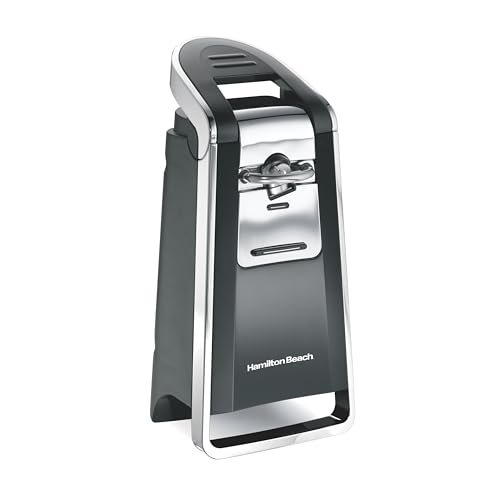
Hamilton Beach Smooth Touch Electric Can Opener
Badge: Best Overall for Safety
Strengths
- Side-cutting action opens the can below the rim, leaving a smooth edge you can run a finger along
- The removed lid comes away clean enough to rest back on the can as a cover
- Push-down lever suits hands that find squeeze-grip manual openers painful
Trade-offs
- Side-cut openers need the wheel seated on the rim bead — the first few cans teach the angle
- Larger body than a handheld battery opener
- Pop-top cans are opened by the same side action, which some users find unnecessary
Key specs (from the verified listing)
- Operation: easy push-down lever
- Can range: standard, extra-tall and pop-top cans
- Cut style: Smooth Touch side-cut design
- Brand: Hamilton Beach
The Smooth Touch is built around the side-cut idea: instead of slicing the lid inside the rim, it cuts through the side wall just below the rim bead, so the top of the can and the lid both end up with smooth, rolled edges rather than a sharp cut one. The lid lifts off whole and can be set back on the can as a temporary cover, which is genuinely handy for pet food and part-used tins. The push-down lever needs far less hand strength than a manual opener, and the body is rated for extra-tall cans as well as standard ones.
There is a small learning curve: the wheel has to sit correctly on the rim before you press, and a mis-seated start can chew the label instead of cutting. Two or three cans in, it becomes automatic. For households where children handle opened cans, or where lids go straight into recycling handled by small hands, that smooth result is the main reason to choose this design.
The Smooth Touch takes the top safety ranking because its side-cut removes the hazard at the source: there is no sharp lid to handle, drop or bin. For a household whose safety worry is the lid itself, this is the most complete answer in the six.
The Smooth Touch rewards one small technique: set the can on a level surface, seat the head so the wheel meets the rim bead, and press the lever down in one confident motion rather than nudging it. From there the machine does the circuit itself. Because the lid separates whole, it can be lifted with the head or a fingertip on its face, and the empty can’s rim is smooth enough to wipe out for recycling without a cloth barrier — a detail pet-food households, who rinse tins constantly, notice within the first week.
Best for: safety-first households that want a smooth edge from a countertop electric / Not suited for: anyone who prefers the traditional top-cut and centre-punch feel

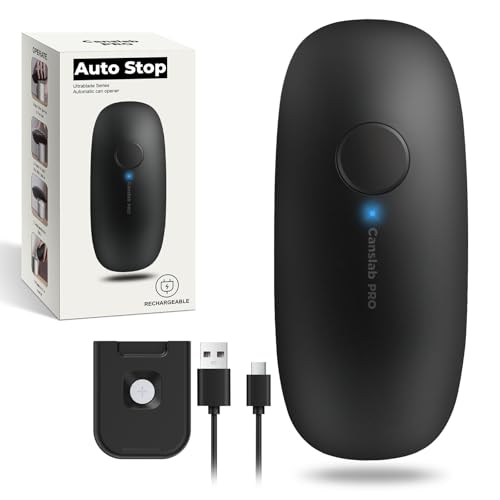
Canslab Ultrablade PRO Electric Can Opener
Badge: Best for Arthritic Hands
Strengths
- Rechargeable handheld — no counter space, no cord, works anywhere in the kitchen
- Smart auto stop ends the cycle when the cut completes, so there is no guessing
- One-button start suits weak or arthritic hands that cannot squeeze a manual opener
Trade-offs
- Battery models need recharging discipline — a flat opener at dinner time is a real failure mode
- Handheld units ride on the can, so very light cans may need steadying
- Smaller brand support network than the legacy countertop names
Key specs (from the verified listing)
- Power: USB rechargeable
- Operation: automatic with smart auto stop
- Format: handheld electric
- Positioning: designed for seniors and arthritic hands (listing)
The Canslab takes the handheld route: a rechargeable unit that sits on top of the can, walks itself around the rim at the press of a button, and stops on its own when the circuit is complete. The smart auto stop is the feature that makes it senior-friendly in practice, not just in marketing — there is no lever to hold, no judgement call about when the cut is done, and no sharp manual wheel to grip. USB charging means it tops up from the same cable ecosystem as everything else in a modern kitchen drawer.
The honest limits are those of any battery handheld: it needs charging before it is flat, not after; it rides on the can rather than clamping to a counter, so an almost-empty lightweight can may need a steadying hand; and it is built for household volumes, not a commercial pass. For one or two cans a day with minimal hand effort, it is one of the easiest formats to live with.
The Canslab’s safety is about the user rather than the lid: auto-stop, one-button operation designed for arthritic hands. A safe opener is one that never demands a grip the user does not have — this is that pick.
Charging is the whole ownership contract here: give it a home — a drawer with the cable, or a counter corner near an outlet — and top it up on a rhythm rather than on a failure. The auto-stop also makes it the most forgiving model here for a distracted cook, because walking away mid-can does not mean a machine still grinding at a finished rim when you return. On very small, light cans, a steadying hand on the can (not the opener) keeps the walk tidy.
Best for: seniors and anyone with reduced grip strength who wants a cordless opener / Not suited for: high-volume households that open many cans back to back

KORSKR Electric Can Opener
Badge: Best Budget Safety Pick
Strengths
- Smooth-edge cut is the headline — lids come away without a sharp rim
- Hands-free automatic travel once started
- Battery format with a black finish that suits modern kitchens
Trade-offs
- Generic-brand support and documentation are thinner than the legacy names
- Battery powered, so the usual charge discipline applies
- Smooth-edge side action needs a clean rim to start reliably
Key specs (from the verified listing)
- Operation: automatic, hands free
- Can range: suitable for any size cans (listing)
- Edge: smooth edge (listing)
- Power: battery powered
- Finish: black
The KORSKR combines the two features most buyers in this category ask for: an automatic hands-free walk around the can, and a smooth-edge result. Its cut separates the lid at the side of the rim, so both the lid and the can top avoid the razor edge a top-cut leaves behind — the difference you feel when you wipe out a can or a child handles the recycling. Battery power keeps it drawer-sized, and the black finish is neutral enough for most kitchens.
The cautions are about the brand rather than the design: documentation, spare-part availability and long-term support from newer labels are less certain than from Cuisinart or Hamilton Beach, so the listing details and the seller’s current terms deserve a careful read before ordering. Functionally, keep the rim clean and the batteries fresh and it does the job it promises — press, walk, lift away a smooth lid.
The KORSKR pairs a stated smooth edge with hands-free travel, which makes it the budget-tier route to the same lid safety as the leader. Its safety case is strong; its brand-support case is the weaker side, as the review notes.
With newer labels, the pre-purchase routine is part of the review: confirm the box contents, the battery type and the seller’s support terms on the current listing, because those details change between production runs more often than with legacy brands. In use, the KORSKR asks for the standard handheld habits — flat surface, clean rim, fresh batteries — and returns a genuinely smooth lid. The black finish hides the splashes that pale openers advertise, which suits a hard-working drawer.
Best for: smooth-edge results in a compact battery handheld / Not suited for: buyers who want a long-established brand’s support network

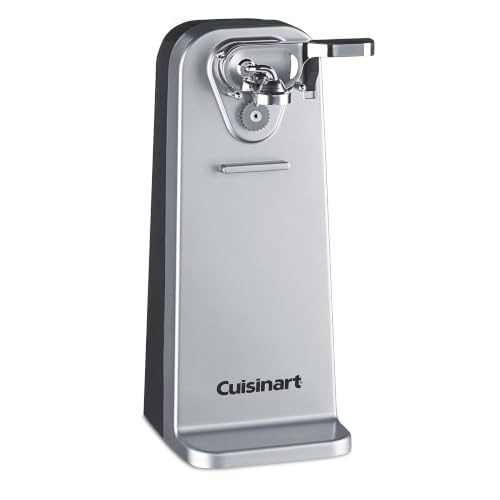
Cuisinart Deluxe Electric Can Opener (CCO-55, Chrome)
Badge: Best Countertop Safety Pick
Strengths
- Press-and-release one-touch cycle is about as simple as countertop opening gets
- Magnetic lid holder lifts the cut lid clear of the food
- Chrome finish suits kitchens where appliances stay on display
Trade-offs
- Top-cut design leaves a conventional cut lid edge, not a smooth rolled one
- Chrome shows fingerprints and splashes more than matte finishes
- Corded and countertop-sized — not a drawer appliance
Key specs (from the verified listing)
- Operation: one-touch press and release
- Lid handling: magnetic lid holder
- Finish: chrome / silver
- Format: countertop electric
- Model: CCO-55
The CCO-55 is Cuisinart’s chrome take on the classic countertop opener: press the lever and the machine takes the can around, release and it stops, with the magnet holding the severed lid so it comes up with the head instead of dropping into the food. It is the kind of appliance that disappears into a routine — which is precisely its appeal for households that open cans every day and do not want to think about it.
Two honest notes. First, this is a top-cut machine, so the lid edge is a cut edge; handle and dispose of it as you would any sharp tin lid, and choose a side-cut model from this list if a smooth edge is your deciding factor. Second, chrome is a display finish: it looks smart on the counter and shows every splash, so it rewards a quick wipe. Neither point undermines it as a durable, simple, mainstream choice.
This Cuisinart’s safety is procedural: one-touch operation and a magnetic lid holder keep hands clear and the lid out of the food. Its cut lid is still a cut lid — handle it as such — but the process around the cut is as safe as top-cut gets.
The CCO-55’s chrome body is best treated like any display appliance: a quick wipe after a splashy can keeps it looking like the listing photo. Mechanically it asks for nothing beyond counter space and an outlet, and its press-and-release cycle is the easiest in this guide to teach a new user — which is why this format persists in family kitchens where several people, of several ages, all open cans. Keep the cutting head wiped and the magnet face clean, and its routine is measured in years.
Best for: display-counter kitchens wanting a proven one-touch countertop opener / Not suited for: smooth-edge purists or drawer-only storage

BELLA Electric Can Opener (Oatmilk)
Badge: Best One-Touch Pick
Strengths
- Automatic one-touch cycle keeps hands away from the cutting action
- Oatmilk finish is a deliberate soft-neutral look few openers offer
- BELLA’s small-appliance styling suits counter-display kitchens
Trade-offs
- Light finishes show tomato and turmeric splashes readily
- One-touch simplicity leaves little manual control for problem rims
- Colour-matched ranges can be harder to replace like-for-like later
Key specs (from the verified listing)
- Operation: automatic one-touch
- Finish: oatmilk
- Format: electric can opener
- Brand: BELLA
BELLA sells small appliances as much on looks as on function, and this opener’s oatmilk finish is the point: a soft, warm neutral that sits comfortably in the pale-wood, matte-ceramic kitchens that stainless and black appliances clash with. Functionally it is an automatic one-touch electric — start the cycle and the machine does the walking and cutting, keeping fingers away from the wheel and the lid.
The practical notes follow from the positioning. A pale finish will show a tomato-sauce splash that a black body hides, so it wants a wipe as part of the routine. And like most one-touch automatics, it is designed for standard, undamaged rims; a badly dented can is a job for patience, not force. If your kitchen is curated and your can volume is ordinary household level, it is a legitimate way to stop hiding the can opener in a cupboard.
BELLA’s one-touch automatic cycle keeps fingers away from the mechanism, which is its safety contribution; pair that with prompt lid disposal and it serves a careful household well, though it does not offer the smooth edge of the side-cut picks.
BELLA’s oatmilk finish is the ownership story: it will show a tomato splash that a black body hides, so this is an opener for cooks who wipe as they go and enjoy how their counter looks. Functionally, the one-touch cycle suits the way most people actually open cans — one or two at a time, mid-recipe, with other things on the stove — and the automatic action keeps hands out of the process at exactly the distracted moment when lid accidents usually happen.
Best for: style-conscious kitchens wanting an automatic opener in a soft neutral / Not suited for: heavy-use households indifferent to finish

Famawo Electric Can Opener (USB-C Rechargeable)
Badge: Best Rechargeable Safety Pick
Strengths
- USB-C charging matches modern cables — no proprietary charger to lose
- Smooth-edge cut plus a magnetic lid hold covers both halves of lid safety
- One-touch automatic operation suits low-grip hands
Trade-offs
- Rechargeable handhelds still need charge discipline for heavy sessions
- Newer label — check current listing terms and support before ordering
- Magnetic hold helps most on standard steel lids
Key specs (from the verified listing)
- Power: USB-C rechargeable
- Operation: automatic, one-touch
- Edge: smooth edge (listing)
- Lid handling: magnetic lid hold
- Format: handheld electric
The Famawo pairs the two safety features this category has converged on — a smooth-edge cut and a magnetic lid hold — with the charging standard buyers now expect: USB-C. That combination makes it a tidy modern handheld: press once, let it walk the rim, and lift away a lid that is both smooth-edged and held by the magnet rather than balanced on your fingertips over the food.
Its limits are the familiar handheld ones. A rechargeable battery is a consumable habit — top it up on a routine rather than discovering it is flat mid-meal — and a newer label means the sensible pre-purchase checks apply: read the current listing carefully, confirm what is in the box, and note the seller’s support terms. For everyday cans in a household that values the smooth result, it is a well-judged package.
The Famawo combines both safety layers — smooth-edge cut and magnetic lid hold — in a rechargeable handheld. On pure safety specification it is the most complete handheld here; the review’s cautions are about charging discipline, not the cut.
USB-C charging sounds like a footnote until you live with the alternative: no proprietary brick to lose, and the same cable that charges a phone revives the opener. Build a monthly top-up into an existing routine — the day you descale the kettle, say — and the battery never becomes the story. The magnetic hold deserves a clean face to grip properly, so add a one-second wipe of the magnet to your post-can habit and the lid lift stays reliable.
Best for: smooth-edge opening with modern USB-C charging / Not suited for: households that open many cans daily and prefer corded certainty
Comparison Table
The table below puts the six best safe can openers picks side by side on the attributes that decide daily satisfaction. It deliberately carries no prices and no ratings — both change too often to print honestly; use the links to check the current listing.
| Pick | Badge | Format | Key detail | Check it |
|---|---|---|---|---|
| Hamilton Beach Smooth Touch Electric Can Opener | Best Overall for Safety | Operation: easy push-down lever | Can range: standard, extra-tall and pop-top cans | Check on Amazon |
| Canslab Ultrablade PRO Electric Can Opener | Best for Arthritic Hands | Power: USB rechargeable | Operation: automatic with smart auto stop | Check on Amazon |
| KORSKR Electric Can Opener | Best Budget Safety Pick | Operation: automatic, hands free | Can range: suitable for any size cans (listing) | Check on Amazon |
| Cuisinart Deluxe Electric Can Opener (CCO-55, Chrome) | Best Countertop Safety Pick | Operation: one-touch press and release | Lid handling: magnetic lid holder | Check on Amazon |
| BELLA Electric Can Opener (Oatmilk) | Best One-Touch Pick | Operation: automatic one-touch | Finish: oatmilk | Check on Amazon |
| Famawo Electric Can Opener (USB-C Rechargeable) | Best Rechargeable Safety Pick | Power: USB-C rechargeable | Operation: automatic, one-touch | Check on Amazon |
How to Choose the Right Option for Best safe can openers
Start with who opens the cans and how their hands are. If grip strength is limited — arthritis, injury, age — the decision is already made: a one-touch automatic that needs no squeeze and no sustained pressure. If hands are strong, the choice opens up, and cut style becomes the deciding factor instead.
Cut style is the second decision. A smooth-edge (side-cut) result means lids that can be lifted, carried and binned without a sharp rim, and can tops smooth enough to wipe out cleanly. A top cut is quicker to learn and works on almost any rim, but leaves a cut edge. Households with children, pets fed from tins, or anyone who has sliced a finger on a lid should weight the smooth edge heavily.
Power source is the third. Corded countertop machines never run flat and suit daily volume; battery and USB-rechargeable handhelds trade that certainty for drawer storage and portability. Be honest about which failure annoys you more — a cord and a footprint, or an opener that needs charging the one night you forgot.
Colour-led shoppers can check which models to verify in the Best Red Electric Can Openers guide.
Opening Cans With Weak or Painful Hands: A Practical Routine
For hands with arthritis or reduced grip, the opener does the work — but the setup still matters. This routine removes the remaining effort points.
- Work at a clear, dry section of counter at comfortable height, with the bin or recycling within reach so a cut lid never has to be carried far.
- Set the can down and let the counter hold its weight; never hold a can in one hand and an opener in the other.
- Position the opener on the rim and check it is seated before pressing anything — a correctly seated start is what makes the rest effortless.
- Press the button or lever once and let the machine travel hands-free; keep hands clear of the rim until the cycle stops on its own.
- Use the magnet or the lid’s face to lift the lid clear, and drop it straight into the bin — no gripping edges, no fishing in the can.
- If a rim is dented and the machine stalls, stop rather than forcing it; a dented can is the one case where asking for help beats struggling.
Troubleshooting
Problem: pressing the start button itself hurts → what to do: use the heel of the hand or a knuckle rather than a fingertip, and choose auto-stop models so the press is a single moment, not a hold
Problem: the opener feels heavy to position → what to do: rest it on the can and slide it into place instead of holding it suspended — the can takes the weight
Problem: cans spin instead of cutting → what to do: the surface is wet or the can is very light — dry the counter and steady the can lightly against a wall or a heavy object
Where Can Opener Injuries Actually Happen
The cut itself is rarely the injury moment. Lids hurt people afterwards: fished out of food with fingertips, swept off counters, pressed down in bins, or pulled from recycling by a child. That is why this guide weights the lid’s edge and the lid’s handling so heavily — they govern the minutes after opening, which is when the sharp object is loose in the kitchen.
Side-cut designs delete the hazard rather than managing it, which is why they lead this ranking. But management still matters for top-cut users: lift the lid by its face with the magnet, drop it straight into a rigid bin, and never press rubbish down by hand on top of it.
The Best Smooth Open Electric Can Openers round-up covers electric side-cut models in depth.
Safe Opening for Children Learning the Kitchen
An electric opener is often a child’s first powered kitchen tool, and the safe progression is: an automatic model, a side-cut if possible, and a supervised routine — can on the counter, hands clear while it travels, lid straight into the bin. The auto-stop handhelds in this guide suit that teaching pattern best, because the child’s whole job is placement and patience.
What to avoid teaching on: a top-cut countertop model with a loose lid, where the final step — lifting a sharp lid — is the hardest part. Build the habit on the forgiving design first; the skill transfers, the scars do not have to.
The Anatomy of a Can: Why Rims Decide Everything
A food can is three pieces of metal folded into one: body, base and lid, joined by rolled seams called beads. Every opener in this guide is really a bead-cutting or lid-cutting tool, and every failure mode in the troubleshooting notes — slipping, chewing, stalling — is a story about that seam: dented, dirty, or met at the wrong angle. Understanding the bead explains the whole category, including why a crushed rim defeats even the best machine.
It also explains the smooth edge. The bead is rolled metal, so cutting through the fold separates along already-rounded surfaces. A top-cut bypasses the bead and slices flat sheet metal instead — strong, quick, and sharp by geometry. When you choose an opener, you are choosing which part of the can’s anatomy to cut, and the edge you live with follows from that single fact.
Openers in Rental Kitchens, Offices and Shared Houses
Shared kitchens change the buying maths. An opener there must be findable (a fixed countertop spot or a bright colour), teachable in one sentence, and forgiving of users who will never read its manual. That is why one-touch automatics dominate workplace kitchens, and why the model a household buys for a single careful cook is often the wrong model for a house-share of five.
Durability also scores differently in shared use: the cutting head gets wiped less, the batteries get changed by nobody in particular, and the lid magnet collects grime. If your kitchen is shared, weight the ownership criterion — brand support, simple cleaning, standard batteries — as heavily as the cut itself, and agree the power routine out loud, because unowned routines are unkept routines.
Top-Cut Versus Side-Cut: What Actually Changes
A top-cut opener drives its wheel inside the rim and slices the lid across the top. It is quick, tolerant of odd rims, and leaves two things behind: a lid with a cut edge, and a can whose rim is usually smooth enough. A side-cut opener drives through the rim bead itself, separating the lid whole, so both lid and can end up with rolled, finger-safe edges.
Neither is universally better. Top-cut suits speed and difficult cans; side-cut suits safety and clean handling. Most households that switch to side-cut do so after one lid cut too many — and most who switch back do so because a favourite oversized can would not seat. Knowing which household you are is the whole decision.
Can Openers and Arthritis: What the Evidence of Use Shows
The barrier in can opening is rarely sharpness or power — it is the sustained squeeze-and-twist a manual opener demands, applied to a small handle, often with wet hands. Electric one-touch designs remove exactly that motion, replacing it with positioning and a single press. That is why occupational therapists so often suggest them: the task becomes about placement, not strength.
When choosing for arthritic hands, look past the motor to the details: a button that can be pressed with a knuckle, an auto-stop so nothing must be held, a body light enough to place without gripping hard, and a lid magnet so the sharp part never needs pinching. The picks in this guide were assessed on those details, not on headline power.
Why Lids Matter: Recycling, Pets and Small Hands
A cut lid is one of the most common minor kitchen injuries, and the risk concentrates in predictable moments: fishing a lid out of food, sweeping a counter, emptying a recycling bin, or a child ‘helping’. Smooth-edge opening does not just feel nicer — it removes the sharp object from all of those moments at once.
Pet feeding deserves a mention too: part-used tins are often covered with their own lid between meals. A smooth-edge lid can be pressed back onto the can as a cover without a sharp rim against fingers or fridge shelves — a small, daily convenience that owners of side-cut openers mention constantly.
Countertop Versus Handheld: Living With the Choice
Countertop openers are infrastructure: always plugged in, always ready, always in the same place — and always visible. They suit households that open cans daily and have the counter to spare. Handhelds are tools: they appear when needed and vanish into a drawer, at the price of batteries or charging and a slightly more deliberate setup per can.
The deciding question is frequency. Daily openers earn a countertop machine its space within a month. Weekly openers usually regret the footprint and prefer the drawer. Be honest about your real can count — most households overestimate it.
Care, Cleaning and Making It Last
Rinse nothing that contains a motor. Handheld openers get a wiped head and a dry storage spot; countertop models get unplugged and wiped. The wheel and the magnet face are the two places residue collects, and thirty seconds with a cloth after a messy can (tomato, tuna, pet food) prevents the built-up grime that eventually makes any opener smell and slip.
Powered models also need a power routine: rechargeables topped up monthly even in quiet periods, battery models given fresh cells at the first sign of slowing. Store the opener where the same hands can always find it — an opener that lives in three different drawers is, in practice, an opener you do not own.
Cross-brand favourites are compared in the Best Tested Can Openers guide.
Common Buying Mistakes
- Assuming ‘electric’ automatically means ‘safe’. the cut style decides the lid edge — a top-cut electric still produces a sharp lid; check for side-cut or smooth-edge in the listing
- Fishing a dropped lid out of food with fingers. use the magnet or a utensil, and choose a model with a lid holder if this keeps happening
- Pressing bin contents down by hand. cut lids hide in rubbish — drop lids into a rigid container and never compress waste by hand
- Letting children learn on a top-cut model. start them on an auto-stop side-cut handheld where the routine is placement, not lid handling
- Ignoring a weakening battery. a handheld stalling mid-rim leaves a half-cut lid — the most awkward sharp object of all; keep power topped up
- Leaving cut lids on the counter ‘for a minute’. the loose lid is the hazard; the safe habit is lid-to-bin in one motion, every time
At a Glance: Who Each Pick Suits
If you have read this far and want the whole guide compressed into one screen, this map matches each pick to the buyer it serves and the buyer it would frustrate. It repeats the verdicts from the detailed reviews in shorthand — use it to confirm a choice, not to skip the trade-offs entirely.
- Best Overall for Safety — Hamilton Beach Smooth Touch Electric Can Opener: best for safety-first households that want a smooth edge from a countertop electric; not suited for anyone who prefers the traditional top-cut and centre-punch feel.
- Best for Arthritic Hands — Canslab Ultrablade PRO Electric Can Opener: best for seniors and anyone with reduced grip strength who wants a cordless opener; not suited for high-volume households that open many cans back to back.
- Best Budget Safety Pick — KORSKR Electric Can Opener: best for smooth-edge results in a compact battery handheld; not suited for buyers who want a long-established brand’s support network.
- Best Countertop Safety Pick — Cuisinart Deluxe Electric Can Opener (CCO-55, Chrome): best for display-counter kitchens wanting a proven one-touch countertop opener; not suited for smooth-edge purists or drawer-only storage.
- Best One-Touch Pick — BELLA Electric Can Opener (Oatmilk): best for style-conscious kitchens wanting an automatic opener in a soft neutral; not suited for heavy-use households indifferent to finish.
- Best Rechargeable Safety Pick — Famawo Electric Can Opener (USB-C Rechargeable): best for smooth-edge opening with modern USB-C charging; not suited for households that open many cans daily and prefer corded certainty.
Final Recommendation
For the most complete safety answer, choose the Hamilton Beach Smooth Touch: its side-cut design means the sharp lid never exists. The Famawo runs it close as a handheld, adding a magnetic hold to the same smooth edge.
If the opener is for arthritic or weakening hands, the Canslab’s auto-stop one-button design is the safest kind of usable — an opener that demands nothing is an opener that never gets forced. The Cuisinart remains the pick for households that prefer a countertop machine and will handle a conventional lid with care.
Whichever you choose, adopt the routine with it: hands clear during the cut, lid straight to the bin. The machine removes most of the risk; the habit removes the rest.
To revisit the top of the list: Hamilton Beach Smooth Touch Electric Can Opener and Canslab Ultrablade PRO Electric Can Opener — confirm the exact model and variant on the listing before ordering.
And the Best Tested Electric Can Openers round-up gathers the wider electric field in one place.
One more safety scenario deserves attention: the almost-empty can. Lightweight cans can spin or tip under a handheld opener, and the instinct to grab them mid-cycle puts fingers near the rim at the worst moment. Set light cans against a wall or a heavy jar so they cannot travel, and let the machine finish rather than intervening.
Finally, remember that safety features only work in the format you will use. A smooth-edge handheld left in a drawer while a sharp manual opener does daily duty protects nobody. Choose the safe design in the format your kitchen reaches for automatically, and the protection becomes part of the routine instead of a feature on a box.
Frequently Asked Questions
What makes a can opener ‘safe’?
Three things: a cut that leaves no sharp edge (side-cut/smooth-edge designs), lid handling that keeps fingers away (magnets and holders), and operation that needs no force near the blade (one-touch automatics). The top picks here combine all three.
Are smooth-edge openers really safer for children?
Yes — the lid they produce can be handled without a cut edge, which removes the main injury route. Children should still be supervised with any powered opener.
Is a top-cut electric opener unsafe?
Not inherently — its process can be very safe, with hands clear and a magnetic lid lift. But the lid it produces is sharp, so it must be handled and binned with care, unlike a smooth-edge lid.
Which opener is safest for arthritic hands?
One-touch auto-stop models like the Canslab, because they remove grip and judgement from the task. Among side-cut models, the handhelds here all start with a single press.
Can a smooth-edge lid be reused as a cover?
Yes — a side-cut lid sits back on the can neatly, which is handy for part-used tins such as pet food. It is a loose cover, not a seal, so refrigerate and use contents promptly.
What should I do with a half-cut lid if an opener stalls?
Stop, support the can, and finish or remove the lid with a utensil rather than fingers. Then fix the cause — usually low battery power or a dented rim — before the next can.