Disclosure: topratedkitchenware.com is reader-supported. When you buy through links on our site, we may earn an affiliate commission from Amazon and other retailers, at no extra cost to you.
Where to buy
For best under cad can openers, start here. This guide is written for shoppers pricing can openers in Canadian dollars and tired of US listings that hide the real landed cost. We print no prices — they change too often to trust — so use the Amazon links to check the latest price on Amazon in your own currency and region before you decide.
- Canslab Ultrablade PRO Electric Can Opener, Black — Best Overall Value
- Kitchen Mama Auto Electric Can Opener, Red — Best Low-Effort Pick
- KITCHENMUH One Touch Electric Can Opener, Black and Grey — Best for Arthritic Hands
- KORSKR Automatic Electric Can Opener, Black — Best for Left-Handed Cooks
- Cuisinart CCO-55 Deluxe Electric Can Opener, Chrome — Best Long-Term Buy
- BELLA Electric Can Opener, Oatmilk — Best Style-Led Value
Check on Amazon — start with our first pick, then read the full guide ↓ for the honest trade-offs behind every ranking.
Searching for the best under cad can openers usually means one thing: you are shopping from Canada, you have a budget in Canadian dollars, and you want an electric opener that is genuinely good value rather than merely cheap. This guide cannot print a trustworthy CAD figure — exchange rates and marketplace pricing shift too quickly, and a printed number would be wrong by the time you read it — so instead it ranks six verified electric openers by the value signals that survive currency conversion: design honesty, running costs, cleanability and fit for the job.
Value in this category is mostly about what a model does not cost you later. A battery handheld with no charger included costs cells forever; a countertop model with a sealed, uncleanable mechanism costs you a replacement when the wheel gums up; a flimsy opener that mangles every third rim costs you cans. The six picks below were chosen because their listings show the features that keep lifetime cost low. Canadian readers comparing safety-first designs will also want Best Safety Can Openers open in another tab.
The line-up spans both schools: the Canslab and Famawo-style rechargeable approach is represented by the Canslab Ultrablade PRO, pure battery handhelds by Kitchen Mama, KITCHENMUH and KORSKR, and the corded countertop tradition by the Cuisinart CCO-55. Whichever way your budget leans, one of these is the value answer for your kitchen — and the Final Recommendation explains which is which, in plain terms.
Key Takeaways
- No printed CAD price can be trusted for long; always check the live price in your own region before judging value.
- Running costs decide real value: rechargeable beats disposable batteries over a year of daily use.
- The Canslab is the only pick here that is also listed as wall mountable, saving counter space as well as money.
- A removable, washable lever — the Cuisinart CCO-55 has one — extends working life more than any motor claim.
- Smooth-edge side cuts reduce the hidden cost of cut fingers and ruined bin bags.
- Value is fit: the cheapest opener that suits your hands and cans beats a premium one that does not.
In this guide
Quick Picks
Ranked by lifetime value rather than by sticker. Read the badge as the kind of saving each model offers: running-cost, space, longevity or simplicity.
| Pick | Badge | Why it is here |
|---|---|---|
| Canslab Ultrablade PRO Electric Can Opener, Black | Best Overall Value | Rechargeable side-cut handheld with auto stop; no disposable batteries to keep buying. |
| Kitchen Mama Auto Electric Can Opener, Red | Best Low-Effort Pick | Battery handheld in red; press it on and let it walk the rim by itself. |
| KITCHENMUH One Touch Electric Can Opener, Black and Grey | Best for Arthritic Hands | One-touch battery model designed for seniors, with a smooth-edge cut. |
| KORSKR Automatic Electric Can Opener, Black | Best for Left-Handed Cooks | Automatic battery handheld whose listing calls out left-handed users by name. |
| Cuisinart CCO-55 Deluxe Electric Can Opener, Chrome | Best Long-Term Buy | Corded chrome countertop model with a removable lever for proper washing. |
| BELLA Electric Can Opener, Oatmilk | Best Style-Led Value | Automatic one-touch opener in a soft Oatmilk finish for design-led kitchens. |
How These Picks Were Chosen
The method mirrors the rest of this programme: every pick was verified against its Creators API listing record before inclusion, spec boxes contain only facts those records state, and no prices, ratings or review counts appear anywhere in the guide. For a value-focused keyword that discipline matters doubly, because the temptation in budget content is to invent a number; we would rather explain how to judge the number you find live.
Value scoring weighed four factors. Upfront positioning, described qualitatively: is this a lower-cost tier design, a mid-tier all-rounder or a premium-tier model? Running cost: disposable batteries, rechargeable cells or mains power. Longevity signals: washable parts, established brand support, mechanism simplicity. And waste avoidance: smooth edges and reliable rim grip mean fewer mangled cans and fewer injuries. The ranking is the sum of those four, which is why a rechargeable handheld outranks cheaper battery models for daily users.
One Canada-specific note. Marketplace availability and pricing for US-listed models vary by region and seller, and plug or voltage questions do not arise for battery and USB models at all — one more quiet value point in favour of the handheld school for Canadian buyers. Corded models should be checked against local electrical norms at purchase, as with any imported appliance. For a red-finish detour, Best Red Electric Can Openers covers the colour-led corner of the same category.
The 6 Best Under CAD Can Openers for Value

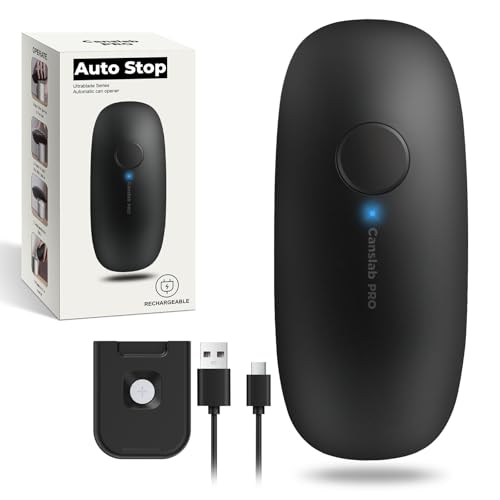
Canslab Ultrablade PRO Electric Can Opener, Black
Badge: Best Overall Value
Strengths
- Side cut leaves a smooth edge and a lid you can reseat
- Smart auto stop ends the cut without you watching the can
- Cordless, rechargeable design moves between counter, table and wall mount
Trade-offs
- Rechargeable battery needs topping up between heavy sessions
- Compact handheld body still needs two hands free at the start
- Side-cut technique takes one or two cans to learn
Key specs from the listing: Power: USB rechargeable, cordless in use; Operation: automatic with smart auto stop; Cut style: hands-free side cut with smooth edge; Mounting: listed as wall mountable; Colour: black.
The Canslab wins the value ranking on arithmetic you can do without a price tag: a rechargeable battery removes the one running cost that quietly eats budget openers alive. Add a side cut that leaves resealable lids, an auto stop that ends cuts cleanly, and a listing that describes the unit as wall mountable, and you have the model that saves money, space and attention simultaneously. For a Canadian household opening cans daily, that stack of small savings is the definition of value.
Where this model earns its place is the unglamorous middle of the job: the seconds while the wheel is travelling. An opener that holds the rim steadily, keeps its line through the seam and finishes cleanly saves more frustration over a year than any headline feature. Judge it on that steadiness, on how the lid behaves at the end of the cut, and on how little cleaning the mechanism asks for afterwards.
There is also the question of what this opener replaces. For many buyers it replaces a manual opener that had become a small daily negotiation, and the correct standard is not perfection but relief: does the negotiation end? On the evidence of its design — the start it asks for, the travel it performs, the lid it controls — that is the question this model answers most directly, and it is why it holds its place in a ranking that had six slots and no sentimentality.
Best for: daily users who want the lowest lifetime cost in this line-up / Not suited for: households that prefer a traditional countertop unit

Kitchen Mama Auto Electric Can Opener, Red
Badge: Best Low-Effort Pick
Strengths
- Press-and-go automatic cutting with no lever to hold down
- Battery power means it works anywhere, no outlet hunting
- Smooth-edge cut reduces sharp rim contact
Trade-offs
- Batteries are a running consumable to keep stocked
- Handheld size suits standard cans best
- Red finish will not suit every kitchen scheme
Key specs from the listing: Power: battery operated; Operation: automatic, hands free; Cut style: smooth edge; Food contact: described as food-safe; Colour: red.
Kitchen Mama is the value answer for a different budget: the time-and-effort budget. It asks for batteries, yes, but it asks for nothing else — no outlet, no counter, no technique. For occasional users the battery cost stays trivial because the opener rests most days, and the smooth-edge result protects fingers and bin liners alike. The red finish, easy to spot in a drawer, is a small practical mercy.
Think about who else will use it. Electric openers are shared tools, and a design that only its buyer can operate is a design that fails the household. Simple starts, forgiving alignment and a lid that stays under control matter more in a family kitchen than a spec-sheet advantage, and they are the qualities that decide whether this becomes the default opener or the spare.
Repairability and support deserve a sentence in any honest review. Electric openers are simple machines, and the failures that end them are usually worn wheels, tired batteries or gummed mechanisms rather than dead motors. A design whose food-contact parts come off for washing, whose power source is replaceable or rechargeable, and whose brand still answers its own support pages in five years is a design with a longer expected life — factor that expectation into the badge it carries here.
Best for: occasional users and small kitchens where effort matters more than running cost / Not suited for: high-volume households that would burn through batteries

KITCHENMUH One Touch Electric Can Opener, Black and Grey
Badge: Best for Arthritic Hands
Strengths
- One-touch start is designed with arthritic hands in mind
- Smooth-edge cut keeps rims safer to handle
- Battery operation keeps it drawer-sized and portable
Trade-offs
- Battery changes interrupt if you open cans daily
- Handheld format gives less leverage on dented rims
- Two-tone finish is a style you either like or do not
Key specs from the listing: Operation: one touch, automatic; Can range: fits all can sizes per the listing; Cut style: smooth edge; Power: battery operated; Colour: black and grey.
Value means something specific when hands hurt: a cheap opener you cannot use is infinitely expensive. The KITCHENMUH earns its place by designing for arthritis explicitly — one touch to start, automatic travel, a smooth edge to finish — and by stating that it fits all can sizes, so one purchase covers the whole cupboard. For a senior household, that inclusivity is not a luxury feature; it is the product.
In daily terms, what this design gets right is consistency. The cut starts the same way every time, the mechanism does not ask for grip strength or wrist technique, and the result is predictable enough that a new cook can be trusted with it on their second can. That predictability is what you are really buying with any electric opener, and it is the quality to weigh against the more visible differences in size and styling.
Consider the second week of ownership, not the first day. By then the novelty has gone and what remains is rhythm: how the opener behaves with cold hands, wet hands, a restless child asking questions and a pan that needs watching. Designs that stay calm under that ordinary chaos are the ones still on the counter in year three, and calm is a property of simple starts, steady travel and predictable finishes — judge this one against that week, not against its photograph.
Best for: seniors and anyone whose grip makes manual openers a barrier / Not suited for: buyers who want a corded model with no batteries to manage

KORSKR Automatic Electric Can Opener, Black
Badge: Best for Left-Handed Cooks
Strengths
- Hands-free running frees your other hand for the pan
- Smooth-edge result is kinder to fingers and bin bags
- Listing calls out left-handed users as a design consideration
Trade-offs
- Battery powered, so output fades as cells run down
- Compact body is slower on very large catering cans
- Automatic travel needs a flat, steady rim to grip
Key specs from the listing: Operation: automatic, hands free; Can range: suitable for any size cans per the listing; Cut style: smooth edge; Power: battery powered; Colour: black.
Most kitchen tools quietly assume a right-handed world, and the KORSKR listing is unusual for saying the opposite out loud. As a value pick it mirrors the other battery handhelds — automatic, hands-free, smooth edge — with that one inclusive difference. If the left-handed cook in your house has spent years adapting to tools designed against them, a model designed for them is worth more than its price difference from a generic rival.
Where this model earns its place is the unglamorous middle of the job: the seconds while the wheel is travelling. An opener that holds the rim steadily, keeps its line through the seam and finishes cleanly saves more frustration over a year than any headline feature. Judge it on that steadiness, on how the lid behaves at the end of the cut, and on how little cleaning the mechanism asks for afterwards.
There is also the question of what this opener replaces. For many buyers it replaces a manual opener that had become a small daily negotiation, and the correct standard is not perfection but relief: does the negotiation end? On the evidence of its design — the start it asks for, the travel it performs, the lid it controls — that is the question this model answers most directly, and it is why it holds its place in a ranking that had six slots and no sentimentality.
Best for: left-handed cooks and mixed-handed households / Not suited for: cooks who open very large cans daily

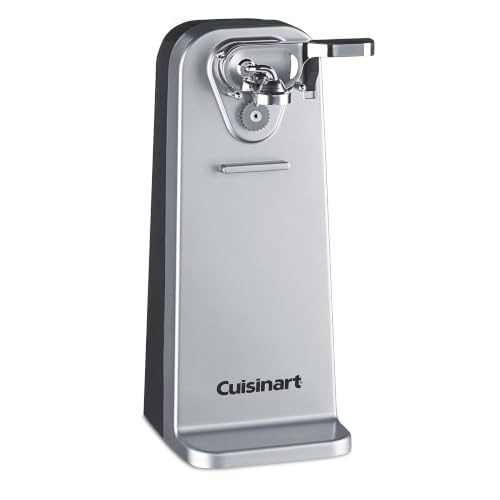
Cuisinart CCO-55 Deluxe Electric Can Opener, Chrome
Badge: Best Long-Term Buy
Strengths
- Press-and-release one-touch cycle is simple to teach anyone
- Magnetic holder captures the lid at the end of the cut
- Chrome finish suits traditional and stainless-heavy kitchens
Trade-offs
- Countertop corded format claims permanent space
- Chrome shows fingerprints and water spots readily
- Top-cut style rather than a smooth-edge side cut
Key specs from the listing: Operation: one-touch press and release; Lid handling: magnetic lid holder; Cleaning: removable lever; Finish: chrome / silver; Model: CCO-55.
The Cuisinart CCO-55 is the spend-once answer. Corded power means zero running cost and no fading mid-can, the one-touch cycle is as simple as the category gets, and the removable lever lets you wash the part that touches food — the longevity feature that matters most over a five-year horizon. Chrome will show fingerprints, but mechanically this is the pick most likely to still be on the counter when the battery models have been replaced twice.
Think about who else will use it. Electric openers are shared tools, and a design that only its buyer can operate is a design that fails the household. Simple starts, forgiving alignment and a lid that stays under control matter more in a family kitchen than a spec-sheet advantage, and they are the qualities that decide whether this becomes the default opener or the spare.
Repairability and support deserve a sentence in any honest review. Electric openers are simple machines, and the failures that end them are usually worn wheels, tired batteries or gummed mechanisms rather than dead motors. A design whose food-contact parts come off for washing, whose power source is replaceable or rechargeable, and whose brand still answers its own support pages in five years is a design with a longer expected life — factor that expectation into the badge it carries here.
Best for: buyers who prefer to spend once on a countertop fixture / Not suited for: renters who cannot give an opener a permanent counter home

BELLA Electric Can Opener, Oatmilk
Badge: Best Style-Led Value
Strengths
- One-touch automatic cycle keeps the job to a single press
- Soft Oatmilk finish stands apart from black-and-chrome norms
- Simple control layout suits shared and guest kitchens
Trade-offs
- Listing gives the least technical detail of this line-up
- Light finish shows tomato and turmeric splashes sooner
- Single-purpose design, no extra tools built in
Key specs from the listing: Operation: automatic one-touch; Finish: Oatmilk; Brand line: bella.
The BELLA makes the value list on a simple proposition: an automatic one-touch opener that does not look like a workshop tool. The Oatmilk finish suits the soft, pale kitchens many Canadian homes favour now, and the control could not be simpler for guests and family. Its listing is the least detailed here, which is its honest trade-off — you are buying proven simplicity and style rather than a long feature list.
In daily terms, what this design gets right is consistency. The cut starts the same way every time, the mechanism does not ask for grip strength or wrist technique, and the result is predictable enough that a new cook can be trusted with it on their second can. That predictability is what you are really buying with any electric opener, and it is the quality to weigh against the more visible differences in size and styling.
Consider the second week of ownership, not the first day. By then the novelty has gone and what remains is rhythm: how the opener behaves with cold hands, wet hands, a restless child asking questions and a pan that needs watching. Designs that stay calm under that ordinary chaos are the ones still on the counter in year three, and calm is a property of simple starts, steady travel and predictable finishes — judge this one against that week, not against its photograph.
Best for: design-led kitchens that still want one-touch convenience / Not suited for: feature hunters who want the longest spec sheet
Comparison Table
Compare running cost first, then cut style. Those two rows predict what each opener will actually cost you over its life.
| Pick | Key facts from the listing | Badge | Check |
|---|---|---|---|
| Canslab Ultrablade PRO Electric Can Opener, Black | Power: USB rechargeable, cordless in use; Operation: automatic with smart auto stop | Best Overall Value | Check on Amazon |
| Kitchen Mama Auto Electric Can Opener, Red | Power: battery operated; Operation: automatic, hands free | Best Low-Effort Pick | Check on Amazon |
| KITCHENMUH One Touch Electric Can Opener, Black and Grey | Operation: one touch, automatic; Can range: fits all can sizes per the listing | Best for Arthritic Hands | Check on Amazon |
| KORSKR Automatic Electric Can Opener, Black | Operation: automatic, hands free; Can range: suitable for any size cans per the listing | Best for Left-Handed Cooks | Check on Amazon |
| Cuisinart CCO-55 Deluxe Electric Can Opener, Chrome | Operation: one-touch press and release; Lid handling: magnetic lid holder | Best Long-Term Buy | Check on Amazon |
| BELLA Electric Can Opener, Oatmilk | Operation: automatic one-touch; Finish: Oatmilk | Best Style-Led Value | Check on Amazon |
How to Choose a Can Opener on a Canadian Budget
Convert the question before you shop. A US sticker price is not your price: check the live listing in your region, in CAD, including any delivery cost, before comparing models. Two openers that look a tier apart in USD can be near-identical landed in Canada, and vice versa. This is exactly why this guide prints no numbers — the only honest price is the one on the page in front of you today. Readers also comparing the tested-style rankings should see Best Tested Electric Can Openers for the performance-first view of the same category.
Next, price the next two years, not the next two minutes. Disposable batteries for a daily-used handheld are a subscription you did not mean to buy; a rechargeable model or a corded countertop unit removes it. Washable parts remove the other hidden subscription — early replacement. A model whose lever or cutting head can be cleaned properly will outlast a sealed rival in any kitchen that opens fish, beans or pet food regularly.
Finally, let your cans and hands arbitrate. All-can-size claims matter if your cupboard mixes tiny tins and tall cans; smooth edges matter if children or cautious hands handle lids; one-touch starts matter if grip is limited. The value pick is the one that removes your specific friction, which is why this guide badges six different kinds of value instead of pretending one model is cheapest at everything.
How to Get Full Value from a Budget Electric Opener
Cheap to buy and cheap to own are different things. These habits close the gap.
- Wipe the can top before opening, every time. It keeps debris out of the food and grit off the wheel, and wheel condition is what budget mechanisms live or die by.
- Seat the opener flat and square before starting. A tilted start makes any motor work harder and roughens the edge it leaves behind.
- Let the mechanism travel unassisted. Guiding or dragging a budget handheld strains its gearing far more than the can does.
- Control the lid with the magnet or the seam, never with fingertips, and bin it immediately — a cut finger costs more than any opener in this guide.
- Wipe the wheel after use and wash removable parts weekly. Residue build-up is the number one reason inexpensive openers start slipping within months.
- Feed rechargeable models before they are empty and keep spare batteries for battery models in the same drawer, so a flat opener never forces a takeaway night.
- Store the opener in one fixed place. A tool you can find is a tool you use; a tool you hunt for gets replaced by something worse.
- Keep a basic manual opener as a backup. It covers dents, blackouts and dead batteries for very little money.
Problem: The cut stalls on a thick seam → what to do: do not force it. Lift off, rotate the can a quarter turn and restart; check the wheel for residue and the batteries or charge level before trying again.
Problem: Edges come out rough → what to do: the wheel is dirty or the power is fading. Clean the cutting area thoroughly and refresh the power source; rough edges on a budget model are maintenance news, not a death sentence.
Problem: The lid drops into the can → what to do: retrieve it with a clean fork, and on the next can wait for the magnet or the full side-cut to finish before lifting the opener away.
Why We Do Not Print a CAD Price
Budget guides that print prices feel helpful and age terribly. A figure written in November can be wrong by December, wronger across the border, and wrongest of all once delivery is added — yet it sits in the article being quoted as fact. The honest alternative is what this guide does: rank by the durable signals of value and send you to the live listing for the number, where Best Smooth Edge Can Openers as a comparison will always rest on today’s live figure rather than ours.
If you want a personal rule, set your CAD ceiling first, then buy the highest-ranked model in this guide whose live price fits it. That order of operations — ceiling from your budget, ranking from evidence — protects you from the two classic errors: overspending on features you will not use, and underspending on a tool whose running costs quietly exceed the saving.
The Running-Cost Ledger Nobody Shows You
Over two years of daily use, a disposable-battery handheld can consume a surprising stack of cells, while a rechargeable model consumes a few overnight charges and a corded model consumes nothing but counter space. None of that appears on a price tag, and all of it appears in your household budget. The same ledger applies to cans: an opener that mangles one rim in twenty is charging you a can a month for its cheapness.
None of this argues for buying the most expensive opener. It argues for buying the one whose total cost — purchase, power, replacement risk, wasted cans — is lowest for your pattern of use. Occasional users genuinely are better served by a simple battery handheld; daily users genuinely are not. Value is a match, not a number, which is also the theme of Best Smooth Open Electric Can Openers for the edge-quality side of the same coin.
Power, Cleaning and the True Cost of Cheap
Power source shapes daily life more than cutting speed does. Corded countertop openers are always ready and never fade mid-can, but they claim permanent counter space and chain you to an outlet. Battery handhelds live in a drawer and travel to the table, the garden or a caravan, yet their cutting strength ebbs as the cells run down, and a forgotten battery swap always seems to happen with a hungry family waiting. USB-rechargeable models split the difference: no disposable cells to buy, but a charge routine to remember. Households that open cans daily usually end up happiest with corded or rechargeable power, while occasional users get more from a drawer-sized battery unit that is simply there when needed.
Safety with electric openers is mostly about the lid, not the blade. The cutting wheel itself is guarded in normal use, but the freshly cut lid is a thin disc of sharp metal that wants to fall into the food or onto fingers. Magnetic lid holders exist precisely to control that moment, and they are worth having. Side-cut lids are safer to handle because the sharp edge stays on the lid’s rolled seam rather than on an exposed cut face. Whichever style you choose, lift lids with the magnet or with fingertips on the flat centre, drop them straight into the bin, and never press a lid down into a full bin with your palm.
Storage decides whether an opener gets used or resented. A countertop unit that lives out is used daily without thought, but it has to earn its footprint in a small kitchen. Handheld electrics disappear into a drawer, which keeps counters clear yet adds a hunt through the utensil tray when your hands are wet and the pan is already on. Wall mounting, where a model genuinely supports it, is the third answer: the opener is always in the same place, off the counter and out of the drawer. Whichever home you choose for it, consistency matters more than the choice itself — an opener with a fixed home gets used; one that migrates gets replaced by a knife and bad decisions.
Power, Cleaning and Everyday Reliability
Cut style is the first fork in the road with any electric opener. A top-cut wheel slices just inside the rim and leaves the lid sitting on top of the food until the magnet lifts it away, while a side-cut wheel parts the seam below the rim so the lid lifts off with a smooth, rolled edge. Neither is objectively better. Top-cut models tend to be the tall countertop units with the longest track records, and their lids cannot be reseated as covers because the cut edge is the sharp one. Side-cut models, usually handheld, leave an edge you can press back onto the can for short fridge storage, and the rim left on the can is the safer surface to handle. Decide which behaviour matches how you actually use half-used cans before you compare anything else.
Hygiene is the quiet reason openers get replaced. The cutting wheel and the area around it collect tomato juice, tuna oil and bean liquor, and that residue is rarely rinsed because the mechanism looks sealed. Models with removable levers or detachable cutting heads let you wash the parts that actually touch food, which is the single feature most worth prioritising if you open fish or pet food often. Whatever the design, a quick wipe of the wheel after every use and a proper wash weekly keeps flavours from crossing between cans and stops the sticky build-up that makes an opener labour and slip.
Can geometry matters more than brochures admit. Extra-tall cans, small condensed-milk tins and dented rims each stress an opener differently. Tall cans need either a tall countertop body or a handheld that can ride the full height without the can tipping, and small tins need a wheel that can bite a short rim without skating. Dents defeat almost every automatic mechanism at least once: the wheel loses the seam and the cut stalls. The honest fix is technique, not force — rotate the can by hand past the dent, or finish that one can with a manual opener kept in the drawer for exactly this job.
Pet Food, Fish and the Hygiene-First Kitchen
Some cans change what an opener is for. Pet food and oily fish leave residue that flavours the next can and offends the next cook, and households that open them daily should shop hygiene-first: removable or easily wiped cutting areas, smooth mechanisms with few residue traps, and a storage spot away from the main prep zone. Several households keep a dedicated second opener for pet food alone, which sounds excessive until the first tin of tuna follows the first tin of cat food through the same unwashed wheel.
The picks in this guide were read with that kitchen in mind. Where a lever removes or a head detaches, the review says so, because for hygiene-first buyers that single feature outranks cut style, finish and brand combined. If that is your kitchen, rank by cleanability first and let every other criterion queue behind it.
Reading Any Opener Listing Like an Engineer
A listing is a negotiation, and the engineer’s habit is to separate its sentences into claims, specifications and atmosphere. Specifications — watts, speeds, dimensions, materials, contents — can be checked and compared. Claims — effortless, professional, heavy-duty — can only be believed. Atmosphere — the photography, the lifestyle, the smiling multigenerational table — can only be enjoyed. Most bad purchases come from letting atmosphere do the work of specifications.
Applied to openers, the discipline is quick. Find the cut style in words. Find the power source in words. Find the can range, the cleaning method and the lid handling in words. Whatever is missing from that list is missing from the product’s promises, and a round-up — this one included — should be read the same way: trust the sentences that could be wrong, discount the ones that could not.
That habit is the real deliverable of a guide like this. The six models will be replaced by six newer ones within a few seasons; the ability to read their listings without being steered will still be saving you money and counter space a decade from now.
Care, in the end, is a two-minute religion. Wipe the wheel today and the opener will not slip next month; wash the removable parts this week and the flavours of March will not haunt the cans of April. Nothing in this guide’s maintenance advice requires products, tools or talent — only the decision to treat a small machine as if you would like it to last, which, having read this far, you presumably would.
Storage is the other half of care. A corded unit stored with its cable kinked, a handheld stored under heavier utensils, a rechargeable stored flat for a season — each returns to duty slightly diminished. Give the opener its one home, keep that home dry and uncluttered, and the tool’s second year will feel exactly like its first, which is the entire ambition of appliance ownership.
Noise deserves its honest sentence too. Electric openers are not silent, and the countertop school announces itself to the whole flat for the seconds a cut takes, while handhelds whirr at conversational pitch wherever they are used. For most households this is trivia; for open-plan flats, night-shift sleepers and parents of light-sleeping infants, it can be the deciding footnote. If your kitchen keeps unusual hours, favour the design you can use behind a closed door — one more way in which the right opener is the one fitted to a life, not to a worktop.
Finally, a word about the manual opener you should keep regardless. Every electric in this guide has a failure mode — a dead battery, a dented rim, a blackout — and a simple manual in the drawer converts each from a ruined dinner into a thirty-second detour. It is the cheapest insurance in the kitchen, it never needs charging, and on the evidence of every household that has made the switch, it will be used just often enough to justify its drawer space and never often enough to regret the electric.
One more consideration belongs in every opener decision, and it is the household’s future rather than its present. Hands change: a wrist that is strong this year may argue next year, a parent moves in, a child becomes old enough to open their own soup. An opener chosen with a margin of ease — automatic travel, a forgiving start, a lid that behaves — absorbs those changes without a second purchase. Buying slightly kinder than you currently need is not indulgence; in this category it is the closest thing to future-proofing that exists, and it costs nothing at the shelf because the easy designs and the basic ones share the same tiers.
Common Buying Mistakes
Budget buying has its own classic traps. These are the five we see most.
- Comparing US sticker prices instead of your live CAD landed cost, then being surprised at checkout.
- Choosing disposable batteries for a daily-use opener and paying the difference many times over in cells.
- Buying a sealed mechanism you cannot clean, then replacing the whole opener when the wheel gums up.
- Ignoring smooth-edge cuts to save a little, then paying in plasters and torn bin bags.
- Skipping the backup manual opener, leaving dented cans and dead batteries with veto power over dinner.
Final Recommendation
For most Canadian households the Canslab Ultrablade PRO is the value recommendation: rechargeable power removes the running cost, the side cut removes the sharp-edge problem, and the wall-mountable design removes the counter-space problem. Three removals, one purchase — that is what under-budget should mean.
Adjust by pattern. Occasional users should take the Kitchen Mama and stop thinking about it. Arthritic hands should take the KITCHENMUH. Left-handed cooks should take the KORSKR. Anyone who prefers to buy once for years should take the corded Cuisinart CCO-55, and anyone furnishing a pale, design-led kitchen will be happiest with the BELLA. Value is personal; the ranking just makes the trade-offs visible.
Start with Check on Amazon for our first pick, and compare it against Check on Amazon if the runner-up description sounds closer to your kitchen.
Frequently Asked Questions
Why does this guide not list CAD prices?
Because they would mislead you. Marketplace prices and exchange rates change constantly and vary by seller and region, so any printed figure would soon be wrong. Check the live listing in your region for the current price in CAD before deciding.
Is a rechargeable opener really cheaper to own than a battery one?
For daily use, usually yes: it removes the steady cost of disposable cells. For occasional use the difference shrinks, because a resting battery opener consumes almost nothing. Match the power source to your frequency.
Are budget electric openers safe for seniors?
The one-touch automatic designs here are among the safest options for seniors, because the motor does the work and smooth-edge models reduce sharp rims. The KITCHENMUH is designed with arthritis explicitly in mind.
What should I check before buying a US-listed opener from Canada?
The live CAD price including delivery, the power source — battery and USB models avoid plug questions entirely — and, for corded models, that the appliance suits local electrical standards.
How long should a budget electric opener last?
With a clean wheel and sensible power habits, years. The two killers are residue build-up on the cutting area and forcing stalled cuts; both are habits, not price points.
Is a smooth-edge cut worth paying more for?
If children handle lids, if you reseat lids on half-used cans, or if you simply dislike sharp metal, yes. It is one of the few upgrades you will notice on literally every can.