Disclosure: topratedkitchenware.com is reader-supported. When you buy through links on our site, we may earn an affiliate commission from Amazon and other retailers, at no extra cost to you.
Where to buy
To buy is the operative word: this guide assumes money is about to move and organises everything around that moment. The best type of chopsticks to buy, for most households, resolves to a short specification — stainless steel, textured or square at the tips, adult length, in a set sized to the table — and the six verified sets below are that specification in its main commercial forms, all linked: a lightweight hollow-core all-rounder, a square colour-coded set, a plated occasion pair, an eight-pair family bench, a ten-pair household reserve and the cleanest spec sheet in the pool. Read the reviews as purchase decisions, each with its buyer named.
- MUYOS Stainless Steel Chopsticks, 5 Pairs, Silver — the all-rounder: hollow-core, lightweight, silver, five pairs
- Greatamzor Multicolor Stainless Steel Chopsticks, 5 Pairs — the patterned buy: square, engraved coin design, colour-coded
- Greatamzor Titanium-Plated Stainless Steel Chopsticks, 2 Pairs — the occasion buy: titanium-plated pairs in a gift format
- NEWDRIP Multicolor Stainless Steel Chopsticks, 8 Pairs — the family buy: eight multicolor pairs at 9.25 inches
- Lazycorner 304 Stainless Steel Chopsticks, 10 Pairs — the reserve buy: ten pairs of 304 steel for big households
- IQCWOOD 304 Stainless Steel Chopsticks, 5 Pairs — the spec buy: 304 steel, stated 9.25 inches, no frills
Read the full guide ↓ for the detailed reviews, the comparison table, and the technique and care guidance that decides which of these sets actually fits your hands and your table.
Buying chopsticks looks trivial until you notice how long the purchase lasts. A sound pair is a decade-scale object, bought in minutes, from listings that emphasise everything except what decides satisfaction: how the tips meet food, how the profile sits in fingers, how the set size matches a household’s real rotation. The best type of chopsticks to buy is therefore less a product than a specification — and specifications can be checked, in the listing, before money moves. This guide states the specification, then maps the six verified sets that meet it onto the buyers they fit.
All six picks are stainless steel, and the reviews do not hide the reasoning: steel is the buy-once material, dishwasher-proof and effectively permanent, and the variety that matters lives inside it — hollow versus solid construction, square versus engraved profiles, colour systems, plating, and set sizes from two pairs to ten. Each review names its buyer in the verdict line, because a purchase guide that will not say who should not buy something is advertising in a trench coat. Where a listing leaves a specification unstated, the review flags it as a buying consideration, not a footnote.
After the reviews, the guide turns to the transaction itself: how to read a listing like an auditor, which specifications to demand in writing, how to size the purchase to the household, and the mistakes that turn a ten-year object into a ten-week regret. If you buy one thing from this page — a set, or only the checklist — the aim is that it still looks like a good decision at the hundredth meal.
Key Takeaways
- Buy a specification, not a photograph: steel, textured or square tips, adult length, household-sized set.
- All six picks are stainless steel; the real choices are construction, profile, finish and set size.
- Demand the facts in the listing — steel grade and length are stated on the best buys here and absent on weaker ones.
- Set size is the most under-bought specification: two pairs suit a kept set, eight to ten suit a household conversion.
- The IQCWOOD set is the spec-led benchmark: grade stated, length stated, nothing decorative to pay for twice.
In this guide
Quick Picks
| Pick | Badge | Why it stands out |
|---|---|---|
| MUYOS Stainless Steel Chopsticks, 5 Pairs, Silver | Best First Buy | Hollow-core lightness in the classic five-pair format |
| Greatamzor Multicolor Stainless Steel Chopsticks, 5 Pairs | Best Patterned Buy | Square grip plus colour identity in one purchase |
| Greatamzor Titanium-Plated Stainless Steel Chopsticks, 2 Pairs | Best Occasion Buy | Plated formality for the occasions budget |
| NEWDRIP Multicolor Stainless Steel Chopsticks, 8 Pairs | Best Family Buy | Eight pairs: the family conversion in one box |
| Lazycorner 304 Stainless Steel Chopsticks, 10 Pairs | Best Bulk Buy | Ten pairs of 304 steel: the reserve bench |
| IQCWOOD 304 Stainless Steel Chopsticks, 5 Pairs | Best Spec-Led Buy | Grade and length in writing: the auditor’s pick |
How These Picks Were Chosen
We built this shortlist as a buyer’s shortlist, which imposed two filters on the verified pool. First, every set had to meet the core specification — reusable stainless steel, a grip feature at the tips, dishwasher care. Second, the six together had to cover the real buying situations a household faces: a first all-round set, a patterned set for shared homes, an occasion purchase, family and bulk conversions, and a specification-pure option for buyers who want the facts unadorned. Sets are ordered for reading, not ranked by worth; the verdict lines do the matching to buyers that a ranking cannot.
The evidence standard is the listing itself. Prices are excluded by this programme’s standing rule — check the current figure at the retailer — and so are ratings and review counts, which fluctuate and persuade without informing. What remains is what should decide a decade-long purchase: materials, dimensions, construction and contents, quoted from verified data, with omissions named. This is research-led guidance, not a hands-on test report, and its confidence comes from that discipline: everything asserted here can be re-checked in the listings in minutes.
The 6 Best Type Of Chopsticks To Buy
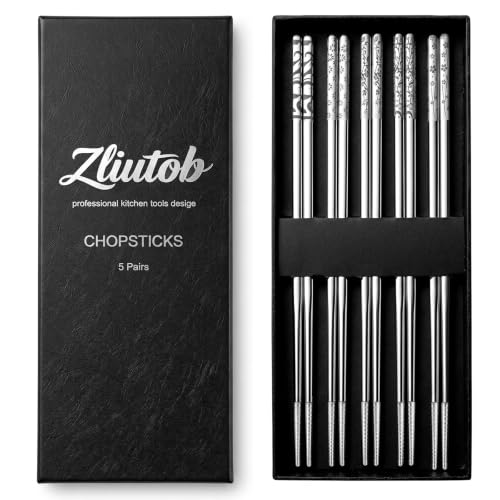
MUYOS Stainless Steel Chopsticks, 5 Pairs, Silver
Badge: Best First Buy Readers comparing nearby options often also look at Best Type Of Chopsticks.
Weight is the MUYOS argument. A hollow-core build trims the heft that makes solid steel chopsticks tiring over a long meal, which matters more than most first-time metal buyers expect: chopstick fatigue is real, and it shows up as a cramping grip and sloppy pickups halfway through a bowl of noodles. Five silver pairs with non-slip tips keep the format familiar — daily meals, per the listing — while the lighter hand feel narrows the gap between metal durability and bamboo lightness. If you have bounced off steel chopsticks before because they felt like knitting needles, this is the design that answers that complaint.
This set is the lightweight type, and its hollow core is a reminder that ‘stainless steel’ names a material, not a weight. Within one material, construction splits the category: solid pairs with their heft and feedback, hollow pairs with their ease over long meals. Neither type is the correct one; they are answers to different hands. Buyers who have rejected ‘metal chopsticks’ wholesale after one heavy pair have usually rejected a construction type while blaming a material — this set exists to correct that sampling error.
Strengths
- Hollow-core build is noticeably lighter over long meals
- Non-slip tips compensate for the lighter touch
- Plain silver finish matches any existing flatware
Trade-offs
- Featherweight feel can read as insubstantial to some diners
- Length is not stated in the verified listing
- Hollow construction rewards avoiding use as a kitchen pry tool
At a glance:
- Set size: 5 pairs
- Build: hollow-core, lightweight
- Tips: non-slip
- Care: dishwasher safe
- Finish: silver
- Listing use: daily meals
Best for: first-time steel buyers / Not suited for: buyers wanting maximum heft

Greatamzor Multicolor Stainless Steel Chopsticks, 5 Pairs
Badge: Best Patterned Buy
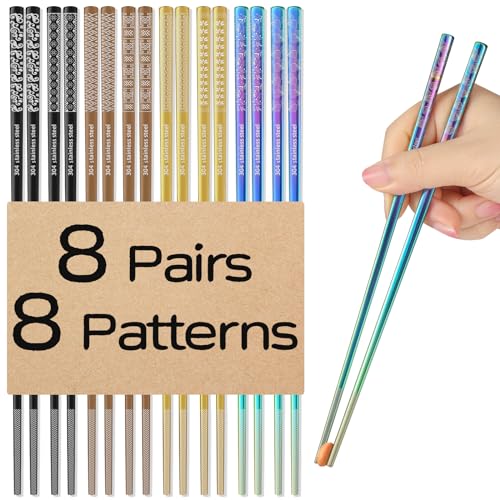
The second Greatamzor entry pairs a square profile with a laser-engraved copper coin pattern and a multicolor finish across five pairs at 9 1/4 inches. Square sides keep the pair from rolling off a plate rim, the engraving gives fingers and food something to hold onto, and the colour spread lets a household assign pairs by colour — a small system that quietly ends the shared-drawer mix-ups. It reads as the personality pick of the steel sets: all the practical engineering of its plainer sibling, with a finish that makes the table setting part of the point. Readers comparing nearby options often also look at Best Type Of Chopsticks For Reuse.
The multicolor type treats finish as information: colour as an identification system for shared households. It is easy to dismiss as decoration until a drawer holds five identical pairs and three people’s hygiene preferences; then colour becomes the feature the household actually uses daily. The type keeps its engineering honest underneath — square profile, engraved tips — so the identification layer costs nothing in function. In a taxonomy of chopsticks, this is the organisational type.
Strengths
- Square profile plus engraving: grip help at both ends
- Colour variety supports a pair-per-person household system
- Five pairs at full 9 1/4 inch adult length
Trade-offs
- Copper coin motif will not match every table style
- Engraved grooves need deliberate washing after oily meals
- Multicolor sets can clash with formal flatware
At a glance:
- Length: 9 1/4 inches
- Set size: 5 pairs
- Profile: square, non-slip
- Pattern: laser-engraved copper coin
- Care: dishwasher safe
- Finish: multicolor
Best for: shared households buying once / Not suited for: formal minimalists

Greatamzor Titanium-Plated Stainless Steel Chopsticks, 2 Pairs
Badge: Best Occasion Buy
Two pairs with a titanium-plated black-silver finish: this Greatamzor set is built to be looked at as much as used. The plating gives the steel a darker, more formal presence than bright silver pairs, the laser engraving keeps the non-slip story intact, and the gift-set presentation points it at couples, hosts and anyone furnishing a first serious table. Plated finishes do ask for a little respect — they are not the pair to toss loose into a cutlery drawer or scrub with abrasives — but as a kept-for-best set that also works daily, it occupies a niche none of the multipacks try to fill.
Plating is the type-defining choice here: a titanium-plated finish over steel, trading a measure of carefree handling for the most formal presence in this line-up. Categories sort themselves by such trades — the type you keep for best is defined by what it asks you to protect. Engraved tips keep this pair’s function uncompromised beneath the ceremony, which is what separates a plated working pair from a merely decorative object: it can be the kept set and still earn its place at Tuesday’s noodles. Readers comparing nearby options often also look at Best Type Of Reusable Chopsticks.
Strengths
- Titanium-plated finish: the most formal look in this line-up
- Engraved non-slip tips keep function under the styling
- Two-pair gift format suits couples and occasions
Trade-offs
- Plated finishes reward gentle washing over abrasive scrubbing
- Two pairs only: a kept set, not a household workhorse
- Length is not stated in the verified listing
At a glance:
- Set size: 2 pairs
- Finish: titanium-plated, black silver
- Tips: laser-engraved, non-slip
- Care: dishwasher safe
- Style: Japanese / Korean
- Presentation: gift set
Best for: occasion and gift budgets / Not suited for: daily family rotation

NEWDRIP Multicolor Stainless Steel Chopsticks, 8 Pairs
Badge: Best Family Buy
This NEWDRIP variant takes the eight-pair format and adds colour: a multicolor finish across the set, with the same 9.25 inch length and laser-engraved non-slip detailing as its plainer sibling. Colour-coding sounds like a gimmick until a household starts arguing about whose pair is whose, or a parent wants each family member to keep their own set for hygiene. It also makes the set read as a gift rather than a restock — the kind of multipack that can go straight from box to table at a housewarming. The steel grade is not stated in the listing, so judge it on format and finish rather than metallurgy claims.
Engraving is this type’s thesis: pattern cut into steel so that grip survives washing, wear and years, rather than printed on a surface that time will polish smooth. The laser-engraved school spans plain and patterned variants across this line-up, and its shared claim is functional decoration — the design you see is the texture you feel, at the fingertips and at the food. In a category where most features are invisible, engraving is the rare one that shows its working.
Strengths Readers comparing nearby options often also look at Best Type Of Wood For Chopsticks.
- Multicolor finish lets each diner claim an identifiable pair
- Eight pairs cover hosting without a second purchase
- Engraved tips keep the food-grip story intact despite the colour
Trade-offs
- Steel grade is not stated in the verified listing
- Bright finishes will not suit every table aesthetic
- Colour sets can look informal for formal place settings
At a glance:
- Set size: 8 pairs
- Length: 9.25 inches
- Tips: laser-engraved, non-slip
- Care: dishwasher safe
- Style: Japanese / Korean / Chinese
- Finish: multicolor
Best for: families converting a drawer / Not suited for: grade-focused buyers (grade unstated)

Lazycorner 304 Stainless Steel Chopsticks, 10 Pairs
Badge: Best Bulk Buy
Ten pairs of 304 stainless steel — the largest set in this cluster, and the most utilitarian. 304 is the workhorse food-grade steel used across commercial kitchens, the listing stresses a lightweight, non-slip, dishwasher-safe build for daily meals, and at ten pairs the set absorbs losses, guests, lunch bags and dishwasher lag without anyone eating noodles with a fork. There is no engraving story and no gift presentation; this is infrastructure. Households that run through chopsticks the way they run through teaspoons will recognise the value immediately.
This is the capacity type: eight or ten pairs bought as household infrastructure rather than as individual objects. The type’s specifications are logistical — depth for guests, spares for the dishwasher cycle, a bench that absorbs loss — and its steel and texture specifications, while real, serve the logistics. Households that eat with chopsticks daily live inside this type whether they name it or not; the only question is whether the bench was bought deliberately, in matching steel, or accumulated by accident.
Strengths
- Ten pairs: the biggest capacity in this line-up
- 304 food-grade steel is the commercial-kitchen standard
- Lightweight build suits everyday, high-rotation use
Trade-offs Readers comparing nearby options often also look at Best Tips For Using Chopsticks.
- Plain presentation: no engraving or gift packaging story
- Length is not stated in the verified listing
- Ten pairs demand real drawer or crock space
At a glance:
- Material: 304 stainless steel
- Set size: 10 pairs
- Tips: non-slip
- Build: lightweight
- Care: dishwasher safe
- Finish: silver
Best for: large or high-rotation households / Not suited for: small households with little storage

IQCWOOD 304 Stainless Steel Chopsticks, 5 Pairs
Badge: Best Spec-Led Buy
The IQCWOOD set is the quiet specification pick: 304 stainless steel, a stated 9.25 inch length, five lightweight pairs with non-slip tips in a Korean-Japanese style. Nothing about it chases attention, which is precisely its appeal for a buyer who wants the checklist — food-grade steel, known length, dishwasher care, enough pairs for the household — without engraving, colour or plating to have opinions about. It is the set most likely to disappear into daily use and simply still be there, working, years later.
The plain type is the category’s control group: stated steel, stated length, no engraving, colour or plating to argue about. Its value in a taxonomy is diagnostic — it shows exactly how much of a fancier set’s appeal is engineering and how much is presentation, by delivering the engineering alone. Buyers who choose it are not missing the point of the decorated types; they have located the point of this one, which is to disappear into daily use and still be working, unchanged, years from now.
Strengths
- Stated length and steel grade: the clearest spec sheet here
- Lightweight five-pair format fits most households
- Understated silver look matches any flatware drawer
Trade-offs
- No decorative engraving for extra finger grip
- Five pairs may run short for frequent hosts
- Plain styling gives gift-givers nothing to present
At a glance: Readers comparing nearby options often also look at Best Titanium Chopsticks.
- Material: 304 stainless steel
- Length: 9.25 inches
- Set size: 5 pairs
- Tips: non-slip
- Build: lightweight
- Care: dishwasher safe
- Style: Korean / Japanese
Best for: auditor-minded buyers / Not suited for: gift presentation
Comparison Table
| Pick | Set size | Length (as listed) | Standout trait | Link |
|---|---|---|---|---|
| MUYOS Stainless Steel Chopsticks, 5 Pairs, Silver | 5 pairs | Not stated in listing | Hollow-core lightness in the classic five-pair format | Check on Amazon |
| Greatamzor Multicolor Stainless Steel Chopsticks, 5 Pairs | 5 pairs | 9 1/4 inches | Square grip plus colour identity in one purchase | Check on Amazon |
| Greatamzor Titanium-Plated Stainless Steel Chopsticks, 2 Pairs | 2 pairs | Not stated in listing | Plated formality for the occasions budget | Check on Amazon |
| NEWDRIP Multicolor Stainless Steel Chopsticks, 8 Pairs | 8 pairs | 9.25 inches | Eight pairs: the family conversion in one box | Check on Amazon |
| Lazycorner 304 Stainless Steel Chopsticks, 10 Pairs | 10 pairs | Not stated in listing | Ten pairs of 304 steel: the reserve bench | Check on Amazon |
| IQCWOOD 304 Stainless Steel Chopsticks, 5 Pairs | 5 pairs | 9.25 inches | Grade and length in writing: the auditor’s pick | Check on Amazon |
For a purchase decision, read across: set size against your household, length as listed against your current pair, and the trait column against your reason for buying. Where a cell says a fact is not stated in the listing, treat that as price-relevant information — you are being asked to buy an unknown, and sometimes the correct response is the set beside it.
How to Choose Chopsticks to Buy: The Specification Checklist
Write the specification before opening a single listing. Material: stainless steel for permanence, with the grade stated — 304 and 18/8-class steels are the workhorse specifications, 18/10 the premium one. Length: stated, and matched to your hand and cuisine, with 9 to 9.25 inches the adult standard across these listings. Grip: engraved, textured or square at the tips, in words. Care: dishwasher safe, in words. Set size: counted against your household, not against the photograph’s styling. A listing that states all five has earned your money’s attention; a listing vague on two or more is asking to be believed rather than bought.
Then match the type to the buying situation, because the same specification wears different forms. A first set for one or two eaters is a five-pair all-rounder — the hollow-core MUYOS in this line-up is the gentlest version. A shared household buys identity with its grip: the colour-coded square sets. A family buys depth: eight or ten pairs, converting the drawer in one transaction so the new default has no gaps. An occasion purchase inverts the priorities — presentation and grade first, rotation last — and should be made after the daily set is secured, not instead of it.
Finally, price the purchase correctly in your head: per year, not per box. A steel set’s cost divided by a decade of meals is a rounding error beside the recurring cost of lesser types replaced on a cycle, or of disposables leaking back into a household that under-bought its bench. That arithmetic is why this guide keeps steering families toward the multipacks their first instinct calls excessive. The instinct prices the box; the checklist prices the decade — and the keyword, to buy, deserves the decade’s answer.
How to Buy Chopsticks Online Without Regretting It
Online, the listing is the product’s only representative, so interrogate it like one. Read the contents and specifications before the photographs; photographs are styled to imply cases, spoons, rests and second pairs that the contents list may not include. Note every fact the listing states — grade, length, count, care — and treat the pattern of its silences as information. A seller who publishes dimensions trusts the product; a seller who publishes adjectives is selling adjectives.
Then run the purchase through the sequence below, which takes minutes and prevents the category’s standard regrets:
- Measure a pair you already like, or your hand’s span if none exists, and fix your target length before browsing.
- Draft the five-point specification — grade, length, grip type, care, set size — and score each candidate against it in writing.
- Read the contents list literally: pairs counted, extras named, nothing assumed from photographs.
- Check the care line against your real routine; dishwasher-safe is a fact to find in text, not a hope.
- Size the set to the household’s worst week — guests plus wash lag — not to its average day.
- Keep the receipt and packaging until the set has survived a week of real meals; length and weight verdicts need dinners, not minutes.
One last buying habit separates satisfied owners in this category: buying the second type later, deliberately. Most households that start with a sound daily set eventually add an occasion pair or a cooking length, and that sequence — workhorse first, refinement second — produces drawers that look curated because they were, one justified purchase at a time. The reverse order, occasion first, is how plated pairs end up in daily rotation being resented for the care they were never bought to receive.
Troubleshooting:
- Problem: the set that arrived feels shorter than expected → the length was unstated or unmeasured. Both failures are preventable: measure first, buy stated lengths.
- Problem: tips are polished despite ‘non-slip’ claims → texture language without texture. Engraved, scored or square are verifiable words; insist on one of them.
- Problem: the household still runs short at guest nights → the set was sized to the average day. The fix is a bench top-up, not a new type.
Reading a Listing Like an Auditor
Every claim in a chopstick listing belongs to one of three classes: verifiable fact (grade, length, count), design description (square profile, hollow core, engraved tips) and atmosphere (premium, elegant, perfect). Money should follow the first class, consider the second and ignore the third entirely. The six listings behind this guide are unusually fact-forward — grades and lengths stated on most, constructions named — which is a large part of why these sets, and not prettier listings, carry this page’s links. Imitate that selection pressure in every future purchase and the category becomes remarkably honest to shop.
The auditor’s second rule is to price omissions. A missing length is not a neutral gap; it is the seller declining to compete on a dimension where they would lose, or not troubling to win a buyer who measures. A missing grade, similarly, caps what the set can claim to be. None of this makes an omission a scandal — several fine sets in this very guide omit one fact or another, and their reviews say which and why it matters less there. It makes omissions data, to be weighed openly rather than discovered at the unboxing.
The Two-Purchase Drawer: Workhorse First, Occasion Second
Settled chopstick households converge on the same drawer architecture: a daily type in depth, and an occasion type in ones or twos. The daily type is chosen on the checklist — durable, grippy, dishwasher-safe, enough pairs for the rotation — and it absorbs ninety percent of meals and one hundred percent of the abuse. The occasion type is chosen on presence: grade, finish, a box, the small ceremony of bringing out the good pairs. Buying both in one transaction, as a matched fantasy, usually compromises both; buying them in sequence, as this guide’s structure suggests, lets each be exactly what its role requires.
The sequence also protects the budget’s logic. The workhorse purchase proves the household’s real usage — how many pairs rotate, which lengths vanish, whose hands prefer what weight — and that evidence specifies the occasion purchase better than any amount of advance imagining. A plated pair bought after a season of daily steel is bought by an expert: you, on your own table. That is the deepest sense in which the best type to buy is a process rather than a product, and why this guide spends as many words on the buying as on the bought.
Care is where stainless steel quietly wins the long game. There are no lacquers to chip, no fibres to swell, no finishes that object to the dishwasher, and no seasoning ritual. What steel does ask for is basic thoroughness: engraved and textured sections hold onto oils and sauces, so a proper wash — not a rinse — keeps them tasting like nothing, which is exactly what a utensil should taste like. Dry storage matters too. A pair put away wet in a closed case or a sealed drawer compartment will eventually show it, whatever the grade stamped on the listing.
The honest way to think about set size is to count eaters, then add friction. A household of two that hosts monthly needs a different bench than a family of five eating with chopsticks nightly, and the dishwasher cycle is a real constraint: pairs in the wash are pairs you cannot use. Multipacks look excessive on a product page and feel inadequate on a Friday night with six guests and a hot pot. Buy for the table you actually set most months of the year, not the table you set once at a holiday, and let the big-occasion problem be solved by a second, cheaper backup set if it ever becomes real.
Etiquette travels with the tool. Resting a pair across the bowl is fine on a rest and contentious without one; sticking chopsticks upright in rice is widely read as a funerary image and worth avoiding at any table where it might land badly; passing food directly from one pair to another carries similar associations in Japanese settings. None of this affects which set you should buy, but a buyer learning chopsticks as an adult is usually also learning the table culture around them, and the two educations are cheaper together. A simple rest, incidentally, also keeps engraved tips off tablecloths and stops round pairs rolling onto the floor.
Finally, judge any pair by its third month, not its first meal. New steel can feel slick until your grip adjusts; new textures can feel aggressive until your fingers learn how little pressure they need. The sets that last are the ones whose compromises you stop noticing: the weight that becomes normal, the length that becomes instinct, the finish that survives your actual dishwasher rather than an idealised one. That is why this guide weights durability signals — steel grade where stated, construction, dishwasher care — as heavily as first-impression features. A chopstick is a ten-year object bought in a ten-minute decision; the least a guide can do is slow the decision down.
Grip is a trainable skill, and the timeline is kinder than most new users expect. The first week with any new pair is mostly about the rest position: the lower stick stays still, braced against the ring finger and the base of the thumb, while the upper stick does all the travelling, pivoted by the index and middle fingers. Once that division of labour clicks, the hand stops squeezing, and squeezing was the real source of most early failures — dropped noodles, aching fingers, food launched across the table. Practice with forgiving foods first: thick noodles, chunky stir-fry pieces, anything with texture. Save peas, beans and glossy dumplings for when the motion is boring, because boring is what mastery feels like from the inside.
Length deserves more respect than it gets in most product listings. The standard adult eating length across these sets sits around nine to nine and a quarter inches, and that is not arbitrary: it keeps fingertips clear of hot broth, spans a dinner plate comfortably, and balances in the hand without the tail end catching on sleeves. Shorter pairs feel nimble for sushi and small plates; longer pairs earn their keep at a hot pot or a shared serving bowl. If you already own a pair you like, measure it before ordering anything new — matching a known-good length removes the single biggest source of first-week disappointment with an otherwise good set.
Children at the table change the arithmetic of any set, even in an adult-focused guide. Small hands need shorter tools, and a household’s adult pairs will be borrowed, brandished and occasionally lost to the sofa regardless of policy. The pragmatic defence is depth — a bench that absorbs the chaos — plus one deliberate decision: keep the pair you care about out of the general pool, by colour, pattern or a separate rest by your own setting. Households that plan for the borrowing lose less to it.
There is a sensory detail experienced eaters mention and listings never do: temperature. Steel arrives at the mouth at room temperature and warms instantly; it neither insulates like bamboo nor chills like a spoon from a cold drawer. Most diners stop registering this within a week. Those who never do are not wrong — they are simply telling you their material preference is real, and the correct response is to honour it with a second type in the drawer rather than to argue a palate out of its own evidence.
Sustainability claims in this category deserve the same audit as product claims. A durable pair used daily for a decade displaces a small mountain of disposables; a durable pair used twice displaces almost nothing, and a cheap pair replaced yearly sits honestly in between, provided the replacements are genuinely recycled or composted where the material allows. The variable is never the object alone — it is object multiplied by meals. Which is one more reason this guide keeps returning to depth, comfort and care routines: they are what turn a purchase into the multiplied term.
If you take one analytical habit from this guide into the rest of your kitchen, let it be the contents-list habit: read what is verifiably in the box before admiring what is in the photograph. It applies to chopsticks, to the combined travel sets this programme has audited, and to nearly everything sold with styling. Sellers who state grades, lengths, counts and contents are competing on facts; sellers who state only adjectives are competing on fog. Your money is a vote for which kind of listing gets written next year.
Storage sounds like the least important decision in this category and quietly determines how long any set stays pleasant. Pairs kept loose in a cutlery drawer collide with heavier utensils thousands of times a year; pairs kept in a crock, a divided insert or their own case meet almost nothing but air and meals. Tips deserve the gentlest berth, since they do the finest work and show damage first. None of this requires equipment more elaborate than a jam jar — it requires only the decision that the pairs have a home, made once and then simply kept.
A note on rests, the smallest accessory in this world: a rest keeps tips off the table, keeps round pairs from emigrating to the floor, and gives a meal a small, civilised pause button. Households that adopt rests find their pairs last longer in finish and in dignity, and guests read the table as considered. Rests are not bundled with the sets in this guide — the listings do not claim them — so treat them as a separate, inexpensive completion of any set you buy, chosen in a material that shares your pairs’ care routine.
Common Buying Mistakes
Purchase regrets in this category are remarkably consistent, and remarkably avoidable. These are the ones the checklist exists to prevent.
- Buying from the photograph. Cases, spoons and extra pairs appear in styling and vanish in contents lists. Read text; it is the contract.
- Skipping the length check. A quarter inch is a real dimension in the hand. Measure, then buy stated lengths only.
- Under-buying the set size. Sized to the average day, the set fails every guest night. Size to the worst week instead.
- Paying for atmosphere words. Premium and elegant are not specifications. Grade, length, grip and care are.
- Occasion first, workhorse later. The plated pair in daily rotation resents its life and so will you. Sequence the purchases.
Final Recommendation
Buy the checklist first and the brand second, and within this guide the matches are direct: the MUYOS hollow-core for a first, gentle all-rounder; the IQCWOOD for the buyer who wants the specification unadorned and in writing; the colour-coded Greatamzor for shared homes; the NEWDRIP eight-pair and Lazycorner ten-pair sets for the family conversion, sized to your worst week; and the plated Greatamzor pair when — and only when — the daily drawer is already settled and an occasion type has earned its purchase.
Check the current price at the retailer for whichever set fits, since this guide does not print prices that would stale. What it prints instead is the part of the decision that does not change: the specification, the audit and the sequence. Follow those, and the best type of chopsticks to buy stops being a question you ask the internet and becomes a standard you apply to it.
Start here: MUYOS Stainless Steel Chopsticks, 5 Pairs, Silver (Best First Buy); Greatamzor Multicolor Stainless Steel Chopsticks, 5 Pairs (Best Patterned Buy); Greatamzor Titanium-Plated Stainless Steel Chopsticks, 2 Pairs (Best Occasion Buy).
Frequently Asked Questions
What type of chopsticks should I buy for everyday home use?
A stainless steel set with engraved, textured or square tips, at an adult length around 9 to 9.25 inches, in a count matched to your household — five pairs for a couple, eight to ten for a family rotation. That specification, which the picks in this guide embody in several forms, combines permanent durability, dishwasher care and real food grip. Within it, choose construction by hand: hollow-core if you prefer lightness over a long meal, solid if you like feedback and heft.
How much should I expect to spend?
This guide does not print prices, because they change and stale figures mislead; check the current price at the retailer for any set you shortlist. What we can give you is the right frame: a steel set is a decade-scale purchase, so judge its cost per year of meals rather than per box, and expect the honest multipacks that look expensive beside two-pair sets to be the cheaper decade by a wide margin once replacement cycles and disposable leakage are counted.
Which specifications should a good listing state?
Five: steel grade, length, grip type, care, and set contents. The strongest listings in this guide’s pool state most or all of them — the IQCWOOD set, for instance, publishes its 304 grade and 9.25 inch length plainly. Treat each omission as information: a missing length prevents matching the pair to your hand, and a missing grade caps the durability claim. Atmosphere words — premium, elegant, perfect — are not specifications and should move no money.
Should I buy a big multipack or start small?
Start at the size of your household’s worst week, not its average day. Couples can start with five pairs and top up; families eating with chopsticks nightly should convert in one purchase of eight to ten pairs, because a half-converted drawer keeps the old default alive on every busy night. If you are genuinely unsure whether chopsticks will stick in your home, one five-pair all-rounder — the hollow-core set in this guide is the gentle version — is the honest trial size.
Is it worth paying more for 18/10 steel or plated finishes?
For the right role, yes. 18/10 is the premium flatware grade and suits a kept, gift or occasion pair — the LIXTONGR set in the wider pool is that purchase — while plated finishes buy presence for set tables. Neither improves daily function enough to justify itself as a first, hard-rotated set, where stated 304 or 18/8-class steel and real tip texture deliver the value. Sequence matters: workhorse first, at workhorse specifications; occasion second, when its premium is buying something real.
What if the set I buy feels wrong when it arrives?
Give it a week of real meals before judging — length and weight verdicts need dinners, not minutes, and many first impressions reverse as a grip adjusts. If it still feels wrong, identify which specification failed: too long, too heavy, too smooth, too few. That diagnosis converts a failed purchase into the specification of its replacement, which is the most valuable thing a first set can teach. Keep packaging until the week is out, and let the checklist, not frustration, write the second order.