Disclosure: topratedkitchenware.com is reader-supported. When you buy through links on our site, we may earn an affiliate commission from Amazon and other retailers, at no extra cost to you.
Where to buy
Reusable is the whole brief, so this guide holds every pick to it without exception: the best type of reusable chopsticks must be non-porous, wash-proof, grip-stable and effectively permanent, and the six verified sets below — all stainless steel, all linked — are that type in its main forms. An engraved 18/8 all-rounder leads, followed by a square textured set, a hollow-core lightweight, a colour-coded household system, a plated occasion pair and an eight-pair multicolor bench. Bamboo, wood and fibreglass get their fair hearing in the comparison sections, because a reusable decision deserves the whole material map — but the linked evidence on this page is steel, for reasons the reviews make concrete.
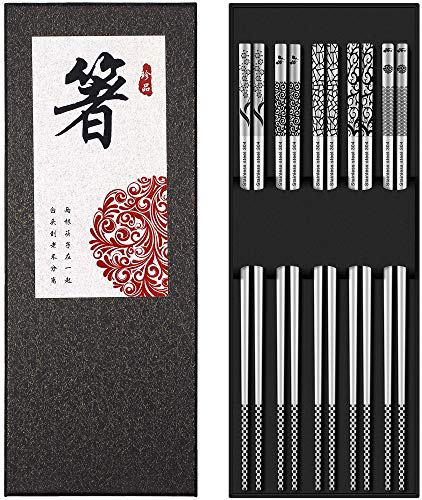
- NEWDRIP 18/8 Stainless Steel Chopsticks, 8 Pairs — engraved 18/8 steel, 9.25 inches, eight pairs: the reusable all-rounder
- Zliutob Stainless Steel Chopsticks, 5 Pairs — square textured steel: reusable grip by geometry
- MUYOS Stainless Steel Chopsticks, 5 Pairs, Silver — hollow-core steel: the reusable type without the weight
- Greatamzor Multicolor Stainless Steel Chopsticks, 5 Pairs — square colour-coded pairs: reuse assigned per person
- Greatamzor Titanium-Plated Stainless Steel Chopsticks, 2 Pairs — plated pairs: the occasion end of reusable
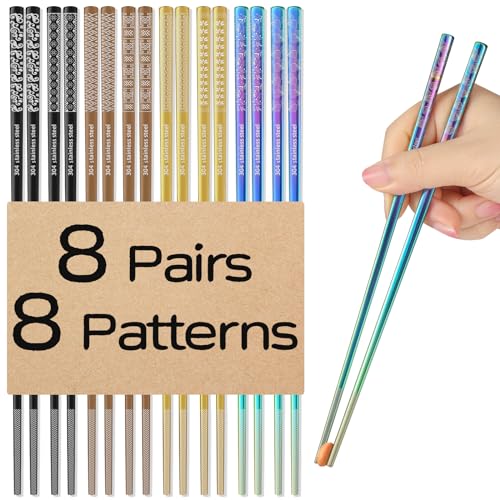
- NEWDRIP Multicolor Stainless Steel Chopsticks, 8 Pairs — eight multicolor pairs: reusable depth for the whole table
Read the full guide ↓ for the detailed reviews, the comparison table, and the technique and care guidance that decides which of these sets actually fits your hands and your table.
Reusable sounds like a yes-or-no property and behaves like a spectrum. Almost any chopstick can be used twice; the best type of reusable chopsticks can be used ten thousand times, washed ten thousand times, and meet the ten-thousandth meal with its grip, shape and dignity intact. That standard — repetition without degradation — is the one this guide applies, and it reorganises the category quickly. Porous materials that stain and swell fall behind; surface grips that wash away fall behind; what remains standing is a short list of constructions, and stainless steel, textured by engraving or profile, stands at its head.
The six verified sets reviewed and linked below are all steel, chosen to show the reusable type’s range rather than to repeat one product six times: an engraved multipack all-rounder, a square-profile grip specialist, a hollow-core lightweight for daily comfort, a colour-coded household system, a plated pair for recurring occasions, and an eight-pair bench that makes reuse logistically unbreakable. Each review keeps the repetition ledger — what five hundred washes would do to this design — because that simulation, not the first meal, is the reusable buyer’s actual question.
The material alternatives are treated honestly in the sections that follow: bamboo’s renewable charm and finite life, wood’s beauty and care demands, fibreglass’s professional indifference. A buyer set on any of them will find its most reusable form described there. But the guide’s linked conclusion is unambiguous, and it is the conclusion the evidence supports: for reuse as a permanent household system, textured stainless steel, owned in depth, is the type to buy — and here are its six best current forms.
Key Takeaways
- Reusable means repetition without degradation: non-porous material, structural grip, wash-proof care.
- All six linked picks are stainless steel — engraved, square, hollow-core, colour-coded, plated and bulk forms of the type.
- Grip made of the object (engraving, profile) outlasts grip applied to it (printing, coating) by years.
- Depth is a reuse feature: eight-pair benches and per-person colour systems keep disposables out of the house.
- Bamboo, wood and fibreglass each have a most-reusable form, assessed in the comparison sections — steel remains the benchmark.
In this guide
Quick Picks
| Pick | Badge | Why it stands out |
|---|---|---|
| NEWDRIP 18/8 Stainless Steel Chopsticks, 8 Pairs | Best All-Round Reusable | Engraved 18/8 steel in an eight-pair bench: the complete reusable answer |
| Zliutob Stainless Steel Chopsticks, 5 Pairs | Best Grip Reusable | Square texture: grip that cannot wash off |
| MUYOS Stainless Steel Chopsticks, 5 Pairs, Silver | Best Lightweight Reusable | Hollow-core: daily reuse at a weight hands forgive |
| Greatamzor Multicolor Stainless Steel Chopsticks, 5 Pairs | Best Household Reusable | Colour-coded squares: a reusable pair per person |
| Greatamzor Titanium-Plated Stainless Steel Chopsticks, 2 Pairs | Best Occasion Reusable | Plated pairs: occasions on a permanent footing |
| NEWDRIP Multicolor Stainless Steel Chopsticks, 8 Pairs | Best Bulk Reusable | Eight multicolor pairs: hosting without disposable relapse |
How These Picks Were Chosen
The shortlist was built by applying a repetition audit to the verified pool: Is the material non-porous? Is the grip structural — engraved, textured or profiled — rather than applied? Is care dishwasher-simple, so the routine survives busy years? Is the format deep enough, or pairable with depth, to run a household? Six steel sets passed with distinct strengths, and they are ordered to be read as a system: the all-rounder first, then the specialists in grip, weight, organisation, occasion and scale. Every fact in the reviews comes from the verified listings; unstated grades or lengths are flagged where they occur.
Method, stated plainly: this is research-led comparison of verified listing data and the documented ageing behaviour of these materials and constructions — not a claim of hands-on testing, and no invented measurements. Reuse is a prediction about the future, so each prediction here is tied to a mechanism you can verify: a grade of steel, a method of texturing, a count of pairs. Where the guide discusses bamboo, wood and fibreglass, it does so as category guidance in dedicated sections, clearly separated from the six verified steel picks it links.
The 6 Best Type Of Reusable Chopsticks

NEWDRIP 18/8 Stainless Steel Chopsticks, 8 Pairs
Badge: Best All-Round Reusable Readers comparing nearby options often also look at Best Type Of Chopsticks.
Eight pairs is the headline here. The NEWDRIP set stretches one purchase across a full table — a dinner party, a hot-pot night, a family that eats with chopsticks daily — in 18/8 stainless steel at 9.25 inches, with laser-engraved non-slip detailing. For households that host, the maths of multipacks matters more than any single-pair refinement: matching pairs look intentional on a set table, and a deep bench of spares means the dishwasher cycle never dictates the menu. The engraved patterning keeps the look playful rather than institutional, which is not always true of bulk steel sets.
Engraving is this type’s thesis: pattern cut into steel so that grip survives washing, wear and years, rather than printed on a surface that time will polish smooth. The laser-engraved school spans plain and patterned variants across this line-up, and its shared claim is functional decoration — the design you see is the texture you feel, at the fingertips and at the food. In a category where most features are invisible, engraving is the rare one that shows its working.
Strengths
- Eight pairs: the deepest bench in this line-up for hosting
- Engraved non-slip sections help both grip and food control
- One consistent length and style across the whole table
Trade-offs
- Eight pairs is more than a solo cook will ever rotate through
- Storage for eight pairs needs a drawer organiser or crock
- Engraving style is decorative; minimalists may prefer plain steel
At a glance:
- Material: 18/8 stainless steel
- Length: 9.25 inches
- Set size: 8 pairs
- Tips: laser-engraved, non-slip
- Care: dishwasher safe
- Style: Japanese / Korean / Chinese
Best for: households standardising on reusable / Not suited for: buyers wanting an organic material feel

Zliutob Stainless Steel Chopsticks, 5 Pairs
Badge: Best Grip Reusable
The Zliutob set makes its case through shape. A square grip profile does not roll on the table, sits steadier between the fingers, and gives a learner’s hand four flat reference faces instead of a slippery cylinder; textured tips then do the food-side work on ramen noodles and sushi pieces, the two jobs the listing itself names. Five pairs keep it a household set rather than a hosting arsenal. The listing does not state a length or a steel grade, so this is a pick you choose for geometry and texture, not for published dimensions — measure your current favourite pair first if length matters to you. Readers comparing nearby options often also look at Best Type Of Chopsticks For Reuse.
In the taxonomy of types, this set represents the square-profile school: flat faces that resist rolling and rotation, a geometry with deep roots in Japanese and Korean metal chopstick design. Type is not trivia — profile decides how a pair behaves in the hand before material ever gets a vote — and a square steel pair is the type buyers reach for when control, not novelty, is the requirement. Its textured tips complete the type’s argument: grip at the finger end, grip at the food end.
Strengths
- Square profile resists rolling and steadies finger placement
- Textured tips are aimed squarely at noodles and sushi
- Five pairs is a sensible household quantity
Trade-offs
- Length and steel grade are not stated in the verified listing
- Square edges feel angular to diners raised on round bamboo
- Texture holds onto oily sauces until washed
At a glance:
- Set size: 5 pairs
- Grip: square profile
- Tips: textured, non-slip
- Care: dishwasher safe
- Listing uses: sushi, ramen, daily meals
Best for: eaters who prioritise permanent grip / Not suited for: diners who dislike angular profiles
MUYOS Stainless Steel Chopsticks, 5 Pairs, Silver
Badge: Best Lightweight Reusable
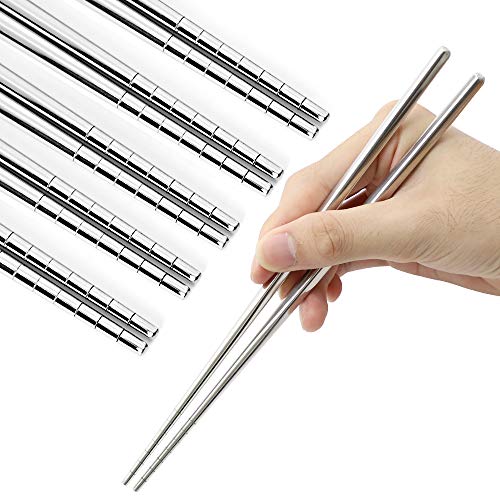
Weight is the MUYOS argument. A hollow-core build trims the heft that makes solid steel chopsticks tiring over a long meal, which matters more than most first-time metal buyers expect: chopstick fatigue is real, and it shows up as a cramping grip and sloppy pickups halfway through a bowl of noodles. Five silver pairs with non-slip tips keep the format familiar — daily meals, per the listing — while the lighter hand feel narrows the gap between metal durability and bamboo lightness. If you have bounced off steel chopsticks before because they felt like knitting needles, this is the design that answers that complaint.
This set is the lightweight type, and its hollow core is a reminder that ‘stainless steel’ names a material, not a weight. Within one material, construction splits the category: solid pairs with their heft and feedback, hollow pairs with their ease over long meals. Neither type is the correct one; they are answers to different hands. Buyers who have rejected ‘metal chopsticks’ wholesale after one heavy pair have usually rejected a construction type while blaming a material — this set exists to correct that sampling error. Readers comparing nearby options often also look at Best Type Of Chopsticks To Buy.
Strengths
- Hollow-core build is noticeably lighter over long meals
- Non-slip tips compensate for the lighter touch
- Plain silver finish matches any existing flatware
Trade-offs
- Featherweight feel can read as insubstantial to some diners
- Length is not stated in the verified listing
- Hollow construction rewards avoiding use as a kitchen pry tool
At a glance:
- Set size: 5 pairs
- Build: hollow-core, lightweight
- Tips: non-slip
- Care: dishwasher safe
- Finish: silver
- Listing use: daily meals
Best for: daily users with tired hands / Not suited for: diners who equate weight with quality

Greatamzor Multicolor Stainless Steel Chopsticks, 5 Pairs
Badge: Best Household Reusable
The second Greatamzor entry pairs a square profile with a laser-engraved copper coin pattern and a multicolor finish across five pairs at 9 1/4 inches. Square sides keep the pair from rolling off a plate rim, the engraving gives fingers and food something to hold onto, and the colour spread lets a household assign pairs by colour — a small system that quietly ends the shared-drawer mix-ups. It reads as the personality pick of the steel sets: all the practical engineering of its plainer sibling, with a finish that makes the table setting part of the point.
The multicolor type treats finish as information: colour as an identification system for shared households. It is easy to dismiss as decoration until a drawer holds five identical pairs and three people’s hygiene preferences; then colour becomes the feature the household actually uses daily. The type keeps its engineering honest underneath — square profile, engraved tips — so the identification layer costs nothing in function. In a taxonomy of chopsticks, this is the organisational type.
Strengths Readers comparing nearby options often also look at Best Type Of Wood For Chopsticks.
- Square profile plus engraving: grip help at both ends
- Colour variety supports a pair-per-person household system
- Five pairs at full 9 1/4 inch adult length
Trade-offs
- Copper coin motif will not match every table style
- Engraved grooves need deliberate washing after oily meals
- Multicolor sets can clash with formal flatware
At a glance:
- Length: 9 1/4 inches
- Set size: 5 pairs
- Profile: square, non-slip
- Pattern: laser-engraved copper coin
- Care: dishwasher safe
- Finish: multicolor
Best for: families running a per-person system / Not suited for: formal place settings

Greatamzor Titanium-Plated Stainless Steel Chopsticks, 2 Pairs
Badge: Best Occasion Reusable
Two pairs with a titanium-plated black-silver finish: this Greatamzor set is built to be looked at as much as used. The plating gives the steel a darker, more formal presence than bright silver pairs, the laser engraving keeps the non-slip story intact, and the gift-set presentation points it at couples, hosts and anyone furnishing a first serious table. Plated finishes do ask for a little respect — they are not the pair to toss loose into a cutlery drawer or scrub with abrasives — but as a kept-for-best set that also works daily, it occupies a niche none of the multipacks try to fill.
Plating is the type-defining choice here: a titanium-plated finish over steel, trading a measure of carefree handling for the most formal presence in this line-up. Categories sort themselves by such trades — the type you keep for best is defined by what it asks you to protect. Engraved tips keep this pair’s function uncompromised beneath the ceremony, which is what separates a plated working pair from a merely decorative object: it can be the kept set and still earn its place at Tuesday’s noodles.
Strengths
- Titanium-plated finish: the most formal look in this line-up
- Engraved non-slip tips keep function under the styling
- Two-pair gift format suits couples and occasions
Trade-offs Readers comparing nearby options often also look at Best Tips For Using Chopsticks.
- Plated finishes reward gentle washing over abrasive scrubbing
- Two pairs only: a kept set, not a household workhorse
- Length is not stated in the verified listing
At a glance:
- Set size: 2 pairs
- Finish: titanium-plated, black silver
- Tips: laser-engraved, non-slip
- Care: dishwasher safe
- Style: Japanese / Korean
- Presentation: gift set
Best for: hosts with recurring occasions / Not suited for: rough daily rotation

NEWDRIP Multicolor Stainless Steel Chopsticks, 8 Pairs
Badge: Best Bulk Reusable
This NEWDRIP variant takes the eight-pair format and adds colour: a multicolor finish across the set, with the same 9.25 inch length and laser-engraved non-slip detailing as its plainer sibling. Colour-coding sounds like a gimmick until a household starts arguing about whose pair is whose, or a parent wants each family member to keep their own set for hygiene. It also makes the set read as a gift rather than a restock — the kind of multipack that can go straight from box to table at a housewarming. The steel grade is not stated in the listing, so judge it on format and finish rather than metallurgy claims.
This is the capacity type: eight or ten pairs bought as household infrastructure rather than as individual objects. The type’s specifications are logistical — depth for guests, spares for the dishwasher cycle, a bench that absorbs loss — and its steel and texture specifications, while real, serve the logistics. Households that eat with chopsticks daily live inside this type whether they name it or not; the only question is whether the bench was bought deliberately, in matching steel, or accumulated by accident.
Strengths
- Multicolor finish lets each diner claim an identifiable pair
- Eight pairs cover hosting without a second purchase
- Engraved tips keep the food-grip story intact despite the colour
Trade-offs
- Steel grade is not stated in the verified listing
- Bright finishes will not suit every table aesthetic
- Colour sets can look informal for formal place settings
At a glance: Readers comparing nearby options often also look at Best Titanium Chopsticks.
- Set size: 8 pairs
- Length: 9.25 inches
- Tips: laser-engraved, non-slip
- Care: dishwasher safe
- Style: Japanese / Korean / Chinese
- Finish: multicolor
Best for: large households replacing disposables / Not suited for: grade-focused spec shoppers (grade unstated)
Comparison Table
| Pick | Set size | Length (as listed) | Standout trait | Link |
|---|---|---|---|---|
| NEWDRIP 18/8 Stainless Steel Chopsticks, 8 Pairs | 8 pairs | 9.25 inches | Engraved 18/8 steel in an eight-pair bench: the complete reusable answer | Check on Amazon |
| Zliutob Stainless Steel Chopsticks, 5 Pairs | 5 pairs | Not stated in listing | Square texture: grip that cannot wash off | Check on Amazon |
| MUYOS Stainless Steel Chopsticks, 5 Pairs, Silver | 5 pairs | Not stated in listing | Hollow-core: daily reuse at a weight hands forgive | Check on Amazon |
| Greatamzor Multicolor Stainless Steel Chopsticks, 5 Pairs | 5 pairs | 9 1/4 inches | Colour-coded squares: a reusable pair per person | Check on Amazon |
| Greatamzor Titanium-Plated Stainless Steel Chopsticks, 2 Pairs | 2 pairs | Not stated in listing | Plated pairs: occasions on a permanent footing | Check on Amazon |
| NEWDRIP Multicolor Stainless Steel Chopsticks, 8 Pairs | 8 pairs | 9.25 inches | Eight multicolor pairs: hosting without disposable relapse | Check on Amazon |
Compare for repetition: the trait column names the mechanism that survives washing, and set size tells you whether the system survives your household’s worst week. Lengths and grades appear only where the verified listing states them — a reusable purchase is a long commitment, and it deserves published facts.
How to Choose Reusable Chopsticks: Choosing the Type
Begin with the material ledger, honestly kept. Stainless steel: non-porous, dishwasher-proof, immune to staining, splintering and warping — the benchmark reusable, taxed only in weight. Fibreglass: nearly as indifferent to repetition, plainer in the hand, the professional’s quiet choice. Bamboo: renewable and pleasant, but porous and mortal — a reusable for a season of heavy use, honestly replaced thereafter, with carbonised and thicker forms lasting longest. Wood: the widest variance, from durable everyday pairs to lacquered pieces whose reuse depends on hand care their owners must genuinely enjoy providing. Plastic and melamine: reusable in the narrow sense, best confined to children’s and institutional roles.
Within your material, audit the grip’s construction. Engraving and scoring are cut into the object; square and flattened profiles are the object’s shape; both are present at meal five hundred exactly as at meal five. Printing, painting and soft coatings are on the object, and repetition is precisely the force that removes them. This one distinction — of versus on — predicts reusable satisfaction better than brand, price tier or styling, and it is checkable from a listing’s wording in seconds. The six picks in this guide were chosen because their grips are all of the object.
Finish with the system decisions, because reuse is a household behaviour before it is a material property. Depth: enough pairs that guests and wash cycles never force a disposable relapse. Assignment: colour or pattern per person in shared homes, so pairs are kept, washed and missed when absent. Care: a routine — for steel, simply the dishwasher — that no busy week can break. A buyer who specifies material, grip construction and system in that order has, in our judgement, fully answered the keyword’s question before choosing among the six forms linked above.
How to Run a Reusable Chopstick System at Home
A reusable system is a small piece of household infrastructure, and it runs on placement more than willpower. The pairs live where meals are decided — a crock by the stove or a divided drawer at the table — never in a presentation box in a sideboard. Each eater’s pair is identifiable at a glance. Washing is the dishwasher’s job, without ceremony or soaking rituals that invite postponement. Guests draw from the bench, not from anyone’s assigned pair. None of this is difficult; all of it is decided once, in advance, which is exactly why it keeps working.
The operating routine, such as it is, fits in five habits:
- Assign: one identifiable pair per regular eater — by colour, pattern or a marked rest — kept in the same spot daily.
- Wash: dishwasher after meals, with a deliberate brush pass over engraved tips after oily dishes.
- Dry and store: pairs go back dry, tips uncrushed, in their crock or divided drawer — never sealed away damp.
- Host from the bench: guest pairs live in the multipack reserve, so occasions never borrow assigned pairs or trigger disposables.
- Audit seasonally: count the bench, replace losses with the same type, and demote any damaged pair to kitchen utility.
Notice what the routine never requires: special detergents, oiling, hand-drying rituals or guilt. That absence is the reusable type’s deepest feature, and it is why steel systems persist in real households while fussier arrangements quietly lapse into takeaway disposables. When you choose your type, choose the routine you are actually willing to run a thousand times — then notice that, for the sets in this guide, the routine is the one you already run for your forks.
Troubleshooting:
- Problem: assigned pairs keep getting mixed up → the identification layer is too subtle. Move to explicit colour-coding; systems beat intentions.
- Problem: engraved tips hold odours after oily meals → residue, cured by prompt washing and a brush pass, not by replacing the set.
- Problem: the bench keeps shrinking → losses are normal; the failure is not topping up. Replace in kind, seasonally, before shortages force disposables.
Steel vs Bamboo vs Fibreglass: The Reuse Case for Each
Bamboo’s case is renewal: a fast-growing material, light and naturally grippy, whose pairs are inexpensive enough that honest replacement is part of the system rather than a failure of it. For households that enjoy that rhythm — and will actually keep it — bamboo is a defensible reusable choice, especially in thicker, carbonised forms. Its limits are physical: porosity invites staining and lingering flavours, fibres roughen, and heavy daily use with machine washing shortens the cycle from years to seasons. The type asks its owner to accept mortality in exchange for feel and footprint.
Fibreglass makes the opposite trade: an industrial material with a plain hand feel and an almost steel-like indifference to heat, water and repetition — the reason so many restaurants standardise on it. Steel, this guide’s linked answer, splits the difference upward: permanence equal to fibreglass, a hand feel and presence closer to real tableware, grades and finishes that let one material serve both the Tuesday rotation and the anniversary table. None of the three is a wrong answer; they are answers to different weightings of feel, permanence and ceremony — and the weighting, not the marketing, should decide.
Why Depth Beats Quality in a Reusable System
Given a fixed budget, households instinctively buy up — fewer, finer pairs — and reusable systems instinctively punish them for it. The mathematics of relapse are unforgiving: every meal where the reusable option is unavailable, unwashed or unfindable is a meal where disposables return, and habits re-form around availability far more than around virtue. A bench of sound pairs at every place the household eats outperforms a small set of perfect pairs in a box, on the only metric reuse is ultimately scored by: how many meals, across a year, were actually eaten reusably.
This is why two of this guide’s six picks are eight-pair sets and two more are household multipacks in disguise, and why the occasion pair is deliberately positioned last in most readers’ buying sequence. Quality still matters — it is what makes the available pair pleasant enough to reach for — but it matters second. Buy the depth first, at the best quality the remaining budget allows, and let the anniversary upgrade arrive later, into a system already running. Reuse, like most infrastructure, rewards the boring decision made completely over the excellent decision made partially.
The honest way to think about set size is to count eaters, then add friction. A household of two that hosts monthly needs a different bench than a family of five eating with chopsticks nightly, and the dishwasher cycle is a real constraint: pairs in the wash are pairs you cannot use. Multipacks look excessive on a product page and feel inadequate on a Friday night with six guests and a hot pot. Buy for the table you actually set most months of the year, not the table you set once at a holiday, and let the big-occasion problem be solved by a second, cheaper backup set if it ever becomes real.
Etiquette travels with the tool. Resting a pair across the bowl is fine on a rest and contentious without one; sticking chopsticks upright in rice is widely read as a funerary image and worth avoiding at any table where it might land badly; passing food directly from one pair to another carries similar associations in Japanese settings. None of this affects which set you should buy, but a buyer learning chopsticks as an adult is usually also learning the table culture around them, and the two educations are cheaper together. A simple rest, incidentally, also keeps engraved tips off tablecloths and stops round pairs rolling onto the floor.
Finally, judge any pair by its third month, not its first meal. New steel can feel slick until your grip adjusts; new textures can feel aggressive until your fingers learn how little pressure they need. The sets that last are the ones whose compromises you stop noticing: the weight that becomes normal, the length that becomes instinct, the finish that survives your actual dishwasher rather than an idealised one. That is why this guide weights durability signals — steel grade where stated, construction, dishwasher care — as heavily as first-impression features. A chopstick is a ten-year object bought in a ten-minute decision; the least a guide can do is slow the decision down.
Grip is a trainable skill, and the timeline is kinder than most new users expect. The first week with any new pair is mostly about the rest position: the lower stick stays still, braced against the ring finger and the base of the thumb, while the upper stick does all the travelling, pivoted by the index and middle fingers. Once that division of labour clicks, the hand stops squeezing, and squeezing was the real source of most early failures — dropped noodles, aching fingers, food launched across the table. Practice with forgiving foods first: thick noodles, chunky stir-fry pieces, anything with texture. Save peas, beans and glossy dumplings for when the motion is boring, because boring is what mastery feels like from the inside.
Length deserves more respect than it gets in most product listings. The standard adult eating length across these sets sits around nine to nine and a quarter inches, and that is not arbitrary: it keeps fingertips clear of hot broth, spans a dinner plate comfortably, and balances in the hand without the tail end catching on sleeves. Shorter pairs feel nimble for sushi and small plates; longer pairs earn their keep at a hot pot or a shared serving bowl. If you already own a pair you like, measure it before ordering anything new — matching a known-good length removes the single biggest source of first-week disappointment with an otherwise good set.
Care is where stainless steel quietly wins the long game. There are no lacquers to chip, no fibres to swell, no finishes that object to the dishwasher, and no seasoning ritual. What steel does ask for is basic thoroughness: engraved and textured sections hold onto oils and sauces, so a proper wash — not a rinse — keeps them tasting like nothing, which is exactly what a utensil should taste like. Dry storage matters too. A pair put away wet in a closed case or a sealed drawer compartment will eventually show it, whatever the grade stamped on the listing.
There is a sensory detail experienced eaters mention and listings never do: temperature. Steel arrives at the mouth at room temperature and warms instantly; it neither insulates like bamboo nor chills like a spoon from a cold drawer. Most diners stop registering this within a week. Those who never do are not wrong — they are simply telling you their material preference is real, and the correct response is to honour it with a second type in the drawer rather than to argue a palate out of its own evidence.
Sustainability claims in this category deserve the same audit as product claims. A durable pair used daily for a decade displaces a small mountain of disposables; a durable pair used twice displaces almost nothing, and a cheap pair replaced yearly sits honestly in between, provided the replacements are genuinely recycled or composted where the material allows. The variable is never the object alone — it is object multiplied by meals. Which is one more reason this guide keeps returning to depth, comfort and care routines: they are what turn a purchase into the multiplied term.
If you take one analytical habit from this guide into the rest of your kitchen, let it be the contents-list habit: read what is verifiably in the box before admiring what is in the photograph. It applies to chopsticks, to the combined travel sets this programme has audited, and to nearly everything sold with styling. Sellers who state grades, lengths, counts and contents are competing on facts; sellers who state only adjectives are competing on fog. Your money is a vote for which kind of listing gets written next year.
Storage sounds like the least important decision in this category and quietly determines how long any set stays pleasant. Pairs kept loose in a cutlery drawer collide with heavier utensils thousands of times a year; pairs kept in a crock, a divided insert or their own case meet almost nothing but air and meals. Tips deserve the gentlest berth, since they do the finest work and show damage first. None of this requires equipment more elaborate than a jam jar — it requires only the decision that the pairs have a home, made once and then simply kept.
A note on rests, the smallest accessory in this world: a rest keeps tips off the table, keeps round pairs from emigrating to the floor, and gives a meal a small, civilised pause button. Households that adopt rests find their pairs last longer in finish and in dignity, and guests read the table as considered. Rests are not bundled with the sets in this guide — the listings do not claim them — so treat them as a separate, inexpensive completion of any set you buy, chosen in a material that shares your pairs’ care routine.
Children at the table change the arithmetic of any set, even in an adult-focused guide. Small hands need shorter tools, and a household’s adult pairs will be borrowed, brandished and occasionally lost to the sofa regardless of policy. The pragmatic defence is depth — a bench that absorbs the chaos — plus one deliberate decision: keep the pair you care about out of the general pool, by colour, pattern or a separate rest by your own setting. Households that plan for the borrowing lose less to it.
Common Buying Mistakes
Reusable systems fail at the household level far more often than at the material level. These are the standard failure modes.
- Buying quality without depth. Two perfect pairs cannot run a household. Shortages relapse into disposables, and the system never forms.
- Choosing grip that is printed on. Repetition removes surface decoration first. Reusable grip is engraved, scored or shaped — made of the object.
- Adopting care you will not sustain. Hand-wash-only types in a dishwasher household are a countdown, not a system.
- Storing the good pairs away. A reusable set in a presentation box reuses nothing. The crock by the stove is the system’s headquarters.
- Letting losses slide. Every unreplaced pair thins the bench toward the next relapse. Top up in kind, seasonally.
Final Recommendation
The complete reusable answer in this guide is the NEWDRIP 18/8 eight-pair set: engraved grip made of the object, food-grade steel, depth enough to run a household without relapse. Build around it by need — the Zliutob square set where grip is the priority, the MUYOS hollow-core where hands tire, the colour-coded Greatamzor where assignment keeps the peace, the NEWDRIP multicolor bench where hosting is constant — and add the plated pair when your occasions deserve a permanent footing of their own.
Whichever form you start with, hold the standard that organised this page: non-porous material, structural grip, boring care, honest depth. A type that meets it does not need to be re-chosen, re-researched or re-bought — and a purchase that never has to be repeated is, in the end, what reusable was always supposed to mean.
Start here: NEWDRIP 18/8 Stainless Steel Chopsticks, 8 Pairs (Best All-Round Reusable); Zliutob Stainless Steel Chopsticks, 5 Pairs (Best Grip Reusable); MUYOS Stainless Steel Chopsticks, 5 Pairs, Silver (Best Lightweight Reusable).
Frequently Asked Questions
What is the best type of reusable chopsticks?
Textured stainless steel, owned in household depth. Steel is non-porous and dishwasher-proof, immune to the staining, splintering and warping that retire organic pairs, and when its grip is engraved or profile-shaped it is structural — present at the five-hundredth wash as at the first. The six picks in this guide are that type in its main forms, from an engraved eight-pair all-rounder to a hollow-core lightweight and a plated occasion pair. Fibreglass is the closest alternative; bamboo is the renewable, shorter-lived one.
How long do reusable chopsticks last?
A sound stainless steel pair has no ordinary wear-out mechanism: in home use it lasts indefinitely, leaving service through loss or misuse rather than age. Bamboo pairs last a season to a few years depending on thickness, finish and washing, and are honestly replaced on that cycle. Wood varies widest, from years for hard, plainly finished pairs to much less for lacquer that is machine-washed against its nature. Choose the lifespan model — permanence or renewable replacement — that matches how your household actually lives.
Are reusable chopsticks hygienic?
Steel ones are as hygienic as your other cutlery, for the same reason: a non-porous surface that a proper wash fully cleans, and dishwasher tolerance that makes the proper wash the default. The hygiene cautions are routine-level, not material-level: wash engraved sections thoroughly after oily meals, store pairs dry, and do not seal used pairs away damp. Porous materials demand more care to reach the same standard, which is one of the quieter arguments for steel in shared households.
Why does grip construction matter for reuse?
Because repetition is the force that removes applied finishes. Printed or coated texture sits on the surface and depreciates with every wash; engraved texture is cut into the material, and a square profile is the material’s shape, so both survive exactly as long as the pair does. A reusable purchase is a bet on the future state of the object, and grip made of the object is the only version of that bet that cannot be lost to ordinary use.
How many reusable pairs should a household own?
One assigned pair per regular eater, plus a bench: spares for the wash cycle and enough guest pairs that hosting never borrows assigned pairs or revives disposables. In practice that means five pairs for a couple and eight to ten for a family — the formats this guide’s multipacks exist to supply. Depth is not excess in a reusable system; it is the mechanism by which the system survives its worst week, which is the only week that tests it.
Can reusable chopsticks go in the dishwasher?
Stainless steel sets can, and every pick in this guide is listed as dishwasher safe — a central reason steel anchors the reusable category, since machine washing is the routine busy households actually sustain. Bamboo and many wooden pairs degrade faster under machine heat and detergents and are better hand-washed, which is a legitimate choice only if your household will genuinely keep it up. Match the material to the routine you have, not the routine you admire.