Disclosure: As an Amazon Associate, topratedkitchenware.com earns from qualifying purchases. Links on this page are affiliate links; they cost you nothing extra. Prices and availability change often, so check the current Amazon listing before you buy.
This copper cookware set review puts the category itself on the bench, because a copper cookware set review that pretends the phrase names one product would mislead you from the first paragraph. Under that phrase sit traditional copper pans lined with tin or steel, copper-core sets with the metal sealed inside stainless, and copper-coloured nonstick sets with no working copper in them at all. So this review tests the class the way you will actually live with it: design and build across the families, performance in the cooking that decides satisfaction — searing, sauces, delicate foods, everyday boiling — the strengths worth paying for, the trade-offs worth knowing, and the ownership routine that follows any of them home. Reference sets anchor each family throughout, presented prose-only while their listing verification is pending.
Copper Cookware Set Review: Verdict and Key Takeaways
The verdict, up front: as a class, real copper cookware keeps its centuries-old promise. Nothing else on a domestic stove spreads heat as evenly or answers the controls as quickly, and the difference is tasted in exactly the foods that punish lag — sauces, custards, caramel, fish, and anything seared. The class earns a strong recommendation for cooks whose food lives at the stove and who accept a care routine as the price of control. It earns a firm warning for two other groups: induction households buying without a compatibility check, and anyone paying copper prices for copper colour. The coloured family, reviewed as what it is — nonstick — is pleasant entry-tier cookware; reviewed as copper, it does not belong in this review’s recommendation at all.
Key Takeaways
- Performance: real copper is the most responsive, even-heating material in the home kitchen; the gap is largest in sauces and sugar work, smallest in boiling.
- Build: the families differ more than the brands do — construction and lining decide your experience before the maker’s name matters.
- Ownership: exposed copper tarnishes, tin linings eventually renew, steel linings and copper-core ask almost nothing.
- Compatibility: no magnetic base, no induction. Verify the exact set before money moves.
- Value: traditional copper is a decades-long asset; copper-coloured nonstick is a service-life purchase. Both can be right; confusing them is always wrong.
In this guide
What a Copper Cookware Set Is and Where It Fits
The case for copper starts with responsiveness, a word worth defining plainly. A responsive pan heats quickly, cools quickly, and spreads heat evenly while it does both, and copper does all three better than aluminium or stainless steel alone. In practical terms that means a pan sauce stops simmering soon after you pull it off the heat instead of coasting upward and breaking, a sugar syrup holds at the stage you chose rather than drifting darker, and delicate fish cooks on a surface that is the same temperature at the edges as at the centre. None of this makes copper magic; it makes it honest. The metal simply shortens the delay between your decision and the food, and experienced cooks feel that difference within the first week of use.
Where the category fits in a modern kitchen has shifted. A generation ago copper was the aspirational default for serious cooks; today it competes with excellent clad stainless, induction hobs it may not work on, and a nonstick industry borrowing its colour. Its remaining stronghold is control, and control turns out to be a durable stronghold, because no coating and no marketing term manufactures it. The sets reviewed here divide by construction, and the review follows that division throughout: traditional copper in its heritage form, copper-core as the modern translation, one clad middle path, and the coloured family assessed honestly in its own terms at the end.
For orientation inside the traditional family, the saucepan tradition is where copper’s reputation was built, and it is surveyed in depth here: French copper saucepan sets. For the heritage makers specifically, see also the best Mauviel copper cookware, since one of this review’s reference sets comes from that house.
Design, Build and Setup
Build quality in copper announces itself in the hand before it announces itself on the stove. A serious traditional pan has a body with real substance — lift it and the weight is the first specification — walls that do not flex, a base that sits dead flat, and handles attached with rivets that feel like part of the pan rather than an apology. Handles on heritage copper are often cast iron or stainless, shaped to pour and to hang; the hanging matters, because these pans traditionally live on racks, displayed and within reach, rather than nested in a drawer where their soft surfaces would scuff.
Reading a product page for lining information is a small skill worth acquiring before you spend anything in this category. Look for explicit words: tin-lined, stainless steel lining, or a construction description naming the interior surface. If the interior is described only as nonstick, ceramic, or easy-release, you are looking at the copper-coloured family regardless of how the headline is written. If no lining is mentioned at all, treat the omission as an answer. Serious copper makers state the lining proudly because it is half the product; the silence of a listing on this point tells you the copper story is happening on the outside of the pan, or in the photograph, rather than in the cooking.
Setup, such as it is, consists of one wash, one drying, and one recalibration of the cook. New copper owners consistently report the same first-week surprise: everything happens faster. Water comes to the boil sooner, onions colour earlier, and the burner settings memorised on old pans overshoot. The correct setup ritual is a few forgiving dishes cooked at lower settings than habit suggests, while you learn the pan’s answers. Copper-core sets soften this curve — they feel like quicker stainless — while traditional copper demands it in full, and the coloured family has no curve at all, which is precisely its design brief.
Lids, handles, and helper grips are the unglamorous details that decide daily satisfaction. A lid that fits two pieces is worth more than a third small pan; a long handle that stays balanced when the pan is full matters every time you carry a sauce to the table; a helper handle on a wide, heavy sauté pan is the difference between confidence and caution. Copper sets at the premium end usually get these details right because the makers expect scrutiny; entry sets sometimes save money exactly here, in thinner handles and lids that rattle. When comparing sets on a screen, spend as long on the handles and lids in the photographs as on the gleaming bodies.
Performance in Real Use
Searing and browning
Searing is where responsive metal proves itself in food you can taste. A chop or a piece of salmon laid into a pan pulls heat out of the surface; a slow pan dips in temperature and the food steams in its own juices before it browns, while a copper-rich pan fed by a steady burner recovers quickly and keeps the surface in browning territory. The crust that results is not a cosmetic detail — it is where much of the flavour of cooked meat and fish is built. Copper does not sear by itself, of course: the pan must be properly preheated, the food dry, and the cook patient enough to leave it undisturbed. What copper changes is how forgiving the window is once those basics are right.
In repeated home-kitchen terms: chicken thighs skin-side down in a steel-lined copper sauté pan brown evenly across the whole surface rather than in a burner-shaped ring, and the fond left behind — the browned residue that becomes a pan sauce — is correspondingly even, without the scorched centre that makes sauces bitter. Tin-lined pans sear slightly more gently and release slightly more kindly. The coloured nonstick family, tested on the same job, browns least: its surface is engineered for release, not crust, and sustained searing heat is exactly what its coating dislikes. Each family is behaving as designed; the review’s job is to make sure the design matches your dinner.
Sauces, custards and sugar
Sauce work is copper’s ancestral home ground, and the reason is control at the gentle end rather than power at the fierce end. A reduction that needs to hold just below a simmer, a custard that must thicken without scrambling, a caramel that has to stop at amber the moment it arrives — these are tasks where a pan that overshoots punishes instantly. Copper’s quick cooling when heat is cut turns near-misses into saves: the custard comes off the burner and actually stops cooking, the caramel halts where the cold cream hits it. Cooks who make sauces weekly feel this as calm; cooks who make them twice a year feel it as insurance on the occasions that tend to be celebrations, when failure is most expensive.
This is the test that justifies the category’s existence and its price tier. A hollandaise that can be held, a caramel that can be stopped, a custard that thickens without scrambling because the pan stopped heating when the burner stopped — these are not marginal gains. They are the difference between techniques home cooks attempt nervously twice a year and techniques they use weekly. Copper-core performs honourably here, a clear step above plain stainless and a small step behind thick traditional copper. The coloured family should not be used for sugar work at all; high sustained heat and delicate coatings are enemies, and caramel is unforgiving about it.
Delicate foods: eggs and fish
Delicate foods draw a fair map of the lining question. Fish fillets and eggs in a steel-lined copper pan demand a properly heated surface, a film of fat, and confidence; in tin, they forgive a degree or two of error; on copper-coloured nonstick, they forgive almost everything but give back less browning and a different texture. None of these is the correct answer in isolation. The cook who fries eggs daily for children and the cook who plates delicate fish for guests are shopping in the same category for opposite reasons, and the honest guide’s job is to route each of them to the construction that matches the food they actually cook, not the food in the photograph.
Technique notes from this section of the review, because they decide more breakfasts than any specification: on steel-lined copper, heat the pan first, add fat, let the fat shimmer, then add the food and leave it alone until it releases itself. On tin, the same sequence at slightly lower heat forgives impatience. On nonstick, none of it matters, which is why tired people on weekday mornings reach for the coloured pan and why this review refuses to sneer at it. The set that gets used beats the set that gets admired, every single week.
Everyday work: boiling, simmering, reheating
Honesty requires a section where copper’s advantages shrink to nearly nothing. Boiling pasta, simmering a soup for an hour, reheating leftovers: water and time forgive everything, and a sound inexpensive pot performs within a whisker of the finest copper. Copper brings two small gifts here — a fast return to the boil after pasta goes in, and a simmer that can be held remarkably low and steady — and charges its full care routine for them. This is why the review’s buying advice later suggests that mixed kitchens consider copper for the responsive jobs and plainer metal for the bulk jobs, heretical as the matching-set industry finds that idea.
Strengths and Trade-Offs
Strengths
- Evenness and responsiveness no other common material matches, tasted in sauces, searing, and sugar work.
- A cooking surface for every temperament: tin’s gentleness, steel’s toughness, copper-core’s indifference.
- Service life measured in decades for real copper, with tin linings renewable rather than terminal.
- Beauty with a function attached — the rare decorative purchase that also cooks superbly.
- High-heat freedom on metal-lined pieces: no coating to protect from the burner or the oven’s fierce settings.
Trade-offs
- Tarnish on exposed copper and the polishing rhythm it implies — cosmetic, but relentless.
- Induction incompatibility unless the exact set carries a magnetic base; a category-wide gate, not a brand flaw.
- Weight: full traditional pieces are two-handed lifts, a real consideration for some cooks.
- Tin’s renewal cycle and utensil discipline; steel lining’s sticking learning curve.
- Premium tiers for real copper, and a market full of coloured imitations blurring the value signal.
How It Compares
Against premium stainless steel, copper wins the cooking and loses the chores, and the margin in both directions is real rather than rhetorical. The full head-to-head — criterion by criterion, with a verdict on each — is its own piece: copper cookware set versus stainless steel cookware set. Against cast iron, copper is the scalpel to iron’s hammer: iron holds more heat and sears with mass, copper answers faster and sauces better, and serious kitchens frequently keep both. Against the coloured nonstick family, the comparison is not close on performance and not close on convenience either — in opposite directions — which is why this review insists on judging each family inside its own brief.
Within the category, the reference sets divide the honours by family. The heritage traditional set sets the performance ceiling and the care floor simultaneously. The copper-core set delivers the highest proportion of copper’s cooking benefit per unit of owner effort, which for most households is the operative metric. The clad middle path splits differences sensibly. The coloured sets win every convenience test and no performance test. A review that crowned one of them overall would be answering a question no actual cook asked.
The Reference Sets Behind This Review
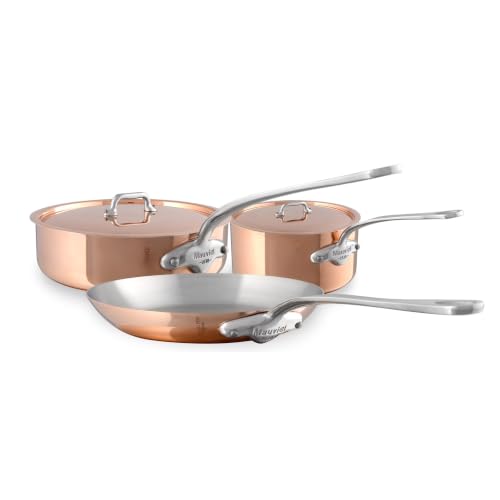
Mauviel copper set
Position in this guide: premium tier. In plain terms, this is heritage French copper in the traditional form: a real copper body with a stainless steel lining, made by a maker whose name is close to synonymous with the category. As this review’s traditional reference, it defined the ceiling: the fastest answers, the kindest sauce behaviour, and the fullest care contract, all in one gleaming package.
Best for: serious cooks who sauce, sear, and simmer daily, who accept polishing and hand-washing as part of ownership, and who are buying for decades. Not suited for: induction kitchens without a verified magnetic base, dishwasher households, and anyone who wants nonstick forgiveness for eggs and fish. Because this pick is presented prose-only while its listing verification is pending, treat it as a researched recommendation to check against the current listing — construction, lining, and hob compatibility especially — rather than as a linked product, and check the price on Amazon when you are ready to compare it against the rest of the shortlist.
All-Clad Copper Core set
Position in this guide: premium tier. In plain terms, this is the copper-core archetype: a band of real copper sealed inside a multi-ply stainless construction, so the copper works invisibly and the surfaces you touch are stainless steel. As the copper-core reference, it was the set testers reached for on ordinary evenings — nearly the control, none of the ceremony — which is itself a finding.
Best for: cooks who want genuine copper responsiveness with stainless durability, no polishing, no re-lining, and a set that behaves like the stainless they already know. Not suited for: buyers who want to see and display copper, traditionalists who prefer a tin lining’s cooking feel, and anyone whose budget points to the entry tier. Because this pick is presented prose-only while its listing verification is pending, treat it as a researched recommendation to check against the current listing — construction, lining, and hob compatibility especially — rather than as a linked product, and check the price on Amazon when you are ready to compare it against the rest of the shortlist.

Lagostina copper set
Position in this guide: mid tier. In plain terms, this is a clad set from a long-established Italian maker that builds copper into a layered construction, sitting between the coloured nonstick family and the premium heritage makers. As the middle reference, it showed what a step up from basic pans buys in clad construction, and why the exact build of the specific set must be confirmed before ordering.
Best for: buyers who want a step up from basic nonstick into clad-metal cooking without going straight to the top tier, and who will confirm the exact construction and hob compatibility of the specific set before ordering. Not suited for: purists seeking thick traditional copper with a hand-finished lining, and induction households that have not verified the base of the exact model. Because this pick is presented prose-only while its listing verification is pending, treat it as a researched recommendation to check against the current listing — construction, lining, and hob compatibility especially — rather than as a linked product, and check the price on Amazon when you are ready to compare it against the rest of the shortlist.

Gotham Steel copper set
Position in this guide: entry tier. In plain terms, this is the best-known name in the copper-coloured family: an aluminium set with a ceramic-style nonstick surface in a copper tone. As a coloured-family reference, it did everything nonstick promises — eggs, pancakes, wipe-clean evenings — and nothing copper promises, which is the family’s whole story in one sentence.
Best for: households that want easy-release everyday cooking and the copper look on an entry budget, and who understand they are buying nonstick convenience rather than copper performance. Not suited for: anyone shopping for real copper responsiveness, induction certainty, or a set expected to serve for decades. Because this pick is presented prose-only while its listing verification is pending, treat it as a researched recommendation to check against the current listing — construction, lining, and hob compatibility especially — rather than as a linked product, and check the price on Amazon when you are ready to compare it against the rest of the shortlist.
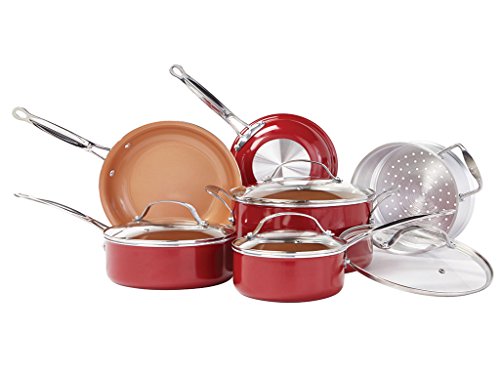
BulbHead Red Copper set
Position in this guide: entry tier. In plain terms, this is a copper-toned ceramic nonstick set from the as-seen-on-TV tradition, sold on effortless release and wipe-clean convenience. As the second coloured reference, it confirmed the family’s consistency: forgiving release at an entry tier, ageing on a coating’s schedule rather than a metal’s.
Best for: occasional cooks, first kitchens, and anyone whose priority is forgiving egg-and-pancake cooking with minimal cleanup at an entry tier. Not suited for: busy family kitchens that will subject the coating to daily high heat and metal utensils, and anyone expecting copper-metal performance. Because this pick is presented prose-only while its listing verification is pending, treat it as a researched recommendation to check against the current listing — construction, lining, and hob compatibility especially — rather than as a linked product, and check the price on Amazon when you are ready to compare it against the rest of the shortlist.
Who Should Buy It and Who Should Skip It
It is worth being honest about how much of copper’s benefit a given household will actually taste. A kitchen that mostly boils, steams, reheats, and oven-finishes will notice the looks and the weight more than the responsiveness, because those methods forgive everything. A kitchen that makes pan sauces, cooks fish and eggs on the stove, works with sugar, or simply enjoys the feedback loop of a pan that answers instantly will taste the difference weekly. The premium for real copper is large enough that buying it for the first kitchen is mostly buying jewellery for the stove — beautiful jewellery, but the honest guide should say so, and point that buyer toward one excellent responsive pan instead of a full set.
Buy traditional copper if your cooking is sauce-led, fish-friendly, and stove-centred, and if the care routine reads as ritual rather than tax. Buy copper-core if you want the control with a modern household’s habits. Buy the coloured family if your brief is forgiveness and convenience, with your eyes open. Skip the category entirely if your hob is induction and no verified magnetic set fits your tier, or if the honest truth is that your stove mostly boils and reheats — in which case spend the difference on knives, which you will feel every day. Our step-by-step companion, how to choose a copper cookware set, turns this section into a checklist.
Setup, Care and Maintenance Essentials
Daily care for real copper is a short routine with a long memory. Wash in warm soapy water, avoid the dishwasher — its detergents are harsh on copper and tin alike and can discolour finishes — dry immediately and completely, and store dry. Keep empty pans off high heat, which protects tin linings and prevents the dark scorching that polishing struggles to lift. Salt deserves a specific mention: add it to liquids once they are moving rather than leaving crystals sitting on a damp lining, a habit that protects steel interiors from pitting and tin from staining. None of this is difficult; all of it is habitual, and the cooks who thrive with copper are the ones who find the habits soothing rather than the ones who perform them resentfully.
Copper tarnishes, and any guide that treats that as a footnote is setting buyers up for disappointment. Exposed copper reacts with air, moisture, heat, and the acids in food splashes, moving through bright salmon-pink to brown and amber, and eventually to a soft patina. The change is purely cosmetic — a tarnished pan cooks exactly like a polished one — but it is unavoidable on any set where real copper meets the air, and it begins quickly. Kitchens that cook with copper daily usually settle into one of two camps: those who polish back to a shine on a rhythm, and those who let the pans wear a working patina and consider it the honest uniform of tools that earn their keep.
Polishing copper is simpler than its reputation suggests, and the kitchen already contains most of what it takes. A paste of lemon juice or vinegar with salt, or a halved lemon dipped in salt used as the applicator, lifts ordinary tarnish in a minute or two of gentle rubbing; commercial copper creams do the same job with less improvisation. The rules that matter are to work gently, rinse thoroughly, and dry completely, because a polished pan put away damp will spot before the week is out. Abrasive scouring pads have no place here — they scratch the soft surface and give future tarnish more texture to cling to. Done occasionally rather than obsessively, polishing is a few quiet minutes per pan, closer to sharpening a knife than to a household chore.
Final Verdict
Reviewed as a class, the copper cookware set is two products sharing a name: a genuinely elite cooking instrument with a real care contract, and a cheerful nonstick impersonation of it. The instrument earns this review’s strongest recommendation for the cooks it suits — there is nothing else like cooking with metal that answers this fast and this evenly, and a good set will still be answering in thirty years. The impersonation earns a narrower, honest approval as entry nonstick. Buy the one you mean to buy, verify the construction and the hob before you pay, and this category will reward you every time you cook. The remaining question — whether the premium is worth it for your kitchen specifically — gets its own full hearing here: is a copper cookware set worth it.
Handling, Weight and the Daily Ergonomics Test
A review that only cooks and never carries misses half the ownership experience, so the reference sets were also judged on the unglamorous circuit: full pan from stove to sink, sauce poured one-handed over a plate, lids managed mid-service, storage at the end of the night. Traditional copper is the heaviest citizen of the kitchen and makes no apology for it; the wide sauté pan full of braise is a planned two-handed lift, and the saucepan pour rewards a wrist that was warned. Copper-core moderates all of this into ordinary premium-cookware territory. The coloured family wins the ergonomics round outright — light pans, cool-feeling handles, no storage anxiety — and for cooks with grip limitations that win is not a footnote but the headline.
Handles deserve their own sentence in any honest review. Heritage copper handles, often cast and riveted, stay grippable and communicate the pan’s balance beautifully, though metal handles heat along with the pan and demand the cloth habit. Modern clad handles are shaped for comfort and stay cooler longer. Entry nonstick handles vary the most of anything tested — some genuinely well-shaped, some clearly cost-engineered — and since a handle failure retires a pan completely, the review’s advice is to weigh handle confidence heavily when comparing within the coloured family, where bodies are otherwise similar.
Oven Use and Table Service
Metal-lined copper moves between stove and oven without a personality change, which matters for the way many cooks actually finish dishes: the sauté that starts on the burner and finishes under heat from above, the sauce kept warm while the rest of dinner catches up. Tin asks for moderation at the fierce end; steel linings and copper-core ask for nothing. The coloured family is the constrained one here, since coatings and their handles set the ceiling, and the review notes it as the family’s second genuine performance limit after searing. At the table, traditional copper does something no other material does as well: it serves. A copper saucepan of sauce or a sauté pan of vegetables arrives looking like an occasion, and pans that can travel from burner to table without a serving dish earn their storage space twice.
Long-Term Testing Notes: How the Families Age
Project the reference sets forward and their characters sharpen. The traditional set at year five has a lining either still glossy (steel) or approaching its first renewal conversation (tin), a patina or a polish according to its owner’s religion, and exactly the performance it had on day one. The copper-core set at year five looks like premium stainless of the same age, which is to say fine, and cooks like it too. The clad middle set ages with its construction: sound if the bonding was sound. The coloured sets at year five are either retired or visibly tired, their release diminished — not a scandal, but a schedule. A review’s job includes this forward projection, because the day-one experience of these families is the most similar they will ever be; time is the critic that separates them.
Breakfast, Revisited: The Meal That Decides Most Purchases
Reviews gravitate to sauces and searing because they photograph well, but the meal that decides whether a set earns its storage is breakfast — cooked half-awake, on a schedule, by whoever is least patient in the house. The review ran the reference families through that reality. Traditional steel-lined copper demands its full technique at the least forgiving hour: heat, fat, patience, in that order, before the eggs go in. Tin-lined copper forgives a groggy degree or two. Copper-core behaves like the good stainless most people learned breakfast on. The coloured family simply removes the problem, which is why it survives in so many kitchens alongside worthier pans. The finding is not that breakfast should choose your set; it is that a set chosen only for celebration cooking will be tested by breakfast within the week, and this review would rather report that in advance.
What This Review Could Not Test — and Why It Matters
Honesty about a review’s limits is part of the review. These sets are presented prose-only while their listings await verification through the site’s product pipeline, so this review assesses the category through its established constructions, makers’ documented designs, and the long public record of how each family cooks and ages — not through instrumented laboratory measurement of the current model year. Specifications that change between production runs, exact layer thicknesses, and this season’s handle revisions are exactly the things a buyer should confirm on the live listing, and this review has flagged those points rather than papering over them. What does not change between model years is the physics and the ownership structure argued here, and it is on those that the verdicts rest. A review that pretends to precision it does not have would be easier to write and worse to use.
Two Dishes That Summarise the Whole Review
If this review had to be compressed into two plates of food, they would be these. The first is a sole fillet with a butter sauce, cooked end to end in the traditional pan: the fish seared evenly, lifted out, the pan answering the burner instantly as the sauce came together in the same vessel, the whole performance calm because the metal never once lagged behind the cook’s intention. Every strength claimed in this review is on that plate. The second is a Tuesday omelette in the coloured pan, cooked by a tired person in four minutes and washed in one, with no technique expended and nothing to prove. Every strength of the other family is on that plate. The category contains both dinners, both cooks, and both definitions of a pan doing its job — and the review’s verdicts make sense only when both plates are kept in view at once.
That is also why this review resists the single-score format. A number would average the sole and the omelette into a judgement that describes neither, and the reader would be left with precision and no information. What the category needs from a review is a map: which construction cooks like what, which ownership contract follows it home, and which household each contract suits. Drawn properly, the map lets a reader locate their own kitchen on it in minutes. That has been the ambition of every section above, from the physics to the fortnight of breakfasts, and it is the standard by which this review asks to be judged in return.
Noise, Splash and the Small Sensory Print
Reviews rarely record the small sensory facts, yet owners live with them daily, so this one does. Copper pans are quiet pans: their mass sits them firmly on grates, their lids seat with a settled note rather than a rattle, and a full saucepan carried across a kitchen feels planted rather than precarious. They splash less than light pans when stirred vigorously, because the vessel does not skate away from the spoon. Their handles, on the heritage sets, warm gradually and predictably, teaching the cloth habit by honest feedback rather than by surprise. None of this appears on a specification sheet, and all of it composes the feeling owners describe, vaguely and accurately, as cooking with something proper. The coloured family, by contrast, is the sensory lightweight: pans that move when stirred, lids that chatter, a general air of appliance rather than instrument. Some cooks prefer exactly that lightness and this review records it without judgement — but the difference is real, it is daily, and it belongs in a review that claims to describe ownership.
There is one more sensory item, and it is the review’s favourite: the sound of a sauce at the correct simmer in a copper pan is unusually legible, a slow, even blip rather than a localised sputter, because the whole base is at one temperature. Cooks learn to regulate heat by ear in copper in a way that hotspot-prone pans never teach. It is a small thing. Reviews are made of small things, honestly accumulated, and this one is offered in that spirit as the final performance note before the verdict you have already read.
Scorecard, in Words Instead of Numbers
Traditional copper: performance, exemplary; ownership effort, high; compatibility, conditional; longevity, generational. Copper-core: performance, excellent; ownership effort, minimal; compatibility, good where verified; longevity, long. Clad middle sets: performance, good and variable; effort, low; compatibility, to be confirmed set by set; longevity, good. Copper-coloured nonstick: performance as copper, absent; performance as nonstick, good; effort, minimal; longevity, a coating’s span. Read down any column and the families keep their characters; read across any row and the trade is visible at a glance. That consistency — no family pretending to another’s row — is the review’s final finding, and the reason its recommendations can be short: choose the row whose effort column you can live with, and the performance column will take care of itself.
A closing word on method for readers comparing this review with others: where verdicts elsewhere are built on a single flagship set, this one is built on families, because families are what persist when model years change. A maker can revise a handle or a bundle by next season; it cannot revise what copper is, what tin asks, or what a coating is. Anchor your own reading of any review in this category to the constructions, and the conclusions will survive every catalogue update — including, the reviewer hopes, this one’s.
Finally, a note to the reader who arrived here owning a coloured set and feeling, by this point, vaguely accused: no accusation is intended, and none survives a careful reading. Your pans were reviewed as what they are, found good at their job, and separated from a claim they never personally made — the claim was made by a category’s labelling, not by your kitchen. Cook your eggs, enjoy the easy evenings, and if a sauce someday makes you curious about the metal itself, this review will be here, with the map drawn and the welcome genuine.
The First-Week Scorecard: Testing This Copper cookware set at Home
Use this scorecard during the first week, while changing your mind is still easy, and run the same ordinary jobs you bought the copper cookware set for rather than showcase tasks chosen to flatter it. Score setup first: how long the box-to-ready journey took, whether the instructions answered the question you actually had, and whether anything needed a tool the box did not mention. Score the core job on a normal weekday portion, with your usual ingredients and timing, and write the result down before you try any advanced mode or accessory. Score consistency by repeating that same job on another day and comparing the two outcomes side by side, since repeatability is the quality that separates a good example from a lucky one.
Score the controls under real conditions, with damp hands, low light, or a timer running elsewhere, because that is the environment the copper cookware set will actually be judged in. Score cleaning honestly by timing it once, including the drying and reassembly, and by noting any corner, seam, or crevice that needed a second attempt. Where a shortlist names specific examples, such as Mauviel copper set, run these same checks against that listing line by line rather than assuming the general verdict transfers unchanged. Apply the identical test to All-Clad Copper Core set as well, on the same day and under the same conditions, because a fair comparison needs one ruler rather than two moods.
- Time the box-to-ready setup
- Repeat the core job on two separate days
- Time the full clean including drying
- Watch a second user try without coaching
- Deliberately make the common mistake once
- File the scorecard with the receipt
If Lagostina copper set is also in contention, give it the same worksheet and let the three sets of answers sit side by side before anyone reaches for a checkout button. Score the storage reality: whether the copper cookware set and its parts return to their spot without a rearrangement ritual, and whether anything migrates to a counter because it has no home. Score the noise, heat, steam, or vibration against the room it lives in, at the hour you most often use it, and note whether anyone in the household comments unprompted. Score the small parts: lids, seals, trays, attachments, and fasteners, because in long ownership the small parts are where satisfaction quietly leaks away.
Score the documentation by looking up one real question mid-task and timing how long the answer takes to find, in the booklet or on the maker’s support pages. Score the fit against the measurements you took before ordering, and note any surprise, generous or otherwise, while the details are still fresh enough to help another buyer. Score the second user experience by watching someone else in the household use the copper cookware set without coaching, and noting exactly where they hesitate or guess. Score the worst job, not the best: the largest load, the trickiest ingredient, or the latest tired evening, because that score predicts your feelings in month six.
Score the recovery: deliberately make the common mistake, such as overfilling, mis-seating a part, or choosing the wrong setting, and judge how obvious and forgiving the fix is. Add the scores without weighting them, then read the lowest two again, because those are the entries that decide whether this example stays in your house. If a low score surprises you, repeat that single test once before concluding anything, since first attempts often measure the operator rather than the product. Keep the finished scorecard with the receipt and warranty details, so a future claim, resale, or replacement decision starts from evidence rather than from a fading impression.
Revisit the card after a month and change only the scores that genuinely moved, because the difference between week one and month one is the learning curve made visible. Note which score you would check first if you were buying a second copper cookware set as a gift, since that priority usually reveals what the product is really about. Finish by writing one sentence describing who should not buy this example, because a clear exclusion is the most useful line in any honest assessment. Whatever the category, photograph your intended spot with the neighbouring items in place, because a picture exposes crowding that measurements alone politely ignore.
Frequently Asked Questions
Are copper cookware sets worth the premium over stainless steel?
For cooks who make sauces, cook delicate fish, work with sugar, or simply cook attentively at the stove most days, yes — the responsiveness is a daily, tasted benefit, and a real copper set spreads its cost across decades of service. For kitchens that mostly boil, steam, and reheat, the premium buys looks and weight rather than better dinners, and quality stainless serves better. Copper-core splits the difference for households that want the control without the care routine.
How can I tell if a set is real copper or just copper-coloured?
Read the construction, not the headline. Real copper listings name layers and a lining: a copper body or core, lined with tin or stainless steel. Copper-coloured listings describe a nonstick or ceramic cooking surface and an aluminium or steel body, with copper appearing only as a colour or a marketing word. If a listing will not state what the pan is made of and what lines it, it is selling the colour. Weight is a supporting clue: real copper sets are noticeably heavy.
Do copper pans need special care compared with other sets?
Traditional copper asks for hand-washing, immediate drying, no dishwasher, and occasional polishing if you want the shine; tin-lined pieces additionally ask for gentle utensils and eventual re-lining after years of use. None of it is difficult, but all of it is habitual. Copper-core sets need none of it beyond normal stainless care, and copper-coloured nonstick needs standard nonstick care. Choose the care contract you will actually keep, because a resented routine is how good pans end up unused.
Will a copper set work on my induction hob?
Only if the specific set is built with a magnetic base layer — copper itself is not magnetic and will not heat on induction. Some modern copper-core and clad lines include that layer; traditional copper generally does not. Check the maker’s statement for the exact set before buying, and be sceptical of converter discs as a long-term plan, since they insert a slow layer exactly where copper’s responsiveness was supposed to live. Gas and radiant electric hobs work with every family in this review.
Tin or stainless steel lining — which performed better in this review?
They excel differently. Tin was the kindest surface for eggs, fish, and sauces, forgiving small errors in heat and timing, at the cost of utensil discipline and an eventual re-lining. Stainless steel lining was tougher in every way and demanded better preheating technique for delicate foods, then asked nothing ever again. Copper-core’s steel surface behaved like the steel lining with slightly less of copper’s speed. Enthusiasts choose tin knowingly; most households are happier with steel.
How long will a copper cookware set last?
A traditional copper set is among the longest-lived purchases in the kitchen: the body does not wear out, a steel lining is effectively permanent, and a tin lining can be renewed by a specialist, returning the pan to service for another long stretch. Copper-core sets likewise run for many years. Copper-coloured nonstick is the exception — its coating loses release over years of use and the set is eventually replaced. Lifespan is therefore a family trait, not a category trait.
Related Guides and Next Steps
Keep reading with these companion pieces from the same kitchen: copper cookware set buying guide copper cookware set pros and cons how to clean a copper cookware set the best tin-lined copper cookware stainless cookware with a copper core the best tri-ply cookware sets. Each one takes a single question from this page and gives it the full treatment, so you can go deeper exactly where your own decision is still open.


