Disclosure: As an Amazon Associate, topratedkitchenware.com earns from qualifying purchases. Links on this page are affiliate links; they cost you nothing extra. Prices and availability change often, so check the current Amazon listing before you buy.
Ask is a tea kettle worth it in a kitchen that already owns a saucepan, a microwave and perhaps an electric kettle, and the honest answer is: worth it if you boil water often and care how the boiling feels, sounds and pours — not worth it if hot water is an occasional errand you barely notice. This article works through that answer properly. It sets out what a dedicated stovetop tea kettle actually gives you beyond hot water, counts the real costs that are not money, profiles the households it pays off for and the ones it does not, and ends with a short checklist you can answer from your own last month of mornings. No verdict here depends on a price tag; it depends on frequency, and frequency is something you already know.
Key Takeaways
- A kettle earns its place through frequency: daily boiling makes it worthwhile, weekly boiling rarely does.
- What you actually get is control, a proper pour, a whistle that summons you, and an object built to last for years.
- The real costs are hob space, a few minutes of attention per boil, and a descaling rhythm — not the purchase alone.
- Households that brew tea or coffee by hand, cook with boiled water, or keep a stove-centred kitchen gain the most.
- If an electric kettle already serves you happily every day, a stovetop kettle is a pleasure purchase, not a need.
Is A Tea Kettle Worth It? The Short Answer by Household
Worth it, clearly, if your household boils water every day — for tea, for pour-over or French press coffee, for filling a hot water bottle, for starting pasta or blanching vegetables — and if the stove is already the centre of your kitchen. In that house the kettle is in near-constant use, its whistle becomes the household’s punctuation, and a well-made one will still be working when several generations of small appliances have come and gone. Worth it, probably, if you drink tea daily but currently boil in a pan or a microwave mug: the dedicated kettle pours better, heats faster than a pan of the same water, and removes the small daily friction you have stopped noticing. Not worth it if hot water is a twice-a-week event, if counter and hob space are genuinely scarce, or if your household’s habit is to press a button and walk into another room — a stovetop kettle asks for a person within earshot, and a household that cannot give it that should keep the appliance that switches itself off. The full reasoning follows, but if your household matched one of those sketches cleanly, you already have your answer.
In this guide
What You Actually Get
First, a pour designed for the job. A kettle’s spout delivers a controlled, predictable stream into a teapot, a press or a narrow bottle, where a saucepan sloshes and a jug dribbles. That control is not a luxury for anyone who makes pour-over coffee or fills a hot water bottle for a child; it is the difference between a routine and a small daily hazard. Second, a whistle — an honest, mechanical summons that needs no app, no battery and no attention until the moment the water is ready, and that frees you to leave the kitchen without forgetting the boil. Third, durability of a kind modern appliances rarely offer. A stovetop kettle has no element to burn out invisibly, no electronics to age, no firmware and no proprietary parts beyond perhaps a whistle cap; a good steel or enamel kettle is a decades object, repairable in the small ways that matter and recyclable at the very end. Fourth, independence: it works on gas during a power cut, on a camp stove, on a wood burner, in a rental with a strange kitchen. Fifth, and not trivially, the ritual itself. Many owners will tell you the kettle’s value is the pause it builds into the day — fill, light, wait, pour — a small ceremony that an instant appliance deliberately removes. Whether that ceremony is a benefit or a cost is personal, and this article counts it honestly on both sides below.
There is also a quieter gain: one vessel doing the whole job well tends to retire several worse ones. The saucepan goes back to cooking, the measuring jug stops being a kettle substitute, and the hob keeps a single, handsome resident that earns its footprint every day. Households feel this as tidiness, but it is really specialisation — the same reason a good knife is worth it to someone who cooks. The framework for choosing that one vessel, once you decide it is worth having, is laid out in tea kettle buying guide, and the balanced ledger of its strengths and weaknesses is in tea kettle pros and cons.
The Real Costs Beyond Money
The purchase is the smallest cost. The real ones are space, attention and upkeep. Space: a kettle lives on the hob or beside it, permanently. In a four-burner kitchen that is a trivial claim; in a small flat where every burner is contested at dinner time, a resident kettle is a genuine tax, and it should be counted as one. Attention: a stovetop kettle boils when it boils and then keeps boiling until someone comes. It will whistle, which helps, but it will not switch itself off, and a household of people who start tasks and leave rooms will spend its life being rescued from dry boils — which shorten a kettle’s life and, in the case of enamel, can damage the finish in a single forgotten afternoon. Upkeep: descaling on your water’s schedule, washing, drying, the small disciplines set out in how to clean tea kettle. None of these is heavy. All of them are forever, and a worth-it judgement that ignores them is advertising, not advice. Finally there is the learning curve, which is short but real: judging cooler water for delicate teas by resting and blending rather than by button, learning your hob’s speed with your kettle’s base, learning the whistle’s meaning in your house. A week of mornings teaches all of it, but the week should be counted.
Who It Pays Off For
The Daily Tea Household
If tea is made two, three, four times a day — a pot in the morning, a cup at lunch, a brew in the evening — the kettle is among the most-used objects in the house, and almost any reasonable kettle pays for its place within that rhythm. These households gain the pour, the whistle and the durability at full value, and they are the readers the detailed verdicts in tea kettle reviews are written for.
The Hand-Brew Coffee Drinker
Pour-over and French press drinkers boil water daily and pour it slowly and precisely. A kettle with a well-shaped spout transforms that pour, and the stove-top version adds nothing to the counter’s appliance crowd. If your coffee routine is daily and manual, the worth-it question is close to settled before it is asked.
The Stove-Centred Cook
Cooks who constantly start with boiled water — grains, pasta, blanching, soaking, filling a bain-marie — use a kettle as a cooking tool that happens to make tea. For them the kettle’s speed over a saucepan and its safe, one-handed pour are kitchen infrastructure, and its cost per use across a year of cooking is effectively nothing.
Who Should Skip It
Skip it if your household boils water a few times a week and feels no friction doing so; a kettle bought for an imagined routine becomes hob decoration and then cupboard clutter. Skip it if no one is reliably within earshot of the kitchen — shift workers sleeping through the day, households where the cook is also supervising children in another room behind a closed door — because a kettle that cannot be attended is the wrong tool, however charming. Skip it, finally, if you already own an electric kettle you genuinely like and use daily: the honest gain from adding a stovetop kettle is pleasure and resilience, not function, and pleasure is a fine reason to buy things but should be named as itself. Those households will find the other side of the family surveyed in best electric kettles for tea more to the point, and the direct comparison in tea kettle vs electric tea kettle shows exactly what each side gives up.
Strengths and Trade-Offs of Owning One
Strengths
- A controlled pour that makes tea, coffee and cooking water safer and tidier than any pan or jug.
- Mechanical simplicity: no electronics to fail, so a good kettle’s working life is measured in years to decades.
- Works anywhere heat exists — any hob, a camp stove, during a power cut — with no base, cord or counter claim.
Trade-offs
- It must be attended: it whistles but never switches itself off, and forgotten boils punish it.
- It claims a permanent place on or beside the hob, which small kitchens feel at busy meals.
- Cooler water for delicate teas is a learned technique of resting and blending, not a button press.
Alternatives to Consider
The first alternative is the electric kettle, covered fairly and at length in the head-to-head at tea kettle vs electric tea kettle: faster unattended boiling and, on tea-focused models, temperature presets, in exchange for counter space, electronics and a shorter working life. The second is the gooseneck kettle, stovetop or electric, which trades capacity and whistle for the thin, slow spout pour-over coffee loves; the stove-top end of that family appears in gooseneck kettles for pour over coffee. The third is no new object at all: a good saucepan with a pouring lip and a lid, which serves the occasional boiler honestly. Naming that third option matters, because the worth-it question is sometimes answered best by buying nothing and spending the money on better tea instead — the vessel the water ends up in, after all, is the one in teapot buying guide and its companions.
How to Get the Most Value If You Buy
Buy the kettle your real routine needs, not the one your imagined routine admires: the capacity you fill daily, the material your handling habits suit, the whistle you can hear from the room you actually sit in. Then use it for everything it does — cooking water, bottles, presses — because value in this category is cost divided by uses, and uses are a choice. Keep it on the rhythm of care in how to clean tea kettle, descale before the boil slows, and treat the first week as tuition: learn your hob’s timing, your rest times for green tea, your whistle’s range. A kettle bought this way stops being a purchase and becomes a fixture, which is the only form in which it was ever going to be worth it.
Safety First: Steam, Boiling Water and Hot Metal
A tea kettle’s whole job is to bring water to boiling point, so respect for that water is not a footnote to using one — it is the skill the rest of the routine hangs on. Steam and boiling water scald faster than most people expect, and the classic kettle injuries are all variations on the same few moments: a face bent over a just-boiled kettle as the lid lifts, a hand passing through the steam plume above the spout, a kettle filled past its limit surging as it boils, a hot body grabbed without a mitt because it looked like only the handle gets hot.
Work to a few fixed habits and those moments mostly disappear. Never fill past the maximum line marked inside or on the gauge — the space above the water is not wasted capacity, it is the room the water needs to boil without pushing out of the spout. Open lids and spout caps away from your face and hands, tilting the lid so the steam escapes at the far side, and keep your free hand out of the plume above the spout when you pour. Treat the whistle as information, never as supervision: a whistling kettle still needs a person in earshot who will actually come, and no kettle, however trustworthy its whistle, should be left boiling while you leave the house or fall asleep. Handles and bodies both get hot — on many designs the body is the hottest part of all — so lift and carry with a mitt or a dry cloth as a default, not as a rescue. Keep the kettle stable on a burner sized to its base, set it back from the edge of the hob, and turn the handle out of the walkway and away from other burners, so sleeves, children and passing elbows never meet it by accident. Let a kettle cool before you refill it, clean it or put it away, and descale regularly on the rhythm your water demands: a scaled kettle boils less predictably, spits more, and tempts its owner into exactly the impatient handling that causes scalds.
The Decision Checklist
- Do we boil water most days, for drinks or cooking? If not, stop here — it is not worth it.
- Is someone reliably within earshot of the kitchen while water boils?
- Can the hob or the space beside it host a permanent resident without a daily fight?
- Would a controlled pour genuinely improve our tea, coffee or cooking routine?
- Are we willing to descale on schedule and dry the kettle with its lid ajar?
- Do we value an object that should outlast several rounds of small appliances?
Five or six yes answers: buy with confidence, and choose using tea kettle buying guide. Three or four: buy at an entry or mid tier and let a season of use deliver the final verdict. Two or fewer: keep your current method, and spend the money on the tea itself.
Water Temperature Without a Thermometer: the Stovetop Method
The standing criticism of a stovetop kettle is that it only knows one temperature — boiling — while delicate teas want cooler water. Tea drinkers managed this for centuries before preset buttons existed, and the methods still work. The simplest is boil and rest: bring the kettle to a full boil, take it off the heat, and let it stand with the lid on. Water in a lidded kettle loses heat slowly and predictably enough that a short rest suits black-tea drinkers who want just-off-boiling water, a longer rest suits oolongs, and the longest rest of the three suits green and white leaves. The second method is the cold-water blend: pour a little cold water into the cup or pot first, then top with boiled water, which drops the temperature in the vessel where it actually meets the leaf. The third is watching and listening. Water talks as it heats — quiet at first, then a gentle murmur, then small bubbles rising and breaking at the surface well before the rolling boil — and generations of tea makers have judged the moment by those stages for delicate teas, taking the kettle off before the whistle for the coolest water of all.
None of this matches the repeatability of a preset button, and this article will not pretend otherwise. What it does match is the result in the cup for most drinkers, most days, once the routine is practised for a week. If you drink one delicate tea obsessively and judge it critically, the electric side of the family has a real answer for you, and the comparison in tea kettle vs electric tea kettle weighs it fairly. If you drink across the shelf and value the kettle itself, the rest-and-blend methods close most of the gap at no cost but attention.
The Arithmetic Nobody Puts on the Box: Cost per Boil Across Years
There is a way of judging worth that cuts through taste and ritual alike, and it is worth doing explicitly once: divide what a kettle costs — in money, in attention and in upkeep — by the number of times it will be used, and compare the answer with the appliances around it. A kettle in a daily household is used several times a day, every day, for years and plausibly for decades. Spread even a premium purchase across that many boils and the money per boil falls below anything else in the kitchen that heats, chills or blends; spread the upkeep — a few minutes of descaling at intervals — across the same count and it nearly vanishes; spread the attention, three or four minutes of earshot per boil, and it becomes the largest of the three costs, which is exactly the conclusion this article reached by other roads. The arithmetic also explains why the entry tier can be the rational purchase even for a household that could afford the premium one: if the kettle is used daily for a decade, the difference between tiers, per boil, is too small to measure, and what the premium tier buys is not economy but pleasure in fit and finish. Pleasure is a legitimate purchase. It simply should not dress itself as savings.
The same arithmetic, run honestly in the other direction, is what condemns the kettle in the occasional household. A kettle boiled twice a week accumulates uses so slowly that its costs — the hob space it occupies every day, including the five days it does nothing, the descaling it still needs because standing water and time scale a kettle too, the attention it demands on the rare occasions it is used by people out of practice with it — never get divided by enough boils to shrink. This is why the frequency question opens this article and why no feature list can substitute for it. Worth, for a kettle, is not a property of the object. It is a ratio between the object and a household’s rhythm, and the ratio can be estimated in advance with unusual accuracy, because unlike most purchases, a kettle asks you to predict nothing more exotic than how often you will want hot water — something your last month already knows.
One more term belongs in the arithmetic, and it is the one owners mention most after a year: the uses that were not predicted. The kettle bought for tea that becomes the household’s way of filling bottles, starting grains, warming a baby’s bath water to test, rescuing a dinner with instant stock. Specialised objects earn their keep partly by being recruited, and a kettle’s recruitability is unusually high because boiled water is an ingredient in half of domestic life. Households deciding on the margin should count a modest allowance for recruitment — not as a fantasy of transformation, but as the observed behaviour of every household in this article’s profiles that bought one and kept it by the hob, where recruitment happens, rather than in a cupboard, where it does not.
A Season With a Kettle: What Owners Report After the Novelty
Worth-it judgements made in the first week are hostage to novelty in both directions: the ritual delights before it has been tested by a rushed February morning, and the attention requirement irritates before it has become habit. The more useful evidence comes a season in, and it follows a pattern consistent enough to report. Owners who boil daily describe the kettle disappearing — not from use, but from thought. The fill line is judged by eye, the whistle is heard through the house without being listened for, the rest time for green tea is known in the hands rather than counted, and the descale has attached itself to some existing rhythm of the household. That disappearance is the signature of a purchase that was worth it: the object has stopped being a possession and become part of the kitchen’s plumbing, in the affectionate sense. Owners who boil rarely describe the opposite trajectory. The kettle stays an object — noticed, moved aside at dinner, occasionally resented, its whistle startling rather than summoning because the household never learned its voice. Nothing about the kettle changed between those households. The rhythm did, which is why this article keeps returning the question to the household and away from the product.
The season also settles the delicate-tea question in practice. Households that feared the lack of presets usually report one of two outcomes: either the resting and blending methods became unremarkable within a fortnight, or the household’s delicate tea drinking quietly migrated to the days when there was time for it — which those households tend to describe not as a loss but as the tea becoming an occasion again. The households that still mind, a season in, are the true specialists, and for them this article’s advice stands without embarrassment: the electric side has a genuine answer, and worth-it arithmetic that ignores a daily frustration is not arithmetic but advocacy. A verdict worth trusting must be able to say who should not buy, and mean it.
Finally, the season reveals the kettle’s social life, which no specification predicts. Guests are offered tea more often in kettle households, because the offer costs a whistle’s wait rather than a production. Children learn the whistle as one of the house’s clocks. A kettle on the hob becomes, in the way of permanent objects, a small landmark of home — which sounds sentimental until it is priced correctly: it is a benefit received daily, at no marginal cost, by households that were going to boil the water anyway. Sentiment that arrives free with a functional purchase is not a reason to buy. It is, owners report, a reason the purchase keeps feeling worth it long after the arithmetic has been forgotten.
OXO Brew Classic Tea Kettle
If the worth-it question ends in a yes, the kettle that most often converts that yes into a decade of satisfaction in shared households is the OXO Brew Classic, because its costs land where this article says the real costs live: not in the purchase, but in the daily handling. Its handle and spout lever reduce the friction of every single boil, and friction per boil, multiplied by thousands of boils, is the true price of ownership. Judged by that measure, an ergonomic kettle at a mid tier is frequently the best value in the whole category.
Best for: households converting a yes into daily, low-friction use for years
Not suited for: buyers whose yes was really about a display piece
Tier: mid-range. Check price on Amazon.
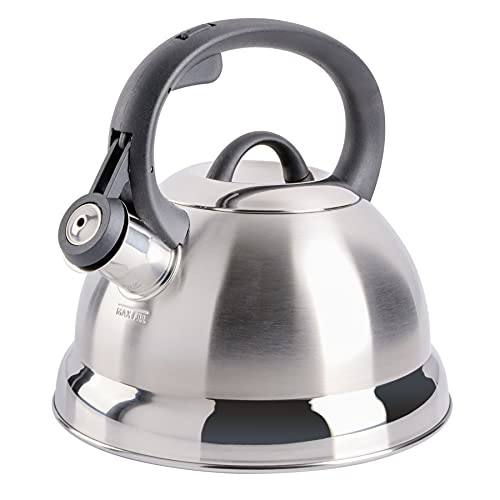
Mr. Coffee Flintshire Stainless Steel Tea Kettle
For households whose honest answer is probably, the Flintshire is the instrument of the experiment: an entry-tier kettle that delivers the complete stovetop experience — whistle, pour, ritual, upkeep and all — so that a season of real use can deliver the verdict no article can. If the season ends in daily use, the household has learned what it values at the lowest possible tuition. If it ends in a cupboard, the lesson cost an entry tier and not a premium one, which is exactly what entry tiers are for.
Best for: households running the probably experiment for a season
Not suited for: households that have already answered yes and want the keeper
Tier: entry. Check price on Amazon.
The Counterfactual Kitchen: Imagining Your Mornings Without One, Properly
Decision advice usually asks people to imagine owning the thing, which is the seller’s favourite exercise, because imagined ownership glows. The sterner and more useful exercise runs the other way: imagine, in concrete detail, the next month of your mornings without a kettle, using whatever you use now, and notice precisely where the friction lives. Walk it hour by hour. The first tea of the day, made in a pan that must be found, filled, watched because it has no voice, and poured with two hands and a prayer over the pot. The coffee water, judged by eye because nothing announces it, and twice a week judged wrong. The evening bottle, filled from a jug that dribbles down its own side onto a dark counter. If that month, honestly imagined, reads as a series of small shrugs — none of it matters much, none of it happens often — then the kettle is not worth it to you, whatever its virtues in other kitchens, and this article releases you from the purchase with its blessing. Buy better tea instead.
But walk the same month and count how often the friction repeats, and a different picture may assemble itself. Friction that occurs once is an anecdote; friction that occurs four times a day is a tax, and taxes are worth buying your way out of when the price is a single durable object. This is why the counterfactual must be a month and not a morning: a single morning can be unrepresentative in either direction, but a month contains your real ratio of rushed days to slow ones, your real count of boils, your real number of delicate teas and cooking waters and bottles. Households that perform this exercise honestly rarely end undecided. The month either indicts their current method often enough to justify the kettle, or acquits it — and either verdict, being drawn from their own evidence, tends to stay made, which is more than can be said for verdicts drawn from other people’s enthusiasm.
There is a second counterfactual, for households replacing a dead electric kettle and tempted to simply buy another: imagine instead the decade in which the replacement is not replaced. Imagine the counter without the cord, the mornings announced by a whistle, the power cut that becomes an anecdote instead of an inconvenience, the small appliance shelf with one fewer object aging toward its failure date. Then imagine, with equal honesty, the mornings in that decade when nobody is home to hear a whistle, and the delicate tea that wants a number, not a judgement. The decade exercise does not crown a winner; it reveals which set of imagined mornings feels more like the life the household is actually living its way into. Worth, at the scale of a kettle, is finally that: not a property of metal, but a fit between an object and a life, tested in imagination before it is tested in money.
Whichever way the exercises conclude, conclude them. The worst outcome in this small category is not the wrong kettle; it is the unmade decision that leaves a household boiling water badly for another year while a solved question sits open on its list. A kettle is a morning object. Decide about it in the morning, with the month in view, and then either buy the one the buying guide in this cluster recommends for your profile, or close the question and spend the money on leaf. Both are victories. Only dithering is a defeat.
What the Money Buys at Each Tier, Translated Into Worth
Since worth is this article’s whole subject, the tiers deserve one explicit translation, because buyers persistently misread what the steps between them purchase. At the entry tier, the money buys the complete function: water boiled, whistle sounded, pour controlled, for years if the kettle is attended. Nothing in the worth-it analysis above — not the ritual, not the recruitment, not the longevity in its basic form — is withheld from the entry buyer. At the mid tier, the money buys ease: handles that forgive tired hands, lids that seat without persuasion, finishes that hide the evidence of a working kitchen, openings that make the owner’s own maintenance lighter. These are worth real money to households that will perform those actions thousands of times, and very little to households that will perform them hundreds of times — which is the frequency principle again, wearing a different hat. At the premium tier, the money buys presence and precision of manufacture: colour that anchors a room, a design that has been thought about by a named mind, tolerances that make every interaction fractionally more satisfying. It buys nothing functional that the tiers below lack, and it should be bought, when it is bought, in that knowledge and without apology, because a household that will look at an object every day for twenty years is not foolish to care how it looks.
The translation cuts the other way for the household still deciding whether the category itself is worth entering. Such a household should notice that the complete experience — every argument in this article, for and against — is available at the entry tier, and that no premium purchase can rescue a household whose rhythm does not fit the object. The expensive mistake in this category is never buying too cheap a kettle. It is buying any kettle, at any tier, for a household that boils rarely, wanders often and fights for its burners — and then blaming the kettle, in a review, for the household’s own arithmetic. Buy the fit first. The tier is a detail the fit will settle for you.
The Verdict Restated, Without the Evidence
Everything in this article can be compressed, for the reader who has absorbed the evidence and wants only its shape, into a single paragraph. A tea kettle is worth it to a household that boils water most days, that can keep a person within earshot of a whistle, that has a hob or the space beside one to give a permanent resident, and that values an object built to be kept. To that household it returns, daily and for years, a better pour, an honest summons, a small ceremony and a near-total exemption from the replacement cycle that governs the rest of the kitchen’s heated objects. It is not worth it to a household that boils rarely, wanders always, fights for its burners or judges a delicate tea by laboratory standards — and to that household its absence returns something equally valuable, which is a clear hob, an unattended boil and money left in the pocket for the leaf itself. Between those households lies a band of probables, and for them the article’s instruments — the checklist, the counterfactual month, the borrowed saucepan — exist to convert a guess into a season’s evidence at the lowest possible cost.
What no reader should take from this page is the idea that the question was ever really about kettles. It is the same question a household asks about the good knife, the cast iron pan, the chair by the window: whether an object that asks a little of you, every day, in exchange for serving you well for a very long time, fits the life you are actually living. Households differ, and their correct answers differ, and the dignity of the question is that both answers are right somewhere. Decide yours from your own month’s evidence, and then — whichever way it falls — enjoy the mornings it produces. They were the point all along.
The Question Behind the Question
It is worth noticing, before the checklist is put away, why this small question generates such long answers — in this article and in every kitchen where it is argued. Nobody writes five thousand words about whether a spatula is worth it. The kettle attracts the argument because it sits at the crossing of three things households care about out of proportion to money: their mornings, their rituals and their relationship with objects that last. To ask whether a kettle is worth it is to ask, in miniature, whether the household wants its days to contain small ceremonies or none, whether it trusts objects that demand attention or prefers objects that demand nothing, and whether it is building a kitchen for a season or for a life. Those are real questions, and the kettle is simply the cheapest available occasion for asking them. That is also why the answers people reach tend to be held with unusual firmness, and why this article has been careful to honour both of them. A household that has decided, consciously, how it wants its mornings to feel has not merely settled a purchase. It has said something true about itself — and the kettle, bought or declined, is just the evidence.
And If You Still Cannot Decide
Then let the tie be broken by the smallest possible experiment, because indecision about a kettle should never cost more than a kettle. Buy the entry-tier stainless model, the one whose loss would be a shrug, and give it a single season of honest use: on the hob, filled to its line, descaled once, its whistle learned. A season is long enough for novelty to die in both directions and for the household’s true rhythm to declare itself in the only evidence that has ever settled this question — the count of its own boils, and the feeling, at the season’s end, of either reaching for the kettle as a fixture or stepping around it as furniture. Keep it, and the experiment has bought a decade at entry prices. Pass it on, and the experiment has bought certainty at the same prices. Either way, the question closes — and a closed question, as this article said at its start, is worth more than a perfect answer arrived at too late to enjoy.
The Fridge-Door Tally: Testing the Case Before You Buy
Borrow, rent, or simulate before you commit if you possibly can, and run the tea kettle through your real week rather than an imagined improved version of it. Keep a plain tally of uses for a month, on paper on the fridge if necessary, because the honest count of actual uses is the number every value judgement secretly depends on. Note what each use replaced: a purchase, a chore done by hand, another appliance’s time, or nothing at all because the job would simply not have happened. Record the minutes the tea kettle saves or costs across a whole session, including setup and cleaning, since value lives in the full cycle and not in the headline moment.
Write down the uses that felt like genuine pleasure rather than mere efficiency, because enjoyment is a legitimate return and pretending otherwise distorts the arithmetic. Ask who else in the household benefits and who merely tolerates the storage, the noise, or the counter space, and count those votes without weighting your own twice. Where a shortlist names specific examples, such as OXO Brew Classic Tea Kettle, run these same checks against that listing line by line rather than assuming the general verdict transfers unchanged. Apply the identical test to Mr. Coffee Flintshire Stainless Steel Tea Kettle as well, on the same day and under the same conditions, because a fair comparison needs one ruler rather than two moods.
- Tally real uses for one full month
- Log what each use actually replaced
- Count full-cycle minutes including cleaning
- Give the space a vote in the decision
- Imagine a breakdown in year two
- Set a decision deadline with a default
Consider the space as a cost with a rent of its own: a tea kettle that earns its footprint weekly is a different proposition from one that squats on it monthly. Think about the season ticket question: whether your interest is a durable habit or a project-shaped enthusiasm that will fade when the project ends. Compare against the honest alternative, which is usually doing the job with what you already own, slowly and imperfectly, rather than against doing it not at all. Imagine the tea kettle breaking in year two and ask whether you would replace it immediately, eventually, or never, since that imagined answer is the cleanest verdict available before buying.
Factor in the learning period without resenting it, but do not let a promise of future ease excuse a present that your tally says is not working. Notice whether you keep finding new jobs for it or keep finding excuses to use it, because the difference between those two patterns is the difference between value and clutter. Give the decision a deadline and a default: if the tally has not persuaded you by that date, the answer is no for now, and no is a complete decision rather than a failure. Revisit the question if your household, space, or routine changes materially, because worth is a property of a match between product and life, not of the product alone.
Write the sentence that would make it worth it, in advance and in numbers you can check, so the verdict comes from evidence you gathered rather than from mood at the checkout. Count the accessories you would genuinely buy alongside it as part of the commitment, since a product that only works with extras is really the bundle, sized as such. Ask whether the same money and space spent on your current setup, on better ingredients, storage, or a repair, would beat the improvement the tea kettle promises. Talk to your future self at the spring clean: will this be in the used-weekly group, the stored hopefully group, or the why-do-we-own-this group, and what in the tally supports that guess?
Accept that a narrow, wholehearted yes for one weekly job is worth more than a broad, lukewarm yes across ten occasional ones. Close the question by deciding what happens to the tool or appliance it replaces, because keeping both forever is often the hidden cost that tips a fair yes into a no. Whatever the category, photograph your intended spot with the neighbouring items in place, because a picture exposes crowding that measurements alone politely ignore. Keep every measurement, tally, and note from these checks in one place, ideally with the receipt, so the next decision in this category starts from your evidence rather than from scratch.
Involve the household early where the product is shared, since a decision everyone helped measure is a decision nobody relitigates at the first inconvenience. Prefer the option that fits your existing routine with the fewest new habits, because each new habit is a small tax collected every single day. Be wary of solving a storage problem by creating a carrying problem, since distance between storage and use is where good equipment goes to be forgotten. Check the return conditions before the trial period begins, and calendar the last safe decision day, so the deadline works for you instead of surprising you.
Frequently Asked Questions
Is a tea kettle worth it if I already own an electric kettle?
Functionally, mostly no; as a pleasure and a backup, sometimes yes. An electric kettle you use happily every day already covers speed and convenience. A stovetop kettle adds a better ritual, a controlled pour, independence during power cuts and an object that will outlast the electric one, but none of those is a need. Buy it only if you can name which of those gains you actually want, and read the direct comparison first so the purchase is a choice rather than a duplication.
How long does a good stovetop tea kettle last?
Years, and for a well-made steel or enamel kettle, plausibly decades, because there is almost nothing in it to fail: no element sealed inside, no electronics, no battery. The parts that age are small and visible — a whistle cap, a handle fixing, a lid seal — and the habits that shorten a kettle’s life are equally visible: repeated dry boils, hard knocks to enamel, and scale left to build for years. Attended and descaled, a kettle is one of the longest-lived objects in a kitchen.
Is a kettle faster than boiling water in a pan?
For the same amount of water, generally yes. A kettle’s shape is designed for the job: a wide base over the heat, walls that keep the heat in the water rather than the room, and a lid that stays on without rattling away. A pan spreads water thin, loses heat at its open or ill-fitting top, and then pours badly at the end of the process. The difference on a single boil is small; across several boils a day, every day, it is the difference between a routine and a chore.
Does a whistling kettle use more energy than an electric one?
The honest answer is that it depends more on your hob and your habits than on the kettle. A gas flame heating a room around a kettle wastes more than an electric element heating only water, while an induction hob driving a kettle is efficient and quick. The largest waste in either system is boiling more water than you need, which is why the practical advice is identical on both sides: fill for the cups you are actually making, to the line and not beyond it.
What size kettle is worth buying for one or two people?
Buy for your largest daily round, not your largest imaginable one. A compact to mid-size kettle that covers a pot for two and a press, filled most of the way most days, heats faster and pours better than a family kettle boiled a third full. Oversized kettles earn their size only in households that regularly boil for a tableful of drinkers or a big cooking pot. If guests are the only reason for the larger size, the saucepan you already own can cover the twice-a-year occasion.
Can a stovetop kettle work on an induction hob?
Yes, if its base is magnetic, which most modern stainless steel kettles are and which is worth confirming on the listing before you buy, because some decorative and glass designs are not induction-ready. Enamel on steel is steel at its core and generally works. The practical test at home is a fridge magnet on the cold base: if it holds firmly, the hob will heat it. Glass kettles need explicit stovetop approval from their maker for any hob type, induction included.