Disclosure: As an Amazon Associate, topratedkitchenware.com earns from qualifying purchases. Links on this page are affiliate links; they cost you nothing extra. Prices and availability change often, so check the current Amazon listing before you buy.
This toaster oven buying guide exists because the category hides its real differences behind function counts and shiny doors: every toaster oven buying guide reader actually needs to know how the machine heats, how big its cavity truly is in meals rather than marketing slices, and which controls they will still enjoy on a tired Tuesday. Get those three right and almost any reputable model will please you. Get them wrong and the most decorated oven in the store becomes counter clutter. The setup and care habits that protect your purchase.
Key Takeaways
- Choose by heating style first: radiant for toast purists, convection for even baking and roasting, air fry models for crisping households.
- Measure your counter and your largest regular dish; interior fit is measured in meals, not slice counts.
- Controls you enjoy daily beat functions you use monthly.
- A front-access crumb tray and a wipeable interior are quality-of-life features, not details.
- Buy the tier that matches your frequency: daily cooks feel premium differences, weekly cooks rarely do.
What a Toaster Oven Does and the Main Types
Radiant Toast-First Ovens
The original design: heating elements above and below, no fan, tuned for toast, bagels, melts and reheats. These ovens are typically compact, fast to preheat and honest in price. Their weakness is evenness in baking and roasting, where still air lets hot spots show. For breakfast-led households they remain a perfectly rational choice, and their simplicity means fewer things to fail.
Convection Ovens
A fan circulates hot air, evening out temperature and usually cooking a little faster and more uniformly. Baking, roasting and reheating all improve, cookies brown across the tray rather than in a map of the elements, and vegetables roast instead of steaming in their own moisture. Convection is the safest default for buyers who want one oven to do a bit of everything well.
Air Fry Ovens
Convection turned up: higher fan speeds and top heat aimed at crisping, with a mesh basket or tray that lets air under the food. These models chase the basket air fryer’s results while keeping the oven’s shape and toast ability. They are the current mainstream for good reason, though they splatter more grease and ask more of your cleaning routine.
Large and Specialty Formats
At the top of the category sit extra-wide ovens that swallow family portions and small roasts, French-door designs that open both doors with one pull, and compact infrared toast specialists that heat almost instantly. Each format solves a specific problem: volume, access, or toast speed. Buy a format for the problem you actually have, not for the novelty.
In this guide
Toaster Oven Buying Guide: Top Picks at a Glance
The picks below are, with badges by role and qualitative tiers instead of prices. Full mini-reviews follow later in this guide.
| Pick | Badge | Tier | Choose it if |
|---|---|---|---|
| Breville Smart Oven Air Fryer Pro | Best Overall | Premium | You cook daily and want breadth plus air fry strength |
| Cuisinart AirFryer Toaster Oven | Best for Air Frying | Mid-to-premium | Crisping is the headline job in your kitchen |
| Panasonic FlashXpress Toaster Oven | Best for Toast | Mid | Breakfast speed and even toast lead your list |
| Hamilton Beach Easy Reach Toaster Oven | Best Access | Mid | Easy reach-in access and simple cleaning matter most |
| BLACK+DECKER 4-Slice Toaster Oven | Best Budget | Entry | You want the honest basics at the lowest commitment |
| Ninja Prestige Smart XL Countertop Oven | Best for Families | Premium | Your small meals are not that small |
Safety Comes First: Fire, Heat and Clearance
A toaster oven is a small box of exposed heating elements, and it deserves the same respect you would give a stovetop burner. The single most important habit is cleaning: crumbs and grease are fuel. Empty the crumb tray often, wipe grease splatter from the interior walls before it bakes into a hard, smoky film, and never let drippings pool under the elements. A clean oven is not just tidier, it is measurably safer, because the material most likely to catch or smoke is simply not there anymore.
Never leave a toaster oven running unattended. Toast can go from golden to smoking in well under a minute once it passes its peak, and fatty foods can flare when drippings meet a hot element. Stay in the kitchen while it runs, keep an eye on dark or sugary foods in their final minute, and treat any smoke as a signal to switch the unit off and let it cool with the door closed rather than fanning it open.
Keep the area around the unit clear. Paper, paper towels, dishcloths, wooden utensils, cookbooks and plastic containers should never sit on top of the oven or pressed against its sides, because the exterior gets genuinely hot and vents need room to breathe. Follow the clearance guidance in the manual for your model, leave space behind and above the unit, and never run it tucked under a low cabinet overhang with towels draped nearby. Before any cleaning, unplug the oven and let it cool fully; a warm oven is a burn risk and a shock risk once water enters the picture. Finally, use oven mitts whenever you reach in or pull a tray out. The door, the rack edges and the top of the cavity stay hot long after the timer ends, and most toaster oven burns happen in the thirty seconds after cooking, not during it.
Food choice matters too, at the principle level. Never put oversized items in the cavity, never cook food sealed under tight covers or in closed containers that can build pressure or touch the elements, and keep anything flammable well away from the heating elements themselves. If a dish does not fit with clear space around it on every side, it belongs in the full-size oven instead. That one judgment call prevents most of the scorch marks, smoke alarms and ruined dinners associated with this appliance.
How Much Capacity Do You Actually Need?
Ignore slice counts, which measure a manufacturer’s optimism about bread geometry. Think in your real dishes: the small baking dish you use twice a week, the frozen pizza size your household actually buys, the two chicken thighs plus vegetables that make your standard dinner. The cavity must fit that dish with clear space around it on every side, because air needs to move for even cooking and food must never crowd the elements. Bring the dish’s measurements when you shop, in person or on a listing, and compare them with interior dimensions rather than exterior ones. Then stop: one size up from your regular maximum is headroom; two sizes up is counter rent paid daily for a hypothetical holiday.
Which Heating Style Matches Your Cooking?
Toast and reheats dominate: radiant or infrared specialists give the fastest, most even results for that narrow job. Baking and roasting dominate: convection’s moving air is worth more than any other single feature. Crisping dominates: choose a true air fry model with a proper mesh tray and accept the extra cleaning. Mixed cooking with no dominant job: convection again, as the best compromise. Be honest about dominance; most households have one, and buying for the fantasy rotation of all three equally is how ovens end up mediocre at the job that mattered.
How Much Do Controls Matter Day to Day?
Enormously, and more with every month of ownership. Dials are fast, tactile and glove-friendly, and they suit toast-led routines beautifully. Digital controls give precise temperatures, presets and timers that suit bakers and anyone who cooks by repeatable settings. Touch panels look sleek and wipe clean but can frustrate wet or floury hands. The right question is not which is best but which your household will operate half-awake at breakfast and distracted at dinner. A preset you use daily is a feature; twelve functions you never touch are decoration, and decoration should never outrank a crumb tray you can reach.
How Easy Is It to Clean, Really?
Judge cleaning by design, not promises. A crumb tray that slides out from the front without opening the door gets emptied; one that requires gymnastics does not. Smooth interior finishes release film better than textured ones. Racks and pans that fit your sink and tolerate soaking save weekly minutes. Air fry models need a mesh tray you can scrub without destroying. Read the cleaning section of any manual before buying if you can, and weight this criterion heavily: in long-term owner satisfaction, ease of cleaning quietly beats almost every cooking feature, because it decides whether the oven stays pleasant or becomes the smoky box everyone avoids.
How to Prioritise by Use Case
The breakfast household: toast evenness, preheat speed, compact footprint, in that order; the Panasonic class exists for you. The weeknight dinner household: convection evenness, capacity for a small dish plus vegetables, controls with a reliable timer; mid-tier convection models are your centre of gravity. The crisping household: air fry strength, mesh tray quality, and cleaning access, because you will clean more than anyone. The small-space household: exterior dimensions and clearance first, then a ruthless audit of which functions survive; a compact radiant or infrared oven used daily beats a large multi-function oven stored in a cupboard, every single time.
Keep exploring with these related guides from this series: how to clean a toaster oven, step by step, whether a toaster oven is worth it, toaster oven pros and cons in full, our in-depth toaster oven review, our roundup of toaster oven reviews.
The Picks in Detail

Breville Smart Oven Air Fryer Pro
The reference point for the category’s top end: a generous cavity, strong and even heating across toast, bake and air fry work, and controls that make its breadth genuinely usable rather than decorative. It suits daily cooks who will exploit that breadth, and its size demands a counter that can welcome it permanently. Owners consistently treat it as a second oven rather than a gadget, which is the highest compliment this category offers.
Best for: cooks whose priorities match the strengths described above. Not suited for: kitchens where its size, tier or control style fights the space or the cook. Tier: premium positioning in its class; check price on Amazon when you are ready to compare current listings.

Cuisinart AirFryer Toaster Oven
Built around crisping: assertive air fry performance in an oven shape that still toasts, bakes and broils credibly. It is the pick for households whose frozen foods, wings and roasted vegetables outnumber their casseroles. The air fry focus means more interior splatter than gentle ovens, so its cleaning routine is part of the deal, and cooks who accept that trade get the crispest results in this line-up.
Best for: cooks whose priorities match the strengths described above. Not suited for: kitchens where its size, tier or control style fights the space or the cook. Tier: mid-to-premium positioning in its class; check price on Amazon when you are ready to compare current listings.
Panasonic FlashXpress Toaster Oven
The toast specialist: fast radiant heat that starts almost immediately and browns with a consistency slice-count ovens struggle to match, in a compact body small kitchens can actually house. Its cavity is modest, so roasting ambitions should look elsewhere, but for breakfast-led and reheat-led households it performs its narrow job superbly and asks very little counter for the privilege.
Best for: cooks whose priorities match the strengths described above. Not suited for: kitchens where its size, tier or control style fights the space or the cook. Tier: mid positioning in its class; check price on Amazon when you are ready to compare current listings.

Hamilton Beach Easy Reach Toaster Oven
The access champion: a roll-top door that lifts away from the food instead of dropping into the work zone, making loading, checking and cleaning noticeably easier, especially for cooks who dislike reaching over a hot door. Performance is honest mid-tier convection-class cooking for everyday meals, and for many households the daily ergonomics outweigh small differences in browning charts.
Best for: cooks whose priorities match the strengths described above. Not suited for: kitchens where its size, tier or control style fights the space or the cook. Tier: mid positioning in its class; check price on Amazon when you are ready to compare current listings.
BLACK+DECKER 4-Slice Toaster Oven
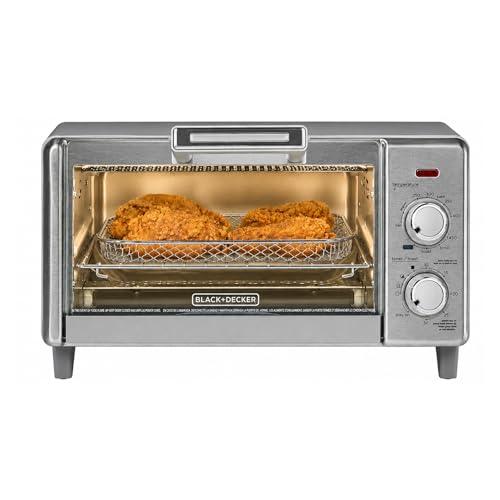
The category’s honest baseline: toast, bake, broil and reheat in a compact, simple machine at an entry tier. Controls are basic, finishes are functional, and capacity suits one or two people. It is the right buy for first apartments, offices, and anyone testing whether the category fits their life before committing more money and more counter.
Best for: cooks whose priorities match the strengths described above. Not suited for: kitchens where its size, tier or control style fights the space or the cook. Tier: entry positioning in its class; check price on Amazon when you are ready to compare current listings.

Ninja Prestige Smart XL Countertop Oven
The volume pick: a wide cavity aimed at family-sized small meals, sheet-pan-style cooking and households whose portions broke standard toaster ovens. It blurs toward the countertop oven category in the best way, handling bigger trays while keeping countertop convenience. The footprint is the commitment; kitchens that can house it gain the closest thing to a true second oven in this guide.
Best for: cooks whose priorities match the strengths described above. Not suited for: kitchens where its size, tier or control style fights the space or the cook. Tier: premium positioning in its class; check price on Amazon when you are ready to compare current listings.
First Setup and Care Essentials
Unbox onto a clear counter, confirm the clearance on every side that the manual specifies, and keep paper, towels and flammables away from the top and sides from the very first day, because habits set at setup persist. Wash the rack, pan and tray before first use, run the empty oven once as the manual directs to clear manufacturing residues, and do the toast-map test: a full rack of bread slices, toasted and read like a chart, tells you where the hot spots live. Start the crumb tray routine immediately, unplug and cool fully before interior wiping, and use mitts for every tray pull, since the door and rack edges stay hot long after the timer sounds. Never leave the oven running unattended, never force oversized or covered dishes into the cavity, and your new appliance will cook evenly and safely for years.
Keeping It Clean So It Keeps Cooking Well
Routine care is short and unglamorous: slide the crumb tray out after toasting sessions and empty it before crumbs mound up, wash the rack and pan in warm soapy water when grease appears, and wipe the interior walls with a damp cloth once the oven is unplugged and fully cool. Melted cheese and sauce splatter come off far more easily the same day than a week later, when they have been reheated into varnish. A paste of baking soda and water, applied gently and left to sit, loosens baked-on film without scratching; avoid abrasive pads on coated interiors and never spray cleaner directly onto heating elements.
The glass door deserves its own pass, because a clear door is a cooking tool: you judge toast and browning by eye, and a fogged door leads to guesswork and burnt edges. Wipe the inside of the glass once it is cool, and clean the exterior with a soft cloth so fingerprints and steam marks do not bake on. Check the door seal and hinges as you go; a door that no longer closes squarely leaks heat and cooks unevenly, and catching that early tells you whether the oven needs attention or replacement.
For the full method, including deep-clean steps for stubborn grease and safe ways to deal with smoke smells, follow how to clean a toaster oven, step by step rather than improvising with harsh chemicals. The principle is always the same: unplugged, fully cool, gentle tools, patience over force. Ten unhurried minutes once in a while beats an hour of scrubbing a neglected oven, and a clean cavity cooks more evenly, smells neutral, and removes the fuel that fire safety rules worry about in the first place.
Mistakes to Avoid When Buying
Buying by exterior dimensions and discovering the interior will not take your dish. Buying by function count and discovering you use three. Ignoring the crumb tray’s access until the first smoky month. Forgetting clearance, then parking the oven against a wall or under a low cabinet with towels on top. Choosing a finish your cleaning habits cannot support. And the classic: buying the oven your aspirational self wants for the cooking your actual self does. The fix for all six is the same unglamorous discipline: measure the space, name your top three jobs, and let those two lists overrule the showroom.
For more depth before you decide, see also toaster oven vs countertop oven, compared, related guide, related guide, related guide, related guide.
Reading Specifications Without Being Fooled
Specification sheets in this category reward scepticism. Capacity stated in slices measures a manufacturer’s optimism, not your casserole; capacity stated as interior dimensions is the number to trust, checked against your own dish with clearance around it. Function lists count modes, not quality: an oven with three modes executed evenly will out-cook a twelve-mode oven with hot spots every single week. Temperature ranges matter less than temperature honesty, which no sheet can prove and which is why owner patterns and the toast-map logic in this guide matter more than printed numbers. When a listing leads with its longest number rather than its interior dimensions and tray access, it is telling you what it is proud of, and it is not cooking.
Power figures deserve the same calm treatment. Higher draw generally means faster recovery and fiercer top heat, but in a compact cavity the tuning of elements and reflectors decides results more than raw muscle does, and this guide deliberately avoids pinning numbers to individual models, because the honest comparison is performance in the jobs, not arithmetic on the box. Judge by what the oven does to bread, vegetables and frozen food in the accounts you trust, and let the specification sheet confirm fit and features rather than crown winners.
Doors, Racks and the Details That Age Well
Doors are the moving part you will touch thousands of times, so judge them like a handshake. A good door closes squarely, seals evenly, and opens without a clang or a wobble; a poor one leaks heat at a corner and slowly teaches you to rotate every dish. Drop-down doors double as a landing shelf and a crumb catcher; roll-top and French-door designs trade that shelf for access and clearance. Racks should slide smoothly, sit level under weight, and offer enough positions to manage distance from the top element, which is the working baker’s most-used adjustment. Pans should be rigid enough not to twist when hot and sized to the cavity rather than rattling inside it.
Feet, cords and controls age quietly. Non-slip feet keep the oven planted when a rack slides; a cord of sensible length reaches the outlet without draping across the work zone; controls with clear markings survive years of greasy fingertips better than faint printed legends. None of these details photographs well, and all of them decide whether year three with the machine feels like year one or like a slow negotiation with a tired appliance. In the shop, open the door, slide the rack, turn the dial. Your hands will file the most reliable review you will ever read.
Warranty, Support and the Long View
In a category built on heating elements and thermostats, support matters in proportion to tier. Premium prices partly buy better doors and evenness, and partly buy a maker who answers, stocks parts like racks and pans, and honours claims without theatre. Before buying, check that replacement racks, pans and crumb trays for the model are actually obtainable, because those are the parts that wear, warp and wander off, and an oven orphaned by its own accessories is a waste of an otherwise sound machine. Keep the manual, physical or digital, because its clearance figures, cleaning limits and element guidance outrank every general guide, including this one.
Think, too, about who else will use the oven. Households with several cooks benefit from controls that explain themselves and from a machine whose quirks are few; a household of one can happily learn a more idiosyncratic instrument. Rental kitchens and shared houses argue for the robust middle of the market, where performance is real and replacement is painless. The long view is not about buying forever; it is about buying the machine whose whole life, support, parts, cleaning, other users, fits the household it is entering.
A Shortlist Method You Can Run in Ten Minutes
Write down your top three jobs and your largest regular dish. Measure the counter spot with clearance. Set your tier by frequency: daily means mid or premium, weekly means entry or mid, monthly means reconsider buying at all. Eliminate every model whose interior fails the dish or whose footprint fails the spot, without nostalgia. From the survivors, choose by cleaning design first and controls second. That method, run honestly, produces a shortlist of one or two machines from any retailer’s wall of forty, and it has the great virtue of being finished before enthusiasm or salesmanship can spend your money for you.
Finally, sanity-check the survivor against the safety basics you will live with: a permanent spot away from paper, towels and flammables, clearance that survives real kitchen clutter, a crumb tray you can reach without moving the oven, and a door you can open fully with a tray in your hands and mitts on. If the machine passes your kitchen’s geography as comfortably as it passes its cooking tests, you have found your oven. Buy it, set it up once and properly, and let the toast map be your first and most enjoyable homework.
Matching the Oven to the Cookware You Own
Your existing kitchenware is a specification sheet you already own. The small casserole, the quarter sheet pan, the loaf tin and the ramekins that carry your actual cooking must fit the cavity with clearance, or the oven will spend its life cooking around your habits instead of inside them. Measure the two or three pieces you use weekly and treat them as non-negotiable gatekeepers at purchase time. Buyers who do this discover, occasionally, that their beloved dish is a centimetre too proud for the entire standard class, and that single discovery, made before purchase, is worth the whole measuring exercise; made after purchase, it is a return, a resentment, or a dish quietly exiled to the back of a cupboard.
The same logic applies in reverse after purchase: a small, well-chosen piece of bakeware sized to the oven multiplies its usefulness more than any accessory bundle. A pan that fits the rack properly, a small dish that leaves air room around it, and a rack-friendly tray for reheats turn the oven from a toast appliance into the household’s small-meal engine. When you budget for the oven, hold a little back for the one or two pieces that will let it do its best work, because fit, in this category, is a feature you can buy separately and cheaply.
Buying for Someone Else
Toaster ovens are gifted often, to students, first-home couples and parents, and the buying rules shift slightly in the giver’s hands. Favour simplicity over repertoire: controls that explain themselves, a size matched to the recipient’s household rather than your own, and cleaning design that forgives a beginner’s habits. Include the unglamorous companions, mitts that live beside it and a note with the three safety habits that matter most: clearance and clear surfaces, tray emptied often, never left running unattended. A gifted appliance that arrives with its safety culture attached is a better gift than a larger model that arrives as a mystery, and the recipient’s first month, the month that decides whether any oven becomes infrastructure, will go measurably better for it.
Seasonal and Second-Hand Buying Notes
The category’s retail rhythm rewards patience at the usual moments, when new models arrive and outgoing ones are cleared, and when holiday demand briefly rearranges the shelves. The disciplined buyer uses those moments to buy the already-chosen model at a better tier rather than to choose a different model under time pressure, because a discount on the wrong oven is still the wrong oven at a lower price. Keep the shortlist method from this guide in charge of the decision and let the calendar merely negotiate on its behalf. That order of operations, decision first, timing second, is the whole art of buying appliances well.
Second-hand, the category is friendly territory with the checks already described in this guide’s spirit: door alignment, element glow, complete trays and racks, and a deep clean before first use. Simpler models age best in the used market, because their virtues are mechanical and visible, while heavily featured models hide their wear in electronics you cannot inspect on a doorstep. A sound used mid-tier oven, matched to your dish and your counter, is not a compromise purchase; for weekly cooks it may be the most rational route into the category that exists, and it leaves budget for the bakeware that makes any oven, new or used, perform at its best in your kitchen.
The Guide’s Final Checklist
Before any purchase, confirm each line out loud. The interior fits my largest regular dish with clearance. The exterior fits my measured spot with the maker’s clearance on every side, and nothing flammable will live on or near it. The heating style matches my dominant job. The crumb tray slides out from the front and the interior finish suits my cleaning habits. The controls please the hands that will use them at breakfast. The tier matches my frequency. Replacement racks and pans exist. I will place it permanently, keep it attended while it runs, use mitts for every hot tray, and empty the tray from the first week. An oven bought against that checklist is not a gamble; it is a plan, and plans are what buying guides are for.
How Retail Displays Mislead, and How to Shop Anyway
Showrooms flatter the wrong variables. Under bright lights, finishes gleam that will fingerprint by Friday; beside identical neighbours, sizes blur that will dominate a real counter; and a wall of ovens all toasting nothing tells you nothing about the one job that reveals tuning. Shop against the display’s grain. Bring your dish’s measurements and your counter’s, in writing, because memory negotiates and numbers do not. Open doors and slide racks with your own hands. Find each crumb tray and mime its removal. Ask where the replacement pans live, in the store or in a catalogue, and treat a vague answer as information. If a salesperson steers by slice counts and function totals, smile and return to your list, because your list was written in your kitchen, where the oven will actually live, and the showroom’s list was written to move the showroom’s stock.
Online, the same discipline wears different clothes. Filter by interior dimensions where the site allows it, read the manual’s clearance and cleaning pages before the reviews, and weight owner comments about trays, doors and smoke above owner comments about features, because the former describe year two and the latter describe week one. Photographs of the oven in real kitchens, counters crowded and all, are worth a page of studio shots. And when two finalists remain stubbornly equal, choose the one whose cleaning design you prefer, on the principle repeated throughout this guide: in long ownership, the machine you keep clean is the machine that keeps cooking well, and every other difference fades behind that one.
After the Purchase: The First Fortnight, Planned
A buying guide owes its reader the landing as well as the takeoff. Day one: placement with clearance, parts washed, empty run done, manual’s key pages read, especially cleaning limits and element guidance. Day two: the toast map, a full rack of slices whose browning pattern you photograph or sketch and keep, because it will inform every placement decision for years. The first week: your real rotation cooked deliberately, one bake, one roast, one reheat, one messy job, with timings noted against your old oven’s habits so the recalibration is written rather than remembered. The second week: the first tray emptying and interior wipe performed while both are still easy, cementing the rhythm before the first film can form. A fortnight run this way converts a purchase into an appliance, and an appliance into infrastructure, and it costs nothing but the attention you were going to spend anyway on learning a new machine’s moods.
Understanding the Category’s Price Ladder in Words
Since this guide trades in tiers rather than figures, here is what each rung actually buys, stated plainly. The entry rung buys the category itself: toast, small bakes, reheats and the knowledge of your own frequency, in functional finishes with basic controls. The mid rung buys refinement where daily hands feel it: more even heat, better doors and racks, clearer controls, interiors that clean more kindly. The premium rung buys the extremes of the distribution: the broadest repertoire executed evenly, the strongest crisping or the largest capacity, build that shrugs off a decade of daily use, and support that treats parts as a promise. Nothing on any rung buys a different category, and that is the ladder’s most useful secret: a household climbing it is buying degrees of the same good thing, which means stopping at the rung your frequency justifies is not settling. It is the definition of buying well, and it is available at every rung to anyone who measured first.
The Guide in One Breath
If the whole of this buying guide had to survive as a single paragraph on a shopper’s phone, it would read as follows. Decide the heating style by your dominant job, convection for the mixed kitchen, air fry for the crisping one, radiant for the breakfast one. Size the interior by your largest regular dish with air room around it, and the exterior by your measured counter with the maker’s clearance, and let either measurement veto without appeal. Demand a front crumb tray and an interior your cleaning habits can love, choose controls your tired hands enjoy, and set the tier by how often you cook, daily handsomely, weekly modestly. Place it permanently, keep its top and sides clear of everything flammable, attend it while it runs, mitt every hot tray, and start the tray habit in the first week. An oven bought and kept on those terms will not merely satisfy; it will disappear into the routine of a kitchen that cooks more, waits less and thinks about its oven hardly at all, which is the precise definition of a purchase that worked.
One More Distinction: Buying for Now Versus Buying for Keeps
Some purchases in this category are honestly temporary: the flat year’s oven, the office’s oven, the probe bought to learn a household’s frequency. For those, the entry and mid tiers are not compromises but correct engineering of the decision itself, and durability beyond the intended horizon is value paid for and never collected. Other purchases are for keeps: the family kitchen’s second oven, the daily driver’s decade-long post. For those, build, parts and support deserve their premium, because the cost of the machine is divided by thousands of breakfasts. Naming which purchase you are making, before the tiers start their persuasion, is the buying guide’s final discipline. Temporary money spent as permanent money is waste; permanent service expected from temporary money is disappointment. Both errors are common, both are avoidable in one honest sentence spoken before the shopping starts, and the sentence is simply: this oven is for now, or this oven is for keeps.
Before You Order: A Fit-and-Routine Worksheet for the Toaster oven
Start this worksheet with the space, not the product page: measure the exact spot where the toaster oven will live, including the clearance above it, the swing or reach you need in front of it, and the route you will take to move it for cleaning. Write down the largest item you realistically expect to use with it, because that single measurement settles more sizing arguments than any capacity figure printed in a listing headline. Check the nearest outlet and be honest about whether a cord will cross a walkway, a sink edge, or another appliance that also needs that socket on busy mornings. Count the people the toaster oven must serve on an ordinary weekday, then count again for the busiest gathering you host in a typical year, and notice whether those two numbers point to the same size.
List the three jobs you will ask of it every week and the one job you will ask only a few times a year, because the weekly jobs should drive the decision and the rare job should not. Decide where the accessories, attachments, and spare parts will be stored before you order, since a toaster oven whose extras live in a distant cupboard quietly becomes a toaster oven with fewer features. Where a shortlist names specific examples, such as Breville Smart Oven Air Fryer Pro, run these same checks against that listing line by line rather than assuming the general verdict transfers unchanged. Apply the identical test to Cuisinart AirFryer Toaster Oven as well, on the same day and under the same conditions, because a fair comparison needs one ruler rather than two moods.
- Measure the working spot and the clearance around it
- Count weekday servings and the biggest gathering
- List the three weekly jobs in writing
- Decide storage for every accessory in advance
- Name the one compromise you accept knowingly
- Set the return deadline in your calendar
If Panasonic FlashXpress Toaster Oven is also in contention, give it the same worksheet and let the three sets of answers sit side by side before anyone reaches for a checkout button. Think about who else in the household will use it, including anyone shorter, anyone with less grip strength, and anyone who will clean it without reading the manual first. Note the surfaces it will touch in normal use and whether heat, moisture, weight, or vibration from the toaster oven could mark, stain, or stress those surfaces over months of daily contact. Plan the cleaning position as carefully as the working position, because a toaster oven that is awkward to carry to the sink or to open fully will be cleaned less often than it should be.
Write the three questions you still cannot answer from listings and guides, and treat those unanswered questions as your shortlist filter rather than as details to discover after delivery. Compare the footprint against the appliance or tool it replaces, and decide in advance what leaves the room if the new arrival is larger than the old one. Consider the noise, steam, heat, or light it produces in use and whether that output lands in a room where someone sleeps, works, or studies at the same hours. Check how it behaves at the smallest task, not only the largest, because many households abandon oversized gear that feels clumsy for the quick everyday job.
Think through the second week of ownership, when the novelty has faded, and ask which features you will still touch daily and which were only interesting in the showroom sense. Decide what good enough looks like in writing: the result you would accept without complaint, the result that would delight you, and the result that would send the box back. Look at the controls with fresh eyes and imagine using them with wet hands, greasy hands, or gloves, depending on the work, because small controls punish exactly those moments. Ask how the toaster oven fails gracefully: whether a worn part, a lost attachment, or a single broken control ends its usefulness or merely removes one mode you rarely used.
Check whether replacement parts and consumables are ordinary, widely stocked items or proprietary pieces tied to one maker, since that difference compounds over years of ownership. Measure the storage shelf, drawer, or cupboard you intend to use with the door closed and other contents in place, not the optimistic empty version of that space. Think about guests and helpers who will meet the toaster oven without your habits, and whether its safe, correct use is obvious to a newcomer within a minute of looking at it. Write down the one compromise you are consciously accepting, so that when it shows up in daily use it reads as a chosen trade rather than a nasty surprise.
Revisit your shortlist after the worksheet is done and delete any option that fails a measurement, because a tape measure is a cheaper teacher than a returns process. Whatever the category, photograph your intended spot with the neighbouring items in place, because a picture exposes crowding that measurements alone politely ignore. Keep every measurement, tally, and note from these checks in one place, ideally with the receipt, so the next decision in this category starts from your evidence rather than from scratch. Involve the household early where the product is shared, since a decision everyone helped measure is a decision nobody relitigates at the first inconvenience.
Prefer the option that fits your existing routine with the fewest new habits, because each new habit is a small tax collected every single day. Be wary of solving a storage problem by creating a carrying problem, since distance between storage and use is where good equipment goes to be forgotten. Check the return conditions before the trial period begins, and calendar the last safe decision day, so the deadline works for you instead of surprising you. Judge the packaging and unboxing only once, briefly, and then ignore them, because they are the one part of ownership guaranteed never to repeat.
Frequently Asked Questions
What is the best type of toaster oven for most people?
A convection model of moderate size is the safest default, because moving air improves baking, roasting and reheating evenness across the widest range of food, and moderate size fits the small dishes most households actually cook. Move toward an air fry model if crisping dominates your cooking, toward a compact radiant or infrared model if toast and reheats dominate and space is tight, and toward the large formats only when your regular portions genuinely demand them. The best type is the one matched to your dominant job.
How do you know what size to buy?
Measure your largest regular dish and your intended counter spot, then match interior dimensions to the dish with clear space around it and exterior dimensions to the spot with the maker’s clearance on every side. Ignore slice counts entirely. If your regular maximum is toast and reheats for two, the compact class suffices. If it is a small casserole or a family frozen pizza, you need the larger class. Buying one size above your regular maximum gives headroom; buying two sizes above rents counter to a hypothetical.
Are digital controls worth it over dials?
They are worth it if you bake by repeatable temperatures, use timers heavily, or cook the same dishes often enough to value presets. Dials remain faster and more tactile for toast-led routines and are less likely to frustrate wet or floury hands. Neither is objectively better; the right choice is the interface your household will operate confidently when tired and distracted. If in doubt, prioritise a clear display or positive dial detents and a timer you can set without reading a manual.
Do you need an air fry function?
Only if crisping is a regular part of your cooking: frozen foods, wings, breaded items and roasted vegetables several times a month or more. In that case a true air fry model with a mesh tray earns its premium and may retire a separate basket appliance. If your cooking is mostly toast, gentle bakes, melts and casseroles, convection alone serves you well and the air fry premium buys splatter and cleaning you did not need. Decide from your last month of actual meals.
What features matter most for easy cleaning?
A crumb tray that slides out from the front, smooth interior finishes, racks and pans that fit your sink, and, on air fry models, a mesh tray that tolerates scrubbing. Door design matters too: doors that open away from the cavity make wiping easier. These features decide long-term satisfaction more than most cooking functions, because a clean oven cooks evenly, does not smoke, and stays safe, while a neglected one degrades on all three counts at once.
How much should you spend on a toaster oven?
Spend in proportion to frequency. Daily cooks feel the difference that mid and premium tiers buy: more even heat, better controls, sturdier doors and racks, and easier cleaning. Weekly cooks are usually served fully by the entry and lower-mid tiers, whose cooking is honest even if their finishes and features are simpler. In every tier, protect the basics first: fit, heating style and cleanability. A well-matched entry oven used daily is a better purchase than a mismatched premium oven used monthly.
Buying Guide Bottom Line
Heating style, true fit and controls you enjoy: decide those three with your real meals in mind, let cleaning design break ties, and the market’s noise falls away. The right toaster oven is the one that disappears into your routine, and routines are built from fit, not features.