Disclosure: topratedkitchenware.com is reader-supported. When you buy through links on our site, we may earn an affiliate commission from Amazon and other retailers, at no extra cost to you.
Where to buy
Cooking with chopsticks is a different job from eating with them: heat, oil, steam and timing all enter the equation, and the best material for cooking chopsticks is the one that survives the stove while serving the cook. This guide’s verified pool is stainless steel, and the six sets below are judged as cooking materials — how the alloy behaves near heat, how the tips grip food in a pan, how the finish handles oil and washing-up. We will be honest about steel’s two famous caveats, heat conduction and nonstick pans, and equally honest about why wood, bamboo and fiberglass — the classic cooking materials, assessed in the buying guide — each carry caveats of their own.
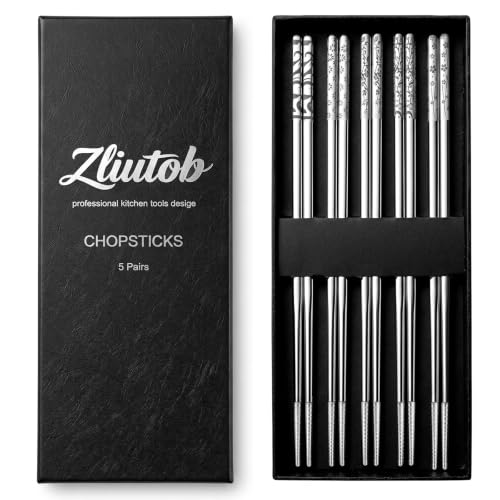
- Zliutob Stainless Steel Chopsticks, 5 Pairs — textured tips and square grip for control in the pan.
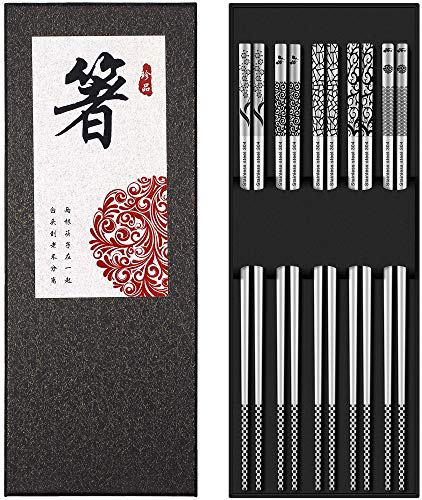
- LIXTONGR Dragon & Phoenix Black Stainless Steel Chopsticks, 2 Pairs — 18/10 steel at 9 inches, for plating straight from the pan.
- MUYOS Stainless Steel Chopsticks, 5 Pairs — hollow-core lightweight, a natural whisking and turning tool.
- Greatamzor Multicolor Stainless Steel Chopsticks, 5 Pairs — color-coded pairs for raw-and-cooked separation, 9 1/4 inches.
- Greatamzor Titanium Plated Stainless Steel Chopsticks, 2 Pairs — plated finish over a steel core that tolerates stove-side work.
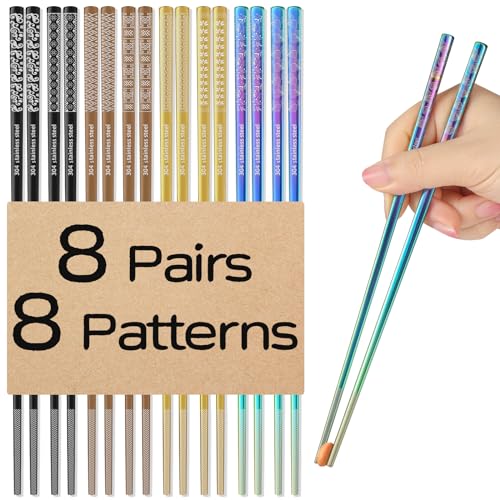
- NEWDRIP Multicolor Metal Chopsticks, 8 Pairs — explicitly listed for cooking and eating, 9.25 inches.
Read the full guide ↓ for the heat question every cooking material must answer, a method-by-method matching of materials to pans, and the technique rules that make steel safe and effective at the stove.
Watch a skilled cook work a wok or a skillet and the chopsticks never stop moving: turning dumplings so each face crisps, separating noodles before they clump, whisking eggs in the bowl, fishing a single piece out to test doneness, arranging the finished dish without a spatula in sight. Cooking chopsticks are a cook’s fingers, extended — and like fingers, they work close to heat, which is why the material question here is dominated by one variable the eating guides can ignore: temperature.
Each classic material answers the heat question differently. Wood and bamboo insulate beautifully, which is why the iconic long cooking chopstick is wooden — but they char, absorb frying oil, and die young in dishwashers. Fiberglass composites tolerate serious heat without insulating quite as well, and have become the modern professional compromise. Melamine and plastics simply leave the conversation where real heat is involved. Stainless steel, this pool’s material, takes the opposite trade from wood: it cannot burn, melt, absorb oil or splinter, and it goes straight in the dishwasher after a frying session — but it conducts, so a pair left resting in a hot pan warms up, and its hardness demands respect around nonstick coatings.
One more honesty note shapes everything below: length. The classic cooking chopstick is long — well beyond dining length — because distance is the cheapest heat protection. The sets in this verified pool are dining-length pairs (9 to 9 1/4 inches where lengths are stated), and this guide treats them as what they are: stove-adjacent tools for the turning, whisking, separating, serving and plating work that makes up most home cooking with chopsticks, not deep-fryer instruments. Within that honest brief, material choice is a rich question, and steel’s answer is stronger than its reputation suggests.
Key Takeaways
- For cooking, stainless steel’s decisive advantages are that it cannot burn, melt, char, absorb oil or splinter — and it can be dishwashed after the greasiest session, unlike wood and bamboo.
- Steel’s caveats are real: it conducts heat (do not leave a pair resting in a hot pan) and it can scratch nonstick coatings (match it to steel, cast iron or carbon steel pans, or use it for serving and plating).
- Tip texture matters at the stove as much as at the table: engraved and textured tips grip oily, slippery food that defeats smooth sticks — and a dedicated raw/cooked color system, like the multicolor pick, is a genuine safety feature.
- The classic alternatives keep real crowns: wood insulates best, fiberglass balances heat tolerance and lightness — the comparison is developed alongside Best Material For Reusable Chopsticks, where long service under washing is the theme.
- Length is the boundary of this pool: these are dining-length pairs for stove-adjacent work, and the guide says plainly where a dedicated long cooking pair remains the right tool.
- One pick — the NEWDRIP eight-pair set — is listed by its maker for cooking and eating outright; the others earn their place as steel cooking tools for turning, whisking, serving and plating.
In this guide
Quick Picks
| Pick | Badge | Cooking strength | Link |
|---|---|---|---|
| Zliutob Stainless Steel Chopsticks, 5 Pairs | Best Stove-Top Control | Textured tips and square grip for turning food in the pan | Check on Amazon |
| LIXTONGR Dragon & Phoenix Chopsticks, 2 Pairs | Best for Plating From the Pan | Short, precise 18/10 pair for arranging hot food | Check on Amazon |
| MUYOS Stainless Steel Chopsticks, 5 Pairs | Best for Whisking and Turning | Hollow-core lightness for fast, repeated motions | Check on Amazon |
| Greatamzor Multicolor Stainless Steel Chopsticks, 5 Pairs | Best for Raw/Cooked Separation | Color coding keeps a raw-meat pair and a cooked-food pair apart | Check on Amazon |
| Greatamzor Titanium Plated Chopsticks, 2 Pairs | Best Heat-Side Finish | Hard plated surface over an unbothered steel core | Check on Amazon |
| NEWDRIP Multicolor Metal Chopsticks, 8 Pairs | Best Listed for Cooking | Maker lists it for cooking and eating; eight pairs for a busy stove | Check on Amazon |
How These Picks Were Chosen
We assessed the verified pool as cooking materials, in the order a cook would. First, heat behavior: the material must tolerate stove-side work without degrading — stainless steel passes absolutely, with the conduction caveat managed by technique. Second, grip in the pan: oily, wet, moving food demands textured or engraved tips, and every pick here has a treated surface. Third, the aftermath: a cooking tool that cannot be aggressively cleaned is a hygiene problem, so the dishwasher-safe listings mattered. Fourth, control: weight and profile decide whether a pair can turn, whisk and separate for a whole session.
We were equally deliberate about what these picks are not. None is a dedicated extra-long cooking chopstick, and the guide does not dress them up as such; the cooking they serve is the everyday kind — stir-fries, dumplings, noodles, eggs, serving and plating — where dining-length steel is genuinely excellent. One pick’s listing names cooking outright; the others are assessed as steel tools whose material suits those tasks, with their dining-first design stated plainly.
This is a research-led guide based on verified listings. No heat tests were invented, no temperature figures are quoted for any product, and the spec boxes contain only what the listings state. Material behavior described in the guide sections is the standard, well-established conduct of steel, wood, bamboo and fiberglass around heat and oil.
The 6 Best Steel Chopsticks for Cooking Work

Zliutob Stainless Steel Chopsticks, 5 Pairs
Badge: Best Stove-Top Control
- Material: Stainless steel (grade not stated in the listing)
- Pairs: 5
- Tips: Textured, for grip
- Profile: Square grip section
- Care: Dishwasher safe; reusable
- Stated uses: Sushi, ramen and daily meals
Strengths
- Textured tips hold oily, moving food — the exact failure point of smooth sticks in a pan.
- The square grip section keeps the pair from rotating in busy fingers during fast turns.
- Steel shrugs off pan heat that would char wood and destroy plastic.
Trade-offs
- Dining length and dining-first design: not a deep-pot or fryer tool.
- Steel conducts — the pair must work and rest, never sit in the pan.
- No grade or length is stated in the listing.
Cooking with chopsticks is a grip sport played on slippery ground. Food in a pan is wet, oiled and moving, and the pair that controls it needs friction at the tips and stability in the hand. The Zliutob’s design answers both: texture where the food is, a square section where the fingers are. Turning a row of dumplings, each needing one confident flip, is the kind of task this geometry was born for — the stick does not roll, the tip does not skate, and the cook’s attention stays on the browning instead of the tool.
The material underneath the geometry does the heat work. Steel does not char at pan temperatures, does not soften, and does not drink the frying oil that slowly saturates wooden cooking pairs and makes them impossible to fully clean. After a greasy session, this set goes in the dishwasher — the listing approves it — and comes out neutral, which is more than any wooden cooking pair can claim after a month of stir-fries.
Respect its two boundaries and it will serve beautifully. It is a dining-length pair, so deep pots and tall fryer walls are outside its brief; and as steel, it conducts, so work in strokes and rest the pair on the pan’s rim or a rest between turns rather than leaving it soaking in the heat. Within those honest limits — which describe most weeknight cooking — this is the pool’s most capable stove-top controller, the pair that makes the case that the right steel design belongs in the pan, a case the wider Best Metal Chopsticks category keeps making.
Best for: stir-fry and dumpling cooks who want maximum control at the stove / Not suited for: deep frying or anyone who needs a long, insulated cooking pair

LIXTONGR Dragon & Phoenix Black Stainless Steel Chopsticks, 2 Pairs
Badge: Best for Plating From the Pan
- Material: 18/10 stainless steel
- Pairs: 2
- Length: 9 inches (as stated in the listing)
- Grip: Non-slip
- Care: Dishwasher safe
- Presentation: Gift box; dragon and phoenix design in black
Strengths
- The shortest pair here is the most precise — ideal for arranging hot food directly from pan to plate.
- 18/10 is the premium non-reactive alloy: nothing transfers to delicate sauces or garnishes.
- Steel tolerates the pan’s edge heat that would endanger lacquered or plastic plating tools.
Trade-offs
- Two pairs, gift-presented: a finishing instrument, not a prep workhorse.
- The black finish deserves non-abrasive treatment after greasy work.
- Short length means hands work closest to the heat; technique matters.
Every cooked dish has a last thirty seconds, when it leaves the pan and becomes a plate — and that handoff is where this pair earns its place in a cooking guide. At 9 inches, in premium 18/10 steel, the LIXTONGR works like a cook’s tweezers with better manners: lifting a seared scallop without tearing it, aligning asparagus, placing the herb, nudging the sauce. Steel’s heat tolerance means the tool can work straight from the pan’s edge, where a lacquered wooden pair would be risking its finish and a plastic one its shape.
The material’s non-reactivity matters at the plate too. Finishing work involves the most delicate chemistry in the dish — wine sauces, citrus, fresh herbs — and a tool that contributes nothing of its own is the professional standard. Add the black finish’s contrast against pale foods while you position them, and the set reveals a quiet, practical intelligence beneath its gift-box presentation.
Its boundaries are those of a finishing instrument. Two pairs will not run a prep line; the short length asks for a cook comfortable working near heat in short strokes; and the black surface prefers a soft wash after oily sessions. Used as intended — the final, precise thirty seconds — it is the most refined cooking-adjacent tool in this pool, and a reminder that “cooking chopsticks” includes the moment cooking becomes presentation.
Best for: cooks who plate carefully and want a heat-tolerant precision pair / Not suited for: high-volume frying or buyers needing a multi-pair work set
MUYOS Stainless Steel Chopsticks, 5 Pairs
Badge: Best for Whisking and Turning
- Material: Stainless steel
- Pairs: 5
- Construction: Hollow-core, lightweight design
- Tips: Non-slip
- Finish: Silver
- Care: Dishwasher safe; reusable for daily meals
Strengths
- Hollow-core lightness is speed: whisking eggs, tossing noodles and turning small pieces stay effortless.
- Steel whisks without fear — no finish to flake into the eggs, no wood to stain.
- Non-slip tips keep the fast work accurate.
Trade-offs
- A light pair has less authority on dense, heavy pieces; big chunks want a weightier tool or a spatula’s help.
- No grade or length is stated in the listing.
- Hollow construction should not be used to pry at stuck food.
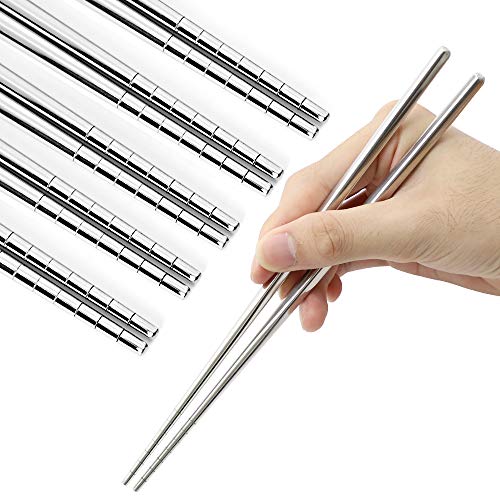
Some cooking chopstick work is not about grip or heat but about tempo. Beating eggs to a uniform gold, loosening a nest of noodles the second it hits the water, keeping small pieces moving in a hot pan so they color instead of steam — these are wrist-speed tasks, and the tool for them should weigh almost nothing. The MUYOS hollow-core design is the pool’s tempo specialist: a steel pair with the working properties of steel — heat indifference, total cleanability — at a weight that lets the wrist flick for minutes without complaint.
The whisking case deserves emphasis, because it is where material quietly decides quality. Wooden pairs whisk well enough but emerge stained and oil-hungry; whisks are metal but bulky in a small bowl; a steel chopstick pair is the traditional tool for beaten eggs in much of East Asian cooking precisely because it combines a whisk’s material with a chopstick’s precision. The non-slip tips keep the pair honest when the tempo work turns to lifting — a piece of chicken fished out for a doneness check, a noodle strand tested between the tips.
Know its lane: featherweight tools trade authority, so dense work — wrestling a whole fish, prying a stuck crust — belongs to heavier implements, and the hollow core should never be a lever. Within the fast, light, repetitive heart of home cooking, though, this is the pair that makes steel feel like an extension of the wrist rather than a utensil, the same multi-tasking spirit celebrated under Best Multi Use Chopsticks.
Best for: egg, noodle and stir-fry cooks whose work is fast and repetitive / Not suited for: heavy turning work or cooks who like a weighty tool

Greatamzor Multicolor Stainless Steel Chopsticks, 5 Pairs
Badge: Best for Raw/Cooked Separation
- Material: Stainless steel
- Pairs: 5, in multiple colors
- Length: 9 1/4 inches (as stated in the listing)
- Design: Laser engraved copper coin pattern; square, non-slip profile
- Care: Dishwasher safe
- Format: Gift set
Strengths
- Colors are a food-safety system at the stove: one color handles raw meat, another only ever touches cooked food.
- Engraved grip is cut into the metal, so it survives greasy sessions and aggressive washing intact.
- Steel sanitizes completely in the dishwasher — the correct ending for a raw-meat tool.
Trade-offs
- The color system works only if the household honors it; colors without discipline are just decoration.
- Colored finishes mellow over years of washing.
- Dining length: a stove-adjacent worker, not a fryer tool.
The most important cooking-chopstick rule is not about heat at all. It is about the pair that touched raw chicken never touching the cooked dish until it has been washed — the cross-contamination rule that professional kitchens enforce with colored tongs and boards. This Greatamzor set brings that system to chopsticks: assign a color to raw work, another to cooked, and the rule becomes visible across a busy stove, even to a helper who joins mid-recipe. It is the only pick in the guide whose design directly encodes a safety practice, and for meat-heavy cooking that encoding is worth more than any alloy upgrade.
The rest of the design supports the stove. The laser engraved copper coin pattern grips through oil and marinade — the conditions under which raw work happens — and because the texture is in the metal, the dishwasher’s full reset after a raw session costs the grip nothing. Steel’s non-porous surface is the other half of the safety story: unlike wood, it gives bacteria no grain to hide in, and it tolerates the hottest wash without complaint.
Be honest about the system’s one weakness: it is a social technology. Colors prevent cross-contamination only in a household that agrees on the code and keeps it under time pressure — write it on the holder if you must. And like all colored steel, the hues will soften over the years even as the safety system, being about assignment rather than saturation, keeps working. For cooks who prep meat and vegetables in the same session — which is to say, most cooks — this is the most practically intelligent set in the guide.
Best for: households that cook meat and produce in the same session and want a visible safety system / Not suited for: buyers who will not maintain a color code

Greatamzor Titanium Plated Stainless Steel Chopsticks, 2 Pairs
Badge: Best Heat-Side Finish
- Material: Stainless steel with titanium plating
- Pairs: 2
- Colors: Black and silver
- Design: Laser engraved, non-slip; Japanese Korean style
- Care: Dishwasher safe (per listing)
- Format: Premium gift set
Strengths
- Titanium plating is a hard, heat-stable surface — a finish chosen for cookware, not just for looks.
- The stainless core beneath cannot burn, melt or absorb oil, whatever the surface meets.
- Engraved grip works through oil and steam at the pan’s edge.
Trade-offs
- Two pairs only, at a premium presentation level.
- Plating near a pan’s hardest knocks will age faster than at the table; treat it as a finishing and light-cooking pair.
- No length or grade is stated in the listing.
Finishes usually flee the stove; this one was engineered in its neighborhood. Titanium plating appears on cookware and premium cutlery because the surface is hard and stable under heat and abrasion, and over a stainless core it creates a two-layer cooking tool: a working surface that shrugs off the pan’s edge, and a body that cannot be harmed by anything a home stove produces. In this guide the set’s cooking role is the refined end — turning delicate pieces, serving from the pan, plating — where its engraved grip and balanced presentation shine.
The material honesty cuts both ways, and the review should say so: plating is a surface, and a pan is the most abrasive environment in this guide. Used daily as a wok scraper, any plated finish will show its life at the contact points long before a plain steel pair would. Used as its design intends — skilled, light, precise cooking work — it holds its beauty and its function together for years, and the dishwasher-safe listing means the post-frying cleanup needs no special pleading.
Buy it if your cooking style is the finishing style: composed pans, careful turns, food that goes from stove to plate in one motion. Households whose cooking is heavy, fast and wok-led will get more from the plain or engraved workhorses above, and can admire this set at the table, where the wider world of Best Metallic Chopsticks also places it.
Best for: precise, presentation-minded cooks who want a heat-tolerant premium pair / Not suited for: heavy wok work or buyers needing a multi-pair cooking set

NEWDRIP Multicolor Metal Chopsticks, 8 Pairs
Badge: Best Listed for Cooking
- Material: Stainless steel
- Pairs: 8, in multiple colors
- Length: 9.25 inches (as stated in the listing)
- Design: Laser engraved, non-slip; Japanese Korean Chinese styles
- Care: Dishwasher safe
- Stated uses: Cooking and eating; gift set format
Strengths
- The maker lists it for cooking and eating in so many words — the pool’s clearest cooking brief.
- Eight color-coded pairs scale the raw/cooked separation system to a whole cooking session.
- Engraved grip, steel hygiene and a full dishwasher reset after greasy work.
Trade-offs
- Colored finishes soften with heavy washing over time.
- Still a dining length: the cooking it is listed for is pan-and-serving work, not deep frying.
- No steel grade is stated in the listing.
Start with the listing itself: among this pool, this set’s maker claims cooking outright, pairing it with eating in the title — and the design backs the claim with the two features cooking actually uses, an engraved grip and a color system, at the scale cooking sessions demand. Eight pairs means the raw station, the pan, the serving dish and the table can each hold their own pair simultaneously, with the code — colors for raw, colors for cooked — visible at a glance. It is less a set of chopsticks than a small kitchen system that happens to be made of them.
The material completes the system. Steel moves between stations without absorbing anything from the last one; a rinse resets a pair mid-session, and the dishwasher resets the fleet afterward. In a long cooking session — a dumpling production, a multi-dish family meal — that reset-ability is the difference between a tool set that keeps up and one that becomes the bottleneck at the sink.
Its limits are the pool’s limits, stated one last time: 9.25 inches is a dining length, so its cooking kingdom is the pan’s surface, the pot’s rim, the serving bowl — not the depths of a fryer — and colored finishes age cosmetically faster than bare steel. Judged inside its true brief, it is the most complete cooking answer here, and the set we would put in a new cook’s hands first, with the technique section below as its manual — a manual whose grip lessons the community also prizes, as Best Metal Chopsticks Reddit discussions tend to confirm.
Best for: busy home cooks who want one color-coded system from prep to plate / Not suited for: deep frying or buyers who want a named alloy grade
Comparison Table
| Pick | Material (as listed) | Pairs | Length (as listed) | Cooking role | Link |
|---|---|---|---|---|---|
| Zliutob | Stainless steel | 5 | Not stated | Stove-top control | Check on Amazon |
| LIXTONGR | 18/10 stainless steel | 2 | 9 inches | Plating from the pan | Check on Amazon |
| MUYOS | Stainless steel, hollow-core | 5 | Not stated | Whisking and turning | Check on Amazon |
| Greatamzor Multicolor | Stainless steel | 5 | 9 1/4 inches | Raw/cooked separation | Check on Amazon |
| Greatamzor Titanium Plated | Stainless steel, titanium plated | 2 | Not stated | Heat-side finishing | Check on Amazon |
| NEWDRIP Multicolor | Stainless steel | 8 | 9.25 inches | Listed for cooking and eating | Check on Amazon |
How to Choose a Cooking Chopstick Material
Interrogate each material with the stove’s four questions. What does heat do to it? Wood insulates the hand and chars only at abuse levels; bamboo similar, with a shorter life; fiberglass tolerates high heat without drama; steel ignores heat as damage but conducts it to the hand if left resting in the pan; plastics and melamine fail the question outright for serious cooking. What does oil do to it? Wood and bamboo absorb it progressively — the slow saturation that makes old cooking pairs impossible to truly clean — while steel and fiberglass absorb nothing. What does washing do to it? The dishwasher is steel’s home turf and wood’s executioner. And what does it do to the pan? Steel is the only common material that can mark a nonstick coating, which is why pan matching — steel tools on steel, iron and carbon steel pans; gentler tools on nonstick — is a rule, not a preference.
Then match material to your actual cooking, not your aspirational cooking. A household whose chopstick cooking is stir-fries in a carbon steel wok, dumplings in a steel skillet, eggs, noodles and serving will find dining-length steel not merely adequate but excellent — grippy, hygienic, immortal. A household deep-frying weekly in a tall pot needs the one tool this pool does not contain: a dedicated long pair, traditionally wood for its insulation, and should buy it as a specialist alongside a steel set rather than instead of one. Most kitchens, honestly assessed, need the steel system for ninety percent of the work and the long wooden pair for the rest.
Finally, weigh hygiene as a material property, because at the stove it is one. Raw proteins, marinades and shared pans make cooking the highest-stakes cleaning environment in the kitchen. A non-porous, dishwasher-proof material with a visible raw/cooked system — the logic of the two multicolor picks — is not a luxury specification. It is the professional standard, translated home.
How to Cook With Steel Chopsticks: Technique and Safety
Steel rewards a few habits that wood never demands. Learn these and the material’s caveats mostly disappear.
- Work in strokes, rest on the rim. Turn, lift, separate — then rest the pair across the pan’s rim or on a rest. A steel pair left standing in hot oil or sauce is a pair conducting heat toward your fingers.
- Grip high for hot work. Hold the pair in its upper third near heat; your hand’s distance is your insulation.
- Keep raw and cooked pairs apart. Use a color code or separate rests, and never let the raw pair touch plated food. When in doubt, the steel pair rinses and resets in seconds — use that superpower.
- Test doneness with the tips. A strand of noodle, a corner of dumpling, a squeeze of a meatball between the tips tells you more than a timer; steel’s firmness transmits texture honestly.
- Match the pan. Steel pairs belong in steel, cast iron and carbon steel pans. On nonstick, work gently with the tips or switch to serving and plating roles.
- Wash like you mean it. After raw or greasy work, the dishwasher is the correct finish — every pick here is listed for it.
Troubleshooting. Problem: the pair feels hot after working a wok → it rested in the pan too long; shorten contact, grip higher, and rest it out of the heat between turns. Problem: food keeps sliding off in the pan → the pieces are wet or the sauce is heavy; pat pieces dry before they meet the pan, and lean on the textured and engraved tips rather than finger force. Problem: light scratching appears in a nonstick pan → retire steel to that pan’s serving role and cook in it with wood or fiberglass; the steel pair has done nothing wrong — the match was wrong.
Material by Cooking Method
Stir-frying is steel’s showcase at home scale: constant motion, oily food, high flavor stakes, and a pan — wok or skillet — that is usually steel-friendly carbon steel or iron. Textured tips and a light pair divide the work between them. Pan-frying dumplings and similar is a turning test, where square profiles and engraved grips earn their badges. Boiling work — noodles, dumplings, blanching — is where steel’s water indifference shines; a pair can fish, test and lift all session, then be dishwashed, while a wooden pair would end the day waterlogged.
Deep frying is the honest exception that defines the boundary: tall oil, long exposure, and hands that must stay far away belong to the dedicated long pair in an insulating material, and no pick in this guide pretends otherwise. Grilling sits in between — dining-length steel handles tabletop and pan grilling well, with the conduction rule firmly in mind. Serving and plating, finally, are cooking’s last act and steel’s home ground: non-reactive, precise, beautiful enough to go from pan to table without a tool change, which is the entire philosophy of the cooking-and-eating listings in this pool.
Oils, Acids and Marinades: The Chemistry a Cooking Material Must Survive
A cooking chopstick lives in chemistry as much as in heat. Frying oil at working temperature is an aggressive solvent that migrates into any porous material — which is why an old wooden cooking pair smells faintly of every oil it has ever met, and why that smell eventually becomes a flavor you did not order. Marinades add acids and salts; tomato and citrus dishes add more acid; fermented ingredients bring their own lively cultures. Against that whole panel, the material question is simply: does the stick participate, or does it stay neutral? Wood participates — absorbing, staining, carrying. Steel does not participate at all. Its surface is a closed door: oil rinses off, acid finds the chromium layer unmoved, and yesterday’s gochujang has no mechanism to attend today’s delicate fish.
That neutrality compounds over a cooking life. The steel pair you cook with in year three behaves exactly as it did in week one, because nothing has accumulated in it or on it that washing cannot remove. The wooden pair is a palimpsest of its history — charming in a family heirloom, questionable in a working tool. Fiberglass sits honorably between: non-absorbent on the surface, though its tips can roughen with age and give residues more to hold onto. For cooks who move between strong-flavored cuisines in a single week — and modern home cooking is exactly that — the neutral material is not a sterile preference; it is what keeps each dish tasting like itself.
Building the Cook’s Drawer: A Two-System Solution
The mature conclusion of the material debate is not a winner but a drawer. System one is the steel fleet this guide reviews: dining-length pairs for prep, pan work at the surface, serving and eating, organized — if you cook meat — by the raw/cooked color logic of the multicolor picks. System two is the single specialist: one long pair in an insulating material, wood by tradition, reserved for the deep pot and the tall fryer, used rarely, stored apart, and replaced without ceremony when its tips tire. Each system covers the other’s honest weakness, and together they cost less than most single “does-everything” fantasies while outperforming all of them.
Organize the drawer so the systems stay legible under time pressure: steel pairs in the holder by the stove, the long pair on its own hook or the drawer’s far side, rests at the pan’s edge for the work-and-rest rhythm steel asks for. Add the color code to the holder itself — a note, a band, anything — so a helper inherits the system without a briefing. This is the unglamorous end of material wisdom: the right substances, in the right lengths, in the right places, with the rules visible. Cooks who set it up once spend years not thinking about chopstick materials at all, which is the surest sign the question has been answered.
Common Buying Mistakes
- Buying a dining pair and expecting a fryer tool. Length is a safety specification; match it to the pot.
- Leaving steel resting in a hot pan. Conduction is predictable; technique, not the material, is at fault.
- Using any pair for raw and cooked food interchangeably. The rule outranks every material debate in this guide.
- Scraping nonstick with steel and blaming the sticks. Match tools to pan surfaces.
- Choosing wood for a dishwasher household’s cooking. The oil-plus-machine combination ends wooden cooking pairs quickly.
- Ignoring tip texture for pan work. Oily food is the grip final exam; smooth tips fail it.
Final Recommendation
For most home cooks, start with the Zliutob set for stove-top control, or the LIXTONGR pair if your cooking ends in careful plating; add the MUYOS when whisking and noodle work dominate your week. Households cooking meat and produce together should build around the color-coded sets — the five-pair Greatamzor or the eight-pair NEWDRIP, the pool’s explicit cooking listing — and treat the titanium plated pair as the finishing instrument it is. Keep the boundaries this guide drew — dining lengths, work-and-rest technique, pan matching — and stainless steel will prove itself the most capable, cleanest and longest-lived cooking material in your drawer, with one honest exception carved out for the deep fryer.
That exception is worth honoring rather than resenting, because it completes the material education this guide set out to give. Every substance at the stove is a trade: wood trades life for insulation, plastic trades everything for cheapness, fiberglass trades tradition for tolerance, and steel trades a little warmth management for permanence, hygiene and precision. A cook who can name the trade they are making, meal by meal, has finished shopping and started cooking — and that, more than any single set, is the purchase this page hopes you make.
Frequently Asked Questions
Is stainless steel a good material for cooking chopsticks?
For most home cooking, yes: it cannot burn, melt, absorb oil or splinter, it grips well when the tips are textured or engraved, and it can be fully sanitized in the dishwasher. Its two caveats are manageable — it conducts heat if left resting in a hot pan, and it should be used gently, or not at all, on nonstick coatings. Judged across a whole cooking life — performance, hygiene, washing and replacement cost in effort — it is the material the evidence in this guide keeps returning to.
Why are traditional cooking chopsticks made of wood?
Because wood insulates: a long wooden pair keeps the cook’s hand cool over a wok or fryer, and length plus insulation is the classic safety formula. The trade is lifespan and hygiene — wood absorbs oil, chars over time and cannot be dishwashed. Many kitchens therefore keep a long wooden pair for deep work and steel for everything else, a division this guide recommends openly.
Will steel chopsticks scratch my pans?
Steel is harder than nonstick coatings, so energetic scraping can mark them; on stainless, cast iron and carbon steel pans there is no issue. The practical rule is matching: cook with steel in hard pans, and on nonstick use the pair gently for turning and lifting, or reserve it for serving and plating.
Do steel chopsticks get too hot to hold while cooking?
Only if they are left resting in the pan or pot, which conducts heat up the stick. Used properly — working in strokes, resting on the rim or a rest, gripping the upper third — a dining-length steel pair stays comfortable for the pan-surface work this guide covers. Sustained deep-pot work is the job of a long insulating pair instead.
What is fiberglass, and how does it compare for cooking?
Fiberglass chopsticks are a glass-fiber composite: light, heat-tolerant and dishwasher-friendly, and a legitimate modern cooking material — the strongest non-metal candidate. Against steel it trades a little permanence and a lot of tradition; against wood it wins on washing and loses on insulation and feel. It is the alternative we would name first for a cook who wants a dedicated cooking pair and does not want wood.
Why does this guide emphasize separate pairs for raw and cooked food?
Because cross-contamination is the highest-stakes mistake in chopstick cooking: the pair that handled raw meat must not touch the finished dish until washed. Steel makes the rule easy to keep — pairs rinse instantly and dishwasher fully — and color-coded sets make it visible, which is why two picks in this guide are built around that system.
Can one pair really cook and eat, as some listings claim?
Within dining-length limits, yes — that is the traditional pattern in much of East Asian home cooking: the pair that turns the food serves it and then eats it, with a wash in between when raw ingredients were involved. The NEWDRIP set in this guide is listed for exactly that double duty. The exception remains deep, tall-pot frying, which wants its own long tool.
Do steel chopsticks affect the taste of food while cooking?
No. Stainless steel is non-reactive and non-absorbent: it contributes no flavor, picks up none, and does not discolor delicate ingredients. That neutrality is one of its strongest cooking credentials — the same neutrality that makes it the material of professional prep bowls and pans. What you taste is the dish, including when the dish was turned, tested and served by the pair.
How do I keep a steel pair from slipping when food is oily?
Use the pair’s texture rather than your fingers’ force. Every pick in this guide has a treated tip — textured, engraved or non-slip — which is engineered for exactly the oily-pan moment. Technique helps too: grip pieces by an edge or a fold rather than across a slick flat face, and let excess oil drain for a second before moving a piece across the pan.