Disclosure: topratedkitchenware.com is reader-supported. When you buy through links on our site, we may earn an affiliate commission from Amazon and other retailers, at no extra cost to you.
Where to buy
This guide to the best metal measuring cups and spoons compares six stainless steel sets side by side, with the full reviews, comparison table and buying guidance below. The linked sets can be checked on Amazon from the list here, from the Quick Picks, or from each detailed review. Read the full guide ↓
- TILUCK Stainless Steel Measuring Cups and Spoons Set of 10 — 10 pcs cups + spoons, nesting.
- TILUCK Stainless Steel Measuring Cups and Spoons Set of 6 — 6 pcs cups + spoons, compact.
- THLHKD 6-Piece Measuring Spoons Set — reviewed in full below as a prose-only alternative (no purchase link for this keyword; see the review for why).
- Spring Chef Nesting Measuring Spoons Set of 7 with Leveler — reviewed in full below as a prose-only alternative (no purchase link for this keyword; see the review for why).
- Spring Chef Measuring Cups and Spoons Set of 14 with Leveler — 14 pcs cups + spoons + leveler.
- Hudson Essentials Stainless Steel Measuring Spoons Set of 7 — reviewed in full below as a prose-only alternative (no purchase link for this keyword; see the review for why).
Searching for the best metal measuring cups and spoons means you have already made the material decision — metal, not plastic — and the real questions are which combined system to buy and how much set you need. This guide compares six stainless steel options honestly, including an honesty point most guides skip: three of the six are spoons-only sets. They are reviewed in full below as prose-only alternatives, clearly labelled, because some readers who arrive with this search actually need great spoons more than they need cups. The three true cups-and-spoons systems carry the links and the top recommendations.
Why metal wins this category is worth one paragraph. Stainless steel does not stain from turmeric or tomato, does not keep the smell of onion or spice, does not flex when you scoop stiff dough or cold butter mixtures, and goes in the dishwasher without warping. Plastic measuring tools fail on every one of those points eventually, usually starting with stains and smells and ending with a warped cup that measures generously forever after. Metal’s costs are weight, noise in the drawer, and a higher purchase price than basic plastic — a fair trade for tools bought once and used for years. If you are still deciding between formats after the reviews, our notes on Best Metal Measuring Spoons cover the neighbouring question most readers ask next.
The three combined systems here span ten, six and fourteen pieces, all nesting or stackable stainless designs. The fourteen-piece Spring Chef set adds a leveler and rectangular spoons; the ten-piece TILUCK set is the balanced middle; the six-piece TILUCK set is the compact option with a coffee-scoop angle. Read the linked reviews as the main event and the prose-only spoon reviews as the alternative path, and choose based on what your current drawer is genuinely missing.
Key Takeaways
- Top recommendation: the TILUCK Stainless Steel Measuring Cups and Spoons Set of 10, which balances coverage, handling and storage best for this search.
- Runner-up worth a close look: the TILUCK Stainless Steel Measuring Cups and Spoons Set of 6.
- Every set compared here is stainless steel, so odour resistance, stain resistance and dishwasher-friendly care are shared strengths.
- Bowl shape and levelling help — rectangular bowls, levelers, dual-sided designs — separate the sets more than piece count does.
- Buy coverage that matches your recipes: wide size runs reward bakers and spice-led cooks; compact sets reward small drawers.
- Verify any set at home with levelled water on a kitchen scale; five minutes turns an assumed measure into a known one.
In this guide
Quick Picks
| Set | Badge | Format | Where |
|---|---|---|---|
| TILUCK Stainless Steel Measuring Cups and Spoons Set of 10 | Best Overall | 10 pcs cups + spoons, nesting | Check on Amazon |
| TILUCK Stainless Steel Measuring Cups and Spoons Set of 6 | Best Compact Combined Set | 6 pcs cups + spoons, compact | Check on Amazon |
| THLHKD 6-Piece Measuring Spoons Set | Best Spoons-Only Alternative | 6 spoons, 1/8 tsp to 1 tbsp | See review below |
| Spring Chef Nesting Measuring Spoons Set of 7 with Leveler | Best Jar Access (Spoons Only) | 7 spoons + leveler, rectangular | See review below |
| Spring Chef Measuring Cups and Spoons Set of 14 with Leveler | Most Complete Combined Set | 14 pcs cups + spoons + leveler | Check on Amazon |
| Hudson Essentials Stainless Steel Measuring Spoons Set of 7 | Best Simple Spoons (Spoons Only) | 7 spoons, jar-fit design | See review below |
How These Picks Were Chosen
The six sets in this guide were chosen from stainless steel measuring spoon sets whose listings state their construction, piece count and key design features plainly enough to be checked. Each pick was verified against the Amazon catalogue data available at the time of writing: the product identity, material and headline features in every review come from the listing title itself, and any feature the title does not state is treated as absent rather than assumed. That discipline matters in this category, where listings love adjectives and cooks need facts. Readers comparing approaches may also find our discussion of Best Mini Measuring Spoons useful alongside this one.
Ranking weighed five things: size coverage against real recipe demand, bowl geometry for levelling and jar access, marking clarity, storage design, and the honesty of the trade-offs each format carries. This is a research-led guide, not a laboratory test report: no hands-on testing is claimed, no sales figures are invented, and long-term judgements are drawn from design analysis and the patterns that repeat across owner feedback for sets of this type. Where a set is included as a prose-only alternative, the reason is stated openly in its review and in the sources note published with this guide.
One scope note: this guide compares sets, not single spoons or novelty measures. A cook who needs one replacement spoon has a different problem from a cook choosing a system, and systems are what the six reviews below judge — how the pieces work together, store together and cover a recipe between them.
Best metal measuring cups and spoons: The 6 Picks in Detail

TILUCK Stainless Steel Measuring Cups and Spoons Set of 10
Badge: Best Overall
Strengths
- Cups and spoons in one nesting set is the tidy answer for a kitchen being equipped from scratch
- Stainless construction suits both dry baking measures and wet cooking measures without absorbing smells
- Ten pieces is a middle path: fuller than a spoons-only set, smaller than the fourteen-piece option
Trade-offs
- The title does not list individual sizes for either the cups or the spoons, so check the listing chart before ordering
- The title does not mention a leveler, so dry measures are levelled manually
- Combined sets ask for one storage spot that fits cups and spoons together
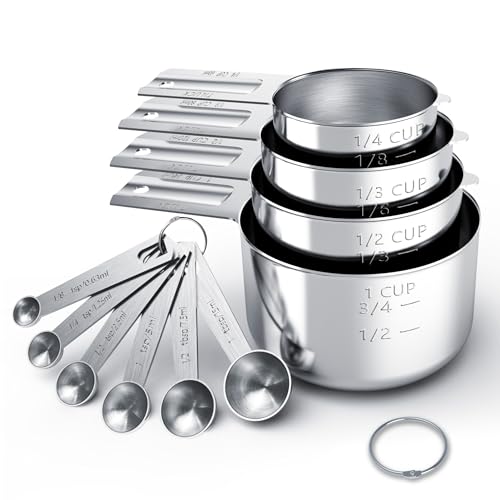
At a glance: Material: stainless steel (per listing title); Pieces: 10, measuring cups and spoons combined; Design notes: nesting measure cups (per listing title); Listed uses: cooking and baking.
TILUCK’s ten-piece set splits the difference between the spoons-only purists and the fourteen-piece maximalists. Nesting cups handle the volume work of baking and cooking while the spoons cover the small measures, all in stainless steel that can go from cocoa to curry without keeping score.
As part of a combined metal set, the spoons have to justify sharing a purchase with the cups. The strongest combined sets keep the spoons fully featured — proper small sizes, readable markings, jar-friendly shapes — rather than treating them as filler around the cups, and that is the standard used below.
In use, the set behaves the way its specification suggests it should. The bowls fill and level without drama, the handles give enough length to work inside jars and canisters without burying your fingers in the ingredient, and the whole set returns to storage as one unit rather than as a handful of loose steel. Those are modest virtues, but measuring is a modest, constant job, and modest virtues repeated daily are what separate a set you keep from a set you tolerate.
Taken together, the picture is of a set that knows what it is for. It will not be the right answer for every kitchen in this guide, and the verdict line below is deliberately blunt about who should walk past it. But judged on the work its title promises — no more, no less — it makes a coherent case, and coherence is what survives contact with daily cooking.
Best for: homes equipping a kitchen with one balanced cups-and-spoons system / Not suited for: cooks who want a leveler included in the box

TILUCK Stainless Steel Measuring Cups and Spoons Set of 6
Badge: Best Compact Combined Set
Strengths
- The most compact combined set here, for kitchens that want cups and spoons covered without a large stack
- The coffee scoop angle suits households where the set will live near the coffee routine as much as the stove
- Stainless steel keeps the set simple to wash and resistant to lingering flavours
Trade-offs
- Six combined pieces means fewer individual sizes than the larger combined sets
- The title does not enumerate the sizes included, so the listing details matter more here than usual
- The title does not mention a leveler or nesting design for the spoons
At a glance: Material: stainless steel (per listing title); Pieces: 6, measuring cups and spoons combined; Extras: coffee scoop spoon mentioned in listing title; Listed uses: cooking and baking.
The smallest combined set in this group is also the one that mentions a coffee scoop, which tells you where TILUCK expects it to live: within reach of the morning routine as well as the stove. Six stainless pieces will not cover every exotic size, but they cover the daily ones in very little space.
As part of a combined metal set, the spoons have to justify sharing a purchase with the cups. The strongest combined sets keep the spoons fully featured — proper small sizes, readable markings, jar-friendly shapes — rather than treating them as filler around the cups, and that is the standard used below.
The coffee connection is more practical than it first appears. A set that lives comfortably beside a morning coffee routine gets handled daily, washed daily and kept together — and measuring tools that are kept together and handled daily are the ones still complete and legible in year three.
In use, the set behaves the way its specification suggests it should. The bowls fill and level without drama, the handles give enough length to work inside jars and canisters without burying your fingers in the ingredient, and the whole set returns to storage as one unit rather than as a handful of loose steel. Those are modest virtues, but measuring is a modest, constant job, and modest virtues repeated daily are what separate a set you keep from a set you tolerate.
The honest limitation is the one built into its format, and it is stated in the trade-offs rather than hidden from them. No set in this guide escapes its format: coverage costs pieces, compactness costs coverage, and combined sets cost drawer commitment. What distinguishes the stronger sets is that their compromise is the one their intended cook would choose on purpose.
Best for: small kitchens and coffee-centred routines wanting cups and spoons in six pieces / Not suited for: cooks who need a wide run of individual sizes
THLHKD 6-Piece Measuring Spoons Set
Badge: Best Spoons-Only Alternative
Prose-only for this keyword: Spoons-only set: the listing title lists spoons alone, with no measuring cups, so it cannot meet the cups-and-spoons requirement of this keyword. Reviewed in full as a prose-only alternative for readers who only need spoons.
Strengths
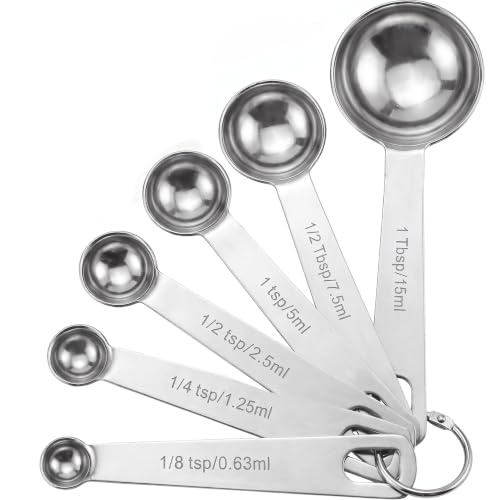
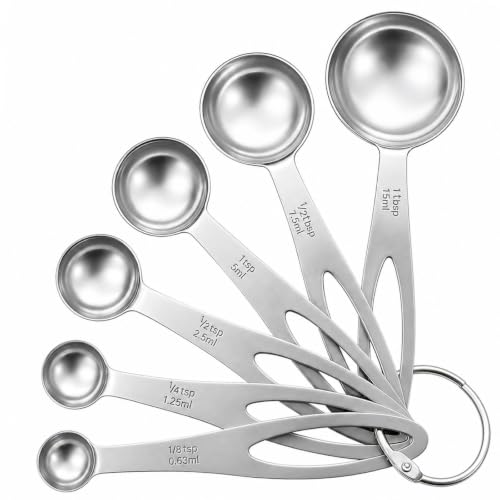
- The stated 1/8 tsp to 1 tbsp range covers the small end many basic sets skip, which matters for spices and baking powder
- Clear size markings are called out in the title, and legible markings are the feature you use every single time
- Stainless steel handles sticky, oily and strongly coloured ingredients without holding odours the way plastic can
Trade-offs
- Six pieces is a compact set, so cooks who use intermediate sizes constantly may still reach for a second set
- The title does not mention a leveler, so dry ingredients are levelled with a knife or straight edge instead
- The title does not state that the spoons are narrow or rectangular, so spice-jar fit is not something the listing itself promises
At a glance: Material: stainless steel (per listing title); Pieces: 6 spoons; Size range: 1/8 tsp to 1 tbsp (per listing title); Markings: clear size markings (per listing title); Listed uses: dry and liquid ingredients, coffee, spices, protein powder.
The detail that defines this set is the stated size range. Running from 1/8 tsp up to 1 tbsp in six pieces means the small measures that flavour-driven cooking depends on are present from the start, and the clear size markings promised in the title are the feature your eyes go to dozens of times a week.
As part of a combined metal set, the spoons have to justify sharing a purchase with the cups. The strongest combined sets keep the spoons fully featured — proper small sizes, readable markings, jar-friendly shapes — rather than treating them as filler around the cups, and that is the standard used below.
The coffee connection is more practical than it first appears. A set that lives comfortably beside a morning coffee routine gets handled daily, washed daily and kept together — and measuring tools that are kept together and handled daily are the ones still complete and legible in year three.
Markings are the interface of a measuring spoon, and clear markings are the difference between measuring and estimating at a glance. Mid-recipe, with hands occupied and a pan waiting, you read the spoon you grabbed in half a second or you guess — this set is designed for the first outcome. In use, the set behaves the way its specification suggests it should. The bowls fill and level without drama, the handles give enough length to work inside jars and canisters without burying your fingers in the ingredient, and the whole set returns to storage as one unit rather than as a handful of loose steel. Those are modest virtues, but measuring is a modest, constant job, and modest virtues repeated daily are what separate a set you keep from a set you tolerate.
Long-term, the ownership story is simple: wash it, dry it, store it as a unit, and it will measure the same in year three as on day one. That predictability is the real product. Recipes reward it quietly, in bakes that repeat and sauces that come out the same twice, which is all most of us ever asked a measuring spoon to do.
Best for: cooks who want the small sizes covered in a compact, clearly marked set / Not suited for: cooks who need measuring cups in the same purchase
Spring Chef Nesting Measuring Spoons Set of 7 with Leveler
Badge: Best Jar Access (Spoons Only)
Prose-only for this keyword: Spoons-only set: the listing title covers measuring spoons with a leveler and no measuring cups, so it is prose-only for this cups-and-spoons keyword.
Strengths
- Rectangular bowls are the standout detail here: they level cleanly and slide into narrow spice jars that round spoons cannot enter
- The included leveler removes the hunt for a knife every time you measure flour, cocoa or baking soda
- Long handles keep fingers out of deep jars and give better leverage with thick, sticky ingredients
Trade-offs
- Seven spoons plus a leveler is more pieces to keep together than a basic six-piece ring set
- Rectangular bowls pour liquids a little less gracefully than deep round bowls, so very small liquid measures need a steady hand
- Nesting storage only stays tidy if the set goes back together in order after washing
At a glance: Material: stainless steel (per listing title); Pieces: 7 spoons, plus leveler; Shape: rectangular bowls (per listing title); Design notes: fits in spice jars, long handle, nesting (per listing title); Listed uses: dry and liquid ingredients.
Rectangular bowls change how a measuring spoon behaves. Instead of a round bowl that hovers over a spice jar mouth, the flat-sided bowl slides in, scoops, and levels against the jar rim or the included leveler in one motion, and the long handle keeps the whole action away from your knuckles.
As part of a combined metal set, the spoons have to justify sharing a purchase with the cups. The strongest combined sets keep the spoons fully featured — proper small sizes, readable markings, jar-friendly shapes — rather than treating them as filler around the cups, and that is the standard used below.
The rectangular bowl profile deserves emphasis because it changes two everyday actions: the spoon enters jars that round bowls cannot, and the flat edge levels against a straight edge or the included leveler without the rocking that makes small measures inconsistent.
The included leveler sounds like a minor extra until a baking day prices it in. Levelling with a dedicated tool is faster and more repeatable than fetching a knife, and repeatability is the whole point of a measuring spoon. Sets without one are not worse spoons, but they ask your knife drawer to finish the system. In use, the set behaves the way its specification suggests it should. The bowls fill and level without drama, the handles give enough length to work inside jars and canisters without burying your fingers in the ingredient, and the whole set returns to storage as one unit rather than as a handful of loose steel. Those are modest virtues, but measuring is a modest, constant job, and modest virtues repeated daily are what separate a set you keep from a set you tolerate.
Taken together, the picture is of a set that knows what it is for. It will not be the right answer for every kitchen in this guide, and the verdict line below is deliberately blunt about who should walk past it. But judged on the work its title promises — no more, no less — it makes a coherent case, and coherence is what survives contact with daily cooking.
Best for: spice-heavy cooks and anyone tired of spoons that cannot enter their jars / Not suited for: cooks who strongly prefer deep round bowls for liquids

Spring Chef Measuring Cups and Spoons Set of 14 with Leveler
Badge: Most Complete Combined Set
Strengths
- One purchase covers cups and spoons together, so a new kitchen or a full replacement is sorted in a single set
- The spoons share the rectangular, jar-friendly shape of the spoons-only Spring Chef set, with a leveler included
- Nesting storage keeps fourteen pieces from turning into drawer chaos
Trade-offs
- If you only need spoons, you are storing cups you may rarely use
- A combined set is a bigger commitment than a spoons-only set, in drawer space as much as anything
- Losing one spoon from a matched set is more annoying than losing one from a standalone set
At a glance: Material: stainless steel (per listing title); Pieces: 14, measuring cups and spoons combined, plus leveler; Spoon shape: rectangular bowls (per listing title); Design notes: nesting (per listing title); Listed uses: dry and liquid ingredients.
This is the set for a drawer that currently holds a bent plastic cup, two orphaned spoons and a guess. Fourteen nesting stainless pieces replace all of it at once, and because the spoons use the same rectangular profile as the spoons-only Spring Chef set, jar access does not suffer for choosing the combined route.
As part of a combined metal set, the spoons have to justify sharing a purchase with the cups. The strongest combined sets keep the spoons fully featured — proper small sizes, readable markings, jar-friendly shapes — rather than treating them as filler around the cups, and that is the standard used below.
The rectangular bowl profile deserves emphasis because it changes two everyday actions: the spoon enters jars that round bowls cannot, and the flat edge levels against a straight edge or the included leveler without the rocking that makes small measures inconsistent.
The included leveler sounds like a minor extra until a baking day prices it in. Levelling with a dedicated tool is faster and more repeatable than fetching a knife, and repeatability is the whole point of a measuring spoon. Sets without one are not worse spoons, but they ask your knife drawer to finish the system. In use, the set behaves the way its specification suggests it should. The bowls fill and level without drama, the handles give enough length to work inside jars and canisters without burying your fingers in the ingredient, and the whole set returns to storage as one unit rather than as a handful of loose steel. Those are modest virtues, but measuring is a modest, constant job, and modest virtues repeated daily are what separate a set you keep from a set you tolerate.
The honest limitation is the one built into its format, and it is stated in the trade-offs rather than hidden from them. No set in this guide escapes its format: coverage costs pieces, compactness costs coverage, and combined sets cost drawer commitment. What distinguishes the stronger sets is that their compromise is the one their intended cook would choose on purpose.
Best for: kitchens replacing cups and spoons together in one nesting system / Not suited for: cooks whose cups are already excellent and staying
Hudson Essentials Stainless Steel Measuring Spoons Set of 7
Badge: Best Simple Spoons (Spoons Only)
Prose-only for this keyword: Spoons-only set: the listing title covers a seven-piece spoon set with no measuring cups, so it is prose-only for this cups-and-spoons keyword.
Strengths
- Jar fit is stated plainly in the title, which is exactly the promise spice-heavy cooks need kept
- Seven pieces gives a step more coverage than the most basic six-piece sets
- A straightforward stainless design with no coatings or moving parts is easy to wash and hard to wear out
Trade-offs
- The title does not mention a leveler, so levelling dry ingredients is a knife job
- The title does not describe the spoons as magnetic or dual-sided, so storage is ring or drawer based
- The title lists no explicit size range, so check the listing size chart if one unusual size matters to you
At a glance: Material: stainless steel (per listing title); Pieces: 7 spoons; Design notes: fits in spice jars (per listing title); Listed uses: dry or liquid ingredients.
Hudson Essentials keeps the proposition simple: seven stainless spoons shaped to fit in spice jars, for dry or liquid ingredients, with nothing else competing for your attention. Sets like this live or die on whether that one promise holds in daily use, and the design gives it every chance.
As part of a combined metal set, the spoons have to justify sharing a purchase with the cups. The strongest combined sets keep the spoons fully featured — proper small sizes, readable markings, jar-friendly shapes — rather than treating them as filler around the cups, and that is the standard used below.
Jar fit is stated in the title, and for spice-led cooking it is close to the whole game. A spoon that enters the jar scoops once, levels on the rim and leaves; a spoon that cannot enters the story as a pouring, tapping, spilling workaround that also aerates and wastes the spice.
In use, the set behaves the way its specification suggests it should. The bowls fill and level without drama, the handles give enough length to work inside jars and canisters without burying your fingers in the ingredient, and the whole set returns to storage as one unit rather than as a handful of loose steel. Those are modest virtues, but measuring is a modest, constant job, and modest virtues repeated daily are what separate a set you keep from a set you tolerate.
Long-term, the ownership story is simple: wash it, dry it, store it as a unit, and it will measure the same in year three as on day one. That predictability is the real product. Recipes reward it quietly, in bakes that repeat and sauces that come out the same twice, which is all most of us ever asked a measuring spoon to do.
Best for: a simple, jar-friendly spoons-only upgrade / Not suited for: cooks who want a leveler or magnetic storage included
Comparison Table
| Set | Badge | Format | Link |
|---|---|---|---|
| TILUCK Stainless Steel Measuring Cups and Spoons Set of 10 | Best Overall | 10 pcs cups + spoons, nesting | Check on Amazon |
| TILUCK Stainless Steel Measuring Cups and Spoons Set of 6 | Best Compact Combined Set | 6 pcs cups + spoons, compact | Check on Amazon |
| THLHKD 6-Piece Measuring Spoons Set | Best Spoons-Only Alternative | 6 spoons, 1/8 tsp to 1 tbsp | Prose-only — see review |
| Spring Chef Nesting Measuring Spoons Set of 7 with Leveler | Best Jar Access (Spoons Only) | 7 spoons + leveler, rectangular | Prose-only — see review |
| Spring Chef Measuring Cups and Spoons Set of 14 with Leveler | Most Complete Combined Set | 14 pcs cups + spoons + leveler | Check on Amazon |
| Hudson Essentials Stainless Steel Measuring Spoons Set of 7 | Best Simple Spoons (Spoons Only) | 7 spoons, jar-fit design | Prose-only — see review |
How to Choose the Right Set for Best metal measuring cups and spoons
Start with the recipes, not the products. Spend two minutes listing the measures your last month of cooking actually used. Most households find a tight cluster — the standard teaspoons and tablespoons, one small size for salt and leaveners — plus one or two surprises. If the surprises were intermediate sizes, weight coverage heavily in your choice. If there were no surprises, a compact set will serve you for years and the money saved is better spent on ingredients. This audit is the single most reliable step in the whole decision, and it is free.
Next, look at your jars. Spice-led cooking lives or dies on whether the spoon enters the jar, so measure your narrowest regular jar mouth against the shapes on offer: rectangular and narrow bowls exist precisely for this problem, and two designs in this guide are built around it. Then look at your storage. A set you will nest, stack or magnetise into one place can be larger without costing calm; a set that will live loose should be smaller, because loose pieces multiply drawer friction every single day.
Markings deserve a decision of their own. You will read these spoons thousands of times, often mid-recipe, so clarity is not a cosmetic extra. Prefer sets whose titles make marking clarity a stated feature, and plan to protect whatever you buy: wash promptly, dry before nesting, and avoid leaving spoons soaking print-side down in detergent. If you cook across measurement systems, dual markings — stated on one set here — remove conversion friction entirely. Our related notes on Best Most Accurate Measuring Spoons dig further into how neighbouring buyers weighed the same trade-offs.
Finally, decide the scope question once: spoons only, or a combined system. Replacing everything at once argues for a combined nesting set; upgrading only the spoons argues for spending the whole budget on spoon coverage and shape. What does not argue for anything is duplication — two half-systems in one drawer. Choose the scope, then let the badges in this guide rank within it, and you will have made the decision the way test kitchens and long-term owners both make it: by fit, not by headline.
How to Measure Accurately: Use, Care and Troubleshooting
Good measuring is a small technique applied constantly, and it matters most for using metal cups and spoons correctly for dry and liquid measures. The steps below work with every set in this guide.
- Dip, do not scoop, dry ingredients. Spoon the ingredient into the measure loosely, or dip the measure gently, so nothing is compacted. Scooping a spoon or cup through a bag packs the ingredient and over-measures it.
- Level once, firmly. Draw a straight edge — a knife, or the leveler included with some sets here — across the measure in a single pass. Shaking level compacts; repeated passes sculpt. One honest pass is the standard.
- Read at the spoon, not from above a heap. If you cannot see a clean, flat surface, you are not looking at a measure yet. Level first, judge second.
- Release completely. Tap dry ingredients out with one sharp tap; scrape sticky ones against the bowl edge or with a small spatula. What stays in the spoon is a measurement error you chose.
- Wash, dry, reunite. Wash off acidic, salty and oily residues promptly, dry the spoons, and return the set to its single home as a unit. Accuracy survives on this habit more than on any purchase.
Care is uncomplicated for stainless steel, and it is worth stating plainly because it protects accuracy. Wash off acidic and salty residues rather than leaving them sitting, dry the spoons before nesting them so water is not trapped between bowls, and keep abrasive scouring away from the markings. A spoon whose size marking has worn smooth is a guessing tool, whatever it is made of, so the two minutes spent storing the set dry and together pay for themselves every time you cook from a recipe that matters.
Troubleshooting. Problem: bakes keep rising too much or too little → check your levelling first, then verify the teaspoon and tablespoon with weighed water; a bent or misread spoon explains more failed bakes than ovens do. Problem: the size you need is never in the drawer → the set has lost its home; give it one tray or hook and return it whole after washing for a fortnight, and the problem usually ends. Problem: markings are getting hard to read → wash and dry a spoon and read it in good light; if it is still unclear, plan a replacement around marking clarity, because guessing sizes is measuring badly on purpose.
Stainless Steel Versus Plastic: The Honest Trade-Offs
The case for stainless steel in measuring tools rests on four durable facts. It is dimensionally stable, so a cup that measured correctly when new measures correctly in year five, while plastic can warp in hot dishwashers and quietly drift. It is non-absorbent, so flavours and colours wash off instead of moving in. It is stiff, so spoons lever and scoop without flexing and cups keep their rims true for levelling. And it is repairable by neglect — it asks for nothing beyond washing and drying, no oiling, no special storage, no babying.
Plastic’s honest advantages are price, quiet, and kindness to non-stick pans when a spoon doubles as a stirrer. Those advantages are real for a first flat or a camping box. But for a primary kitchen set bought to end the replacement cycle, they lose to steel’s stability, which is why this entire guide — combined sets and spoons-only alternatives alike — is stainless. If you take one idea from this section, take the levelling one: a metal cup’s straight, firm rim levels flour more honestly than a flexing plastic rim, and levelling is where measuring accuracy is actually decided.
When a Combined Set Beats Separate Sets
A combined cups-and-spoons set wins when your measuring tools are failing as a system: mismatched pieces, warped cups, orphaned spoons, three different eras of plastic sharing one drawer. One nesting stainless system replaces the archaeology with a single stack that stores in one spot and covers dry measures from a small spoon size up to a full cup. The Spring Chef fourteen-piece set is the fullest expression of that idea here, adding the leveler that baking wants and rectangular spoons that spice jars want.
Separate purchases win when only half your system is failing. If your cups are good steel already, the prose-only spoon sets below — particularly the jar-friendly Spring Chef and Hudson Essentials designs — are the rational buy, and this guide reviews them properly rather than pretending they are combined sets. The expensive mistake is duplication: buying a combined set while keeping the old cups and spoons too, which produces two half-systems, one crowded drawer, and no improvement in what you actually reach for.
Measuring Spoons in Depth: Three Things Worth Knowing
A word about spoon sizes and recipe reality. Most recipes draw on a small working set — quarter, half and full teaspoons, half and full tablespoons — and then surprise you, roughly once a month, with a three-quarter teaspoon, a third of a teaspoon, or a scant small measure for a potent spice. Whether a wider set is worth owning depends entirely on how often your cooking throws those surprises. Bakers and spice-led cooks meet them weekly; a two-recipe repertoire may never meet them at all. There is no virtue in owning sizes you never use, and no economy in lacking a size you use every Friday.
Storage deserves one more paragraph because it decides more purchases than steel grade ever will. A set lives where you put it on day one, so decide that place deliberately: a shallow tray near the spices for spice-led cooks, a hook or crock near the baking cupboard for bakers, a single drawer section for everyone else. The set that has a home gets washed, dried and returned whole. The set without one dissolves into the general utensil population within a season, and you will buy its replacement while still technically owning most of it.
Finally, a note on replacing single spoons. When one size from a set disappears — and it is always the teaspoon — the instinct is to buy a random replacement. Resist it if the set matters to you: a stranger spoon brings a stranger volume, and your recipes have quietly calibrated themselves to the original. Either replace from the same set family, verify the newcomer with the water-and-scale check, or accept the moment as the honest end of the set’s service and replace the whole system. Measuring tools are a system, and systems reward being treated as one.
Common Buying Mistakes
Buying coverage you will never use. A fourteen-piece system is wonderful for a baking household and pure drawer tax for a cook who makes three recipes. Audit your cooking first; the right size of set is the one matched to it, not the largest one on the page.
Ignoring jar fit until the first spice recipe. Round, wide bowls and narrow spice jars are natural enemies. If your cooking is spice-led, shape is a headline specification, not a detail to discover at the stove with a jar in one hand and an unusable spoon in the other.
Treating markings as decoration. The sizes printed or etched on a spoon are its user interface. Sets bought without a thought for marking clarity become counting puzzles as the markings wear, and counting puzzles produce quietly wrong recipes for years before anyone blames the spoons.
Duplicating instead of replacing. A new combined set bought alongside the old cups and spoons creates two half-systems and one crowded drawer. Decide what the purchase replaces, and let the replaced tools actually leave.
Skipping the five-minute verification. A new set is an unknown instrument until water and a scale say otherwise. The check is quick, it catches the rare bent or mis-stamped spoon, and it calibrates your levelling at the same time. Buyers who skip it are trusting packaging with their baking. A related discussion in Best Narrow Measuring Spoons makes the same point from a neighbouring angle.
Final Recommendation
For most readers who arrived with this search, the TILUCK Stainless Steel Measuring Cups and Spoons Set of 10 is the set to buy first: it makes the fewest compromises across coverage, handling and storage, and its trade-offs are the kind a typical kitchen will never notice. Start there unless a specific need below describes you better.
Choose the TILUCK Stainless Steel Measuring Cups and Spoons Set of 6 instead if it matches your cooking more closely — the badges and verdict lines in the detailed reviews exist to make exactly this substitution easy. And if your real gap is narrower than a whole set, the honest move is the smaller purchase: systems reward completeness, but drawers punish excess. Whichever set you choose, verify it with water and a scale in its first week, give it one home in the kitchen, and it will repay the attention every time you cook. For one more perspective before you decide, see Best Nesting Measuring Cups Spoons Mixing Bowl Set.
Shortlist links: TILUCK Stainless Steel Measuring Cups and Spoons Set of 10 · TILUCK Stainless Steel Measuring Cups and Spoons Set of 6 · Spring Chef Measuring Cups and Spoons Set of 14 with Leveler
Frequently Asked Questions
Why choose metal over plastic for measuring cups and spoons?
Stability and hygiene. Stainless steel does not warp in the dishwasher, stain from strong colours, absorb odours, or flex under stiff mixtures, so it measures the same in year five as on day one. Plastic’s advantages are lower price and quieter handling.
What is the difference between dry and liquid measuring cups?
Dry cups are filled to the brim and levelled, which is how the metal cups in these combined sets are meant to be used. Liquid measures have headroom and a spout for pouring without spilling. Use dry metal cups for flour and sugar, and a spouted jug for larger liquid volumes.
How many pieces should a combined set have?
Enough to cover your cooking without drawer sprawl. Six pieces suits light cooking, ten covers most homes, and fourteen — like the Spring Chef set here — suits baking households that use cups, spoons and a leveler constantly. Buy for your recipe habits, not for the largest number.
Can metal measuring cups be used in the microwave or oven?
The cups themselves are metal, so never in a microwave. Oven use is not their purpose either; they are measuring tools. Their heat tolerance matters at the washing and storage end — no warping from hot water or dishwasher cycles — rather than as cookware.
How do I level flour in a metal cup properly?
Spoon flour into the cup loosely, then sweep the straight rim with a knife or leveler in one pass. Do not scoop the cup through the flour bag, which compacts the flour and over-measures, and do not shake the cup level, which compacts it further.
Are the spoons in combined sets as good as spoons-only sets?
They can be — the Spring Chef combined set here uses the same rectangular, jar-friendly spoon design as its spoons-only sibling. Check that a combined set’s spoons cover the sizes you use and enter your spice jars; if they do, the combined route sacrifices nothing.