Disclosure: topratedkitchenware.com is reader-supported. When you buy through links on our site, we may earn an affiliate commission from Amazon and other retailers, at no extra cost to you.
Where to buy
Short on time and just want the best metal measuring spoons without reading the whole guide? The six sets below are the ones this guide recommends, in the order they are reviewed. Each name links to its Amazon listing, where you can check the latest price on Amazon and confirm the current set contents before you buy.
- THLHKD 6-Piece Stainless Steel Measuring Spoons Set — Check on Amazon
- Spring Chef Nesting Stainless Steel Measuring Spoons Set of 7 with Leveler
- Spring Chef Stainless Steel Measuring Cups and Spoons Set of 14 with Leveler
- Hudson Essentials Stainless Steel Measuring Spoons Set of 7
- U-Taste 18/8 Stainless Steel Measuring Spoons Set of 9
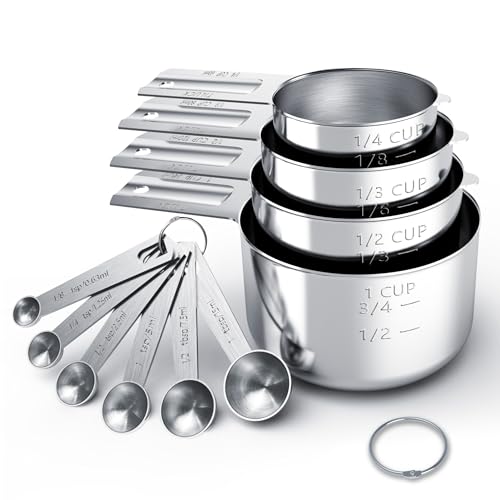
- THLHKD 13-Piece Stainless Steel Measuring Cups and Spoons Set with Funnel
Read the full guide ↓ for the strengths, trade-offs, and honest limitations of each set, plus how to choose and how to measure accurately once your set arrives.
If you bake more than once or twice a month, the best metal measuring spoons stop being a minor upgrade and start being the tool that decides whether a recipe works. Plastic spoons flex under a heaped scoop of flour, their printed markings wear away in the wash, and thin handles bend when you pry them into a jar of packed brown sugar. A stainless steel set does none of that. The bowl holds its shape year after year, the sizes stay readable, and a narrow metal head slides into spice jars that a chunky plastic spoon simply cannot enter. This guide compares six stainless steel sets that cover the main ways people actually measure: a compact six-piece set with clear markings, a rectangular nesting set that fits inside spice jars, two combined cup-and-spoon sets for bakers who want one purchase to cover everything, a jar-friendly seven-piece set, and a nine-piece set with unusually fine small sizes for people who scale recipes up and down. Every pick here is metal, every size and feature mentioned comes from the manufacturer’s own listing, and where a set has a real limitation, this guide says so plainly.
Key Takeaways
- Stainless steel is the default recommendation for measuring spoons because it does not flex, stain, or lose its markings the way plastic does, and it handles both dry and liquid ingredients.
- Size range matters more than piece count: a set that includes 1/8 teaspoon and a true 1 tablespoon covers daily cooking, while fine increments such as 1/16, 1/3, and 3/4 teaspoon help with scaling and spice blends.
- Rectangular heads and slim profiles fit inside standard spice jars; round, wide bowls often do not, which is the most common frustration with basic sets.
- A leveler, included with two sets here, is a small accessory that makes dry measuring noticeably more repeatable.
- If you also need measuring cups, a combined metal set costs less drawer space than buying cups and spoons separately and keeps the markings in one consistent style.
- For tiny quantities, technique matters as much as the spoon: level dry ingredients, read liquids at the brim without overfilling, and spoon flour into the measure rather than scooping from the bag.
In this guide
Quick Picks
| Pick | Badge | Set size | Standout feature from the listing | Link |
|---|---|---|---|---|
| THLHKD 6-Piece Measuring Spoons Set | Best Overall | 6 spoons | Sizes from 1/8 tsp to 1 tbsp with clear size markings | Check on Amazon |
| Spring Chef Nesting Spoons Set of 7 | Best for Spice Jars | 7 spoons plus leveler | Rectangular heads, long handle, fits in spice jars | Check on Amazon |
| Spring Chef Cups and Spoons Set of 14 | Best Complete Set | 14 pieces, cups and spoons | Nesting metal cups plus rectangular spoons and a leveler | Check on Amazon |
| Hudson Essentials Spoons Set of 7 | Best Simple Set | 7 spoons | Slim profile made to fit in spice jars | Check on Amazon |
| U-Taste Measuring Spoons Set of 9 | Best for Fine Increments | 9 spoons | 18/8 stainless steel with 1/16 tsp and 1/3 tsp sizes | Check on Amazon |
| THLHKD 13-Piece Cups and Spoons Set | Best for New Kitchens | 13 pieces plus funnel | Stackable cups and spoons, dishwasher safe, bonus funnel | Check on Amazon |
How These Picks Were Chosen
This is a research-led guide, not a hands-on lab test, and it is written to be honest about that. The six sets were selected from currently available stainless steel measuring spoon sets by comparing what each manufacturer actually states in its listing: the material, the number of pieces, the exact sizes included where stated, and the design features that affect daily use, such as rectangular heads, nesting storage, included levelers, and whether the set adds measuring cups to the spoons. Sets were favored when the listing gave clear, checkable information rather than vague claims. Every product named below was cross-checked against the manufacturer’s listing data, and the only specifications used in the spec boxes are ones stated there. Where a listing does not state a detail, this guide leaves it out instead of guessing. Prices are not printed because they change; each pick links to its listing so you can check the latest price on Amazon. If your priority is a different style of set entirely, the guide to Best Mini Measuring Spoons covers compact sets built around the smallest sizes, and the roundup of Best Most Accurate Measuring Spoons focuses on the features that support repeatable measuring.
The 6 Best Metal Measuring Spoons

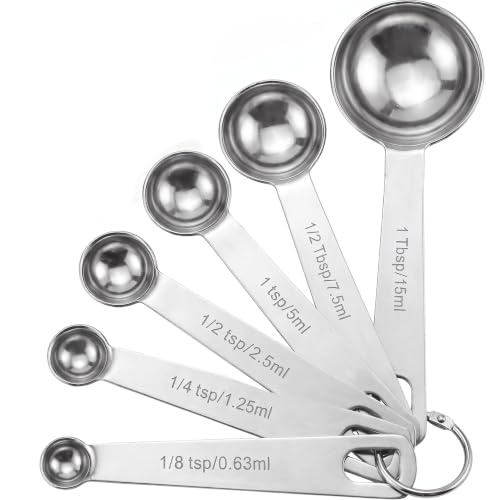
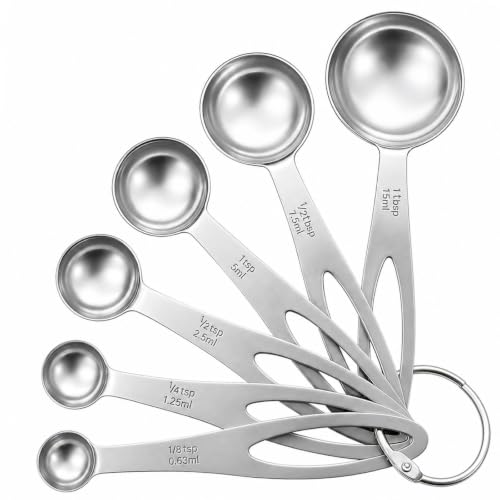
THLHKD 6-Piece Stainless Steel Measuring Spoons Set
Badge: Best Overall
Strengths
- Covers the everyday range from 1/8 teaspoon to 1 tablespoon, which handles the vast majority of recipe calls without doubling up spoons.
- Clear size markings are called out in the listing, and legible markings are what keep a set useful after years of washing.
- Listed for dry and liquid ingredients, plus coffee, spices, and protein powder, so it works as a general kitchen and pantry set.
Trade-offs
- Six pieces is a focused set; bakers who want 1/4 teaspoon certainty should check the listing’s full size list, because the stated range starts at 1/8 teaspoon.
- Spoons only: if you also need measuring cups, you will buy them separately or choose a combined set below.
- No leveler is mentioned in the listing, so you will level with a knife or chopstick.
Mini spec box
- Material: stainless steel
- Pieces: 6
- Size range stated: 1/8 tsp to 1 tbsp
- Markings: clear size markings
- Use: dry and liquid ingredients, coffee, spices, protein powder
For most kitchens, this is the set to beat. It concentrates on the spoons people reach for daily, in stainless steel, with markings the manufacturer specifically describes as clear. That last point sounds minor until you have owned a set whose sizes were printed in ink that faded within a year; a measuring spoon you cannot read is just a small spoon. The stated range beginning at 1/8 teaspoon is genuinely useful for salt in small-batch baking, spice rubs, and coffee drinks, where a quarter teaspoon can overshoot. Because the listing covers both dry and liquid use, the same set handles vanilla extract, oils, and syrups without needing a separate liquid set. The honest limitation is scope: this is a spoons-only, six-piece set, so it will not replace measuring cups, and anyone who regularly needs a 1/16 teaspoon for potent spices or leavening adjustments should look at the U-Taste set below. As a first metal set or a replacement for a worn plastic set, though, it covers the core job with no filler pieces.
Best for: everyday cooks replacing plastic spoons with a durable metal core set / Not suited for: bakers who need measuring cups in the same purchase
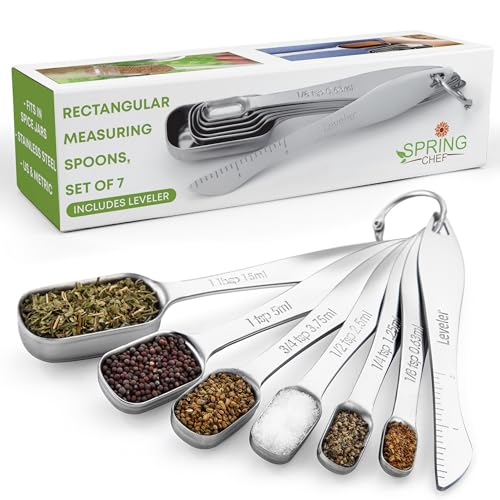
Spring Chef Nesting Stainless Steel Measuring Spoons Set of 7 with Leveler
Badge: Best for Spice Jars
Strengths
- Rectangular heads are the shape that actually fits through the mouth of standard spice jars, the single most common measuring-spoon frustration.
- An included leveler makes dry measuring repeatable instead of depending on a knife edge.
- Nesting design with a long handle keeps the set compact in a drawer and easy to hang.
Trade-offs
- Rectangular bowls hold liquid a little less forgivingly than deep round bowls; pour slowly with oils and extracts.
- Seven spoons only, no cups, so high-volume bakers may still want a combined set.
- The leveler is one more small piece to keep track of in a busy drawer.
Mini spec box
- Material: stainless steel
- Pieces: 7 spoons plus leveler
- Head shape: rectangular
- Storage: nesting
- Handle: long handle
- Use: dry and liquid ingredients; fits in spice jars
If your spice collection lives in standard jars, this set solves the problem that makes people abandon measuring spoons and start shaking spices straight into the pot. The rectangular head slides into jars that reject round spoons, and the long handle reaches to the bottom of tall containers. The leveler deserves more credit than it usually gets: sweeping a leveler across a spoon of baking powder gives the same result every time, while the back of a knife depends on angle and patience. Nesting storage means the seven spoons sit together instead of scattering through a utensil drawer. The trade-off is the flip side of the design: a shallow rectangular bowl is slightly less secure for liquids, so measure vanilla or oil over the bowl you are mixing in, not over the floor on the way there. For spice-heavy cooking, seasoning blends, and baking that leans on leaveners and salt, this is the most purpose-built set in the guide. Readers comparing profiles will also want to see the guide to Best Narrow Measuring Spoons, which focuses entirely on slim heads for jars and small containers.
Best for: spice-heavy cooks and bakers who measure straight from the jar / Not suited for: cooks who mainly measure liquids and prefer deep round bowls

Spring Chef Stainless Steel Measuring Cups and Spoons Set of 14 with Leveler
Badge: Best Complete Set
Strengths
- Cups and spoons in one matched metal set, so one purchase equips a kitchen for both volume and small measures.
- Rectangular spoon heads carry over the spice-jar-friendly design from the spoons-only set.
- Includes a leveler, and the cups nest for storage.
Trade-offs
- Fourteen pieces is the largest footprint here; small drawers may prefer a spoons-only set.
- If you already own good metal cups, you are paying for duplication.
- Combined sets ask you to store cups and spoons together to get the nesting benefit.
Mini spec box
- Material: stainless steel
- Pieces: 14, measuring cups and spoons
- Spoon head shape: rectangular
- Storage: nesting
- Included accessory: leveler
- Use: dry and liquid ingredients
This is the set for the cook who is starting from zero or replacing a mixed drawer of plastic in one move. Having cups and spoons from the same maker means the markings share one style, the metal matches, and everything nests into a single stack instead of two. The rectangular spoons keep the jar access that makes the Spring Chef design popular, and the leveler supports consistent dry measuring across both cups and spoons, which is exactly where baking goes wrong when people scoop flour straight from the bag. The limitation is simply size: fourteen pieces need a home, and if your kitchen already has serviceable metal cups, the spoons-only Spring Chef set above is the leaner buy. For a wedding registry, a first apartment, or a full reset of the baking drawer, this is the most complete option in the guide. It also pairs naturally with the larger combinations discussed in the guide to Best Nesting Measuring Cups Spoons Mixing Bowl Set for readers building a full prep station.
Best for: new kitchens and anyone replacing cups and spoons together / Not suited for: minimalists with limited drawer space

Hudson Essentials Stainless Steel Measuring Spoons Set of 7
Badge: Best Simple Set
Strengths
- Designed to fit in spice jars, stated plainly in the listing, so jar access is a core design goal rather than a side effect.
- Seven spoons cover the standard range for daily cooking and baking without extra novelty sizes.
- Straightforward stainless steel construction for both dry and liquid ingredients.
Trade-offs
- No leveler is listed, so consistent dry measuring depends on your knife technique.
- Spoons only; no cups included.
- The listing states fewer extras than rivals, which suits minimalists but gives spec shoppers less to compare.
Mini spec box
- Material: stainless steel
- Pieces: 7
- Design note: fits in spice jars
- Use: dry or liquid ingredients
Some buyers do not want accessories, funnels, or fourteen pieces; they want a well-made set of spoons that fits their spice jars and survives the dishwasher years. Hudson Essentials aims squarely at that buyer. The listing leads with the two facts that matter: stainless steel construction and a profile that fits in spice jars. Seven spoons is the classic count for a home set, spanning the sizes recipes actually call for. In daily use, a set like this disappears into the routine, which is a compliment: you grab it, measure, rinse, and move on. The honest limitation is the absence of stated extras. There is no leveler in the listing and no nesting claim beyond the jar-fit design, so if those features matter to you, the Spring Chef sets make their case above. But if your current frustration is a wide plastic spoon that will not enter a cumin jar, this set answers it directly and simply. For a broader look at materials and safety questions, see the guide to Best Non Toxic Measuring Spoons.
Best for: minimalists who want a jar-friendly metal set with no extras / Not suited for: bakers who specifically want an included leveler
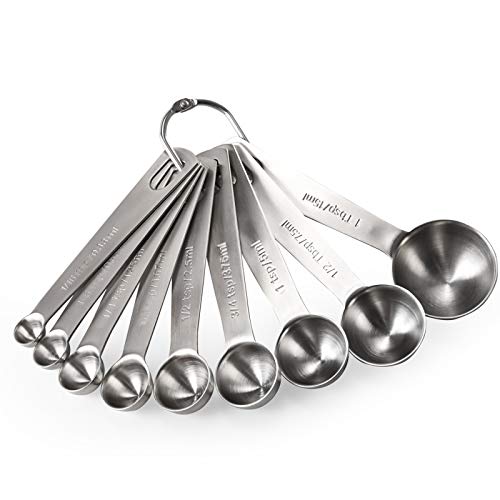
U-Taste 18/8 Stainless Steel Measuring Spoons Set of 9
Badge: Best for Fine Increments
Strengths
- The widest stated size range here: 1/16, 1/8, 1/4, 1/3, 1/2, and 3/4 teaspoon, plus 1 teaspoon, 1/2 tablespoon, and 1 tablespoon.
- 18/8 stainless steel is stated in the listing, a detail material-focused buyers look for.
- Intermediate sizes like 1/3 and 3/4 teaspoon remove the guesswork from halving and thirding recipes.
Trade-offs
- Nine similar spoons demand attention to markings when you grab one in a hurry.
- No leveler or cups are included; it is a specialist spoons set.
- Very small spoons are easy to misplace in a crowded drawer or sink.
Mini spec box
- Material: 18/8 stainless steel
- Pieces: 9
- Sizes stated: 1/16 tsp, 1/8 tsp, 1/4 tsp, 1/3 tsp, 1/2 tsp, 3/4 tsp, 1 tsp, 1/2 tbsp, 1 tbsp
- Use: dry and liquid ingredients
Most sets force you to estimate the in-between amounts: a scant half teaspoon here, two quarter teaspoons there. U-Taste removes that friction by including the intermediate sizes, and the difference shows up in real cooking. Halving a recipe that calls for 3/4 teaspoon of baking soda becomes a single spoon instead of a small arithmetic problem. A 1/16 teaspoon, sometimes called a pinch in older recipes, is the right tool for potent spices, curing salt blends, and adjusting heat without overshooting. The stated 18/8 stainless steel gives material shoppers a concrete detail rather than a generic claim. The limitation is cognitive rather than physical: with nine spoons on a ring, you must actually read the handle each time, and in a fast-moving kitchen that slows some people down. If your cooking involves scaling, spice blending, or small-batch baking, the trade is worth it. This is also the set that readers of the Best Most Accurate Measuring Spoons guide tend to ask about first, because fine increments are half of what accuracy means in practice.
Best for: recipe scalers, spice blenders, and small-batch bakers / Not suited for: cooks who want the fewest possible pieces

THLHKD 13-Piece Stainless Steel Measuring Cups and Spoons Set with Funnel
Badge: Best for New Kitchens
Strengths
- Cups and spoons together in a stackable design that stores as one unit.
- Dishwasher safe is stated in the listing, which simplifies cleanup for busy households.
- An included funnel is genuinely handy for refilling spice jars and oil bottles without spills.
Trade-offs
- Thirteen pieces plus a funnel is a lot of hardware for cooks who only need spoons.
- Stackable storage works best when the whole set is kept together.
- The listing does not state a leveler, so dry-goods technique still matters.
Mini spec box
- Material: stainless steel
- Pieces: 13, measuring cups and spoons, plus funnel
- Storage: stackable
- Care: dishwasher safe
- Use: dry and liquid ingredients; baking and cooking
THLHKD’s combined set takes a different route from the Spring Chef 14-piece: stackable storage and a funnel in the box. The funnel sounds like a throwaway extra until you have tried to refill a narrow spice jar with a spoon and worn half the paprika. For households setting up a kitchen, or replacing a drawer of mismatched plastic, a single stackable tower of metal cups and spoons is an easy system to keep tidy. The stated dishwasher-safe construction suits weeknight cooking, where hand-washing a measuring set is the step most likely to be skipped and leave spoons sitting in the sink. The limitation is the same as any large set: if you already own cups you like, this duplicates them, and the spoons-only sets above are leaner. Between this and the Spring Chef combined set, the choice comes down to the leveler and rectangular spoons on one side versus stacking and the funnel on the other. Either way, you end up with a full metal measuring kit, which is the real goal. If you are also deciding where to buy, the overview at Best Place To Get Measuring Spoons compares the main retail routes.
Best for: first kitchens, gift buyers, and households that value dishwasher-safe cleanup / Not suited for: cooks who already own quality metal cups
Comparison Table
| Set | Pieces | Material stated | Notable design | Cups included | Link |
|---|---|---|---|---|---|
| THLHKD 6-Piece Spoons | 6 | Stainless steel | Clear markings, 1/8 tsp to 1 tbsp | No | Check on Amazon |
| Spring Chef Nesting 7 | 7 plus leveler | Stainless steel | Rectangular, fits spice jars, long handle | No | Check on Amazon |
| Spring Chef 14-Piece | 14 | Stainless steel | Nesting cups, rectangular spoons, leveler | Yes | Check on Amazon |
| Hudson Essentials 7 | 7 | Stainless steel | Fits in spice jars | No | Check on Amazon |
| U-Taste 9 | 9 | 18/8 stainless steel | Fine increments down to 1/16 tsp | No | Check on Amazon |
| THLHKD 13-Piece | 13 plus funnel | Stainless steel | Stackable, dishwasher safe | Yes | Check on Amazon |
How to Choose the Right Metal Measuring Spoons
Start with the sizes you actually use. A standard home set should include 1/4, 1/2, and 1 teaspoon plus 1 tablespoon at minimum. Sets that add 1/8 teaspoon help with salt and spices in small batches, and sets with 1/3 and 3/4 teaspoon, like the U-Taste above, make scaling recipes cleaner. Next, look at the head shape. Round bowls are traditional and secure for liquids, but rectangular or slim heads fit into spice jars, which is where most home measuring actually happens. If your spices live in jars with narrow mouths, head shape is not a cosmetic choice; it decides whether the spoon gets used at all. Then consider markings. Markings that are stamped or etched into the metal, or described as clear by the manufacturer, will outlast printed ink. Check the handle length if you measure from tall canisters, and decide whether you want a leveler included or are happy leveling with a knife. Finally, decide on scope: spoons only, or cups and spoons together. Buying a combined metal set is usually the better value when both are needed, and it keeps the whole measuring kit in one material and one marking style. Tier differences in this category are mostly about size range, included accessories, and design details rather than exotic materials, so pay for the features you will use weekly, not the longest piece count.
How to Measure Accurately with Metal Spoons
Metal spoons reward good technique because they do not flex, so the result you get is the result your technique produces. For dry ingredients, use the spoon-and-level method: spoon the ingredient into the measure until it heaps, then sweep a leveler or the flat back of a knife across the top in one motion. Do not pack unless the recipe says to pack, as with brown sugar. For flour in measuring cups, spoon the flour in and level the same way rather than scooping, which compresses the flour and adds more than the recipe intends. For liquids, fill the spoon to the brim over the mixing bowl, keep it level, and pour steadily; surface tension will hold a slight dome, which is normal for a teaspoon of extract or oil. For sticky ingredients like honey or molasses, a light coating of oil in the spoon first helps the ingredient release cleanly. Store the set nested or on its ring so the small sizes do not migrate to the back of the drawer, and wash and dry promptly to keep the markings easy to read.
Troubleshooting
Problem: baked goods come out salty or over-spiced even though you measured → check whether you are heaping the spoon instead of leveling it; a heaped teaspoon of salt can hold far more than a level one, so adopt the level-off habit for small quantities.
Problem: the spoon will not fit into a spice jar → the head is too wide for the jar mouth; decant that spice into a wider container, or switch to a rectangular or slim-profile set for jar work and keep the round set for liquids.
Problem: markings are getting hard to read → wash gently rather than scouring, dry the set instead of leaving it wet in the sink, and hold the handle at an angle to the light, since stamped markings read best with side light.
Metal vs Plastic vs Silicone Measuring Spoons
Plastic sets are light and inexpensive, but the material flexes under load, stains from spices like turmeric, and its printed sizes wear. Silicone appears more often in spatulas and cup-style measures than in precision spoons, and its flexibility works against exact leveling. Metal, specifically stainless steel, is rigid, non-staining in normal kitchen use, and keeps its shape at the rim, which is the dimension that defines the measure. That rigidity is why recipe developers and test kitchens default to metal for small measures. The one place plastic still makes sense is as a spare set for travel or camping, where weight and breakage matter more than precision. For the home baking drawer, metal is the buy-once choice, and the sets in this guide are all stainless steel because that is what the listings state and what holds up over years of daily use.
Understanding Spoon Sizes: What the Numbers on the Handle Mean
A measuring spoon set is a small system of volumes, and understanding the system makes you faster and more accurate than any single premium spoon. The anchor sizes are the teaspoon and the tablespoon, with three teaspoons equaling one tablespoon. Most home sets build downward from there: a half teaspoon, a quarter teaspoon, and in better sets an eighth teaspoon for small quantities of salt, spices, and leavening. The U-Taste set in this guide goes further in both directions of usefulness, adding a 1/16 teaspoon at the tiny end and the often-missing 1/3 and 3/4 teaspoon sizes in the middle. Those middle sizes matter more than the tiny one for most cooks, because recipes are constantly halved and thirded. A sauce that calls for a tablespoon of spice becomes a teaspoon problem when cut to a third, and a baker halving a recipe with 3/4 teaspoon of baking soda needs either the dedicated spoon or a steady hand with two smaller ones. When you read a set’s listing, the stated size list is the single most informative line in it: it tells you whether the set matches the arithmetic of your actual cooking. Sets that state their sizes plainly, as the picks in this guide do, are easier to buy with confidence than sets that only advertise a piece count, because nine spoons with the wrong sizes help less than six spoons with the right ones.
Metric markings deserve a mention for anyone who cooks from international recipes. Most American spoon sets are built around the teaspoon and tablespoon, while many European and Australian recipes give small quantities in milliliters. A set that states both measurement systems on its handles removes the conversion step at the counter, where mistakes happen. Even without metric markings, the working conversions are simple enough to memorize for the common sizes: a teaspoon is roughly five milliliters and a tablespoon roughly fifteen, so a recipe asking for ten milliliters of vanilla is two teaspoons. Keeping a small conversion note inside the drawer where the spoons live is a low-effort habit that prevents the most common small-measure errors, which are almost never about the spoon and almost always about the arithmetic done in a hurry.
Metal Spoons for Coffee, Spices, and Pantry Staples
Not all measuring happens at the stove. Coffee drinkers dose grounds and flavorings in small spoons, and consistency there changes the cup as surely as it changes a cake. The THLHKD six-piece set in this guide explicitly lists coffee, spices, and protein powder among its uses, which reflects how these sets actually live in a kitchen: one spoon for the morning coffee, one for the evening curry, one for the post-workout shake. Metal suits pantry work for a practical reason beyond durability. Ground spices stain and carry strong flavors, and a non-porous metal bowl rinses clean without holding yesterday’s cumin into today’s cinnamon. Protein powders and supplement scoops benefit from the same rigidity; a metal spoon cuts into a packed powder and levels predictably, while a thin plastic spoon bows and delivers a heaped, inconsistent scoop. If you keep a set by the coffee station, choose one with clear markings, because early-morning measuring is not when anyone reads a faded handle accurately. And if your pantry work involves a lot of jars, the jar-fit question returns: a spoon that enters the jar is a spoon that gets used, while one that does not leads to shaking and guessing, which is how a quarter teaspoon of cayenne becomes a full teaspoon in the pot.
Caring for Stainless Steel Measuring Spoons
Stainless steel asks little, but a few habits keep a set measuring well for decades. Wash the spoons soon after measuring acidic or salty ingredients, not because a single exposure will damage them, but because leaving salt paste sitting on any metal overnight is poor practice that can mark the finish over time. Dry the set rather than leaving it to air-dry in a puddle at the bottom of the sink; water spots are cosmetic, yet they make stamped markings harder to read, and readability is a functional feature in this category. Store the spoons nested or on their ring in a drawer where heavier utensils will not bend the handles; stainless steel is rigid, but a thin handle trapped under a heavy pan and levered can still take a bend, and a bent spoon no longer levels properly against a straight edge. If a spoon does pick up a stubborn spice stain, a paste of baking soda and water with a soft cloth usually lifts it without scratching. Avoid steel wool on the bowls, since scratches give future stains more to hold onto. Sets whose listings state dishwasher-safe construction, like the THLHKD 13-piece above, can go in the dishwasher freely; for sets without that statement, the top rack or a quick hand wash is the cautious route. None of this is demanding care. It is simply the small routine that keeps a buy-once tool behaving like one.
When One Set Is Not Enough: Building a Two-Set System
Serious home bakers often end up with two sets, and there is a rational system behind it. A primary set with fine increments, like the U-Taste nine-piece, lives at the baking station where scaling and precision happen. A secondary, jar-friendly set, like the Spring Chef or Hudson Essentials seven-piece, lives with the spices where access matters more than increments. The two sets divide the work by location instead of forcing one set to be perfect at everything, and the total cost of two focused metal sets is still modest because this is an inexpensive category. A two-set system also solves the wet-spoon problem: when one teaspoon is wet from measuring oil, a dry teaspoon from the second set keeps a baking session moving without constant washing and drying between ingredients. If you cook with a partner, the second set ends the quiet standoff over who has the tablespoon. None of this is necessary for a once-a-month baker, for whom any single set in this guide is plenty. But if you have ever washed the same teaspoon four times during one recipe, you already understand the appeal, and metal is the material that makes a two-set system a permanent solution rather than a recurring purchase.
Level, Heaped, and Scant: Reading Recipe Language Correctly
Recipes assume a level spoon unless they say otherwise, and the vocabulary around that assumption causes more quiet failures than any equipment problem. A level measure means the ingredient is filled to the brim and swept flat, which is the only version of a teaspoon that two cooks in two kitchens can reproduce identically. A heaped or rounded spoon, called for occasionally with sugar or flour in older recipes, means a gentle mound above the rim, and it is deliberately imprecise, a holdover from an era of less standardized spoons. A scant measure means slightly under-filled, common with potent spices and salt, where the recipe author is warning you that a full level spoon may dominate the dish. Metal spoons serve all three styles better than plastic because the rim stays true: leveling against a bent or flexed rim produces a different volume every time, while a rigid rim makes the level sweep a repeatable gesture. This is also why the leveler included with the Spring Chef sets is more than a novelty. It standardizes the sweep, removing the variation between a knife held flat and a knife held at an angle. When a recipe fails despite careful measuring, check the language before blaming the tool: many older recipes were written for heaped spoons, and a modern level measure of a leavener can undershoot what the author intended. Conversely, modern recipes tested with level measures will overshoot on salt if you heap out of habit. Matching your spoon technique to the recipe’s era and wording is the last accuracy skill, and it costs nothing.
One more piece of language worth knowing is the difference between a measuring spoon and a table spoon. The spoon in a place setting is not a standardized measure, and its capacity varies widely between flatware sets. Baking with flatware spoons is the most common cause of the complaint that a recipe never works, because a flatware teaspoon can hold noticeably more or less than a true measuring teaspoon. Owning a real metal measuring set, and keeping it where you bake rather than mixed in with the eating utensils, removes that entire class of error. It is a small organizational point, but kitchens run on such points: the right tool, in the right drawer, with markings you can read, used with the technique the recipe assumes.
Common Buying Mistakes
- Buying by piece count alone: a 13-piece set with sizes you never use is worse than a 6-piece set matched to your cooking.
- Ignoring head shape: wide round spoons that cannot enter your spice jars will be bypassed within a week.
- Assuming all sets include the same sizes: some start at 1/4 teaspoon, others reach 1/16; read the stated size list before buying.
- Forgetting the cups question: buying spoons now and cups later in a different style leaves a mismatched drawer; combined sets exist for a reason.
- Treating markings as a minor detail: unreadable sizes turn a precise tool into guesswork, so favor clearly marked or stamped sizes.
- Scooping flour from the bag with the measure: it compacts the flour and overshoots the recipe no matter how good the spoon is.
Final Recommendation
For most readers, the THLHKD 6-Piece Set is the first choice: focused sizes, clear markings, and stainless steel construction for both dry and liquid work. If spice jars are your daily reality, step up to the Spring Chef Nesting Set of 7, whose rectangular heads and leveler are built for exactly that. Bakers scaling recipes should pick the U-Taste 9-piece for its fine increments, and anyone equipping a kitchen from scratch should choose between the two combined sets: Spring Chef’s 14-piece for the leveler and nesting cups, or THLHKD’s 13-piece for stackable, dishwasher-safe convenience with a funnel. Whichever you choose, you are buying the last measuring spoon set you should need for a long time, and that is the real value of metal. A final practical note: before your first bake with a new set, wash it, dry it, and run one familiar recipe with it, paying attention to how the sizes feel in your jars and canisters. That single test bake tells you more about whether the set fits your kitchen than any specification list, and it confirms your leveling technique while the stakes are low and the recipe is one you already trust completely.
Frequently Asked Questions
Are metal measuring spoons more accurate than plastic ones?
Metal spoons hold their shape, so the bowl volume stays consistent, while plastic can flex under a heavy scoop and change the amount slightly. Accuracy in practice depends just as much on leveling dry ingredients and filling liquids to the brim, but a rigid metal spoon removes one variable, which is why this guide recommends stainless steel as the default.
What sizes should a basic measuring spoon set include?
At minimum, look for 1/4 teaspoon, 1/2 teaspoon, 1 teaspoon, and 1 tablespoon. A 1/8 teaspoon is a useful addition for salt and spices, and intermediate sizes such as 1/3 and 3/4 teaspoon, included in the U-Taste set above, make halving and thirding recipes much easier.
Why do some measuring spoons have rectangular heads?
Rectangular heads fit through the mouths of standard spice jars, where round spoons often cannot enter. Sets like the Spring Chef nesting spoons use this shape so you can measure directly from the jar instead of shaking spice into a separate spoon and guessing.
Can metal measuring spoons be used for liquids?
Yes. Every set in this guide is listed for both dry and liquid ingredients. Fill the spoon to the brim, keep it level, and pour over your mixing bowl. Deep round bowls feel slightly more secure for liquids, while rectangular heads are optimized for jars and dry goods.
How do I keep the size markings readable?
Choose sets with clear or stamped markings, wash without harsh scouring, and dry the spoons rather than leaving them soaking. Reading a stamped handle at an angle to the light also helps, since the shadows in the stamping make the size visible even after years of use.
Do metal measuring spoons react with acidic ingredients?
Stainless steel is chosen for kitchen tools precisely because it resists reacting with everyday ingredients during normal measuring. A spoon spends seconds in contact with vinegar, citrus juice, or tomato, which is far too brief to matter, and every set in this guide is listed for liquid ingredients. The sensible habit is simply to rinse the spoon after measuring something acidic or salty rather than leaving it sitting in the ingredient, which is good practice for any kitchen tool and keeps the finish and markings in the best condition over years of use.
Should I buy a combined cups and spoons set or separate sets?
If you need both, a combined metal set keeps materials and markings consistent and usually stores more compactly through nesting or stacking. If you already own good metal cups, a spoons-only set avoids duplication. This guide includes two combined options and four spoons-only options for exactly that reason.