Disclosure: As an Amazon Associate, topratedkitchenware.com earns from qualifying purchases. Links on this page are affiliate links; they cost you nothing extra. Prices and availability change often, so check the current Amazon listing before you buy.
This cookware set review assesses the general cookware set as a category in its own right — the mainstream matched sets, in nonstick, ceramic nonstick and stainless steel, that most households actually buy when a kitchen needs equipping. A cookware set review that pretended one material told the whole story would fail its readers, because the category’s real question is comparative: which family’s behaviour fits your cooking, and what does a good example of that family look like on the hob, at the sink and in the cupboard. So this review examines design and construction across the families, walks through performance in the jobs that dominate home cooking, and closes with clear verdicts by cook type. Specialist families are reviewed in their own depth elsewhere — ceramic in the ceramic cookware set review and copper via the copper cookware set buying guide — so this page can stay honestly general.
Cookware Set Review: Verdict and Key Takeaways
The verdict: the mainstream cookware set is a mature, well-sorted category in which genuinely bad options are rarer than mismatched ones. Stainless sets earn the strongest recommendation for longevity and high-heat cooking; nonstick sets earn it for effortless weeknight cooking and washing; ceramic nonstick earns a qualified recommendation for buyers committed to that coating family and its gentle-care contract. For a first or replacement kitchen core, a set from any family — matched honestly to the cook — is a sound buy. The reference sets reviewed below show the standard each family should be held to.
- Design: three settled families — coated aluminium nonstick, ceramic nonstick, and stainless in disc-base and clad constructions.
- Performance: all families handle the simmering, boiling and gentle frying core well; they separate on searing, release and washing effort.
- Build: base construction and lid fit predict daily satisfaction better than brand or box count.
- Care: coated sets reward gentle heat and soft utensils; stainless rewards preheating patience and drying after washing.
- Value shape: judge cost across the set’s realistic service pattern, not the headline piece count.
In this guide
What a Cookware Set Is and Where It Fits
A cookware set is the hob wardrobe of a kitchen: frying pans for the fast work, saucepans for the wet work, a large lidded pot for volume, bought as one matched system. It fits the centre of home cooking — the recurring week of pasta, sauces, grains, vegetables, soups, eggs and one-pan dinners — and it fits the moment of equipping: new homes, worn-out collections, merged households. It does not pretend to be the specialist’s bench. The wok, the heavy braiser and the copper saucier remain separate instruments for separate obsessions, and this review marks those boundaries rather than blurring them, because a general set judged by specialist standards looks worse than it is, and a general set sold as a specialist misleads the buyer who trusts it.
Within the category, price tiers express themselves through construction and finish rather than through a different idea of what a pan is. Entry sets concentrate on coated aluminium and the everyday core; mid tiers add clad stainless, better lids and handles, and more considered piece mixes; the premium edge drifts toward specialist materials covered in their own guides. That structure is healthy: it means a modest set is a simpler version of a good idea, not a different and lesser idea, and it means the review questions below — base, lids, handles, piece mix — sort the whole market.
Design, Build and Setup
Traditional nonstick in a general cookware set usually means a coated aluminium pan: a lightweight aluminium body that heats quickly and fairly evenly for its class, finished inside with a slick coating that releases eggs, fish and milky sauces with very little fat and wipes clean in seconds. That convenience is real, and for weeknight cooking it is the single biggest reason general sets sell in such numbers. The trade is lifespan and heat discipline. Every coated surface is a wearing surface, so the coating is at its best early in the set’s life and gradually less slick over years of use, and the manufacturer’s guidance on heat matters: a nonstick pan should never sit empty over high heat, because an empty coated pan climbs in temperature far faster than a full one and sustained overheating is what ages coatings fastest. Used on low to medium heat, preheated briefly with food or a little oil in it, and washed gently, a nonstick set gives easy, forgiving service; treated as a searing pan and left empty on a fierce burner, it will not.
Stainless steel is the durability anchor of the general cookware set category. A stainless surface has no coating to wear away, tolerates metal utensils far better than any coated pan when the manufacturer allows them, handles high heat for searing without the empty-pan anxiety that coated pans demand, and moves between hob and oven in many designs. Its honest costs are equally clear: eggs and delicate fish stick without enough preheating and fat, sauces can catch on hot spots in thin bases, and the mirror finish shows every water mark until you learn to dry pieces after washing. Construction is where stainless sets separate. A simple disc of conductive metal bonded to the base heats mostly through that base, while fully clad construction wraps the conductive core up the sidewalls as well, so soups heat up the sides and sauces reduce more evenly. Both approaches appear in mainstream sets at different tiers, and the buying sections below explain how to tell which you are looking at from the product description alone.
Ceramic nonstick is the second coating family inside the general cookware set category, and it behaves like a close cousin rather than a different species. The cooking surface is a smooth, glassy-feeling coating over an aluminium body, marketed on easy release and easy cleaning, and in daily use it scrambles eggs, reheats leftovers and flips pancakes with the same low-effort charm as traditional nonstick. The differences are in temperament. Ceramic coatings tend to feel slickest when new, reward gentle heat even more strongly, and prefer soft utensils and hand washing if they are to stay slick for long. Shoppers who like the idea of nonstick but prefer this coating family should still read this whole guide, because the set-level decisions — which pieces, which lids, how the handles feel, whether the bases suit the hob — matter just as much as the coating choice, and our dedicated guide goes deeper on this family alone: the ceramic cookware set review.
Count pieces the way manufacturers count them and every set looks generous; count them the way a cook uses them and the picture sharpens. Lids are counted as pieces, utensils bundled in the box are counted as pieces, and two small saucepans that a household may use twice a month inflate the number just as much as the large frying pan used every single day. The pieces that earn their cupboard space in most homes are a small and a large frying pan or skillet, a small and a medium saucepan with lids, a larger lidded pot for pasta, soups and batch cooking, and ideally a wide, deep sauté-style pan that bridges frying and braising. Everything beyond that core — tiny butter warmers, extra lids, steamer inserts, bundled tools — is welcome only if your cooking actually calls for it. A smaller set built around the core six shapes, in a material you like, will out-cook a sprawling set padded with pieces that exist to make the box number bigger, and it will fit the cupboard better too.
Handles decide how a set feels at the exact moment cooking gets physical: draining pasta water one-handed, sliding a full pan across the hob, or carrying a heavy pot of soup to the table. Look first at attachment and shape rather than finish. A handle that stays comparatively cool on the hob is a convenience, never a guarantee, because any handle left over a flame or beside a hot burner will get hot, and the safe habit is to treat every handle as hot and reach for a mitt or a dry towel by default. Long handles give leverage on saucepans and frying pans; helper handles on large pots share the load between two hands and matter more than almost any other detail once a pot is full. Grip shape is personal in a way no specification captures: round handles roll in some hands, flatter handles feel planted in others, and silicone-wrapped grips feel secure when hands are wet but should be checked against the manufacturer’s oven guidance before the pan goes under high oven heat.
Lids look like an afterthought and behave like a system. Glass lids let you watch rice absorb water or a sauce come to a simmer without lifting and losing steam, which suits patient, everyday cooking; metal lids are lighter, shrug off knocks in a crowded cupboard, and often tolerate higher oven heat, but hide the food completely. Either way, the fit matters more than the material: a lid that sits flush keeps moisture in a braise and stops a simmer from spattering the hob, while a loose lid rattles, leaks steam and slows everything down. Check whether lids are shared between pieces — many sets design one lid to serve both a saucepan and a frying pan of the same diameter, which saves storage but means the lid can only cover one pan at a time on a busy night. Rim shape matters too, because a lid with a straining edge or a pot with pouring spouts turns draining vegetables from a colander hunt into a one-step job.
Setup, such as it is, deserves a reviewer’s note because first impressions mislead. A new set should be washed, dried and read — the manufacturer’s care card is part of the product, defining utensil, heat and oven rules that this review applies throughout. Stainless will show rainbow heat tint and water marks early; that is the material’s normal working appearance, not a defect. Coated pans will feel almost supernaturally slick at first; that, equally, is the surface at its peak, and the review standard is how the set behaves once those first weeks settle into routine.
Performance in Real Use
Eggs, fish and delicate work
Delicate work is the coated families’ home ground and stainless’s examination hall. In nonstick and ceramic nonstick pans, eggs slide, fish fillets turn without tearing, and reheated leftovers lift cleanly, all at gentle heat with minimal fat — the single most repeated performance win in everyday cooking. Stainless can do this work well, but it asks for its ritual: preheat the pan, add fat, let it shimmer, then add food and wait for release rather than forcing it. Cooks who perform that ritual happily lose nothing; cooks who want breakfast to be thoughtless should read this section as the review’s clearest steer toward a coated set.
Searing and high-heat work
Searing reverses the ranking completely. Stainless takes a hard preheat, holds it, and builds the deep crust and fond that pan sauces are made from, then deglazes without a worry and tolerates the utensils that scraping requires where the maker allows them. Coated pans should not be asked to do this work at all: their heat discipline forbids the empty, fierce preheat that searing starts with, and forcing the issue shortens the coating’s life for a worse result. This is the performance divide that should decide material for meat-focused cooks, and it is why so many stainless households keep one small coated pan for eggs while insisting — correctly — that the searing pans be steel.
Sauces, simmering and the large pot
The wet work of the kitchen — sauces, soups, grains, pasta — is where construction quietly shows. Clad stainless heats up its sidewalls, so a sauce warms evenly and a soup does not scorch at the base while the top lags; disc-base designs concentrate heat at the bottom, which is perfectly serviceable for boiling and reheating but asks for an occasional stir on long simmers. Coated saucepans shine for milky and cheesy sauces that rinse away afterwards, and large coated pots make light work of sticky grains. Lid fit, reviewed above, governs all of it: a simmer under a flush lid is a different, calmer process than a simmer leaking steam around a rattling one.
Washing up and the morning after
Reviewers underweight washing up; households do not. Coated sets rinse in seconds and forgive a forgotten soak; stainless asks for a soak after cheese or eggs, an occasional firmer scrub where its maker allows, and drying if water marks offend. Neither burden is large, but multiplied across a year of weeknights it becomes a genuine performance characteristic — for tired cooks, arguably the performance characteristic. The review verdict weights it accordingly: a set that gets washed cheerfully gets cooked with more, and cooking more is the entire point of owning it.
Strengths and Trade-offs
Strengths
- Complete core coverage in one coherent, lid-matched system.
- A material family for every cooking temperament, from effortless release to lifetime stainless.
- Predictable storage and a single handling language across all pieces.
Trade-offs
- One material must serve every job, including the job it does worst.
- Coated families carry a wearing surface; stainless carries a technique and washing toll.
- Headline piece counts flatter every set and must be translated into usable vessels.
Read as a balance sheet, the category’s strengths are structural — they come from the set format itself — while its trade-offs are material-specific and therefore choosable. That is an unusually favourable profile for a buyer: it means the decision is less about avoiding bad products and more about selecting which known cost your household minds least. The comparisons in cookware set versus stainless steel cookware set and the live shortlist at the best cookware set list exist to make exactly that selection easier.
How It Compares
Against specialist cookware, the general set trades peak performance for breadth: a dedicated braiser out-braises it, a wok out-tosses it, a copper pan out-responds it — and none of them can also make breakfast, boil pasta and simmer soup in matched lids tomorrow. Against separates, the set trades tailoring for coherence, as the pros-and-cons companion details. Against its own families, the comparison is the review in miniature: nonstick for release, ceramic nonstick for that coating’s feel, stainless for heat and years, clad stainless for evenness within steel. The table a shopper should hold in mind is therefore not brand against brand but temperament against temperament — and on that table, every family in this review has a column it wins outright.
The Reference Sets Reviewed
The six sets below are this review’s reference standards, one or two per family, assessed in prose until their listings are verified. Each note follows the same pattern: what the set is, where it performs, and where its honest limitation sits.

T-fal Signature Nonstick Cookware Set
The T-fal Signature line is the archetypal mainstream nonstick set: coated aluminium pieces built around easy release, easy washing and a forgiving learning curve, aimed squarely at households equipping a first kitchen or replacing tired pans in one box. Its role in this cluster is to represent what the entry tier does best — eggs that slide, sauces that rinse away, and a full spread of everyday shapes without ceremony. Judge it by nonstick rules: gentle heat, no empty preheating on high, soft utensils, and the understanding that the coating is a wearing surface whose best years come first. Households that sear steaks weekly will outgrow it; households that cook eggs, vegetables, fish and pasta sauces most nights will understand immediately why this format sells.
Review angle: hold this set to the performance sections above — release, searing, simmering and washing — in that order of relevance to its family. Position in this guide: entry-tier nonstick, treated prose-only until its listing is verified, so compare it on the current Amazon listing before you buy rather than on any fixed detail printed here.
Best for: cooks whose habits match the entry-tier nonstick format described above. Not suited for: cooks whose main jobs contradict that format’s heat, utensil or care rules.
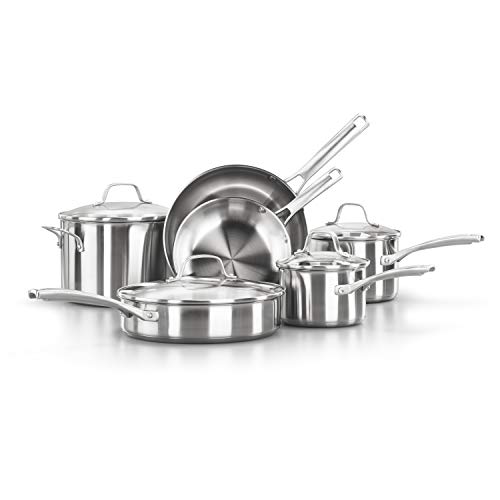
Calphalon Classic Stainless Steel Cookware Set
The Calphalon Classic stainless set represents the mainstream stainless promise in its most familiar form: uncoated cooking surfaces, a substantial feel in the hand, and pieces intended to stay in service for many years rather than a coating’s lifespan. It suits cooks who have made peace with preheating — giving a pan a minute on the heat, adding fat, and letting proteins release naturally once a crust forms — and who value being able to use high heat, deglaze with liquid, and move a pan toward the oven without consulting a coating limit first. Its honest costs are the stainless costs: more attention at the hob, more visible water marks, and a little more washing effort after eggs or cheese. As a set, its appeal is coherence — matched lids, matched handles, and a learning curve you climb once for the whole cupboard.
Review angle: hold this set to the performance sections above — release, searing, simmering and washing — in that order of relevance to its family. Position in this guide: mid-tier stainless steel, treated prose-only until its listing is verified, so compare it on the current Amazon listing before you buy rather than on any fixed detail printed here.
Best for: cooks whose habits match the mid-tier stainless steel format described above. Not suited for: cooks whose main jobs contradict that format’s heat, utensil or care rules.
Cuisinart Chef’s Classic Stainless Cookware Set
Cuisinart’s Chef’s Classic line is the other household name in mainstream stainless, and it earns its place in this cluster by offering the same uncoated durability proposition with its own take on shapes, rims and lid fit. Drip-friendly rims and lids that sit properly matter more in daily service than most buyers expect, because saucepans are pouring and simmering tools before they are anything else. Treat this set as a direct alternative to the Calphalon above rather than a step up or down from it: the decision between mainstream stainless sets usually comes down to which handles suit your grip, which piece mix matches your cooking, and which lids your cupboard stores best. Either way, the stainless rules apply in full — preheat with patience, dry after washing, and expect the pans to look more seasoned, not less capable, with age.
Review angle: hold this set to the performance sections above — release, searing, simmering and washing — in that order of relevance to its family. Position in this guide: mid-tier stainless steel, treated prose-only until its listing is verified, so compare it on the current Amazon listing before you buy rather than on any fixed detail printed here.
Best for: cooks whose habits match the mid-tier stainless steel format described above. Not suited for: cooks whose main jobs contradict that format’s heat, utensil or care rules.
Tramontina Tri-Ply Clad Stainless Steel Cookware Set
The Tramontina tri-ply set is the construction enthusiast’s mainstream pick: clad construction that carries the conductive core up the sidewalls, so the whole vessel — not just its base — takes part in heating. In practice that shows up as soups and sauces that warm more evenly, sidewalls that do not lag behind the base, and reductions that behave predictably. It is the set in this group most likely to satisfy a cook who notices hot spots, and it keeps every stainless advantage — high-heat searing, metal-utensil tolerance where the maker allows, and no coating clock ticking. The trade-offs are weight and attention: clad pieces feel more substantial than disc-base equivalents, and the surface still demands proper preheating for delicate foods. For buyers choosing one stainless set to keep for a long time, this is the construction story to understand before deciding.
Review angle: hold this set to the performance sections above — release, searing, simmering and washing — in that order of relevance to its family. Position in this guide: mid-tier tri-ply stainless steel, treated prose-only until its listing is verified, so compare it on the current Amazon listing before you buy rather than on any fixed detail printed here.
Best for: cooks whose habits match the mid-tier tri-ply stainless steel format described above. Not suited for: cooks whose main jobs contradict that format’s heat, utensil or care rules.

Rachael Ray Cucina Nonstick Cookware Set
The Rachael Ray Cucina set shows the personality side of mainstream nonstick: coated aluminium everyday pieces presented as a coordinated, colourful kitchen system rather than anonymous pans. Under the styling it obeys exactly the same physics as the T-fal above — quick-heating aluminium, a slick wearing surface, gentle-heat discipline — and it should be judged by the same standards of piece mix, lid fit and handle comfort. Where it earns its place is for buyers who want the nonstick format and care how the cupboard and hob look together, or who are buying a set as a gift for a new home where coordination matters. Its limits are the format’s limits, stated plainly: it is a low-to-medium-heat, soft-utensil set, and no colour palette changes that contract.
Review angle: hold this set to the performance sections above — release, searing, simmering and washing — in that order of relevance to its family. Position in this guide: entry-to-mid-tier nonstick, treated prose-only until its listing is verified, so compare it on the current Amazon listing before you buy rather than on any fixed detail printed here.
Best for: cooks whose habits match the entry-to-mid-tier nonstick format described above. Not suited for: cooks whose main jobs contradict that format’s heat, utensil or care rules.

GreenLife Soft Grip Ceramic Nonstick Cookware Set
The GreenLife Soft Grip set is this cluster’s ceramic nonstick representative: an aluminium body with a ceramic-style slick surface and comfort-shaped handles, pitched at buyers who want easy release with this coating family and a soft, secure grip in wet hands. Read it alongside the dedicated ceramic coverage on this site for the coating deep-dive, and judge it here as a general set: the piece mix covers the everyday core, the surface rewards low-to-medium heat and prompt, gentle washing, and the handles deserve a check against the manufacturer’s oven guidance before any hob-to-oven plans. Ceramic coatings are at their slickest early, so the value case rests on easy weeknight cooking now plus disciplined care — soft utensils, no empty high heat, protected stacking — to stretch that performance as far as it will go.
Review angle: hold this set to the performance sections above — release, searing, simmering and washing — in that order of relevance to its family. Position in this guide: entry-tier ceramic nonstick, treated prose-only until its listing is verified, so compare it on the current Amazon listing before you buy rather than on any fixed detail printed here.
Best for: cooks whose habits match the entry-tier ceramic nonstick format described above. Not suited for: cooks whose main jobs contradict that format’s heat, utensil or care rules.
Who Should Buy a Cookware Set and Who Should Skip It
Buy a set if you are equipping a core, replacing a worn collection, or simplifying a mismatched cupboard into one system; choose the family by your heat habits and washing patience as this review describes. Skip the set format — for now — if your core already works and only one vessel needs replacing, if your cooking is dominated by one specialist discipline whose instrument you do not yet own, or if you know you want different materials for different jobs and prefer to assemble them deliberately from the start. Skipping is not a verdict against sets; it is a recognition that the set’s moment is the equipping moment, and yours may simply be a different moment. The value question in full lives in is a cookware set worth it.
Setup, Care and Maintenance Essentials
Care is where a cookware set’s real lifespan is decided, and the rules are simpler than the internet makes them sound. Let pans cool before washing, because plunging a hot pan into cold water stresses any construction and can warp lighter bases over time. Wash coated pieces with a soft sponge and ordinary washing-up liquid, keep scouring pads and harsh abrasives for the stainless pieces whose manufacturers allow them, and dry stainless after washing if water marks bother you — they are cosmetic, not damage. Stacking is the silent coating killer in most cupboards: pans nested directly against each other scrape with every removal, so a cloth, a pan protector or simply a sheet of kitchen paper between coated surfaces preserves the finish for a trivial effort. Handles and lids deserve the same thirty seconds: check handle fixings occasionally, wash lids around their rims where grease gathers, and store lids where their edges will not chip against pot rims.
The safety notes for a general cookware set are unglamorous and absolute. Never leave a coated pan empty over high heat: an empty pan has nothing absorbing the energy, its temperature climbs quickly, and overheating is the fastest way to damage a nonstick surface and the cooking in it afterwards. Keep any pan’s handle turned inward so it cannot be knocked or grabbed by a passing child, and treat every handle as hot regardless of stay-cool claims, because handles absorb heat from flames, neighbouring burners and oven air alike. Use the utensils the manufacturer recommends for the surface in front of you — soft silicone, nylon or wood on coated pans as a default, metal only where the maker explicitly allows it — and lift rather than drag heavy pots across glass hobs. Finally, a pan that has warped so it spins on the hob, a coating that is flaking into food, or a handle that wobbles after tightening is a pan to retire, not to nurse along; sets are modular in practice, and replacing one tired piece protects everything cooked after it.
Final Verdict
The general cookware set earns a confident recommendation as the foundation of a home kitchen: mature designs, honest materials, and a family for every temperament. Stainless — clad above all — is this review’s pick for cooks who sear and who buy for the long term; nonstick is its pick for cooks who prize effortless weeknights; ceramic nonstick serves its committed audience well under gentle care. Choose by temperament, verify hob and storage, and the set will repay the decision daily. Deeper buying method sits in the cookware set buying guide, and current market shortlists sit at T-fal cookware sets and Cuisinart cookware sets.
Performance in Real Use: Two More Tests
Oven-to-table and hob-to-oven work
Sets earn quiet marks here that hob-only testing misses. A stainless sauté pan that starts a braise on the burner and finishes it in the oven collapses two vessels into one motion, and the household feels that convenience weekly once the habit forms. Coated sets participate within their manufacturer’s oven guidance — gentler finishes, warm-keeping, gratins under modest heat — and glass lids set their own lower ceiling beneath the pan’s. The review standard is not the highest number a pan can survive but the match between the set’s cleared range and the dishes a household actually transfers. Kitchens that never move a pan to the oven should spend nothing on this criterion; kitchens that do should filter by it early, checking pan and lid separately as this review has insisted throughout.
Storage, stacking and the cupboard test
Every set in this review was imagined back into a real cupboard, because that is where sets spend most of their lives. The questions are physical: do the pans nest without their surfaces grinding, do the lids have a home that is not a jumble, does the largest pot fit with its lid on, and can the daily frying pan be reached without unloading two other pieces? Sets designed as systems pass this test gracefully; sets assembled for a photograph fail it nightly. Coated sets add one rule — protect nested surfaces — and stainless sets add one observation, that their weight makes low storage kinder than high shelves. A review that ignores the cupboard test has reviewed a showroom, not a kitchen tool.
Build Quality: What Separates the Good Examples
Across families, the good examples share tells that have nothing to do with tier. Bases sit flat and true, so pans do not rock or spin on the hob and oil pools where it should. Rims are finished smoothly and pour without dribbling. Handle junctions feel planted under load, with no flex that asks the wrist to compensate. Lid rims meet pot rims in a clean line. Coatings, where present, are even at the edges where wear begins. None of these tells requires equipment to check — a countertop, a jug of water and a lifted full pan reveal most of them — and together they predict the daily experience more faithfully than any brand story. The mediocre examples fail the same tells in the same order, which is why this review teaches the tells rather than merely naming winners: winners get revised, but a flat base is a flat base forever.
Weight deserves its own sentence in any honest build assessment, because it cuts both ways and reviewers too often praise heft as a synonym for quality. A pan must be heavy enough to sit stable and hold heat through the addition of cold food, and light enough to be lifted, drained and washed by the actual cooks in the house, one-handed at a saucepan, two-handed at a full stockpot. Clad stainless concentrates the category’s weight; coated aluminium concentrates its lightness. Neither is the quality — the match to the household’s hands is the quality, and it can only be judged by the people who will do the lifting.
Long-Term Ownership: How the Reviewed Families Age
A review written at unboxing is a photograph; ownership is a film. Projecting these families forward from their known behaviour: the nonstick references will be at their best in their first long stretch, with release so complete it feels like a parlour trick, then settle into a gradual, honest decline concentrated in the frying pans while the saucepans and stockpot remain near their peak — the household renewing pieces singly and barely noticing the system’s continuity. The ceramic reference follows the same arc on a slightly more delicate timetable, rewarding the households that hold its gentle contract. The stainless references invert the film entirely: an opening fortnight of tint, marks and technique lessons, then a plateau that simply continues, the pans growing more familiar rather than less capable, until the set’s story becomes the household’s story. Neither film is better cinema. But a buyer should choose the film they want to watch, because they will be watching it at breakfast for years, and this review’s final service is to insist that the choice is about time as much as about cooking.
The Reviewer’s Notebook: Small Behaviours That Decided Marks
Reviews are decided by large criteria and confirmed by small behaviours, and this notebook records the ones that recurred across the families assessed here. The saucepan that pours cleanly at a near-empty tilt, without a runnel down its own side, earned its set more goodwill at the sink than any construction claim. The lid that can be set down on a worktop without rolling or clattering changed how calmly a simmer could be checked. The handle that stays oriented — that does not slowly rotate a pan on a glass hob as it heats — separated careful engineering from adequate engineering in a single breakfast. The frying pan whose sides slope for turning rather than decoration, the stockpot whose rim accepts a spoon rest without ceremony, the base that wipes clean instead of harbouring a baked ring: none of these appears in a headline, and together they are most of what owners mean, two years later, when they say a set is good. This review has weighted them accordingly, and it recommends that readers shopping in person spend their minutes on exactly these behaviours — pour, set down, lift, wipe — rather than on the shine of the showroom shelf.
The Review in One Paragraph
For readers who will act today: the general cookware set is a mature category whose families each keep their promises — nonstick releases and rinses, ceramic nonstick charms its careful audience, stainless sears and endures — and whose failures are almost always mismatches rather than defects. Hold any candidate set to the tests in this review: delicate work, searing, simmering, washing, the cupboard, and the full pan lifted in your own hand. The set that passes your tests, in the family your menu chooses, is the right set at whatever tier it sits, and the reviewer’s remaining advice is only to read its care card before its first meal rather than after its first mistake.
Cookware Set: What Long-Term Use Reveals That a First Test Misses
Start with how a {p} holds up once the novelty wears off and routines settle in. Most coverage of a cookware set concentrates on the first week of ownership, yet the decisions that matter most tend to surface later, once the cookware set has to earn its place in an ordinary weekday routine rather than a carefully staged first attempt. Write down the three jobs you expect it to do most often, in the order you actually do them, and judge every claim you read against that short personal list instead of against a generic ideal.
Troubleshooting is easier when you expect the usual failure points. With any cookware set, the recurring problems tend to cluster in the same places: uneven results from overloading or poor arrangement, wear showing first on the parts handled most often, and small annoyances with lids, seals, handles, controls or fittings that only appear after repeated use. Before buying, look for whether those wear parts can be cleaned properly, replaced or worked around, and whether the instructions address them directly rather than pretending they never happen.
Finally, plan the first fortnight deliberately. Use the cookware set for one familiar job first, so you have a baseline you trust, then introduce the harder cases one at a time and note what changes. Small adjustments to arrangement, timing, quantity or preparation usually close most of the gap between disappointing first results and the performance the design is capable of. That short learning period is also the fairest test of long-term ownership: if the routine has not settled by the end of it, the mismatch is real, and it is better to know while returning or exchanging is still straightforward.
Use a short decision checklist to finish. One, does it fit the space and the storage you really have. Two, does it handle your three most common jobs without a workaround. Three, do the edge cases you listed stay manageable. Four, can every wear part be cleaned or replaced without drama. Five, would you still choose it if a friend described the same drawbacks in their own kitchen. A cookware set that passes all five is a sound buy; one that fails two or more is a compromise you are choosing with open eyes, which is a very different thing from being surprised later.
When you check listings such as T-fal Signature Nonstick Cookware Set, Calphalon Classic Stainless Steel Cookware Set and Cuisinart Chef’s Classic Stainless Cookware Set, use them as worked examples: run through the same checks below on each one in turn, so the comparison stays honest and like for like rather than based on whichever listing happens to shout loudest.
Maintenance decides how long the good results last. Set a simple rhythm: a quick wipe or rinse after each use, a deeper clean on a fixed day, and a periodic check of the parts that move, seal or bear weight. A cookware set that needs fiddly disassembly for basic care will be cleaned less often, and performance drifts long before anything actually breaks. Prefer designs where the parts that get dirtiest are the parts that are easiest to reach, and be honest with yourself about which cleaning steps you will genuinely keep up.
Edge cases deserve a deliberate pass. Think about the odd shapes, the thicker or thinner than usual loads, the leftovers, the second helping and the guest with different preferences. A well-chosen cookware set handles the exceptions gracefully, or at least predictably, while a poor match turns every exception into a workaround. List your two or three most common exceptions in advance and check, from the manual or the listing details, that nothing about them is ruled out by size, shape, material or care requirements.
Measure before you commit. Note the footprint, the clearance above and behind the spot where the cookware set will live, and the route you will carry it by when it is hot, full or awkward. A cookware set that technically fits but blocks a cupboard door, crowds a neighbouring appliance or has to be dragged across a worktop every time will quietly fall out of use, whatever its merits on paper. In the Kitchen Cookware category especially, a few centimetres of clearance and a sensible storage plan separate a daily tool from a bulky regret.
Work through a realistic scenario, not a best case. Picture the busiest version of the job: more people to serve, less time than planned, ingredients or materials that are slightly out of the ordinary, and a clean-up waiting at the end. Ask how the cookware set behaves at that upper edge, because a model that only shines on a small, simple load will disappoint precisely when you need it most. If the honest answer is that you would split the job into batches or fall back on an older method, factor that into the decision now rather than discovering it later.
Frequently Asked Questions
What should a good cookware set include?
The working core: two frying pans in different sizes, two saucepans with lids, and one large lidded pot, in a single material family matched to your cooking. Beyond the core, judge extras by named weekly uses — a wide deep sauté pan earns its place in many kitchens, while duplicate tiny saucepans rarely do. Lids should fit flush, handles should feel secure in a wet grip, and the largest piece should suit both your biggest burner and your cupboard.
Is stainless steel or nonstick better in a set?
Better depends on the job you repeat. Stainless is better for searing, high heat, deglazing and long service, and it asks for preheating technique and slightly more washing. Nonstick is better for eggs, fish, milky sauces and fast clean-up at gentle heats, and its surface wears gradually. Many households resolve the question with a stainless set plus one small coated pan, or the reverse, rather than forcing one family to win every job.
How can I tell if a stainless set is well made?
Look at construction and fit rather than slogans. Clad construction carries the conductive core up the sidewalls for even heating; disc-base designs concentrate it at the bottom and suit boiling and reheating well. Lids should sit flush without rattling, handles should feel planted rather than decorative, and rims on saucepans should pour without dribbling down the side. The manufacturer’s own description states the construction plainly — read it, and be wary of any listing that will not say which construction it sells.
Are ceramic nonstick sets a good alternative?
For buyers who want the slick, easy-release format in the ceramic coating family, yes — with the family’s contract understood: gentle heat, soft utensils, prompt gentle washing, and the expectation that slickness is strongest early. As a general set it covers the same everyday core as traditional nonstick. Readers weighing that family specifically should read the dedicated review linked in this article’s introduction, which assesses ceramic sets on their own terms rather than as a footnote to the general category.
Can a cookware set go in the oven?
Many can, within limits that belong to the specific set: pan bodies, handle materials, coatings and glass lids each carry their own tolerance, and the manufacturer’s guidance for the exact version on sale is the only authority. Stainless sets commonly offer the broadest oven use; coated sets and glass lids commonly carry lower limits. If hob-to-oven dishes are weekly in your kitchen, make oven clearance a first-order filter when comparing sets, checking pans and lids separately.
When should I replace a cookware set?
Replace by piece and by symptom rather than by age. A coated pan whose surface is flaking or has lost its release despite gentle care, a pan warped enough to spin on the hob, or a handle that stays loose after tightening are all retirement cases. Stainless sets rarely need wholesale replacement; individual pieces can serve for many years. Because sets age unevenly — the daily frying pan first — replacing the tired piece and keeping the system is usually the sensible path.


