Disclosure: As an Amazon Associate, topratedkitchenware.com earns from qualifying purchases. Links on this page are affiliate links; they cost you nothing extra. Prices and availability change often, so check the current Amazon listing before you buy.
These cookware set reviews take the plural seriously: instead of anointing one winner, these cookware set reviews assess the mainstream field family by family and set by set, so a reader can find the review that matches the kitchen they actually run. The general cookware set market divides cleanly into nonstick, ceramic nonstick and stainless steel, and within stainless into disc-base and clad constructions — and the honest review of each sounds different, because each is good at different work. Below, the field is mapped first, then each reference set is reviewed on the same evidence: design, everyday performance, care burden and the cook it suits. Specialist families keep their own pages — start with the ceramic cookware set review for that coating family — while this page holds the general field in one view.
Cookware Set Reviews: How This Roundup Works
Every set here is reviewed against the jobs that dominate home cooking, weighted equally: delicate release work, searing and high-heat work, sauces and simmering, and the washing up that follows. A set is never marked down for failing a job its family never claimed — a nonstick set is not criticised for refusing a fierce sear, any more than a stainless set is criticised for demanding preheating — but each set is marked on how completely it delivers its own family’s promise, and on the set-level virtues of piece mix, lid fit, handles and storage. All six are presented prose-only, in qualitative tiers, until their listings are verified; use the current listing to confirm the exact version, since set compositions are revised under the same names.
- Nonstick sets reviewed on release, gentle-heat behaviour and washing ease.
- Ceramic nonstick reviewed on the same terms, with its own care contract applied.
- Stainless sets reviewed on searing, evenness by construction, and long-service build.
- Every set reviewed on usable piece count, never on the box number.
In this guide
The Field at a Glance
Traditional nonstick in a general cookware set usually means a coated aluminium pan: a lightweight aluminium body that heats quickly and fairly evenly for its class, finished inside with a slick coating that releases eggs, fish and milky sauces with very little fat and wipes clean in seconds. That convenience is real, and for weeknight cooking it is the single biggest reason general sets sell in such numbers. The trade is lifespan and heat discipline. Every coated surface is a wearing surface, so the coating is at its best early in the set’s life and gradually less slick over years of use, and the manufacturer’s guidance on heat matters: a nonstick pan should never sit empty over high heat, because an empty coated pan climbs in temperature far faster than a full one and sustained overheating is what ages coatings fastest. Used on low to medium heat, preheated briefly with food or a little oil in it, and washed gently, a nonstick set gives easy, forgiving service; treated as a searing pan and left empty on a fierce burner, it will not.
Stainless steel is the durability anchor of the general cookware set category. A stainless surface has no coating to wear away, tolerates metal utensils far better than any coated pan when the manufacturer allows them, handles high heat for searing without the empty-pan anxiety that coated pans demand, and moves between hob and oven in many designs. Its honest costs are equally clear: eggs and delicate fish stick without enough preheating and fat, sauces can catch on hot spots in thin bases, and the mirror finish shows every water mark until you learn to dry pieces after washing. Construction is where stainless sets separate. A simple disc of conductive metal bonded to the base heats mostly through that base, while fully clad construction wraps the conductive core up the sidewalls as well, so soups heat up the sides and sauces reduce more evenly. Both approaches appear in mainstream sets at different tiers, and the buying sections below explain how to tell which you are looking at from the product description alone.
Ceramic nonstick is the second coating family inside the general cookware set category, and it behaves like a close cousin rather than a different species. The cooking surface is a smooth, glassy-feeling coating over an aluminium body, marketed on easy release and easy cleaning, and in daily use it scrambles eggs, reheats leftovers and flips pancakes with the same low-effort charm as traditional nonstick. The differences are in temperament. Ceramic coatings tend to feel slickest when new, reward gentle heat even more strongly, and prefer soft utensils and hand washing if they are to stay slick for long. Shoppers who like the idea of nonstick but prefer this coating family should still read this whole guide, because the set-level decisions — which pieces, which lids, how the handles feel, whether the bases suit the hob — matter just as much as the coating choice, and our dedicated guide goes deeper on this family alone: the ceramic cookware set review.
Count pieces the way manufacturers count them and every set looks generous; count them the way a cook uses them and the picture sharpens. Lids are counted as pieces, utensils bundled in the box are counted as pieces, and two small saucepans that a household may use twice a month inflate the number just as much as the large frying pan used every single day. The pieces that earn their cupboard space in most homes are a small and a large frying pan or skillet, a small and a medium saucepan with lids, a larger lidded pot for pasta, soups and batch cooking, and ideally a wide, deep sauté-style pan that bridges frying and braising. Everything beyond that core — tiny butter warmers, extra lids, steamer inserts, bundled tools — is welcome only if your cooking actually calls for it. A smaller set built around the core six shapes, in a material you like, will out-cook a sprawling set padded with pieces that exist to make the box number bigger, and it will fit the cupboard better too.
The Reviews
Read the reviews in family order, or jump to the family your heat habits point to. Each review closes with the same verdict pattern — best for, not suited for — so the six can be compared at a glance once read.

T-fal Signature Nonstick Cookware Set
The T-fal Signature line is the archetypal mainstream nonstick set: coated aluminium pieces built around easy release, easy washing and a forgiving learning curve, aimed squarely at households equipping a first kitchen or replacing tired pans in one box. Its role in this cluster is to represent what the entry tier does best — eggs that slide, sauces that rinse away, and a full spread of everyday shapes without ceremony. Judge it by nonstick rules: gentle heat, no empty preheating on high, soft utensils, and the understanding that the coating is a wearing surface whose best years come first. Households that sear steaks weekly will outgrow it; households that cook eggs, vegetables, fish and pasta sauces most nights will understand immediately why this format sells.
Roundup angle: this review scores the set against its own family’s promise first and the general core second. Position in this guide: entry-tier nonstick, treated prose-only until its listing is verified, so compare it on the current Amazon listing before you buy rather than on any fixed detail printed here.
Best for: cooks whose habits match the entry-tier nonstick format described above. Not suited for: cooks whose main jobs contradict that format’s heat, utensil or care rules.
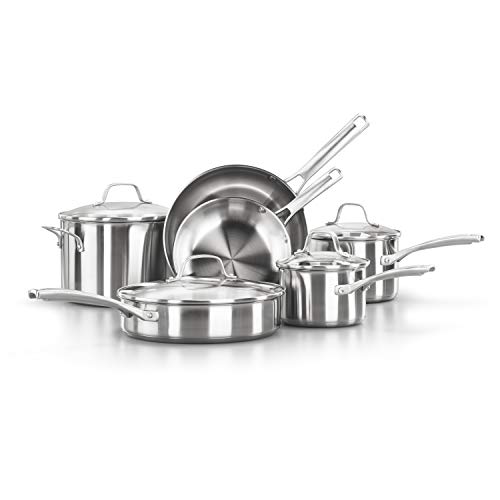
Calphalon Classic Stainless Steel Cookware Set
The Calphalon Classic stainless set represents the mainstream stainless promise in its most familiar form: uncoated cooking surfaces, a substantial feel in the hand, and pieces intended to stay in service for many years rather than a coating’s lifespan. It suits cooks who have made peace with preheating — giving a pan a minute on the heat, adding fat, and letting proteins release naturally once a crust forms — and who value being able to use high heat, deglaze with liquid, and move a pan toward the oven without consulting a coating limit first. Its honest costs are the stainless costs: more attention at the hob, more visible water marks, and a little more washing effort after eggs or cheese. As a set, its appeal is coherence — matched lids, matched handles, and a learning curve you climb once for the whole cupboard.
Roundup angle: this review scores the set against its own family’s promise first and the general core second. Position in this guide: mid-tier stainless steel, treated prose-only until its listing is verified, so compare it on the current Amazon listing before you buy rather than on any fixed detail printed here.
Best for: cooks whose habits match the mid-tier stainless steel format described above. Not suited for: cooks whose main jobs contradict that format’s heat, utensil or care rules.
Cuisinart Chef’s Classic Stainless Cookware Set
Cuisinart’s Chef’s Classic line is the other household name in mainstream stainless, and it earns its place in this cluster by offering the same uncoated durability proposition with its own take on shapes, rims and lid fit. Drip-friendly rims and lids that sit properly matter more in daily service than most buyers expect, because saucepans are pouring and simmering tools before they are anything else. Treat this set as a direct alternative to the Calphalon above rather than a step up or down from it: the decision between mainstream stainless sets usually comes down to which handles suit your grip, which piece mix matches your cooking, and which lids your cupboard stores best. Either way, the stainless rules apply in full — preheat with patience, dry after washing, and expect the pans to look more seasoned, not less capable, with age.
Roundup angle: this review scores the set against its own family’s promise first and the general core second. Position in this guide: mid-tier stainless steel, treated prose-only until its listing is verified, so compare it on the current Amazon listing before you buy rather than on any fixed detail printed here.
Best for: cooks whose habits match the mid-tier stainless steel format described above. Not suited for: cooks whose main jobs contradict that format’s heat, utensil or care rules.
Tramontina Tri-Ply Clad Stainless Steel Cookware Set
The Tramontina tri-ply set is the construction enthusiast’s mainstream pick: clad construction that carries the conductive core up the sidewalls, so the whole vessel — not just its base — takes part in heating. In practice that shows up as soups and sauces that warm more evenly, sidewalls that do not lag behind the base, and reductions that behave predictably. It is the set in this group most likely to satisfy a cook who notices hot spots, and it keeps every stainless advantage — high-heat searing, metal-utensil tolerance where the maker allows, and no coating clock ticking. The trade-offs are weight and attention: clad pieces feel more substantial than disc-base equivalents, and the surface still demands proper preheating for delicate foods. For buyers choosing one stainless set to keep for a long time, this is the construction story to understand before deciding.
Roundup angle: this review scores the set against its own family’s promise first and the general core second. Position in this guide: mid-tier tri-ply stainless steel, treated prose-only until its listing is verified, so compare it on the current Amazon listing before you buy rather than on any fixed detail printed here.
Best for: cooks whose habits match the mid-tier tri-ply stainless steel format described above. Not suited for: cooks whose main jobs contradict that format’s heat, utensil or care rules.

Rachael Ray Cucina Nonstick Cookware Set
The Rachael Ray Cucina set shows the personality side of mainstream nonstick: coated aluminium everyday pieces presented as a coordinated, colourful kitchen system rather than anonymous pans. Under the styling it obeys exactly the same physics as the T-fal above — quick-heating aluminium, a slick wearing surface, gentle-heat discipline — and it should be judged by the same standards of piece mix, lid fit and handle comfort. Where it earns its place is for buyers who want the nonstick format and care how the cupboard and hob look together, or who are buying a set as a gift for a new home where coordination matters. Its limits are the format’s limits, stated plainly: it is a low-to-medium-heat, soft-utensil set, and no colour palette changes that contract.
Roundup angle: this review scores the set against its own family’s promise first and the general core second. Position in this guide: entry-to-mid-tier nonstick, treated prose-only until its listing is verified, so compare it on the current Amazon listing before you buy rather than on any fixed detail printed here.
Best for: cooks whose habits match the entry-to-mid-tier nonstick format described above. Not suited for: cooks whose main jobs contradict that format’s heat, utensil or care rules.

GreenLife Soft Grip Ceramic Nonstick Cookware Set
The GreenLife Soft Grip set is this cluster’s ceramic nonstick representative: an aluminium body with a ceramic-style slick surface and comfort-shaped handles, pitched at buyers who want easy release with this coating family and a soft, secure grip in wet hands. Read it alongside the dedicated ceramic coverage on this site for the coating deep-dive, and judge it here as a general set: the piece mix covers the everyday core, the surface rewards low-to-medium heat and prompt, gentle washing, and the handles deserve a check against the manufacturer’s oven guidance before any hob-to-oven plans. Ceramic coatings are at their slickest early, so the value case rests on easy weeknight cooking now plus disciplined care — soft utensils, no empty high heat, protected stacking — to stretch that performance as far as it will go.
Roundup angle: this review scores the set against its own family’s promise first and the general core second. Position in this guide: entry-tier ceramic nonstick, treated prose-only until its listing is verified, so compare it on the current Amazon listing before you buy rather than on any fixed detail printed here.
Best for: cooks whose habits match the entry-tier ceramic nonstick format described above. Not suited for: cooks whose main jobs contradict that format’s heat, utensil or care rules.
How the Families Compare on the Evidence
Across the six reviews, a consistent pattern emerges that no single winner can express. On release and washing, the coated families lead and stainless follows at a respectful distance, closing the gap only in skilled hands. On searing, heat freedom and expected service life, stainless leads outright, with clad construction ahead of disc-base on evenness. On the set-level virtues — lids, handles, piece mix, storage — the families tie, because those virtues belong to individual set design rather than material: a well-shaped nonstick set beats a careless stainless set on daily comfort, and vice versa. The shopper’s task is therefore two-stage: pick the family by temperament, then pick the set by design. The buying method for the second stage is laid out in the cookware set buying guide, and the head-to-head material arguments are developed in cookware set versus nonstick cookware set and cookware set versus stainless steel cookware set.
What These Reviews Weight — and What They Ignore
These reviews weight repeated weekly behaviour over first impressions, because a set’s character is its fiftieth breakfast, not its first. They weight lid fit and handle comfort heavily, since those touch every meal, and they weight the manufacturer’s stated heat, utensil and oven guidance as hard evidence, since those lines define the product’s real contract. They ignore headline piece counts, ignore any fixed performance numbers that cannot survive a listing revision, and ignore the assumption that one family’s standards judge another. A reader who disagrees with a weighting can still use every review here, because each one states its evidence — release, searing, simmering, washing, build — separately before its verdict.
Handles decide how a set feels at the exact moment cooking gets physical: draining pasta water one-handed, sliding a full pan across the hob, or carrying a heavy pot of soup to the table. Look first at attachment and shape rather than finish. A handle that stays comparatively cool on the hob is a convenience, never a guarantee, because any handle left over a flame or beside a hot burner will get hot, and the safe habit is to treat every handle as hot and reach for a mitt or a dry towel by default. Long handles give leverage on saucepans and frying pans; helper handles on large pots share the load between two hands and matter more than almost any other detail once a pot is full. Grip shape is personal in a way no specification captures: round handles roll in some hands, flatter handles feel planted in others, and silicone-wrapped grips feel secure when hands are wet but should be checked against the manufacturer’s oven guidance before the pan goes under high oven heat.
Lids look like an afterthought and behave like a system. Glass lids let you watch rice absorb water or a sauce come to a simmer without lifting and losing steam, which suits patient, everyday cooking; metal lids are lighter, shrug off knocks in a crowded cupboard, and often tolerate higher oven heat, but hide the food completely. Either way, the fit matters more than the material: a lid that sits flush keeps moisture in a braise and stops a simmer from spattering the hob, while a loose lid rattles, leaks steam and slows everything down. Check whether lids are shared between pieces — many sets design one lid to serve both a saucepan and a frying pan of the same diameter, which saves storage but means the lid can only cover one pan at a time on a busy night. Rim shape matters too, because a lid with a straining edge or a pot with pouring spouts turns draining vegetables from a colander hunt into a one-step job.
Hob compatibility is the one specification in a cookware set purchase that is not a matter of taste. Gas and conventional electric hobs accept almost any flat-based pan, but an induction hob only heats cookware whose base responds to a magnet, and not every stainless or coated set qualifies. The home test is simple and definitive: if a fridge magnet grips the base firmly, the piece is induction-ready; if it slides or barely holds, it is not. Manufacturers state induction compatibility in the product description, and that statement — not the material name alone — is what to trust, because some stainless constructions are magnetic and some are not. Glass and ceramic hobs add a second, gentler consideration: bases should be flat and smooth so they sit stable and do not drag grit across the surface, and heavy pieces should be lifted rather than slid. Buyers replacing a hob at the same time as a set should settle the hob question first, since it silently eliminates part of the set market.
Care and Safety Notes That Apply to Every Review
Care is where a cookware set’s real lifespan is decided, and the rules are simpler than the internet makes them sound. Let pans cool before washing, because plunging a hot pan into cold water stresses any construction and can warp lighter bases over time. Wash coated pieces with a soft sponge and ordinary washing-up liquid, keep scouring pads and harsh abrasives for the stainless pieces whose manufacturers allow them, and dry stainless after washing if water marks bother you — they are cosmetic, not damage. Stacking is the silent coating killer in most cupboards: pans nested directly against each other scrape with every removal, so a cloth, a pan protector or simply a sheet of kitchen paper between coated surfaces preserves the finish for a trivial effort. Handles and lids deserve the same thirty seconds: check handle fixings occasionally, wash lids around their rims where grease gathers, and store lids where their edges will not chip against pot rims.
The safety notes for a general cookware set are unglamorous and absolute. Never leave a coated pan empty over high heat: an empty pan has nothing absorbing the energy, its temperature climbs quickly, and overheating is the fastest way to damage a nonstick surface and the cooking in it afterwards. Keep any pan’s handle turned inward so it cannot be knocked or grabbed by a passing child, and treat every handle as hot regardless of stay-cool claims, because handles absorb heat from flames, neighbouring burners and oven air alike. Use the utensils the manufacturer recommends for the surface in front of you — soft silicone, nylon or wood on coated pans as a default, metal only where the maker explicitly allows it — and lift rather than drag heavy pots across glass hobs. Finally, a pan that has warped so it spins on the hob, a coating that is flaking into food, or a handle that wobbles after tightening is a pan to retire, not to nurse along; sets are modular in practice, and replacing one tired piece protects everything cooked after it.
Oven use separates casual sets from flexible ones, and the honest answer always lives in the manufacturer’s guidance for that specific set rather than in the material name. Many stainless sets are comfortable in the oven across a wide range of home cooking, many coated sets carry lower oven limits tied to their coating or their handle material, and glass lids commonly carry their own lower limit separate from the pan beneath them. What matters practically is whether the set covers the oven jobs your cooking actually includes: finishing a frittata, keeping a casserole warm, braising with the lid on, or crisping a topping. If those jobs are weekly, prioritise a set whose pans and lids are both cleared by the manufacturer for that work; if the oven is mostly for baking trays, a hob-focused set loses very little. Never assume a handle wrap, a lid knob or a coating shares the pan body’s tolerance — each component has its own, and the product manual is the authority.
Which Reviewed Set Should You Shortlist?
Shortlist by temperament
If your week is eggs, fish, sauces and speed, shortlist the two nonstick references and the ceramic set, then decide between them on piece mix and handle feel. If your week is searing, simmering and cooking to keep, shortlist the three stainless references, then decide between disc-base value and clad evenness. If your household contains both temperaments — most do — shortlist the family of the cook who cooks most, and budget for one adopted pan of the other family as the known second step. That plan, boring as it sounds, is what these reviews converge on from six different directions.
Shortlist by kitchen
Small kitchens should shortlist by storage first: nesting, shared lids, honest counts. Induction kitchens shortlist by the manufacturer’s compatibility statement before any other virtue is allowed to speak. Oven-heavy kitchens shortlist by pan and lid clearance. Large households shortlist by the big pot and the wide pan, because undersized heroes are the most common regret in family reviews. In every case the constraint comes first and the family second — a discipline the live lists at the best cookware set shortlist and stainless steel cookware set options are organised to support.
How These Reviews Handle Set Versions and Revisions
Cookware sets are revised under their own names more often than almost any kitchen category: a piece is added, a lid changes from glass to metal, a handle is reshaped, a construction quietly moves. A responsible roundup therefore reviews behaviour — how a family’s sets cook, wash and age — and treats the exact piece list as listing information to be confirmed at purchase, which is why these reviews carry no fixed details that a revision could falsify. When you compare a review here against a current listing, expect the behaviour to match and the box contents to need checking. That division is not a weakness of the roundup; it is the only honest way to review a category whose boxes are moving targets, and it protects the reader from the most common disappointment in set buying, which is receiving last season’s idea of this season’s set.
Family Deep Dive: What the Reviews Found
Nonstick sets in daily service
Across the nonstick references, the lived experience is remarkably consistent: breakfast becomes thoughtless, fish survives turning, sauces stop being a washing negotiation, and the household’s least confident cook volunteers more often. The friction points are equally consistent — a cook who forgets and reaches for the metal turner, a pan left empty on a lit burner by a distracted parent, stacking scrapes in a hurried cupboard. None of these is a product flaw; they are the format’s contract being tested by real life, and households that hold the contract report exactly the easy years the format promises. The reviews accordingly mark nonstick sets on piece mix and handle comfort more than on release, because release is the family’s given and design is where individual sets separate.
Stainless sets in daily service
Stainless references show the opposite curve: a first fortnight of sticking, tinting and adjustment, followed by a long plateau of complete predictability. Owners describe the same milestones — the first clean egg release earned by proper preheating, the first pan sauce built on real fond, the gradual indifference to water marks — and the same division between disc-base contentment and clad enthusiasm, which maps almost perfectly onto how much simmering and saucing the household does. The reviews mark stainless sets on construction honesty and lid fit for this reason: the surface behaviour is the family’s given, and what varies is how evenly the vessel heats and how calmly it simmers.
Ceramic nonstick sets in daily service
Ceramic references live between the two curves: nonstick’s easy opening weeks, with a care contract their owners describe as slightly more precious — lower heat as a habit, softer tools without exception, washing sooner after meals. Households that enjoy that rhythm report deep satisfaction with the format’s feel and appearance; households that cook roughly report faster disappointment than with traditional nonstick. The reviews therefore treat ceramic sets as a temperament purchase inside a temperament purchase, and direct readers who recognise themselves to the dedicated ceramic coverage for the full picture before deciding.
A Note on Reviewing for Households, Not Individuals
Most cookware reviewing imagines a single cook; most cookware is used by a household, and the difference changes verdicts. A set must survive its most impatient user, fit its smallest hands, and please its most frequent washer, none of whom may be the person reading the review. These reviews have weighted accordingly — handle security over handle elegance, forgiveness over peak performance, lid visibility for the cook who is still learning — and they recommend the reader do the same. When a review in this roundup says a set suits busy families, it means it suits the family’s least forgiving member on the family’s most tiring evening, which is the only standard a shared cupboard is ever really held to.
What Changed Between First Impressions and Settled Use
Roundups are usually written early in a product’s household life, so this section records the adjustments that settled use reliably produces across the reviewed families — the deltas a reader should apply to any first-impression verdict, including the ones above. Coated sets delight early and are judged finally on month six: whether the household’s heat habits have been as gentle as its intentions, whether the utensil drawer has been purged of its metal strays, whether stacking protection survived contact with busy evenings. Stainless sets impress nobody in week one and are judged finally on month six too: whether preheating has become reflex, whether the marks have been reclassified from damage to patina, whether the weight has been routed around with lower storage and helper handles. In both directions, the settled verdict is kinder than the early one for households that adapted, and harsher for households that expected the pans to adapt instead. Cookware, these reviews conclude, is a relationship with terms — and the terms were printed in the care card all along.
One more settled-use observation belongs in any honest roundup: the piece that matters is rarely the piece that was photographed. Across households, the daily work concentrates in one frying pan and one saucepan to a degree that surprises their owners, while the set’s glamour pieces — the wide sauté pan, the grand stockpot — earn their place in intense bursts. Reviews weight the whole box because buyers buy the whole box, but readers should weight the two hero pieces double when comparing sets, because those two surfaces, handles and lids are the ones their hands will know by heart within a season. A set whose heroes suit you and whose supporting cast is merely adequate will satisfy more than the reverse arrangement, however impressive the supporting cast looks in a listing.
Reading Other Reviews Critically: A Field Guide
Because this page is one roundup among many, it owes readers a method for reading the others — including the scepticism to apply here. First, ask what the reviewer cooked: a roundup built on searing tests will crown stainless, one built on breakfast will crown coatings, and both will call their winner overall. Second, ask what the reviewer counted: any comparison that repeats box piece counts without translating them into usable vessels has not done the category’s basic work. Third, ask what the reviewer ignored — lids, handles, storage and washing decide ownership, and a review silent on all four has reviewed a specification, not a set. Fourth, ask whether the verdicts separate families before ranking within them, because cross-family rankings without temperament are horoscopes. And finally, ask what would have to change for the verdict to change: a review that names its own conditions can be trusted where it applies and set aside where it does not. This roundup has tried to state its conditions on its face — temperament first, design second, heroes weighted double — and it invites exactly the audit it recommends.
A word, too, on the age of reviews in this category. Sets are revised, lines are renamed, and a roundup from several seasons ago may describe boxes that no longer exist wearing names that still do. The behaviour-level findings of an older review — how clad heats, how coatings age, how lids should fit — decay slowly and remain useful; its piece lists, versions and market framing decay quickly and should be re-verified against current listings before they influence a purchase. Readers who separate those two layers can use the whole internet’s reviewing without being used by it, which is the real skill this page hopes to leave behind, beyond any individual verdict it contains.
The Roundup’s Confession: What Reviews Cannot Tell You
Every roundup, this one included, should end by confessing its blind spots, because a reader who knows them can use the reviews at full value. No review can feel a handle in your hand, and grip is the most personal variable in the category: the handle praised here may roll in a smaller palm or crowd a larger one. No review can hear your household’s patience — the same preheating ritual reads as craft to one cook and as friction to the family waiting behind them. No review can measure your cupboard, your hob’s exact burner layout, or the way light falls on a finish you will look at daily for years. And no review can cook your menu, which remains the final authority every verdict here has deferred to. What reviews can do — what this one has tried to do — is narrow the field to the sets worth your own hands-on judgement, state the evidence family by family, and hand over a method that survives contact with your kitchen. The last comparison is always performed by the cook, at the hob, with breakfast. These reviews exist to make sure that comparison is between the right candidates.
The Roundup in One Paragraph
For readers who will act today: choose your family by temperament — coated for release-led weeknights, stainless for heat-led cooking and long service, ceramic nonstick for its committed audience — then choose your set by the hero pieces, the lid fit and the handles, in that order, and confirm hob compatibility and the manufacturer’s guidance on the current listing before buying. That paragraph contains every verdict in this roundup in compressed form; the reviews above exist to show the evidence, the exceptions and the households behind each clause, and they repay reading whenever the compressed version leaves a doubt. Doubt, in a purchase handled daily for years, is worth an hour — and certainty bought without evidence is the most expensive item in the entire category.
Cookware Set: What Long-Term Use Reveals That a First Test Misses
Start with how a {p} holds up once the novelty wears off and routines settle in. Most coverage of a cookware set concentrates on the first week of ownership, yet the decisions that matter most tend to surface later, once the cookware set has to earn its place in an ordinary weekday routine rather than a carefully staged first attempt. Write down the three jobs you expect it to do most often, in the order you actually do them, and judge every claim you read against that short personal list instead of against a generic ideal.
Edge cases deserve a deliberate pass. Think about the odd shapes, the thicker or thinner than usual loads, the leftovers, the second helping and the guest with different preferences. A well-chosen cookware set handles the exceptions gracefully, or at least predictably, while a poor match turns every exception into a workaround. List your two or three most common exceptions in advance and check, from the manual or the listing details, that nothing about them is ruled out by size, shape, material or care requirements.
Measure before you commit. Note the footprint, the clearance above and behind the spot where the cookware set will live, and the route you will carry it by when it is hot, full or awkward. A cookware set that technically fits but blocks a cupboard door, crowds a neighbouring appliance or has to be dragged across a worktop every time will quietly fall out of use, whatever its merits on paper. In the Kitchen Cookware category especially, a few centimetres of clearance and a sensible storage plan separate a daily tool from a bulky regret.
Troubleshooting is easier when you expect the usual failure points. With any cookware set, the recurring problems tend to cluster in the same places: uneven results from overloading or poor arrangement, wear showing first on the parts handled most often, and small annoyances with lids, seals, handles, controls or fittings that only appear after repeated use. Before buying, look for whether those wear parts can be cleaned properly, replaced or worked around, and whether the instructions address them directly rather than pretending they never happen.
Maintenance decides how long the good results last. Set a simple rhythm: a quick wipe or rinse after each use, a deeper clean on a fixed day, and a periodic check of the parts that move, seal or bear weight. A cookware set that needs fiddly disassembly for basic care will be cleaned less often, and performance drifts long before anything actually breaks. Prefer designs where the parts that get dirtiest are the parts that are easiest to reach, and be honest with yourself about which cleaning steps you will genuinely keep up.
Use a short decision checklist to finish. One, does it fit the space and the storage you really have. Two, does it handle your three most common jobs without a workaround. Three, do the edge cases you listed stay manageable. Four, can every wear part be cleaned or replaced without drama. Five, would you still choose it if a friend described the same drawbacks in their own kitchen. A cookware set that passes all five is a sound buy; one that fails two or more is a compromise you are choosing with open eyes, which is a very different thing from being surprised later.
Work through a realistic scenario, not a best case. Picture the busiest version of the job: more people to serve, less time than planned, ingredients or materials that are slightly out of the ordinary, and a clean-up waiting at the end. Ask how the cookware set behaves at that upper edge, because a model that only shines on a small, simple load will disappoint precisely when you need it most. If the honest answer is that you would split the job into batches or fall back on an older method, factor that into the decision now rather than discovering it later.
When you check listings such as T-fal Signature Nonstick Cookware Set, Calphalon Classic Stainless Steel Cookware Set and Cuisinart Chef’s Classic Stainless Cookware Set, use them as worked examples: run through the same checks below on each one in turn, so the comparison stays honest and like for like rather than based on whichever listing happens to shout loudest.
Finally, plan the first fortnight deliberately. Use the cookware set for one familiar job first, so you have a baseline you trust, then introduce the harder cases one at a time and note what changes. Small adjustments to arrangement, timing, quantity or preparation usually close most of the gap between disappointing first results and the performance the design is capable of. That short learning period is also the fairest test of long-term ownership: if the routine has not settled by the end of it, the mismatch is real, and it is better to know while returning or exchanging is still straightforward.
Frequently Asked Questions
Which cookware set is best overall?
There is no temperament-free answer, and reviews that offer one are selling certainty rather than cookware. For long service and high-heat cooking, the clad stainless reference in this roundup is the strongest general recommendation; for effortless weeknight cooking, the leading nonstick reference is. The best overall set is the one whose family matches your repeated dishes and whose piece mix matches your cupboard — the two-stage method this page is built around.
Are expensive cookware sets always better in reviews?
Higher tiers generally buy construction — clad bodies, better lids and handles, more considered piece mixes — rather than a different category of performance, and the improvement is real but incremental. A modest set used within its family’s rules will out-cook a premium set used against them. Review the construction and fit evidence, not the tier label, and remember that in coated families the wearing surface sets a lifespan that no tier escapes.
How many cookware set reviews should I read before buying?
Read your family’s reviews closely and the other families’ verdicts briefly. The cross-family reading tells you what you are giving up; the within-family reading tells you which set gives it up least. Then verify the practicalities — hob compatibility, storage measurements, the manufacturer’s heat and oven guidance — on the current listing of the exact version you will buy. That is a complete method; reading twenty more roundups adds opinions, not evidence.
Do cookware sets include lids for every pot?
Not always, and the pattern matters. Many sets share lids between same-diameter pieces, which stores beautifully but means one lid covers one pan at a time. Check the piece list for which vessels have dedicated lids and which share, and picture your busiest meal — two pans simmering at once — before deciding whether sharing is a virtue or a bottleneck in your kitchen. Glass versus metal is a secondary choice about visibility versus toughness and oven tolerance.
What is the difference between disc-base and clad stainless in reviews?
Disc-base sets bond a conductive disc to the base, heating primarily through the bottom; clad sets wrap the core up the sidewalls, so the whole vessel heats and sauces reduce more evenly. In reviews, clad sets earn their advantage on simmering, sauces and hot-spot-sensitive cooking, while disc-base sets remain entirely competent for boiling, reheating and everyday frying. Both are stainless on the cooking surface, with the same utensil, heat and care behaviour.
Can one cookware set really cover all my cooking?
For most households, a well-chosen general set covers the large majority of hob cooking: frying, simmering, boiling, reheating and gentle braising across the core shapes. What it does not replace are true specialists — a wok’s geometry for high-heat tossing, a heavy Dutch oven’s mass for long braises, or a cast iron skillet’s searing reserve. The practical approach is a general set as the foundation, bought for the meals you cook weekly, plus one or two specialists added later only when a repeated recipe proves the need. That sequence spends money in the order your cooking actually demands it.


