Disclosure: As an Amazon Associate, topratedkitchenware.com earns from qualifying purchases. Links on this page are affiliate links; they cost you nothing extra. Prices and availability change often, so check the current Amazon listing before you buy.
The cookware set vs nonstick cookware set question sounds odd until you hear how shoppers actually ask it: should I buy a general cookware set, or commit the whole cupboard to nonstick? Framed as cookware set vs nonstick cookware set, the choice is really about scope — a general set lets one purchase mix the market’s families or choose stainless, while a dedicated nonstick set bets everything on the coated format. This comparison works through that bet criterion by criterion: release, heat, lifespan, washing, utensils and the shape of a cooking week. It treats nonstick fairly — it is the most popular format in the category for good reasons — and it treats the general set fairly too, including the option most comparisons hide: that a general set can itself be nonstick, chosen knowingly rather than by default.
Cookware Set Vs Nonstick Cookware Set: Quick Verdict and Key Takeaways
Quick verdict: choose the dedicated nonstick route if your cooking lives at low-to-medium heat, your household values effortless release and fast washing above longevity, and you accept a coating’s lifespan as a renewable cost. Choose a general set — in stainless, or in a deliberately mixed plan — if you sear regularly, cook at high heat, use metal utensils freely where makers allow, or want one purchase to serve for many years. Many households land between the verdicts: a nonstick set for now, or a stainless set plus one coated pan, both of which this comparison counts as honourable outcomes.
- Release and washing: nonstick wins outright, every day, with no technique required.
- Heat and searing: the general set in stainless wins outright; coated pans must never sit empty over high heat.
- Lifespan: stainless has no coating clock; every nonstick surface wears gradually.
- Utensils: stainless tolerates metal where the maker allows; coatings ask for soft utensils by default.
- Scope: a nonstick set commits every vessel to one format; a general set keeps the material decision open.
In this guide
Side-by-Side at a Glance
Cooking surface: general set — buyer’s choice of family, stainless assumed in this comparison; nonstick set — coated aluminium throughout. Best heat range: general/stainless — low to high, including searing; nonstick — low to medium, never empty over high heat. Release: general/stainless — technique-dependent; nonstick — effortless. Washing: general/stainless — soak and scrub within maker’s guidance, dry to avoid marks; nonstick — seconds with a soft sponge. Utensils: general/stainless — metal tolerated where maker allows; nonstick — soft utensils as the default. Lifespan shape: general/stainless — long service, cosmetic ageing; nonstick — best performance early, gradual decline. Oven use: check the specific set either way; stainless commonly broader, coatings and glass lids commonly lower. Read the criteria below before treating any single row as decisive.
Release and Everyday Ease
This criterion is nonstick’s home fixture and it wins it without argument. Eggs release, fish turns whole, cheese sauces rinse from the pan, and leftovers reheat without welding themselves down — at gentle heat, with little fat, for a cook of any experience level. A stainless general set can approach this performance only through technique: correct preheating, enough fat, patience while proteins release themselves. That technique is learnable and satisfying, but it is a toll charged at every breakfast, and households with several cooks of mixed patience feel the difference most. Criterion verdict: nonstick, decisively, for release-led cooking.
Heat, Searing and Cooking Range
Heat reverses the fixture just as completely. Stainless takes a fierce empty preheat safely, sears hard, builds fond, deglazes, and moves toward the oven under the manufacturer’s guidance — the full expressive range of hob cooking. Nonstick’s contract forbids the opening move of that repertoire: a coated pan must never sit empty over high heat, because its temperature climbs fast and overheating is what ages the coating. Within low-to-medium heat, nonstick cooks beautifully; the boundary is not quality but range. Cooks whose signature dishes live beyond that boundary should not ask a coating to follow them there. Criterion verdict: the general set in stainless, decisively, for heat-led cooking.
The safety notes for a general cookware set are unglamorous and absolute. Never leave a coated pan empty over high heat: an empty pan has nothing absorbing the energy, its temperature climbs quickly, and overheating is the fastest way to damage a nonstick surface and the cooking in it afterwards. Keep any pan’s handle turned inward so it cannot be knocked or grabbed by a passing child, and treat every handle as hot regardless of stay-cool claims, because handles absorb heat from flames, neighbouring burners and oven air alike. Use the utensils the manufacturer recommends for the surface in front of you — soft silicone, nylon or wood on coated pans as a default, metal only where the maker explicitly allows it — and lift rather than drag heavy pots across glass hobs. Finally, a pan that has warped so it spins on the hob, a coating that is flaking into food, or a handle that wobbles after tightening is a pan to retire, not to nurse along; sets are modular in practice, and replacing one tired piece protects everything cooked after it.
Lifespan and How Each Choice Ages
A stainless set ages cosmetically — heat tint, water marks, fine scratches — while remaining functionally itself for a very long service life. A nonstick set ages functionally: the surface that defines it gradually loses slickness, fastest in the most-used frying pan, slowest in the stockpot. Neither ageing pattern is a scandal; they are different ownership shapes. The nonstick owner buys ease now and renewal later; the stainless owner buys technique now and permanence later. Trouble comes only from expecting the other shape — permanence from a coating, or effortlessness from steel. Criterion verdict: stainless for permanence; nonstick only for buyers who price its easy years honestly.
Washing, Utensils and Daily Friction
Daily friction is where comparisons are actually lived. Nonstick washes in seconds with a soft sponge and tolerates a forgotten soak without consequence; its friction is utensil discipline — soft tools by default, no metal against the coating unless the maker explicitly allows it, and protected stacking so nested pans do not scrape. Stainless washes with more effort after eggs or cheese and shows water marks until dried; its friction is technique at the hob rather than rules at the sink. Households should audit which friction they mind less, because they will meet it nightly. Criterion verdict: nonstick at the sink, stainless at the utensil drawer — call it even, and decide by your own irritation.
Strengths and Trade-Offs of Each Side
The general set (stainless) — strengths
- Full heat range including searing and deglazing.
- No coating clock; long, repairable-by-piece service.
- Utensil freedom where the maker allows metal.
The general set (stainless) — trade-offs
- Delicate foods demand preheating technique.
- More washing effort and cosmetic marking.
- Heavier in clad constructions; a learning week is real.
The nonstick set — strengths
- Effortless release for eggs, fish and milky sauces.
- Fast, forgiving washing for every skill level.
- Light, quick-heating pieces that suit weeknight pace.
The nonstick set — trade-offs
- Low-to-medium heat ceiling; never empty over high heat.
- A wearing surface whose best performance comes first.
- Soft-utensil and protected-stacking discipline for life.
Who Each Option Suits and Who Should Skip Each
The nonstick set suits new cooks, busy families, fish-and-egg households, and anyone whose honest heat ceiling is a gentle sizzle; it should be skipped by searing-led cooks and permanence-led buyers. The stainless general set suits technique-friendly cooks, meat-led kitchens, and buy-it-for-years households; it should be skipped by households that know preheating patience will not survive contact with a hungry Tuesday. The hybrid — one family’s set plus a single pan of the other — suits the divided household, and this comparison refuses to treat it as indecision: it is the correct engineering answer to genuinely mixed cooking. Our general reviews at cookware set reviews show both families’ best current expressions, and the live list at non-stick cookware sets gathers the coated field.
How to Decide: Questions That Settle It
Ask, in order: How often do I sear at genuinely high heat — weekly or rarely? Who washes up, and how much do they care? Will every cook in the house respect soft utensils and gentle heat, or will the set meet its most impatient user nightly? Do I want this purchase to be a foundation for years or a renewable convenience? And is one adopted pan acceptable as a second step? Weekly searing, permanence and utensil freedom point to the general stainless set; gentle heat, mixed patience and washing ease point to nonstick; split answers point to the hybrid. The decision framework in the cookware set buying guide then handles piece mix, lids and hob checks for whichever side you choose.
Where Each Side Is Represented
The reference sets below stand for the two sides of this comparison — the coated references for the nonstick case, the stainless references for the general case — each presented prose-only until verified. Read the side you lean toward in full and the other side’s lead set in summary; that is usually enough to confirm or reverse a leaning.

T-fal Signature Nonstick Cookware Set
The T-fal Signature line is the archetypal mainstream nonstick set: coated aluminium pieces built around easy release, easy washing and a forgiving learning curve, aimed squarely at households equipping a first kitchen or replacing tired pans in one box. Its role in this cluster is to represent what the entry tier does best — eggs that slide, sauces that rinse away, and a full spread of everyday shapes without ceremony. Judge it by nonstick rules: gentle heat, no empty preheating on high, soft utensils, and the understanding that the coating is a wearing surface whose best years come first. Households that sear steaks weekly will outgrow it; households that cook eggs, vegetables, fish and pasta sauces most nights will understand immediately why this format sells.
Comparison angle: place this set on its side of the divide and judge it by that side’s winning criteria. Position in this guide: entry-tier nonstick, treated prose-only until its listing is verified, so compare it on the current Amazon listing before you buy rather than on any fixed detail printed here.
Best for: cooks whose habits match the entry-tier nonstick format described above. Not suited for: cooks whose main jobs contradict that format’s heat, utensil or care rules.
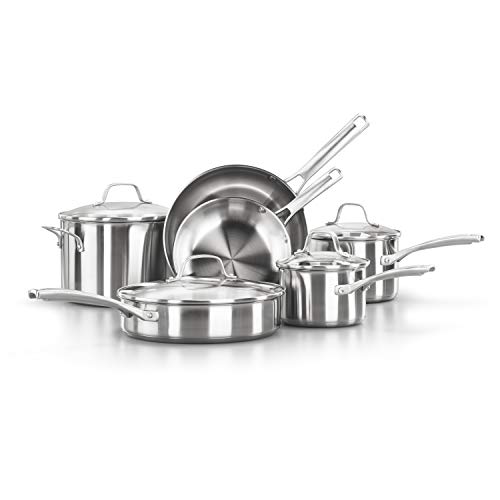
Calphalon Classic Stainless Steel Cookware Set
The Calphalon Classic stainless set represents the mainstream stainless promise in its most familiar form: uncoated cooking surfaces, a substantial feel in the hand, and pieces intended to stay in service for many years rather than a coating’s lifespan. It suits cooks who have made peace with preheating — giving a pan a minute on the heat, adding fat, and letting proteins release naturally once a crust forms — and who value being able to use high heat, deglaze with liquid, and move a pan toward the oven without consulting a coating limit first. Its honest costs are the stainless costs: more attention at the hob, more visible water marks, and a little more washing effort after eggs or cheese. As a set, its appeal is coherence — matched lids, matched handles, and a learning curve you climb once for the whole cupboard.
Comparison angle: place this set on its side of the divide and judge it by that side’s winning criteria. Position in this guide: mid-tier stainless steel, treated prose-only until its listing is verified, so compare it on the current Amazon listing before you buy rather than on any fixed detail printed here.
Best for: cooks whose habits match the mid-tier stainless steel format described above. Not suited for: cooks whose main jobs contradict that format’s heat, utensil or care rules.
Cuisinart Chef’s Classic Stainless Cookware Set
Cuisinart’s Chef’s Classic line is the other household name in mainstream stainless, and it earns its place in this cluster by offering the same uncoated durability proposition with its own take on shapes, rims and lid fit. Drip-friendly rims and lids that sit properly matter more in daily service than most buyers expect, because saucepans are pouring and simmering tools before they are anything else. Treat this set as a direct alternative to the Calphalon above rather than a step up or down from it: the decision between mainstream stainless sets usually comes down to which handles suit your grip, which piece mix matches your cooking, and which lids your cupboard stores best. Either way, the stainless rules apply in full — preheat with patience, dry after washing, and expect the pans to look more seasoned, not less capable, with age.
Comparison angle: place this set on its side of the divide and judge it by that side’s winning criteria. Position in this guide: mid-tier stainless steel, treated prose-only until its listing is verified, so compare it on the current Amazon listing before you buy rather than on any fixed detail printed here.
Best for: cooks whose habits match the mid-tier stainless steel format described above. Not suited for: cooks whose main jobs contradict that format’s heat, utensil or care rules.
Tramontina Tri-Ply Clad Stainless Steel Cookware Set
The Tramontina tri-ply set is the construction enthusiast’s mainstream pick: clad construction that carries the conductive core up the sidewalls, so the whole vessel — not just its base — takes part in heating. In practice that shows up as soups and sauces that warm more evenly, sidewalls that do not lag behind the base, and reductions that behave predictably. It is the set in this group most likely to satisfy a cook who notices hot spots, and it keeps every stainless advantage — high-heat searing, metal-utensil tolerance where the maker allows, and no coating clock ticking. The trade-offs are weight and attention: clad pieces feel more substantial than disc-base equivalents, and the surface still demands proper preheating for delicate foods. For buyers choosing one stainless set to keep for a long time, this is the construction story to understand before deciding.
Comparison angle: place this set on its side of the divide and judge it by that side’s winning criteria. Position in this guide: mid-tier tri-ply stainless steel, treated prose-only until its listing is verified, so compare it on the current Amazon listing before you buy rather than on any fixed detail printed here.
Best for: cooks whose habits match the mid-tier tri-ply stainless steel format described above. Not suited for: cooks whose main jobs contradict that format’s heat, utensil or care rules.

Rachael Ray Cucina Nonstick Cookware Set
The Rachael Ray Cucina set shows the personality side of mainstream nonstick: coated aluminium everyday pieces presented as a coordinated, colourful kitchen system rather than anonymous pans. Under the styling it obeys exactly the same physics as the T-fal above — quick-heating aluminium, a slick wearing surface, gentle-heat discipline — and it should be judged by the same standards of piece mix, lid fit and handle comfort. Where it earns its place is for buyers who want the nonstick format and care how the cupboard and hob look together, or who are buying a set as a gift for a new home where coordination matters. Its limits are the format’s limits, stated plainly: it is a low-to-medium-heat, soft-utensil set, and no colour palette changes that contract.
Comparison angle: place this set on its side of the divide and judge it by that side’s winning criteria. Position in this guide: entry-to-mid-tier nonstick, treated prose-only until its listing is verified, so compare it on the current Amazon listing before you buy rather than on any fixed detail printed here.
Best for: cooks whose habits match the entry-to-mid-tier nonstick format described above. Not suited for: cooks whose main jobs contradict that format’s heat, utensil or care rules.

GreenLife Soft Grip Ceramic Nonstick Cookware Set
The GreenLife Soft Grip set is this cluster’s ceramic nonstick representative: an aluminium body with a ceramic-style slick surface and comfort-shaped handles, pitched at buyers who want easy release with this coating family and a soft, secure grip in wet hands. Read it alongside the dedicated ceramic coverage on this site for the coating deep-dive, and judge it here as a general set: the piece mix covers the everyday core, the surface rewards low-to-medium heat and prompt, gentle washing, and the handles deserve a check against the manufacturer’s oven guidance before any hob-to-oven plans. Ceramic coatings are at their slickest early, so the value case rests on easy weeknight cooking now plus disciplined care — soft utensils, no empty high heat, protected stacking — to stretch that performance as far as it will go.
Comparison angle: place this set on its side of the divide and judge it by that side’s winning criteria. Position in this guide: entry-tier ceramic nonstick, treated prose-only until its listing is verified, so compare it on the current Amazon listing before you buy rather than on any fixed detail printed here.
Best for: cooks whose habits match the entry-tier ceramic nonstick format described above. Not suited for: cooks whose main jobs contradict that format’s heat, utensil or care rules.
Final Recommendation by Use Case
For eggs-first, fish-friendly, wash-up-weary households: the nonstick set, bought lean and used gently. For searing-first, sauce-building, buy-for-years households: the stainless general set, clad if evenness matters. For the common mixed household: stainless set plus a small coated pan, or nonstick set plus one serious searing pan — in either order, the hybrid is this comparison’s most practical recommendation. The value framing for the whole decision sits in is a cookware set worth it.
The Cost Shape Over Years of Ownership
Without printing a single price, the ownership shapes can still be compared honestly, because they differ in rhythm rather than in any fixed sum. The nonstick route spends in instalments: a moderate initial purchase, then a replacement rhythm as the most-used pieces tire, each renewal restoring the set’s easiest surface exactly where it is used most. The stainless route spends in a lump: a considered initial purchase, then years in which the cookware budget is effectively closed, disturbed only by deliberate additions. Households differ in which rhythm suits their finances and their feelings — some prefer small, predictable renewals; others prefer to buy once and resent every later demand. Neither rhythm is cheaper in the abstract, because listings change and households vary, but the rhythm itself is a real criterion and belongs in the decision beside release and searing. A buyer who knows they hate repeat purchases should weight it heavily; a buyer who enjoys refreshing the kitchen should not be shamed out of the instalment shape.
Small Kitchens, Shared Kitchens and Second Kitchens
Context bends this comparison in predictable ways. In a small kitchen, the nonstick set’s lightness and nesting ease count double, and its gentle contract matters less because small kitchens rarely run the fierce, unattended heats of large-range cooking. In a shared kitchen — housemates, extended family, a holiday let — the calculus flips toward whichever side forgives strangers: stainless forgives utensil chaos where its maker allows metal and never punishes a hot empty minute as fast, while nonstick forgives cooking inexperience but not tool inexperience. In a second kitchen or a starter flat, the nonstick set’s completeness at a gentle tier is often the entire argument. The comparison’s criteria do not change across these contexts; their weights do, and honest deciding means setting the weights from your rooms before reading the verdicts.
What Happens When Each Side Is Chosen Wrong
Failure modes are instructive because they are asymmetric. A nonstick set chosen for a searing household fails loudly and early: coatings age fast under heat they were never promised to survive, frustration concentrates on the frying pans, and the household concludes — unfairly — that nonstick is poor quality. A stainless set chosen for a release-led household fails quietly and long: nothing breaks, nothing wears out, and breakfast is slightly annoying for years while the set’s virtues go unused and unappreciated. The loud failure is more expensive; the quiet failure is more corrosive, because it masquerades as contentment. This comparison exists to prevent both, and its branching questions are deliberately behavioural — what do you cook, who cooks, who washes — because the wrongness is never in the pans. It is in the match, and the match is knowable in advance.
The Environmental and Waste Angle
A complete comparison should name the waste ledger plainly. The coated route cycles more objects: surfaces renew, tired pans leave, replacements arrive, even when each step is handled responsibly and tired pieces are replaced singly rather than as sets. The stainless route concentrates its footprint in one durable purchase whose service life is measured in household eras. Buyers for whom this ledger matters will find it points the same way as the searing and permanence criteria, and it can legitimately tip a close decision. Buyers who choose nonstick with open eyes can narrow the gap considerably — gentle care to stretch each surface, per-piece replacement, and lean sets bought without filler — and this comparison counts that mitigated version, not the careless one, as the nonstick side’s honest environmental case.
Breakfast Versus Dinner: Splitting the Day
A useful way to feel this comparison in your own kitchen is to split the day rather than the menu. Breakfast in most homes is delicate, fast and half-awake: eggs, toast-adjacent frying, reheated potatoes, pancakes for children who cannot wait. That meal belongs to nonstick so completely that even stainless households often concede it to a single coated pan. Dinner is the varied meal — the sear, the sauce, the braise, the deglaze — and it is where stainless earns its keep and its reputation. A household whose cooking identity lives at breakfast should weight the first half of this comparison; a household whose identity lives at dinner should weight the second. The hybrid outcome, once again, is simply the day honoured in both its halves, and the cook who finds themselves nodding at both paragraphs has received their answer from their own schedule rather than from any verdict printed here.
Teaching Kitchens and Learning Cooks
Where cooking is being taught — children at the hob, a partner learning, a grandparent returning to the kitchen after years away — the comparison tilts in ways worth stating. Nonstick forgives the student’s two most common errors, food left a moment too long and heat set by guess, and it lets early successes arrive quickly enough to keep a learner cooking. Stainless teaches more, because its feedback is honest and immediate, but it charges for the tuition in stuck eggs and scorched milk that can discourage exactly the cook a household is trying to encourage. The staged answer many families discover is pedagogical rather than material: learn on the forgiving surface, graduate to the honest one, and keep both in the cupboard afterwards because different dishes, like different students, are still best served by different teachers.
Noise, Speed and the Texture of Weeknights
The last criterion is atmospheric, and it decides more purchases than any table admits. Nonstick cooking is quiet and quick: pans heat fast, food moves when asked, washing takes a breath, and the whole texture of a weeknight stays light. Stainless cooking is deliberate: the preheat pause, the sizzle that means something, the soak that says dinner is properly over. Households are not wrong to choose by texture — a kitchen’s feel at seven in the evening, repeated hundreds of times a year, is a quality-of-life fact, not a marketing illusion. This comparison’s work is done if the reader can now name which texture their household is buying, and buy it with the matching material, the matching expectations and no lingering sense that the other side’s owners know something they do not. They do not. They just cook different evenings.
The Two Kitchens Thought Experiment
Imagine two identical kitchens equipped on the same day, one with a nonstick set and one with a stainless general set, and follow them through a single ordinary week. Monday’s eggs slide in the first kitchen and demand ritual in the second; the second kitchen’s cook performs it happily, because Monday is also steak night, and there the pans reverse their fortunes completely — the first kitchen compromises its sear or borrows a pan, the second builds fond and a pan sauce without thinking. Wednesday’s tomato sauce simmers in both without incident, though the first kitchen’s cook lowers the heat a touch earlier out of contract habit. Friday’s fish is the first kitchen’s showcase and the second kitchen’s examination, passed with preheating and patience. Sunday’s marathon — sauce, pasta, a pan of greens, custard for dessert — tests lids, volume and washing in both, and both finish the week convinced their choice was right, because each household’s week was quietly selected by its pans: the first kitchen drifted toward the gentle dishes its set flatters, the second toward the vigorous ones. That drift is the deepest truth in this comparison. Cookware does not merely serve a menu; over months, it edits one. Choosing a side is therefore partly choosing the cook your kitchen will encourage you to become, and the honest buyer weighs that editorial power alongside release, searing and every other criterion in this article.
What If the Budget Only Allows One Pan First?
Some readers arrive at this comparison unable to buy any set yet, and their question — which single pan comes first — deserves the comparison’s logic in miniature. If the household’s cooking is unknown or mixed, the first pan should be the one that covers the most forgiving ground: for most beginners that is a medium coated frying pan, because it makes breakfast, reheating and gentle frying succeed while skills form, and its eventual retirement is painless when the household’s direction clarifies. If the household already knows it sears and saucés, the first pan should be the stainless workhorse in the size dinner uses most, bought well enough to anchor the future set. Either way, the single pan is a scout, not a compromise: it reports back the household’s real heat habits, patience and washing tolerance, and the set purchased a season later — on whichever side of this comparison — will be chosen with evidence no review, including this one, can supply from outside the kitchen.
A Note on Terminology That Confuses Buyers
Part of this comparison’s difficulty is vocabulary, because the market uses its key words loosely. Nonstick names a surface behaviour, not a material: most nonstick pans are coated aluminium, some are coated stainless, and the behaviour — not the body — is what carries the heat ceiling and the utensil rules. General set names a scope, not a surface: a general set may be entirely nonstick, entirely stainless, or built around ceramic coatings, which is why this article has compared the dedicated nonstick commitment against the general set’s freedom rather than pretending the two labels are opposites by nature. Hard-anodized describes a treated aluminium body and says nothing by itself about the cooking surface, which may be coated or not. Clad describes construction, not surface. A buyer who keeps those four distinctions straight — behaviour, scope, body treatment, construction — will find that most of the category’s marketing fog lifts at once, and that the real choice, the one this comparison has argued from its first paragraph, stands clear: which surface behaviour, in which scope, for which menu.
Edge Cases: Allergy to Compromise, Tiny Hobs and Open Shelves
Three edge cases recur in reader questions and deserve direct answers inside this comparison. The first is the cook who refuses compromise on principle and wants one side to simply be better: the honest answer is that the category does not contain that product, because the physics of a wearing slick surface and the physics of a permanent bare one cannot be merged, only chosen between or combined across two pans. The second is the tiny hob — two burners, a small flat, a caravan kitchen — where the comparison compresses: fewer simultaneous pans means the set’s breadth matters less and the hero pan matters more, lightness and nesting dominate, and the nonstick side’s everyday ease usually outweighs range the household cannot stage anyway. The third is open-shelf storage, where cookware is also decor: here appearance stops being a footnote, coordinated coated lines and handsome stainless both argue their cases in plain sight, and protected stacking becomes a visible discipline rather than a cupboard secret. None of these cases overturns the comparison’s criteria; each simply re-weights them so sharply that naming them saves the reader from misapplying verdicts written for the standard kitchen.
If You Still Cannot Decide: The Trial Method
For the genuinely torn household, this comparison offers a procedure instead of a verdict. Borrow or buy the cheapest honest example of the side you lean away from — a single pan, not a set — and cook your real menu on it for a fortnight, including the dish each side is famous for failing. The leaning usually dissolves under evidence: either the feared failure does not materialise and the cheaper, easier side wins a convert, or it materialises so vividly that the decision makes itself with a clarity no article can manufacture. A fortnight and one pan is a small tuition for a purchase that will mediate thousands of meals, and households that run the trial report something reviews cannot give them — not just a choice, but confidence in it, which is the ingredient that stops a cupboard being re-litigated at every subsequent meal.
A Closing Dialogue With the Undecided Reader
If you have read this far and still feel torn, the tear itself is information: it usually means your cooking genuinely contains both sides’ signature dishes in real proportions, and no verdict was ever going to feel clean. For that reader, this comparison’s final advice is to stop asking which set is better and start asking which pan in your current kitchen you reach for without thinking — because that reach, repeated thousands of times, is your temperament expressing itself more honestly than any self-description. Buy the set that honours the reach, adopt the single pan that honours the exception, and let the matter close. The households that cook happiest are not the ones that won an argument about materials; they are the ones whose cupboards stopped being an argument at all. Both sides of this comparison can produce that peace, which is why both sides were argued here at full strength, and why the choice — made from your menu, your hands and your evenings — will be the right one whichever name it carries.
One Last Practical Sweep Before You Choose
Run these final checks in your own kitchen tonight, because they take five minutes and they settle what paragraphs cannot. Stand at your hob and name the last five dinners you cooked, out loud, assigning each to the side whose surface it flattered; the tally is your menu’s vote, counted honestly. Open the utensil drawer and count how many tools are metal, because that count is either a non-issue for the stainless side or a standing instruction the coated side will have to enforce for years. Open the cupboard the set will live in and picture both candidates inside it — the lighter coated stack and the heavier steel one — and notice which picture your shoulders prefer. Then picture the washing-up after your most tiring regular meal, performed by your most tired regular cook, and let that person cast the deciding vote if the tally is close. Comparisons in print can organise evidence, but these four small acts produce the evidence itself, in the only kitchen whose verdict will ever be executed. Readers who perform them almost never return to the question, and readers who skip them almost always do — usually at the hob, mid-breakfast, within the first month of owning the wrong side of an honestly argued comparison.
The Short Version for Readers in a Hurry
If the whole comparison must fit in one breath, it is this: nonstick gives you effortless food and effortless washing at gentle heats for a surface that renews; the general set in stainless gives you every heat, every utensil the maker allows and a surface that stays, at the price of technique at the hob and effort at the sink. Choose by the dinners you actually cook, let one adopted pan cover the exception, and verify hob, storage and the manufacturer’s guidance before money moves. Readers who started this article undecided and finish it able to say which side their menu lives on — and why — have everything the long version was written to give them, and the rest of this page remains theirs to revisit when the second pan, the replacement or the next kitchen reopens the question, as kitchens reliably do.
Cookware Set: A Side-by-Side Reality Check for Borderline Cases
Start with the specific situations where one side of this comparison clearly wins over the other. Most coverage of a cookware set concentrates on the first week of ownership, yet the decisions that matter most tend to surface later, once the cookware set has to earn its place in an ordinary weekday routine rather than a carefully staged first attempt. Write down the three jobs you expect it to do most often, in the order you actually do them, and judge every claim you read against that short personal list instead of against a generic ideal.
Work through a realistic scenario, not a best case. Picture the busiest version of the job: more people to serve, less time than planned, ingredients or materials that are slightly out of the ordinary, and a clean-up waiting at the end. Ask how the cookware set behaves at that upper edge, because a model that only shines on a small, simple load will disappoint precisely when you need it most. If the honest answer is that you would split the job into batches or fall back on an older method, factor that into the decision now rather than discovering it later.
Finally, plan the first fortnight deliberately. Use the cookware set for one familiar job first, so you have a baseline you trust, then introduce the harder cases one at a time and note what changes. Small adjustments to arrangement, timing, quantity or preparation usually close most of the gap between disappointing first results and the performance the design is capable of. That short learning period is also the fairest test of the borderline cases where the comparison flips: if the routine has not settled by the end of it, the mismatch is real, and it is better to know while returning or exchanging is still straightforward.
When you check listings such as T-fal Signature Nonstick Cookware Set, Calphalon Classic Stainless Steel Cookware Set and Cuisinart Chef’s Classic Stainless Cookware Set, use them as worked examples: run through the same checks below on each one in turn, so the comparison stays honest and like for like rather than based on whichever listing happens to shout loudest.
Use a short decision checklist to finish. One, does it fit the space and the storage you really have. Two, does it handle your three most common jobs without a workaround. Three, do the edge cases you listed stay manageable. Four, can every wear part be cleaned or replaced without drama. Five, would you still choose it if a friend described the same drawbacks in their own kitchen. A cookware set that passes all five is a sound buy; one that fails two or more is a compromise you are choosing with open eyes, which is a very different thing from being surprised later.
Edge cases deserve a deliberate pass. Think about the odd shapes, the thicker or thinner than usual loads, the leftovers, the second helping and the guest with different preferences. A well-chosen cookware set handles the exceptions gracefully, or at least predictably, while a poor match turns every exception into a workaround. List your two or three most common exceptions in advance and check, from the manual or the listing details, that nothing about them is ruled out by size, shape, material or care requirements.
Troubleshooting is easier when you expect the usual failure points. With any cookware set, the recurring problems tend to cluster in the same places: uneven results from overloading or poor arrangement, wear showing first on the parts handled most often, and small annoyances with lids, seals, handles, controls or fittings that only appear after repeated use. Before buying, look for whether those wear parts can be cleaned properly, replaced or worked around, and whether the instructions address them directly rather than pretending they never happen.
Measure before you commit. Note the footprint, the clearance above and behind the spot where the cookware set will live, and the route you will carry it by when it is hot, full or awkward. A cookware set that technically fits but blocks a cupboard door, crowds a neighbouring appliance or has to be dragged across a worktop every time will quietly fall out of use, whatever its merits on paper. In the Kitchen Cookware category especially, a few centimetres of clearance and a sensible storage plan separate a daily tool from a bulky regret.
Maintenance decides how long the good results last. Set a simple rhythm: a quick wipe or rinse after each use, a deeper clean on a fixed day, and a periodic check of the parts that move, seal or bear weight. A cookware set that needs fiddly disassembly for basic care will be cleaned less often, and performance drifts long before anything actually breaks. Prefer designs where the parts that get dirtiest are the parts that are easiest to reach, and be honest with yourself about which cleaning steps you will genuinely keep up.
Frequently Asked Questions
Is nonstick or stainless better for everyday cooking?
Everyday cooking contains both families’ best work: the gentle majority — eggs, vegetables, sauces, reheating — flatters nonstick, while searing and pan sauces flatter stainless. Better therefore follows your menu’s centre of gravity, not a universal ranking. Households that cannot decide usually discover, on honest menu inspection, that one family covers four nights in five; buy that family’s set and adopt one pan of the other for the fifth night.
Can a nonstick set handle high-heat cooking if I am careful?
Care does not repeal the contract: a coated pan should not sit empty over high heat, and searing’s opening move is exactly that. Brief, food-loaded cooking at the upper end of the manufacturer’s guidance is normal use; deliberate high-heat searing is a stainless job. Asking nonstick to sear occasionally will not ruin it in a day, but building a cooking style on it shortens the coating’s life for a result stainless still does better.
Do I need to replace a whole nonstick set when one pan wears out?
No — sets age unevenly, and the daily frying pan almost always tires first while saucepans and the stockpot remain serviceable. Replace the tired piece, matching size and lid fit where you can, and keep the system running. This is also why buying a leaner set is safe: the replacement rhythm is per-piece in practice, whatever the original box suggested, and a single fresh pan restores the set’s most-used surface completely.
Are stainless sets harder to clean than nonstick sets?
They ask more, in a different currency: a soak after eggs or cheese, a firmer scrub where the maker allows, and drying to avoid water marks. Nonstick asks almost nothing at the sink but charges its discipline at the hob and the utensil drawer instead. Most households adapt to either within a fortnight; the honest question is which small daily effort your household performs more cheerfully, because that — not the first week’s novelty — predicts satisfaction.
Which option is better for a first kitchen?
For most first kitchens, nonstick’s forgiveness wins the early months: food releases while skills form, washing stays trivial, and confidence compounds. The exception is the first cook who already knows they cook at high heat and wants to buy once. Either way, a first set teaches the household its real habits, and the second purchase — set or single pan — should be made with that evidence in hand rather than in defiance of it.
Can one cookware set really cover all my cooking?
For most households, a well-chosen general set covers the large majority of hob cooking: frying, simmering, boiling, reheating and gentle braising across the core shapes. What it does not replace are true specialists — a wok’s geometry for high-heat tossing, a heavy Dutch oven’s mass for long braises, or a cast iron skillet’s searing reserve. The practical approach is a general set as the foundation, bought for the meals you cook weekly, plus one or two specialists added later only when a repeated recipe proves the need. That sequence spends money in the order your cooking actually demands it.


