Disclosure: As an Amazon Associate, topratedkitchenware.com earns from qualifying purchases. Links on this page are affiliate links; they cost you nothing extra. Prices and availability change often, so check the current Amazon listing before you buy.
Put plainly, the cookware set vs stainless steel cookware set question is whether the whole cupboard should commit to stainless steel, or whether a general cookware set — free to be nonstick, ceramic nonstick, or a deliberate mix of plans — serves the household better. Asked as cookware set vs stainless steel cookware set, it is the mirror of the nonstick comparison elsewhere in this cluster, and the answer is just as temperament-led. Stainless is the longevity and high-heat candidate; the general set is the flexibility candidate. This comparison tests both across searing, delicate work, construction, care and service life, and it is honest about stainless’s real costs, because a material oversold to the wrong household becomes the cupboard’s resentment rather than its foundation.
Cookware Set Vs Stainless Steel Cookware Set: Quick Verdict and Key Takeaways
Quick verdict: commit to a stainless steel set if you sear weekly, deglaze into pan sauces, want metal-utensil freedom where the maker allows it, and prefer buying cookware for the long term. Stay with a general set in a coated family if delicate release and effortless washing dominate your week, if several cooks of mixed patience share the pans, or if your heat habits are honestly gentle. Inside the stainless decision itself, choose clad construction for evenness-led cooking and disc-base for boiling-led value — the construction question matters almost as much as the material question.
- Searing and heat range: stainless wins; coated pans must never sit empty over high heat.
- Delicate release: the coated general set wins without technique; stainless wins it only with technique.
- Service life: stainless has no wearing surface; coatings decline gradually by design.
- Construction: clad heats up the sidewalls, disc-base heats through the bottom — know which you are buying.
- Care: stainless asks preheating patience and drying; coatings ask gentle heat and soft utensils.
In this guide
Side-by-Side at a Glance
Cooking surface: general set — buyer’s family choice, coated families assumed here; stainless set — uncoated steel throughout. Heat: general/coated — low to medium, no empty high heat; stainless — low to high including hard searing. Release: general/coated — effortless; stainless — earned through preheating and fat. Construction questions: general/coated — body and coating family; stainless — disc-base versus fully clad. Utensils: general/coated — soft by default; stainless — metal tolerated where the maker allows. Ageing: general/coated — functional decline of the surface; stainless — cosmetic marks over long service. Washing: general/coated — seconds; stainless — soak, scrub within guidance, dry. The criteria below decide which rows should govern your choice.
Searing, Fond and High-Heat Cooking
Stainless was built for this criterion. A hard preheat, a patient crust, fond that deglazes into a pan sauce, oven transfer under the manufacturer’s guidance — the repertoire is complete and repeatable, and no component of the pan is ageing while it happens. Coated sets decline this work by contract, not by incompetence: their heat ceiling exists to protect the surface that defines them. If high-heat cooking is your kitchen’s headline act, this criterion alone can settle the comparison, and everything else becomes a question of how much the coated advantages are worth giving up. Criterion verdict: stainless, outright, for heat-led kitchens.
Delicate Foods and the Release Question
Eggs, fish, crêpes, milky sauces: the coated general set performs them thoughtlessly well, and stainless performs them conditionally well. The condition — preheat, fat, patience, release — is a genuine skill, quickly learned and quietly satisfying, but it is charged daily and it is charged to every cook in the house, including the tired and the young. Reviewers who cook solo and love the ritual understate this cost; households feel it accurately. If delicate work is your headline act, the mirror of the previous criterion applies with equal force. Criterion verdict: the coated general set, outright, for release-led kitchens.
Construction: Disc-Base, Clad and Why It Matters
Stainless steel is the durability anchor of the general cookware set category. A stainless surface has no coating to wear away, tolerates metal utensils far better than any coated pan when the manufacturer allows them, handles high heat for searing without the empty-pan anxiety that coated pans demand, and moves between hob and oven in many designs. Its honest costs are equally clear: eggs and delicate fish stick without enough preheating and fat, sauces can catch on hot spots in thin bases, and the mirror finish shows every water mark until you learn to dry pieces after washing. Construction is where stainless sets separate. A simple disc of conductive metal bonded to the base heats mostly through that base, while fully clad construction wraps the conductive core up the sidewalls as well, so soups heat up the sides and sauces reduce more evenly. Both approaches appear in mainstream sets at different tiers, and the buying sections below explain how to tell which you are looking at from the product description alone.
This is the criterion shoppers most often skip, and the one that most changes a stainless set’s daily character. Two sets can share a brand tier, a piece count and a cooking surface while heating quite differently, because one carries its conductive core only in a base disc and the other wraps it up the walls. Sauces, soups and reductions expose the difference within a week; boiling pasta water never will. Read the manufacturer’s construction statement before comparing stainless sets against each other, and weight it by your menu: simmer-led kitchens should pay for clad, boiling-led kitchens may never notice what they saved. Criterion verdict: within stainless, clad for evenness-led cooking, disc-base for value-led boiling and reheating.
Care, Utensils and Service Life
Care is where a cookware set’s real lifespan is decided, and the rules are simpler than the internet makes them sound. Let pans cool before washing, because plunging a hot pan into cold water stresses any construction and can warp lighter bases over time. Wash coated pieces with a soft sponge and ordinary washing-up liquid, keep scouring pads and harsh abrasives for the stainless pieces whose manufacturers allow them, and dry stainless after washing if water marks bother you — they are cosmetic, not damage. Stacking is the silent coating killer in most cupboards: pans nested directly against each other scrape with every removal, so a cloth, a pan protector or simply a sheet of kitchen paper between coated surfaces preserves the finish for a trivial effort. Handles and lids deserve the same thirty seconds: check handle fixings occasionally, wash lids around their rims where grease gathers, and store lids where their edges will not chip against pot rims.
The service-life contrast is the comparison’s long shadow. Stainless’s care buys permanence: there is no surface to exhaust, only habits to keep. A coated set’s care buys time: every gentle wash and protected stack extends a surface that is still, by design, finite. Utensils follow the same logic — stainless shrugs where its maker allows metal, coatings ask for soft tools as the standing rule — and the manufacturer’s guidance for the exact set governs both sides without exception. Criterion verdict: stainless for service life and utensil freedom; coated for sink-side ease.
The safety notes for a general cookware set are unglamorous and absolute. Never leave a coated pan empty over high heat: an empty pan has nothing absorbing the energy, its temperature climbs quickly, and overheating is the fastest way to damage a nonstick surface and the cooking in it afterwards. Keep any pan’s handle turned inward so it cannot be knocked or grabbed by a passing child, and treat every handle as hot regardless of stay-cool claims, because handles absorb heat from flames, neighbouring burners and oven air alike. Use the utensils the manufacturer recommends for the surface in front of you — soft silicone, nylon or wood on coated pans as a default, metal only where the maker explicitly allows it — and lift rather than drag heavy pots across glass hobs. Finally, a pan that has warped so it spins on the hob, a coating that is flaking into food, or a handle that wobbles after tightening is a pan to retire, not to nurse along; sets are modular in practice, and replacing one tired piece protects everything cooked after it.
Strengths and Trade-Offs of Each Side
The stainless steel set — strengths
- Complete heat range, from gentle simmer to hard sear.
- No wearing surface; the set is a long-term foundation.
- Deglazing, oven transfer and utensil freedom where makers allow.
The stainless steel set — trade-offs
- Delicate foods require technique, every time, from every cook.
- Washing effort and cosmetic marking are permanent companions.
- Clad quality costs more and weighs more than disc-base simplicity.
The general (coated) set — strengths
- Effortless release and washing for the gentle majority of cooking.
- Forgiving for mixed-skill, mixed-patience households.
- Light pieces and quick heating at weeknight pace.
The general (coated) set — trade-offs
- A heat ceiling that excludes searing technique entirely.
- A wearing surface whose replacement rhythm must be accepted.
- Soft-utensil and gentle-heat discipline without exception.
Who Each Option Suits and Who Should Skip Each
Stainless suits the searing enthusiast, the sauce builder, the buy-for-years household and the cook who finds technique pleasurable; it should be skipped by households that will experience its learning curve as a nightly tax. The coated general set suits busy families, delicate-food menus and new cooks; it should be skipped by anyone whose favourite dishes begin with a ripping-hot empty pan. The undecided household should read its own last fortnight of dinners before reading any more comparisons — the menu has already voted, and both this page and the cookware set buying guide exist to implement its decision. Live stainless options gather at stainless steel cookware set choices and tri-ply cookware sets.
How to Decide: The Branching Questions
Branch one: do you sear weekly? Yes — stainless, and proceed to the construction branch. No — branch two. Branch two: is delicate, sticky-prone food your daily core? Yes — the coated general set, chosen lean. No — branch three. Branch three: do you value permanence over nightly ease? Yes — stainless, disc-base acceptable; no — coated, with the hybrid pan as your searing insurance. Inside stainless, the construction branch asks one question — do sauces and simmers headline your menu? — and answers clad for yes, disc-base for no. Every branch ends at the same final checks: hob compatibility, storage measurements, and the manufacturer’s guidance read before purchase.
Where Each Side Is Represented
The stainless references below carry this side’s case — two mainstream disc-and-clad alternatives and the tri-ply construction exemplar — while the coated references carry the general set’s reply. All are prose-only until their listings are verified.

T-fal Signature Nonstick Cookware Set
The T-fal Signature line is the archetypal mainstream nonstick set: coated aluminium pieces built around easy release, easy washing and a forgiving learning curve, aimed squarely at households equipping a first kitchen or replacing tired pans in one box. Its role in this cluster is to represent what the entry tier does best — eggs that slide, sauces that rinse away, and a full spread of everyday shapes without ceremony. Judge it by nonstick rules: gentle heat, no empty preheating on high, soft utensils, and the understanding that the coating is a wearing surface whose best years come first. Households that sear steaks weekly will outgrow it; households that cook eggs, vegetables, fish and pasta sauces most nights will understand immediately why this format sells.
Comparison angle: judge this set by whether it wins its side’s defining criteria — heat and permanence for stainless, release and ease for coated. Position in this guide: entry-tier nonstick, treated prose-only until its listing is verified, so compare it on the current Amazon listing before you buy rather than on any fixed detail printed here.
Best for: cooks whose habits match the entry-tier nonstick format described above. Not suited for: cooks whose main jobs contradict that format’s heat, utensil or care rules.
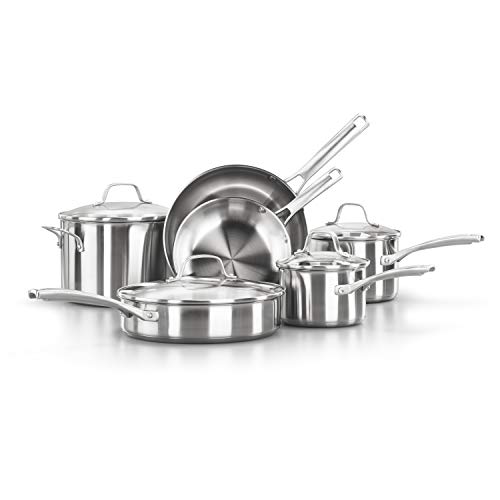
Calphalon Classic Stainless Steel Cookware Set
The Calphalon Classic stainless set represents the mainstream stainless promise in its most familiar form: uncoated cooking surfaces, a substantial feel in the hand, and pieces intended to stay in service for many years rather than a coating’s lifespan. It suits cooks who have made peace with preheating — giving a pan a minute on the heat, adding fat, and letting proteins release naturally once a crust forms — and who value being able to use high heat, deglaze with liquid, and move a pan toward the oven without consulting a coating limit first. Its honest costs are the stainless costs: more attention at the hob, more visible water marks, and a little more washing effort after eggs or cheese. As a set, its appeal is coherence — matched lids, matched handles, and a learning curve you climb once for the whole cupboard.
Comparison angle: judge this set by whether it wins its side’s defining criteria — heat and permanence for stainless, release and ease for coated. Position in this guide: mid-tier stainless steel, treated prose-only until its listing is verified, so compare it on the current Amazon listing before you buy rather than on any fixed detail printed here.
Best for: cooks whose habits match the mid-tier stainless steel format described above. Not suited for: cooks whose main jobs contradict that format’s heat, utensil or care rules.
Cuisinart Chef’s Classic Stainless Cookware Set
Cuisinart’s Chef’s Classic line is the other household name in mainstream stainless, and it earns its place in this cluster by offering the same uncoated durability proposition with its own take on shapes, rims and lid fit. Drip-friendly rims and lids that sit properly matter more in daily service than most buyers expect, because saucepans are pouring and simmering tools before they are anything else. Treat this set as a direct alternative to the Calphalon above rather than a step up or down from it: the decision between mainstream stainless sets usually comes down to which handles suit your grip, which piece mix matches your cooking, and which lids your cupboard stores best. Either way, the stainless rules apply in full — preheat with patience, dry after washing, and expect the pans to look more seasoned, not less capable, with age.
Comparison angle: judge this set by whether it wins its side’s defining criteria — heat and permanence for stainless, release and ease for coated. Position in this guide: mid-tier stainless steel, treated prose-only until its listing is verified, so compare it on the current Amazon listing before you buy rather than on any fixed detail printed here.
Best for: cooks whose habits match the mid-tier stainless steel format described above. Not suited for: cooks whose main jobs contradict that format’s heat, utensil or care rules.
Tramontina Tri-Ply Clad Stainless Steel Cookware Set
The Tramontina tri-ply set is the construction enthusiast’s mainstream pick: clad construction that carries the conductive core up the sidewalls, so the whole vessel — not just its base — takes part in heating. In practice that shows up as soups and sauces that warm more evenly, sidewalls that do not lag behind the base, and reductions that behave predictably. It is the set in this group most likely to satisfy a cook who notices hot spots, and it keeps every stainless advantage — high-heat searing, metal-utensil tolerance where the maker allows, and no coating clock ticking. The trade-offs are weight and attention: clad pieces feel more substantial than disc-base equivalents, and the surface still demands proper preheating for delicate foods. For buyers choosing one stainless set to keep for a long time, this is the construction story to understand before deciding.
Comparison angle: judge this set by whether it wins its side’s defining criteria — heat and permanence for stainless, release and ease for coated. Position in this guide: mid-tier tri-ply stainless steel, treated prose-only until its listing is verified, so compare it on the current Amazon listing before you buy rather than on any fixed detail printed here.
Best for: cooks whose habits match the mid-tier tri-ply stainless steel format described above. Not suited for: cooks whose main jobs contradict that format’s heat, utensil or care rules.

Rachael Ray Cucina Nonstick Cookware Set
The Rachael Ray Cucina set shows the personality side of mainstream nonstick: coated aluminium everyday pieces presented as a coordinated, colourful kitchen system rather than anonymous pans. Under the styling it obeys exactly the same physics as the T-fal above — quick-heating aluminium, a slick wearing surface, gentle-heat discipline — and it should be judged by the same standards of piece mix, lid fit and handle comfort. Where it earns its place is for buyers who want the nonstick format and care how the cupboard and hob look together, or who are buying a set as a gift for a new home where coordination matters. Its limits are the format’s limits, stated plainly: it is a low-to-medium-heat, soft-utensil set, and no colour palette changes that contract.
Comparison angle: judge this set by whether it wins its side’s defining criteria — heat and permanence for stainless, release and ease for coated. Position in this guide: entry-to-mid-tier nonstick, treated prose-only until its listing is verified, so compare it on the current Amazon listing before you buy rather than on any fixed detail printed here.
Best for: cooks whose habits match the entry-to-mid-tier nonstick format described above. Not suited for: cooks whose main jobs contradict that format’s heat, utensil or care rules.

GreenLife Soft Grip Ceramic Nonstick Cookware Set
The GreenLife Soft Grip set is this cluster’s ceramic nonstick representative: an aluminium body with a ceramic-style slick surface and comfort-shaped handles, pitched at buyers who want easy release with this coating family and a soft, secure grip in wet hands. Read it alongside the dedicated ceramic coverage on this site for the coating deep-dive, and judge it here as a general set: the piece mix covers the everyday core, the surface rewards low-to-medium heat and prompt, gentle washing, and the handles deserve a check against the manufacturer’s oven guidance before any hob-to-oven plans. Ceramic coatings are at their slickest early, so the value case rests on easy weeknight cooking now plus disciplined care — soft utensils, no empty high heat, protected stacking — to stretch that performance as far as it will go.
Comparison angle: judge this set by whether it wins its side’s defining criteria — heat and permanence for stainless, release and ease for coated. Position in this guide: entry-tier ceramic nonstick, treated prose-only until its listing is verified, so compare it on the current Amazon listing before you buy rather than on any fixed detail printed here.
Best for: cooks whose habits match the entry-tier ceramic nonstick format described above. Not suited for: cooks whose main jobs contradict that format’s heat, utensil or care rules.
Final Recommendation by Use Case
Searing-led kitchen: stainless, clad if the budget shape allows. Sauce-and-simmer kitchen: stainless clad specifically, for the sidewalls. Egg-and-fish kitchen: the coated general set, without apology. Mixed family kitchen: the family of the primary cook, plus the adopted pan. First kitchen on a long horizon: stainless disc-base as the foundation, coated pan adopted for eggs. The pattern across all five is the comparison’s real conclusion — the material follows the menu, and the menu is knowable before a single pan is bought. The companion comparison, cookware set versus nonstick cookware set, argues the same decision from the other side.
Weight, Handling and the Human Factor
Comparisons of materials tend to forget the cook’s wrist, and this one should not. Stainless — clad stainless above all — is the heavier side of the divide, and its weight is functional: stability on the hob, thermal mass that shrugs when cold food lands, a planted feel when a sauce is stirred hard. The same weight taxes smaller wrists at the draining moment, makes one-handed saucepan work a genuine effort when the pan is full, and argues for helper handles and lower storage. Coated aluminium is the lighter side by construction, quicker to lift, kinder to drain, easier for younger and older cooks alike. Households should treat handling as a first-class criterion, tested honestly against the weakest grip that will use the set weekly, because a pan that is avoided for its weight has lost every other criterion by default.
The Sound, Look and Feel of Each Side
Subjective criteria are still criteria, and kitchens are lived in, not merely cooked in. Stainless looks like a professional bench, records its history in tint and fine scratches, and sounds like itself — a ring when a lid settles, a sizzle with authority. Coated sets look softer and more domestic, coordinate with colour schemes in the personality-led lines, and keep their looks best when their surfaces are protected, since their appearance and their function age together. Some households cook more happily surrounded by one aesthetic than the other, and that happiness is a legitimate input: cookware is handled daily and seen constantly, and a set that pleases its kitchen gets used, maintained and kept. This comparison refuses to rank the aesthetics, but it insists they be admitted to the decision rather than smuggled in afterwards as a surprise preference.
Resale, Inheritance and the Very Long Term
The longest lens available to this comparison shows stainless at its most distinctive. A stainless set can be handed down, sold on, moved to a child’s first kitchen or a holiday home, and arrive still entirely itself, because nothing about its function was ever a coating. Its value shape is therefore closer to furniture than to appliance. A coated set’s long lens is a sequence: several good sets across the same span, each easier than the last to choose because the household knows itself better. Neither lens is the correct one for every buyer — renters, movers and the restless may rationally prefer the sequence — but buyers who keep things, and kitchens that stay in families, should let the long lens speak. It is the criterion on which the stainless side’s case stops being about cooking at all and becomes about ownership itself.
When the Answer Changes: Life Stages
Finally, this comparison should confess that its correct answer moves across a cooking life, and that neither side should claim a household forever. The first kitchen often belongs to the coated side, for forgiveness while skills form. The confident middle years often belong to stainless, when searing, saucing and permanence align with a cook at full powers. Households cooking for children live the mixed years, where the hybrid earns its keep nightly, and later kitchens frequently return to lightness and ease as wrists and patience change. A set bought for the current stage, without guilt about the stages before or after, is the mature outcome of this comparison — and a reason the per-piece, system-based view of sets matters: it lets a kitchen evolve pan by pan as its cooks do, rather than demanding a single material allegiance for life.
Acids, Salts and Reactive Cooking
One technical corner deserves daylight in this comparison, because it quietly favours the stainless side for a whole class of dishes. Long-simmered tomato sauces, wine-heavy reductions, vinegar-based braises and other acidic, salty cooking are exactly what a stainless surface handles without a second thought, meal after meal, year after year. Coated surfaces handle ordinary acidic cooking as normal use, but the combination of acidity, long simmering and a surface that must be protected anyway gives some households pause, and the pause itself is a small tax on dishes they cook often. Households whose signature cooking is a Sunday sauce that simmers all afternoon should let this corner speak loudly; households whose acids arrive as a squeeze of lemon at the table will never hear it at all. As ever in this comparison, the menu votes first.
What Professional Kitchens Actually Teach Us
It is tempting to settle this comparison by pointing at professional kitchens, where stainless and other uncoated workhorse surfaces dominate the line, but the lesson needs translating before it is imported. Professionals optimise for heat abuse, utensil abuse, volume and replacement logistics across a brigade of cooks — a constraint set no household shares. What genuinely transfers is narrower: uncoated surfaces tolerate the full vocabulary of technique without negotiation, and they survive being treated as infrastructure. What does not transfer is the conclusion that coated pans are unserious; the same professional world keeps coated pans for eggs and fish as a matter of routine, which is the hybrid verdict wearing a uniform. Households should copy the professionals’ honesty about which pan does which job, not their purchasing department’s constraints.
Deciding for a Hob You Have Not Bought Yet
A final scenario bends the comparison for many readers: the kitchen renovation, where hob and pans are chosen in the same season and either can be made to fit the other. The practical order is to fix the menu first, the material second and the hob third, because induction — the hob most likely to veto cookware — accepts most stainless constructions and a good share of coated ones when the manufacturer’s statement confirms it, while gas and radiant electric accept everything in this comparison. Deciding material by menu, then choosing a hob that serves it, avoids the one genuinely bad outcome: a beautiful hob and a beloved set that cannot speak to each other. Where the hob is already chosen and induction is in place, the compatibility statement becomes the first page of every listing to read, before a single criterion in this comparison is allowed to argue.
Breakfast, Sauces and the Two Signature Tests
Every comparison in this cluster returns to the same two signature tests because households do: the egg and the sauce. The egg examines release, heat gentleness and the cook’s patience at the day’s least patient moment; the sauce examines evenness, acidity tolerance, simmer behaviour and the lid that governs all three. Stainless passes the sauce test natively and the egg test conditionally; the coated general set passes the egg test natively and the sauce test well within its gentler terms. What the two tests together reveal is that neither side is incomplete — each is a complete answer to a differently weighted kitchen. The household that eats eggs daily and sauces monthly lives in one answer; the household that builds its Sundays around a simmering pot lives in the other; and the household that does both, which is most households in the end, is precisely the household the hybrid was invented for. Comparisons that refuse to name a universal winner are sometimes accused of indecision, but here the refusal is the finding: the category has two correct answers, and the menu chooses between them.
How Each Side Handles a Decade of Utensils
Project the utensil drawer forward ten years and the two sides diverge in a way daily cooking hides. The stainless household’s drawer stays permissive: metal turners, whisks and spoons circulate freely where the maker allows them, tools are bought for their handles and edges alone, and a guest cook can be handed any implement without a briefing. The coated household’s drawer is curated: soft tools at the front, metal exiled or clearly zoned, and a small standing instruction issued to every new cook who opens it. Neither drawer is a burden exactly, but they produce different kitchens — one relaxed about objects, one relaxed about food — and households know, if they stop to ask, which relaxation they value. The decade view also reframes cost without naming a single figure: the curated drawer replaces its soft tools as they age and guards its surfaces as a standing policy, while the permissive drawer spends its attention at the hob instead. Attention, like money, is spent somewhere; this comparison merely insists the buyer choose where, consciously, before the decade spends it for them.
The Verdict Restated for Three Common Kitchens
For the flat-share kitchen, where cooks rotate and rules decay, stainless’s indifference to utensil chaos and heat enthusiasm usually outlasts a coating’s careful contract — the set that survives strangers wins. For the family kitchen with young cooks learning at the hob, the coated general set’s forgiveness protects both the food and the learners, and its renewal rhythm is simply budgeted like school shoes. For the two-cook kitchen where both partners cook seriously and differently, the comparison’s honest verdict is the split itself: stainless for the searing partner’s pans, coated for the other’s, organised as one system with shared lids where diameters allow. Three kitchens, three verdicts, one method — which is the most this comparison, or any honest one, can offer.
The Induction and Oven Matrix, Settled Plainly
Two compatibility questions cut across this comparison often enough to deserve a plain settlement. On induction: the stainless side is not automatically compatible and the coated side is not automatically excluded — construction decides, the manufacturer’s statement reports it, and the magnet test verifies it, in that order, for every set on either side. A household that skips the verification because its chosen material sounds right is gambling on the one specification that cannot be argued with after delivery. In the oven: pan bodies are rarely the limit — handles, coatings and lids are, in ascending order of strictness, and glass lids sit at the strict end on both sides of the comparison. The household that cooks hob-to-oven weekly should therefore compare sets by their weakest component’s clearance, not their strongest, and should treat the manufacturer’s per-component guidance as the comparison’s final word, outranking every generalisation in this article, including this paragraph.
Why This Comparison Refuses a Single Winner
It is worth closing the argument by defending its shape. A single-winner verdict would be easier to print and easier to sell, and it would be wrong in a specific, demonstrable way: it would have to declare one household’s menu the correct one. The searing household and the breakfast household are not making an error relative to each other; they are cooking different food, with different hands, on different evenings, and any verdict that ranks their pans without ranking their lives has smuggled in a preference disguised as a fact. What an honest comparison can do — and what this one has attempted criterion by criterion — is make each side’s costs and winnings so concrete that a reader can locate their own kitchen in the argument and walk out with a decision that survives contact with Tuesday. If the reader finishes this page knowing which side they are on and why, the comparison has won everything it entered for.
The Reader’s Own Evidence: A Fortnight Audit
Before this comparison closes, it prescribes the same evidence-gathering it has recommended in different words throughout: a fortnight audit of your own cooking, kept on paper rather than in memory. Note, for each dinner, whether the pan wanted to sear or to release; whether the washing was a pleasure, a chore or a negotiation; whether any dish was avoided, simplified or rerouted because the vessel felt wrong. A fortnight is long enough for the pattern to outlast novelty and short enough to finish before the purchase it informs. Most households find the audit almost embarrassingly one-sided — the menu has a centre of gravity, and it points at one side of this comparison with a steadiness that surprises the cook keeping the notes. Households that find a true balance have learned something equally valuable: that they are the hybrid’s natural owners, and that their set should be bought lean in the leading family with the adopted pan planned, budgeted and welcomed rather than treated as an admission of defeat. Either result retires the question, and a retired question is worth more than a won argument.
One Last Practical Sweep Before You Choose
Close this comparison the way the nonstick companion closes its own: with five minutes of evidence gathered in your own kitchen rather than in print. Name the last five dinners aloud and assign each to a side — sear-led or release-led — and let the tally speak before preference does. Lift the heaviest pot you own, full of water, and carry it to the sink; that sensation, repeated with clad stainless at family scale, is either reassuring or prohibitive, and your arms know which before your opinions form. Check your hob with a magnet and a glance at its type, because compatibility outranks every argument in this article. And ask the household’s other cooks the only question that predicts the stainless learning curve’s fate: will you preheat, every time, even when you are tired? Their honest answer, not the pans, decides whether steel’s conditions are a craft or a tax in your kitchen. Gather those four pieces of evidence and the comparison resolves itself — which was always its intention.
The Short Version for Readers in a Hurry
In one breath: stainless gives you the full heat range, deglazing, utensil freedom and a surface with no expiry, and charges you preheating technique and washing effort; the coated general set gives you effortless release and washing at gentle heats, and charges you a heat ceiling and a surface that renews. Construction decides how stainless heats, temperament decides which side you should buy, and the hybrid — one family’s set, one adopted pan — remains the honest answer for the genuinely divided kitchen. Verify the magnet question, the storage measurements and the manufacturer’s per-component oven guidance, and the decision made from your own fortnight of dinners will not need revisiting.
Cookware Set: A Side-by-Side Reality Check for Borderline Cases
Start with the specific situations where one side of this comparison clearly wins over the other. Most coverage of a cookware set concentrates on the first week of ownership, yet the decisions that matter most tend to surface later, once the cookware set has to earn its place in an ordinary weekday routine rather than a carefully staged first attempt. Write down the three jobs you expect it to do most often, in the order you actually do them, and judge every claim you read against that short personal list instead of against a generic ideal.
Troubleshooting is easier when you expect the usual failure points. With any cookware set, the recurring problems tend to cluster in the same places: uneven results from overloading or poor arrangement, wear showing first on the parts handled most often, and small annoyances with lids, seals, handles, controls or fittings that only appear after repeated use. Before buying, look for whether those wear parts can be cleaned properly, replaced or worked around, and whether the instructions address them directly rather than pretending they never happen.
Work through a realistic scenario, not a best case. Picture the busiest version of the job: more people to serve, less time than planned, ingredients or materials that are slightly out of the ordinary, and a clean-up waiting at the end. Ask how the cookware set behaves at that upper edge, because a model that only shines on a small, simple load will disappoint precisely when you need it most. If the honest answer is that you would split the job into batches or fall back on an older method, factor that into the decision now rather than discovering it later.
Use a short decision checklist to finish. One, does it fit the space and the storage you really have. Two, does it handle your three most common jobs without a workaround. Three, do the edge cases you listed stay manageable. Four, can every wear part be cleaned or replaced without drama. Five, would you still choose it if a friend described the same drawbacks in their own kitchen. A cookware set that passes all five is a sound buy; one that fails two or more is a compromise you are choosing with open eyes, which is a very different thing from being surprised later.
Edge cases deserve a deliberate pass. Think about the odd shapes, the thicker or thinner than usual loads, the leftovers, the second helping and the guest with different preferences. A well-chosen cookware set handles the exceptions gracefully, or at least predictably, while a poor match turns every exception into a workaround. List your two or three most common exceptions in advance and check, from the manual or the listing details, that nothing about them is ruled out by size, shape, material or care requirements.
When you check listings such as T-fal Signature Nonstick Cookware Set, Calphalon Classic Stainless Steel Cookware Set and Cuisinart Chef’s Classic Stainless Cookware Set, use them as worked examples: run through the same checks below on each one in turn, so the comparison stays honest and like for like rather than based on whichever listing happens to shout loudest.
Measure before you commit. Note the footprint, the clearance above and behind the spot where the cookware set will live, and the route you will carry it by when it is hot, full or awkward. A cookware set that technically fits but blocks a cupboard door, crowds a neighbouring appliance or has to be dragged across a worktop every time will quietly fall out of use, whatever its merits on paper. In the Kitchen Cookware category especially, a few centimetres of clearance and a sensible storage plan separate a daily tool from a bulky regret.
Maintenance decides how long the good results last. Set a simple rhythm: a quick wipe or rinse after each use, a deeper clean on a fixed day, and a periodic check of the parts that move, seal or bear weight. A cookware set that needs fiddly disassembly for basic care will be cleaned less often, and performance drifts long before anything actually breaks. Prefer designs where the parts that get dirtiest are the parts that are easiest to reach, and be honest with yourself about which cleaning steps you will genuinely keep up.
Frequently Asked Questions
Is stainless steel cookware hard to cook with?
It is technique-dependent rather than hard. The whole method is preheating the pan before adding fat and food, then letting proteins release naturally instead of prising them early. Most cooks find the rhythm within a week of ordinary meals, after which stainless feels predictable rather than demanding. The households that struggle are usually those where several cooks share the pans and not all of them will perform the ritual — a people question more than a pan question.
What does tri-ply clad mean, and is it worth choosing?
Tri-ply clad means the pan’s conductive core is sandwiched between stainless layers across the whole vessel, base and sidewalls alike, rather than only in a disc at the bottom. It is worth choosing when simmering, sauces and even heating headline your cooking, because the sidewalls take part in the work. For boiling, reheating and straightforward frying, a well-made disc-base set performs entirely respectably, and the saving can fund the adopted coated pan instead.
Can stainless steel cookware go on induction hobs?
Some can and some cannot — construction decides, because induction needs a magnetic base and not every stainless build provides one. Trust the manufacturer’s compatibility statement for the exact set, or test with a fridge magnet: a firm grip means induction-ready. Never infer compatibility from the words stainless steel alone. Buyers with induction hobs should make this the first filter, before construction, piece mix or any other virtue is compared.
Does food always stick to stainless steel?
Food sticks when the pan is too cool, the fat is missing, or the food is moved before it releases — and releases cleanly when those three are right. Sugars and starches can catch on any surface, and cheese and eggs remain the honest examination. What stainless never does is stick mysteriously: its behaviour is consistent and learnable, which is why cooks who master it describe it as honest rather than difficult. A small coated pan for eggs remains a legitimate companion, not a defeat.
How long does a stainless steel cookware set last compared with a coated set?
A stainless set has no wearing surface, so with ordinary care — no thermal shock, handles checked, pieces dried — it can remain in daily service for many years, ageing cosmetically rather than functionally. A coated set’s surface declines gradually from its first-year peak, however gently it is treated, so its ownership shape is renewal rather than permanence. Compare value across those shapes honestly: years of effortless cooking against years of unrestricted cooking.
Can one cookware set really cover all my cooking?
For most households, a well-chosen general set covers the large majority of hob cooking: frying, simmering, boiling, reheating and gentle braising across the core shapes. What it does not replace are true specialists — a wok’s geometry for high-heat tossing, a heavy Dutch oven’s mass for long braises, or a cast iron skillet’s searing reserve. The practical approach is a general set as the foundation, bought for the meals you cook weekly, plus one or two specialists added later only when a repeated recipe proves the need. That sequence spends money in the order your cooking actually demands it.


