Disclosure: As an Amazon Associate, topratedkitchenware.com earns from qualifying purchases. Links on this page are affiliate links; they cost you nothing extra. Prices and availability change often, so check the current Amazon listing before you buy.
This espresso grinder buying guide exists because the espresso grinder is the single purchase that decides whether a home espresso setup ever becomes consistent. An espresso machine can only extract what the grinder gives it: a bed of coffee particles so fine and so uniform that hot water under pressure meets even resistance from top to bottom of the puck. A general coffee grinder, even a decent burr model built for filter brewing, usually cannot reach that fineness with the tiny, repeatable adjustments espresso demands, and a blade grinder cannot approach it at all. This guide explains what separates a true espresso grinder from everything else on the counter, how the main types differ, which specifications actually matter, and how to match a machine to the way you drink coffee — before a shortlist of proven models at every tier.
Espresso Grinder Buying Guide: Key Takeaways
- Espresso grinding is a different discipline from filter grinding: the grounds must be far finer, far more uniform, and adjustable in steps small enough to slow or speed a shot by a few seconds at a time.
- Every true espresso grinder uses burrs — conical or flat — never blades. The burr set, the motor that drives it, and the adjustment mechanism are the three things you are really buying.
- Adjustment design matters more than raw power: micrometric or stepless adjustment lets you dial in a shot precisely; coarse stepped adjustment built for filter coffee will frustrate you at espresso fineness.
- Decide early between hopper-fed convenience and single-dose weighing. Both work; they suit different households and different relationships with the morning routine.
- Retention, static, and noise are the daily ownership realities. None should surprise you after reading the sections below.
- Buy for the drinks you actually make. A grinder that excels at straight espresso and one that flatters milk drinks overlap heavily, but workflow preferences differ.
In this guide
What an Espresso Grinder Does and the Main Types
An espresso grinder reduces whole beans to a powder fine enough that a compacted puck of it resists pressurised water for roughly the length of a shot. That resistance is what builds pressure, and pressure is what produces espresso’s concentrated flavour and crema. If the particles are uneven — a mix of dust and chunks — water finds the weak paths, races through them, and leaves the rest under-extracted: the shot tastes simultaneously sour and bitter, and no adjustment of the machine can repair a grind problem. This is why espresso people say the grinder is the real espresso machine, and the machine on the counter is mostly a hot-water delivery system.
Conical Burr Espresso Grinders
A conical burr set pairs a cone-shaped inner burr with a ring-shaped outer burr. Beans fall into the narrowing gap by gravity, are drawn down, and are crushed progressively smaller until they exit at the bottom. Conical burrs run at relatively low speeds, tend to produce a grind with a slightly broader particle spread that many drinkers find forgiving and sweet in the cup, and they dominate the entry and mid tiers of the home market. Most of the proven starter espresso grinders — the Baratza Encore ESP and the Fellow Opus among them — use conical burrs, as does the fast, low-retention Baratza Sette 270. Conical designs are often a little quieter in character and a little more tolerant of imperfect dialling-in, which is why they are the usual recommendation for a first dedicated espresso grinder.
Flat Burr Espresso Grinders
A flat burr set uses two horizontal discs with cutting teeth, spinning one against the other; centrifugal force moves the coffee outward through a gap that narrows towards the rim, and the grounds exit at the edge. Flat burrs are prized for a tighter, more uniform particle distribution that can produce striking clarity — distinct, separated flavours in lighter roasts — at the cost of a workflow that is sometimes less forgiving. Flat burr grinders such as the Turin DF64 have become the enthusiast’s favourite format in recent years, helped by designs built around single dosing. Neither geometry is simply better; they are different tools with different temperaments, and the choice between them is a genuine fork in this buying guide rather than a hierarchy.
Stepped, Micrometric, and Stepless Adjustment
How a grinder moves its burrs closer together or further apart decides whether espresso is pleasurable or maddening. Stepped grinders click through fixed positions; if the steps are fine and closely spaced near the espresso range, this works well and has the virtue of repeatability — you can note a setting and return to it. Micrometric designs add a fine secondary adjustment on top of coarse steps, effectively giving you a vernier scale for the last small movements espresso requires. Stepless grinders, typified by the Eureka Mignon range, move continuously with no clicks at all: infinitely adjustable, superb for chasing a perfect shot, slightly harder to return to an exact previous setting after cleaning or switching beans. What you must avoid is a grinder whose steps are sized for filter coffee; at espresso fineness, one whole step can be the difference between a choked machine and a gushing shot, with the setting you actually need sitting in between, unreachable.
Hopper-Fed and Single-Dose Workflows
The last major type split is about how coffee enters the machine. Hopper-fed grinders store beans in a hopper and dose by time or by weight when you press a button or engage a portafilter switch — the Breville Smart Grinder Pro and the Eureka Mignon family work this way. This is the fastest route to a morning drink and the easiest workflow for a household making several drinks in a row. Single-dose grinders are loaded with one weighed portion at a time, grind everything through, and are emptied completely; the Turin DF64 is built around this ritual. Single dosing keeps beans fresher (the bulk stays sealed in a tin), makes switching coffees trivial, and pairs naturally with weighing both dose and yield — at the price of a scale and a few extra seconds per drink. Neither workflow is more correct; the honest question is which one your household will still enjoy in month six.
Top Picks at a Glance
The six models below are the reference points of the home espresso grinder market, spanning the sensible entry tier to the enthusiast flat-burr tier. Each is treated in prose in this guide, with a marked slot where its verified listing belongs; tiers are described in words rather than prices, because prices move and the right comparison is capability, not a number captured on one day.
| Model | Badge | Burr type | Workflow | Tier |
|---|---|---|---|---|
| Baratza Encore ESP | Best for beginners | Conical burr | Hopper-fed, stepped with fine espresso range | Entry |
| Fellow Opus | Best compact all-rounder | Conical burr | Single-dose friendly, hopper included | Entry |
| Breville Smart Grinder Pro | Best convenience features | Conical burr | Hopper-fed, timed dosing | Mid |
| Baratza Sette 270 | Best speed and low retention | Conical burr | Hopper-fed, straight-through path | Mid |
| Eureka Mignon | Best quiet hopper-fed | Flat burr | Hopper-fed, stepless | Mid to premium |
| Turin DF64 | Best for single-dose enthusiasts | Flat burr | Single-dose, stepless | Premium |
Read the table as a map, not a ranking. The differences that separate these machines in daily life are workflow, noise, and adjustment character far more than any single specification, and the right choice is the one whose daily behaviour fits your household’s mornings. The mini-reviews later in this espresso grinder buying guide explain who each model genuinely suits, and the criteria sections explain how to test any other model you encounter against the same standards. If a grinder you are considering is not on this list, the questions in the next sections will sort it quickly: Can it grind fine enough for espresso with room to spare? Can it move in increments small enough to tune a shot? Does its workflow match your mornings? A model that fails the first two questions is not an espresso grinder, whatever its product page claims — a distinction explored head-on in espresso grinder vs coffee grinder.
How Fine, and How Consistent, Does the Grind Need to Be?
Espresso fineness is not a vague direction on a dial; it is a specific, demanding region at the very fine end of coffee grinding, finer than table salt, approaching a powder that clumps softly when pinched. A grinder built for filter coffee may technically reach a fine setting, but two problems appear. First, range: a general-purpose grinder spreads its adjustment across everything from cold brew to moka pot, so the espresso zone occupies a tiny slice of its travel, and its steps there are effectively huge. Second, consistency: at fine settings, burr alignment and motor torque are tested hard, and grinders designed for coarser work produce more stray fine dust and more oversized particles mixed together, which is exactly the unevenness that channels. A dedicated espresso grinder concentrates its engineering on that narrow fine band: burrs cut for it, gearing that holds the setting under load, and adjustment fine enough to matter. When you read any espresso grinder buying guide, translate every specification back to this question — what does this feature do for fineness and uniformity in the espresso band specifically?
Consistency also has a time dimension: the tenth shot should match the first. Heat, bean oil build-up, and a burr set that drifts under vibration all erode repeatability, which is why established espresso grinders feel overbuilt compared with general models — heavier housings, metal burr carriers, and adjustment threads that lock rather than wander. You cannot see these qualities in a photograph, but you can read for them: look for metal where the burrs mount, for an adjustment mechanism described as micrometric or stepless, and for a manufacturer that sells replacement burrs, because a company expecting you to keep the machine for a decade supports it differently from one expecting a replacement purchase.
How Much Adjustment Control Do You Actually Need?
Dialling in is the core skill of home espresso: you change one variable — grind size — until the shot runs at the pace and tastes the way you want, then you nudge it as the beans age. A fresh bag might need a slightly finer setting on day ten than on day two, and a new coffee almost always needs a fresh search. The adjustment system is therefore not a set-and-forget control; it is the steering wheel, used every day you own the grinder. Stepped systems with a genuinely fine espresso range, like the Encore ESP’s dedicated fine settings, make this friendly for beginners because returning to a noted number is easy. Stepless systems like the Eureka Mignon’s micrometric knob reward patience with ultimate precision. What you should not accept is vague adjustment: a dial marked only with pictures of brew methods, or steps so coarse that espresso occupies two clicks. If a product description cannot explain how fine its adjustment goes in the espresso range, treat that silence as your answer, and cross-check your shortlist against the step-by-step method in how to choose an espresso grinder.
Single Dose or Hopper: Which Workflow Fits Your Kitchen?
Picture two mornings. In the first, you walk up half-awake, push the portafilter into the cradle, and grounds arrive measured by the grinder’s timer while you fetch milk. In the second, you weigh beans on a small scale — the kind sold as a coffee scale with a built-in timer — tip them into an empty grinder, and grind exactly that portion through, knowing nothing stale remains inside. The first morning belongs to hopper-fed grinders; the second to single-dose designs. Households making back-to-back milk drinks for several people usually thrive on hopper convenience, and grinders like the Breville Smart Grinder Pro are built precisely for that rhythm. Solo drinkers, explorers who rotate three coffees at once, and anyone chasing maximum freshness per shot usually prefer single dosing, where the Turin DF64 and the Fellow Opus shine. Be honest about which morning is yours; workflow regret is the most common reason espresso grinders get returned or replaced within a year, ahead of any complaint about taste.
How Much Retention, Static, and Mess Can You Live With?
Retention is the ground coffee left inside the machine after grinding — in the burr chamber, the chute, and the corners you cannot see. Retained grounds go stale and then mix into the next dose, which matters most when you change settings or coffees: the first shot after an adjustment is partly ground at the old setting. Designs differ honestly here. Straight-through paths like the Sette 270’s are famous for keeping retention very low; single-dose grinders are used with bellows or a few taps to clear the chamber; traditional hopper-fed designs retain more, and their owners purge a small amount when changing settings. Static is retention’s messy cousin: fine grounds cling and scatter, worse with dark roasts and dry air, mitigated by a drop of water on the beans before single dosing (a technique to use sparingly and only as your grinder’s maker allows) and by dosing cups and funnels. None of this is a reason to avoid the category — it is a reason to choose a design whose mess profile matches your tolerance, a trade-off weighed fully in espresso grinder pros and cons.
How Loud Will It Be, and How Big Is the Footprint?
Espresso grinders are loud in the way blenders are loud: briefly, and at hours when the house may be asleep. The differences between models are real, though. Sound-insulated housings — a signature of the Eureka Mignon line — can take the edge off dramatically, while compact high-speed designs announce themselves through the whole apartment. Grinding also takes longer at espresso fineness than at filter settings, so the noise lasts longer than new owners expect. If your kitchen shares a wall with a sleeping baby or a shift-working partner, weight quiet operation heavily in your choice and consider where the grinder will stand: a corner against a tiled wall amplifies, a mat under the machine softens. Footprint matters in the other direction too — hopper-fed models need vertical clearance under cabinets both to sit and to be refilled, and single-dose models need elbow room for a scale. Measure your counter the way you would for the machine itself, with the same care you would give to fitting an espresso machine into a small kitchen. And leave a little working room beside whichever grinder you choose: a scale, a tamper, a knock box, and a small brush all live within arm’s reach of a working espresso corner, and a grinder bought for a counter it technically fits — but leaves no room to use — will irritate you daily in a way no specification sheet predicts.
How to Prioritise by Use Case
The First-Espresso Beginner
Your risks are frustration and upgrade regret, in that order. Choose a grinder with a genuinely fine, forgiving adjustment range and a workflow that removes variables while you learn: an Encore ESP or Fellow Opus if you want to weigh doses, a Smart Grinder Pro if timed dosing appeals. Forgiveness matters more than ultimate clarity at this stage, because your palate and technique are developing together, and a grinder that punishes every small error teaches slowly. Spend the effort on fresh beans and a repeatable routine; the grinder tier can grow later, and entry espresso grinders hold their usefulness as a second grinder for filter coffee even if you upgrade.
The Milk-Drink Household
If the morning queue is lattes and cappuccinos for two or more people, prioritise speed, dosing convenience, and a hopper. Milk softens small imperfections, so the marginal clarity of premium flat burrs buys you less than it buys a straight-espresso drinker; workflow buys you more. The Breville Smart Grinder Pro and the Eureka Mignon range are the natural shortlist, with the Sette 270 as the speed-and-freshness candidate. Also consider the drinks themselves: a grinder that doses consistently by time keeps a multi-drink routine sane, and a quieter machine keeps a household harmonious — both points matter as much on the machine side of the pairing as on the grinder side.
The Single-Origin Explorer
If you buy small bags of distinctive coffees and finish them before opening the next, single dosing is your native workflow and clarity is your reward. The Turin DF64 exists for you: weigh in, grind through, nothing retained to blur the next coffee, and flat-burr clarity to separate the flavours you paid for. Budget your attention, not just money: single dosing rewards a scale habit and a notebook, and it asks a few extra seconds per drink. The Fellow Opus is the gentler on-ramp to the same habits at an entry tier.
The Upgrader from a General Coffee Grinder
If you already own a filter grinder and espresso is the new frontier, keep the old grinder for filter duties and buy a dedicated espresso grinder rather than one machine promising both. Dual-purpose grinders exist and the best are respectable, but the daily reality of swinging a single adjustment system between distant settings — and purging between them — wears thin. A dedicated pair, each parked in its own range, is the setup experienced home baristas converge on, and it is why so many start with an espresso specialist alongside whatever grinder they already own, as the head-to-head in our espresso grinder review also concludes.
The Shortlist, Pick by Pick
Baratza Encore ESP — Best for Beginners
The Encore ESP takes a beloved entry filter grinder’s platform and re-engineers the adjustment for espresso, adding a fine range of settings at the espresso end where small movements matter. That single design decision is why it anchors the entry tier of this guide: it behaves like an espresso grinder where it counts, while staying simple, compact, and supported by a manufacturer known for selling parts and publishing repair guidance. Grounds quality at espresso settings is honestly good — sweet, forgiving shots that let a beginner learn cause and effect without fighting the equipment.
Best for: first-time espresso owners who want a dedicated grinder that teaches well. Not suited for: high-volume households or clarity chasers who already know they want flat burrs.
Strengths: espresso-dedicated fine adjustment; compact footprint; strong parts and repair support; doubles as a capable filter grinder. Trade-offs: stepped adjustment is less infinite than stepless rivals; hopper-fed workflow retains some grounds between setting changes; the experience is functional rather than luxurious.

Fellow Opus — Best Compact All-Rounder
The Opus approaches the entry tier from the design-studio direction: a small, handsome conical-burr grinder with a clever two-part adjustment — outer steps plus an inner fine ring — that together cover espresso through cold brew. Its anti-static treatment and single-dose-friendly layout make it unusually tidy on the counter, and its catch cup and dosing aids suit the weigh-in, grind-through routine. For small kitchens where the grinder is always on display, the Opus makes the fewest visual compromises in this guide.
Best for: small kitchens, design-conscious buyers, and single-dose beginners. Not suited for: owners who want a big hopper and push-button timed dosing for a crowd.
Strengths: compact and quiet-mannered; genuine espresso capability with fine inner-ring adjustment; tidy, low-mess workflow. Trade-offs: the two-part adjustment takes a little learning; small capacity suits small households; hopper-fed convenience seekers should look elsewhere.

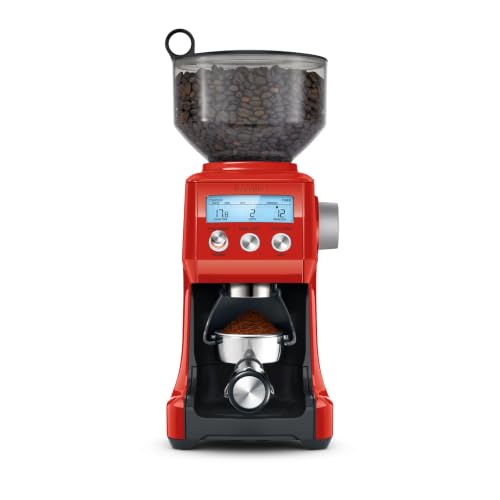
Breville Smart Grinder Pro — Best Convenience Features
Breville’s long-running answer to home espresso grinding is a study in convenience: a clear display, timed dosing you can program, a portafilter cradle that holds the basket while grinding, and a wide adjustment range with an additional inner-burr adjustment for extending the fine end. It is the grinder most likely to be chosen by households that already own a Breville espresso machine, and the pairing is genuinely harmonious in daily use. Shots from it are consistent and crowd-pleasing, particularly in milk.
Best for: milk-drink households wanting timed, hands-light dosing. Not suited for: single-dose purists or owners determined to swap coffees every day.
Strengths: excellent dosing conveniences; intuitive controls; wide range with extra fine adjustment available; strong value as a complete package. Trade-offs: retention means purging when you change settings; timed dosing drifts as beans age and needs re-checking; stepped control is good rather than ultimate.
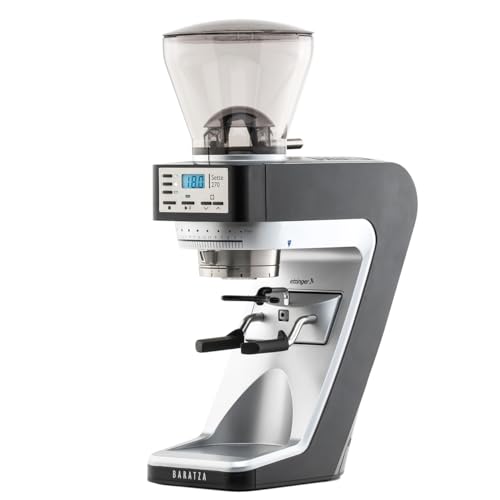
Baratza Sette 270 — Best Speed and Low Retention
The Sette 270 inverts the usual layout: the outer burr rotates around a stationary cone, and grounds fall straight down through the burrs into the portafilter with almost nowhere to hide. The result is a grinder that is very fast and retains remarkably little, so the dose you set is the dose you get, shot after shot — a quality that makes dialling in noticeably less wasteful. Its macro and micro adjustment pairing gives both range and finesse, and its speed suits households making several drinks in sequence.
Best for: multi-drink households and anyone who hates purging. Not suited for: noise-sensitive homes; it is an enthusiastic, audible machine.
Strengths: very low retention; fast grinding; precise micro adjustment; consistent dosing. Trade-offs: among the louder options; the open design can scatter grounds without a funnel; aesthetics divide opinion.

Eureka Mignon — Best Quiet Hopper-Fed Grinder
The Mignon family, handmade in Florence, is built around two ideas home users feel every day: stepless micrometric adjustment, turned by a small knob that moves the burrs in genuinely tiny increments, and sound insulation that makes the range famously civilised to live with. Flat burrs deliver a clean, structured cup, and the hopper-fed workflow with timed dosing suits a settled household routine. Several variants trade features — displays, dosing styles, burr sizes — but the shared character is quiet precision.
Best for: settled households wanting quiet, stepless precision with a hopper. Not suited for: frequent coffee-swappers; stepless settings are harder to note and revisit.
Strengths: stepless micrometric control; notably quiet operation; flat-burr clarity; solid, compact metal build. Trade-offs: returning to an exact setting after cleaning takes care; single dosing is possible but not the design’s home ground; premium tier positioning.

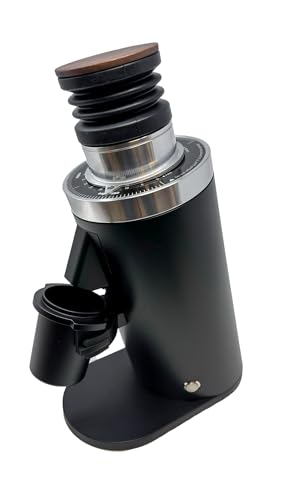
Turin DF64 — Best for Single-Dose Enthusiasts
The DF64 is the enthusiast format distilled: a substantial flat burr set in a single-dose body, stepless adjustment, and a workflow built around weighing every dose and clearing the chamber with a bellows. It rewards the ritual with clarity and separation that make light-roast single origins legible, and its popularity has created a lively ecosystem of burr options and small modifications for owners who like to tinker. It asks more of its owner than any other pick here — and gives more back to the owner who enjoys the process.
Best for: single-origin explorers and tinkerers who weigh every dose. Not suited for: anyone wanting push-button convenience for a morning queue.
Strengths: flat-burr clarity; true single-dose, low-retention workflow; stepless precision; strong upgrade and burr-swap ecosystem. Trade-offs: fully manual workflow; static management is part of ownership; the routine takes longer per drink.
First Setup and Care Essentials
Unbox onto a clear counter and read the maker’s manual before the first bean: every model in this guide has a specific way its burrs are accessed and its adjustment should be moved, and several should only be adjusted while the motor runs with beans in the chamber, so that trapped fragments are not crushed between the burrs. Start with the grinder unplugged while you fit the hopper and check the burr chamber is empty of packing material. Season a new grinder patiently — the first small batches of grounds go in the bin while burr edges settle and factory residues clear — then begin dialling in coarser than you expect and walk finer in small steps, tasting as you go. Keep the electrical parts dry at all times, never reach into the throat or burr chamber of a plugged-in grinder, and never grind anything that is not coffee: stones hide even in good beans, so pour beans into the hopper in a way that lets you spot foreign objects rather than dumping blindly. A fuller safety-first routine lives in how to clean an espresso grinder.
How Dosing Works: Timed, Weighed, and Manual
Getting the same amount of coffee into the basket every time is half of consistency, and grinders solve it three ways. Timed dosing runs the motor for a set number of seconds; it is fast and, once calibrated, reasonably repeatable, but the output for a given time shifts as the hopper empties, as beans change, and as the burrs warm — which is why owners of timed grinders learn to check the dose on a scale every few days. Weight-based dosing, where the grinder itself weighs the output and stops at a target, is the most set-and-forget method where it is offered, though it remains a premium convenience rather than a category standard. Manual dosing — grinding into a cup or directly by eye and judgement — is the oldest method and the least repeatable, fine for forgiving drinks, limiting for espresso. Single-dose workflows sidestep the whole question by weighing the beans before grinding and grinding everything through: the dose is exact by construction, which is a large part of their appeal to methodical drinkers.
Whichever method a grinder uses, judge it by its worst morning, not its best. A timer that is consistent when the hopper is full but erratic when it is nearly empty will teach you to keep the hopper topped up. A single-dose routine that is meditative on a Sunday can feel long on a workday with a train to catch. The right dosing system is the one whose failure mode you can live with, and it is worth reading the picks above with that lens: each model’s dosing style is stated plainly so you can match it to your temperament before you commit.
Beans and Roasts: Why Your Coffee Changes the Answer
Not all beans ask the same of a grinder. Dark roasts are brittle and grind easily, producing more fine dust and more static; they are forgiving to dial in but messy to live with, and they coat burrs with oil faster, shortening the sensible interval between cleanings. Light roasts are dense and hard, resist the burrs, stress motors, and punish any wobble or flex in the burr mounting — the same grinder can feel precise on a medium roast and vague on a pale Scandinavian-style coffee. Decaf behaves like an older, more fragile bean and often needs a finer setting than its caffeinated twin. If your taste has a strong centre of gravity, let it steer the purchase: light-roast drinkers should weight burr quality, motor strength, and flat-burr clarity; dark-roast and milk-drink households can weight workflow, dosing, and ease of cleaning more heavily, because their coffees forgive the small inconsistencies that light roasts expose. The grinder does not need to be all things — it needs to be excellent at your thing.
Burrs, Motors, and Build: Reading the Hardware Honestly
Product pages love burr diameter, and diameter does matter — larger burrs generally grind a given dose faster and can run cooler doing it — but it is the least informative number on the page when read alone. What matters more is burr quality and alignment: how precisely the cutting surfaces are machined, how rigidly they are mounted, and how little they wobble relative to each other at speed. A small, well-aligned burr set in a rigid carrier will out-grind a large, sloppy one, which is why established makers talk about their carriers, bearings, and machining rather than diameter alone, and why the DF64’s appeal is as much its solid, well-aligned platform as its burr size. Treat diameter as a tiebreaker between otherwise similar machines, never as the headline reason to buy.
The motor’s job is unglamorous and decisive: hold a steady speed while dense beans at a fine setting try to slow it down. When a motor labours, burrs deflect microscopically, grind size wanders within a single dose, and the shot you dialled in yesterday is not the shot you get today. This is one reason espresso grinders feel heavier than filter grinders at the same price tier — torque and rigidity are physical things. It is also why very hard, light-roasted beans are the stress test of the category: they are denser and less brittle, and a grinder that stalls or strains on them is telling you the truth about its drivetrain. If your taste runs to light roasts, weight motor strength and burr quality heavily, and be suspicious of any espresso claim from a featherweight machine.
Build quality shows up in quieter ways over years: a hopper lid that still seals, an adjustment collar that has not developed play, a grounds bin whose edges have not cracked. Metal in the body and burr carrier ages differently from plastic, and repairability compounds the difference — a grinder whose burrs, burr carriers, and even motors can be ordered as parts is a grinder designed to be kept. When comparing two finalists, open each maker’s parts catalogue in your mind: if one sells burrs and small spares and the other sells only whole machines, you have learned something important about which company expects to know you in ten years.
Dialling In: What Success Actually Looks Like
New owners often imagine dialling in as a one-time calibration. It is better understood as a short daily conversation with the coffee. Beans change as they rest after roasting — very fresh beans behave gassy and erratic, and the same setting drifts as a bag ages — so the ritual is: grind, pull, taste, adjust one small step, repeat. A good espresso grinder makes this loop pleasant because its steps are small enough to move the shot’s timing by a few seconds at a time and its dosing is consistent enough that grind is the only variable changing. This is the practical meaning of every specification in this guide. Micrometric adjustment, low retention, and consistent dosing are not luxuries; they are what keep the loop to one or two test shots instead of five, which is also why the value question resolves so strongly for daily drinkers: a grinder that wastes less coffee and less morning pays its way in beans alone.
Keep notes while you learn. A scrap of paper by the grinder — coffee, date, setting, dose, and how the shot ran — turns a week of confusion into a map, and returning to a favourite coffee becomes a matter of starting near your noted setting instead of searching from zero. Owners of stepped grinders have an advantage here, since a setting is a number; stepless owners learn to mark positions or count turns. Either way, the habit is the same, and it is the habit, more than any hardware feature, that separates households whose espresso keeps improving from households stuck re-learning the same lesson each time a new bag opens. Expect the first bag through a new grinder to be partly tuition: some shots will be too fast, some too slow, and a few will be undrinkable. That is not the grinder failing you; it is the two of you learning each other, and it happens with every model in this guide, at every tier, in every kitchen.
Mistakes to Avoid
The most expensive mistake is buying a general coffee grinder for espresso because its dial shows a fine setting; the second most expensive is buying a blade grinder at all, which cannot produce espresso grounds by design. Third: judging a grinder by its coarsest marketing claim instead of its adjustment system — ask how it adjusts in the espresso range, specifically. Fourth: ignoring workflow and buying a single-dose instrument for a five-drink household queue, or a hopper-fed machine for a rotating collection of small bags. Fifth: forgetting the supporting cast — a small scale, a dosing funnel, and a brush change daily satisfaction more than a tier jump does. Sixth: neglecting cleaning until rancid oils are seasoning every shot; espresso fineness means enormous surface area, and old grounds flavour new coffee quickly. Finally, do not chase a perfect first week: every grinder in this guide improves as its burrs season and as your hands learn its adjustment, and the honest verdict on value is the one in is an espresso grinder worth it.
Pairing a Grinder With Your Machine
A final consideration belongs to the partnership on your counter. Pressurised-basket starter machines — the kind with dual-wall baskets that build pressure artificially — are forgiving of grind and can make drinkable coffee from a lesser grinder, which tempts owners to under-buy. The trap is that the grinder then becomes the ceiling the moment you move to a standard basket or a better machine, and the upgrade has to be bought twice. If there is any chance your machine will grow, buy the grinder for the machine you will own next, not only the one you own now. Conversely, a superb grinder paired with a basic machine is money well spent: it extracts everything the machine can give, and it will still be the right grinder when the machine is eventually replaced. Experienced home baristas budget the pairing in that order instinctively — grinder first, machine second — and the second-hand market reflects it, with good grinders holding their usefulness across several generations of machines. Judge every candidate in this guide by that standard: not whether it flatters today’s setup, but whether it will still be earning its counter space after the next upgrade.
Before You Order: A Fit-and-Routine Worksheet for the Espresso grinder
Start this worksheet with the space, not the product page: measure the exact spot where the espresso grinder will live, including the clearance above it, the swing or reach you need in front of it, and the route you will take to move it for cleaning. Write down the largest item you realistically expect to use with it, because that single measurement settles more sizing arguments than any capacity figure printed in a listing headline. Check the nearest outlet and be honest about whether a cord will cross a walkway, a sink edge, or another appliance that also needs that socket on busy mornings. Count the people the espresso grinder must serve on an ordinary weekday, then count again for the busiest gathering you host in a typical year, and notice whether those two numbers point to the same size.
List the three jobs you will ask of it every week and the one job you will ask only a few times a year, because the weekly jobs should drive the decision and the rare job should not. Decide where the accessories, attachments, and spare parts will be stored before you order, since a espresso grinder whose extras live in a distant cupboard quietly becomes a espresso grinder with fewer features. Where a shortlist names specific examples, such as Baratza Encore ESP, run these same checks against that listing line by line rather than assuming the general verdict transfers unchanged. Apply the identical test to Fellow Opus as well, on the same day and under the same conditions, because a fair comparison needs one ruler rather than two moods.
- Measure the working spot and the clearance around it
- Count weekday servings and the biggest gathering
- List the three weekly jobs in writing
- Decide storage for every accessory in advance
- Name the one compromise you accept knowingly
- Set the return deadline in your calendar
If Breville Smart Grinder Pro is also in contention, give it the same worksheet and let the three sets of answers sit side by side before anyone reaches for a checkout button. Think about who else in the household will use it, including anyone shorter, anyone with less grip strength, and anyone who will clean it without reading the manual first. Note the surfaces it will touch in normal use and whether heat, moisture, weight, or vibration from the espresso grinder could mark, stain, or stress those surfaces over months of daily contact. Plan the cleaning position as carefully as the working position, because a espresso grinder that is awkward to carry to the sink or to open fully will be cleaned less often than it should be.
Write the three questions you still cannot answer from listings and guides, and treat those unanswered questions as your shortlist filter rather than as details to discover after delivery. Compare the footprint against the appliance or tool it replaces, and decide in advance what leaves the room if the new arrival is larger than the old one. Consider the noise, steam, heat, or light it produces in use and whether that output lands in a room where someone sleeps, works, or studies at the same hours. Check how it behaves at the smallest task, not only the largest, because many households abandon oversized gear that feels clumsy for the quick everyday job.
Think through the second week of ownership, when the novelty has faded, and ask which features you will still touch daily and which were only interesting in the showroom sense. Decide what good enough looks like in writing: the result you would accept without complaint, the result that would delight you, and the result that would send the box back. Look at the controls with fresh eyes and imagine using them with wet hands, greasy hands, or gloves, depending on the work, because small controls punish exactly those moments. Ask how the espresso grinder fails gracefully: whether a worn part, a lost attachment, or a single broken control ends its usefulness or merely removes one mode you rarely used.
Check whether replacement parts and consumables are ordinary, widely stocked items or proprietary pieces tied to one maker, since that difference compounds over years of ownership. Measure the storage shelf, drawer, or cupboard you intend to use with the door closed and other contents in place, not the optimistic empty version of that space. Think about guests and helpers who will meet the espresso grinder without your habits, and whether its safe, correct use is obvious to a newcomer within a minute of looking at it. Write down the one compromise you are consciously accepting, so that when it shows up in daily use it reads as a chosen trade rather than a nasty surprise.
Revisit your shortlist after the worksheet is done and delete any option that fails a measurement, because a tape measure is a cheaper teacher than a returns process. Whatever the category, photograph your intended spot with the neighbouring items in place, because a picture exposes crowding that measurements alone politely ignore. Keep every measurement, tally, and note from these checks in one place, ideally with the receipt, so the next decision in this category starts from your evidence rather than from scratch. Involve the household early where the product is shared, since a decision everyone helped measure is a decision nobody relitigates at the first inconvenience.
Frequently Asked Questions
Can a regular burr coffee grinder really not handle espresso?
Most cannot handle it well, and the reason is adjustment, not effort. Espresso needs grounds at the extreme fine end, changed in increments small enough to alter a shot’s timing by seconds. A filter-focused grinder spreads its steps across a wide range, so its steps in the espresso zone are too coarse, and its burrs and motor are not optimised for sustained fine grinding. A few all-rounders add a genuine fine range and can serve as starter espresso grinders; the rest produce frustrating, inconsistent shots no matter how carefully you work.
Which matters more, conical or flat burrs?
Less than the internet suggests, and less than adjustment quality and workflow fit. Conical burrs dominate the entry and mid tiers, run quietly, and tend to produce a forgiving, sweet cup. Flat burrs, common in enthusiast and café designs, can deliver extra clarity and flavour separation, especially in lighter roasts. Choose geometry after you have chosen workflow and adjustment style; a well-adjusted conical grinder will out-pull a neglected flat-burr machine every morning of the week.
Do I need a scale to use an espresso grinder?
For single-dose grinders, yes — weighing the dose in is the workflow, and weighing the shot out is how you know your grind setting is doing what you intend. For hopper-fed grinders with timed dosing, a scale is still the fastest way to check that the timer is delivering the dose you think it is, because timed output drifts as beans age and hoppers empty. A small coffee scale is the cheapest consistency upgrade in the entire espresso hobby.
How long should an espresso grinder last?
A well-kept home espresso grinder should serve for many years: motors and housings are durable, and burrs are replaceable wear parts that manufacturers of the established brands stock and support. Longevity habits are simple — keep the burr chamber clean, do not grind foreign objects, let the motor rest between back-to-back grinds if the manual advises it, and replace burrs when shots turn muddy despite correct adjustment. Buying from a maker that sells parts is the single best predictor of a long service life.
Is a hand grinder a real alternative for espresso?
A quality hand grinder with espresso-capable burrs and fine adjustment can produce excellent espresso grounds and is a legitimate choice for travellers, minimalists, and one-drink households. The honest cost is effort: espresso fineness multiplies the work of hand grinding, and a daily multi-drink routine becomes a workout. As a sole grinder for a household queue it wears thin; as a personal instrument for a considered daily shot, it can be a pleasure rather than a compromise.
What should I buy first, a better machine or a better grinder?
The grinder, in almost every case. Espresso machines deliver hot water at pressure with reasonable consistency across a wide range of prices, but extraction quality is capped by grind quality, and an upgraded grinder transforms shots from even a modest machine. If your current grinder is a blade model or a filter-focused burr grinder, replacing it will change your espresso more than any machine upgrade at a similar tier. Buy the grinder your technique deserves, then let the machine follow when budget allows.
Related Guides
espresso grinder reviews · best burr coffee grinders · best espresso machines for home · best espresso portafilter baskets