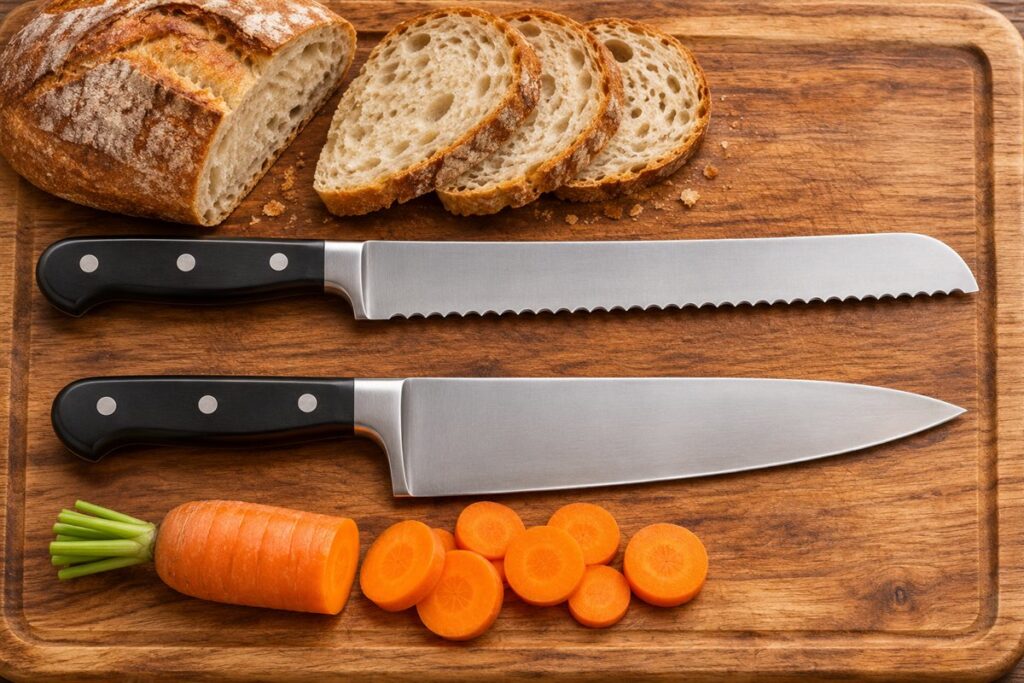
A straight edge knife slices cleanly through most foods with a smooth push or pull, while a toothed, scalloped edge grips and saws through foods with a hard outside and a soft inside. If you cut mostly vegetables and meat, a straight edge is the main tool. For crusty bread and tomatoes, a toothed blade helps.
What Each Edge Does Best
A straight edge is a continuous cutting line. It makes precise, clean cuts and is the style used on chef knives, paring knives and slicers. A toothed edge has small points and gullets along the blade. The points bite into a tough surface, such as a bread crust or tomato skin, and the blade then cuts the soft interior as you saw back and forth.
Think of the straight edge as a razor-like line that slides through, and the toothed edge as a series of tiny points that grab first. That is why a toothed blade can cut a slippery tomato skin without pressing the whole fruit flat, and why a straight edge feels better on a firm carrot.
Differences at a Glance
| Question | Straight edge | Toothed edge |
|---|---|---|
| Best foods | Vegetables, meat, herbs, fruit | Crusty bread, tomatoes, citrus, cakes |
| Cut quality | Smooth, clean faces | Slightly ridged faces |
| Motion | Push, pull or rock | Gentle sawing |
| Sharpening | Simple at home | Harder, tooth by tooth |
Keeping Each Edge Working
A straight edge can be honed on a rod and sharpened on a stone using steady, even strokes. A toothed edge has many small curves, so it often needs a tapered rod or a sharpening service, and the maker may have specific advice. Because the points do most of the work, a toothed knife usually stays useful longer between sharpenings, but check the maker’s guide for details.
- Wash both by hand and dry them promptly.
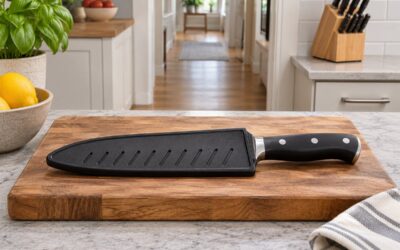
- Store them in a block, sheath or magnetic strip so the edge is protected.
- Do not use either for prying or cutting through bone unless the maker says it is designed for it.
Who Should Choose Which
- If you can own only one knife, choose a straight edge chef knife.
- If you bake or buy loaves with a hard crust, add a toothed bread knife.
- If you slice ripe tomatoes often, a small toothed utility knife can save frustration.
- If you cut delicate fish, choose a straight edge for a clean surface.
Use any knife carefully, on a stable board, and follow the safety instructions from the maker.
How Tooth Patterns Differ From One Toothed Knife to Another
Not every toothed blade is built the same way, and the pattern affects what the knife does best. Some have large, deep scallops with widely spaced points. These bite aggressively into thick crusts and are often seen on bread knives. Others have shallow, fine teeth that suit soft or delicate foods, such as tomatoes, cakes or soft fruit, where a deep sawing action would tear the food.
The spacing and depth of the teeth also affect how the knife leaves the food. Large teeth can produce crumbs from a delicate loaf and leave a ridged surface, while finer teeth leave a cleaner face. Some knives mix patterns, with large points interspersed with smaller ones, to grip more reliably.
Blade length matters as well. A long toothed blade lets you slice a whole loaf in a smooth stroke without lifting the knife, while a short one suits a small utility job. A slightly curved blade can help with rounded loaves, and a flatter one helps with sheet cakes.
When you read a product listing, look for details such as blade length, tooth style and whether the edge is serrated on one or both sides. Also check how the blade is ground, since some toothed knives are ground on one side only, which changes how you sharpen them. If the description is vague, consider checking the maker’s guide before buying so you know what to expect.
Matching Foods to the Right Edge
The simplest way to decide is to think about the surface and interior of the food. Foods with a firm or slippery skin and a soft inside are usually easier with a toothed edge, because the points grip where a straight edge may skid. Foods that are uniformly firm or that you want to cut cleanly are better with a straight edge.
- Toothed edge suits: crusty bread, bagels, tomatoes, citrus fruit, layer cakes, soft sandwiches and some cured meats with a hard casing.
- Straight edge suits: onions, carrots, potatoes, raw and cooked meat, herbs, fish, firm cheese and most fruit.
Some foods fall in between. Pineapple has a tough skin, but the flesh is firm and juicy, and many cooks use a straight edge. Roast meat with a crisp skin can be sliced with either, depending on whether you prefer a sawing motion or a clean draw cut. Soft cheese can stick to either blade, and a thin straight edge sometimes helps.
When slicing bread, let the teeth do the work. Use a gentle back-and-forth motion with light downward pressure, rather than pressing hard. Pressing flattens soft bread and can push crumbs everywhere. For tomatoes, start at the skin with a light sawing motion, and then the blade will glide through.
If you only want a single knife for these tasks, a small toothed utility knife often covers tomatoes, sandwiches and citrus, while a longer bread knife handles loaves.
Sharpening, Honing and Replacing Toothed Blades
Toothed knives are often described as low maintenance, but they do dull eventually. The points wear down first, and when they do, you will notice that the knife starts to slip on crusts or tear tomatoes instead of cutting them. At that point you can either sharpen the knife or replace it.
Sharpening is more specialized than for a straight edge. Because each tooth has its own curve, a flat stone or a pull-through sharpener may not reach the scalloped portions properly. Options include a tapered rod that fits each gullet, a sharpening service, or a tool designed for toothed edges. Check the maker’s guide first, since some knives are ground in a way that requires specific methods. Take care, as the points are sharp and a rod can slip.
A few habits extend the life of the edge:
- Use a wood or soft plastic board. Hard surfaces dull the points quickly.
- Wash by hand and dry promptly. Crumbs can lodge in the scallops, so a soft brush helps.
- Store in a sheath, block or magnetic holder so the teeth do not rub against other tools.
- Avoid cutting through bones or frozen food unless the maker says the knife is built for it.
Consider that an inexpensive toothed knife may be more practical to replace than to send for sharpening, while a higher-quality one may be worth servicing. Think about the cost and effort involved when you decide how to handle a dull blade.
Choosing Your First Toothed Knife
If you already own a good straight-edge chef knife and want to add a toothed knife, consider what you will cut most. If bread is your main target, pick a longer blade, as it should extend past the width of your loaf so one stroke can pass through. A knife that is too short forces you to cut in awkward segments. If you mainly want tomatoes and sandwich cutting, a shorter utility knife is easier to control.
Look at the handle, since sawing involves repeated motion. A handle that fits your hand well and gives a secure grip, even when wet or floury, reduces fatigue and the chance of slips. Check the balance by holding the knife, if possible, and imagine pulling it through a loaf. Look also at the knuckle clearance, so your hand does not hit the board when the blade is on the bottom of the stroke.
Think about the following before you buy:
- Do you slice loaves often, or only occasionally?
- How big are your loaves and the board you use?
- Do you want a knife that can do double duty on cakes and tomatoes?
- Are you comfortable with the care required for the steel?
Budget-wise, a basic toothed knife can be perfectly effective if the teeth are well formed. Spending more may bring better steel and finishing, but it is not essential. Check the maker’s guide for care instructions and any warranty terms.
Common Mistakes When Choosing Between the Two
A few errors show up regularly. The first is expecting one edge to do everything. A toothed knife is not a replacement for a chef knife, and a straight edge struggles on a firm crust. Having both covers the widest range of tasks.
The second is using the wrong technique. Pressing straight down on a toothed edge squashes food and can slip, while sawing with a straight edge is often unnecessary and can leave ragged cuts. Match the motion to the blade, using a sawing action for toothed and a smooth push or pull for straight.
The third is neglecting the cutting surface. Hard boards, plates or countertops dull both types of blades. Choose a wood or plastic board and keep it stable.
The fourth is poor storage. Tossing knives into a drawer chips edges and risks cuts when you reach in. A block, sheath or magnetic strip solves both problems, provided it is mounted securely and kept away from children.
The fifth is skipping the maker’s guide. Edges, steel and finishes vary, and so does the proper maintenance. Read the care notes, and if you cannot find them, assume gentle hand washing, immediate drying and storage that protects the edge. Following these basics gives either type of knife a long working life.
FAQ
Can a toothed knife replace a chef knife?
No. It is a specialist tool and leaves ridged cuts on most foods, so it works best alongside a straight edge knife.
Why does a toothed blade seem to stay sharp longer?
The points take most of the contact, while the recessed parts stay protected. It still dulls over time and will need attention.
Can I sharpen a toothed knife at home?
Sometimes, with a tapered rod or a tool made for toothed edges, but it takes care. Check the maker's guide, or use a sharpening service if you are unsure.
Is a toothed knife good for meat?
It can handle roasts with crisp skin or tough casings, but most cooks prefer a straight edge for clean slices of cooked and raw meat. The choice depends on the texture.
What length of bread knife should I choose?
Choose one longer than the width of your usual loaf, so you can cut through in a single smooth motion. Check the listing for blade length.
Why does my tomato still squash with a toothed knife?
The points may be worn, or you may be pressing down too hard. Use light pressure and a gentle sawing motion, and consider whether the knife needs attention.
Can I use a toothed knife on a glass cutting board?
It is best to avoid this, as hard surfaces dull the points and can damage the blade. A wood or soft plastic board is a better choice.
Do toothed knives work for cutting cake?
Many people use them for layer cakes and sponges, with a light sawing action. Wipe the blade between cuts for cleaner slices.
The Short Version
Choose a straight edge for everyday precision and a toothed edge for crusty bread, tomatoes and similar foods. Most kitchens do best with one of each.