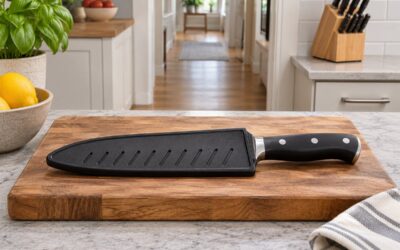
A kitchen utility knife is a mid-sized blade, commonly 4 to 7 inches, that handles jobs too big for a paring knife and too small for a chef knife. Choose it by blade length, edge style, steel and how it feels in your hand.
What It Is Good For
Think of it as the in-between knife. It slices sandwiches, trims small cuts of meat, cuts fruit and tomatoes, and handles cheese and herbs when a chef knife feels like too much. Many cooks reach for it for quick tasks that do not justify pulling out a larger knife.
Criteria Table
| Factor | Why it matters | What to check |
|---|---|---|
| Length | Reach versus control | Shorter for precision, longer for sandwiches |
| Edge style | Cutting feel | Plain edge for clean slices, toothed edge for soft skins |
| Blade width | Stability | Narrow blades slip through, wider blades give knuckle room |
| Steel | Edge hold and care | Stainless is easy to look after |
| Handle | Comfort during short tasks | Rounded, no sharp seams |
| Weight | Control | Light and balanced suits fine work |
Plain or Toothed Edge
- A plain edge makes neat slices and is simple to sharpen.
- A toothed edge grips tomatoes, citrus and crusty rolls, but it needs special sharpening or professional help.
- If you cut mostly soft or slick items, consider a toothed utility knife as a second option.
How to Decide
- Write down the tasks you currently do with a paring knife or chef knife that feel awkward.
- If most are small, choose a blade around 4 to 5 inches.
- If you slice sandwiches, roasts or large fruit, choose 6 to 7 inches.
- Hold the handle, if possible, and check the balance.
- Read the maker’s care guide for washing and sharpening.
Using and Looking After It
Use a stable board and keep fingers curled away from the edge. Do not use the knife to pry or twist. Wash by hand, dry at once and store in a block, a sheath or on a magnetic strip. Hone regularly and sharpen when it loses its bite.
It helps to see the knife in the context of your whole set. If your chef knife is 8 inches and your paring knife is 3 inches, a 5 or 6 inch utility knife fills the middle. If you already own a santoku or a small chef knife, a utility knife may overlap, and you might prefer to spend on another tool.
Everyday Tasks and Technique
A utility knife earns its place through jobs that fall between the extremes of a small paring knife and a large chef knife. Slicing a tomato for a sandwich, halving grapes, trimming green beans, cutting a wedge of cheese, segmenting an apple and carving a small roast portion are all natural fits. The blade is long enough to pass through a medium fruit in one stroke and short enough to turn easily around a curved surface.
Technique is mostly about control. Use a pinch grip with your thumb and forefinger on the blade just ahead of the handle, and curl the fingers of the other hand into a claw so the knuckles guide the blade. For soft, slippery items such as tomatoes, start with a light drawing motion, pulling the blade toward you as it moves downward, rather than pressing straight down. This is where a sharp edge, or a toothed one, makes a difference, as it grips the skin before it cuts.
For small cutting jobs, a stable board is a must. Place a damp cloth or non-slip mat beneath the board if it moves. Use a cutting surface that suits the edge, and avoid glass, stone or ceramic boards, which can damage the blade. Choose the right length for the task, a shorter blade for peeling and trimming, a longer one for slicing sandwiches and meat. If a food needs force, such as a hard squash or a frozen item, switch to a heavier knife, because a utility knife is not made for prying or splitting.
- Pinch grip and claw hold for control.
- Use a drawing motion on slippery skins.
- Switch to a heavier knife for hard or frozen items.
Blade Shape, Thickness and Flex
Blades labeled as utility knives can differ more than the name suggests. Some have a straight edge that runs almost the full length, with a slightly upswept point. Others have a gentle belly, the curve near the tip, which allows a rocking cut. A pointed tip is useful for piercing and fine trimming, while a more rounded tip is more forgiving but less precise. Think about whether you want a shape closer to a mini chef knife or closer to a long paring knife.
Blade thickness affects how it moves through food. A thin blade slices cleanly through soft produce with less wedging, which is why thin, lightweight blades suit tomatoes, citrus and cheese. A thicker blade is sturdier for firmer items, such as small cuts of meat or dense vegetables, but it can wedge in tight cuts. Some utility knives have a slight flex, which helps follow the contour of fruit and meat, while others are rigid and give a more controlled, stable feel.
Height from spine to edge also matters. A narrow blade slips between items and works well for trimming and slicing in small spaces. A taller blade gives your knuckles more clearance above the board, which can feel safer for chopping and slicing. Check the listing for blade length, width and thickness, since these are the numbers that determine feel. If the listing provides only a length, look at product photos to judge the proportions. A blade that looks very narrow might feel nimble, but may offer limited knuckle room on a flat board.
Where It Fits in Your Knife Set
The best way to decide whether you need a utility knife is to look at the gaps in your current set. If you own a paring knife, a chef knife and a bread knife, you may find that a utility knife overlaps with one of them. The key is to look for the tasks that feel awkward. If you find yourself reaching for the chef knife for a single tomato, or struggling with a paring knife on a large apple, a middle size fills that gap.
Consider how your knives differ. A paring knife is short and nimble for peeling, hulling and detail work. A chef knife is long and versatile for chopping, slicing and heavier prep. A serrated knife handles bread and some delicate items. A utility knife sits in between: it can slice a sandwich, trim fat, cut cheese or segment citrus, and it reduces the number of times you need to wash a large knife for a small task.
Some cooks prefer a santoku or small chef knife for the same roles. If you already own one, a utility knife may be a luxury rather than a necessity. Others cook for one or two people, with a small prep area, and find a utility knife sufficient as a main blade for light tasks. Think about your kitchen routines. If you cook large batches or handle big cuts of meat, a chef knife remains essential. If most of your cooking is light, a utility knife plus a paring knife may cover most needs. Avoid buying duplicates that serve the same purpose.
Handles, Grip and Safety
With a smaller knife, handle comfort affects control more than you might expect. A handle that is too small can cramp your hand, and one that is too large can make fine movements awkward. Rounded or oval handles tend to be comfortable for most hands. Materials vary: wood offers a warm feel but needs gentle handling, composite materials resist moisture, and synthetic handles often provide a secure grip even when wet. Check the product listing for material details and consider how the handle feels when your hands are damp or greasy.
Look at the joint where the blade meets the handle. There should be no gaps where moisture or food could collect, and the transition should feel smooth. A small guard or bolster can protect your fingers, but it may get in the way if you sharpen the knife with certain methods. A flat spine with a comfortable edge helps with a pinch grip, whereas a sharp spine can dig into your finger over time.
Safety habits matter even more with small knives, because people often grip them casually. Keep the edge pointed away from your body, never cut toward your hand, and avoid holding food in your palm while cutting. Do not leave a knife in a sink of soapy water where someone could reach in unseen. Store it where the edge is protected, and keep it out of reach of children. A sharp knife is generally safer than a dull one because it needs less force. If your hands are small, look for lighter handles with a shorter overall length to reduce fatigue.
Buying Questions and Budget Tiers
Ask a few questions before you buy. What do I cut most with a paring knife or chef knife that feels awkward? Do I want a plain edge for clean slices or a toothed edge for tomatoes and crusty items? What length best fits my board and hands? Would I prefer a light, nimble knife or something with more heft? How important is it that the handle resists moisture? Can I handle a blade that needs specific sharpening?
Budget tiers differ mainly in steel, construction and finish. Entry-level knives often use simple stainless steel and plain handles and are fine for casual use. Mid-range options generally add better steel, more refined edges and sturdier handles. Higher-priced knives may use specialized steel or hand finishing, but whether that benefits you depends on how you cook and maintain it. Rely on listing details such as steel type, blade dimensions and care guidance rather than assumptions.
Signs that it is time to replace a utility knife include a bent or chipped blade that sharpening cannot fix, a loose or cracked handle, pitting or rust that does not clean off, and an edge that no longer holds sharpness for any reasonable time. A knife that wobbles in the handle is a safety risk and should be retired. Consider buying a knife with a clear return or warranty policy, check the edge and fit on arrival, and let it replace your habit of using the chef knife for small jobs.
FAQ
Is a utility knife the same as a petty knife?
They are similar. Petty knives are the Japanese-style version, often thinner and sharper, but the names overlap.
Do I need one if I own a paring knife and chef knife?
Not necessarily, but many cooks find it handy for medium jobs. If you are happy with your current knives, you may not need one.
What length utility knife is best?
Shorter blades around 4 to 5 inches offer control for fruit and trimming, while 6 to 7 inches suit sandwiches and small roasts. Choose based on your board space and the tasks you do most.
Should I get a serrated utility knife?
A toothed edge grips tomatoes and crusty rolls well, but it is harder to sharpen. Many cooks pick a plain edge as their main utility knife and add a serrated one if they cut a lot of soft skins.
Can a utility knife cut meat?
It can slice and trim small portions. For large roasts, bones or tough cuts, use a larger, sturdier knife.
Is a thin blade better than a thick one?
Thin blades slice soft produce cleanly, while thicker blades are sturdier for firmer items. Pick based on what you cut most.
Can I use it instead of a paring knife?
For many tasks, yes, but a paring knife is better for peeling and detailed work in hand. Many cooks keep both.
What cutting board should I use with it?
Wood or plastic boards are kind to the edge. Avoid glass, stone and ceramic surfaces, which can dull or chip the blade.
Is a utility knife a good gift?
It can be, especially for someone building a first knife set. Choose a comfortable handle, a plain edge and a clear care guide, and avoid duplicating knives they already own.
The Short Version
Match the blade length and edge to the jobs you do, choose a comfortable handle and follow the care guide. It is a useful middle knife, not a must-have.