Disclosure: As an Amazon Associate, topratedkitchenware.com earns from qualifying purchases. Links on this page are affiliate links; they cost you nothing extra. Prices and availability change often, so check the current Amazon listing before you buy.
So, is a cookware set worth it for a real household — not as a slogan, but as an accounting of money, cupboard space, cooking quality and years? The short answer is that is a cookware set worth it resolves differently for the equipping cook and the equipped cook: for anyone who needs a working core at once, a set is usually the most sensible purchase in the kitchen; for anyone whose core already works, the same box is usually a duplication. This article builds that answer properly — what you actually get, what it really costs beyond money, who it pays off for, who should skip it, and the checklist that settles the question for your kitchen specifically. Material value differs too, and the stainless-versus-coated lifespan shapes are weighed honestly along the way.
Is a Cookware Set Worth It: The Short Answer
Worth it if you are equipping or re-equipping a kitchen’s core, you cook a varied week of ordinary meals, and you will choose the material family by your heat habits rather than by the box photograph. Not worth it if your current core already covers your cooking, if only one pan actually needs replacing, or if your cooking is so specialist-led that a general set would sit beneath the instruments you reach for daily. Everything else in this article is the evidence and the exceptions for those two sentences — including the middle path, a leaner set plus one adopted pan, that turns out to be the right answer for a large share of households.
- A set buys a system — matched lids, handles and storage — not just a pile of pans.
- Its value peaks at the equipping moment and declines as your existing core improves.
- Stainless sets repay through years; coated sets repay through effortless weeknights.
- Filler pieces are the main value leak; usable-vessel counting is the defence.
- One adopted specialist pan often completes a set’s value better than a bigger set does.
In this guide
What You Actually Get
What you get, first, is coverage: the core shapes of hob cooking — frying, saucing, boiling, simmering — present from the first day, in sizes that were planned together. Second, you get the system effects that separates never quite reproduce: lids that fit and interchange, handles with one grip language, pieces dimensioned to store together. Third, you get a single learning curve, because every vessel shares one material temperament, so the instincts you build at breakfast transfer to dinner. And fourth, you get decision economy — one researched purchase instead of six — which has real value for busy households even though it never appears in a specification. Weighed together, that bundle is the set’s genuine product, and it is why the format dominates equipping purchases despite every caveat this article will honestly raise.
Count pieces the way manufacturers count them and every set looks generous; count them the way a cook uses them and the picture sharpens. Lids are counted as pieces, utensils bundled in the box are counted as pieces, and two small saucepans that a household may use twice a month inflate the number just as much as the large frying pan used every single day. The pieces that earn their cupboard space in most homes are a small and a large frying pan or skillet, a small and a medium saucepan with lids, a larger lidded pot for pasta, soups and batch cooking, and ideally a wide, deep sauté-style pan that bridges frying and braising. Everything beyond that core — tiny butter warmers, extra lids, steamer inserts, bundled tools — is welcome only if your cooking actually calls for it. A smaller set built around the core six shapes, in a material you like, will out-cook a sprawling set padded with pieces that exist to make the box number bigger, and it will fit the cupboard better too.
The Real Costs Beyond Money
Space is the first hidden cost: a set occupies a cupboard as a system, and a set bought without measuring colonises the oven instead, taxing every baking session with an unload-and-reload ritual. Maintenance is the second: each family charges its care in a different currency — coatings charge gentle heat, soft utensils and protected stacking; stainless charges preheating patience and drying — and a household that will not pay its family’s currency owns a depreciating asset whichever it chose. The learning curve is the third cost, concentrated in stainless and in the first month. And uniformity is the fourth: the set’s material will be wrong for at least one job you cook, and the honest budget includes the adopted pan that eventually fixes that. None of these costs is hidden by this article, because a set bought with them counted is a set that stays worth it.
Handles decide how a set feels at the exact moment cooking gets physical: draining pasta water one-handed, sliding a full pan across the hob, or carrying a heavy pot of soup to the table. Look first at attachment and shape rather than finish. A handle that stays comparatively cool on the hob is a convenience, never a guarantee, because any handle left over a flame or beside a hot burner will get hot, and the safe habit is to treat every handle as hot and reach for a mitt or a dry towel by default. Long handles give leverage on saucepans and frying pans; helper handles on large pots share the load between two hands and matter more than almost any other detail once a pot is full. Grip shape is personal in a way no specification captures: round handles roll in some hands, flatter handles feel planted in others, and silicone-wrapped grips feel secure when hands are wet but should be checked against the manufacturer’s oven guidance before the pan goes under high oven heat.
Lids look like an afterthought and behave like a system. Glass lids let you watch rice absorb water or a sauce come to a simmer without lifting and losing steam, which suits patient, everyday cooking; metal lids are lighter, shrug off knocks in a crowded cupboard, and often tolerate higher oven heat, but hide the food completely. Either way, the fit matters more than the material: a lid that sits flush keeps moisture in a braise and stops a simmer from spattering the hob, while a loose lid rattles, leaks steam and slows everything down. Check whether lids are shared between pieces — many sets design one lid to serve both a saucepan and a frying pan of the same diameter, which saves storage but means the lid can only cover one pan at a time on a busy night. Rim shape matters too, because a lid with a straining edge or a pot with pouring spouts turns draining vegetables from a colander hunt into a one-step job.
Who It Pays Off For
The new-home and first-kitchen buyer
The payoff is at its maximum here: an entire working core, coherent from day one, at one decision. A coated set buys forgiveness while skills form; a stainless set buys a foundation that need never be re-bought. Either way the set converts an empty cupboard into a kitchen in a single step, and no sequence of separates matches that conversion for speed or coherence. For gift buyers furnishing someone else’s first kitchen, the same logic applies with extra force.
The household replacing a worn-out collection
When pans age together — coatings tired, bases warped, lids orphaned — replacement by set restores the system in one move and ends the drip of one-off purchases that never quite match. The payoff calculation should be honest about what is actually worn: if only the frying pans have tired, two pans are the purchase, not a set. But where the whole core has genuinely reached its end, the set’s coherence is worth more than the sum of its replacements.
The busy family cook
Time is this household’s currency, and a set pays in it nightly: the right vessel present, lids that fit, washing matched to the family’s patience. Coated sets pay fastest per evening; stainless sets pay longest per year. The family’s own arithmetic — how many dinners a week, for how many years, washed by whom — decides which repayment schedule is worth more, and both schedules are respectable answers to the same question.
Who Should Skip It
Skip the set if your core already works and your real need has a single name — a bigger pot, a better frying pan, the braiser your recipes keep requesting. Skip it if your cooking is specialist-led to the point that general vessels would be backup instruments; build the specialist bench first and let a set follow only if ordinary cooking later demands one. And skip it, for now, if you cannot yet say which material family your cooking belongs to: a few months of cooking on borrowed or basic pans produces that knowledge for free, and a set bought after it is a set bought once. Skipping is a timing decision, not a verdict — the set’s moment is the equipping moment, and arriving at that moment informed is worth more than arriving early.
Strengths and Trade-Offs of Owning the Set
Strengths
- Complete, coherent core coverage from the first day.
- System value in lids, handles and storage that separates rarely match.
- One material temperament to learn, one care routine to keep.
Trade-offs
- Uniform material, including for the job that material does worst.
- Filler risk in padded piece counts; storage cost if unmeasured.
- A lifespan shape — coating renewal or stainless technique — that must be accepted, not just bought.
Alternatives to Consider
The first alternative is separates, assembled deliberately: slower, more decisions, but perfectly tailored materials per job — the enthusiast’s route and the right one when the core is being built by a cook who knows their own menu precisely. The second is the hybrid foundation: a lean set in your main family plus one adopted pan of the other, which captures most of the set’s system value while cancelling its uniformity cost. The third is the specialist-first route for disciplined cooks. And the fourth, underrated, is waiting: cooking a season on what you have, noting every moment a vessel was missing or wrong, and buying the set that list describes. The reference sets below anchor the set side of all four alternatives, and the market’s current shape is visible at the best cookware set shortlist and hard-anodized cookware sets.

T-fal Signature Nonstick Cookware Set
The T-fal Signature line is the archetypal mainstream nonstick set: coated aluminium pieces built around easy release, easy washing and a forgiving learning curve, aimed squarely at households equipping a first kitchen or replacing tired pans in one box. Its role in this cluster is to represent what the entry tier does best — eggs that slide, sauces that rinse away, and a full spread of everyday shapes without ceremony. Judge it by nonstick rules: gentle heat, no empty preheating on high, soft utensils, and the understanding that the coating is a wearing surface whose best years come first. Households that sear steaks weekly will outgrow it; households that cook eggs, vegetables, fish and pasta sauces most nights will understand immediately why this format sells.
Value angle: ask what this set repays — years, evenings, or forgiveness — and whether that is the repayment your household needs. Position in this guide: entry-tier nonstick, treated prose-only until its listing is verified, so compare it on the current Amazon listing before you buy rather than on any fixed detail printed here.
Best for: cooks whose habits match the entry-tier nonstick format described above. Not suited for: cooks whose main jobs contradict that format’s heat, utensil or care rules.
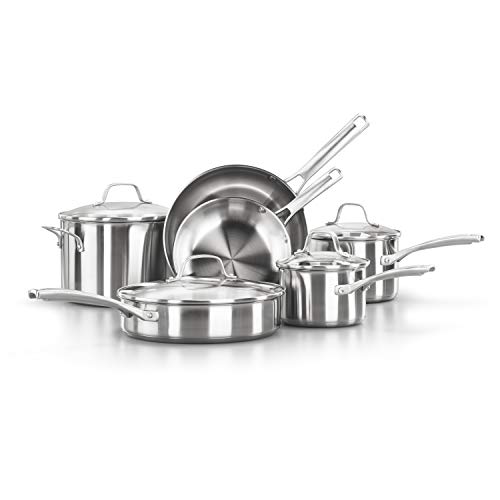
Calphalon Classic Stainless Steel Cookware Set
The Calphalon Classic stainless set represents the mainstream stainless promise in its most familiar form: uncoated cooking surfaces, a substantial feel in the hand, and pieces intended to stay in service for many years rather than a coating’s lifespan. It suits cooks who have made peace with preheating — giving a pan a minute on the heat, adding fat, and letting proteins release naturally once a crust forms — and who value being able to use high heat, deglaze with liquid, and move a pan toward the oven without consulting a coating limit first. Its honest costs are the stainless costs: more attention at the hob, more visible water marks, and a little more washing effort after eggs or cheese. As a set, its appeal is coherence — matched lids, matched handles, and a learning curve you climb once for the whole cupboard.
Value angle: ask what this set repays — years, evenings, or forgiveness — and whether that is the repayment your household needs. Position in this guide: mid-tier stainless steel, treated prose-only until its listing is verified, so compare it on the current Amazon listing before you buy rather than on any fixed detail printed here.
Best for: cooks whose habits match the mid-tier stainless steel format described above. Not suited for: cooks whose main jobs contradict that format’s heat, utensil or care rules.
Cuisinart Chef’s Classic Stainless Cookware Set
Cuisinart’s Chef’s Classic line is the other household name in mainstream stainless, and it earns its place in this cluster by offering the same uncoated durability proposition with its own take on shapes, rims and lid fit. Drip-friendly rims and lids that sit properly matter more in daily service than most buyers expect, because saucepans are pouring and simmering tools before they are anything else. Treat this set as a direct alternative to the Calphalon above rather than a step up or down from it: the decision between mainstream stainless sets usually comes down to which handles suit your grip, which piece mix matches your cooking, and which lids your cupboard stores best. Either way, the stainless rules apply in full — preheat with patience, dry after washing, and expect the pans to look more seasoned, not less capable, with age.
Value angle: ask what this set repays — years, evenings, or forgiveness — and whether that is the repayment your household needs. Position in this guide: mid-tier stainless steel, treated prose-only until its listing is verified, so compare it on the current Amazon listing before you buy rather than on any fixed detail printed here.
Best for: cooks whose habits match the mid-tier stainless steel format described above. Not suited for: cooks whose main jobs contradict that format’s heat, utensil or care rules.
Tramontina Tri-Ply Clad Stainless Steel Cookware Set
The Tramontina tri-ply set is the construction enthusiast’s mainstream pick: clad construction that carries the conductive core up the sidewalls, so the whole vessel — not just its base — takes part in heating. In practice that shows up as soups and sauces that warm more evenly, sidewalls that do not lag behind the base, and reductions that behave predictably. It is the set in this group most likely to satisfy a cook who notices hot spots, and it keeps every stainless advantage — high-heat searing, metal-utensil tolerance where the maker allows, and no coating clock ticking. The trade-offs are weight and attention: clad pieces feel more substantial than disc-base equivalents, and the surface still demands proper preheating for delicate foods. For buyers choosing one stainless set to keep for a long time, this is the construction story to understand before deciding.
Value angle: ask what this set repays — years, evenings, or forgiveness — and whether that is the repayment your household needs. Position in this guide: mid-tier tri-ply stainless steel, treated prose-only until its listing is verified, so compare it on the current Amazon listing before you buy rather than on any fixed detail printed here.
Best for: cooks whose habits match the mid-tier tri-ply stainless steel format described above. Not suited for: cooks whose main jobs contradict that format’s heat, utensil or care rules.

Rachael Ray Cucina Nonstick Cookware Set
The Rachael Ray Cucina set shows the personality side of mainstream nonstick: coated aluminium everyday pieces presented as a coordinated, colourful kitchen system rather than anonymous pans. Under the styling it obeys exactly the same physics as the T-fal above — quick-heating aluminium, a slick wearing surface, gentle-heat discipline — and it should be judged by the same standards of piece mix, lid fit and handle comfort. Where it earns its place is for buyers who want the nonstick format and care how the cupboard and hob look together, or who are buying a set as a gift for a new home where coordination matters. Its limits are the format’s limits, stated plainly: it is a low-to-medium-heat, soft-utensil set, and no colour palette changes that contract.
Value angle: ask what this set repays — years, evenings, or forgiveness — and whether that is the repayment your household needs. Position in this guide: entry-to-mid-tier nonstick, treated prose-only until its listing is verified, so compare it on the current Amazon listing before you buy rather than on any fixed detail printed here.
Best for: cooks whose habits match the entry-to-mid-tier nonstick format described above. Not suited for: cooks whose main jobs contradict that format’s heat, utensil or care rules.

GreenLife Soft Grip Ceramic Nonstick Cookware Set
The GreenLife Soft Grip set is this cluster’s ceramic nonstick representative: an aluminium body with a ceramic-style slick surface and comfort-shaped handles, pitched at buyers who want easy release with this coating family and a soft, secure grip in wet hands. Read it alongside the dedicated ceramic coverage on this site for the coating deep-dive, and judge it here as a general set: the piece mix covers the everyday core, the surface rewards low-to-medium heat and prompt, gentle washing, and the handles deserve a check against the manufacturer’s oven guidance before any hob-to-oven plans. Ceramic coatings are at their slickest early, so the value case rests on easy weeknight cooking now plus disciplined care — soft utensils, no empty high heat, protected stacking — to stretch that performance as far as it will go.
Value angle: ask what this set repays — years, evenings, or forgiveness — and whether that is the repayment your household needs. Position in this guide: entry-tier ceramic nonstick, treated prose-only until its listing is verified, so compare it on the current Amazon listing before you buy rather than on any fixed detail printed here.
Best for: cooks whose habits match the entry-tier ceramic nonstick format described above. Not suited for: cooks whose main jobs contradict that format’s heat, utensil or care rules.
How to Get the Most Value If You Buy
Value is protected after purchase by habits, not hope. Cook within the family’s heat contract — never an empty coated pan over high heat, handles always treated as hot, utensils matched to the surface as the manufacturer directs. Wash by material, as the companion guide details in full: how to clean a cookware set. Store with protection between coated surfaces. Replace per-piece as the set ages unevenly, rather than re-buying the system. And add specialists only on proven need — each addition justified by a repeated recipe is value compounding; each addition justified by a photograph is the cupboard filling with good intentions. A set treated this way repays its purchase in the currency it was bought in, for as long as its family’s shape allows.
Care is where a cookware set’s real lifespan is decided, and the rules are simpler than the internet makes them sound. Let pans cool before washing, because plunging a hot pan into cold water stresses any construction and can warp lighter bases over time. Wash coated pieces with a soft sponge and ordinary washing-up liquid, keep scouring pads and harsh abrasives for the stainless pieces whose manufacturers allow them, and dry stainless after washing if water marks bother you — they are cosmetic, not damage. Stacking is the silent coating killer in most cupboards: pans nested directly against each other scrape with every removal, so a cloth, a pan protector or simply a sheet of kitchen paper between coated surfaces preserves the finish for a trivial effort. Handles and lids deserve the same thirty seconds: check handle fixings occasionally, wash lids around their rims where grease gathers, and store lids where their edges will not chip against pot rims.
Hob compatibility is the one specification in a cookware set purchase that is not a matter of taste. Gas and conventional electric hobs accept almost any flat-based pan, but an induction hob only heats cookware whose base responds to a magnet, and not every stainless or coated set qualifies. The home test is simple and definitive: if a fridge magnet grips the base firmly, the piece is induction-ready; if it slides or barely holds, it is not. Manufacturers state induction compatibility in the product description, and that statement — not the material name alone — is what to trust, because some stainless constructions are magnetic and some are not. Glass and ceramic hobs add a second, gentler consideration: bases should be flat and smooth so they sit stable and do not drag grit across the surface, and heavy pieces should be lifted rather than slid. Buyers replacing a hob at the same time as a set should settle the hob question first, since it silently eliminates part of the set market.
The Decision Checklist
- Do I need three or more core vessels at once? If not, buy the single piece instead.
- Can I name my material family from my actual menu — searing-led or release-led?
- Have I counted usable vessels in the sets I am weighing, ignoring box numbers?
- Have I measured the storage space, lids on, and checked the largest pan against my burner?
- Is the set induction-ready if my hob needs it, per the manufacturer’s own statement?
- Do I accept this family’s lifespan shape — renewal for coatings, technique for stainless?
- Is there one adopted pan I already know will complete the system?
Four or more honest yeses, including the first two, and the set is worth it for your kitchen. A no on the first question ends the inquiry immediately — buy the piece. A no on the second postpones it profitably. The remaining questions convert a worth-it set into the right worth-it set, and they take less time than the returns process for skipping them. For the buying method itself, proceed to the cookware set buying guide; for the balanced ledger, cookware set pros and cons.
The Value of a Set Across Its Whole Life
A set’s worth is not a single moment at the till; it is a curve. In the equipping month the curve peaks, because every meal uses the coverage and coherence the purchase bought. Through the settled years the curve runs flat and quiet — the set disappears into the kitchen’s infrastructure, which is what success looks like for a tool — while its family charges its maintenance currency and the household pays it or does not. Late in the curve the families diverge visibly: the stainless set is still on its first plateau, cosmetically seasoned and functionally complete, while the coated set has renewed a piece or two and asks its owners to judge the easy years they received against the renewals they funded. Judged across the whole curve rather than at any single point, both shapes can clear the worth-it bar comfortably — which is why this article refuses to crown one, and why the checklist weights the household’s horizon so heavily. A buyer with a two-year horizon and a buyer furnishing a family kitchen for decades are not purchasing the same product, even when the box is identical.
Three Households, Three Answers
The renter who moves every few years
For the mobile household, permanence is worth little and lightness is worth much: pans travel, kitchens change shape, hobs alternate between gas and induction across tenancies. A lean coated set — or a compact stainless set confirmed induction-ready — earns its worth by flexibility rather than by decades, and the worth-it answer is a clear yes at the modest end of the market, with the checklist’s storage and hob questions doing most of the work. The renter should specifically resist the sprawling set: every unmeasured piece is a thing to pack, and the filler that merely annoyed a settled kitchen actively taxes a moving one.
The multigenerational family kitchen
Here the set must survive many hands, much volume and decades of memory, and its worth compounds in ways a solo kitchen never sees: children learn on it, its saucepans hold recipes that predate them, its replacement pieces are chosen by cooks who were not born when it arrived. Stainless’s permanence aligns with this household’s shape, glass lids help its youngest cooks, and handles must suit its oldest hands. The worth-it answer is yes at a considered tier, bought once and maintained as the family infrastructure it will become — the strongest version of the set’s case anywhere in this article.
The serious hobbyist cook
The hobbyist is the checklist’s hardest case, because their cooking is genuinely specialist-led and a general set risks becoming the understudy cupboard. The honest answer is conditional: worth it as a foundation if ordinary weeknight cooking still dominates the calendar — as it does even in most enthusiasts’ homes — and not worth it as the first purchase if the budget forces a choice between the set and the specialist instrument the hobby actually runs on. Many hobbyists resolve it in sequence: the specialist first, the set when weeknight friction proves its case. That ordering, reversed from the usual advice, is correct for this household precisely because their centre of gravity is known and unusual.
What Worth It Never Means
Worth it never means the largest box, the longest feature list or the set a more serious cook would buy. It never means permanence purchased for a household that moves, or forgiveness purchased for a household that sears. It is a match quality, not a product quality — which is why this article has spent its length on menus, hands, cupboards and horizons rather than on rankings. A reader who finishes the checklist honestly knows their answer with a confidence no star system could give them, and a reader whose answer is no has been served exactly as well as the reader whose answer is yes. That is the standard this verdict set for itself, and the companion guides exist to implement whichever answer the checklist returns.
The Second-Hand and Hand-Me-Down Test
A revealing way to price a set’s worth is to ask what it is worth to the next kitchen. A stainless set passes this test almost without loss: handed to a student, a sibling or a second home, it arrives as a complete working core whose only history is cosmetic, and households routinely report sets serving two kitchens across their lives. A coated set passes the test partially and honestly — its saucepans and stockpot hand down well, its hero frying pan hands down its remaining life rather than a fresh start — and that partial credit is still real value that a till receipt never shows. Purchases that survive their first kitchen carry a quiet dividend, and buyers furnishing a family home, where the next kitchen is often a child’s, may legitimately count it. The test also disciplines the original purchase: a set worth handing down is a set that was worth buying, and the reverse is a warning worth hearing before the box is opened.
When Worth It Arrives Late
Some sets are worth it immediately and some become worth it, and confusing the two timelines causes most of the regret in this category. Stainless sets are the classic late arrivals: bought for permanence, judged harshly in the technique weeks, and valued properly only when the household realises a year has passed without a single cookware thought. Coated sets are the classic immediate arrivals whose worth must be re-earned at each renewal, and households that understand the rhythm stay satisfied while households expecting the stainless timeline feel cheated by a product that kept its actual promise. The checklist in this article therefore asks about horizons twice, in different forms, because matching the timeline is matching the product. A set judged on its own timeline, by a household that chose that timeline knowingly, is the definition this whole article has been building toward: worth it, in full, with the evidence in.
Opportunity Cost: What the Same Commitment Buys Elsewhere
Worth-it questions are secretly comparisons, and the honest rival to a cookware set is rarely another set — it is the other things a kitchen budget and a cupboard can hold. The same commitment could buy two exceptional individual pans and leave the old saucepans in service; it could buy the specialist instrument a household’s signature dish keeps requesting; it could buy nothing at all this season, while a notebook on the counter records every moment the current pans failed a real meal. Each rival has a household where it wins outright, and naming them protects the set’s verdict from inflation: a set is worth it when it beats those rivals for your kitchen, not when it merely beats doing nothing in the abstract. The notebook rival deserves special respect, because it is free, it takes one season, and it converts the eventual purchase — set, separates or specialist — from an act of hope into an act of record. Households that keep it rarely ask whether their purchase was worth it afterwards, which is the surest sign the question was answered before the money moved.
Regret Patterns: What Owners Actually Wish They Had Done
The regrets in this category are so consistent they can be listed, and every one of them is preventable by the checklist in this article. Owners regret the padded set whose back half never cooked, and wish they had counted vessels instead of pieces. They regret the material chosen for the cook they admired rather than the cook who shows up on Tuesdays. They regret the unmeasured cupboard and the set that has lived in the oven ever since. They regret discovering induction incompatibility at the hob, with dinner waiting. And they regret, most quietly, the set bought to end deliberation rather than to serve a menu — the purchase that was really about stopping shopping. Against that list, the satisfied owners’ pattern is equally plain: they can name the dishes their set was bought for, they accepted its family’s terms in advance, and their one surprise has been how little they think about cookware now. That absence of thought, in the end, is what worth it feels like from the inside — and it is available on either material side of this category, to any household willing to answer seven honest questions first.
The Answer, Restated Without the Scaffolding
Strip away the profiles, the curves and the checklists, and the answer this article has built is short enough to carry into any shop. A cookware set is worth it when a kitchen needs a core, when the buyer can name the dishes that core will cook, and when the material’s terms — renewal for coatings, technique for stainless — are accepted as part of the purchase rather than discovered as its fine print. It is not worth it when the core already exists, when the dishes cannot be named, or when the terms would be resented, because a resented term is charged at every meal. Everything else — piece counts, constructions, lids, handles, horizons — is refinement of those three conditions, useful exactly in proportion to how honestly the three are answered. The reader who can answer them now does not need this article’s remaining paragraphs, and the reader who cannot has been given, in the checklist, the precise questions whose answers will finish the job. That is the whole of the matter, and it has been the whole of the matter since the first paragraph: worth follows fit, and fit is knowable before the box is opened.
The Verdict in One Paragraph
For readers who will act today: buy the set if three or more core vessels are genuinely needed, if your menu can name the material family it belongs to, and if you accept that family’s terms — renewal for coatings, technique for stainless — as part of the purchase. Buy the single piece instead if only one vessel is missing, and buy nothing yet if the material question is still unanswered, because a season of honest cooking answers it for free. Worth, in this category, is not found in the box; it is found in the match between the box and the kitchen, and the match is knowable tonight, at your own hob, with your own menu in front of you.
Cookware Set: The Break-Even Test: When the Purchase Pays Off
Start with how often a {p} must actually be used before it earns its counter or cupboard space. Most coverage of a cookware set concentrates on the first week of ownership, yet the decisions that matter most tend to surface later, once the cookware set has to earn its place in an ordinary weekday routine rather than a carefully staged first attempt. Write down the three jobs you expect it to do most often, in the order you actually do them, and judge every claim you read against that short personal list instead of against a generic ideal.
Maintenance decides how long the good results last. Set a simple rhythm: a quick wipe or rinse after each use, a deeper clean on a fixed day, and a periodic check of the parts that move, seal or bear weight. A cookware set that needs fiddly disassembly for basic care will be cleaned less often, and performance drifts long before anything actually breaks. Prefer designs where the parts that get dirtiest are the parts that are easiest to reach, and be honest with yourself about which cleaning steps you will genuinely keep up.
Finally, plan the first fortnight deliberately. Use the cookware set for one familiar job first, so you have a baseline you trust, then introduce the harder cases one at a time and note what changes. Small adjustments to arrangement, timing, quantity or preparation usually close most of the gap between disappointing first results and the performance the design is capable of. That short learning period is also the fairest test of the break-even calculation: if the routine has not settled by the end of it, the mismatch is real, and it is better to know while returning or exchanging is still straightforward.
Use a short decision checklist to finish. One, does it fit the space and the storage you really have. Two, does it handle your three most common jobs without a workaround. Three, do the edge cases you listed stay manageable. Four, can every wear part be cleaned or replaced without drama. Five, would you still choose it if a friend described the same drawbacks in their own kitchen. A cookware set that passes all five is a sound buy; one that fails two or more is a compromise you are choosing with open eyes, which is a very different thing from being surprised later.
Troubleshooting is easier when you expect the usual failure points. With any cookware set, the recurring problems tend to cluster in the same places: uneven results from overloading or poor arrangement, wear showing first on the parts handled most often, and small annoyances with lids, seals, handles, controls or fittings that only appear after repeated use. Before buying, look for whether those wear parts can be cleaned properly, replaced or worked around, and whether the instructions address them directly rather than pretending they never happen.
Measure before you commit. Note the footprint, the clearance above and behind the spot where the cookware set will live, and the route you will carry it by when it is hot, full or awkward. A cookware set that technically fits but blocks a cupboard door, crowds a neighbouring appliance or has to be dragged across a worktop every time will quietly fall out of use, whatever its merits on paper. In the Kitchen Cookware category especially, a few centimetres of clearance and a sensible storage plan separate a daily tool from a bulky regret.
Work through a realistic scenario, not a best case. Picture the busiest version of the job: more people to serve, less time than planned, ingredients or materials that are slightly out of the ordinary, and a clean-up waiting at the end. Ask how the cookware set behaves at that upper edge, because a model that only shines on a small, simple load will disappoint precisely when you need it most. If the honest answer is that you would split the job into batches or fall back on an older method, factor that into the decision now rather than discovering it later.
Edge cases deserve a deliberate pass. Think about the odd shapes, the thicker or thinner than usual loads, the leftovers, the second helping and the guest with different preferences. A well-chosen cookware set handles the exceptions gracefully, or at least predictably, while a poor match turns every exception into a workaround. List your two or three most common exceptions in advance and check, from the manual or the listing details, that nothing about them is ruled out by size, shape, material or care requirements.
When you check listings such as T-fal Signature Nonstick Cookware Set, Calphalon Classic Stainless Steel Cookware Set and Cuisinart Chef’s Classic Stainless Cookware Set, use them as worked examples: run through the same checks below on each one in turn, so the comparison stays honest and like for like rather than based on whichever listing happens to shout loudest.
Frequently Asked Questions
Is a cookware set cheaper than buying pans separately?
For equipping a whole core at once, a set is generally the more coherent purchase, with matched lids and storage designed in. Separates can make more sense when only one or two vessels are needed, or when each job genuinely wants a different material. Prices move constantly, so compare the current listings of the specific set against the specific pieces you would otherwise buy, and count usable vessels on both sides of the comparison — that count, not the box number, is where set value hides or leaks.
How long before a cookware set pays for itself?
In use rather than in currency: a set pays from its first week if it equips an empty or worn-out kitchen, because every meal uses its coverage and coherence. The longer accounting depends on family — stainless spreads its value across many years of service, coated sets concentrate theirs in effortless early years. A set that duplicates a working core, by contrast, may never pay at all, which is why the first checklist question — do I need three or more vessels now — carries the whole verdict.
Is a stainless cookware set worth it over a nonstick one?
For searing-led cooking and long horizons, yes: stainless repays through years of unrestricted heat and no surface renewal. For release-led cooking and busy households, the nonstick set’s nightly ease can be worth more than stainless’s longevity, even accepting renewal. The comparison is developed head-to-head in cookware set versus stainless steel cookware set and cookware set versus nonstick cookware set, and the honest answer always starts from your menu.
What size of cookware set is worth buying?
The size that covers your core with named uses: typically two frying pans, two lidded saucepans and one large lidded pot, plus only those extras your cooking can describe a weekly job for. Bigger counts mostly add lids, duplicates and bundled utensils. A leaner set plus one deliberate addition — a specialist or an adopted pan of the other family — is worth more in most kitchens than a sprawling set whose back half never leaves the cupboard.
Should I buy a cookware set as a gift?
A set is one of the few complete, intelligible kitchen gifts, and for a new home it lands exactly at the equipping moment where sets are worth most. Choose the forgiving coated families for new cooks, confirm the recipient’s hob type if you can — induction above all — and prefer the lean, well-shaped set over the padded one. A set chosen by the recipient’s actual cooking, rather than by the size of its box, is remembered at every meal it serves.
Can one cookware set really cover all my cooking?
For most households, a well-chosen general set covers the large majority of hob cooking: frying, simmering, boiling, reheating and gentle braising across the core shapes. What it does not replace are true specialists — a wok’s geometry for high-heat tossing, a heavy Dutch oven’s mass for long braises, or a cast iron skillet’s searing reserve. The practical approach is a general set as the foundation, bought for the meals you cook weekly, plus one or two specialists added later only when a repeated recipe proves the need. That sequence spends money in the order your cooking actually demands it.


