Disclosure: As an Amazon Associate, topratedkitchenware.com earns from qualifying purchases. Links on this page are affiliate links; they cost you nothing extra. Prices and availability change often, so check the current Amazon listing before you buy.
Weighing up electric kettle pros and cons sounds like a small task until you live with the wrong kettle for a year. The everyday electric kettle — a cordless jug on a powered base, built to boil water fast and switch itself off — is one of the most-used appliances in most kitchens, which means its advantages compound daily and its disadvantages annoy daily. This is not the gooseneck kettle of pour-over coffee ceremony; this is the household workhorse for tea, coffee, noodles, and cooking shortcuts, and it deserves an honest balance sheet rather than a sales pitch.
The quick verdict: the pros win comfortably for any household that boils water more than a couple of times a day, because speed, safety shut-off, and walk-away convenience are advantages you collect at every single use. The cons are real but manageable: limescale upkeep, counter space, boiling noise, and the fact that a kettle full of just-boiled water is a genuine scald hazard that demands respect. The kettle suits drinkers, families, offices, and cooks who pre-boil water for pans. It does not suit the rare household that boils water once a week, where a stovetop pan already does the job and a counter appliance would mostly gather dust.
Key Takeaways
- The biggest pro is not raw speed but unattended speed: fill it, switch it on, and walk away while it boils and stops itself.
- The biggest con is upkeep: limescale builds quietly, slows the boil, and dulls taste until you descale on a regular rhythm.
- Safety cuts both ways — automatic shut-off and boil-dry protection make the appliance safer than a forgotten stovetop pan, while the jug itself carries a full load of scalding water and steam.
- Material decides which cons you live with: glass shows scale and weight, steel hides scale and runs hot outside, plastic ages fastest but stays light and cool.
- Most cons shrink dramatically with three habits: fill between the marks, descale on schedule, and keep the powered base dry.
The Pros
Speed You Do Not Have to Supervise
The headline advantage of an electric kettle is pace, but the deeper advantage is that the pace needs none of your attention. A stovetop kettle or a pan demands that someone notice the boil, turn off the heat, and remember the water while it is still hot. An electric kettle boils, clicks off, and waits. In a real kitchen that difference is worth more than the minutes themselves: you can dress a child, answer the door, finish an email, or prep the mugs and the tea while the water handles itself. Multiply that small freedom by several boils a day, every day, and the appliance has quietly returned hours of fragmented attention to the household within its first year.
Consistent, Repeatable Results
An electric kettle delivers the same rolling boil, at the same point, in the same way, every time, and temperature-control models extend that consistency to cooler settings for delicate teas. Human judgement with a stovetop is variable: water caught too early tastes flat in tea, water boiled and reboiled tastes tired. The kettle removes that variance. For households that care about how their drinks taste — and for anyone making formula-adjacent preparations, hot drinks for guests, or a cafetière they want to taste the same on Friday as on Monday — that repeatability is a genuine quality-of-life pro, not a gimmick.
Safety Systems a Pan Cannot Offer
Automatic shut-off and boil-dry protection are unglamorous and invaluable. A pan boiled dry on a hob is a damaged pan, a smoke-filled kitchen, and in the worst case a fire risk; an electric kettle switched on empty or forgotten simply cuts its own power. The cordless jug also removes the trailing flex across a hot hob that stovetop kettles sometimes involve, and the powered base stays in one fixed, known place rather than living on a burner. None of this makes boiling water safe in any absolute sense — the cons section is blunt about scalds — but the appliance’s built-in cut-outs remove the two most common ways a boiling vessel gets forgotten into danger.
Energy and Water Efficiency in Daily Use
A kettle heats only the water in the jug, with the element in direct contact with its task, instead of heating a hob ring, a pan, and the air around both. Households that boil roughly what they need — and a clear water gauge makes that easy to judge — waste less energy and less water than the stovetop habit of filling a big pan just in case. The efficiency pro depends on the user, admittedly: a kettle habitually overfilled and reboiled squanders its advantage. But the design at least makes the efficient behaviour the easy behaviour, which is the right way round.
Versatility Far Beyond Tea
Judged only as a tea tool, the kettle already earns its place in most homes, but its real value shows in the supporting roles. Pre-boiled kettle water starts pasta, rice, and vegetable pans dramatically faster than cold water on the hob. It fills hot water bottles, makes instant soups, noodles, couscous, and oatmeal, warms bottles in a bowl, loosens lids, and supplies the hot water for a dozen small cleaning tasks. Each use is minor; together they mean the kettle works for the household many times a day in ways a single-purpose appliance never could, which is why it so often becomes the last appliance anyone would give up.
Easy to Use for Almost Everyone
There is no learning curve to an electric kettle: fill, click, pour. That simplicity matters in households spanning generations. A grandparent does not need instructions, a teenager making noodles after school cannot really misuse the controls, and a guest can make their own tea without a tour of the kitchen. Lids that open at a button, gauges you can read at a glance, and a jug that lifts off its base from any angle make the appliance accessible to people with limited grip or eyesight in a way that a heavy stovetop kettle on a lit burner is not. Ease of use is a soft pro that hardens into a decisive one in real family life.
Low Cost of Entry and of Ownership
Without naming figures, the category’s tiers are forgiving: the entry tier costs little in the landscape of kitchen appliances, the mid tier buys noticeably better build for a modest step up, and there are no consumables, filters, pods, or subscriptions attached to ownership. The running costs are electricity for the boils you actually make and an occasional descale with simple household solutions. Few appliances offer a lower total burden for this much daily service, and the comparison in our electric kettle buying guide shows how the tiers divide. That value picture is a large part of why the verdict in is an electric kettle worth it lands where it does.
In this guide
The Cons
Limescale Is a Permanent Housemate
Every electric kettle that boils hard water grows limescale; the only choice is whether you manage it or it manages you. Scale coats the floor and element, lengthens the boil, makes the kettle louder, flakes into drinks, and dulls the taste of delicate teas. Left long enough it can shorten the appliance’s life. The upkeep itself is simple — the routine in how to clean an electric kettle takes a few unattended minutes — but it is undeniably a chore that a stovetop pan spreads less visibly. Households in very hard-water areas feel this con most, and glass owners see it most, since the clear wall displays every chalky tide mark.
Counter Space and Another Cord
A kettle and its powered base claim a permanent patch of counter and a socket, and in a small kitchen both are contested resources. The appliance cannot be stored in a cupboard with any convenience, because an appliance that must be fetched and assembled gets used less, and a kettle earns its keep precisely by always being ready. For renters with tiny worktops, or kitchens already hosting a coffee machine, toaster, and microwave, adding a kettle means something else loses its spot. This con is trivial in a large kitchen and decisive in a small one, which is why compact models exist and why honest measurement of your counter should precede any purchase.
Boiling Water Is a Real Hazard
Balance requires bluntness here. A full kettle carries enough just-boiled water to cause a serious scald, and the steam from its spout and freshly opened lid burns invisibly and instantly. Children pulling a cord, a jug knocked at a crowded counter, a careless overfill that spits boiling water from the spout as it boils: these are the category’s real-world risks, and no shut-off feature prevents them. The mitigation is behaviour — fill between the marks, keep the kettle back from edges, route cords out of reach, pour with the lid closed and your face and free hand clear of the steam path — but a household unwilling to build those habits around small children should weigh this con seriously and consider placement before purchase.
Noise at the Wrong Hours
A kettle approaching a rolling boil is loud, and some designs — thin steel and many glass jugs — broadcast that rumble further than others. In a studio flat, an open-plan home with a sleeping baby, or a house where the first riser boils water at an hour when everyone else is asleep, the noise is a daily friction rather than a footnote. It lasts only while the boil builds, and most households simply absorb it, but light sleepers and shift workers should know that quietness varies between models and that insulated, double-wall designs exist partly for this reason. No kettle is silent; the con is a matter of degree and of household rhythm.
One Job, Done Only With Electricity
The electric kettle is a single-purpose appliance that works only where its powered base and a socket are. It cannot help in a power cut, on a camping trip, or at a holiday cottage with a temperamental fuse, and it will not brown, bake, or do anything except boil water brilliantly. Households that prize multi-purpose tools, or that already own a stovetop kettle they love and use on a range that is always warm, may find the electric version redundant. The counter-argument is that single-purpose tools used constantly beat multi-purpose tools used rarely — but the con stands for the minimalists and the power-cut realists.
Materials Age in Different, Visible Ways
Each body material carries its own ageing con. Plastic can stain, absorb odours over a long life, and look tired sooner than it stops working. Glass shows every fingerprint and scale mark and can be chipped or cracked by one hard knock against a tap or worktop edge. Steel can dent, its exterior can mark, and on some designs the outside runs hot enough to be its own minor hazard. None of these is a reason to avoid the category, but buyers should choose the ageing pattern they mind least rather than imagining any material stays new. The detailed comparison sits inside the electric kettle buying guide’s material section, and the tea-focused alternatives in the best electric kettles for tea show how the materials divide in practice.
Temperature Control Can Be a Paying-for-Nothing Extra
The final con belongs to the premium tier rather than the appliance itself. Presets and keep-warm functions add cost, buttons, and complexity that a black-tea-and-coffee household will never use, and a complicated kettle bought for features that gather dust is a worse purchase than a simple kettle bought well. The con cuts the other way for green tea drinkers, for whom presets are the product. But as a general warning it belongs on the balance sheet: the category’s most common waste of money is not buying too cheap, it is buying features your drinks do not need.
What the Trade-Offs Mean for You
For a family kitchen, the pros dominate almost completely. The kettle will boil constantly, the supervision-free speed returns real time, and the cons reduce to a descaling rhythm and sensible placement away from small hands. Choose capacity and durability, accept the noise, and the balance is not close. For a tea enthusiast, the balance depends on range: a household drinking only black tea gets the standard pros with a simple jug, while a household drinking green and white teas gains the consistency pro in its strongest form from a temperature-control model, at the price of the premium-tier con described above.
For a solo renter in a small flat, the trade-offs tighten. The pros of speed and convenience remain, but the counter-space con grows teeth and the capacity of family models is wasted. A compact kettle resolves most of the tension, and the remaining question — whether a kettle earns a permanent spot over a simple pan — is answered by frequency: boil daily and it does, boil weekly and it may not. For an office or shared workspace, the pros of guest-proof simplicity and shut-off safety are decisive, the cons of noise and scale are shared problems that a simple rota solves, and a mid-tier steel jug is usually the sweet spot. For an older person living alone, the ease-of-use pro and the boil-dry safety pro weigh heavily in favour, provided the jug is light when full and the kettle lives within easy, uncluttered reach.
How the Kettle Compares With the Alternatives
| Option | Strengths | Trade-offs |
|---|---|---|
| Everyday electric kettle | Fast, self-switching, portable between counters, consistent boil | Needs a socket and counter space; scale upkeep; scald hazard like any boiling vessel |
| Stovetop kettle | Works in power cuts and on any heat source; no electrics to fail; classic ritual | Must be watched; slower to the boil on most hobs; no automatic shut-off or boil-dry protection |
| Microwave mug of water | No extra appliance; fine for a single occasional mug | Uneven heating, superheating risk in smooth cups, no good for rounds of drinks or cooking water |
| Gooseneck kettle | Precision pouring for pour-over coffee | A specialist tool; slower, smaller pours are a drawback for family rounds and pan-filling |
The table clarifies the kettle’s niche: it is the best tool ever made for the specific job of boiling water in a home, repeatedly, safely, and without supervision. The stovetop kettle remains the romantic and resilient alternative, and the one to keep for power cuts if your household worries about them. The microwave is a mug-at-a-time improvisation, not a system. The gooseneck is a different instrument for a different drink, compared properly in the best gooseneck kettles for pour-over coffee, and it should not be allowed to confuse an everyday buying decision.
How to Buy Smart if the Pros Win
If the balance lands in favour, buy against the cons deliberately. Choose the material whose ageing you mind least. Choose capacity for your largest regular job and check the minimum fill suits your smallest. Insist on the safety basics — automatic shut-off, boil-dry protection, a lid that closes firmly, a stable base — and treat a clear gauge and a wide cleaning opening as near-essentials. The six reference models below span the sensible options; each is prose-only here, in qualitative tiers, with the current listing left for you to check.

COSORI Electric Kettle
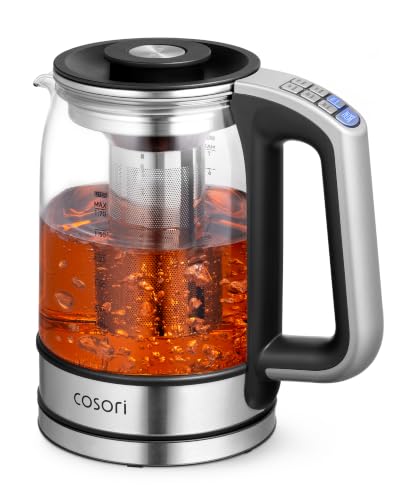
The glass all-rounder: visible level and scale, a wide mouth that makes the descale chore as painless as it gets, and simple controls. It answers the upkeep con by making upkeep easy. Best for: mixed households. Not suited for: rough handling. Tier: mid. Check price on Amazon.
Cuisinart PerfecTemp Kettle
The control option: presets that turn the consistency pro up to its maximum for varied tea drinkers, with a keep-warm hold. It is also the clearest example of the premium-tier con if your drinks never leave boiling point. Best for: multi-tea households. Not suited for: boil-only drinkers. Tier: premium. Check price on Amazon.

Hamilton Beach Electric Kettle
The throughput option: a generous steel jug for households whose boil count is high and whose patience for delicate appliances is low. Steel hides scale, so its owners must descale by the calendar. Best for: families and shared houses. Not suited for: solo drinkers. Tier: mid. Check price on Amazon.

Amazon Basics Kettle
The entry option: light, simple, and honest about what it is. It carries the plastic ageing con in its mildest, most acceptable form — as a starter appliance rather than a heirloom. Best for: first flats, dorms, spare duty. Not suited for: buyers wanting a decade of service. Tier: entry. Check price on Amazon.
Ovente Glass Kettle
The display option: glass that makes the water itself part of the kitchen’s small pleasures, with the visibility con-and-pro that glass always brings — you see the scale early, and you must handle the jug kindly. Best for: ritual tea drinkers. Not suited for: crowded, knock-prone counters. Tier: entry to mid. Check price on Amazon.

Mueller Electric Kettle
The compact steel option: the counter-space con answered with a smaller footprint and steel’s durability kept. Best for: small flats and couples. Not suited for: entertainers and big families. Tier: entry to mid. Check price on Amazon. The full reasoning behind each pick sits in our electric kettle review and the roundup in electric kettle reviews.
Setup and Care That Reduce the Cons
Most of the cons above shrink under three habits and one placement decision. The placement decision: give the kettle a permanent home back from the counter edge, on a dry stretch of worktop, with its cord routed so nothing can snag it, and keep the powered base away from the sink’s splash zone, because the base is electrical and must stay dry. Habit one: fill between the minimum and maximum marks every time — the maximum is a safety line against boiling water spitting from the spout, and the minimum protects the element. Habit two: descale on a schedule matched to your water, using the simple routine in how to clean an electric kettle, rather than waiting for the boil to slow and the taste to dull. Habit three: pour with the lid closed, open the lid away from your face afterwards, and keep hands clear of the steam path, because steam scalds as surely as the water does.
Two smaller habits help as well. Empty and refill with fresh water for the first drinks of the day, since water boiled repeatedly tastes tired and adds to scale. And wipe the jug’s exterior with a damp cloth only — never immerse the jug or its base in water, and never rinse the base under a tap. Follow those rules and the con list contracts to its irreducible core: the appliance takes some counter, makes some noise, and must be descaled. For most households that is a small rent for a large daily service.
How the Balance Shifts Over Time
The pros and cons of a kettle are not static across its life, and an honest balance sheet should say so. In the first months, the pros are at their loudest: the speed delights, the pour is clean, the glass or steel is unmarked, and the household wonders how it managed without one. The cons in this honeymoon are mostly the small ones — finding the counter spot, learning the gauge, remembering that the outside of a steel jug runs hot. Owners who descale on schedule barely meet the upkeep con at all in this period, because early scale is thin scale and a young kettle returns to full speed after a single simple routine.
In the middle years, the balance depends almost entirely on habits. A kettle that has been filled between the marks, kept on a dry base, and descaled by the calendar behaves nearly as it did when new, and its pros continue to compound quietly. A neglected kettle tells the opposite story: the boil slows and grows louder as scale insulates the floor, the taste of tea roughens, the lid and switch accumulate the wear of a thousand small violences, and the owner begins to blame the category for faults that belong to the care routine. This is the stage where the difference between materials also declares itself — plastic looking tired, glass either sparkling or visibly chalked depending on its owner, steel carrying its dents with a kind of dignity.
Late in a kettle’s life, the cons that finally matter are mechanical: a switch that no longer clicks with certainty, a lid hinge that loosens, a base contact that grows temperamental. These are the honest end-of-life signals, and they are also a safety matter, because a kettle whose shut-off behaviour you no longer trust should be retired rather than nursed. The encouraging truth is how long the good middle can be stretched by the three habits this article keeps returning to. Descale on schedule, fill between the marks, keep the electrics dry, and the pros of an electric kettle will outlast several changes of kitchen fashion around it. When replacement day does come, the household usually replaces like with like within the week — which may be the most eloquent verdict on the balance sheet of all.
Pros and Cons for Particular People
For parents of young children, the ledger has a distinctive shape. The pros include speed at the exact moments speed matters — warming, sterilising-adjacent hot water tasks, and the endless small drinks of a household running on broken sleep — plus a shut-off that forgives exhaustion. The cons concentrate in one place: access. A kettle must live where small hands and dangling cords cannot reach it, and the household must treat its counter spot as a stove zone, not a storage zone. Parents who can guarantee that placement get an strongly positive balance; those in kitchens where toddlers roam the worktops by climbing should think harder, and pour-over-the-sink habits and back-of-counter placement become part of the purchase decision itself.
For people who live alone, the balance is quieter but still positive in most cases. The supervision-free boil suits a life where nobody else is watching the kitchen, the versatility supports simple cooking, and the running burden is minimal. The counter-space con is the main counterweight, joined by a subtler one: a large kettle boiled for one mug is a small daily waste, so solo buyers should weight the compact end of the range heavily and let capacity follow their real habit rather than their occasional guests. For students and first-flat renters, the entry tier’s combination of low commitment and high daily usefulness is hard to beat, and the kettle is often the first appliance bought and the last one regretted. For keen cooks, finally, the kettle’s pro is speed in service of other dishes — pans started at a rolling boil, grains and noodles hydrated instantly — and its con is merely that it competes for the same sockets as the rest of a busy cooking session. In a cook’s kitchen the kettle is not a drinks accessory at all; it is part of the stove team, and it earns its place accordingly.
The Environmental Ledger
A complete balance sheet should include the costs that never appear on a listing. On the debit side, an electric kettle is a manufactured appliance with a finite life, and the cheapest models, replaced often, carry the heaviest footprint per year of service; a kettle boiled dry repeatedly, scaled into inefficiency, or discarded at the first tired switch is waste in both money and materials. There is also the small, real cost of standby habits in some designs and of water heated and never used, multiplied across millions of kitchens into something that matters. None of this is an argument against the appliance; it is an argument for buying once, at the tier your household will actually keep, and for maintaining what you buy.
On the credit side, the kettle is one of the more efficient ways to heat water in a home, because it heats a small, enclosed volume directly and stops at the boil instead of warming a hob, a pan, and the kitchen air. Used with a gauge and honest filling, it discourages the large, speculative boils that waste both water and power. A mid-tier kettle kept for many years, descaled rather than replaced when its boil slows, is a genuinely modest environmental citizen by appliance standards. The environmental pro and con therefore point to the same behaviour as the financial ones: buy the kettle you will keep, fill it with what you need, and descale it instead of replacing it. Sustainability in this category is not a feature to purchase; it is a habit the right purchase makes easy.
What Owners Usually Get Wrong
Ask people who dislike their kettle what went wrong and the same stories recur, which makes them useful as a checklist of avoidable cons. The first story is the dribble: a spout that pours beautifully in the shop’s empty jug and trails water down the side when full and heavy, solved only by slowing the pour to a patience-testing trickle. The second is the lid: a button that needs a thumb and a prayer, or a lid that springs open and spits steam and droplets when the kettle is carried. The third is the gauge hidden behind the handle, readable only by rotating the jug under a light. The fourth is scale blindness in a steel kettle, discovered only when the boil has slowed beyond ignoring. The fifth is the overfill habit, marked by a kettle that spits at the boil and a worktop that is always wet beneath the spout.
Every one of these is a con of a particular example or a particular habit, not of the category, and that distinction is the practical heart of this whole article. The category-level cons — counter space, noise, the scald hazard inherent in boiling water, the need for electricity — are fixed and knowable before you buy. The example-level cons are avoidable by choosing a design with a clean pour, a positive lid, a readable gauge, and a mouth wide enough to descale without a struggle, then holding up your side of the bargain. Read the per-model notes in electric kettle reviews with these five stories in mind and you will hear them echo exactly where they should, in the details of each design rather than in surprises after purchase.
Noise, Speed and the Numbers Game
Two apparent cons deserve a cooler examination than they usually get, because both are routinely exaggerated. Noise first. Yes, a kettle approaching the boil is loud, and yes, designs differ — but the noise lasts for the short climb to boiling and then stops entirely, which makes it a different species of annoyance from a humming fridge or a rattling extractor. Most households adapt within a week and thereafter hear the noise as information: the kettle is nearly ready. The households for whom it remains a genuine con are those boiling beside sleeping babies, thin walls, or night-shift sleepers, and for them the insulated designs exist and the timing of boils can be planned. Speed second. The differences between reputable kettles are real in a stopwatch test and trivial in a kitchen, where the water is ready before the mugs are regardless. Buyers who choose a kettle chiefly for a headline boil time are optimising the one variable they will never perceive, while the pour, the lid, and the gauge — the variables they will perceive several times a day — go unexamined. Neither noise nor speed should lead a buying decision, and a balance sheet that places them beside scalds and scale, as this one does, should also record that they are the lightest items on it.
What the Warranty and the Maker Tell You
A quieter signal in the pros-and-cons ledger is how a maker stands behind the appliance. A kettle is a heating element, a thermostat, a switch, and a lid, cycled several times a day in the presence of water and steam; the parts that fail are known, and a maker who offers a clear, reachable warranty and publishes honest care instructions is telling you they expect the kettle to live long enough for the question to matter. This is not a call to buy paperwork over product. It is a recognition that at the entry tier especially, where build margins are thinnest, the maker’s attitude is data. The counterweight, honestly recorded, is that a long warranty on a badly fitting kettle is worthless: a family jug with a five-year promise is still the wrong kettle for a solo flat. Fit first, then the maker’s standing, then the finish — in that order the pros and cons of any particular model resolve themselves with very little mystery left.
The Second-Hand and Hand-Me-Down Question
Kettles pass between households more than most appliances — students inherit them, spare rooms receive them, offices absorb them — so the balance sheet should address the used kettle honestly. The pros transfer well: a sound mid-tier kettle has years of boils in it, its virtues are undimmed by a previous owner, and taking one on costs the household nothing but a descale. The cons concentrate in hygiene and in the unknown. A used kettle should be descaled thoroughly and given several discarded rinse boils before its first drink, its spout filter rinsed or the spout brushed, and its shut-off tested deliberately: fill it, boil it, and confirm it switches itself off and behaves. A kettle that fails that test, or whose lid no longer closes firmly, or whose base contacts look damaged, should be retired rather than inherited, because the safety systems are the product. Judged that way, the hand-me-down kettle is one of the category’s quiet virtues — few appliances pass between owners this gracefully — provided the new owner spends one descale and one honest inspection on the transfer.
Electric Kettle Pros and Cons for Children, Guests and Borrowed Kettles
Three situations test the balance sheet in ways daily ownership does not. Children first: the kettle’s pros include a simplicity a supervised older child can genuinely use, and its cons include a hazard a younger child must simply never reach, so the household’s answer is placement and rules rather than a different appliance — back of the counter, cord short and routed, and the kettle’s spot treated as part of the stove’s territory. Guests second: a kettle is the one appliance a visitor can be trusted with unaided, which is a pro that hosts feel at every gathering, provided the jug is not filled past its mark by a helpful stranger — a risk the clear gauge quietly insures against. Borrowed and holiday kettles third: the strange kettle in a rented cottage concentrates every con in this article — unknown scale, an unfamiliar pour, a lid with its own ideas — and the traveller’s defence is the same trio of habits, applied with extra care for the first boil. None of these situations overturns the ledger; they simply remind us that a kettle’s pros are engineered, while its cons are mostly negotiated, household by household and morning by morning.
The Verdict in One Household at a Time
If this balance sheet has a single lesson, it is that the electric kettle’s pros and cons refuse to be weighed in the abstract. The same glass jug is a pleasure in a calm kitchen and a liability in a crowded one; the same family capacity is freedom at breakfast for six and dead weight for one; the same preset panel is the whole point for the green-tea drinker and pure decoration for the coffee household. That is why the honest articles in this cluster keep returning to the reader’s own shelves, counters, and mornings rather than to a universal score. Weigh your household, not the category, and the kettle’s ledger will balance itself in front of you with unusual clarity.
One More Consideration: The Kettle as a Gift and a First Appliance
Kettles are given constantly — to students leaving home, to couples setting up a first kitchen, to parents whose old jug has finally tired — and the gift lens rearranges this article’s priorities in an instructive way. For a gift, the entry and mid tiers are the honest territory: the Amazon Basics kettle for the student whose needs are real but simple, the COSORI for the new household that will boil daily for years, the Mueller for the small first flat. The PerfecTemp is a gift only for a known tea enthusiast, because a flagship given to a boil-only drinker is generosity misaddressed. What the gift cases confirm, from an angle reviews rarely take, is that this category’s worth is unusually legible: you can know, from a person’s mornings alone, whether a kettle will be used daily or gather dust, and choose accordingly with a confidence few other appliances permit.
Bottom Line
The electric kettle’s pros are structural — speed without supervision, consistency, built-in cut-outs, versatility, and near-zero learning curve — while its cons are mostly behavioural, shrinking under ordinary care and sensible placement. That asymmetry is why the appliance has become a default in modern kitchens. The households for whom the cons genuinely win are the very occasional boilers, the extremely space-poor, and those who simply prefer the stovetop ritual. Everyone else should buy a kettle matched to their drinks and their counter, keep it descaled, respect the water it boils, and enjoy one of the few appliances that gives back time every single day. If you want the shortlist view before deciding, start with the best electric kettle guide and how to choose an electric kettle.
The One-Week Diary: Stress-Testing the Electric kettle Trade-Offs
Treat this diary as the practical sequel to the ledger above: for one ordinary week, note each time the electric kettle delights you and each time it irritates you, in the moment rather than from memory at the end. Record the jobs where the advantages felt largest, because a strength that only appears on tasks you rarely do is worth less than the summary tables suggest. Record the irritations with equal honesty, and mark whether each one came from the product itself, from your space, or from a habit you could change once and forget. Pay attention to the setup and put-away minutes, since trade-offs that look trivial on paper become the deciding factor when they repeat twice a day for years.
Note who else used the electric kettle during the week and what they struggled with, because a drawback that only affects the most patient person in the house is easy to underestimate. Watch for the workaround you invent by day three, and judge it fairly: a painless workaround retires a con, while a fiddly one confirms it. Where a shortlist names specific examples, such as COSORI Electric Kettle, run these same checks against that listing line by line rather than assuming the general verdict transfers unchanged. Apply the identical test to Cuisinart PerfecTemp Kettle as well, on the same day and under the same conditions, because a fair comparison needs one ruler rather than two moods.
- Log delights and irritations as they happen
- Time the setup and the put-away honestly
- Test the worst job, not the easiest one
- Note the workaround you invent by day three
- Ask a second user for their verdict
- Write the sentence you would tell a friend
If Hamilton Beach Electric Kettle is also in contention, give it the same worksheet and let the three sets of answers sit side by side before anyone reaches for a checkout button. Test the loudest, messiest, or slowest mode at the time of day you would actually use it, not at a forgiving hour chosen to make the product look good. Check the cleaning burden after the worst realistic job rather than the easiest one, since the honest version of that chore is the one you will live with. Notice whether the headline strength survives ordinary ingredients, ordinary timing, and an ordinary tired evening, because strengths that need perfect conditions are narrower than they appear.
Write down any benefit you had not expected, since unlisted advantages discovered in use are often the ones that keep a product in the house for a decade. Write down any drawback that no review mentioned, and consider whether it is specific to your space, your water, your power supply, or your household size. Compare the week against the tool or appliance the electric kettle replaced, task by task, instead of against an idealised version of what ownership would feel like. Ask whether the cons cluster at the start of each session, in the middle of the work, or in the cleanup, because that pattern tells you whether habit can fix them.
Decide which single con you would pay to remove and which single pro you would refuse to give up, since that pair of answers is the real verdict of the week. If the diary shows the balance tilting on one recurring job, re-read the sections above with that job in mind rather than averaging your impressions across everything. Finish the week by writing the sentence you would say to a friend who asked about the electric kettle, and check whether it sounds like the summary you believed before the diary began. Keep the diary somewhere you will find it before a future replacement decision, because your own recorded week outweighs any general verdict, including the ones in this guide.
Notice, too, whether your standards moved during the week: some apparent cons are simply the feeling of a new routine replacing an old one, and they fade on their own. Mark the moment you stopped thinking about the trade-offs and just got on with the task at hand, because that moment is when the balance quietly settled itself. If no such moment arrived, that absence is data as well, and it usually points at one specific friction worth naming precisely rather than blaming the whole product. Whatever the category, photograph your intended spot with the neighbouring items in place, because a picture exposes crowding that measurements alone politely ignore.
Keep every measurement, tally, and note from these checks in one place, ideally with the receipt, so the next decision in this category starts from your evidence rather than from scratch. Involve the household early where the product is shared, since a decision everyone helped measure is a decision nobody relitigates at the first inconvenience. Prefer the option that fits your existing routine with the fewest new habits, because each new habit is a small tax collected every single day. Be wary of solving a storage problem by creating a carrying problem, since distance between storage and use is where good equipment goes to be forgotten.
Frequently Asked Questions
What is the biggest advantage of an electric kettle?
Unattended speed. Any method can eventually boil water, but only the electric kettle boils it quickly, switches itself off at the boil, and waits safely while you do something else. That combination of pace and freedom is what households actually feel every day, and it is why the appliance survives every kitchen clear-out. The shut-off also removes the forgotten-pan scenario, which makes the speed safer than the stovetop equivalent rather than merely faster.
What is the biggest disadvantage of an electric kettle?
Limescale upkeep, for most owners. Scale is unavoidable in hard-water areas, and it quietly taxes the appliance — slower boils, more noise, duller taste — until it is removed. The saving grace is that descaling is cheap, simple, and infrequent enough to schedule. The more serious disadvantage, a full jug of scalding water, is managed by placement and pouring habits rather than maintenance, and it is shared by every method of boiling water at home.
Is an electric kettle safer than a stovetop kettle?
In the ways that cause most accidents, yes: it switches itself off, protects itself against boiling dry, and never sits on a lit burner with a handle over the heat. In one way it is equal: the water inside is exactly as hot and exactly as dangerous in a spill or a splash. The fair summary is that the electric kettle removes the forgetfulness risks of the stovetop while keeping the scald risk that belongs to boiling water itself, which is why placement and pouring habits still matter.
Does an electric kettle use a lot of electricity?
It draws significant power while it boils, but it boils for a short time and heats only the water you put in it, which makes its total consumption modest for households that fill sensibly. The waste creeps in through habit: boiling a full jug for one mug, and reboiling the same water repeatedly, both spend energy for nothing. A clear gauge, honest filling, and boiling roughly what you need keep the kettle on the efficient side of the household ledger.
How long does an electric kettle usually last?
Longevity depends on build tier, water hardness, and whether the kettle is descaled, so any single figure would be invented precision. In practical terms, an entry kettle in daily hard-water service without descaling lives the shortest life, while a mid-tier steel or glass kettle, descaled on schedule and not abused, serves for many years. The switch, the lid hinge, and scale damage are the usual failure points, which is why the buying advice in this piece stresses those details over finishes and features.
Is a glass or stainless steel kettle better?
Neither is better outright; they trade different pros and cons. Glass shows you the level and the scale, pours a little heavier, and can be broken. Steel is tougher and hides its scale — which means its owners must descale by the calendar — and its walls can run hot. Plastic, the third option, is lightest and coolest but ages fastest. Choose by your household’s hands, eyes, and habits rather than by a universal ranking.
Related Reading
Next steps: the step-by-step in the electric kettle buying guide, the deep dive in our electric kettle review, and the maintenance walkthrough in how to descale an electric kettle.