Disclosure: topratedkitchenware.com is reader-supported. When you buy through links on our site, we may earn an affiliate commission from Amazon and other retailers, at no extra cost to you.
Where to buy
Picking up herbs sounds like the smallest job in the kitchen, until you try to place a single basil leaf exactly where it belongs, or lift a tangle of cilantro without bruising a stem. Then it becomes a precision task, and the question of the best material for chopsticks picking up herbs turns out to be a real one — about tip texture, weight, reactivity and control. All six verified sets below are stainless steel with treated tips, and the reviews judge each one as a delicate-work tool: how finely it can grip, how lightly it can be handled, and how cleanly it works between raw ingredients. The buying guide gives the rival materials — wood, bamboo, tweezers’ metal cousins — their honest hearing too.
- Greatamzor 18/8 Stainless Steel Chopsticks, 5 Pairs — laser engraved grip, 9 1/4 inches, listed for cooking and eating.
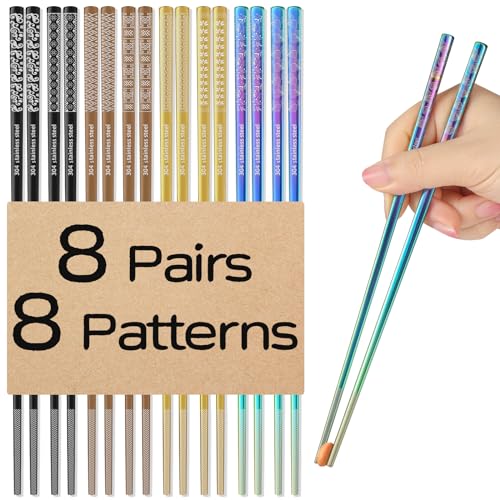
- NEWDRIP 18/8 Stainless Steel Chopsticks, 8 Pairs — eight engraved pairs for many-handed garnish work.
- Zliutob Stainless Steel Chopsticks, 5 Pairs — textured tips and a square grip, the precision specialist.
- LIXTONGR Dragon & Phoenix Black Stainless Steel Chopsticks, 2 Pairs — 18/10 steel at 9 inches, the fine-plating pair.
- MUYOS Stainless Steel Chopsticks, 5 Pairs — hollow-core lightweight, for a feather touch.
- Greatamzor Multicolor Stainless Steel Chopsticks, 5 Pairs — engraved, color-coded pairs for serving herbs at the table.
Read the full guide ↓ for the technique of picking, stripping and placing herbs with chopsticks, the material science of delicate work, and an herb-by-herb matching of tools to tasks.
Herbs are the divas of the ingredient world. Basil bruises if you look at it firmly. Cilantro tangles itself into knots that punish impatience. Mint blackens where a reactive surface touches it, delicate leaves tear at a squeeze, and a garnish placed a centimeter off its mark makes a plated dish look accidental instead of composed. Professional kitchens solve this with tweezers and fingertips; home cooks increasingly solve it with chopsticks, which offer something fingers cannot — reach, separation, and a touch that can be feather-light because the hand stays out of the food.
But chopsticks are not automatically gentle. A heavy, smooth, mirror-tipped pair is a clumsy instrument for leaf work: it slides off stems, demands a squeezing grip, and the squeeze is what bruises. The material question is therefore really three questions. Does the surface grip without force? Stainless answers with texture — engraving and treated tips, which every pick here has. Does the material react with the food? Stainless is non-reactive and non-absorbent, so it neither discolors delicate leaves the way reactive metals can nor drinks in herb oils and aromas the way wood does, carrying yesterday’s cilantro into today’s mint. And can the hand stay light for a whole session of garnish work? That is weight and balance, where the lightweight builds in this pool earn their place.
Our pool is entirely stainless steel, and for this task that is a defensible verdict rather than a limitation: the material that is non-reactive, non-absorbent, washable between ingredients in seconds, and available with precision tips is the material delicate herb work wants. The reviews below rank the six sets as herb tools specifically — a different ranking than a general eating guide would produce, because the virtues that matter here are finesse virtues.
Key Takeaways
- For herbs, the winning material traits are a textured or engraved tip (grip without squeezing), a non-reactive surface, and light weight for control — stainless steel with treated tips, as in all six picks, delivers all three.
- Stainless does not absorb herb oils or aromas, so one pair can move between basil, mint and cilantro with a rinse and no flavor carry-over — unlike porous wood.
- Tip design outranks alloy grade for this task: the textured-tip Zliutob and the engraved Greatamzor and NEWDRIP sets grip soft leaves with the least force.
- Shorter and lighter pairs are precision pairs: the 9-inch LIXTONGR and the hollow-core MUYOS suit fine plating best.
- Technique matters as much as material: support leaves from below, grip stems not leaves, and let texture do the work — the how-to section teaches the full method, which pairs naturally with the cooking-material analysis under Best Material For Cooking Chopsticks.
- Color-coded pairs help when herbs are served at the table — a dedicated serving pair per dish, a system the multicolor set supports and the reusable-material guide under Best Material For Reusable Chopsticks also values.
In this guide
Quick Picks
| Pick | Badge | Herb-work strength | Link |
|---|---|---|---|
| Greatamzor 18/8 Stainless Steel Chopsticks, 5 Pairs | Best Overall for Herb Work | Engraved grip plus a cooking-and-eating brief | Check on Amazon |
| NEWDRIP 18/8 Stainless Steel Chopsticks, 8 Pairs | Best for Batch Garnishing | Eight pairs — a clean pair for every herb and helper | Check on Amazon |
| Zliutob Stainless Steel Chopsticks, 5 Pairs | Best Precision Tips | Textured tips and square grip for single-leaf control | Check on Amazon |
| LIXTONGR Dragon & Phoenix Chopsticks, 2 Pairs | Best for Fine Plating | 9-inch 18/10 pair — the tweezer alternative | Check on Amazon |
| MUYOS Stainless Steel Chopsticks, 5 Pairs | Best Lightweight Control | Hollow-core featherweight for long garnish sessions | Check on Amazon |
| Greatamzor Multicolor Stainless Steel Chopsticks, 5 Pairs | Best for Table Service | Color-coded serving pairs for herb-topped dishes | Check on Amazon |
How These Picks Were Chosen
We read the verified pool through a garnish cook’s eyes. The questions were task-specific: Is the tip treated — textured, engraved, non-slip — so a leaf can be held with minimal force? Is the pair light or short enough for precision work? Is the material non-reactive and quick to rinse between ingredients? Sets answered from their listings; the spec boxes quote only what the listings state, and where a listing is silent (a length, a grade), the review works with what is known rather than inventing the rest.
Every pick is stainless steel, so the ranking turns on design rather than base material — which is itself a finding of this guide: once the material is non-reactive, non-absorbent steel, the differences that matter for herbs are tip geometry, weight and length. We weighted tip treatment first, control (weight and length) second, and set size third, because garnish work is usually solo — except when it is a family plating party, where the eight-pair pick earns its badge.
This is a research-led guide, not a test kitchen log: no bruising trials, no invented measurements. The technique section draws on standard garnish and plating practice, and the material claims are the well-established behaviors of stainless steel, wood and bamboo around delicate, aromatic ingredients.
The 6 Best Chopsticks for Picking Up Herbs, by Material and Design
Greatamzor 18/8 Stainless Steel Chopsticks, 5 Pairs
Badge: Best Overall for Herb Work
- Material: 18/8 stainless steel
- Pairs: 5
- Length: 9 1/4 inches (as stated in the listing)
- Design: Laser engraved, non-slip; Japanese Korean style
- Care: Dishwasher safe
- Stated uses: Cooking and eating; gift set format
Strengths
- Laser engraving gives the tips a permanent micro-grip — leaves are held by texture, not by squeezing force.
- The listing covers cooking and eating, matching the herb workflow from prep board to plate.
- 18/8 steel is non-reactive and rinses clean between herbs in seconds.
Trade-offs
- At 9 1/4 inches it is a fraction longer than the most precise plating pairs.
- Engraved grooves can hold a fleck of herb; a rinse under the tap clears them.
- Plain steel color only; no coding for multi-herb stations.
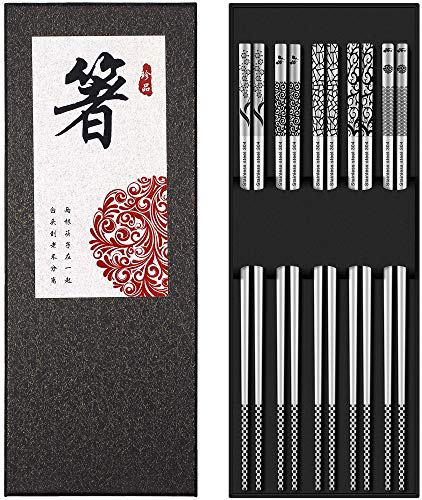
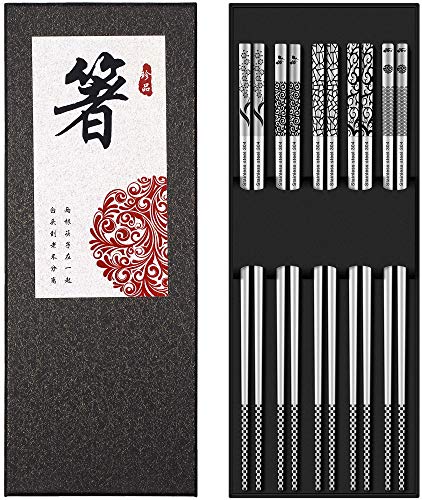
The all-round herb pair has to do three jobs in one session: strip leaves at the prep board, carry them without damage, and place them at the plate. This Greatamzor set is built for exactly that arc. The engraved surface is the key property — a leaf resting between engraved tips is held by friction distributed across the pattern, so the fingers can stay almost open. Bruising is a pressure injury; reduce the pressure and the basil stays green, the mint stays bright, and the garnish looks like it grew there.
The material supports the workflow in quieter ways. Between the cilantro and the mint, a steel pair rinses truly clean — no absorbed oils, no ghost aromas — which matters more in herb work than in almost any other kitchen task, because herbs are aroma in solid form. The 18/8 alloy is non-reactive, so nothing in the pair argues with acidic dressings or delicate leaves. And the cooking-and-eating listing means the pair that garnishes the pan sauce can also serve it.
Its compromises are small and specific. A quarter inch more length than the shortest pick costs a whisper of plating precision, and the engraving that grips so well will occasionally hold a fleck of chopped herb until rinsed. Neither matters in ordinary prep. As the single pair to keep by the cutting board for everything green, this is the guide’s first choice — and the pair we would hand to anyone learning the technique section below, where the same engraved logic is prized under Best Metal Chopsticks generally.
Best for: home cooks who prep and garnish with one pair at the board / Not suited for: plating perfectionists who want the shortest, most tweezer-like pair

NEWDRIP 18/8 Stainless Steel Chopsticks, 8 Pairs
Badge: Best for Batch Garnishing
- Material: 18/8 stainless steel
- Pairs: 8
- Length: 9.25 inches (as stated in the listing)
- Design: Laser engraved, non-slip; Japanese Korean Chinese styles
- Care: Dishwasher safe
- Stated uses: Cooking and eating; gift set format
Strengths
- Eight pairs turns garnish into a station: a dedicated pair per herb, per helper, per course.
- Engraved tips give every pair in the set the same gentle, texture-based grip.
- Steel pairs rinse and rotate instantly — no cross-aroma contamination between herbs.
Trade-offs
- No color coding, so dedicated pairs must be tracked by position or a rest per station.
- More pairs than a solo cook’s garnish work strictly needs.
- Plain steel presentation; a working set, not a gift object.
Garnish work changes character at scale. Plating eight servings of a herb-topped dish — or prepping for a dinner where three herbs appear in three courses — is a logistics problem disguised as a delicate one. The NEWDRIP set solves it the way professional kitchens do: with multiplicity. A pair lives with the basil, a pair with the mint, a pair at the plating pass, and nobody rinses mid-service or, worse, carries flavors across dishes because the one pair was busy.
The engraved consistency across all eight pairs is what makes the system work. Any hand that picks up any pair gets the same texture-based grip, so the light touch the technique requires does not depend on grabbing the “good” pair. The 18/8 steel keeps every station non-reactive and instantly rinsable, and the whole fleet goes through the dishwasher afterward — the listing confirms it — which is the only sane ending to a many-pair garnish session.
Its honest limitation is identification: in plain steel, a dedicated pair is dedicated by discipline, not by color, so set each station with its own rest and keep the geography strict. Solo cooks garnishing one plate will find the set more than the task demands, though the same depth serves family dinners beautifully. For households where herb-topped food is a production rather than an occasional flourish, this is the material system to buy.
Best for: hosts and families who garnish in batches and want a pair per herb / Not suited for: solo cooks who garnish rarely and store minimally

Zliutob Stainless Steel Chopsticks, 5 Pairs
Badge: Best Precision Tips
- Material: Stainless steel (grade not stated in the listing)
- Pairs: 5
- Tips: Textured, for grip
- Profile: Square grip section
- Care: Dishwasher safe; reusable
- Stated uses: Sushi, ramen and daily meals
Strengths
- Textured tips are the strongest anti-squeeze design here — single leaves and fine stems stay held at minimal pressure.
- The square grip section indexes in the fingers, steadying the micro-movements plating requires.
- Listed for sushi, the other great precision cuisine — the design brief transfers directly to herbs.
Trade-offs
- No steel grade or length is stated in the listing.
- The square profile takes a few sessions to feel natural.
- Texture can grip a delicate leaf a touch firmly if your technique is heavy-handed at first.
If herb work has a specialist in this pool, it is the Zliutob. Its design brief — textured tips, square grip — reads like an answer to the garnish cook’s two prayers: hold this leaf without crushing it, and hold my hand steady while I place it. The texture multiplies friction exactly at the contact patch, so a cilantro stem or a single shiso leaf stays put under the lightest closure. The square section, meanwhile, gives the fingers flat registration faces; the pair does not rotate subtly in the grip the way a round stick can, and rotation is the enemy of placement.
Its stated territory is sushi and ramen, and that lineage matters: sushi work is the cuisine of one-bite precision, of placing a single leaf or a wisp of garnish exactly once, correctly. A pair designed for that world arrives in herb work with the right instincts already built in. The steel is non-reactive and rinses clean, so the pair can move from the herb board to the table without carrying aromas.
The caveats are informational rather than functional: the listing names no alloy grade and no length, so the specification-minded buyer has less to verify, and the square profile asks for a short courtship before it feels like an extension of the hand. Neither dims the central fact — for the single most delicate task in this guide, this is the most purpose-built tool in the pool, the pair that community threads about precision metal sets tend to describe wanting, a pattern we note under Best Metal Chopsticks Reddit.
Best for: plating-focused cooks who place herbs leaf by leaf / Not suited for: buyers who require a named steel grade and stated length

LIXTONGR Dragon & Phoenix Black Stainless Steel Chopsticks, 2 Pairs
Badge: Best for Fine Plating
- Material: 18/10 stainless steel
- Pairs: 2
- Length: 9 inches (as stated in the listing)
- Grip: Non-slip
- Care: Dishwasher safe
- Presentation: Gift box; dragon and phoenix design in black
Strengths
- At 9 inches it is the shortest pair here — the closest a chopstick comes to plating tweezers.
- 18/10 steel is the premium non-reactive alloy; nothing in it argues with delicate leaves.
- The black finish makes pale herbs and edible flowers easy to see against the tips while you work.
Trade-offs
- Two pairs only — a personal plating instrument, not a prep fleet.
- The black surface treatment deserves non-abrasive care.
- Its gift-box presentation is aimed at the table, not the cutting board’s rough and tumble.
Fine plating is where herb work becomes art: the single mint leaf centered on the dessert, the chive batons aligned, the microgreen placed rather than scattered. The tool for that moment wants to be short, precise and invisible to the food — and this is the pool’s candidate. At 9 inches, the LIXTONGR is the most compact pair here, and compactness is control: the tips move almost exactly where the fingers point, with the least lever-arm amplification of small tremors.
The material is the premium recipe, 18/10, and while alloy grade matters less for herbs than tip design does, non-reactivity matters absolutely — and every stainless grade here has it. The black finish adds an unadvertised plating advantage: contrast. Pale herbs, white edible flowers and light garnishes show clearly against black tips while you position them, the same reason pastry chefs favor dark tweezers. It is a small thing that a plating cook will notice in the first session.
Accept the format’s limits with open eyes: two pairs, gift-boxed, with a finish that prefers gentle washing. This is not the pair to strip a bunch of parsley at speed — the fleet picks above exist for that. It is the pair for the last five percent of a dish, the part guests photograph. If your herb work leans toward composed plates and desserts, no other pick here speaks your language as fluently.
Best for: plating-focused cooks and dessert finishers who want a tweezer-like pair / Not suited for: high-volume prep or buyers needing many pairs
MUYOS Stainless Steel Chopsticks, 5 Pairs
Badge: Best Lightweight Control
- Material: Stainless steel
- Pairs: 5
- Construction: Hollow-core, lightweight design
- Tips: Non-slip
- Finish: Silver
- Care: Dishwasher safe; reusable for daily meals
Strengths
- Hollow-core lightness means the hand tires last — long garnish sessions stay precise to the final plate.
- A light pair is a gentle pair: less momentum, less accidental pressure on delicate leaves.
- Non-slip tips supply the grip so the featherweight build never has to squeeze.
Trade-offs
- No steel grade or length is stated in the listing.
- A hollow stick can dent if crushed; it is a precision instrument, not a pry bar.
- Some cooks prefer a weightier pair for a sense of authority in the hand.
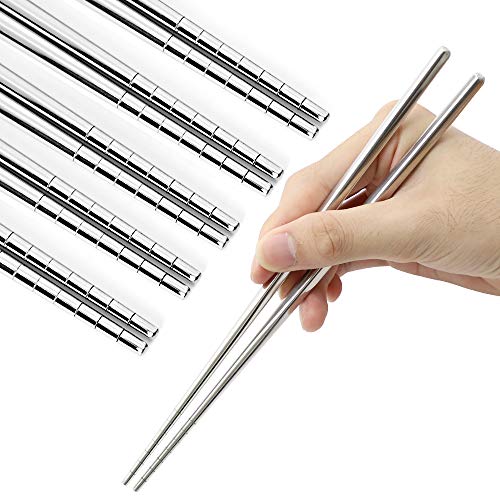
Garnish fatigue is real. The first plate gets your best hands; the twelfth gets your tired ones, and tired hands squeeze. The MUYOS set attacks the problem through the material property nobody lists in headlines: mass. Its hollow-core construction strips out weight while keeping the steel surface — non-reactive, non-absorbent, dishwasher safe — fully intact. What reaches the herb is a pair that asks almost nothing of the fingers holding it, so the light touch of plate one is still available at plate twelve.
There is a subtler benefit for delicate work: control of pressure is control of momentum. A lighter stick starts and stops with the fingers rather than with inertia, which makes the micro-corrections of placement — a millimeter left, a breath of rotation — easier to perform and easier to stop performing. Combined with non-slip tips that remove the need to squeeze, the design forms a coherent philosophy: grip by texture, move by lightness, touch by restraint.
Its limits are the familiar hollow-core ones, plus missing specifications. Treat it as an instrument — no crushing loads, no drawer-bottom burial — and note that the listing states neither grade nor length. For cooks whose herb work is measured in dozens of plates or long prep sessions, those are easy terms. The pair also travels beyond herbs gracefully; a stick this light and neutral is the one cocktail garnishers reach for too, a crossover we mention under Best Metal Chopsticks Stirring Cocktails.
Best for: cooks who garnish many plates and want precision that does not fade with fatigue / Not suited for: users who prefer a heavy, authoritative stick

Greatamzor Multicolor Stainless Steel Chopsticks, 5 Pairs
Badge: Best for Table Service
- Material: Stainless steel
- Pairs: 5, in multiple colors
- Length: 9 1/4 inches (as stated in the listing)
- Design: Laser engraved copper coin pattern; square, non-slip profile
- Care: Dishwasher safe
- Format: Gift set
Strengths
- Color coding lets each herb-topped dish keep its own serving pair at the table — no cross-flavor wandering.
- Engraved grip holds slippery dressed herbs and salad leaves with a light touch.
- The square profile and pattern make it the most placeable, presentable serving pair here.
Trade-offs
- Colored finishes soften over years of washing; steel function is unaffected.
- At 9 1/4 inches it is a dining length, less tweezer-like than the shortest pick.
- The bold pattern suits festive tables more than minimalist ones.
Herb work does not end at the kitchen door. Half the reason herbs are picked up carefully is that they finish dishes at the table — the herb salad served family style, the bowl of pho arriving with its plate of basil, mint and bean sprouts, the grilled dish that takes its herbs fresh at the moment of eating. This set is the table-service specialist for that world: five engraved pairs in distinct colors, so each dish, or each diner, keeps an assigned pair and the delicate cargo moves without mixing.
The engraving earns its keep on dressed herbs in particular. A leaf slicked with vinaigrette or chili oil is one of the slipperiest objects in dining; the copper coin pattern’s texture gives the tips purchase at low pressure, so the leaf arrives whole rather than squeezed. The square profile sits tidily on a rest between servings — a small grace that round sticks, prone to rolling, do not offer a busy table.
Its compromises are the multicolor family’s own: finishes that mellow with washing, and a decorative boldness that will not suit every table. Within its brief — herbs served, shared and finished in public — it is the most capable and the most charming pick in the guide, and its color logic makes it a natural companion to the metallic finishes surveyed under Best Metallic Chopsticks.
Best for: households that finish dishes with herbs at the table, family style / Not suited for: minimalists or cooks whose herb work is all fine plating
Comparison Table
| Pick | Material (as listed) | Pairs | Length (as listed) | Tip / grip | Link |
|---|---|---|---|---|---|
| Greatamzor 18/8 | 18/8 stainless steel | 5 | 9 1/4 inches | Laser engraved, non-slip | Check on Amazon |
| NEWDRIP 18/8 | 18/8 stainless steel | 8 | 9.25 inches | Laser engraved, non-slip | Check on Amazon |
| Zliutob | Stainless steel | 5 | Not stated | Textured tips, square grip | Check on Amazon |
| LIXTONGR | 18/10 stainless steel | 2 | 9 inches | Non-slip grip | Check on Amazon |
| MUYOS | Stainless steel, hollow-core | 5 | Not stated | Non-slip tips | Check on Amazon |
| Greatamzor Multicolor | Stainless steel | 5 | 9 1/4 inches | Laser engraved, square | Check on Amazon |
How to Choose a Material for Herb Work
Grade the candidates by the four properties herbs actually test. First, reactivity: herbs are chemically lively — basil darkens against reactive surfaces, and delicate leaves pick up off-notes from materials that interact with them. Stainless steel is non-reactive across all its food grades, which is the foundational reason this pool is steel. Second, absorption: wood and bamboo are porous, and porous materials drink herb oils. That is a small tragedy in both directions — the pair loses the aroma it stole, and returns it to the next ingredient. Steel absorbs nothing, so flavors stay where they were put.
Third, grip mechanics. A smooth material forces the fingers to supply all the holding force, and force is what bruises. Treated tips — textured, engraved, non-slip — let the surface do the holding, which is why every pick here has one and why a mirror-polished luxury stick, however fine its alloy, would rank below all six for this task. Fourth, mass and length: lighter and shorter means finer control for longer, which is why the hollow-core and 9-inch picks punch above their price of admission in this particular ranking.
Where do the rival materials still make sense? Wooden pairs are kind to leaves and quiet, and for a cook who garnishes one plate at a sitting and hand washes happily, a fine wooden pair is a legitimate instrument — accepting that it will hold aromas and age faster. Bamboo is the light, cheap practice tool. Plastic and melamine are the training wheels. But for repeated, multi-herb, wash-and-repeat work, the material evidence points one way, and it points at treated stainless steel.
How to Pick Up Herbs With Chopsticks: The Technique
Material sets the ceiling; technique decides whether you reach it. Work through the method in order.
- Set up dry and organized. Herbs washed and gently dried hold better and bruise less than dripping ones; lay each herb on its own small plate or towel so the pair never has to excavate a pile.
- Strip leaves by the stem. Hold a stem in your free hand and use the closed pair as a gentle comb, drawing downward so leaves release without tearing; or pinch single leaves at the stem junction, never by the leaf blade.
- Carry from below. For a single leaf, slide one tip beneath it and let the second tip rest on top like a paperweight — support, do not squeeze. For bunches, cradle the stems, not the foliage.
- Place, do not drop. Lower the herb into position and open the tips a fraction so the leaf settles; a dropped garnish lands where gravity wants, not where the composition does.
- Rinse between herbs. A two-second rinse and a shake keeps aromas pure — trivial with steel, and one of the reasons the material wins this category.
Troubleshooting, in problem-and-response form. Problem: basil leaves keep bruising → you are gripping the blade; switch to stem contact and let the tips’ texture hold, or move to the textured-tip Zliutob for a session and feel the pressure difference. Problem: leaves slide off the tips → they are wet, or your tips are closing past parallel; dry the herbs, and open the pair slightly so the tips meet at the leaf, not beyond it. Problem: mint darkens where it was handled → handle less and later: garnish at the last moment, with a non-reactive steel pair, and keep cut mint out of contact with reactive boards and blades where you can.
Herb by Herb: Matching the Tool to the Leaf
Basil is the bruise test: large, tender leaves that blacken at pressure points. It wants the lightest closure in the guide — textured or engraved tips, stem contact, carried from below. Cilantro is the tangle test: fine stems in a knotted pile, best approached by lifting a small bunch by the stems and shaking the tangle loose rather than pulling single stems against the knot. Parsley, flat or curly, is the volume test — the batch pick’s moment — stripped by the comb method and moved in bunches. Mint is the timing test: sturdy enough to handle, quick to darken once cut, so it is picked up last and placed last.
Shiso and perilla are the placement test: big, delicate, architectural leaves that belong exactly where they are put, the natural clients of the short LIXTONGR. Chives and herb flowers are the tweezers test — tiny, precise, one-at-a-time work where the lightest pair and the steadiest grip section win. Soft salad herbs and microgreens are the fatigue test, dozens of small placements in a row, where hollow-core lightness quietly outperforms every other property. Read the menu you actually cook, find its dominant test, and the table of picks above resolves into a shortlist of one or two — which is what a good guide is for.
The Garnish Workflow: From Market Bunch to Finished Plate
Herb work begins before the chopsticks come out, and material thinking improves every stage. At selection, you are already choosing your tool’s workload: bunches with intact stems strip cleanly, while pre-torn herbs force the fiddly, bruise-prone handling that no material can fully rescue. At washing, a salad spinner or a gentle pat dry matters because water is the enemy of grip — a wet leaf on a wet tip is the one combination that defeats even textured steel, which is why the technique section insists on dry herbs before any pair is picked up.
Storage between prep and service is the overlooked stage. Herbs held in a damp towel keep their turgor, and turgor is what makes a leaf holdable: a crisp leaf presents a stem and a surface; a wilted one presents a smear. When service begins, set the station the way the batch pick’s review describes — a pair per herb, a rest per pair, herbs on small plates rather than in a communal pile — and the material advantages you bought (non-reactivity, instant rinsing, texture) can actually be used, instead of being defeated by logistics. The final stage is the pass: plates move, herbs are placed last, and the short precision pair does the final five percent while the prep pairs rest. A workflow like this is why the guide ranks a system of pairs above any single hero pair for serious herb cooking.
Notice what the workflow assumes: tools that can be rinsed in seconds, that do not carry yesterday’s flavors, that survive being set down wet and picked up again a hundred times. Those assumptions are material properties, and they are the reason this category belongs to steel. A wooden fleet would need drying between rinses; a plastic fleet would fear the hot pass; the steel fleet simply works the line.
Material Manners: Herbs at the Table
The last herb skill is social. In the cuisines where chopsticks and herbs meet most famously — a pho table with its forest of basil and mint, a Korean grill table with perilla for wrapping, a Vietnamese herb plate passed hand to hand — the serving pair is a shared instrument, and its material carries etiquette weight. A dedicated serving pair, distinct from anyone’s eating pair, is the hygienic norm; a color-coded pair, like the multicolor set in this guide, makes the dedication visible so no one has to ask. Steel serves this role gracefully: it can be rinsed between dishes in plain sight, it does not hold the previous dish’s aroma, and it looks intentional rather than improvised.
Handling manners follow from the material too. Serve herbs by the stems or from beneath, as the technique section teaches, and set the serving pair back on its rest — never across a shared bowl, never resting in the food. When a guest’s own pair is the tool, the same gentleness applies double: their squeeze is not your squeeze, and delicate leaves forgive the host’s instruction (“the stems, gently — the tips grip more than you’d think”) better than they forgive a demonstration crush. None of this is fussiness; it is the accumulated table wisdom of cultures that finish dishes with living leaves, translated into a modern steel drawer.
Beyond the Leaf: Other Delicate Work This Material Logic Covers
The properties that make treated stainless the herb material — non-reactivity, texture grip, light control, instant rinsing — generalize across the whole delicate end of cooking, which is worth knowing before you decide how many pairs to own. Soft tofu is the classic transfer: a cube that punishes force and rewards the support-from-below carry the herb technique teaches, on the same textured tips. Poached eggs, dumplings with thin skins, ripe avocado slices, soft cheeses for a composed salad — each is an herb problem in different clothing, and each is solved by the same material answer rather than by a drawer of single-task tools.
The logic extends out of the kitchen. Aquarium keepers plant delicate stems with long steel tools for the same non-reactive, precise reasons; terrarium builders place tiny leaves with steel for the same grip-without-crush geometry; bakers position gold leaf and fragile decorations with non-reactive metal because porous or reactive tools mark the work. We mention these not to sell you a chopstick for your fish tank, but to show that the material verdict in this guide is not a food-blog opinion — it is the same conclusion several unrelated crafts reached independently, which is usually the sign of a real property rather than a fashion.
Back at the stove, the conclusion simplifies buying. A cook who understands why steel wins the herb test owns a framework, not just a pair: judge any future utensil by reactivity, absorption, grip mechanics and mass, and the marketing falls away. The six picks in this guide are simply that framework, already applied to the verified pool, one delicate leaf at a time.
Common Buying Mistakes
- Choosing by alloy grade for a tip-design task. For herbs, texture and weight matter more than the difference between good steel grades.
- Using a smooth, polished pair and squeezing harder. Force is the bruising mechanism; grip must come from the surface.
- Using one porous wooden pair for every herb. Absorbed oils carry aromas across dishes; steel rinses pure.
- Gripping leaves by the blade. A buying mistake’s cousin — a technique mistake that even the best material cannot fully forgive.
- Buying the longest pair for precision work. Length amplifies tremor; plating wants the compact end of the range.
- Skipping the rinse between herbs. The material makes purity easy; the habit makes it real.
Final Recommendation
For the single best herb pair, take the Greatamzor 18/8 set: engraved grip, non-reactive alloy, and a cooking-and-eating brief that covers the whole garnish workflow. For leaf-by-leaf precision, the NEWDRIP eight-pair set is the batch station, while the Zliutob is the specialist whose textured tips and square grip were practically designed for this task. Choose the LIXTONGR for fine plating, the MUYOS for long light sessions, and the multicolor Greatamzor when the herbs are headed for the table. Pair any of them with the technique above — stem contact, support from below, texture instead of force — and delicate ingredients will stop feeling delicate.
A closing word on expectations: no material makes herb work automatic, and the first sessions with any new pair will include a dropped leaf or two while your hands learn its weight and texture. That learning curve is short — a few meals, not a season — and it is the last one you will climb, because a steel pair’s behavior does not change as it ages the way wood’s does. Buy the treated tips, learn the light touch, and the greenest, most fragile corner of your cooking becomes the calmest.
Frequently Asked Questions
Why is stainless steel recommended for herbs instead of wood?
Two material behaviors decide it. Stainless is non-reactive, so it does not discolor or flavor delicate leaves, and it is non-absorbent, so it does not drink herb oils and carry aromas to the next ingredient — wood does both, gently but surely. Add a textured tip for grip without squeezing, and steel answers every requirement herb work makes.
What tip design is best for picking up herbs?
A treated one: textured, laser engraved or otherwise non-slip. The texture holds leaves and stems by friction at minimal closing force, and minimal force is the whole secret, because bruising is caused by pressure. All six picks in this guide have treated tips; the Zliutob’s textured tips and the engraved Greatamzor and NEWDRIP designs are the standouts.
Can chopsticks really replace plating tweezers?
For most home plating, yes — especially a shorter pair like the 9-inch LIXTONGR, which behaves like a tweezer with better leverage and a kinder touch. Dedicated tweezers still win for the tiniest work, such as individual herb flowers, but a precision chopstick covers the great majority of garnish tasks and then serves dinner afterward.
How do I stop bruising basil when I pick it up?
Change the contact point and the force. Grip the stem, not the blade; support the leaf from below with one tip rather than pinching it; and use a textured or engraved pair so the hold comes from the surface. Also garnish late — basil handled at the last moment shows the least damage, however it was held.
Does the chopstick material affect herb flavor?
It can, at the margins that herb lovers notice. Reactive surfaces can darken and dull delicate leaves, and porous materials return absorbed aromas to later ingredients. Stainless steel is neutral in both respects, which is precisely why professional garnish work defaults to steel tools: the herb tastes like itself.
Are shorter chopsticks better for herbs?
For placement work, generally yes: a shorter pair amplifies hand tremor less and points more exactly, which is why the 9-inch pick is our fine-plating choice. For stripping and batch prep, a standard dining length is comfortable and efficient. Many herb-heavy cooks keep one of each, as this guide’s picks make easy.
How should I clean chopsticks between different herbs?
A rinse under the tap and a shake is enough for steel — the non-absorbent surface releases oils and aromas completely, unlike porous materials that need washing and drying to come back neutral. At the end of the session, all six sets here are listed as dishwasher safe for a full reset.