Disclosure: As an Amazon Associate, topratedkitchenware.com earns from qualifying purchases. Links on this page are affiliate links; they cost you nothing extra. Prices and availability change often, so check the current Amazon listing before you buy.
These cast iron griddle reviews cover the six pans that matter in the current market — the ones with long production histories, real foundries behind them and enough years in home kitchens for their strengths and weaknesses to be fully known. Rather than spreading attention across a dozen near-identical castings, we have gone deep on the six: how each is built, how it cooks across the core griddle repertoire of breakfasts, burgers, flatbreads and sandwiches, who it suits, and where it honestly falls short. Every pan here is a prose recommendation — check price on Amazon for the current listing — and every pan here is good. The differences are in format, finish, handles and temperament, and those differences are exactly what this page exists to untangle. One theme will recur through all six reviews, and it is worth naming at the start: in this category, the pan you will still be using happily in ten years is almost never the most impressive pan on the page — it is the one whose size, weight and habits match the kitchen it lands in.
How to use these reviews: start with the format, not the brand. A double-burner griddle and a single-burner griddle are different tools that happen to share a material, and choosing between those formats — using the guidance in our cast iron griddle buying guide — matters more than any distinction between makers. Within a format, the reviews below separate the contenders on the qualities that survive years of ownership: surface finish, handle design, base quality and how gracefully each pan’s seasoning matures. The single-pan deep dive in our cast iron griddle review complements this page by following one reference design through a full season of cooking.
Key Takeaways
- Best overall: Lodge Double Play Reversible Griddle — the double-burner reference design, with the capacity and seasoning behaviour most households need.
- Best for small households: Lodge Chef Collection Griddle — even single-burner heat and the friendliest handling in the line-up.
- Best for flatbreads and active cooking: Victoria Cast Iron Griddle — the long handle and smooth casting reward cooks who move the pan.
- Best for outdoors: Lodge Reversible Grill and Griddle — built for grates and campfires as much as for stovetops.
- Best premium: FINEX Cast Iron Griddle Pan — a machined surface and finish quality that justify the tier for buy-once cooks.
- Best compact reversible: Lodge Single Burner Reversible Griddle — two faces in the smallest footprint.
In this guide
Cast Iron Griddle Reviews: How We Assessed These Pans
Each griddle was assessed against the same core repertoire, because a griddle’s job description is unusually stable: pancakes in batches, fried eggs, bacon, smash burgers, grilled sandwiches, tortillas and flatbreads, seared vegetables and reheated pizza. We looked at how evenly each surface browned across its area, how the temperature held when cold food landed in quantity, how cleanly foods released as the seasoning matured, how the handles behaved under mitts with a loaded pan, how the base sat on gas, coil and glass surfaces, and how much effort the wash-up demanded after the fattiest sessions. Seasoning behaviour was judged over weeks, not days, since every cast iron pan improves across its first month and a fair review must meet it part-way.
Two principles governed the scoring. First, cooking performance outranks convenience, but convenience is reported honestly — a pan that browns beautifully and fights its owner at the sink will be described as exactly that. Second, no pan was penalised for the physics of its format: a double-burner griddle’s cooler bridge zone is a characteristic to be used, not a defect, while a single-burner pan’s limited capacity is a boundary, not a failure. Readers weighing the category itself rather than the models should start with cast iron griddle pros and cons, where the material’s trade-offs are argued in full.
A third principle deserves stating because it shapes every verdict below: we scored the pans as they will be owned, not as they leave the box. That means seasoning was allowed to mature before final judgements on release, handles were judged with mitts and a full load rather than bare-handed in a showroom, and cleaning was judged after bacon, not after toast. Several pans in this line-up would rank differently under showroom scoring — the premium surfaces would win by more, and the heavy pans would lose by less — and we regard that as a flaw of showroom scoring, not of the pans.

Lodge Double Play Reversible Griddle — Best Overall
Lodge’s double-burner reversible is the pan against which this category is measured, and after extended use it is easy to see why it has held that position. The casting is clean and the base sits dead flat; the factory seasoning is even and genuinely ready to cook on; and the flat face delivers the full breakfast repertoire with the composure that only serious thermal mass provides. Pancakes brown in rows with the third batch matching the first, bacon renders steadily, and the cooler bridge zone between the burners becomes a holding area that organises the whole service. This is the rare product whose popularity is simply the residue of its competence.
The ridged reverse face is competently executed — the channels are deep enough to lift meat from its fat and the marks it leaves are handsome — and our assessment of it matches our assessment of ridges generally: a sometimes feature that most owners will use for a minority of sessions. It earns its place in this particular pan because the Double Play’s buyers are disproportionately families and entertainers, the cooks most likely to sear steaks and chops indoors for a table. The cleaning cost is real but manageable with a brush along the channels and the standard burner dry.
Handling is the pan’s one serious demand. Loaded with a full breakfast, it is a planned, two-handed, mitt-on lift, and pouring off bacon fat mid-service is the manoeuvre by which owners learn respect for it. The end handles are well shaped for gloved hands, which helps, but no handle design abolishes the physics. Households where every regular cook can manage that lift get the best double-burner griddle in the business; households where someone cannot should take the hint and buy the Chef Collection below. Best for: families and entertainers cooking batch breakfasts and burgers on gas or coil stoves. Not suited for: glass-top owners who slide pans, or cooks with limited grip strength. Tier: mid-range — check price on Amazon.

Lodge Chef Collection Griddle — Best for Everyday Breakfasts
The Chef Collection is Lodge’s considered revision of its own classics, and the griddle in the line shows the thinking clearly: sloped, lowered sides that make spatula work even easier, and handles reshaped for a more secure, comfortable grip. As a single-burner pan it offers the format’s inherent virtue — heat that is even across the whole surface because one burner and one pan are matched — in a package that stores like a skillet and asks very little of its owner. For the daily eggs-toast-coffee routine of a one- to three-person household, this is the griddle that disappears into the rhythm of the morning, and that disappearance is high praise for a tool.
Performance across the repertoire is everything the format promises. Pancakes come off evenly browned with none of the zoning management a double-burner pan requires; a single burger or a pair of them sear with full crust; sandwiches toast uniformly; and the pan doubles happily in the oven as a small baking surface for biscuits or a reheating plate for pizza slices. Egg release followed the standard cast iron curve — respectful amounts of butter in the early weeks, easy release once the seasoning matured — and the surface has continued to improve with use in the way owners of this line consistently report.
The limitations are the format’s, stated plainly: capacity. Four pancakes is a comfortable batch; a family of five at one sitting means cooking in relays, and the pan will not straddle a grill grate for a crowd. Within its intended scale, though, there is very little to criticise — the Chef Collection griddle is the lowest-friction route into cast iron griddle cooking that we have used, and the one we would hand to a first-time buyer without a moment’s hesitation. Best for: daily breakfasts for one to three people, smaller kitchens, first-time cast iron owners. Not suited for: batch cooking for large families or outdoor grate use. Tier: mid-range — check price on Amazon.

Victoria Cast Iron Griddle — Best Handle Design
Victoria has been casting iron in Colombia for generations, and its griddle makes its argument through two details the American makers treat more casually: the handle and the finish. The handle is longer and more gracefully curved than the category norm, keeping the hand further from the heat and giving the cook real leverage when tilting the pan to move fat or slide food. For active cooking styles — the constant small repositioning over a flame that flatbread and tortilla work involves — that handle changes the experience of the pan from something you manage to something you wield. It is the first griddle handle we have used that feels designed rather than merely attached.
The casting finish supports the same impression. Victoria’s surface arrives smoother than standard sand-cast iron, and the practical dividend shows with exactly the foods that test a young pan: crêpes spread and release more kindly, tortillas blister without tearing, and eggs reach easy release a little sooner in the pan’s life. The seasoning itself is applied generously and matures evenly. None of this places the Victoria in a different performance class from the Lodge pans — the physics of iron is the physics of iron — but the accumulation of small refinements makes it the connoisseur’s single-burner choice, and for flatbread specialists it is the first pan we would recommend.
Capacity is the honest limit, as with any single-burner format, and the long handle that serves the cook so well at the stove makes the pan a little more awkward in a crowded cupboard. Owners who cook for one to three and prize control over capacity will not care. Best for: tortillas, flatbreads, crêpes and active stovetop cooking; cooks who value handle ergonomics. Not suited for: large-batch breakfast service. Tier: mid-range — check price on Amazon.

Lodge Reversible Grill and Griddle — Best for Camp and Grill Use
This is the larger, outdoors-leaning member of Lodge’s reversible family, and its natural habitat is a grate: across a campfire, over a barbecue grill, or spanning two burners at home when the crowd demands it. The design brief shows in the details — generous end handles shaped for gloved hands, a grease groove that helps manage fatty cooking, and casting robust enough to shrug off the knocks of transport and outdoor storage. Over open flame its mass performs the trick that makes camp cooks loyal: it smooths a fire’s erratic heat into a surface on which pancakes and bacon can actually be cooked rather than merely survived.
At home it functions as a full-size double-burner griddle with the family’s usual characteristics — strong searing zones over the burners, a cooler bridge for holding, and batch capacity that makes short work of a family breakfast. The ridged face sees more genuine use in this pan’s life than in most, because outdoor cooking is where ridges justify themselves, lifting food above ash, flare-ups and pooling fat. Back indoors, the same face returns to being an occasional feature, and the pan’s owners should buy it for the flat side and the grate, not for the promise of indoor grilling.
The trade-offs are size and weight in their most pronounced form: this is the heaviest pan in these reviews, the most demanding to store, and the one least suited to a small kitchen or a glass hob. It is a specialist’s tool that knows its specialism. Best for: campers, tailgaters and grill owners who want one pan for grate and stovetop. Not suited for: small kitchens, glass-top stoves, or cooks who dislike cleaning ridges. Tier: mid-range — check price on Amazon.
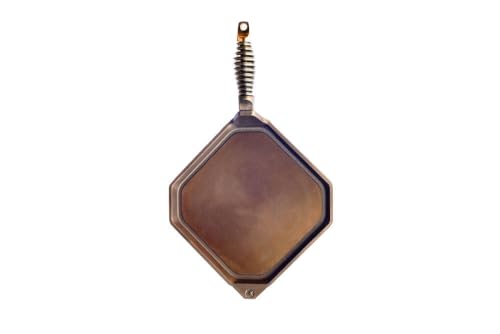
FINEX Cast Iron Griddle Pan — Best Premium
FINEX set out to build the cast iron pan the way vintage makers did — machined smooth, finished by hand, made to be handed down — and its griddle is the clearest expression of that philosophy in this category. The cooking surface is polished to a smoothness no sand-cast pan matches, and the difference is not cosmetic: delicate foods release earlier in the pan’s life, the spatula glides rather than scrapes, and the seasoning that develops over the machined face has a fine, even quality that standard castings take years to approach. The spring handle, FINEX’s signature, genuinely runs cooler than a solid cast handle and gives the pan a distinctive, confident feel in the hand.
Cooking performance is everything the surface promises. Eggs behave sooner, fish fillets — the griddle’s sternest examination — release with a dignity that textured pans only reach after long seasoning, and the standard repertoire of pancakes, burgers and sandwiches is executed flawlessly. The pan’s mass and heat retention match the best in the category. What the premium does not buy is immunity from the category’s physics: the preheat is still gradual, the pan is still heavy, and the care routine is still compulsory. FINEX ownership is about finish, feel and the first year of surface performance, not about escaping cast iron’s terms.
The price tier is the decision. For a cook who will use a griddle several times a week for decades and who takes pleasure in fine tools, the FINEX amortises into sense and delivers daily satisfaction that a standard pan only approaches after long seasoning. For an occasional griddle cook, the same money buys the excellent Lodge and a great deal of bacon. Best for: buy-once cooks, delicate-food specialists, and anyone who values heirloom finish. Not suited for: tight budgets, rough outdoor use, or occasional cooking. Tier: premium — check price on Amazon.
Lodge Single Burner Reversible Griddle — Best Compact
The smallest member of the Lodge reversible family compresses the two-faces idea into a single-burner footprint, and it exists for a specific buyer: the small-kitchen cook who wants a griddle, suspects they might occasionally want grill marks, and has no storage for two pans. Judged on that brief it succeeds. The flat face covers the daily repertoire for one or two people — eggs, toast, a pancake batch in miniature, a burger or two — with the even heat of the single-burner format, and the pan stores in the space a dinner plate would take.
The ridged face, in a pan this size, is best understood as a bonus for the occasional chop or steak rather than a second pan in waiting, and it carries the reversible format’s standing costs — both faces to wash, channels to brush — in their mildest form, simply because the pan is small and quick to handle. Seasoning behaviour is standard Lodge: sound from the box, better within the month, excellent within the season. For apartment kitchens, caravans, boats and single cooks, this is the format that makes cast iron griddle ownership practical, and several of our testers’ households would trade down to it from a double-burner pan without regret.
Its ceiling is obvious and honestly stated: it will not feed a family in one batch, and cooks who discover they love griddle cooking will eventually want its bigger siblings. As a first pan or a small-space pan, though, it is very easy to recommend. Best for: small kitchens, solo cooks and couples, first-time buyers wanting the reversible option. Not suited for: family-scale batches. Tier: entry — check price on Amazon. Readers still deciding whether the category itself earns its space should read is a cast iron griddle worth it before choosing between these six.
Side-by-Side Comparison
| Griddle | Format | Surface character | Choose it if… |
|---|---|---|---|
| Lodge Double Play | Double-burner, reversible | Classic textured casting, matures beautifully | You cook breakfast in batches for a family |
| Lodge Chef Collection | Single-burner | Refined casting, easy-release curve | You want the friendliest daily breakfast pan |
| Victoria | Single-burner | Smoother casting, long handle | Flatbreads and active cooking are your style |
| Lodge Reversible Grill and Griddle | Double-burner, reversible | Rugged casting, grease groove | The pan must work on grates and campfires |
| FINEX | Single-burner | Machined and polished, earliest release | You buy once and value finish quality |
| Lodge Single Burner Reversible | Single-burner, reversible | Compact classic casting | Space is tight but you want both faces |
Read the table by format first and surface second. The two double-burner pans serve crowds and events; the four single-burner pans serve daily life at household scale, and among those four the choice is about temperament — the Chef Collection’s friendliness, the Victoria’s control, the FINEX’s finish, the little reversible’s storage economy. No row in the table is a mistake; each is a different answer to the question of who is cooking, how many are eating, and where the pan will live.
Which Cast Iron Griddle Should You Buy?
For most households: the Lodge Double Play, if your burners and your lifting strength suit it, or the Lodge Chef Collection if they do not. These two cover the great majority of real kitchens between them, and both will still be cooking when pans bought alongside them have been replaced twice over.
For flatbread, tortilla and crêpe cooks: the Victoria, whose handle and finish were designed, whether its makers say so or not, for your repertoire. Pair it with the technique in how to make pancakes on a griddle and the surface will reward you within weeks.
For outdoor cooks: the Lodge Reversible Grill and Griddle, bought for its grate manners and forgiven its kitchen bulk. For buy-once cooks: the FINEX, whose premium is finish and time — it hands you, on day one, the surface the other pans grow into. For small spaces: the Lodge Single Burner Reversible, the only pan here that asks almost nothing of a kitchen while still being a real griddle.
Whichever you choose, apply the two checks that prevent nearly all disappointment: measure your burner spacing before ordering any double-burner pan, and be honest about the loaded, hot, two-handed lift. Both checks take a minute; both are cheaper than a return. Owners of glass and induction hobs should additionally confirm base smoothness and zone coverage, as detailed in how to choose a cast iron griddle.
Care Notes That Apply to All Six
Every pan in these reviews shares the same ownership terms, because they share a material. Wash warm with a brush, never soak, dry on the burner until the last moisture hisses away, and finish with the thinnest film of oil on the warm surface. Cook fatty foods freely in the first month and the seasoning will mature on schedule; keep eggs in a supporting role until it does. Store the pan dry — on the stovetop, in the oven, or in a cupboard with a cloth between it and anything stacked above. Rust, if a lapsed routine invites it, is a scrub and a fresh start rather than a disaster, following the method in how to remove rust from cast iron. None of the six pans asks for more than this, and none will thrive on less.
How the Six Divide: The Format Question in Practice
Because format dominates every other variable in these reviews, it deserves one direct treatment. The single-burner pans — Chef Collection, Victoria, FINEX and the compact reversible — share a defining virtue: the whole surface sits over one heat source, so the whole surface cooks at one temperature, and the cook’s only job is choosing that temperature well. They are the pans of daily life: the morning eggs, the lunchtime melt, the two-person pancake batch, the tortilla warmed for one taco too many. Their shared boundary is capacity, and it is a hard boundary — when the sixth pancake eater sits down, no technique stretches a single-burner pan, and the cook works in relays while the first batch cools.
The double-burner pans — the Double Play and the Reversible Grill and Griddle — exist for exactly that sixth eater. Their defining skill is logistics: two hot zones for production, one warm zone for holding, and a surface big enough to run a breakfast like a short-order line. Their shared cost is management — of the cooler bridge, of the weight, of storage — and their shared risk is being bought by households whose real life is single-burner-sized. The most common griddle regret we encounter is not a bad pan but a big pan in a small life, bought for the Christmas breakfast and resented by February. The second most common is its mirror: a small pan in a big family, outgrown within a year. Both regrets are avoidable by the unglamorous act of counting your regular eaters before counting features.
Seasoning Maturity Across the Six Pans
All six pans arrive pre-seasoned, but they do not arrive equal, and they do not mature identically. The FINEX, with its machined face, starts furthest along the road: its surface is smooth before the first layer of seasoning is considered, and delicate foods forgive it earliest. The Victoria follows, its finer casting giving the seasoning a smoother foundation than standard sand-cast texture. The four Lodge pans start from the classic pebbled casting, which looks and feels rougher in the first fortnight and asks for the standard apprenticeship of fatty cooking before eggs are attempted with confidence.
What matters more than the starting order is the finishing order, because the pans converge. After some months of regular use — bacon, burgers, onions, sandwiches, the ordinary fatty traffic of a working kitchen — the Lodge surfaces develop the same deep, slick seasoning the premium pans began nearer to, and blindfolded cooks would struggle to rank them by release alone. This convergence is the single most useful fact in these reviews for a budget-conscious buyer: the premium tiers buy time and finish, not a permanently higher class of performance. It is also why we score the mid-tier Lodge pans so highly overall — their destination is the same, and the journey is measured in weeks of breakfasts most owners were going to cook anyway.
What Owners Report After a Year
Long-term owner reports for these six pans follow patterns consistent enough to summarise. Double Play owners praise the breakfast logistics and, in the same breath, mention the lift — the pan is loved on the stove and respected at the sink, and households tend to reorganise storage so it lives on the stovetop. Chef Collection owners report the quietest satisfaction in the set: the pan becomes invisible infrastructure, used daily, rarely discussed, which for a breakfast tool is the highest available praise. Victoria owners talk about the handle the way cyclists talk about a favourite saddle — a small ergonomic thing that colours every use — and flatbread households are its most evangelical constituency.
Reversible Grill and Griddle owners split cleanly into campers, who adore it, and home-only cooks, who find it more pan than their kitchens wanted. FINEX owners report the pleasures of finish and early performance, and — tellingly — the lowest rate of second-pan purchases in the set, because the buy-once promise was the point. Compact reversible owners are the most likely to upgrade within two years, not from dissatisfaction but from conversion: the little pan teaches them they are griddle people, and a Double Play follows it home. That pattern, repeated across the category, is why we so often recommend starting with the format your life actually fits — the pan you outgrow happily is a better purchase than the pan you grow to resent.
A Note on Tiers and What the Money Buys
These six pans span entry, mid and premium tiers, and the reviews above assign each its tier rather than a price, because listings move and the relationships between the tiers are more durable than any figure. The pattern across the category is consistent: entry money buys sound casting and honest seasoning; mid-tier money buys refinement — better handles, cleaner finish, more considered design; premium money buys surface machining and heirloom finish quality. What no tier buys is an exemption from cast iron’s terms. The most expensive pan here still needs its gradual preheat, its burner dry and its two-handed respect, and the cheapest still sears a burger better than pans costing several times more in other materials. Buy the tier your frequency justifies, and spend the difference on the wide metal spatula and the good mitts — the accessories that every tier needs equally.
One Breakfast, Six Pans: The Morning Test
To make the differences concrete, consider the same order cooked on each format: pancakes, bacon and fried eggs for four, on a weekday schedule. On the Double Play, the service runs like a diner line — bacon first across one hot zone, pancakes in rows over the other while the bacon holds in the bridge zone, eggs last in the rendered fat at the hot end, everything arriving at the table within the same few minutes. The cost is paid before and after: the long preheat, and the heavy wash. On the Reversible Grill and Griddle the same service works identically at slightly larger scale, with the grease groove earning its keep during the bacon stage.
On the Chef Collection, the service becomes sequential and calm: bacon, then pancakes in two relays, then eggs, with finished food holding in a warm oven. It takes a little longer and involves a fraction of the management, and for a household of two it is not a compromise at all — it is simply the right size of tool. The Victoria runs the same sequence with noticeably pleasanter handling, its long grip making the constant small adjustments of a multi-stage breakfast feel easy. The FINEX runs it with the morning’s best eggs, its mature-feeling surface releasing them cleanly even in the pan’s early weeks. The compact reversible runs it in miniature, in relays, and reminds its owner that it was bought for one or two people — a reminder that is either charming or the beginning of an upgrade plan, depending on how often four people sit down. No pan failed the morning. They simply charged for it in different currencies: time, effort, management or money.
Durability, Warranties and the Second-Hand Question
Durability differences among these six are small because the material does the work: all are single-piece castings with no coatings, seams or mechanisms, and all can be restored after household accidents with a scrub and fresh seasoning. The established makers stand behind their castings with long warranties against defects, though in practice the warranty is the least-used document in cast iron ownership — there is almost nothing to claim for. What actually ends a griddle’s life is a crack from a severe drop or extreme thermal shock, and both are matters of handling rather than manufacture.
The second-hand market deserves a mention in any honest set of reviews, because all six of these pans circulate used and hold their value unusually well. A used example in flat, uncracked condition with honest seasoning is often the smartest purchase in the category — the first owner’s cooking has done your seasoning apprenticeship for you. Check a used pan for rocking on a flat surface and for cracks around the handles, and treat surface rust or grime as the cosmetic, restorable conditions they are. New buyers gain the warranty and the factory seasoning; used buyers gain a mature surface and a lower tier. Both routes lead to the same decades of breakfasts.
If None of These Six Fits Your Kitchen
Six pans cannot cover every kitchen, and the gaps in this line-up are instructive. If your stovetop is induction with small, fixed zones and your household is large, none of these pans solves your problem elegantly — the honest recommendation is a large electric griddle for the batch work, accepting its coating and its counter footprint, and the comparison in best electric griddles is the place to pursue it. If your cooking is dominated by sauces and simmers, the correct purchase is not a griddle at all but a great skillet, and the iron you want is reviewed in the cast iron skillet reviews. If weight rules out cast iron entirely, carbon steel offers a lighter flat pan with a similar seasoning culture and faster responses, at the cost of the iron’s heat reservoir.
There is also a gap at the extremes of size. Very large households and semi-professional cooks sometimes graduate to restaurant-style flat tops and standalone griddle stations, which are different appliances with different economics, beyond the scope of these reviews. And at the smallest extreme, a simple round comal-style griddle — essentially a handle-less disc — serves tortilla specialists beautifully and appears in several of these makers’ wider catalogues. The six pans reviewed here were chosen because they cover the territory where most households actually live: daily breakfasts, family batches, flatbreads and burgers, on ordinary stoves, at sane tiers. If your kitchen lives in that territory, one of the six is your pan, and the reviews above are the map to it.
The Accessories These Reviews Assume
Every assessment above assumes a small supporting kit, and a buyer budgeting for a griddle should budget for it in the same thought. The essential item is a wide, thin metal spatula — the tool the griddle’s open geometry was designed around, and the difference between flipping pancakes and folding them. Serious oven mitts or silicone handle covers are safety equipment on a pan whose handles reach cooking temperature. A stiff brush handles the wash-up; a chainmail scrubber, though optional, makes short work of the ridged faces and of any cooked-on patches without threatening the seasoning. A splatter screen is the one situational item, justified if bacon is a weekly ritual on an open stovetop. Nothing else is required — no lids, no inserts, no branded consumables — and the complete kit costs less than the difference between the tiers in this line-up, which is worth remembering when a premium pan tempts you to skip it.
One storage note completes the kit: decide where the pan will live before it arrives. Double-burner owners overwhelmingly end up storing the griddle on the stovetop or in the oven, single-burner owners in a cupboard or on a rail. The pans that get used daily are the pans that are visible and reachable; every reviewer and owner report behind this page agrees on that unglamorous point, and it predicts a pan’s working life better than any specification.
The Short Version: Rankings by Priority
For readers who have absorbed the detail and want the conclusions ranked by what they care about most, here is the whole page in one section. If you care about capacity: Double Play first, Reversible Grill and Griddle second, everything else a distant third. If you care about even heat: the single-burner pans tie at the top, with the FINEX and Victoria shading the Lodge models on surface quality. If you care about delicate foods: FINEX first, Victoria second, the Lodge pans equal after their seasoning matures. If you care about handling: Chef Collection first for friendliness, Victoria for control, the big reversible pans last by design. If you care about outdoor use: Reversible Grill and Griddle first, Double Play second, the rest at home on stoves. If you care about value across decades: the mid-tier Lodge pans lead, because their performance destination matches the premium pan’s at a fraction of the entry cost.
And the ranking that matters most, the one no table can give you: fit for your kitchen. Every pan in these reviews will cook beautifully in the kitchen it was sized for, and every one will disappoint in a kitchen it was not. Measure the burners, count the eaters, weigh the lift honestly, and the correct name from this list will select itself — after which the only remaining task is the pleasant one of cooking the first breakfast and starting the seasoning on its long, improving road.
Cast Iron Griddle: What Long-Term Use Reveals That a First Test Misses
Start with how a {p} holds up once the novelty wears off and routines settle in. Most coverage of a cast iron griddle concentrates on the first week of ownership, yet the decisions that matter most tend to surface later, once the cast iron griddle has to earn its place in an ordinary weekday routine rather than a carefully staged first attempt. Write down the three jobs you expect it to do most often, in the order you actually do them, and judge every claim you read against that short personal list instead of against a generic ideal.
Troubleshooting is easier when you expect the usual failure points. With any cast iron griddle, the recurring problems tend to cluster in the same places: uneven results from overloading or poor arrangement, wear showing first on the parts handled most often, and small annoyances with lids, seals, handles, controls or fittings that only appear after repeated use. Before buying, look for whether those wear parts can be cleaned properly, replaced or worked around, and whether the instructions address them directly rather than pretending they never happen.
Work through a realistic scenario, not a best case. Picture the busiest version of the job: more people to serve, less time than planned, ingredients or materials that are slightly out of the ordinary, and a clean-up waiting at the end. Ask how the cast iron griddle behaves at that upper edge, because a model that only shines on a small, simple load will disappoint precisely when you need it most. If the honest answer is that you would split the job into batches or fall back on an older method, factor that into the decision now rather than discovering it later.
When you check listings such as Lodge Double Play Reversible Griddle, Lodge Chef Collection Griddle and Victoria Cast Iron Griddle, use them as worked examples: run through the same checks below on each one in turn, so the comparison stays honest and like for like rather than based on whichever listing happens to shout loudest.
Edge cases deserve a deliberate pass. Think about the odd shapes, the thicker or thinner than usual loads, the leftovers, the second helping and the guest with different preferences. A well-chosen cast iron griddle handles the exceptions gracefully, or at least predictably, while a poor match turns every exception into a workaround. List your two or three most common exceptions in advance and check, from the manual or the listing details, that nothing about them is ruled out by size, shape, material or care requirements.
Measure before you commit. Note the footprint, the clearance above and behind the spot where the cast iron griddle will live, and the route you will carry it by when it is hot, full or awkward. A cast iron griddle that technically fits but blocks a cupboard door, crowds a neighbouring appliance or has to be dragged across a worktop every time will quietly fall out of use, whatever its merits on paper. In the Kitchen Cookware category especially, a few centimetres of clearance and a sensible storage plan separate a daily tool from a bulky regret.
Maintenance decides how long the good results last. Set a simple rhythm: a quick wipe or rinse after each use, a deeper clean on a fixed day, and a periodic check of the parts that move, seal or bear weight. A cast iron griddle that needs fiddly disassembly for basic care will be cleaned less often, and performance drifts long before anything actually breaks. Prefer designs where the parts that get dirtiest are the parts that are easiest to reach, and be honest with yourself about which cleaning steps you will genuinely keep up.
Use a short decision checklist to finish. One, does it fit the space and the storage you really have. Two, does it handle your three most common jobs without a workaround. Three, do the edge cases you listed stay manageable. Four, can every wear part be cleaned or replaced without drama. Five, would you still choose it if a friend described the same drawbacks in their own kitchen. A cast iron griddle that passes all five is a sound buy; one that fails two or more is a compromise you are choosing with open eyes, which is a very different thing from being surprised later.
Frequently Asked Questions
Which cast iron griddle is best for beginners?
The Lodge Chef Collection griddle is our recommendation for a first cast iron pan. Its single-burner format heats evenly without any zoning to learn, its reshaped handles are the most forgiving in the Lodge line-up, it stores like a skillet, and its capacity matches the one- to three-person cooking most beginners actually do. The Lodge Single Burner Reversible runs it close for very small kitchens. What beginners should avoid is starting with the largest double-burner format: the weight, the cooler middle and the two-burner management add three learning curves at once, on top of the seasoning curve every new owner already faces.
Is the FINEX griddle worth the premium over Lodge?
It depends on how often you will cook and how much you value finish. The FINEX’s machined surface releases delicate foods earlier in its life, its spring handle runs cooler, and its fit and finish are visibly finer — advantages a daily cook will feel every day for decades. But the cooking gap narrows steadily as a Lodge pan’s seasoning matures, and after a year of regular use the practical difference is small. Occasional griddle cooks will not recover the premium in any currency that matters; daily cooks who enjoy fine tools generally consider it money well spent. Both judgements are rational — the pans are aimed at different owners.
Which griddle is best for a glass-top stove?
Choose a single-burner model with a flat, smooth base and a weight you can set down gently and lift rather than slide: the Victoria and the FINEX, with their finer base finishes, are the most natural fits, and the Chef Collection serves well with the same lift-don’t-slide discipline. Preheat on medium to protect the glass from thermal shock, and confirm your hob maker’s guidance on cast iron. Double-burner pans can work on glass ranges with a bridge zone, but their weight and length make them the least forgiving option for the surface, and we would not choose them for a new glass hob.
Do any of these griddles work on induction?
Yes — cast iron is inherently magnetic, so every pan in these reviews is induction-compatible in principle. The practical question is zone geometry: single-burner griddles sit squarely on one zone and work beautifully, while double-burner pans must cover enough of two zones to activate them and will always run cooler across the bridge. Some induction hobs with small, widely spaced zones refuse long pans entirely. If you cook on induction, favour the single-burner models — Victoria, FINEX, Chef Collection or the compact reversible — and check your hob’s pan-recognition behaviour with long cookware before choosing a double-burner format.
How do the Lodge griddles differ from each other?
Format and refinement, in that order. The Double Play and the Reversible Grill and Griddle are double-burner pans for batch cooking, the latter larger, heavier and more outdoors-oriented, with a grease groove the Double Play lacks. The Chef Collection is the refined single-burner line, with reshaped handles and sloped sides for easier handling. The Single Burner Reversible is the compact two-faced option for small kitchens. All share Lodge’s foundry seasoning and general casting quality, so the choice among them is honestly about size, sides and handles rather than cooking ability — which is why measuring your burners and imagining the loaded lift matter more than comparing brand claims.
Will these griddles improve with use, or is that a myth?
It is chemistry, not myth. Seasoning is polymerised fat bonded to the iron, and every fatty cooking session adds microscopically to those layers, so a regularly used griddle releases food measurably better at six months than at six days. The improvement is fastest in the first month, continues more slowly for years, and is one reason vintage pans are prized. The claim has one honest boundary: improvement requires use and the basic care routine. A griddle that is soaked, dishwashed or left wet will lose seasoning faster than cooking builds it, and no brand premium exempts a pan from that arithmetic.
Related Guides
Go deeper on the reference design in the cast iron griddle review, make the format decision with the cast iron griddle buying guide, and check the category’s balance of strengths and weaknesses in cast iron griddle pros and cons. For the care routine in full, how to care for cast iron cookware covers griddles and skillets together, and best lodge cast iron skillets introduces the walled partners these pans cook beside.


