Disclosure: As an Amazon Associate, topratedkitchenware.com earns from qualifying purchases. Links on this page are affiliate links; they cost you nothing extra. Prices and availability change often, so check the current Amazon listing before you buy.
A cast iron griddle buying guide has one job: to stop you buying the wrong slab of iron. A griddle looks like the simplest pan in the kitchen — a flat sheet of cast iron with low edges — yet the difference between a griddle you reach for every morning and one that lives in the back of a cupboard comes down to details most listings barely mention: how it sits across your burners, whether the flat side or the ridged side suits the food you actually cook, how the handles behave when the pan is full and hot, and how much weight your wrists and your stovetop can honestly handle. This guide works through those decisions in the order they matter, then matches them to real griddles you can buy today.
Cast iron earns its place here for three reasons. It holds heat the way few materials can, so pancakes brown evenly and burgers sear instead of steaming. It is effectively indestructible in normal home use — a griddle bought this year can plausibly be handed down. And its seasoned surface improves with use, releasing food more easily the longer you cook on it. None of that makes every cast iron griddle a good buy. Geometry, finish and weight vary a lot between models, and the right choice for a family cooking pancakes on a gas range is the wrong choice for a single cook on a small induction hob. The sections below separate those cases.
Key Takeaways
- Size follows burners, not appetite. A double-burner griddle only earns its footprint if your stovetop spacing lets both burners heat it evenly; otherwise a large single-burner model cooks more consistently.
- Flat beats reversible for most homes. The ridged grill side looks versatile, but most owners use the flat side the overwhelming majority of the time, and flat-only griddles are easier to clean and season.
- Weight is a real specification. Cast iron griddles are heavy by nature; long helper handles and a size you can lift one-handed when loaded matter more than an extra inch of surface.
- Pre-seasoned is the sensible default. Every reputable maker now ships griddles seasoned and ready to cook; the seasoning deepens with use rather than needing a full strip-and-start-over project.
- Glass and induction tops need a flat, smooth base. Check the underside finish and your hob maker’s guidance before putting any cast iron on a glass surface.
In this guide
What a Cast Iron Griddle Does and the Main Types
A griddle is a flat cooking surface with very low sides — or none — designed for foods that do not produce much liquid and benefit from direct, even contact with hot metal: pancakes, eggs, bacon, burgers, grilled sandwiches, tortillas, flatbreads, seared vegetables and hash browns. The low edge is the point. A spatula slides under food at a shallow angle without fighting a pan wall, and several portions cook side by side in one batch. Where a skillet corrals food, a griddle spreads it out, and that spread is what makes batch breakfasts and weeknight smash burgers practical on a home stove.
Cast iron suits the format because the cooking is mostly dry and fast. The pan’s thermal mass smooths out the temperature swings of a cycling burner, so the third pancake browns like the first. The trade-off is warm-up time and weight, both covered later in this guide. Within the cast iron griddle family there are four main types, and choosing between them is the first real decision in any cast iron griddle buying guide worth reading.
Single-Burner Round Griddles
The round griddle is the oldest form: a shallow disc that sits on one burner like a skillet without walls. It is the natural home of tortillas, crêpes, flatbreads and single-portion breakfasts, and it stores easily because it shares the footprint of a frying pan. Round griddles heat the most evenly of any type because the burner shape matches the pan shape. Their limit is capacity — two pancakes or one large one is typical — so they suit smaller households and cooks who value even heat over batch size.
Single-Burner Square Griddles
Square griddles trade a little of the round pan’s even heating for noticeably more usable surface. Corners that would be wasted on a round pan fit extra toast, a fourth egg or the long side of a sandwich. Most square models add a modest handle and sometimes a helper grip, and many are deep enough in profile to double as a light baking surface in the oven. For one- and two-person households that cook breakfast foods often, the square single-burner griddle is frequently the sweet spot of the whole category.
Double-Burner Flat Griddles
The double-burner griddle is a long rectangle designed to straddle two burners — or to sit across a grill or campfire grate. This is the batch-cooking format: a full row of pancakes, a family load of bacon, or six burgers at once. The engineering challenge is the middle. The strip of iron between the two burners receives less direct heat, so good designs use that zone deliberately — it becomes a natural holding area where finished food stays warm without overcooking. Cooks who expect perfectly uniform heat edge to edge will be disappointed by any double-burner pan; cooks who learn to use the hot and warm zones get the most efficient breakfast station a home stove can offer. For a deeper look at how the format performs day to day, see our cast iron griddle review.
Reversible Grill and Griddle Combinations
Reversible models put a flat griddle on one face and raised grill ridges on the other. In theory you get two pans in one footprint. In practice the ridged side is slower to clean, harder to season evenly, and used far less than buyers expect — ridges give you grill marks, but they do not reproduce outdoor grilling because there is no smoke and no flame contact. Reversible griddles still make sense for cooks short on storage who genuinely grill indoors, and for campers who cook over open grates where the ridged side keeps food out of the ash. Everyone else is usually better served by a flat griddle plus, if needed, a separate grill pan.
Top Picks at a Glance
The six griddles below cover the realistic buying landscape, from the classic American foundry pieces to a modern premium option. Full mini-reviews follow later in this guide; this table is the short version. All six are treated as prose recommendations here — check price on Amazon for current listings, and read the detailed notes before choosing.
| Pick | Badge | Format | Best suited to |
|---|---|---|---|
| Lodge Double Play Reversible Griddle | Best Overall | Double-burner, reversible | Families batch-cooking breakfast on gas or electric coil |
| Lodge Chef Collection Griddle | Best for Everyday Breakfasts | Single-burner, low profile | Daily eggs, toast and pancakes for one to three people |
| Victoria Cast Iron Griddle | Best Handle Design | Single-burner, long handle | Cooks who move the pan often and cook tortillas and flatbreads |
| Lodge Reversible Grill and Griddle | Best for Camp and Grill Use | Double-burner, reversible | Outdoor grates, campfires and large-batch searing |
| FINEX Cast Iron Griddle Pan | Best Premium | Single-burner, machined surface | Cooks who want the smoothest finish and heirloom build |
| Lodge Single Burner Reversible Griddle | Best Compact | Single-burner, reversible | Small kitchens that still want a ridged option occasionally |
Notice what the table does not contain: a bad griddle. Every maker here casts, seasons and finishes its pans properly. The differences that matter are format, handle design, surface finish and weight — which is why the buying criteria below deserve more of your attention than brand loyalty. If you are still deciding whether the category itself fits your cooking, our companion piece asks the question directly: is a cast iron griddle worth it.
How Much Cooking Surface Do You Actually Need?
Capacity claims in griddle listings are usually given as a length and width, which tells you less than you think. What matters is usable flat area after you subtract the raised rim, the sloped edges and — on double-burner models — the cooler centre strip. A practical way to judge: picture your biggest regular batch. A family pancake session wants room for at least four pancakes with spatula space between them. A burger night for four wants four patties plus space to press and flip. If your biggest batch fits a single-burner square with room to spare, the double-burner model buys you storage pain and uneven heat in exchange for capacity you will rarely use.
Work the calculation the other way too. Griddles earn their keep through frequency, not occasional feasts. A pan that matches your Tuesday breakfast gets used hundreds of times a year; a pan sized for a holiday brunch gets used twice. Most households that cook for one to three people find a generous single-burner griddle covers nearly everything, while households of four or more, and anyone who cooks breakfast for guests regularly, genuinely benefit from the double-burner format. The honest middle option — a large square single-burner griddle — is underrated and worth serious consideration before defaulting to the biggest pan in the range.
Will It Sit Flat on Your Burners?
Compatibility is where griddle purchases most often go wrong. Start with spacing: on a double-burner griddle, the distance between your burners’ centres should roughly match the pan’s length so both burners sit under the cooking surface rather than under the handles. Stoves vary widely — some ranges place burners close together with a bridge element, others spread them far apart — so measure your stovetop before ordering, not after. A griddle that overhangs the burners by a wide margin develops cold corners; one that is too short wastes its ends and overheats its middle.
Burner type matters as much as spacing. Gas is the most forgiving: flames lick around slight irregularities and cast iron shrugs off direct flame. Electric coil works well too, provided the coil is level. Glass-ceramic and induction tops demand more care. The base of the griddle must be genuinely flat and smooth, because a rough or warped base can scratch glass and will rock on the surface; induction additionally requires the pan to make full magnetic contact, which cast iron does readily, but the pan must cover enough of the induction zone to activate it — some hobs refuse a long double-burner pan whose centre sits over no coil at all. If you cook on glass, also commit to lifting rather than sliding the pan. Our guide to the wider cast iron family, the cast iron skillet buying guide, covers glass-top handling habits that apply to griddles word for word.
Flat, Reversible or Raised Grill Ridges?
This is the decision buyers most often reverse within a year, so think about your actual menu. Flat surfaces handle the widest range: eggs, pancakes, sandwiches, hash, vegetables, fish fillets, quesadillas and reheated pizza all belong on flat iron. Raised ridges do exactly one thing well — they lift fatty meat slightly so it sears on the ridges while fat drains into the channels, leaving attractive marks on steaks, chops and chicken breasts. They do it at the cost of harder cleaning, because cooked-on residue collects in the channels and resists a flat scraper.
A reversible pan splits the difference and splits the compromises too. Whichever side faces down collects grease splatter and burner residue, so both sides need washing; the downward face’s seasoning also takes heat abuse from direct burner contact. None of this makes reversible griddles bad — the two Lodge reversible models in our picks are long-standing favourites for good reason — but it does mean the format should be a deliberate choice, not a default. If your honest answer is that you will grill-mark a steak indoors a few times a year, buy the flat griddle and enjoy easier care the other three hundred days. The full balance of arguments is laid out in cast iron griddle pros and cons.
How Heavy Is Too Heavy for Your Kitchen?
Cast iron’s heat retention comes directly from its mass, so weight is not a flaw to be engineered away — but it is a limit to respect. A double-burner griddle loaded with a full batch of food is a two-handed lift for most people, and it must be moved while hot, often while wearing mitts that reduce grip. Look for handles you can actually hold: long handles that stay away from the heat, helper handles opposite the main grip, and on double-burner models, end handles wide enough for two mitt-covered hands. Avoid decorative handles that sit close to the pan body.
Consider storage as part of the weight question. A griddle that lives on the stovetop gets used; a griddle that must be hauled from a low cupboard gets skipped. Many owners store double-burner griddles in the oven, which works well until the day you preheat the oven with the griddle forgotten inside — harmless to the pan, annoying for the cook. If anyone in the household has limited wrist or grip strength, weight should be the first filter, not the last: choose the smaller format and cook in two batches. The iron will still outperform lighter pans on browning, and a pan that gets used beats a heavier pan that gets avoided.
What Do Pre-Seasoned and Enamelled Finishes Change?
Nearly every cast iron griddle sold today arrives pre-seasoned: the foundry bakes several layers of polymerised oil onto the iron so the pan is non-stick enough to cook on from day one and protected from rust in transit. Pre-seasoning quality varies — premium makers machine or polish the cooking surface smoother before seasoning, which is the main reason a FINEX feels different under a spatula from a standard Lodge — but even basic factory seasoning improves quickly once you start cooking fatty foods on it. Treat pre-seasoning as a head start, not a finished state, and plan on the first month of regular use to build the surface you will eventually love.
Enamelled griddles exist but are the minority in this category, and for good reason: enamel removes the seasoning chore and tolerates acidic foods and soaking, yet it chips if struck, cannot be restored at home, and costs considerably more. For a flat pan that will meet metal spatulas daily, bare seasoned iron is the more forgiving long-term surface — damage is cosmetic and repairable with another layer of seasoning, as explained in how to season a cast iron skillet. Choose enamel only if you are certain you will never maintain seasoning and you accept the chip risk. Whichever finish you pick, the care routine is short and is covered in the setup section below and in more depth in how to care for cast iron cookware.
How to Prioritise by Use Case
The Weekend Breakfast Family
Your defining batch is pancakes, bacon and eggs for four or more, cooked in sequence on the same surface. Prioritise the double-burner flat format, end handles you can grip with mitts, and enough thermal mass that a load of cold bacon does not crash the surface temperature. The warm centre zone becomes your holding area for finished pancakes while eggs cook at the hot end. A reversible model is acceptable here if storage is tight, but flat-only is the lower-maintenance choice. This is the household the Lodge Double Play was designed for.
The Small-Kitchen Solo Cook
Your defining constraint is storage, and your defining meals are eggs, toast, a single burger or a quesadilla. Prioritise a square or round single-burner griddle that can live on the stovetop or hang from a rail, with one good handle rather than two awkward ones. Skip reversible formats — the second side will not repay its cleaning cost at your batch sizes. The Lodge Chef Collection griddle and the compact single-burner reversible both fit this life; choose between them on handle feel and whether you ever want ridges.
The Tortilla and Flatbread Specialist
Your defining need is even, responsive heat across the whole surface and a rimless edge that lets you slide and turn breads without tearing them. Prioritise a round or square single-burner griddle with a smooth finish and a long handle for quick repositioning over the flame — flatbread cooking is active cooking, with constant small adjustments. The Victoria griddle’s longer handle design suits this style well. Double-burner formats are overkill unless you run two breads at once for a crowd.
The Camper and Grill Cook
Your defining environment is a grate over flame, where evenness comes from the fire, not the stove. Prioritise rugged casting, generous end handles for gloved hands, and a reversible format — outdoors, the ridged side genuinely earns its place, keeping food above ash and flare-ups. Weight matters less because the pan travels by vehicle rather than living in a drawer. The Lodge Reversible Grill and Griddle is the classic choice here, and it doubles as a home double-burner pan the rest of the year.
The Picks in Detail

Lodge Double Play Reversible Griddle — Best Overall
Lodge’s double-burner reversible is the reference design for this category: flat on one side, ridged on the other, cast in the company’s Tennessee foundry and seasoned ready to cook. The flat side handles the full breakfast repertoire, and the pan’s mass keeps temperatures steady through a full load of bacon. Best for: families cooking batch breakfasts on gas or coil stoves. Not suited for: glass-top owners who slide pans, or anyone who cannot manage a two-handed hot lift. Tier: mid-range — check price on Amazon.

Lodge Chef Collection Griddle — Best for Everyday Breakfasts
The Chef Collection line is Lodge’s refined take on its classics, with sloped sides and handles shaped for easier lifting. As a single-burner griddle it heats evenly, stores like a skillet and covers the daily eggs-and-toast routine without ceremony. Best for: one- to three-person households cooking breakfast most days. Not suited for: batch cooking for a crowd. Tier: mid-range — check price on Amazon.

Victoria Cast Iron Griddle — Best Handle Design
Victoria, the Colombian maker, distinguishes its griddle with a longer, curved handle that keeps your hand further from the heat and gives better leverage when tilting the pan. The seasoning and casting are a step up in smoothness from entry-level iron, which flatbread and crêpe cooks notice immediately. Best for: tortillas, flatbreads and active stovetop cooking. Not suited for: cooks who want the largest possible batch surface. Tier: mid-range — check price on Amazon.

Lodge Reversible Grill and Griddle — Best for Camp and Grill Use
The larger of Lodge’s reversible double-burner pans is built for grates: it sits across two burners at home and across a camp grill outdoors, with a grease groove that helps manage fatty foods. Best for: campers, tailgaters and grill owners who want one pan for both worlds. Not suited for: induction hobs with small zones, or cooks who dislike cleaning ridges. Tier: mid-range — check price on Amazon.
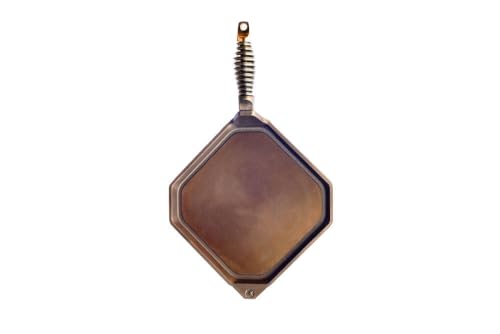
FINEX Cast Iron Griddle Pan — Best Premium
FINEX machines its cooking surface to a smoothness vintage pans were famous for, then seasons it so eggs release with unusual ease for new iron. The spring handle stays cooler to the touch, and the whole pan has the finish quality of a piece bought once for life. Best for: cooks who value surface quality and keep pans for decades. Not suited for: tight budgets or rough outdoor use. Tier: premium — check price on Amazon.
Lodge Single Burner Reversible Griddle — Best Compact
This smaller reversible packs the two-sided idea into a single-burner footprint that fits small stoves and small cupboards. The flat side will see most of the work; the ridged side is there for the occasional steak or chop. Best for: small kitchens wanting occasional grill marks without a second pan. Not suited for: feeding more than two or three at once. Tier: entry — check price on Amazon. Hands-on impressions of the category’s leading pans are gathered in cast iron griddle reviews.
First Setup and Care Essentials
Setup takes ten unhurried minutes. Wash the new griddle in hot water with a small amount of soap, dry it thoroughly on a warm burner, and rub the thinnest possible film of high-smoke-point oil over the whole surface while it is still warm. Then cook something forgiving and fatty — bacon, burgers or sautéed onions — for the first few outings rather than starting with eggs, and the factory seasoning will settle in quickly. Avoid soaking the pan, ever: wash it warm, with a stiff brush or a non-metal scrubber, dry it on the burner, and finish with that same whisper of oil. That routine, repeated, is the entire maintenance programme.
Two habits prevent nearly all griddle problems. First, preheat gradually — set the burner to medium and give the iron several minutes to come up to temperature evenly, rather than blasting it on high, which creates hot spots and can stress the casting. On a double-burner model, light both burners at similar settings and let the centre zone lag deliberately. Second, manage rust before it starts: if water sits on the surface, rust follows, and while light rust is removable — the method in how to remove rust from cast iron works for griddles exactly as for skillets — prevention by drying on the burner is far easier. Store the pan dry, with a cloth or paper layer between it and any pan stacked on top. If cupboard space forces you to store the griddle in the oven, build the habit of glancing inside before every preheat — a two-second check that prevents the one genuinely annoying accident in griddle ownership, an oven heated hard with an oiled pan forgotten inside and a kitchen full of smoke.
Mistakes to Avoid
The most common griddle mistake is buying the biggest pan first and the right pan second. The second is judging seasoning by the first egg: new iron, even good pre-seasoned iron, needs a few weeks of fatty cooking before eggs release cleanly, and many fine pans are returned in that window by cooks who expected a non-stick coating. Third, using high heat to speed preheating warps cheap pans and stresses good ones; medium and patience wins. Fourth, sliding a heavy griddle across a glass hob — lift it, every time. Finally, storing the pan wet or with the ridged side down in a puddle of sink water guarantees rust; the dry-on-the-burner habit takes less than a minute and prevents all of it. If you are cross-shopping the skillet format as an alternative, best cast iron skillet shows what you would gain in walls and lose in surface.
Understanding Heat: Preheat, Zones and Temperature Control
Every griddle success and failure traces back to heat management, and cast iron rewards cooks who learn its rhythm. The pan’s mass is a reservoir: once the iron is evenly hot, it resists the cooling effect of cold food, which is why a burger sears on contact instead of grey-steaming in its own juices. The same mass makes the pan slow to respond when you overshoot — a griddle that has become too hot stays too hot while you fumble with the burner — so the skill is to approach your target temperature gradually and arrive slightly under it, letting the surface settle where you want it.
A reliable preheat routine looks like this. Place the dry griddle over a medium burner — both burners, on a double-burner model — and give it several unhurried minutes. Flick a few drops of water onto the surface: if they sizzle and evaporate steadily, you are in pancake territory; if they dance and skitter, the pan is hot enough for searing. Add your oil or butter only in the last moments before the food, because fat left sitting on hot iron smokes and polymerises into sticky patches. Then cook, and resist adjusting the burner for the first batch. Cast iron’s whole point is stability; constant knob-turning defeats it.
On double-burner griddles, think in zones rather than uniform temperature. The areas directly over the burners are your searing zones. The bridge between them runs cooler and serves as a holding zone where cooked food rests without burning — pancakes wait there while eggs cook, bacon drains there while hash browns crisp. Skilled griddle cooks move food around the map deliberately, and this zoning is precisely why the format outperforms its paper specifications. Single-burner griddles have a simpler map — hot centre, gentler edges — and the same principle applies on a smaller scale: the edges are for resting, the centre is for searing.
Griddle, Skillet or Electric Griddle: Choosing the Format
Many buyers cross-shop three different appliances, and the honest comparison saves money. A cast iron skillet gives you walls: it contains sauces, deep-fries safely and goes from stovetop to oven with liquids inside. What it cannot do is give a spatula free access or cook four pancakes at once. If your cooking is saucy, braised or fried in oil, the skillet is the core pan and the griddle is the accessory — our how to choose a cast iron skillet walks through that decision. If your cooking is dry, flat and batched — breakfasts, sandwiches, burgers, flatbreads — the griddle is the core pan and the relationship reverses.
The electric griddle is the real rival for the breakfast-station role. It offers a thermostat, a larger surface and no stovetop footprint, and for a household that cooks pancakes for six every weekend it is a legitimate choice; best electric griddles covers the leading models. Its weaknesses are durability and heat quality: heating elements cycle on and off, surfaces are usually coated and wear out, and the appliance is one more bulky object to store. A cast iron griddle has no thermostat to fail, no coating to wear and no cord — and it will still be cooking when an electric model’s second replacement is wearing out. Choose electric for hands-off temperature control at scale; choose cast iron for searing quality, oven use, outdoor use and longevity.
Construction Details That Separate Good Griddles From Ordinary Ones
Beyond format and size, four construction details predict how a griddle will behave over years. The first is base flatness. A griddle whose base rocks on a flat surface will spin on glass tops, pool oil at one end and heat unevenly; reputable makers machine or carefully finish the base, and a pan that rocks on arrival should go back. The second is edge design. A low raised rim keeps bacon fat from escaping while still allowing spatula access; completely rimless designs are elegant for flatbreads but let grease wander toward the burner. A shallow grease groove along one edge, found on several double-burner models, is a genuinely useful middle path.
The third detail is handle geometry, already flagged in the weight section but worth repeating as a construction point: handles should rise slightly away from the pan body, giving knuckle clearance above a hot stovetop, and helper handles should be loops you can hook with a mitt rather than nubs you must pinch. The fourth is surface finish. Traditional sand-cast surfaces carry a fine pebble texture that smooths over years of use; machined surfaces from premium makers start smooth. Both cook well — the difference shows mainly with delicate foods in the first months, eggs and fish especially, and it narrows with every week of cooking. Do not pay a premium for smoothness unless delicate foods are your griddle’s main job; do pay attention to flatness and handles, which never stop mattering.
Finally, consider the foundry’s seasoning and support. A maker that seasons with multiple baked layers, publishes care guidance and sells replacement-friendly designs signals a pan intended for decades. Brand heritage is not marketing fluff in cast iron — Lodge has cast in Tennessee for well over a century, Victoria similarly in Colombia, and FINEX built its name on finish quality — because the product is simple enough that reputation tracks real quality unusually closely. If you enjoy the history behind the iron, the major foundries’ stories reward a separate read on their own.
Accessories That Earn Their Drawer Space
A griddle needs very little company, but four accessories genuinely improve the experience. A wide, thin metal spatula is the first — griddle cooking is spatula cooking, and a flexible blade that slides cleanly under pancakes and smash burgers is worth more than any other add-on; cast iron, unlike coated pans, welcomes metal tools without damage. Second, a pair of silicone handle covers or good oven mitts sized for a firm grip, because every handle on a working griddle is a hot handle. Third, a chainmail scrubber or stiff brush for the wash-up: chainmail in particular lifts cooked-on residue from seasoned iron without stripping the seasoning the way aggressive scouring can. Fourth, for double-burner owners, a simple splatter screen reduces the stovetop cleaning that wide-open flat cooking otherwise creates.
Just as useful is knowing what to skip. Dedicated seasoning oils and elaborate multi-step seasoning kits are unnecessary — the oil already in your kitchen and the heat of normal cooking do the work. Glass lids rarely fit griddles usefully. And a bacon press, while fun, is a one-task tool most drawers cannot justify; a second spatula pressing down achieves most of the effect. Spend on the spatula and the mitts, cook often, and let use itself be the accessory budget.
Cast Iron Griddle Buying Guide: How These Picks Were Chosen
The six griddles in this guide were selected to cover the real decision space rather than to fill a quota: both burner formats, both surface philosophies, three handle designs and three price tiers, from makers with long foundry records and readily available replacement support. Each pick is a current production model with an established track record in home kitchens, not a new release riding launch publicity. Where a model appears in several of our cluster articles, it is because the same pan honestly answers several different questions — the buying guide asks which to buy, the cast iron griddle reviews asks how each performs across a menu, and the value question is handled separately in is a cast iron griddle worth it. If your stove, household size or menu sits outside the profiles described here, weight the criteria sections above more heavily than the pick list itself: the criteria are the durable part of any buying guide, and they will steer you correctly even among models we have not listed.
One last piece of framing before the questions below. A griddle is among the cheapest cost-per-decade purchases in the kitchen: the pan has no coating to renew, no electronics to fail and no moving parts, so even a premium model amortises to very little per year of daily service. That arithmetic is why this guide spends so many words on fit — burner match, handle comfort, honest capacity — and so few on price tiers. Getting the format right matters far more than saving a small amount on the wrong shape of iron, because the right griddle is the one still earning its stovetop space twenty years from now.
A Note on Second-Hand and Vintage Griddles
Because cast iron survives for generations, the second-hand market is a real alternative to buying new, and vintage griddles from older American foundries are prized for their machined-smooth surfaces. Buying used can be excellent value, but inspect with three checks. First, flatness: set the griddle on a known-flat surface and press each corner — any rocking suggests warping, which matters far more on a griddle than on a skillet because the cooking surface itself must meet the burner evenly. Second, cracks: tap the pan and listen for a dull thud rather than a clear ring, and inspect the handle junctions under bright light, since a cracked griddle cannot be repaired. Third, surface condition: rust and baked-on grime are cosmetic and fully restorable with stripping and re-seasoning, so a ugly pan at a low price is often the best buy of all — as long as it is flat and uncracked. What you give up versus new is the factory warranty and the ready-to-cook seasoning; what you gain is a surface finish modern entry-level pans do not match. For most first-time buyers, though, a new pre-seasoned griddle remains the lower-effort path into the category, and the vintage hunt is a pleasure best saved for the second pan.
Cast Iron Griddle: A Hands-On Fit Check Before You Commit
Start with the space, storage and everyday routine this {p} has to fit into. Most coverage of a cast iron griddle concentrates on the first week of ownership, yet the decisions that matter most tend to surface later, once the cast iron griddle has to earn its place in an ordinary weekday routine rather than a carefully staged first attempt. Write down the three jobs you expect it to do most often, in the order you actually do them, and judge every claim you read against that short personal list instead of against a generic ideal.
Work through a realistic scenario, not a best case. Picture the busiest version of the job: more people to serve, less time than planned, ingredients or materials that are slightly out of the ordinary, and a clean-up waiting at the end. Ask how the cast iron griddle behaves at that upper edge, because a model that only shines on a small, simple load will disappoint precisely when you need it most. If the honest answer is that you would split the job into batches or fall back on an older method, factor that into the decision now rather than discovering it later.
Finally, plan the first fortnight deliberately. Use the cast iron griddle for one familiar job first, so you have a baseline you trust, then introduce the harder cases one at a time and note what changes. Small adjustments to arrangement, timing, quantity or preparation usually close most of the gap between disappointing first results and the performance the design is capable of. That short learning period is also the fairest test of measurement and fit: if the routine has not settled by the end of it, the mismatch is real, and it is better to know while returning or exchanging is still straightforward.
Troubleshooting is easier when you expect the usual failure points. With any cast iron griddle, the recurring problems tend to cluster in the same places: uneven results from overloading or poor arrangement, wear showing first on the parts handled most often, and small annoyances with lids, seals, handles, controls or fittings that only appear after repeated use. Before buying, look for whether those wear parts can be cleaned properly, replaced or worked around, and whether the instructions address them directly rather than pretending they never happen.
Maintenance decides how long the good results last. Set a simple rhythm: a quick wipe or rinse after each use, a deeper clean on a fixed day, and a periodic check of the parts that move, seal or bear weight. A cast iron griddle that needs fiddly disassembly for basic care will be cleaned less often, and performance drifts long before anything actually breaks. Prefer designs where the parts that get dirtiest are the parts that are easiest to reach, and be honest with yourself about which cleaning steps you will genuinely keep up.
Measure before you commit. Note the footprint, the clearance above and behind the spot where the cast iron griddle will live, and the route you will carry it by when it is hot, full or awkward. A cast iron griddle that technically fits but blocks a cupboard door, crowds a neighbouring appliance or has to be dragged across a worktop every time will quietly fall out of use, whatever its merits on paper. In the Kitchen Cookware category especially, a few centimetres of clearance and a sensible storage plan separate a daily tool from a bulky regret.
When you check listings such as Lodge Double Play Reversible Griddle, Lodge Chef Collection Griddle and Victoria Cast Iron Griddle, use them as worked examples: run through the same checks below on each one in turn, so the comparison stays honest and like for like rather than based on whichever listing happens to shout loudest.
Use a short decision checklist to finish. One, does it fit the space and the storage you really have. Two, does it handle your three most common jobs without a workaround. Three, do the edge cases you listed stay manageable. Four, can every wear part be cleaned or replaced without drama. Five, would you still choose it if a friend described the same drawbacks in their own kitchen. A cast iron griddle that passes all five is a sound buy; one that fails two or more is a compromise you are choosing with open eyes, which is a very different thing from being surprised later.
Frequently Asked Questions
What size cast iron griddle should I buy?
Match the griddle to your burners and your biggest regular batch, in that order. One- to three-person households are usually best served by a generous single-burner square or round griddle, which heats evenly and stores easily. Households of four or more that cook breakfast in batches benefit from a double-burner model, provided the burner spacing on your stove suits its length. Measure the distance between your burner centres before ordering a double-burner pan — that single measurement prevents the most common griddle disappointment, a pan whose ends never get properly hot.
Can I use a cast iron griddle on a glass-top or induction stove?
Yes, with care. On glass-ceramic tops, choose a griddle with a flat, smooth base, lift it instead of sliding it, and never drop it onto the surface. On induction, cast iron is naturally magnetic and works well, but the pan must cover enough of the active zone for the hob to recognise it; very long double-burner griddles can fail on hobs whose zones are small and far apart. Check your hob maker’s guidance on cast iron and on maximum pan weight, and preheat on medium rather than maximum to protect the glass from thermal shock.
Is a reversible griddle worth it over a flat one?
For most home cooks, no — and this guide’s picks reflect that. The flat side of any griddle handles the overwhelming majority of griddle cooking, while the ridged side adds cleaning effort every time the pan is washed, whichever side was used. Reversible models earn their place in two situations: very tight storage where one pan must genuinely do both jobs, and outdoor cooking over grates, where ridges keep food above ash and flare-ups. If neither describes you, a flat griddle plus an occasional grill pan is the happier combination.
How do I stop food sticking to a new cast iron griddle?
Three things matter more than any seasoning ritual: preheat properly, use enough fat, and leave food alone until it releases. A griddle preheated gradually to a steady medium heat, with a thin film of oil added just before the food, will release pancakes, burgers and even eggs once the surface has a few weeks of cooking behind it. Food that is moved too early tears and sticks; food left until a crust forms lifts cleanly. If sticking persists after a month of regular use, cook fatty foods more often and check that you are not washing the seasoning away with prolonged soaking.
Does a cast iron griddle need to be seasoned before first use?
Almost every griddle sold today arrives pre-seasoned from the foundry, so no initial seasoning project is required — wash it, dry it on a burner, and cook. The factory seasoning is a foundation rather than a finish, and it deepens with every fatty meal. If you buy a rare unseasoned or second-hand griddle, or you need to restore one after rust removal, the oven-seasoning method used for skillets applies unchanged: a whisper-thin coat of oil, baked upside down above its smoke point, repeated two or three times.
Can a cast iron griddle go in the oven and under the broiler?
Yes — this is one of cast iron’s structural advantages. A bare cast iron griddle tolerates any oven temperature a home oven or broiler can produce, which makes it useful for finishing steaks, keeping pancakes warm, baking flatbreads and reheating pizza with a properly crisp base. Only the handle materials set limits, and bare cast iron handles have none. Enamelled griddles are also oven-safe but should not be heated empty under a broiler for long periods. Remember that the entire pan, handles included, will be at oven temperature when it comes out.
Related Guides
Continue with the hands-on cast iron griddle review and the multi-model cast iron griddle reviews, weigh the cast iron griddle pros and cons, or step back to the pre-purchase sizing advice in how to choose a cast iron griddle. If your cooking leans toward sauced dishes and deep searing, the skillet cluster — starting with cast iron skillet reviews — may suit you better than any griddle.


