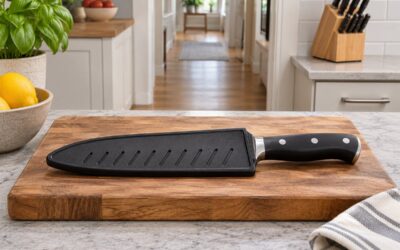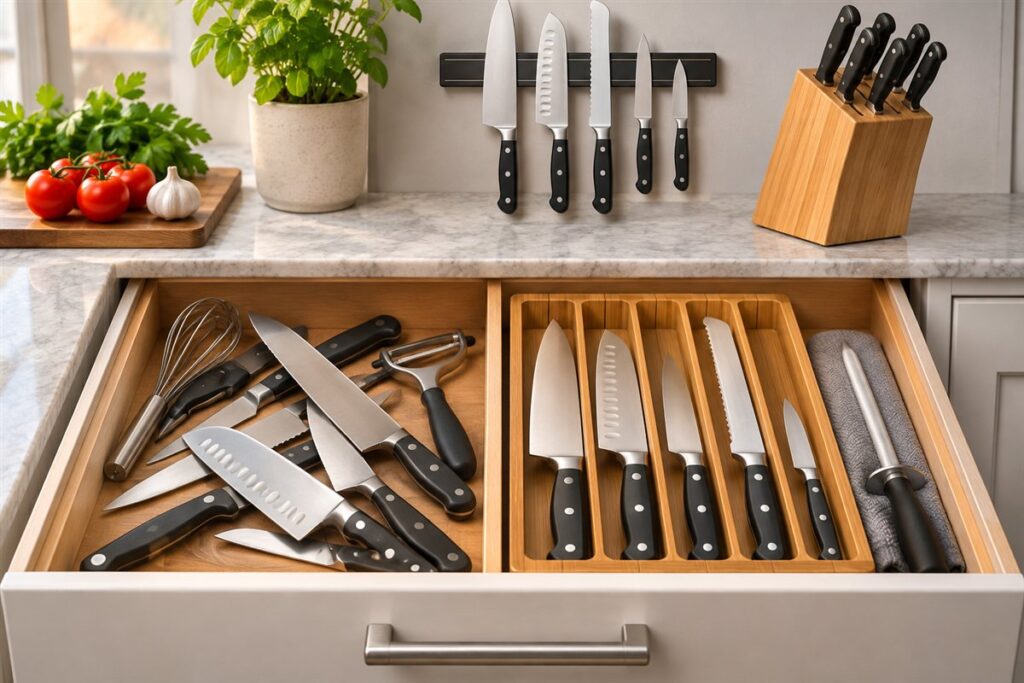
A well-organized knife drawer keeps each blade in its own slot so edges do not rub together and hands do not brush against sharp metal. Use a fitted tray, sheaths, or a magnetic holder, and give each knife a set place. Always follow the maker’s guidance on handling and storing knives.
Why Loose Knives Cause Trouble
Knives thrown into a drawer clash with other tools. Blades can dull or chip, and reaching in blindly raises the chance of a cut. Giving each knife a place protects both the edge and your fingers.
Steps to Set Up the Drawer
- Empty the drawer. Take out every knife and tool. Carry blades by the handle with the edge pointed away from you.
- Sort your knives. Group chef’s knives, paring knives, utility knives, a toothed bread knife, and specialty blades.
- Remove what you do not use. Wrap unwanted knives in thick paper or cardboard and tape them closed before donating or disposing, following local guidance.
- Choose an in-drawer holder. Measure the drawer, then choose a tray or block that fits snugly and holds blades flat or angled.
- Place knives with edges protected. Slot each knife so the blade sits in a groove or sheath, handle toward you.
- Label if you share the kitchen. A small label helps everyone return knives to the right place.
Holder Options
| Option | Good for | Consider |
|---|---|---|
| Fitted in-drawer tray | Most home kitchens | Measure the drawer first |
| Individual blade guards | Mixed or odd sizes | Take time to slide on and off |
| Wall-mounted magnetic strip | Saving drawer room | Keep out of children’s reach |
| Countertop block | Quick access | Uses counter space |
Everyday Habits
- Wash knives by hand and dry them right away, handle first, edge facing away from you.
- Never leave knives in a sink full of water where they cannot be seen.
- Keep the knife drawer separate from drawers that children open freely.
- Store sharpening tools in a different spot from daily knives.
- Follow the maker’s manual for cleaning and care.
Care for the Drawer Itself
Wipe the tray and drawer regularly, and make sure everything is dry before you put knives back. Moisture can mark blades and handles over time. If the drawer is also used for other items, keep those in a separate section so no one reaches past blades. Consider a drawer latch if children are in the home, and always follow the maker’s guidance on storage and care.
FAQ
Is a drawer better than a block?
Both can work. A drawer tray frees counter space and keeps blades out of sight, while a block gives quick access. Choose based on your space and household.
How should I store a long bread knife?
Use a long sheath or a drawer slot sized for it, or hang it on a wall strip. Long blades need extra care so the tip does not catch on other items.
The Short Version
Give each knife a slot in a fitted tray, sheath, or magnetic holder, and keep edges covered. Hold blades with care and follow the maker’s instructions. Label the drawer in shared kitchens.