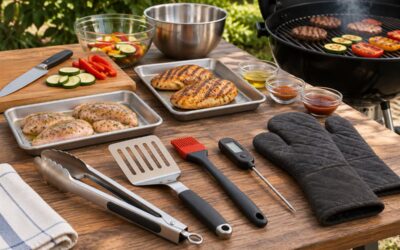
To use a food thermometer correctly, insert the probe into the thickest part of the food, away from bone, fat and the pan, and wait for the reading to settle. Clean it between uses and check it from time to time against ice water. Use the temperatures published by your local food-safety authority to decide when food is done.
Where to Place the Probe
The centre of the thickest part usually heats last, so that is where you want to measure. Bone, gristle and the pan itself conduct heat differently and can give false readings. For thin items such as burgers, insert the probe from the side so the tip sits in the middle. For whole poultry, check several spots as your local guidance suggests.
Steps for a Good Reading
- Read the maker’s guide to learn how deep the probe needs to go. Many need at least a centimetre or so of the tip inside the food.
- Wash the probe with hot soapy water before first use.
- Insert into the thickest part, avoiding bone and the pan base.
- Wait until the number stops changing, which may take a few seconds for a digital model and longer for a dial.
- Note the reading and compare it to the temperature in your local food-safety guidance.
- If the food is not yet at the target, return it to heat and check again in a different spot.
- Clean the probe after each use, particularly after raw meat, before it touches anything else.
Checking Your Thermometer
A simple home check uses ice water. Fill a glass with crushed ice, add cold water and stir. Place the probe in the middle without touching the glass. It should read near 0 degrees C (32 degrees F). If it is off by a small amount, some models can be adjusted; others should be replaced. Check the maker’s guide.
Thermometer Types
| Type | Typical use | Note |
|---|---|---|
| Instant-read digital | Quick checks on meat, bakes and sauces | Not designed to stay in the oven |
| Dial | Larger roasts | Needs deeper insertion |
| Probe with cable | Long roasts or smoking | Keep the cable away from direct flame |
Common Mistakes
- Touching bone or the pan base, which gives a misleading reading.
- Taking the reading too early, before the number settles.
- Leaving an instant-read probe in a hot oven when it is not made for that.
- Using a probe for raw meat, then for cooked food, without washing it.
- Checking only one spot in a large or uneven piece.
Take your time, and when in doubt, keep cooking and check again. Follow your local food-safety guidance for the target temperature of each type of food, and keep a clean cloth nearby for wiping the probe.
FAQ
Can I rely on colour instead?
Colour is not a dependable guide to doneness. A thermometer is the better tool, along with local food-safety guidance.
How often should I check accuracy?
Whenever it has been dropped, or from time to time with the ice water method.
The Short Version
Place the probe in the thickest part, wait for a steady number and clean it after each use. Compare readings to official food-safety temperatures.