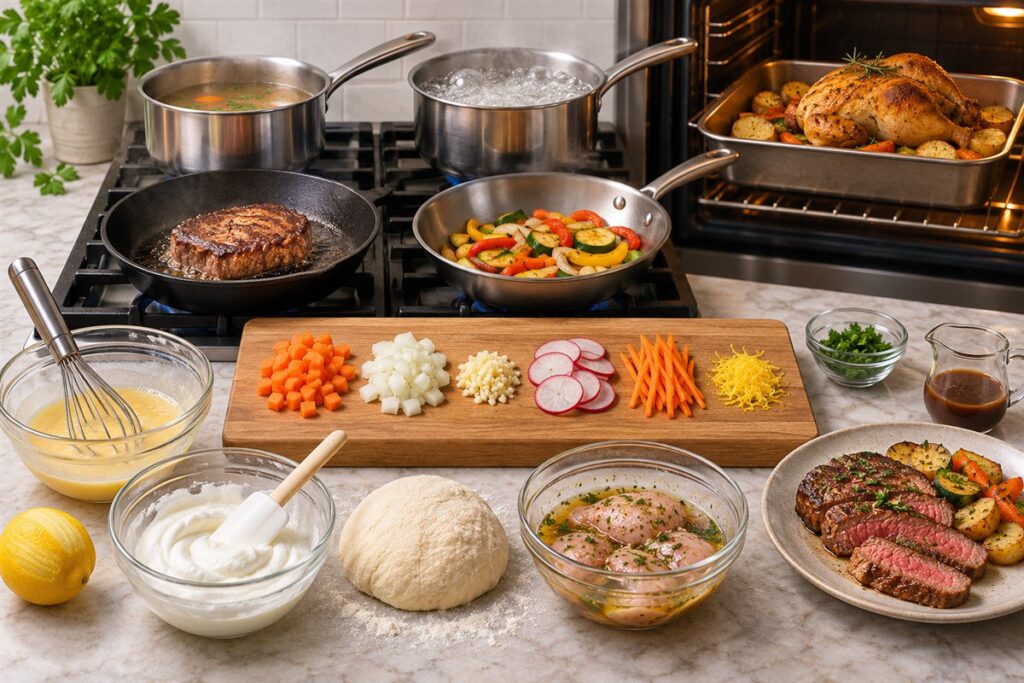
Recipes use a small set of words again and again, and knowing them removes a lot of guesswork. This glossary gives short definitions with examples, grouped by what you are doing in the kitchen.
Heat Words
- Simmer: Cook in liquid held just below a full boil, with small bubbles rising gently.
- Boil: Cook in liquid with large, constant bubbles.
- Saute: Cook food quickly in a small amount of fat over fairly high heat, moving it often.
- Sear: Brown the surface of food over high heat.
- Roast: Cook uncovered in the oven’s dry heat, often to brown the outside.
- Braise: Brown food, then cook it slowly in a little liquid with a lid on.
- Preheat: Bring the oven or pan to the needed heat before food goes in.
Cutting Words
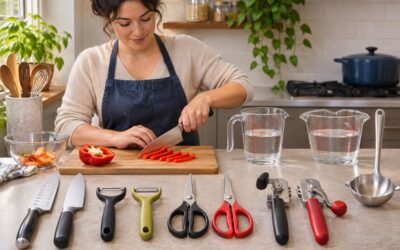
- Dice: Cut into small, even cubes.
- Chop: Cut into rough pieces, less even than a dice.
- Mince: Cut very fine, as for garlic or herbs.
- Slice: Cut into thin, flat pieces.
- Julienne: Cut into thin, matchstick strips.
- Zest: The coloured outer layer of citrus peel, removed in fine pieces.
Mixing and Prep Words
These words describe how ingredients are combined. Each uses a different motion, so the result changes.
- Whisk: Beat quickly to mix or add air.
- Fold: Combine gently with a scraping, lifting motion so air stays in the mixture.
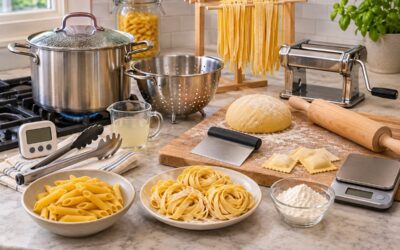
- Knead: Press and stretch dough to build its structure.
- Marinate: Soak food in a seasoned liquid for flavour.
- Season: Add salt, pepper or other flavourings, then taste and adjust.
- Deglaze: Add liquid to a hot pan to loosen browned bits and make a sauce.
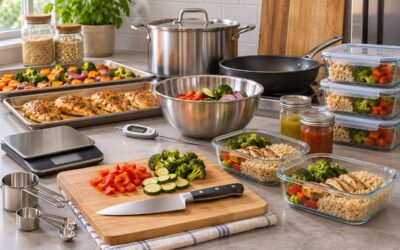
- Mise en place: Having everything measured and ready before you cook.
Finishing Words
| Term | Meaning | Example |
|---|---|---|
| Rest | Let cooked food sit before cutting | Roast meat on a board |
| Reduce | Boil down liquid to thicken it | A pan sauce |
| Garnish | Add a small topping for look or flavour | Chopped herbs |
| Drain | Pour off liquid | Pasta in a colander |
For how to tell when meat, poultry, fish or eggs are cooked through, follow trusted food-safety guidance from your local health authority rather than judging by colour alone.
Time and Temperature Words
Recipes also use words about timing. “Room temperature” means food has sat out of the fridge for a short while, as the recipe describes, and food-safety guidance limits how long perishable items should stay out. “Medium heat” means the middle of your dial, which differs from stove to stove, so watch the food rather than the number. “Until golden” is a visual cue, while “until tender” means a knife or fork slides in easily.
FAQ
What is the difference between a simmer and a boil?
A simmer has gentle bubbles that break the surface now and then. A boil has large, rolling bubbles, and it is more vigorous.
What does “to taste” mean?
It means add the seasoning a little at a time, tasting as you go, until the dish suits you.
The Short Version
Learn the heat, cutting and mixing words first, and most recipes become easy to read. Keep this page handy, and check food-safety guidance for doneness.