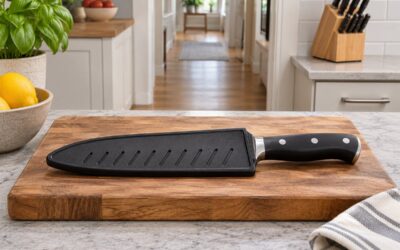
To hold a chef knife, pinch the base of the blade between your thumb and the side of your index finger, then wrap the other three fingers around the handle. Your free hand holds the food with curled fingertips. This grip gives you control over where the edge goes, which matters more than speed.
Why the Grip Matters
A chef knife is long and its weight sits near the middle. If you hold it only by the handle, the tip tends to wander and your wrist tires quickly. Holding the blade itself moves your hand close to the balance point, so the knife feels like an extension of your arm.
Step by Step: The Pinch Grip
- Place the knife flat on a cutting board with the handle toward you.
- Reach over the spine and pinch the blade right where it meets the handle, with the thumb on one side and the bent index finger on the other.
- Close your middle, ring and little fingers around the handle. They should hold it firmly, not squeeze it.
- Lift the knife and let the tip hang slightly below the heel. Your wrist should stay fairly straight.
- Make a few slow cuts through a carrot or an onion to feel how the blade rocks forward and back.
The Guide Hand
Your other hand matters just as much. Curl the fingertips under, like a loose claw, and rest the knuckles against the side of the blade. The knuckles act as a gentle fence, and the tucked fingertips stay out of the way of the edge.
- Move the guide hand back a little after each cut instead of reaching forward.
- Keep the thumb tucked behind the fingertips.
- Hold round foods steady by cutting a flat side first so they do not roll.
Common Grip Mistakes
| Habit | What happens | Better approach |
|---|---|---|
| Index finger pointing along the spine | Less control over the blade sideways | Wrap it around the blade as part of the pinch |
| Gripping very tightly | Sore hand and stiff cuts | Hold firmly but loosely enough to let the blade move |
| Flat fingers on the food | Fingertips sit near the edge | Curl the fingertips under |
Always follow the safety instructions that come with your knife, cut on a stable board, and keep your attention on the blade.
How Knife Size and Handle Shape Change Your Grip
The pinch grip works best when the knife suits your hand. A blade that is very long for your hand can feel unwieldy, and a handle that is too thick or too thin can make it hard to wrap your fingers securely. Many people find a blade in the middle range easier to control than a very long one, but comfort is personal, so try a few knives if you can.
Handle shape matters. Rounded handles allow you to rotate your grip, while angular ones lock into the hand. A handle with a bolster, the thick metal part between blade and handle, gives a stop for your fingers and can add weight at the front. Some knives have a sharply cornered spine that can dig into the side of the index finger during the pinch. Smooth, rounded edges are more comfortable if you cut for a long time.
Balance is another factor. A knife that balances near the bolster feels natural in the pinch grip, because your fingers rest at the pivot point. If the knife feels heavy at the tip or the handle, the grip may feel awkward. Try holding the knife with the pinch grip and see whether it rests easily in the hand. If you struggle to hold it comfortably, a different size or style may help more than changing your technique.
Wrist, Arm and Posture
A good grip is only part of the picture. The way you stand and move affects control and tiredness. Stand with your feet apart and your body slightly angled toward the board, so your cutting arm can move freely. Keep your elbow relaxed and close to your body, not flared out. A board at a height that lets your forearm stay roughly level reduces strain on your shoulder.
Let the motion come from the arm and wrist together. For a rocking cut, the tip stays near the board while the heel rises and falls. For a push cut, the blade moves forward and down in a slicing motion. Avoid forcing the knife through food with downward pressure alone, which can cause slipping. A sharp knife needs less force, so the grip can be relaxed.
- Keep the wrist straight, not bent sharply.
- Relax your shoulder and avoid raising it.
- Take breaks if you feel your hand tiring.
- Use a board at a comfortable height.
If you feel pain, stop and adjust your setup. A damp cloth under the board keeps it from moving, which allows you to concentrate on your grip.
Grip Variations for Different Tasks
The pinch grip is the standard for general chopping and slicing, but other grips have their uses. For very small knives such as a paring knife, a handle grip with the thumb on the side or spine can offer fine control. For peeling in the hand, the thumb works as a guide against the blade’s spine. For heavy tasks, such as cutting through a squash or a large root vegetable, a firmer handle grip may feel more secure, with the other hand placed away from the path of the blade.
When slicing long items such as a loaf of bread or a roast, a longer blade can be held with a similar pinch but with more arm movement. The motion is a long, smooth draw across the food, not a chopping action. Boning and filleting use different grips again, often with the blade pointing in a controlled direction, and these are best learned from a dedicated guide for the specific knife.
Some cooks switch grips during a session. For example, they may begin with a pinch for dicing and move to a handle grip for a heavier job. This is fine as long as you remain in control and cut away from your body. Practice with soft vegetables and then move to firmer ones. Trying each grip slowly builds confidence and helps you decide what feels right.
Guide Hand and Cutting Board Safety
The hand that holds the food is as important as the one that holds the knife. Curl the fingertips under, keep the knuckles forward and allow the flat of the blade to touch them lightly. The knuckles act as a guide for the blade. Move the guide hand back in small steps as you cut, so you never need to reach under the blade.
A stable board is essential. Place a damp cloth or a non-slip mat under the board to keep it still. Choose a board large enough to give you room to work, and keep the surface clear of items that could roll or slide. If the food is round or uneven, cut a flat side to create a base before slicing further. Wet or slippery foods benefit from being dried first.
- Never cut toward your hand or body.
- Keep the knife in view and pay attention while cutting.
- Do not try to catch a falling knife.
- Put the knife down safely when you walk away or talk.
A sharp knife is safer than a dull one because it requires less force and is less likely to slip. Keep your knife well maintained and store it safely.
A Simple Practice Routine for Beginners
Skill comes from short, regular practice. Choose an inexpensive vegetable such as a carrot, an onion or a potato. Start with a slow, careful cut and focus on holding the knife correctly. Cut a flat side, lay the food on it and make slices of even thickness. Use the guide hand to hold the food and move it back after each cut. Pay attention to the position of the fingers, and stop if your grip feels tense.
Once you feel comfortable, make a small number of cuts at a time and increase speed gradually. Avoid rushing, as speed comes with control. Try different cuts, such as slices, sticks and dice, to practice different motions. Reset your grip if the knife drifts, and take a moment to check your posture. Videos can help you compare your technique to a good example, but follow the safety advice that comes with your knife.
Keep sessions short, perhaps ten minutes, so you do not tire. Over time you will notice that the knife does more of the work, and your hand will feel less strained. If you have trouble with a particular movement, go back to slower cuts and focus on the basics. Consistent practice builds good habits, which make cooking more enjoyable and safer.
FAQ
Is the pinch grip right for every knife?
It suits most knives with a blade that has some height at the handle, such as a chef knife or a santoku. For very small knives, a regular handle grip is usually fine.
What if my hand is small?
Try a shorter knife with a handle that fits your hand. The pinch grip still works, and a comfortable knife makes it easier to stay relaxed.
Why does my hand get tired when I chop?
A grip that is too tight, a knife that is too large for your hand or poor posture can all cause tiredness. Relax your grip, check the knife fit and adjust board height.
Is it wrong to hold the knife only by the handle?
Many people do and it works for simple tasks. The pinch grip usually offers more control and balance for a chef knife.
Should my thumb be on the blade or the handle?
In the pinch grip, the thumb rests on the blade side opposite the bent index finger. If it feels uncomfortable, adjust slightly or try a different knife.
How do I hold a knife if I am left-handed?
Use the same technique, mirrored, and make sure the knife and bevel suit you. Some knives are ground for right-handed use, so check the maker's information.
Can I use the pinch grip with a very long knife?
Yes, though you may need to move your hand slightly toward the blade for balance. If control is hard, a shorter knife might suit you better.
How do I stop onions from slipping?
Cut a flat side first and lay the onion on it. Use a stable board and curl your fingertips under on the guide hand.
What should I do if I feel pain in my hand?
Stop, rest and check your grip, knife and board height. If pain continues, consider asking a health professional for advice.
The Short Version
Pinch the blade at the base, wrap your other fingers around the handle, and keep the guide hand curled. Practice slowly on soft vegetables until the motion feels natural, and follow the maker’s safety instructions every time.