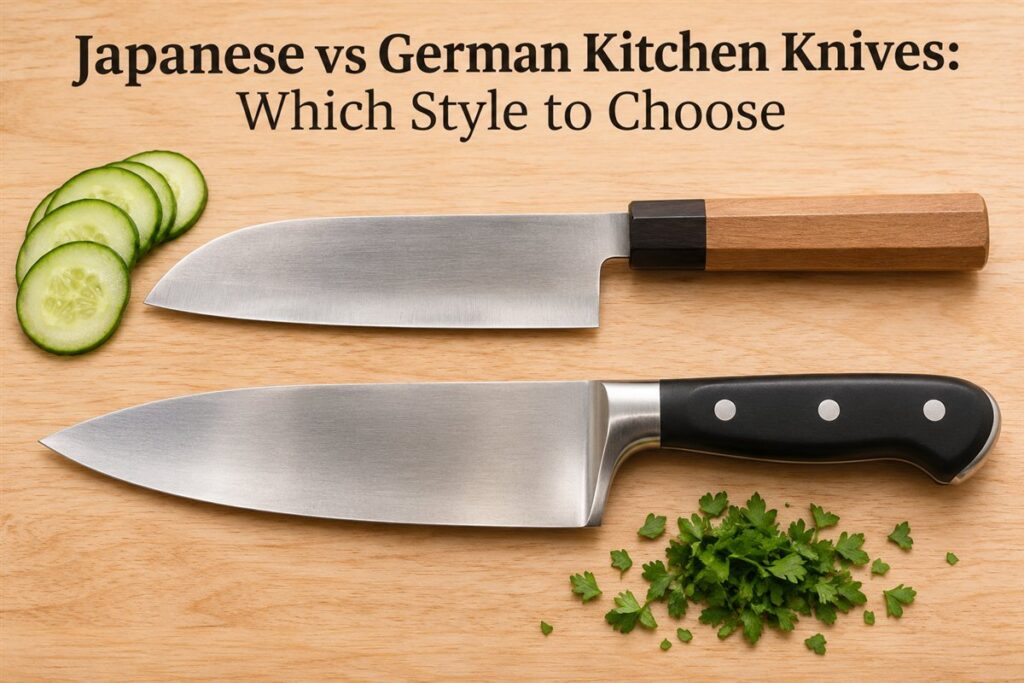
German knives are generally heavier and sturdier, while Japanese knives are generally lighter and thinner with a finer edge. Neither style is better overall. The right one depends on how you cut, how you care for tools and what you cook most often.
What Each Style Is For
German-style knives grew out of a tradition of all-purpose work. They tend to have a thicker blade, a pronounced curve along the belly for rocking, and a sturdy bolster. They are built to handle a wide range of tasks without fuss.
Japanese-style knives often favor precision. Many have thinner blades, a flatter profile for push cutting, and a harder steel that can take a very fine edge. Shapes such as the santoku and gyuto are common examples.
Key Differences
| Feature | German style | Japanese style |
|---|---|---|
| Weight | Usually heavier | Usually lighter |
| Blade | Thicker, more curved | Thinner, flatter |
| Steel | Often softer and tougher | Often harder and more brittle |
| Edge | Wider angle, forgiving | Narrower angle, very fine |
| Care | Tolerates more abuse | Needs gentler handling |
These are broad tendencies, not rules. Many makers blend both traditions, so check the maker’s guide for the steel type, angle and care advice for a specific knife.
How They Feel in Use
The difference shows up most in the hand. A heavier German blade can do some of the work for you as it falls through food, which many cooks find reassuring during long prep sessions. A lighter Japanese blade asks you to guide it, and rewards a clean, controlled motion with thin slices and tidy dice. Handles vary too, with Western-style handles that are full and rounded and many Japanese handles that are slimmer or shaped differently.
Who Should Choose Which
Choose German style if you
- like a rocking motion and a knife with some heft
- cut through harder items such as squash often
- want a knife that forgives rougher handling
Choose Japanese style if you
- prefer light, quick, precise cutting
- slice vegetables, fish or herbs thinly
- are willing to wash and dry by hand and avoid twisting the blade in hard foods
Handling and Care
Harder steel can hold an edge longer but may chip if it hits bone or is used to pry. Softer steel bends before it chips, and honing brings the edge back easily. In both cases, wash by hand, dry promptly and store the blade so the edge does not knock against other metal. Follow the maker’s safety and care instructions.
Blade Shapes and Profiles in Each Tradition
The shape of a blade influences how you move the knife. Many German-style chef knives have a pronounced belly, which is the curve along the cutting edge. This supports a rocking motion, where the tip stays near the board and the heel rises and falls. It is a natural fit for mincing herbs and chopping onions in a continuous rhythm.
Many Japanese-style knives have a flatter edge and a more upright profile. This favors a push cut or a straight up-and-down chop, where the blade lifts off the board and comes down cleanly. The santoku, with its shorter, wider blade and often a rounded tip, is a popular example, and the gyuto is a Japanese take on the chef knife with a longer, more tapered shape.
Other shapes appear in each tradition too, including slicers, boning knives, utility knives and vegetable cleavers. Some Japanese designs, such as those with a straight spine and a thin tip, are made for fine work like slicing fish, while some heavy German cleavers handle tough jobs.
When comparing, look at blade length, height, and where the knife balances. A taller blade gives more knuckle clearance above the board. A longer blade slices more in one stroke but needs more room to use. Check the product listing for dimensions and weight, and, if possible, hold the knife to see how it sits in your grip. These are general tendencies, and individual models vary widely.
Steel, Hardness and What They Mean for Daily Use
Steel choice affects how a knife behaves. In broad terms, softer steels are tougher and more forgiving: they tend to bend or roll slightly when abused and can be brought back with a honing rod. Harder steels can take a finer edge and may keep it longer, but they are more brittle and can chip if the knife is twisted, dropped or used on frozen food or bones.
Makers sometimes list a hardness rating, but numbers on a listing are not a full picture. Heat treatment, blade geometry and alloy all contribute, and the maker’s description should be treated as a guide rather than a guarantee. If hardness data is not given, look for the maker’s care instructions and note any warnings about bones, frozen items or lateral pressure.
Stain resistance varies as well. Some steels resist rust well, while others need more careful drying to avoid spotting. Always check whether the knife is described as stainless, carbon or a clad construction, and follow the matching care advice.
The practical takeaway is to match steel to habits. If you tend to cut quickly, wash in a hurry or use the knife for many tasks, a tougher steel may suit you better. If you cut carefully, love a very sharp edge and are happy to maintain it, a harder blade could be rewarding. Neither choice is a mistake.
Handles, Balance and Comfort in the Hand
A knife can look excellent on paper and feel wrong in the hand, so grip comfort deserves as much attention as steel. Western-style handles are usually full, contoured and attached with a full tang, which is steel extending through the handle. They tend to feel substantial and sit well with a pinch grip near the blade.
Japanese-style handles come in several forms. Some are Western-influenced, with riveted scales, while others use traditional wood handles that are rounder or octagonal and often lighter. These can feel slim and nimble, and some users find them more comfortable for extended precise work, while others prefer the fuller feel of a Western handle.
Consider these checks before buying:
- Hand size: very large hands may want a longer or fuller handle, and small hands may prefer a slimmer one.
- Balance point: some knives balance at the bolster, others toward the handle or blade.
- Weight: heavier knives reduce effort on hard items but can tire the wrist, while lighter ones reduce fatigue but need more guidance.
- Material: wood handles need care to avoid moisture damage, while synthetic handles tend to be more tolerant.
If you can, visit a store and hold several knives. Mimic a chopping motion in the air and note how the knife feels at the start and end of each stroke. Comfort matters more than reputation because a knife that fits you is easier to use safely.
Sharpening and Maintenance Differences
Sharpening habits differ depending on the style. German-style knives often have a slightly wider edge angle, which makes them sturdy and forgiving. Regular honing with a rod keeps the edge aligned, and sharpening on a stone or with a pull-through tool, if the maker permits, restores it when it dulls.
Japanese-style knives frequently have a narrower edge angle, which produces extra sharpness but is less tolerant of mishandling. Many owners prefer a whetstone for sharpening and use a gentler honing method, such as a fine ceramic rod, rather than hard steel. Always check the maker’s guide, because some harder steels can be damaged by a rod that is harder than the blade.
Regardless of style, certain habits protect any knife:
- Use a wood or soft plastic board. Glass, stone and ceramic surfaces dull edges quickly.
- Wash by hand and dry right away. Dishwashers can damage handles and edges.
- Store in a block, sheath or magnetic strip rather than loose in a drawer.
- Avoid cutting through bone, frozen food or hard shells unless the knife is designed for it.
If you do not want to sharpen at home, a professional service is an option. Ask whether they are comfortable with the style of knife you own, since angles and technique can differ. A good knife that is cared for can last for many years.
Matching Knives to Your Budget, Skills and Kitchen
When deciding between styles, think about the cook you are today, not the cook you hope to become. A beginner often benefits from a forgiving, mid-weight knife that tolerates uneven technique and occasional mistakes. A more experienced cook may enjoy the precision of a light, thin blade.
Think about the kinds of food you prepare. A household that cooks a lot of root vegetables, squash and meat might lean toward a sturdier blade. One that does a lot of vegetable slicing, herbs and fish may find a thinner blade more satisfying. Do not forget who else uses the knives. If several people share the kitchen, a tougher, less fussy knife may be the more practical choice.
On budget, think in tiers rather than numbers. Entry-level knives can be perfectly useful if you keep them sharp, but they may use simpler steel and less refined finishing. Mid-range options often balance quality and durability. Premium knives may offer fine materials and craftsmanship, but they also demand more care. Spend where it matters: one good chef knife usually beats a large set of average ones.
Consider a mixed approach. Many cooks own a German-style chef knife for heavy work and a Japanese-style knife for fine slicing. Whatever you choose, read the maker’s guide, and check the return policy so you can swap if the knife does not feel right.
FAQ
Can one knife do everything?
A good chef knife in either style covers most tasks. Add a paring knife and a bread knife when you want more range.
Is a Japanese knife harder to sharpen?
It often needs a gentler technique and a suitable stone, so follow the maker’s advice or ask a sharpening service.
Which style is better for beginners?
Many beginners find a sturdy, mid-weight knife more forgiving, which often points to the German tradition. That said, a comfortable, well-balanced Japanese-style knife can work well if you handle it with care.
Do Japanese knives chip easily?
Harder steels can chip if twisted, dropped or used on bones and frozen food. With proper technique and a suitable cutting board, chipping is much less likely.
What is a santoku?
It is a general-purpose knife of Japanese origin, usually shorter and flatter than a chef knife. It suits push cutting, slicing and dicing, though you should check the listing for the exact shape and size.
Can I use a honing steel on a Japanese knife?
Not always. A hard steel rod can damage some harder blades, so follow the maker's advice and consider a fine ceramic rod if recommended.
Are hybrid knives available?
Yes, many makers blend features of both traditions, such as a Western handle with a thinner blade. Read the description to understand the steel, edge angle and care needs.
How long should a good kitchen knife last?
With regular honing, occasional sharpening and gentle handling, a quality knife can last for many years. The condition of the edge, handle and blade tells you more than its age.
The Short Version
Choose German style for a sturdy, forgiving all-rounder and Japanese style for light, precise cutting. If you are unsure, hold both in a shop and see which one feels natural in your hand.