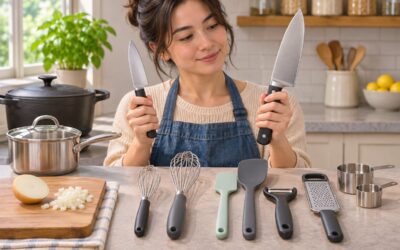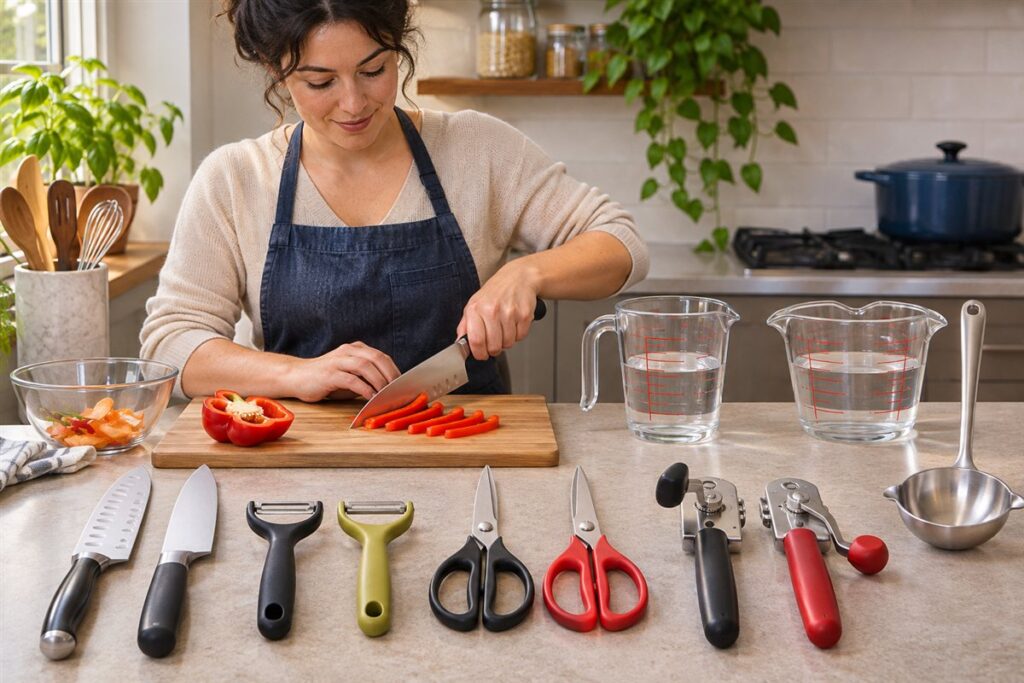
Left-handed cooks can often use standard tools, but a few designs work better in the left hand. The main things to look for are symmetrical handles, markings you can read from either side, and blades or pour spouts that suit your grip. Setting up your workspace to match your dominant hand also helps.
Tools Where Handedness Matters
Most tools are neutral, yet some are shaped for one hand. These are worth checking before you choose.
- Knives. Some blades have a bevel on one side, and a grind that suits right-handed cutting can pull food off line in a left hand. Look for a symmetrical edge or one ground for left-handed use, and check the maker’s description.
- Peelers. Swivel blades that work on both strokes are usually comfortable for either hand.
- Measuring cups and jugs. Markings on one side only can be hard to read when you pour with the left hand. Look for marks on both sides.
- Ladles and pouring spoons. Some have a pouring lip on one side. Choose a double-lipped design.
- Can openers. Standard handles often assume a right-hand turn. Look for one that is comfortable in your hand.
What to Check Before You Choose
| Factor | Why it matters | What to check |
|---|---|---|
| Handle shape | Symmetry suits either hand | Round or oval, not shaped for one grip |
| Blade edge | One-sided bevels cut off line | Maker’s note on left-handed use |
| Markings | Hard to read at the wrong angle | Marks on both sides |
| Spouts and lips | Pouring direction | Both sides or a center spout |
| Weight and balance | Control and comfort | Hold it before buying if you can |
Set Up Your Space for Left-Hand Work
- Place the cutting board so your knife hand has room on the left.
- Keep the scrap bowl on the side of your dominant hand.
- Store frequently used tools on the left of the stove.
- Turn pan handles so they do not stick out into walkways, and follow the maker’s guidance on pan use.
- Arrange work from right to left if that feels natural.
Safety Notes
Take extra care with knives, graters, and mandolines. Guards and gloves designed for right-handed use may not fit the left hand in the same way. Read the maker’s instructions and use any guard that comes with the tool. If a tool feels awkward, choose a different design instead of forcing it.
Understanding Knife Edges and Bevels
Knives are the tools where handedness matters most, and understanding the edge helps you choose. A blade can be ground on both sides evenly, which suits either hand, or ground more on one side, which can pull a cut slightly off line when used by the opposite hand. Many Western-style kitchen knives have a symmetrical or near-symmetrical edge, while some traditional Japanese styles use a one-sided bevel and come in versions for right-handed or left-handed use.
When reading a knife listing, look for words such as double-bevel, symmetrical, or ambidextrous, and check whether the maker offers a left-handed version. If the description does not say, assume a standard grind and consider asking the seller. Handle shape also matters: round or oval handles feel the same in either hand, while contoured handles shaped for a right-handed grip can feel awkward.
Serrated knives are another point to check. The bevel on a serrated blade is often on one side, and cutting direction can change how clean the slice is. Try slicing a loaf with your usual grip, and if the cut drifts, look for a design made for left-handed users or a different blade pattern.
- Hold the knife if you can and cut with it before committing.
- Look at how the guard or bolster sits against your finger.
- Sharpen to the maker’s guidance, since sharpening can change the edge.
Always cut away from yourself and keep your fingers curled under for safety.
Scissors, Peelers, and Openers
Kitchen scissors are a classic handedness issue. Standard scissors have blades set up for the right hand, so when a left-handed person uses them, the blades can push apart instead of together, making cuts ragged. Look for scissors marketed for left-handed users, or models with symmetrical handles and a blade design that works in either hand. Check that the pivot is firm and that the handles are comfortable for the full length of the job, such as breaking down poultry or trimming herbs.
Peelers come in swivel and fixed-blade types. Swivel peelers usually adapt well to either hand, and Y-shaped peelers can be comfortable if the handle is neutral. Check that the blade edge is aligned for the direction you pull, and look at the grip so your hand does not slip when wet.
Can openers vary a lot. Many manual openers assume a right-handed turn of the crank. Some left-handed cooks prefer a safe-edge opener or an electric model, which removes the issue. Read the listing to see how the handle turns and whether it is comfortable. Bottle openers, jar openers, and corkscrews are mostly symmetrical, but check that the leverage feels natural in your hand.
If an item feels awkward, try a different design, since forcing a tool often leads to slips and fatigue.
Measuring, Pouring, and Reading Markings
Measuring tools can be confusing when they are marked for one side only. Liquid measuring jugs often have a spout on the right and the scale printed on one side, so a left-handed cook may need to turn the jug to read the line. Look for jugs with markings on both sides, a spout that pours cleanly from either direction, or a design with a center spout. Clear materials make the line easier to see. Place the jug on a flat surface and read at eye level for accuracy.
Ladles and spoons with a single pouring lip are another trap. A double-lipped ladle works for either hand, and a round-bowled spoon is more neutral. Pots with pour spouts on both sides are also helpful. Check the rim shape in product photos.
Measuring spoons and cups are generally symmetrical, but long handles can be awkward in a crowded drawer, and printed numbers can be hard to read if they are engraved on only one side. Consider sets with clear, deeply marked numbers on both faces, and check whether they can be washed in the dishwasher according to the maker.
- Test a jug by pouring water from it in your usual hand.
- Prefer sturdy handles that do not twist.
- Keep a kitchen scale on hand to reduce reliance on volume marks.
Graters, Mandolines, and Guards
Graters, slicers, and mandolines combine sharp edges with repetitive motion, so comfort and safety matter. Box graters are usually symmetrical and work well for either hand, while paddle graters and microplanes may have a handle designed for a particular grip. Choose a grater with a non-slip base and a handle that you can hold comfortably with your dominant hand while the other steadies the item.
Mandolines deserve special care. Many have a guard that grips the food, but the guard may be designed for a right-handed push. Check how the guard moves and whether it can be flipped or adjusted. Cut-resistant gloves can add a layer of protection, but they are not a substitute for the guard. Follow the maker’s instructions, store blades safely, and slow down at the end of the food where the guard may no longer hold it.
For jobs where a gadget feels risky, a sharp knife and a steady board may be the better choice. Peeler-style slicers and spiralizers often have crank handles that favor one side, so look for models with a reversible crank or consider a hand-held version.
- Practice with soft foods first.
- Keep fingers away from edges and use a guard.
- Replace tools with dull or damaged blades, which can slip.
Choosing equipment that suits your hand reduces strain and risk.
Shopping Tips and Adapting What You Already Own
You do not need to replace your whole kitchen. Start by noticing which tools frustrate you: a scissor that crushes instead of cuts, a jug you cannot read, a can opener that is hard to turn. Replace those first and keep the rest. Many tools are neutral and need no change.
When shopping, read listings carefully for words like ambidextrous, left-handed, symmetrical, or reversible. Look at photos to see where markings and spouts sit. Check return policies, because fit is personal and some tools must be tried in the hand. If shopping in a store, hold the item and mimic the motion you would use at home.
You can also adapt your setup. Place your cutting board so your cutting hand has room, keep tools you reach for on your dominant side, and use a damp towel under boards to keep them steady. Rotate a jug or ladle to a better position, or choose a bowl with a spout on both sides. Sometimes simply turning a tool end for end solves the problem.
Finally, share what you learn. Many people never realize their discomfort comes from tool design. If a family member shares your kitchen, label or store left-handed tools where they will be found easily. Budget choices can focus on comfort and safety first, and extras later.
FAQ
Do I need special left-handed tools for everything?
No. Many tools work fine in either hand. Focus on knives, scissors, peelers, and measuring tools, where design can matter most.
Where can I find left-handed kitchen tools?
Some makers and specialty shops carry left-handed designs. Read product descriptions closely and ask about return options if you are unsure.
Are all kitchen knives right-handed?
No. Many Western-style knives have symmetrical edges that work in either hand. Some knives, especially those with single-sided bevels, are made in right-handed and left-handed versions, so check the listing.
Why do my scissors cut poorly in my left hand?
Standard scissors are shaped for the right hand, and the blades can push apart in the left. Look for scissors made for left-handed users or with symmetrical handles and a firm pivot.
How can I read measuring jugs more easily?
Choose a jug with markings on both sides and a clear body. Place it on a flat surface and read at eye level. A kitchen scale can also reduce reliance on volume lines.
Is a left-handed can opener necessary?
Not always, but manual openers often assume a right-handed turn. Some people prefer a safe-edge or electric model. Check the handle direction and comfort in the listing.
Are mandolines safe for left-handed cooks?
They can be if the guard works well in your hand. Check how it moves, use it every time, and follow the maker's instructions. If it feels awkward, use a sharp knife instead.
Can I sharpen a knife to suit my hand?
Sharpening affects the edge, so follow the maker's guidance or ask a professional. Avoid changing a factory bevel unless you know how. A well-kept symmetrical edge works for most cooks.
The Short Version
Choose symmetrical handles, readable markings, and blades suited to the left hand, then arrange your workspace to match. Prioritize knives, peelers, and measuring tools, and follow the maker’s safety guidance.