Disclosure: topratedkitchenware.com is reader-supported. When you buy through links on our site, we may earn an affiliate commission from Amazon and other retailers, at no extra cost to you.
Where to buy
Ask ten cooks about the best material for chopsticks and you will start an argument, because material decides almost everything about a pair: its weight, grip, heat behavior, washing rules and lifespan. This guide settles the argument the evidence-based way. Our verified pool is stainless steel in several grades — 304, 18/8 and 18/10 — and the six sets below show what steel does at its best, in different constructions. The buying guide then gives the rival materials — wood, bamboo, fiberglass, melamine — their honest hearing, so you can see exactly what steel wins, what it concedes, and which grade deserves your money.
- Lazycorner 304 Stainless Steel Chopsticks, 10 Pairs — food grade 304 steel, the reference alloy, in a ten-pair set.
- IQCWOOD 304 Stainless Steel Chopsticks, 5 Pairs — 304 steel in classic silver proportions, 9.25 inches.
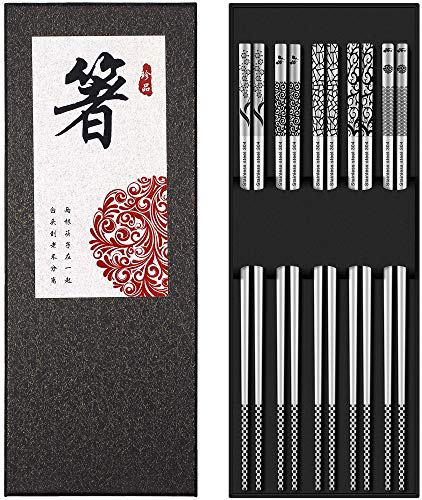
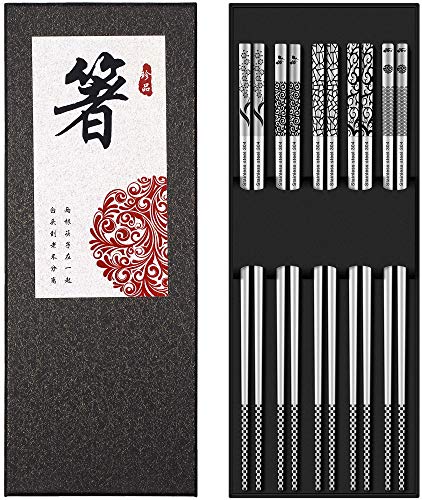
- Greatamzor 18/8 Stainless Steel Chopsticks, 5 Pairs — the classic flatware alloy, laser engraved, 9 1/4 inches.
- NEWDRIP 18/8 Stainless Steel Chopsticks, 8 Pairs — 18/8 steel in an eight-pair family rotation.
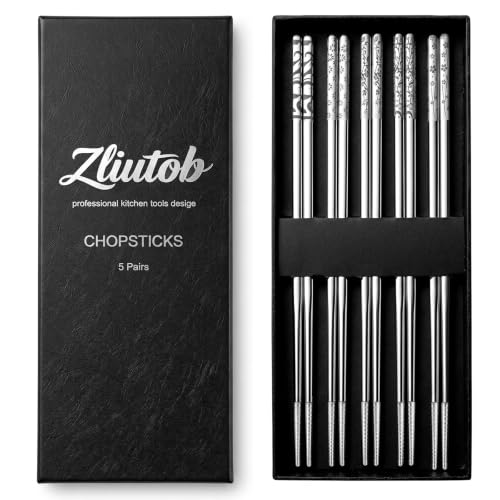
- Zliutob Stainless Steel Chopsticks, 5 Pairs — textured tips and square grip; construction as a material argument.
- LIXTONGR Dragon & Phoenix Black Stainless Steel Chopsticks, 2 Pairs — 18/10 steel, the premium alloy recipe, in a gift box.
Read the full guide ↓ for a plain-language decode of steel grades, a head-to-head of every major chopstick material, and how to match material to the way you actually eat and cook.
Every chopstick material is a bundle of trade-offs pretending to be a simple choice. Wood is warm and grippy and dies by water. Bamboo is light and renewable and frays at the tips. Plastic is cheap and cheerful and fears heat. Fiberglass is the engineer’s answer — stable, dishwasher-proof, a little soulless. And steel is the permanence play: heavier, smoother, utterly indifferent to water, heat and time. People searching for the best material for chopsticks are usually standing at a crossroads between these bundles, often after one material has disappointed them in a specific, memorable way.
This guide’s pool answers from the steel side, and we will be transparent about that: all six verified sets are stainless steel, in three named grades and several constructions. That is not a rigged game — it is the honest result of applying the criteria most buyers actually state: durability, hygiene, dishwasher tolerance, grip and value over years. But steel is not the right answer to every question, and the sections below say where the other materials genuinely win, because a material guide that only cheers for its own pool is advertising, not guidance.
Start with the science, because it is simpler than the marketing suggests. “Stainless” describes a family of alloys whose chromium forms an invisible, self-repairing oxide layer; nickel, where present, deepens corrosion resistance and brightness. The grade numbers — 304, 18/8, 18/10 — are recipes for that alloy, and learning to read them turns you from a label believer into a material judge. By the end of this guide you will know what each recipe means, what it does at the table and in the dishwasher, and why construction — hollow or solid, textured or smooth — can matter as much as the alloy itself.
Key Takeaways
- For most buyers, stainless steel is the best all-round chopstick material: it cannot splinter, warp, stain or absorb odors, and it is the only mainstream material fully at home in the dishwasher.
- Grade numbers are alloy recipes: 304 and 18/8 are near-identical workhorse grades; 18/10 adds nickel for the brightest, most corrosion-resistant finish — the LIXTONGR set is this guide’s 18/10 pick.
- Construction rivals alloy in importance: textured or engraved tips fix steel’s one real weakness, slipperiness — a point that matters doubly for delicate work like Best Material For Chopsticks Picking Up Herbs.
- Wood and bamboo still win on warmth, lightness and natural grip; fiberglass wins on heat tolerance per weight for cooking, as covered under Best Material For Cooking Chopsticks.
- There is no single best material — there is a best material per job, and the final sections match material to eater, cook and household.
- Whatever material you choose, reuse beats disposability; the long-service logic is developed under Best Material For Reusable Chopsticks.
In this guide
Quick Picks
| Pick | Badge | Material story | Link |
|---|---|---|---|
| Lazycorner 304 Stainless Steel Chopsticks, 10 Pairs | Best Reference Alloy | Food grade 304 — the grade of commercial food equipment | Check on Amazon |
| IQCWOOD 304 Stainless Steel Chopsticks, 5 Pairs | Best Classic Steel | 304 in traditional silver proportions | Check on Amazon |
| Greatamzor 18/8 Stainless Steel Chopsticks, 5 Pairs | Best Engraved Steel | 18/8 alloy with grip cut into the metal | Check on Amazon |
| NEWDRIP 18/8 Stainless Steel Chopsticks, 8 Pairs | Best Family Steel | 18/8 across an eight-pair rotation | Check on Amazon |
| Zliutob Stainless Steel Chopsticks, 5 Pairs | Best Grip Design | Textured tips and square section solve steel’s slipperiness | Check on Amazon |
| LIXTONGR Dragon & Phoenix Chopsticks, 2 Pairs | Best Premium Alloy | 18/10 — the richest recipe in this guide | Check on Amazon |
How These Picks Were Chosen
For a material guide, the shortlist method was to read listings as specifications. We required the material to be identifiable — a named steel grade, a stated construction such as hollow-core, a described grip treatment — because a material claim you cannot verify is not a claim at all. The six sets below cover the pool’s full material range: two grades of workhorse steel (304 and 18/8), the premium grade (18/10), and constructions from solid-feeling engraved sticks to a hollow-core lightweight design.
We judged each set as a material object: what the alloy promises, what the surface does, how the tips are finished, and how the whole thing will behave across years of meals and wash cycles. Set size enters only as a secondary factor — though in material terms it matters too, since rotation spreads wear across pairs, and wear is a material’s biography.
This is a research-led guide based on verified listings; we invented no laboratory tests, hardness figures or lifespan data. Where a listing leaves a specification unstated — the Zliutob set’s grade, for instance — the review says so and judges what is actually known. The wider material comparisons in the buying guide are general knowledge about how these substances behave, presented as guidance rather than as claims about specific products.
The 6 Best Chopsticks, Judged as Materials

Lazycorner 304 Stainless Steel Chopsticks, 10 Pairs
Badge: Best Reference Alloy
- Material: 304 stainless steel, food grade
- Pairs: 10
- Design: Non-slip, lightweight; heat resistant per listing wording
- Finish: Silver
- Care: Dishwasher safe; reusable for daily meals and gifts
Strengths
- 304 is the reference food alloy — the grade used for professional food equipment and dishwasher interiors themselves.
- Plain silver finish means the material is the surface: nothing applied, nothing to wear through.
- Ten pairs lets the material prove itself at full household scale.
Trade-offs
- No length is stated in the listing.
- Utilitarian presentation; the material story is told in the specification, not the packaging.
- Like all smooth-ish steel, it relies on its non-slip treatment for wet, oily foods.
If you want to understand why steel tops material rankings, start with the alloy this set is made from. 304 stainless — roughly eighteen percent chromium, eight percent nickel — is the default material of the professional food world: prep tables, sinks, commercial dishwasher racks. It earned that position by surviving exactly the conditions a chopstick faces, at industrial intensity, for decades. A home pair in 304 is, materially speaking, overqualified for the job, and overqualified is what a buy-it-for-years purchase should be.
The plain silver finish is the material purist’s choice. There is no coating between food and steel, no layer whose aging you must track; the surface that touches dinner in year five is the alloy itself, refreshed by washing. The listing’s non-slip and lightweight notes complete a sensible picture: the reference alloy, in a light, grippy, ten-pair format that treats material quality as a household utility rather than a special occasion.
Its compromises are presentational. Nothing about the set performs luxury, and the listing does not state a length, so buyers matching existing tableware should note the gap. But as an answer to the question “which material, in which product, most simply?” — 304 steel, plainly made, in depth — this set is the guide’s reference point, and the standard the more decorated picks must argue against.
Best for: material purists who want the reference food alloy at household scale / Not suited for: buyers who want ornament or gift presentation

IQCWOOD 304 Stainless Steel Chopsticks, 5 Pairs
Badge: Best Classic Steel
- Material: 304 stainless steel
- Pairs: 5
- Length: 9.25 inches (as stated in the listing)
- Design: Lightweight, non-slip tips; Korean Japanese style
- Care: Dishwasher safe; reusable
Strengths
- The same reference 304 alloy in traditional dining proportions.
- Non-slip tips show material intelligence: steel’s weakness addressed by geometry, not coating.
- Lightweight build softens steel’s weight penalty, its most common objection.
Trade-offs
- Plain silver styling offers no pattern or color.
- Five pairs is a household count, not an entertaining count.
- The brand name suggests wood while the product is steel — trust the listing.
The IQCWOOD set makes the same material argument as the Lazycorner in a more traditional dialect: 304 steel, silver, sized at 9.25 inches in the Korean Japanese dining tradition. That tradition is itself a material verdict — Korea standardized on metal chopsticks for daily eating generations ago, in a cuisine full of grilled, sauced and slippery foods, because metal’s hygiene and permanence outweighed its slipperiness once tip design adapted. This set is that adaptation in modern form: classic proportions, engineered tips.
Notice how the design spends its effort. Nothing decorates the stick; everything serves the material’s known profile. Lightweight construction answers “steel is heavy.” Non-slip tips answer “steel is slippery.” The dishwasher-safe listing answers “steel is fussy” — it is not. What remains is steel’s asset column, unobstructed: permanence, hygiene, indifference to water and heat. As a teaching example of how a good product is just a material with its objections answered, this set is the clearest in the guide.
Choose it if your material decision is already made and you want its most classic expression. Look elsewhere in this guide if you want the premium alloy (the LIXTONGR’s 18/10), a color system for a family, or a set sized for parties. And let its brand name be a small lesson in material shopping: names are marketing; the listing’s stated material — 304 stainless steel — is the fact, a habit worth carrying to every product category, including the community-vetted ones discussed under Best Metal Chopsticks Reddit.
Best for: buyers who have decided on steel and want its classic, correct form / Not suited for: buyers who want decoration or a large entertaining set
Greatamzor 18/8 Stainless Steel Chopsticks, 5 Pairs
Badge: Best Engraved Steel
- Material: 18/8 stainless steel
- Pairs: 5
- Length: 9 1/4 inches (as stated in the listing)
- Design: Laser engraved, non-slip; Japanese Korean style
- Care: Dishwasher safe
- Stated uses: Cooking and eating; gift set format
Strengths
- 18/8 is the flatware alloy — a recipe proven across a century of daily washed cutlery.
- Laser engraving modifies the material itself, so grip is a permanent property of the stick.
- Listed for cooking and eating: one material across the whole meal.
Trade-offs
- Engraved grooves need the wash to reach them; load tips-down.
- Plain steel color only, in a guide that also offers multicolor sets.
- At 9 1/4 inches it is a dining length, not a long cooking length.
Here is a small secret of steel grading: 18/8 and 304 are, for practical purposes, the same recipe wearing two naming systems — the percentage style and the grade-number style. This Greatamzor set states it as 18/8, the language of flatware, and the association is apt. Flatware is the most washed, knocked and used category of steel objects in any home, and 18/8 is its classic specification because the alloy balances brightness, corrosion resistance and formability exactly as a daily utensil needs.
What distinguishes this pick materially is the engraving. Most grip treatments are negotiations with a surface; laser engraving is a decision about the material itself — a pattern cut into the stick that cannot delaminate, peel or polish away. In material terms, it converts steel’s famous weakness into a non-issue permanently, without introducing a second material (a coating) whose aging you would then have to track. One material, modified, beats two materials laminated, almost every time, in almost every product category.
The cooking-and-eating listing widens the material’s job description: the same pair can work at the stove’s edge — turning, lifting, serving — and then sit down to dinner, then go in the dishwasher. Steel’s heat tolerance makes that plausible where plastic would fear the pan and wood would fear the wash. If your material philosophy is “one excellent substance, honestly specified, doing everything,” this set is its best expression in the pool — the same philosophy that makes steel a natural cocktail-tool material, as noted under Best Metal Chopsticks Stirring Cocktails.
Best for: buyers who value the flatware alloy and permanent, in-the-metal grip / Not suited for: buyers seeking color or a dedicated long cooking pair

NEWDRIP 18/8 Stainless Steel Chopsticks, 8 Pairs
Badge: Best Family Steel
- Material: 18/8 stainless steel
- Pairs: 8
- Length: 9.25 inches (as stated in the listing)
- Design: Laser engraved, non-slip; Japanese Korean Chinese styles
- Care: Dishwasher safe
- Stated uses: Cooking and eating; gift set format
Strengths
- The flatware alloy at family scale: eight pairs of 18/8 is a material commitment, not a sample.
- Engraved grip is permanent, so the material’s performance does not decay with washing.
- One alloy across cooking and eating simplifies care to a single rule: everything in the machine.
Trade-offs
- Plain steel only — no color system for assigning pairs.
- Eight pairs need storage that keeps the set together.
- Utilitarian in presentation despite the gift set format.
Scale is a material property too, in practice. A single pair of excellent steel proves the alloy; eight pairs make the alloy your household’s standard, with all the compounding benefits: every meal eaten with the same hygienic, dishwasher-proof material, every pair aging at one-eighth the rate of a solo pair, every guest handed the same quality as the family. The NEWDRIP set is the pool’s fullest expression of 18/8 as a system rather than a specimen.
The specification matches the ambition. 18/8’s track record is quite literally the history of washed steel cutlery, and the laser engraved, non-slip surface means the performance side of the material — grip — is engineered in rather than left to chance. The listing’s cooking-and-eating coverage adds the heat dimension: this alloy does not merely survive the dishwasher, it tolerates the stove’s edge, which is more than wood finishes or plastics can claim across a whole service life.
Its limits are aesthetic and organizational rather than material. There are no colors to assign, so the set is communal; and eight plain pairs ask for a holder, not a drawer corner. Buyers who want the same alloy with a smaller footprint have the five-pair Greatamzor above; buyers who want this scale with a color system have the multicolor sets elsewhere in the pool. As the family-scale answer to “which material?” — 18/8, in depth — this is the definitive pick, and the one most aligned with how Best Metal Chopsticks are actually bought and lived with.
Best for: families standardizing on one proven alloy for every meal / Not suited for: buyers who want color-assigned pairs or a small starter set

Zliutob Stainless Steel Chopsticks, 5 Pairs
Badge: Best Grip Design
- Material: Stainless steel (grade not stated in the listing)
- Pairs: 5
- Tips: Textured, for grip
- Profile: Square grip section
- Care: Dishwasher safe; reusable
- Stated uses: Sushi, ramen and daily meals
Strengths
- Textured tips treat steel’s slipperiness as a design problem and solve it in the metal.
- Square profile adds finger indexing and stops rolling — geometry as material performance.
- Suited by design to sushi and ramen, the slippery end of the menu.
Trade-offs
- The listing does not name a steel grade, so the alloy recipe is unverifiable from the listing alone.
- No length is stated.
- Square sections feel unfamiliar for the first few meals.
The Zliutob set is this guide’s argument that material is only half the story. Its listing does not name an alloy grade — we flag that honestly, because in a material guide an unnamed grade is a missing datum — yet its design shows a deeper material literacy than many graded competitors: it understands that stainless steel’s weakness is not corrosion or strength but friction, and it attacks friction with form. Textured tips multiply the contact grip at the eating end; a square grip section gives fingers flat faces to register against. The result is steel that behaves, in the hand, almost like wood — while keeping every one of steel’s structural advantages.
That makes it the connoisseur’s teaching example. Buyers often ask whether they should prioritize grade or design, and this set is the case for design: a perfectly graded stick with mirror tips will still skate on a salmon slice, while this set’s geometry holds it. For sushi and ramen — the listing’s own stated territory, and the slipperiest ordinary test a chopstick faces — geometry is the material property that matters at the moment of the bite.
The reservation stands, and it is the mirror of the design praise: without a named grade, you are trusting the generic stainless claim for corrosion behavior, and the care guidance later in this guide (wash and dry, do not soak for days) matters more for this set than for the named alloys. Buy it for its intelligence of form; maintain it with a touch more diligence; and it will reward both decisions daily.
Best for: buyers who rank grip and control as the material properties that matter most / Not suited for: buyers who require a named alloy grade on the listing

LIXTONGR Dragon & Phoenix Black Stainless Steel Chopsticks, 2 Pairs
Badge: Best Premium Alloy
- Material: 18/10 stainless steel
- Pairs: 2
- Length: 9 inches (as stated in the listing)
- Grip: Non-slip
- Care: Dishwasher safe
- Presentation: Gift box; dragon and phoenix design in black
Strengths
- 18/10 carries the highest nickel content here — the recipe for the brightest, most corrosion-resistant surface.
- The black dragon and phoenix design makes the alloy a kept object, stored and treated accordingly.
- At 9 inches, a precise table length that flatters the material’s fine finish.
Trade-offs
- Two pairs only: the premium alloy in a precious, not household, format.
- The black finish is a surface treatment over the steel; abrasive care is its enemy.
- Premium recipe, premium role — not the set to equip a crowd.
Every material family has its top recipe, and in stainless steel it is 18/10. The extra nickel over the 18/8 standard buys two things a material buyer should care about: deeper resistance to the slow corrosion that acidic foods and years of washing can coax out of lesser alloys, and a brighter, richer surface — the visual difference between good steel and fine steel. The LIXTONGR set is this guide’s only 18/10 pick, and it wears the recipe in a format that suits it: two pairs, black, dragon and phoenix, boxed for giving.
The design intelligence here is that presentation protects material. A set that lives in a gift box, brought out for meals that matter, accumulates none of the drawer damage that ages everyday utensils; the premium alloy is paired with a premium ownership pattern. The non-slip grip keeps the object honest as a tool — this is fine steel that still has to lift dinner, and does.
Its trade-offs are the format’s, not the alloy’s. Two pairs cannot be a household system, and the black finish, while striking, is a surface that asks for non-abrasive care to stay deep and even. Buy the 18/10 for the material summit and the occasions that deserve it; buy the 304 and 18/8 sets above for the daily trenches. A drawer containing both is, materially speaking, a complete answer.
Best for: buyers who want the finest steel recipe in the pool, kept and gifted properly / Not suited for: households needing many pairs in daily rotation
Comparison Table
| Pick | Material (as listed) | Pairs | Length (as listed) | Signature trait | Link |
|---|---|---|---|---|---|
| Lazycorner | 304 stainless steel | 10 | Not stated | Reference alloy at scale | Check on Amazon |
| IQCWOOD | 304 stainless steel | 5 | 9.25 inches | Classic proportions | Check on Amazon |
| Greatamzor 18/8 | 18/8 stainless steel | 5 | 9 1/4 inches | Engraved grip | Check on Amazon |
| NEWDRIP 18/8 | 18/8 stainless steel | 8 | 9.25 inches | Family rotation | Check on Amazon |
| Zliutob | Stainless steel, grade not stated | 5 | Not stated | Textured tips, square grip | Check on Amazon |
| LIXTONGR | 18/10 stainless steel | 2 | 9 inches | Premium alloy, gift box | Check on Amazon |
How to Choose the Right Chopstick Material
Choose by failure mode: ask how each material dies, and pick the death you can live with. Wood dies by water — splintering, warping, finish loss — on a timeline of months to a few years of daily use. Bamboo dies by fraying at the tips. Plastic dies by heat and scuffing. Fiberglass dies slowly, at the tips, after long and honorable service. Steel does not die in normal use at all; it merely accumulates cosmetic history. If your instinct is to buy once and stop thinking, the material decision makes itself, and the remaining questions are grade and geometry.
Within steel, grade by environment. A household that dishwashes daily and eats plenty of acidic, salty food is a corrosion-forward environment: named grades earn their keep, with 18/10 at the summit, 304 and 18/8 as the proven standard. A gentler household — hand washing, milder menu — can relax about grade and prioritize design, which is where the Zliutob’s textured geometry shines. Neither priority is wrong; they are answers to different kitchens.
Then be honest about the senses. Steel is cool, smooth and comparatively heavy; some eaters never love it, and a material you dislike is a bad material for you regardless of its specification sheet. If warmth and featherweight matter most and you accept a shorter service life, wood or bamboo is a legitimate choice — buy it knowingly, hand wash it, and replace it without resentment when its time comes. If heat work at the stove dominates, read the cooking-specific analysis before deciding, because the pan changes the material equation entirely.
How to Identify and Care for Your Chopstick Material
Identification first, because care follows material. Steel is cool to the touch, rings faintly when tapped, and is drawn to nothing — a magnet test is unreliable for food grades, so judge by weight, temperature and surface. Wood and bamboo show grain and warm quickly in the hand. Fiberglass composites feel dense and slightly silky, often with a matte finish. Melamine is light, hard and warm-sounding when tapped. If a listing names the material — as all six here name theirs — believe the listing over the brand name or the product photo.
Care, by material, in brief steps. For steel: wash by hand or machine, dry to prevent water spots, do not leave soaking in dirty water for days, and store out of the rattle pile. For wood and bamboo: hand wash promptly, dry upright, never soak, and retire the pair when tips fray. For fiberglass: machine wash freely, avoid using tips as pry tools, and retire if the tip surface roughens. For melamine and plastic: keep away from pan heat and high-heat cycles, and retire warped pairs without nostalgia.
Troubleshooting. Problem: a steel pair shows a faint rust freckle → it is surface contamination or a lesser-grade scratch story; scrub gently with a baking soda paste, dry fully, and end any soaking habit. Problem: wooden pair smells of old meals → the material has absorbed its history; a lemon-and-salt rub helps briefly, but absorption is wood’s nature and replacement is the real answer. Problem: any pair no longer lies straight → heat or water has won; a warped chopstick cannot be un-warped reliably, whatever the material, which is precisely the failure steel exists to prevent.
The Rival Materials, Honestly Assessed
Wood first, because it is the incumbent. Its virtues are real: warmth, lightness, a naturally grippy surface, quiet against bowls, and centuries of craft tradition. Its costs are structural: it is a once-living fiber that drinks water, and everything about its aging — swelling, cracking, splintering, absorbing — follows from that single fact. Lacquer postpones the reckoning and adds beauty, at the price of a finish that can chip. Choose wood for the hand feel and the table aesthetic, with eyes open about service life.
Bamboo is wood’s lighter, faster-growing cousin: harder than many woods, very light, inexpensive to replace, and the kindest environmental story among the disposables-adjacent options. It frays at the tips and dislikes soaking and dishwashers, so its life is the shortest of the reusables — a fair trade for some households, a false economy for others. Fiberglass is the modern engineer’s candidate: a composite that tolerates heat, water and the dishwasher while staying light, and the strongest non-metal in this comparison; its deficits are a certain characterlessness and tip wear over long use. Melamine and plastics serve beginners and children well — light, forgiving, cheap to replace — and should be kept from serious heat.
Steel’s honest deficits complete the picture: it is the heaviest mainstream material, the smoothest (hence this guide’s obsession with textured tips), the loudest against ceramic, and a conductor that warms in hot broth. The six picks above are what a market looks like when it has spent years engineering around exactly those four deficits — hollow cores for weight, engraving and texture for grip, and grades for glory. Judge the material by its best implementations, and steel earns its ranking; judge it by a cheap, smooth, solid pair, and you will understand every wood loyalist you have ever met.
Material by Dish: Matching the Pair to the Food
The abstract material debate becomes practical the moment a menu appears. Start with noodle soups — ramen, pho, udon — where the chopstick works in hot broth, lifting heavy, slippery strands. Steel earns its place here: it does not absorb broth, does not soften, and its textured tips, as on the Zliutob and engraved sets, grip wet noodles that defeat smooth wood polished by years of use. The one caution is conduction: a steel pair resting in a hot bowl warms along its length, so rest it on the bowl’s rim or a rest between bites, a habit that costs nothing.
Sushi and sashimi reward precision and cleanliness. Steel’s non-porous surface is the hygienic choice for raw fish, and the shorter, finer control of the 9-inch LIXTONGR or the textured Zliutob suits the one-bite geometry of nigiri. Korean barbecue and grilled dishes are metal’s ancestral home: the pair works near heat, among sauces and marinades that would stain wood permanently, and comes back from the dishwasher unmarked. Dumplings and dim sum ask for tip grip above all — a thin-skinned parcel punishes both the too-smooth stick that drops it and the too-forceful squeeze that tears it; textured steel, used lightly, threads that needle.
Salads, grain bowls and Western crossover meals are where steel’s weight can actually help, giving purchase on dense, chopped ingredients, while delicate desserts and soft cheeses are where a lighter hand — and often the hollow-core or lightweight builds in this pool — keeps the material’s firmness from becoming clumsiness. The pattern across the menu is consistent: the more heat, moisture, sauce and washing a dish involves, the stronger steel’s case; the quieter and drier the meal, the more wood’s warmth gets its hearing. Most households eat across that whole map, which is why a steel set as the default, with the material literacy to know its edges, serves better than any single-material dogma.
Weight, Balance and Sound: The Forgotten Material Properties
Material discussions fixate on durability and hygiene, but three quieter properties decide whether you will love a pair daily. The first is weight distribution. A chopstick is a lever held near one end; material density sets its heft, and construction sets where that heft sits. Solid steel concentrates authority at the tips, which some experienced users love for dense foods. Hollow-core steel — the MUYOS approach in the wider pool, echoed by the lightweight builds here — moves the experience toward wood’s float while keeping steel’s surface. Neither is objectively better; they are different instruments, and hand size and meal length decide between them.
The second is sound. Metal on ceramic rings; wood whispers. In a quiet dining room, at a formal table, or with a sleeping household beyond the door, the acoustic signature of your material is a real feature. Steel users learn small courtesies — setting pairs on rests, not tapping bowls — the way glass users learn not to slam doors. The third is temperature: steel arrives cool, warms to the meal, and announces hot broth honestly through the fingers; wood insulates and says nothing. Cooks tasting from a pan sometimes prefer that honesty, which is one reason steel persists at the stove’s edge despite wood’s insulation advantage.
None of these properties appears in a grade number, which is the final lesson of this guide: a material is a recipe plus a construction plus a set of physical behaviors, and the listings that tell you the most — grade, build, tip treatment, stated uses — are the ones worth your trust. The six picks above were chosen because their listings answer those questions. Whatever you buy next, in any category, ask the same questions and you will rarely be disappointed by a material again.
Common Buying Mistakes
- Treating “stainless” as a single material. Grades are recipes; 18/10, 18/8, 304 and unnamed steel are related, not identical.
- Ignoring tip design because the alloy is good. Grip is geometry. A premium alloy with mirror tips still skates on oily food.
- Buying wood for a dishwasher household. The material and the machine are incompatible; the pair will lose.
- Trusting a brand name over the stated material. Names are marketing — one pick here is steel from a brand named for wood.
- Assuming heavier means better. Hollow-core construction shows that design can deliver steel’s permanence without its full weight.
- Demanding one material for every job. Eating, cooking and delicate serving reward different properties; match material to task.
Final Recommendation
If you want the material answer in its purest form, take the Lazycorner 304 set — the reference food alloy, plainly made, in depth. For the classic dining expression of the same alloy, the IQCWOOD set is the connoisseur’s quiet choice, and for the summit of the steel family, the LIXTONGR 18/10 set is the pair to keep and to give. Choose the engraved Greatamzor or the eight-pair NEWDRIP if 18/8’s flatware pedigree and family scale speak to you, and the Zliutob if you believe — as this guide does — that geometry is a material property too. Whichever you pick, you now know how to read what you are buying: recipe, construction, finish. That literacy outlasts any single set.
And if, after all this, your hand still reaches for wood at a favorite restaurant and loves it — believe your hand. Material guides exist to make choices informed, not to make them for you. The best material for chopsticks is the one whose trade-offs you understand and accept, used with the care that material asks for. On the evidence of grades, constructions and lifetimes assembled here, steel simply asks for the least and gives back the most, for the most people, for the longest time.
Frequently Asked Questions
What is the best material for chopsticks overall?
For the combination most buyers want — durability, hygiene, dishwasher tolerance and grip — stainless steel is the strongest all-round answer, which is why all six verified picks here are steel. Wood and bamboo remain better if warmth, lightness and natural texture matter more than lifespan, and fiberglass is a strong specialist for cooking.
What do the steel grades 304, 18/8 and 18/10 actually mean?
They describe the alloy recipe. The numbers in 18/8 and 18/10 are the chromium and nickel percentages: chromium creates stainless steel’s self-repairing protective layer, and nickel deepens corrosion resistance and brightness. 304 is a grade designation for essentially the 18/8 recipe. 18/10, with more nickel, is the premium recipe — brighter and more resistant over years of washing.
Are metal chopsticks harder to use than wooden ones?
They are different, mainly in two ways: steel is heavier and its surface is smoother. Modern designs answer both — hollow-core and lightweight builds trim the weight, and textured or engraved tips supply the grip that smooth wood has naturally. Most users adapt within a few meals, and many come to prefer the precision.
Is bamboo more environmentally friendly than steel?
Bamboo grows fast and is renewable per pair, but bamboo pairs are replaced far more often. A steel pair’s footprint is front-loaded in manufacture and then amortized over years — potentially decades — of daily use. Over a long horizon, the durable object is usually the sustainable one; over a short horizon, bamboo’s renewable story is real. Both guides in this series treat longevity as the deciding variable.
Can steel chopsticks be used for cooking?
Steel tolerates heat far better than plastic and does not fear water like wood, and several sets here are listed for cooking and eating. Two cautions: steel conducts heat, so a pair left in a hot pan warms up, and dining lengths are not dedicated long cooking lengths. For serious stove work, the cooking-specific material analysis is worth reading before you buy.
Why does one pick not state its steel grade, and should that stop me?
The Zliutob listing specifies its construction — textured tips, square grip — without naming an alloy. That is a missing datum, not a disqualification: the design is genuinely strong, and ordinary care (wash, dry, no long soaking) protects ungraded stainless in practice. If a named recipe is a requirement for you, the 304, 18/8 and 18/10 picks in this guide all provide one.
Do steel chopsticks damage bowls or pans?
Steel is harder than ceramic glaze and nonstick coatings, so energetic scraping is unkind to both — use the pair’s tips with the same respect you would give a metal spoon, and avoid sawing at nonstick surfaces. At the table, the main effect is acoustic: metal on ceramic rings more than wood. Neither issue is a material flaw; both are manners the material asks for.
Which material is best for children learning chopsticks?
Learning rewards lightness and grip, which is why many children start on wood, bamboo or trainer designs. Within this guide’s steel pool, the lightweight builds and textured tips are the friendliest starting points, and steel’s permanence means the learning pair can become the keeping pair. Whatever the material, a slightly shorter pair and a textured tip shorten the road to the first successful noodle.
How do I know if a “stainless” listing is a good grade?
Look for the recipe in words: 304, 18/8 and 18/10 are the named grades you can hold a maker to, and their presence in a listing is itself a quality signal. If a listing says only “stainless steel,” judge the rest of the specification — construction, tip treatment, stated care — and apply ordinary steel care. Four of the six picks in this guide name their grade; the other two specify their construction in detail instead.