Disclosure: As an Amazon Associate, topratedkitchenware.com earns from qualifying purchases. Links on this page are affiliate links; they cost you nothing extra. Prices and availability change often, so check the current Amazon listing before you buy.
Any honest account of cast iron griddle pros and cons has to start with a confession: the same slab of iron is responsible for both columns. The mass that makes a cast iron griddle sear so beautifully is the mass that makes it heavy. The seasoning that releases pancakes so cleanly is the seasoning you have to protect from soaking. The durability that lets the pan outlive its owner comes with a preheat that cannot be rushed. This article works through both sides in full — seven genuine advantages and seven genuine disadvantages, each explained rather than merely listed — and then translates the balance into advice for different kinds of cooks, because whether the pros outweigh the cons depends almost entirely on who is cooking and what is for breakfast.
The short verdict, for readers in a hurry: a cast iron griddle suits you if you cook breakfast foods, burgers, sandwiches or flatbreads several times a week, if you value browning quality over speed, and if a short wash-dry-oil routine sounds like a fair trade for a pan that lasts decades. It does not suit you if you need a pan that heats in a minute, goes in the dishwasher, or can be lifted with one hand while full. Everyone in between should read the two lists carefully, because the deciding factor is usually one specific con — weight, glass-top risk or the seasoning learning curve — rather than the overall balance.
Key Takeaways
- The headline pro is heat. No common pan material holds a searing temperature through a full batch of cold food the way cast iron does, and browning quality is the main reason owners stay loyal.
- The headline con is weight. A loaded cast iron griddle is a two-handed, mitt-on lift, and that single fact rules the pan out for some cooks regardless of its virtues.
- Seasoning is a curve, not a chore. The surface starts good and becomes excellent with fatty cooking, but the first weeks demand patience and the pan never tolerates soaking or dishwashers.
- Durability is unmatched. There is no coating to wear out and no electronics to fail; damage is almost always cosmetic and repairable at home.
- Format decides the balance. Several cons — uneven middles, ridge cleaning, glass-top risk — belong to specific formats, so the right model can delete the cons that would have bothered you most.
In this guide
Cast Iron Griddle Pros and Cons at a Glance
Before the detail, the map. On the pro side: exceptional heat retention and searing; even, repeatable browning across batches; a cooking surface that improves with use and never wears out; true multi-heat-source versatility from stovetop to campfire; open spatula access and batch capacity; and lifetime durability that makes the pan one of the cheapest per-year purchases in the kitchen. On the con side: serious weight; slow preheating and slow temperature corrections; a care routine that forbids soaking and dishwashers; rust if the pan is stored wet; handles that get as hot as the cooking surface; uneven heat across the middle of double-burner models; and a learning curve before delicate foods release cleanly.
Notice how few of these are about cooking quality, and how many are about handling and habits. That is the pattern with mature, simple tools: the cast iron griddle’s performance ceiling is high and its failure modes are mostly about fit between the pan and the cook’s routines. The sections that follow take each pro and con in turn, with the practical detail you need to judge whether it will matter in your kitchen. Readers who want the purchasing version of this analysis can jump to the cast iron griddle buying guide, and those who want model-by-model performance notes will find them in the cast iron griddle reviews.
The Pros
Pro 1: Heat Retention That Transforms Searing
This is the pro that sells the pan, and it is physics rather than marketing. Cast iron stores a large amount of heat in its mass, so when cold food lands on the surface, the temperature dips only slightly and recovers immediately. Burgers develop a deep crust instead of steaming in their juices. Pancake batter sets on contact and browns evenly rather than paling at the edges. Bacon renders steadily without the violent temperature swings that make thin pans alternately burn and undercook. Once you have cooked a batch breakfast on iron that was properly preheated, the difference from a thin non-stick pan is not subtle — it is the difference between food that is cooked and food that is browned, and browning is where flavour lives.
The retention advantage compounds across a batch. On a lightweight pan, each successive load of cold food drags the surface temperature further down, so the last pancakes are paler than the first. On cast iron, the reservoir refills between batches from the burner while the mass smooths the peaks and troughs, and the sixth pancake browns like the first. For anyone who cooks for a family or a table of guests, this consistency — not raw maximum heat — is the everyday dividend, and it is the main reason griddle owners describe the pan as making them look like better cooks than they are.
Pro 2: A Surface That Improves Instead of Wearing Out
Every coated pan in your kitchen is on a countdown: the non-stick surface that releases eggs beautifully this year will release them reluctantly in a few years and will eventually be discarded. A cast iron griddle runs the opposite direction. Its seasoning — layers of polymerised oil bonded to the iron — is renewed a little with every fatty meal, so the pan you have owned for five years releases food better than the pan you unboxed. Minor damage is not fatal either: a scorched patch, a rust spot or a sticky mistake can be scrubbed back and re-seasoned at home, returning the surface to service. There is no equivalent rescue for a scratched coating.
This improvement curve changes the economics and the feel of ownership. The griddle becomes a known tool whose behaviour you have learned and whose surface your cooking has literally built. Cooks routinely describe decades-old griddles as the best pan they own, and they are not being sentimental — the surface genuinely is better than new. For a category of cookware where the premium alternatives are defined by how slowly they degrade, a pan that appreciates with use is a rare and real advantage.
Pro 3: Durability Measured in Decades
A cast iron griddle has no coating to chip, no electronics to fail, no thermostat to drift, no plastic parts to melt and no seams to separate. Short of being cracked by a severe drop onto concrete or thermal shock, it cannot really be destroyed by cooking. It tolerates metal utensils, broiler heat, oven roasting, grill grates and open flame. Vintage griddles cast generations ago are still in daily service in home kitchens, still flat, still seasoned, still browning pancakes — a working lifespan no other common cookware category can match.
Durability also means tolerance for abuse and accident. Forget the pan on the heat, scorch food onto it, leave it in a hot oven overnight: the iron shrugs off all of it after a scrub and a fresh film of oil. In a kitchen where tools get borrowed by teenagers, taken camping and pressed into service for jobs they were not designed for, that forgiveness has practical value that never appears on a specification sheet. The environmental arithmetic follows naturally — a pan bought once, possibly second-hand, and never landfilled is the sustainable option almost by definition.
Pro 4: Versatility Across Every Heat Source
Few pans move between heat sources as freely as a cast iron griddle. It works on gas, electric coil, radiant glass and induction stovetops; it slides into the oven to finish a steak or keep pancakes warm; it goes under the broiler without complaint; it sits on a grill grate for smash burgers outdoors; and it works over a campfire, where its mass smooths the fire’s uneven heat into something cookable. One pan therefore covers the weekday breakfast, the oven-finished dinner and the camping trip, which is exactly the profile that earns permanent stovetop residence.
The oven dimension deserves emphasis because cooks underuse it. A griddle preheated in a hot oven becomes a pizza steel for flatbreads and reheated slices, a baking surface for biscuits and scones, and a warming plate that holds a whole breakfast at serving temperature while the last eggs cook. None of this requires a special technique — just the recognition that the pan’s safe temperature range has no practical ceiling in a home kitchen. Pans with coated surfaces, plastic handles or electronic controls simply cannot follow it into these roles.
Pro 5: Open Access and Real Batch Capacity
The griddle’s defining geometry — a broad, nearly wall-less surface — is a genuine ergonomic advantage. A spatula approaches food at a shallow angle and slides underneath cleanly, so pancakes flip without tearing, eggs turn without breaking, and burgers can be smashed flat against the iron for maximum crust contact. In a walled skillet, the same manoeuvres fight the pan’s sides, and the spatula arrives at an angle that pushes food around instead of lifting it. Anyone who has flipped a full load of pancakes both ways understands immediately why short-order cooks have always worked on flat tops.
Capacity follows from the same openness. Foods can be arranged in rows, moved between hotter and cooler zones, and cooked in overlapping stages — bacon rendering at one end while hash browns crisp at the other, finished items holding in the warm zone while the last batch cooks. This zoning turns one pan into a small production line, and it is why the griddle, more than any other single pan, can produce a complete hot breakfast for a family without a queue of skillets rotating through the sink.
Pro 6: Honest Value Over Its Working Life
Judged per year of service rather than per purchase, a cast iron griddle is among the cheapest serious tools in the kitchen. Even a premium model, divided across the decades it will serve, costs very little annually; an entry-level model from a major foundry costs less per year than the replacement cycle of a single coated pan. There are no consumables, no proprietary parts and no maintenance products required beyond the cooking oil already in the cupboard. When a griddle does change hands — passed to a child setting up a first kitchen, or bought second-hand — it carries its full value with it, because the surface improves rather than expires.
The value case strengthens when you count the pans it replaces. A household that cooks breakfasts, burgers and flatbreads on one griddle may never buy the dedicated electric appliance, the sandwich press or the replacement non-stick pan every few years. Against that basket, the iron pays for itself quickly and then keeps paying. Our dedicated value analysis, is a cast iron griddle worth it, runs this arithmetic for different household types in more detail.
Pro 7: Flavour From Real Contact Browning
The final pro is the one cooks talk about most and specifications capture least: food from a well-run cast iron griddle tastes distinctly better. The mechanism is the Maillard reaction — the browning chemistry between proteins, sugars and high, dry heat — and cast iron’s contribution is delivering that heat steadily and recovering it instantly after each flip. Potatoes develop glassy, crisp edges. Onions sweeten and char at the tips. Cheese skirts on a grilled sandwich go lacy and crunchy. Tortillas blister properly. These are small luxuries, but they are the difference between a breakfast people eat and a breakfast people ask for, and they are available every single day from a pan that asks only to be preheated properly.
The Cons
Con 1: The Weight Is Real and Permanent
There is no way to soften this one: cast iron griddles are heavy, double-burner models especially so, and the weight is at its worst exactly when you can least avoid it — when the pan is hot, full of food and grease, and must be moved from burner to trivet or tilted to drain fat. For cooks with limited wrist, hand or shoulder strength, a loaded double-burner griddle can be genuinely unsafe, and no technique fully compensates. Mitigations exist — choose a single-burner format, look for generous helper handles, slide rather than lift where the stovetop allows, and store the pan on the stovetop so it rarely travels — but a buyer for whom weight is a medical rather than a comfort issue should take this con as decisive and look at lighter materials.
Weight also has quieter costs. A heavy griddle is a hazard to glass-ceramic hobs if it is ever set down carelessly or dropped, and it discourages the quick rinse-and-shake washing style that light pans allow. Households where several people of different strengths share cooking duties should choose the format the weakest regular cook can handle safely when the pan is hot and loaded — not the format the strongest cook can manage empty and cold in the shop.
Con 2: Slow to Heat, Slow to Correct
Cast iron’s thermal mass is a commitment in both directions. A proper preheat takes several minutes — longer for a double-burner pan — and a cook who turns the burner to maximum to hurry it along creates a scorched centre and cool edges, the worst of both worlds. If you overshoot and the pan becomes too hot for eggs, there is no quick fix: the iron will shed its excess heat on its own schedule while the butter browns in the pan. Cooks raised on thin, responsive pans often find this rhythm frustrating for the first weeks, and breakfast in a genuine hurry is the scenario where the con bites hardest.
The fair counterweight is that the slowness is predictable. Once you learn your burner’s settings, the preheat becomes a background task that runs while coffee brews and ingredients come out of the fridge, and the stability that replaces responsiveness is precisely what makes batch cooking consistent. But honesty requires naming the trade: a cast iron griddle rewards cooks who plan five minutes ahead and punishes improvisation, and no amount of seasoning changes that.
Con 3: Seasoning and the No-Soak Rule
The care routine is short but non-negotiable, and it is incompatible with two common kitchen habits: soaking and the dishwasher. A cast iron griddle left sitting in water will rust; a trip through the dishwasher strips seasoning and invites rust on a larger scale. The required routine — wash warm with a brush, dry on the burner, wipe with a whisper of oil — takes only a couple of minutes, but it must happen every time, including tired evenings after big meals. Households that rely on soaking pans overnight to deal with cooked-on food will find the griddle’s demands genuinely annoying, and cooks who share a kitchen with people who will not learn the rule face recurring rust-removal sessions.
New owners also face the seasoning learning curve. Factory pre-seasoning is a foundation, not a finish, and in the first weeks delicate foods — eggs especially, and fish — may stick more than expected. This is the phase where many griddles are unfairly judged and returned. The surface improves steadily with fatty cooking, and the guidance in how to care for cast iron cookware shortens the curve considerably, but a buyer who needs flawless egg release on day one, with zero technique adjustment, is shopping for a coated pan and should know it.
Con 4: Rust Is Always Waiting
Bare iron plus water plus time equals rust, and a griddle offers rust a large, flat invitation. The risk points are mundane: the pan left to air-dry on the draining board, the ridged underside of a reversible model sitting in a damp sink, the griddle stored in a humid cupboard near the kettle. Surface rust is not damage — it scrubs off and the pan re-seasons — but it is unsightly, it transfers to food if ignored, and deep pitting from long neglect is genuinely hard to reverse. The prevention is entirely habitual: dry on the burner, every time, and store dry. Cooks in humid climates or with steamy, poorly ventilated kitchens should count this con a little more heavily, and anyone buying a griddle as a gift for a low-maintenance household should think twice.
Con 5: Every Handle Is a Hot Handle
On a cast iron griddle the handles are part of the casting, which means they reach cooking temperature along with the surface. There is no cool-touch grip to grab absent-mindedly, and the classic kitchen accident — bare hand on a handle that looks exactly as it did when cold — is a real rite of passage for new owners. Mitts or handle covers are not optional accessories; they are part of the tool. Some premium designs use spring handles that run cooler, and silicone covers help, but the discipline of treating the whole pan as hot must become automatic. Households with children who are beginning to cook should factor in this supervision cost honestly.
Con 6: The Middle of a Double-Burner Griddle Runs Cooler
Physics again: on a double-burner griddle, the strip of iron between the burners receives no direct heat, and cast iron — contrary to its reputation — is only a moderate conductor, so that centre strip runs noticeably cooler than the ends. Buyers who expect one uniform sheet of heat will burn pancakes at the ends while the middle row pales. Experienced owners turn the flaw into the zoning system described earlier in this article, but it is a technique to be learned, and it never fully disappears. If your cooking demands true uniformity across a large surface — competition pancakes for a crowd, say — a thermostat-controlled electric griddle genuinely does that one thing better, and best electric griddles is the fair place to compare.
Con 7: Not the Pan for Sauces, Simmers or Delicate Saucy Work
A griddle’s openness, celebrated in the pros, is a hard limit here: liquids run to the edges and off them. There is no deglazing a griddle into a pan sauce, no simmering, no braising, and only shallow frying before grease threatens the rim. Long-simmered acidic foods are also unkind to seasoning, though a flat griddle rarely meets them. The practical meaning is that a cast iron griddle is a specialist that must live alongside a walled pan, not a replacement for one — the pairing question is explored in the cast iron skillet review. Buyers furnishing a first kitchen on a tight budget should sequence the skillet first and the griddle second, because the skillet’s range covers more of a typical week.
What the Trade-Offs Mean for You
The daily breakfast cook gets the best of this bargain. Your use pattern — frequent, dry, batched cooking — plays entirely to the pros: heat retention, zoning, spatula access and a surface that improves under exactly the fatty, regular use you give it. The cons shrink to the two-minute wash routine. For this cook the verdict is not close.
The occasional weekend cook faces a fairer fight. The pros still apply on the mornings you cook, but a pan used twice a month builds seasoning slowly, and its storage weight is paid every day for benefits collected rarely. If your weekend cooking is a genuine ritual — pancakes for the family, burgers for friends — the griddle earns its space. If it is an aspiration you mostly do not act on, the honest answer is that a good skillet covers the occasional breakfast with less commitment.
The glass-top and induction household must weigh two cons together: scratch risk from sliding and the sheer set-down weight on glass. Both are manageable with a smooth-based, flat griddle, a strict lift-don’t-slide habit and preheating on medium — thousands of households cook this way daily. But if the hob is new, expensive and shared with less careful cooks, the risk calculus may fairly point elsewhere, and that is a legitimate decision rather than a failure of nerve.
The camper and outdoor cook inverts the usual balance: weight matters less in a vehicle, open-flame versatility matters more, and the care routine is easier outdoors where the pan dries by the fire. For this cook even the reversible format’s cleaning penalty fades, because the ridged side genuinely earns its keep over a grate. The pros dominate.
How a Cast Iron Griddle Compares With the Alternatives
| Option | Where it beats cast iron | Where cast iron wins |
|---|---|---|
| Electric griddle | Thermostatic control; very large uniform surface; no stovetop needed | Searing quality, durability, oven and outdoor use, no coating to wear |
| Non-stick griddle pan | Light weight; instant egg release; dishwasher tolerance | Heat retention, browning, metal utensils, lifespan measured in decades |
| Carbon steel griddle | Lighter; faster temperature response; smoother factory finish | Heat retention through big batches; more forgiving seasoning; lower cost |
| Cast iron skillet | Walls for sauces, frying depth and simmering | Spatula access, batch capacity, zoning across a wide flat surface |
The table’s pattern is consistent: alternatives beat the cast iron griddle on convenience axes — weight, speed, automation — and lose on performance and longevity axes. That is why the pros-and-cons question cannot be answered in the abstract. Cooks who rank convenience first should believe their own ranking and buy accordingly; cooks who rank the food itself first will find every convenience concession in this article repaid at the table.
How to Buy Smart: Choosing the Model That Minimises Your Cons
Because several cons are format-specific, buying well means deleting the disadvantages that would bother you personally. Hate the idea of an uneven middle? Buy a single-burner griddle and the con disappears. Dread cleaning ridges? Buy flat-only. Cook on glass? Prioritise a smooth, machined base and manageable size. Struggle with weight? The compact single-burner formats, lifted with two hands and stored on the stovetop, reduce the burden to its minimum. It is also worth deciding in advance who else will use the pan: a griddle bought for a household should be liftable, at its working weight, by every regular cook in that household, and that single test eliminates more wrong purchases than any other question in this article. Three current models illustrate the balancing act — each is a prose recommendation, so check price on Amazon before deciding.

Lodge Double Play Reversible Griddle
The category’s reference design accepts the double-burner trade-offs knowingly: you get maximum batch capacity and zoning in exchange for the cooler middle and the heaviest lift in the line-up. For a gas-stove family that cooks breakfast in volume, the pros land exactly where they matter. Tier: mid-range.

Victoria Cast Iron Griddle
Victoria’s single-burner griddle deletes several cons at once — even single-burner heat, a lighter lift, and a long handle that improves control — while keeping the searing and durability pros intact. It is the balance point for smaller households and flatbread specialists. Tier: mid-range.
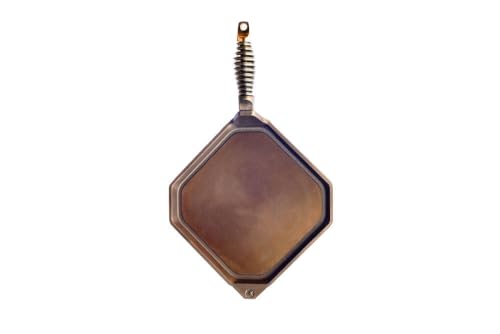
FINEX Cast Iron Griddle Pan
The premium option attacks the seasoning learning curve directly: its machined, polished surface releases delicate foods sooner than textured castings do, and its spring handle runs cooler. You pay a premium tier price for shaving down two cons — early sticking and handle heat — while keeping every structural pro. Tier: premium.
Setup and Care That Reduce the Cons
Half the cons in this article shrink under good habits. Preheat on medium while you prepare ingredients and the slow-heating con becomes invisible. Cook fatty foods for the first few weeks — bacon, burgers, sautéed onions — and the seasoning curve flattens dramatically; save the egg exam for a surface that has passed its apprenticeship, then use the technique in how to make pancakes on a griddle as your model: steady heat, a film of fat, and patience before flipping. Wash warm, dry on the burner without exception, and rust never gets its opportunity. Keep mitts hanging beside the stove and the hot-handle con becomes a non-event. Store the griddle on the stovetop or in the oven and the weight is paid once a day at most, in a short, planned, two-handed move.
What habits cannot fix should be respected rather than fought. The pan will never go in the dishwasher. It will never be the right vessel for a tomato sauce. It will never heat in ninety seconds. Owners who make peace with those three sentences tend to keep their griddles for life; owners who keep testing them tend to sell the pan within a year and conclude, unfairly, that cast iron is overrated. The full maintenance picture, including rust rescue, is covered in how to remove rust from cast iron.
Bottom Line
Weighed fairly, cast iron griddle pros and cons resolve into a single question: do you cook the foods a griddle exists for, often enough for its habits to become your habits? If yes, the pros — searing, consistency, an ever-improving surface, decades of service — are the kind that compound daily, while the cons reduce to a two-minute routine and a respect for weight and heat. If no, the same cons stand at full height and the pros remain theoretical. The pan does not change between those two kitchens; the fit does. Choose the format that deletes your personal worst con, and the balance will take care of itself.
One final observation for readers still undecided after both lists. In reader correspondence and in our own testing kitchen, the cooks who regret a cast iron griddle almost never cite its cooking performance — they cite a mismatch they could have foreseen: the pan was too heavy for their hands, too large for their stove, or bought for a breakfast ritual that never became routine. The cooks who love theirs cite the food, every time. That asymmetry is the most useful summary of this entire article: the cons are all knowable in advance, and the pros are all waiting on the plate.
Cast Iron Griddle Pros and Cons in Daily Life: A Week With the Pan
Lists flatten experience, so consider how the balance actually feels across an ordinary week. Monday is eggs and toast for two on a single-burner griddle: the preheat runs while the kettle boils, the eggs release cleanly on a seasoned surface, and the wash-dry-oil routine takes less time than loading a dishwasher. The pros are invisible because everything simply works; the only con in sight is remembering the mitt. Wednesday is burgers for four. Here the pan argues its own case — a hard sear, crust that a thin pan cannot produce, patties moved to the warm zone while buns toast in the rendered fat. The con arrives at the sink: a wide, heavy pan and a stovetop that caught the splatter a lidded skillet would have contained.
Saturday is the griddle’s showcase and its examination in one: pancakes for six, in batches. The double-burner format earns its footprint completely — rows of pancakes browning evenly, finished ones holding warm in the centre zone, bacon rendering at the far end. This is the meal that converts sceptical households. It is also the meal where the weight con is most concrete, because the loaded pan must be lifted to pour off bacon fat mid-service, and where the no-soak rule meets its sternest test in a sink full of party dishes. Sunday, the pan rests — and that rest is itself a data point. A griddle used four days in a week has long passed the point where its pros are theoretical. A griddle used four days in a month may not have. Frequency is the hidden variable behind every item in both lists, which is why this article keeps returning to it.
Two smaller daily-life observations rarely make the lists at all. First, the griddle changes how a kitchen smells and sounds: the sizzle off iron is louder, the browning aromas stronger, and breakfast becomes a small event rather than a refuelling stop — a pro for cooks who enjoy the theatre, a neutral for everyone else. Second, the pan’s permanence changes buying behaviour around it. Owners stop browsing coated pans, stop replacing worn non-stick, and build small rituals — the mitt on its hook, the brush by the sink — that make the whole breakfast routine smoother. Tools that stay for decades shape kitchens around themselves, and on balance most owners count that shaping as a benefit.
Environmental and Practical Considerations
Three background factors deserve a place in the balance even though they are neither purely pro nor purely con. The first is repairability culture: a cast iron griddle can be restored after almost any household disaster short of cracking, using methods documented in how to remove rust from cast iron and basic seasoning, which keeps the pan in service and out of landfill indefinitely. The second is compatibility with the way kitchens are changing: induction hobs, often assumed to exclude traditional cookware, suit cast iron perfectly because the material is inherently magnetic — the griddle is future-proof against the most likely stovetop change of the coming decade. The third is second-hand liquidity: because the pan does not wear out, a used griddle retains real value, so a buyer who chooses the wrong format can usually resell and correct the mistake at small cost. Few kitchen purchases forgive errors that cheaply.
Set against those, one practical consideration cuts the other way: the griddle’s demands are personal, not transferable. A household member who will not learn the dry-on-the-burner habit can undo the owner’s care in a single evening, and no other common pan punishes a house-sitter’s good intentions — a long, helpful soak — quite so directly. If your kitchen runs on shared, unsupervised goodwill, count that social fact among the cons.
There is also a small, genuine pleasure that belongs in the record even if it resists categorisation: a cast iron griddle is one of the few remaining kitchen tools that is entirely legible. Nothing is hidden, nothing is proprietary, nothing requires a manual, an app or a firmware update. You can see exactly what it is, how it works and what state it is in, and you can maintain every part of it yourself with heat, oil and a brush. For cooks who find quiet satisfaction in tools that ask to be understood rather than merely operated, that transparency is a pro that grows rather than fades with the years.
How the Balance Shifts Between Formats
The lists above describe the category, but individual formats tilt the balance noticeably, and a buyer choosing between them is really choosing which pros to maximise and which cons to accept. The single-burner round or square griddle offers the mildest version of everything: the lightest weight, the most even heat, the easiest storage and the smallest capacity. Its pro list is intact but modest; its con list is the shortest in the family. For a first cast iron purchase, or a small household, it is the lowest-regret entry point — and if it converts you, nothing stops the second, larger pan joining it later.
The double-burner flat griddle maximises the capacity and zoning pros while accepting the full weight con and the cooler-middle quirk. Its balance is the most polarised in the category: for the family breakfast cook it is close to perfect, and for the solo cook it is close to pointless. The reversible format adds the ridge-cleaning con and the two-sided washing penalty in exchange for a versatility most owners use rarely; its balance only turns favourable outdoors or in genuinely tiny kitchens. The premium machined griddles — the FINEX style — tilt the balance by softening the seasoning-curve and surface cons at a premium price, which is a rational trade for cooks who cook delicate foods often and intend to keep the pan for decades. Reading the four formats this way, as four different bargains rather than four versions of one bargain, is the fastest route to the right choice; the model-level detail lives in the cast iron griddle buying guide.
Cast Iron Griddle: Weighing the Trade-Offs in Daily Use
Start with how the strengths and frustrations of a {p} balance out in a real kitchen. Most coverage of a cast iron griddle concentrates on the first week of ownership, yet the decisions that matter most tend to surface later, once the cast iron griddle has to earn its place in an ordinary weekday routine rather than a carefully staged first attempt. Write down the three jobs you expect it to do most often, in the order you actually do them, and judge every claim you read against that short personal list instead of against a generic ideal.
When you check listings such as Lodge Double Play Reversible Griddle, Victoria Cast Iron Griddle and FINEX Cast Iron Griddle Pan, use them as worked examples: run through the same checks below on each one in turn, so the comparison stays honest and like for like rather than based on whichever listing happens to shout loudest.
Use a short decision checklist to finish. One, does it fit the space and the storage you really have. Two, does it handle your three most common jobs without a workaround. Three, do the edge cases you listed stay manageable. Four, can every wear part be cleaned or replaced without drama. Five, would you still choose it if a friend described the same drawbacks in their own kitchen. A cast iron griddle that passes all five is a sound buy; one that fails two or more is a compromise you are choosing with open eyes, which is a very different thing from being surprised later.
Finally, plan the first fortnight deliberately. Use the cast iron griddle for one familiar job first, so you have a baseline you trust, then introduce the harder cases one at a time and note what changes. Small adjustments to arrangement, timing, quantity or preparation usually close most of the gap between disappointing first results and the performance the design is capable of. That short learning period is also the fairest test of the trade-offs that only show up after weeks of use: if the routine has not settled by the end of it, the mismatch is real, and it is better to know while returning or exchanging is still straightforward.
Measure before you commit. Note the footprint, the clearance above and behind the spot where the cast iron griddle will live, and the route you will carry it by when it is hot, full or awkward. A cast iron griddle that technically fits but blocks a cupboard door, crowds a neighbouring appliance or has to be dragged across a worktop every time will quietly fall out of use, whatever its merits on paper. In the Kitchen Cookware category especially, a few centimetres of clearance and a sensible storage plan separate a daily tool from a bulky regret.
Troubleshooting is easier when you expect the usual failure points. With any cast iron griddle, the recurring problems tend to cluster in the same places: uneven results from overloading or poor arrangement, wear showing first on the parts handled most often, and small annoyances with lids, seals, handles, controls or fittings that only appear after repeated use. Before buying, look for whether those wear parts can be cleaned properly, replaced or worked around, and whether the instructions address them directly rather than pretending they never happen.
Work through a realistic scenario, not a best case. Picture the busiest version of the job: more people to serve, less time than planned, ingredients or materials that are slightly out of the ordinary, and a clean-up waiting at the end. Ask how the cast iron griddle behaves at that upper edge, because a model that only shines on a small, simple load will disappoint precisely when you need it most. If the honest answer is that you would split the job into batches or fall back on an older method, factor that into the decision now rather than discovering it later.
Edge cases deserve a deliberate pass. Think about the odd shapes, the thicker or thinner than usual loads, the leftovers, the second helping and the guest with different preferences. A well-chosen cast iron griddle handles the exceptions gracefully, or at least predictably, while a poor match turns every exception into a workaround. List your two or three most common exceptions in advance and check, from the manual or the listing details, that nothing about them is ruled out by size, shape, material or care requirements.
Frequently Asked Questions
What is the biggest disadvantage of a cast iron griddle?
For most households it is weight, because weight is the one con that technique cannot fully mitigate. A double-burner griddle loaded with food demands a planned, two-handed lift with mitts, and for cooks with limited grip or wrist strength that can rule the format out entirely. The care routine runs a close second — the no-soak, no-dishwasher rule is only two minutes of work, but it is compulsory every time, and households that cannot sustain the habit will fight rust repeatedly. Both cons shrink with the right format: a compact single-burner griddle is the lightest, simplest version of the tool.
Do cast iron griddles really get more non-stick over time?
Yes — this is seasoning chemistry, not folklore. Each time you cook with fat on hot iron, a thin layer of that fat polymerises and bonds to the surface, and the accumulated layers form a hard, dry, increasingly slick coating. A new griddle’s factory seasoning is only the foundation; after some weeks of regular cooking with fatty foods, the surface releases eggs and fish noticeably better than it did when new. The improvement continues for years, which is why well-used vintage griddles are prized. The process reverses only under abuse — prolonged soaking, dishwasher cycles or harsh scouring that strips the layers faster than cooking rebuilds them.
Is a cast iron griddle hard to maintain compared with non-stick?
It is different rather than harder, and the daily effort is comparable. Non-stick asks little per wash but imposes its own rules — no metal utensils, no high heat, no stacking without protection — and then expires anyway. Cast iron asks for a warm wash with a brush, a minute of drying on the burner and a wipe of oil: roughly two minutes, every time, forever, in exchange for a surface that never expires. Most owners find the routine becomes automatic within a fortnight. The genuine maintenance burden appears only when the routine is skipped and rust must be removed, which is a twenty-minute job rather than a catastrophe.
Can a cast iron griddle damage my stovetop?
It can damage a glass-ceramic hob if it is dragged across the surface or set down hard, because the pan is heavy and some bases have rough casting texture. The risk is managed by choosing a griddle with a smooth, flat base, lifting rather than sliding it, and preheating on medium to avoid thermal shock to the glass. Gas and electric coil stoves face no meaningful risk at all. Induction hobs add one consideration — the pan’s weight plus food should stay within the hob maker’s stated limits — but cast iron is otherwise an ideal induction material. Treat the hob with the same respect you would give any heavy pan and problems are rare.
Are the grill ridges on a reversible griddle worth the cleaning effort?
For most home cooks, honestly, no. Ridges produce attractive marks and lift fatty meat out of its drippings, but they do not reproduce outdoor grilling — there is no smoke and no flame — and the channels collect cooked-on residue that resists quick cleaning. Meanwhile the flat side of the same pan handles the great majority of griddle cooking. Ridges earn their keep in two situations: outdoor cooking over a grate, where they hold food above ash and flare-ups, and very small kitchens where one reversible pan genuinely replaces two. Everyone else usually ends up cooking on the flat side and cleaning both, which is the worst of the bargain.
How long will a cast iron griddle last?
Effectively for the rest of your cooking life, and beyond. There is no coating to wear through, no mechanism to fail and no material fatigue in normal use; the failure modes are limited to cracking from a severe drop or extreme thermal shock, both avoidable. Griddles cast many decades ago remain in daily service, and a pan bought today can reasonably be handed to the next generation with its surface improved by your years of cooking. This lifespan is the foundation of the category’s value case — measured per year of service, even a premium griddle costs very little, and an entry-level one is among the cheapest serious tools a kitchen can own.
Related Guides
Ready to choose a model? The cast iron griddle buying guide works through formats and burners in detail, the cast iron griddle review examines how the pan performs across a full menu, and the value question gets its own hearing in is a cast iron griddle worth it. If the cons have pushed you toward the walled alternative, start with cast iron skillet pros and cons.


