Disclosure: As an Amazon Associate, topratedkitchenware.com earns from qualifying purchases. Links on this page are affiliate links; they cost you nothing extra. Prices and availability change often, so check the current Amazon listing before you buy.
Every pan has two honest sides, and this breakdown of flat bottom wok pros and cons refuses to hide either of them. The flat bottom wok exists to solve a specific problem — the traditional round bottom pan does not sit properly on modern flat cooktops — and it solves that problem well. In solving it, it gives up a few things the round original does beautifully, and it keeps a few demands, around seasoning, heat, and hot oil, that no base shape can remove. What follows works through the advantages and the drawbacks one by one, with the reasoning a buyer actually needs, then translates the balance into guidance for different households, different hobs, and different cooking styles.
Flat Bottom Wok Pros and Cons: Quick Verdict
Worth it for: induction, electric, and glass-top households, beginners who value stability, and anyone whose stir-fries have suffered on a wobbling ring. Harder to justify for: purists with powerful gas burners who toss one-handed, cooks who will never season a pan, and minimalists with no storage for a wide bowl.
The balance tilts strongly positive for the modern flat cooktop, because the flat bottom’s main con — a less dramatic toss — matters less at home than its main pro, which is that the pan simply works on the stove in front of you.
Key Takeaways
- Biggest pro: full, stable contact with induction, electric, and glass hobs, with no ring required.
- Biggest con: the planted base replaces the classic one-handed toss with spatula work.
- Seasoning and rust care apply to carbon steel and cast iron versions, not to nonstick or stainless.
- Home burners limit wok hei in any wok; the flat bottom gets you as close as your hob allows.
- Hot oil splatter and hot handles are technique issues, manageable with dry ingredients and a dry towel.
In this guide
The Pros
It Sits Flat and Stays Put
Stability is the founding advantage. The pan stands on any flat cooktop without a ring, does not rock when you stir, and does not wander across a glass surface mid-toss. That steadiness is a safety feature as much as a convenience, because a wobbling pan full of hot oil is the one genuinely dangerous object in stir-frying, and the flat base removes it from the story entirely.
It Couples With Induction and Electric Heat
Direct contact is efficient contact. On induction the flat magnetic base engages the cooking zone fully; on radiant electric and glass the flush base transfers heat the ring-hovering round wok wastes. The practical result is a centre that actually reaches searing temperature on the hobs most homes own, which is the difference between a stir-fry and a stir-steam.
It Is Beginner-Friendly Without Being a Toy
A planted pan forgives divided attention. Both hands are free for ingredients, the pan never tips at the critical moment, and the spatula technique it teaches transfers to every other pan you own. Beginners burn less, spill less, and learn the real skills — preheating, batching, sequencing — instead of spending their attention on balance.
It Keeps the Wok’s Core Talents
Nothing about the bowl changes: the hot centre and cool slopes, the small oil pool for frying, the tall sides for tossing and steaming, the one-pan versatility from stir-fry to curry to fried rice. The flat bottom is a base transplant, not a redesign, and owners lose none of the repertoire that made them want a wok.
It Frees You From the Ring
No extra hardware to store, rattle, misalign, or lift the pan away from the heat. The wok goes from cupboard to hob as one object, and for small kitchens and tidy minds that subtraction matters more than it sounds.
The Cons
The Classic Toss Is Off the Menu
The trade is real: the planted base cannot rock into the one-handed flip that round bottom technique is built on. You fold and scoop with a spatula instead, which works well but feels less balletic, and cooks who specifically want to master the traditional toss should buy the traditional pan and the burner to match.
Wok Hei Has a Home-Burner Ceiling
No flat bottom can conjure restaurant flame from a domestic hob. You will get charred edges, blistered vegetables, and a whisper of smokiness with good technique, but the full breath of the wok belongs to burners several times more powerful than yours. Manage the expectation and the pan delights; chase the myth and it disappoints.
Seasoned Versions Ask for Care
Carbon steel and cast iron models need seasoning, thorough drying, and protection from soaking, forever. The routine is short but non-negotiable, and a household that leaves pans in the sink overnight will meet rust. Nonstick and stainless versions dodge the chore and accept their own compromises instead.
Hot Oil and Hot Handles Demand Respect
High-heat stir-frying throws splatter, wet ingredients make it worse, and bare steel handles get properly hot. None of this is unique to flat bottom woks, but the style’s accessibility invites beginners, and beginners should hear plainly that dry ingredients, a dry towel on the handle, and attention during the first sizzle are part of the method.
It Is a Bulky Thing to Store
A wide bowl on a long handle fits few cupboards gracefully. Kitchens without a hanging rail, a deep drawer, or a spare corner will feel the wok’s presence daily, and a pan that is awkward to store gradually becomes a pan that is rarely used.
What the Trade-Offs Mean for You
Induction compatibility is a materials question before it is a shape question, and the flat bottom is what lets the material do its work. An induction hob heats the pan itself through a magnetic field, so the base must be flat enough to sit close and still across the cooking zone, and the metal must be magnetic. Carbon steel and cast iron qualify naturally, which is why flat bottom woks in those metals are the usual recommendation for induction owners. Stainless steel depends on its construction, and aluminium or hard-anodised nonstick models only work on induction when they carry a magnetic base plate, which some do and many do not. Whatever the material, treat any induction claim as a listing detail to confirm for the exact model, and remember that a warped base that rocks or spins has effectively broken the connection even when the metal is right.
Home gas burners sit somewhere between the restaurant jet and the electric element, and a flat bottom wok handles them gracefully. The pan stands securely on the grate without a ring, the flame heats the flat base directly, and the sloping sides still catch enough licking flame to feel wok-like when you toss. What a home burner cannot do is match the raw output of a commercial wok station, so technique adjusts: preheat properly, cook in smaller batches, and let ingredients sit undisturbed long enough to sear instead of stirring constantly. The flat base also removes a small daily annoyance of ring cooking, which is the ring itself walking across the grate as the pan moves. For gas owners the choice between flat and round is genuinely open, but flat wins on stability and loses nothing that a home burner could have delivered to a round bowl.
Value in a wok is measured in meals, not in features. A flat bottom wok is a single, durable tool that replaces a surprising amount of other equipment: it stir-fries, sears, deep-fries with less oil than a wide pan, steams with a rack and lid, tosses salads of warm grains, and reheats leftovers better than a microwave manages. Against that usefulness, weigh the real costs, which are mostly not money. It takes storage space, it asks for a prep-first habit, seasoned versions ask for a minute of care after washing, and it will not perform restaurant tricks on a modest burner no matter what you paid. Cooks who stir-fry, steam, or cook one-pan dinners several times a week extract enormous value. Cooks who make a stir-fry twice a year are renting cupboard space to a souvenir, and a good frying pan would serve them better.
How It Compares With the Alternatives
The honest alternatives clarify what a flat bottom wok is for. A round bottom wok with a ring remains the connoisseur’s choice for powerful gas burners and for cooks who toss one-handed, accepting the storage and stability compromises. A large, heavy frying pan or skillet sears beautifully and lives happily on any hob, but its low sides make tossing a mess and its wide base uses more oil for frying. A nonstick wok-style pan offers the shape with none of the seasoning, at the cost of high-heat confidence and longevity. An electric wok plugs in anywhere and holds temperature politely, but rarely gets hot enough for a true sear. Set against these, the flat bottom wok is the generalist champion for modern hobs: not the best at any single trick, and the best compromise across all of them for the stove most homes actually have.
The traditional round bottom wok was designed for a completely different heat source: an open flame set into a stove top, where the bowl nestles down into the fire and flames climb the sides. On that stove it is superb, responsive in a way few pans match. Moved to a modern flat cooktop, the same shape becomes a compromise. A wok ring can steady it, but the ring lifts the bowl away from the burner, steals contact, and adds a loose piece of hardware that rattles, stores badly, and still leaves the pan tippy when you toss. On induction and glass tops a round bottom barely couples with the element at all. The flat bottom design exists precisely because home stoves changed, and judging it against restaurant burners misses the point of why it was made.
How to Buy Smart
Shopping for a flat bottom wok rewards a short physical checklist, whether you are reading a listing or holding the pan. Check the base first: it should sit dead flat with no rocking or spinning, because a wok that wobbles on the shop counter will wobble on your hob and will couple badly with induction. Check the handle joint next, since rivets or welds carry the full weight of a loaded pan thousands of times; any flex or play there only grows. Run a thumb around the rim for sharp edges, weigh the pan in one hand and imagine it full of food, and confirm the material against your hob type rather than trusting a generic compatibility banner. Finally, look for honest signals about seasoning and care: a maker who explains the first wash and the drying routine is telling you the truth about what owning the pan involves.
Size is the specification that most changes daily cooking, and it should be chosen by household and burner, not by ambition. A wok that is too small crowds ingredients into a steaming pile, which is the single most common cause of disappointing stir-fries. A wok that is too large for its burner heats unevenly, feels clumsy, and stores badly. As a working rule, a couple who stir-fries side dishes can live with a smaller bowl, while a family cooking full one-pan dinners wants the generous end of the range, provided the flat base still sits within the cooking zone of the hob. Diameter is measured across the top, but the working capacity lives in the bowl’s depth and the size of the flat base, so two woks with the same headline size can cook very differently. When in doubt, size for the meals you cook weekly, not the banquet you cook yearly.
Gear That Shows Both Sides

Joyce Chen Pro Chef Flat Bottom Wok
The Joyce Chen Pro Chef option sits in the entry-to-mid tier of this category: a widely available carbon steel flat bottom wok in the classic mould, with a stay-cool style handle arrangement that makes it a friendly first seasoned pan. Treat it the way this guide treats every pick — judge it first on base flatness and hob fit, then on handle comfort when the bowl is loaded, then on whether its material matches the care routine you will honestly keep. In prose terms, its job in this line-up is to show what the entry-to-mid tier buys you in feel and upkeep, and what it asks in return. Check price on Amazon for the current listing, and confirm the material and hob compatibility there before you buy, because variants within a brand’s wok range can differ in exactly those details.

Made In Carbon Steel Wok
The Made In option sits in the premium tier of this category: a carbon steel wok from a modern direct cookware brand, positioned as a more finished, design-conscious take on the traditional pan. Treat it the way this guide treats every pick — judge it first on base flatness and hob fit, then on handle comfort when the bowl is loaded, then on whether its material matches the care routine you will honestly keep. In prose terms, its job in this line-up is to show what the premium tier buys you in feel and upkeep, and what it asks in return. Check price on Amazon for the current listing, and confirm the material and hob compatibility there before you buy, because variants within a brand’s wok range can differ in exactly those details.
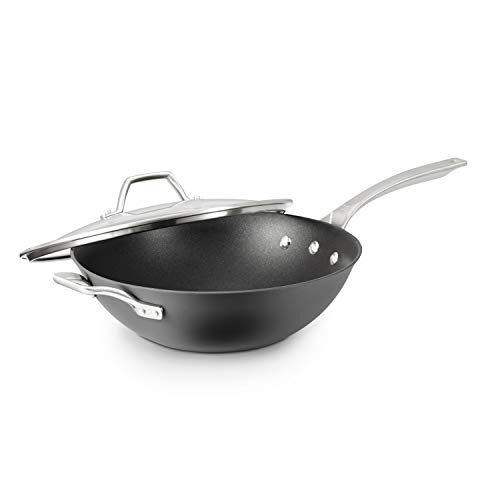
Calphalon Flat Bottom Wok
The Calphalon option sits in the mid tier of this category: a hard-anodised flat bottom wok from a mainstream cookware brand, aimed at cooks who want wok geometry with nonstick-style convenience. Treat it the way this guide treats every pick — judge it first on base flatness and hob fit, then on handle comfort when the bowl is loaded, then on whether its material matches the care routine you will honestly keep. In prose terms, its job in this line-up is to show what the mid tier buys you in feel and upkeep, and what it asks in return. Check price on Amazon for the current listing, and confirm the material and hob compatibility there before you buy, because variants within a brand’s wok range can differ in exactly those details.
Lodge Cast Iron Wok
The Lodge option sits in the mid tier of this category: a cast iron wok from the best-known American cast iron maker, bringing heavy, heat-holding metal to the flat bottom format. Treat it the way this guide treats every pick — judge it first on base flatness and hob fit, then on handle comfort when the bowl is loaded, then on whether its material matches the care routine you will honestly keep. In prose terms, its job in this line-up is to show what the mid tier buys you in feel and upkeep, and what it asks in return. Check price on Amazon for the current listing, and confirm the material and hob compatibility there before you buy, because variants within a brand’s wok range can differ in exactly those details.
Setup and Care That Reduce the Cons
Seasoning is not a coating you apply once but a living surface you build and maintain. Heat and oil bond in thin layers on carbon steel or cast iron, darkening the metal and filling its microscopic texture until food releases cleanly. A new wok often arrives with a protective factory coating that must be scrubbed off first, and the first seasoning sessions, done with a whisper-thin film of high smoke point oil heated until it polymerises, lay the foundation. After that, ordinary cooking does most of the work: every stir-fry with oil adds a little, every gentle wash takes a little less. The surface will look blotchy for weeks and that is normal. Seasoning fails from neglect, not from imperfection, and it recovers from almost any mistake with a scrub, a dry, and another thin layer of oil.
Stir-frying over high heat throws hot oil, and a wok reduces but does not eliminate that hazard. The tall sides contain most of the splatter that a shallow frying pan would spray across the hob, yet a vigorous toss, wet ingredients hitting hot oil, or a crowded pan steaming and spitting can still send droplets toward hands and forearms. Work dry where you can: pat proteins dry, drain marinades, and shake water off washed vegetables, because water is what turns hot oil violent. Add ingredients away from your body, keep a lid or splatter screen within reach for the first sizzle, and never lean your face over the bowl to check a sear. Keep children and loose sleeves out of the splash zone, keep the pan handle turned so it cannot be clipped by a passing hip, and treat the first minute of any stir-fry as the moment that deserves your full attention.
Handles divide flat bottom woks into two camps. Bare metal handles, common on carbon steel, conduct heat from the bowl and become genuinely hot during a long, fierce stir-fry; generations of wok cooks manage this with a dry towel folded over the handle, which works perfectly as long as the towel stays dry, because a wet cloth conducts heat and steam straight to your palm. Stay-cool handles in wood, bamboo, or heat-resistant composite stay comfortable and are kinder to beginners, but they may limit oven use and can loosen over years of heat cycles. A short helper handle opposite the main one is worth more than it looks: a full wok is heavy and awkward, and two grip points make draining, carrying, and storing safer. Whatever the style, assume the helper handle and any metal near the bowl are hot, and build the mitt habit before you need it.
Bottom Line
On a flat modern cooktop, the pros are structural and the cons are mostly technique, and technique can be learned. That asymmetry is why the flat bottom wok has become the default home wok. Buy it with your eyes open about seasoning and storage, and it will repay you in weeknight dinners for years.
Choose the first cook wisely and a new wok will win you over; choose badly and you will blame the pan for a difficult debut. Forgiving first dishes share three traits: they are oily enough to help the young seasoning, sturdy enough to survive imperfect timing, and flavoured boldly enough to be delicious even if the technique is rough. Fried rice made with day-old rice is the classic opener, followed by stir-fried noodles, garlicky greens with a protein you know well, or a simple pepper and beef. Avoid delicate fish, eggs on an unseasoned surface, and anything involving a long acidic simmer, all of which fight a new pan rather than feeding it. Each early cook leaves the surface a little darker and a little slicker, and by the fifth or sixth meal most owners stop thinking about the seasoning at all, which is exactly the point.
Going Deeper: Heat, Patience and the Hot Centre
Deep-frying is the wok’s quiet superpower, and the flat bottom version keeps it. The bowl’s shape means a modest amount of oil pools deeply in the centre while the sloping sides give fried food room to climb out of the oil and drain as you lift it. Temperature recovers quickly because the oil volume is small relative to the heated surface, and the tall sides contain the bubbling that makes frying in a shallow pan feel risky. The same safety rules apply with extra emphasis: never fill the bowl more than partway, because frying food foams and expands the oil level; lower food in gently, away from you; and let the oil cool completely in the pan, undisturbed, before moving it. A thermometer takes the guesswork out, and a spider strainer, made for exactly this bowl shape, is the one accessory most owners end up loving.
Going Deeper: The Habits Behind Good Wok Cooking
Steaming deserves more attention than it gets in wok discussions, because for many households it becomes the wok’s second career. A simple rack set into the bowl, water below, a lid on top, and the wok steams dumplings, fish fillets with ginger and scallion, custards in small bowls, and vegetables that you want vivid and just tender. Bamboo steamers stack inside larger woks for multi-layer cooking, and the bowl’s depth keeps boiling water safely away from the food. Flat bottom models steam more stably than round ones on home hobs, since the pan cannot rock when you lift the lid to check a dumpling. Remember to check the water level during long steams and top up with hot water, and to lift the lid away from your face, because the first rush of steam is the most common minor burn in wok cooking.
Going Deeper: What Daily Use Teaches You
Sauce technique is where home stir-fries usually separate from restaurant ones, and the wok’s shape is built for it. A sauce mixed in advance, so its salty, sweet, sour, and aromatic parts arrive together, goes in at the end, around the hot sides of the bowl rather than onto the food. Running down the heated metal, it sizzles, reduces slightly, and loses its raw edge in the seconds before you toss everything through it. A small amount of starch slurry, added in a drizzle while tossing, gives the sauce the glossy cling that coats each piece instead of pooling in the base. The flat bottom helps the final act, because the pooled sauce sits over the burner and thickens evenly while you fold. Keep sauces brief and concentrated; a wok dinner should be glazed, not drowned, and the bowl should come to the table nearly dry.
Going Deeper: Details That Separate Good From Great
Searing protein in a wok is a study in patience disguised as speed. The slices, whether beef, chicken, pork, or tofu, should be dry on the surface, spread in one layer over the hot base, and then left alone. The instinct to stir immediately is the enemy; undisturbed contact is what builds the browned crust and the fond that flavours the whole dish. When the first side has coloured, a single confident fold with the spatula turns the batch, and a few seconds later it leaves the pan to make room for the vegetables. Marinades help flavour but hinder browning if they are wet, so drain marinated meat well and consider adding the marinade liquid later as part of the sauce. Velveting, the classic technique of coating sliced meat in a starch mixture before a brief blanch or fry, is worth learning once the basics feel easy.
Going Deeper: Making the Pan Work Harder
Vegetables reward sequencing more than any other wok ingredient. Dense vegetables such as carrots, broccoli stems, and green beans need a head start; tender ones such as leafy greens, bean sprouts, and scallion tops need seconds. Cut size is your main control, since a carrot sliced thin on a diagonal cooks as fast as a pepper cut thick, and matching the cut to the cooking time lets everything finish together. A splash of water and a brief lid-on steam, sometimes called steam-frying, rescues a pan of stubborn vegetables without drowning a finished stir-fry. Garlic, ginger, and chilli, the aromatic base of half the wok repertoire, go in early but not first into a smoking pan, because minced garlic burns in the time it takes to reach for the next bowl; a slightly cooler moment in the oil perfumes the whole dish instead.
Going Deeper: Heat, Patience and the Hot Centre
Long-term ownership is where material choice quietly pays out. A carbon steel or cast iron flat bottom wok is effectively a lifetime pan: its surface renews itself through use, it has no coating to fail, and its worst accidents, rust, burnt-on food, a warped moment of carelessness aside, are nearly all recoverable with scrubbing, heat, and oil. A nonstick wok is a consumable by comparison, excellent for a few years and then declining, which may still be the right arithmetic for a cook who values ease today. Whichever you own, small habits compound: dry it after washing, keep the handle joint tight, store it where air moves, and cook in it often, because regular use is the best maintenance a seasoned pan can get. Owners measure wok satisfaction in years, and the pans that earn it are rarely the fanciest, just the ones that fit the stove, the cupboard, and the cook.
Going Deeper: The Habits Behind Good Wok Cooking
Glass and ceramic cooktops reward a few protective habits from wok owners. Lift the pan rather than sliding it whenever it is loaded, since grit trapped under any base can scratch the surface, and be doubly careful with cast iron, whose weight and sometimes rougher casting make it the riskiest pairing. Check the base of a new wok for burrs or a rough rim and smooth anything sharp before its first use. Keep the base clean, because burnt-on residue carbonises onto hot glass and is miserable to remove. None of this is a reason to avoid a wok on glass; flat bottom models are precisely the woks designed for these hobs. It is simply the etiquette of a heavy, high-heat pan on a surface that costs far more to replace than the pan itself.
Going Deeper: What Daily Use Teaches You
The bowl’s temperature gradient is the wok’s defining tool. The flat base over the burner is the searing zone, fiercely hot and best for proteins and for putting colour on vegetables. The lower slopes are the working zone, hot enough to cook through while tossing. The upper sides are the holding zone, where finished or delicate ingredients wait without burning while the next batch sears below. Cooking a full meal is largely traffic management between these zones: sear the beef, push it up the side, bloom the garlic in the centre, add the peppers, then reunite everything for the sauce. A flat bottom wok preserves this gradient faithfully; the base simply anchors the hottest zone more firmly than a round bowl does. Once you start thinking in zones, recipes read differently, and the pan starts to feel less like a vessel and more like an instrument.
Going Deeper: Details That Separate Good From Great
Batch size is the discipline behind almost every wok success story. The pan’s job is to sear, and searing requires that each piece of food touch hot metal with room around it. Overload the bowl and the temperature crashes, juices pool, and the ingredients steam in their own liquid, emerging grey and tired no matter how good the pan is. The fix is unglamorous: cook proteins in a single layer, in rounds if necessary, and give vegetables the same respect, especially watery ones. A flat bottom wok helps here in one specific way, because its wider searing footprint fits a slightly larger single layer than a small-flat-spot design. But no base geometry repeals the physics. Two quick batches will always beat one crowded one, and the resting first batch, kept warm up the sides or on a plate, loses nothing by waiting.
Going Deeper: Making the Pan Work Harder
A wok forgives many things but not disorganisation. Stir-frying moves faster than almost any other cooking method once the pan is hot, and there is no pause in which to chop a forgotten pepper or measure a sauce. Everything, in the French phrase cooks borrow for this, must be in its place before the burner lights: proteins sliced and dried, vegetables cut to sizes that cook in the same time, aromatics minced, sauce mixed in a small bowl. Arrange the bowls in the order you will use them, keep the spatula in hand, and clear a landing zone for finished batches. This discipline is also a safety practice, because a cook who is not rummaging in cupboards is a cook watching the hot oil. The cooks who love their woks are, almost without exception, the cooks who prep first.
Going Deeper: Heat, Patience and the Hot Centre
Preheating is where stir-fries are won. A wok should meet its ingredients already hot, because cold metal plus cold oil plus cold food is the recipe for sticking and steaming. The classic sequence is to heat the dry pan until it just begins to wisps of smoke, add the oil and swirl it to coat the bowl, and then add food immediately while the surface is at its slickest. On a flat bottom wok the flat base makes this more forgiving than on a ring-balanced pan, because the whole base heats evenly and you can judge its readiness by the way a flick of water dances and evaporates almost at once. Electric and induction hobs reward a slightly gentler ramp, climbing through medium to high rather than slamming the pan with maximum power from cold, which also protects thin steel from warping over time.
Going Deeper: The Habits Behind Good Wok Cooking
Fried rice is the dish that tells you the truth about a wok and its owner. Day-old, fridge-cold rice is the correct starting point because its grains have dried and separated; fresh rice steams and clumps no matter what pan it meets. The wok’s contribution is a hot, slick centre where the grains can toast individually, room up the slopes for the egg and vegetables to wait their turn, and enough depth to toss a full batch without launching it across the hob. Work in the order the ingredients demand: aromatics briefly, egg as a quick sheet torn into ribbons, rice pressed lightly against the hot base until it crackles, then everything reunited with soy and a final drizzle of sesame oil off the fiercest heat. A flat bottom wok handles the whole performance planted firmly on the hob, which matters when you are tossing with one hand and seasoning with the other.
Going Deeper: What Daily Use Teaches You
The one-pan dinner is where a wok quietly outperforms the frying pan it is usually compared with. A chicken and vegetable stir-fry for four, a pad see ew, a curry that starts with frying its paste in oil and finishes simmering in the same bowl — all of these exploit the wok’s depth, its zones, and its tolerance for moving between fierce heat and a gentle simmer without changing vessels. The flat bottom version adds stovetop manners to that repertoire: it sits level while a sauce reduces, does not rock when you stir a full load, and goes to the table as its own serving dish in casual kitchens. For households counting washing-up as a real cost of cooking, the bowl that fries, simmers, steams, and serves is not a luxury. It is the entire value proposition in one object.
Going Deeper: Details That Separate Good From Great
Accessories for a wok should be bought in the order your cooking demands them, and the first is not glamorous: a wok spatula, or chuan, whose curved front edge matches the bowl’s curve so it can scoop, fold, and scrape without gouging the seasoning. Second comes a lid if you steam or finish sauces under cover. Third, a spider strainer if you deep-fry, because nothing else lifts food from hot oil in a bowl this shape as gracefully. A bamboo brush earns its place for cleaning seasoned pans, and a steaming rack unlocks the wok’s second career. Everything beyond that list — ring stands you do not need with a flat base, elaborate sets of tools, novelty gadgets — should wait until a recipe you actually cook asks for it. The wok tradition is a one-pan, one-tool tradition, and its restraint is part of its elegance.
Going Deeper: Making the Pan Work Harder
High-heat wok cooking makes smoke, and managing it is part of cooking this way in a modern kitchen. The smoke comes from oil at searing temperatures and from the tiny particles that char on contact with the pan; it is a sign the heat is right, and also a reason to run the extractor before the pan gets hot rather than after the alarm comments. Open a window if your kitchen allows it, keep the oil fresh because old oil smokes earlier and tastes of it, and wipe spills off the hob, since yesterday’s splatter is tomorrow’s smoke. Flat cooktops make one part easier: there are no burner crevices harbouring burnt residue. Cooks in small flats learn to time their fiercest searing for when ventilation is running and doors are arranged, and find that the compromise is minor next to the food.
Going Deeper: Heat, Patience and the Hot Centre
Heat recovery is the invisible specification behind half the judgements in this guide. When cold, wet ingredients hit a hot pan, the pan’s temperature falls; how fast it climbs back decides whether the next minute is searing or steaming. Thin carbon steel recovers by responsiveness, drinking heat from the burner and returning to temperature quickly once the load settles. Cast iron recovers by reserves, having stored so much heat in its mass that the load barely dents it. Nonstick aluminium recovers quickly but is capped by the temperatures its coating tolerates. On a home burner, which replaces heat more slowly than a restaurant jet, recovery is why batch size matters so much: a modest load lets any of these pans recover, while an overloaded one defeats all of them. Judge a wok by how it behaves in the thirty seconds after the food lands, and you will rarely judge it wrong.
Going Deeper: The Habits Behind Good Wok Cooking
There is a natural order in which wok skills build, and following it makes the pan feel easier than struggling against it. Start with fried rice and stir-fried noodles, which forgive timing and feed a young seasoning. Add vegetable dishes with aromatics, where the lesson is sequencing. Move to proteins with marinades and velveting once your preheating and batching are automatic. Then explore the wok’s other careers: steaming fish and dumplings, deep-frying in its economical oil pool, and simmering a curry that began as fried paste. Each stage uses the previous stage’s habits, and none requires new equipment beyond a rack or a strainer. Cooks who grow this way tend to keep their woks for decades, because the pan keeps revealing new uses at exactly the pace their confidence grows.
Putting the Ledger to Work: A Week With the Flat bottom wok
Treat this diary as the practical sequel to the ledger above: for one ordinary week, note each time the flat bottom wok delights you and each time it irritates you, in the moment rather than from memory at the end. Record the jobs where the advantages felt largest, because a strength that only appears on tasks you rarely do is worth less than the summary tables suggest. Record the irritations with equal honesty, and mark whether each one came from the product itself, from your space, or from a habit you could change once and forget. Pay attention to the setup and put-away minutes, since trade-offs that look trivial on paper become the deciding factor when they repeat twice a day for years.
Note who else used the flat bottom wok during the week and what they struggled with, because a drawback that only affects the most patient person in the house is easy to underestimate. Watch for the workaround you invent by day three, and judge it fairly: a painless workaround retires a con, while a fiddly one confirms it. Where a shortlist names specific examples, such as Joyce Chen Pro Chef Flat Bottom Wok, run these same checks against that listing line by line rather than assuming the general verdict transfers unchanged. Apply the identical test to Made In Carbon Steel Wok as well, on the same day and under the same conditions, because a fair comparison needs one ruler rather than two moods.
- Log delights and irritations as they happen
- Time the setup and the put-away honestly
- Test the worst job, not the easiest one
- Note the workaround you invent by day three
- Ask a second user for their verdict
- Write the sentence you would tell a friend
If Calphalon Flat Bottom Wok is also in contention, give it the same worksheet and let the three sets of answers sit side by side before anyone reaches for a checkout button. Test the loudest, messiest, or slowest mode at the time of day you would actually use it, not at a forgiving hour chosen to make the product look good. Check the cleaning burden after the worst realistic job rather than the easiest one, since the honest version of that chore is the one you will live with. Notice whether the headline strength survives ordinary ingredients, ordinary timing, and an ordinary tired evening, because strengths that need perfect conditions are narrower than they appear.
Write down any benefit you had not expected, since unlisted advantages discovered in use are often the ones that keep a product in the house for a decade. Write down any drawback that no review mentioned, and consider whether it is specific to your space, your water, your power supply, or your household size. Compare the week against the tool or appliance the flat bottom wok replaced, task by task, instead of against an idealised version of what ownership would feel like. Ask whether the cons cluster at the start of each session, in the middle of the work, or in the cleanup, because that pattern tells you whether habit can fix them.
Decide which single con you would pay to remove and which single pro you would refuse to give up, since that pair of answers is the real verdict of the week. If the diary shows the balance tilting on one recurring job, re-read the sections above with that job in mind rather than averaging your impressions across everything. Finish the week by writing the sentence you would say to a friend who asked about the flat bottom wok, and check whether it sounds like the summary you believed before the diary began. Keep the diary somewhere you will find it before a future replacement decision, because your own recorded week outweighs any general verdict, including the ones in this guide.
Frequently Asked Questions
What is the difference between a flat bottom and a round bottom wok?
The bowl above the base is broadly the same; the difference is how the pan meets the stove. A round bottom wok needs open flame or a supporting ring, excels at one-handed tossing, and suits powerful gas burners. A flat bottom wok stands on its own flat base, couples directly with induction, electric, and glass hobs, and stays stable when you stir with a spatula. On a modern flat cooktop the flat bottom is usually the practical choice, while the round bottom remains the specialist’s choice for the right burner.
Can I toss food in a flat bottom wok like chefs do?
Not in quite the same way, and that is an acceptable trade for most home cooks. The dramatic one-handed flip relies on a round base rocking over flame. A flat bottom wok stays planted, so you toss by scooping and folding with a wok spatula, whose curved edge matches the bowl and turns food efficiently from the hot centre up the cooler sides. The result mixes, coats, and chars just as well for home cooking, with the bonus that the pan never wobbles while both of your hands are busy.
Will a flat bottom wok work on an induction hob?
Yes, provided the material is magnetic and the base sits flat and still on the cooking zone. Carbon steel and cast iron flat bottom woks are the natural fits, because both metals respond to induction and both are commonly made with a properly flat base. Stainless models depend on their construction, and aluminium or hard-anodised nonstick woks only work when they include a magnetic base layer. Confirm the exact model’s compatibility on its listing, and retire or relegate any wok whose base has warped enough to rock, because poor contact quietly undermines induction performance.
How do I stop my wok from rusting?
Rust prevention is a three-part habit: dry the wok completely after washing, ideally over low heat; wipe in the thinnest film of oil while it is warm; and store it somewhere dry. Never leave a carbon steel or cast iron wok soaking in the sink, and never put it away damp. If rust does appear, scrub the spots back to bare metal, wash, dry over heat, and re-season the patches. The routine takes about a minute, and once it is automatic, rust becomes a rare event rather than a recurring problem.
How hot does the handle get on a carbon steel wok?
Assume it gets hot. Bare steel handles conduct heat from the bowl during a long, high-heat stir-fry, and experienced wok cooks simply keep a dry towel folded over the handle or a mitt at hand. Keep the towel dry, because a damp cloth transmits heat and steam to your palm. Stay-cool wood or composite handles reduce the issue, and a short helper handle on the opposite side is worth having regardless, because a loaded wok is heavy and two grip points make carrying and draining safer.
Why does food stick in my new wok?
Early sticking usually has one of four causes: the pan was not preheated before the oil went in, the ingredients were wet, the pan was crowded so food steamed instead of searing, or the seasoning is still young. Heat the dry pan until it just begins to smoke, add oil and swirl, then add dry ingredients in a single layer and leave them undisturbed until they release. As the seasoning builds over the first weeks, release improves markedly. Persistent sticking on an older pan usually means the seasoning has been scrubbed thin, and a few oily cooks will restore it.
Related Guides
Keep exploring with these companion guides from the same kitchen:


