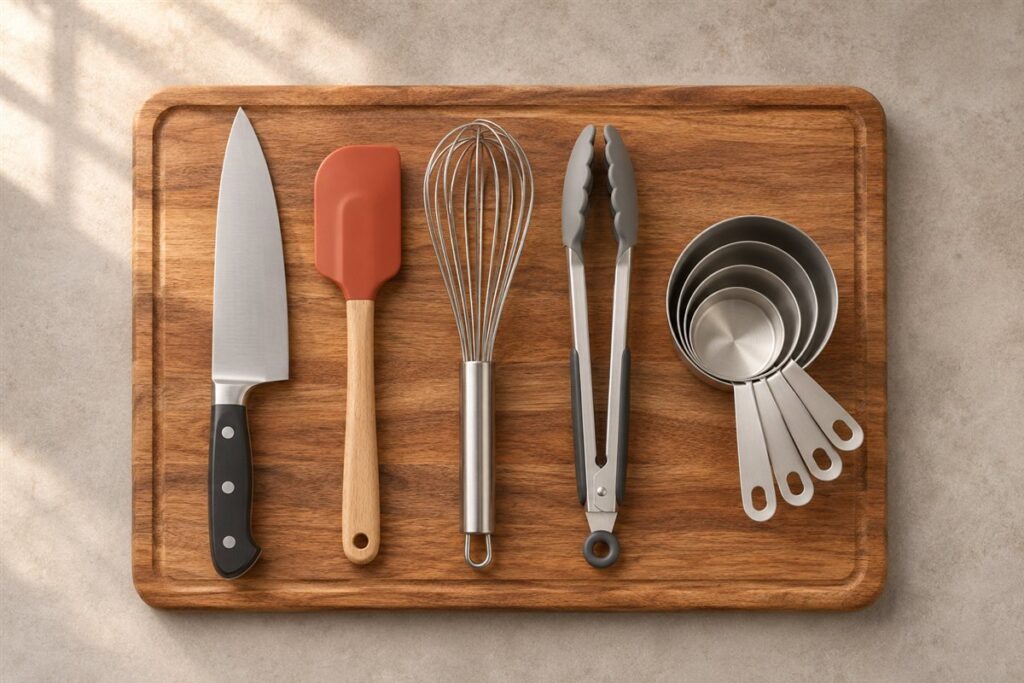
Most home kitchens need only three or four knives: a chef’s knife, a paring knife, a bread knife and, if you like, a utility knife. A big matched set is not required. Learn what each does, and you can build a small collection that handles nearly every task.
The Core Three
The chef’s knife is the workhorse. Its broad, curved blade handles chopping, slicing, dicing and mincing. Many cooks choose a blade of around 8 inches, though sizes differ by maker and hand size.
The paring knife is small and nimble. Use it for peeling, trimming, hulling berries and detail work in your hand or on a board.
The bread knife has a long toothed edge that slices crusty loaves, cakes and soft-skinned produce without crushing them.
Useful Extras
- Utility knife: A medium blade for sandwiches, small vegetables and tasks too big for a paring knife.
- Boning or fillet knife: Thin and flexible, helpful if you often break down poultry or fish.
- Santoku: A Japanese-style all-rounder with a flatter edge, which some cooks prefer to a chef’s knife.
- Kitchen shears: Not a knife, but handy for herbs, poultry and packaging.
What Each Knife Is Best At
| Knife | Best tasks | Less suited to |
|---|---|---|
| Chef’s knife | Chopping, slicing, mincing | Delicate peeling |
| Paring knife | Peeling, trimming, small fruit | Large vegetables |
| Bread knife | Loaves, cakes, tomatoes | Fine chopping |
| Utility knife | Sandwiches, small produce | Heavy chopping |
How to Build Your Set Over Time
- Begin with one good chef’s knife that feels comfortable in your hand.
- Add a paring knife for small jobs.
- Add a bread knife if you buy or bake whole loaves.
- Think about extras only when you notice a task that feels awkward with what you own.
Before you choose, hold the handle and check balance if you can. Keep the knives sharp, store them safely and follow the maker’s care instructions.
Signs You Chose Well
- The handle sits comfortably without cramping your fingers, even during a long prep session.
- The blade feels balanced rather than front-heavy or tail-heavy.
- You reach for the same knife again and again without thinking about it.
- Cleaning and drying it by hand feels like a quick habit, not a chore.
If a knife sits unused in the drawer for months, you probably do not need its type. It is better to own a few knives you enjoy using than a block full of blades you ignore.
Blade Steel and Edge Types
Knife blades differ in the metal they are made from and in the edge ground onto them, and both affect how the knife behaves in daily use. Stainless steel resists rust and is forgiving of kitchens where knives sometimes sit damp. Harder steels can hold an edge longer and take a finer point, but they can also be more brittle and may chip if twisted or used on bone. Softer steels are easier to sharpen and tougher, but dull sooner. The listing or the maker’s guide usually describes the steel in general terms, and the hardness figures, if given, are best read as a rough guide to how the knife will behave.
Edge shape matters too. A plain straight edge cleans slices on vegetables and boneless meat, and it can be resharpened at home. A serrated edge, with small teeth, saws through crusts and soft interiors, and is difficult to sharpen without a special tool. A thin, acute edge slices very smoothly but needs gentler handling, while a thicker edge is more rugged for tougher tasks.
Single-bevel edges, common on some Japanese-style knives, are shaped on one side only, while most Western knives are ground on both. Double-bevel knives are easier for beginners to use and maintain. If you are unsure, choose a plain, double-bevel edge in a durable stainless steel, and learn what you like before moving to more specialized designs.
Handle and Balance Checks
You will hold a knife for long stretches, so the handle deserves as much attention as the blade. Wood, plastic, composite and metal handles each have trade-offs. Wood feels warm and grips well but may need more care and should not sit in water. Molded plastic or composite handles are generally easier to clean and tolerate dish soap better. Metal handles look sleek but can be slippery when wet or greasy.
Shape should fit your hand. If your hand is small, a thick, bulky handle may feel clumsy, and if your hand is large, a slim handle can cramp the fingers. Look for smooth edges with no sharp seams where the handle meets the blade. A bolster, the thickened area between handle and blade, can protect your fingers and add weight. Some cooks prefer a knife without a full bolster because it makes sharpening the entire edge easier.
Balance refers to where the knife feels heavy. Many cooks like a balance near the point where the blade meets the handle, so the knife feels neutral and controlled in a pinch grip. To test it, rest the knife on a finger at the base of the blade and see which way it tips. Also check that the blade is attached firmly, with no gaps or wobble. If you can try before buying, chop a few items and see how your wrist feels afterwards.
Honing and Sharpening Routine
A sharp knife is both safer and more enjoyable than a dull one, because it bites into food instead of slipping. Understanding the difference between honing and sharpening helps you keep an edge. Honing, using a steel or ceramic rod, realigns a slightly bent edge and can be done often, even before each use. Sharpening actually removes metal to create a new edge and is needed only occasionally, depending on how much you cook.
Home sharpening options include whetstones, pull-through sharpeners, electric sharpeners and guided systems. Whetstones give the most control but take practice. Pull-through devices are convenient, though they can remove more metal than needed and may not suit every blade type. Follow the knife maker’s advice, especially for specialty steels or thin Japanese-style blades, which may need gentler methods. Serrated blades usually require a specialty rod or professional service.
Signs your knife needs attention include squashing tomatoes instead of slicing them, needing extra pressure on onions, and food sticking or tearing. Never test the edge by running a thumb along the cutting side. Instead, try slicing a sheet of paper or a ripe tomato. Use a stable board, avoid cutting on glass, ceramic or stone, and wash knives by hand right after use. Good habits help the edge last longer between sharpenings.
Safe Storage Options
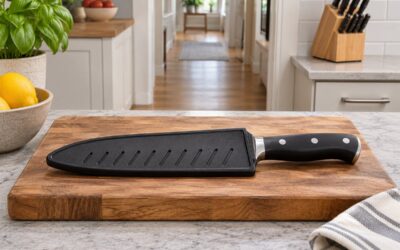
How you store knives affects both safety and edge life. Tossing loose knives into a drawer dulls the edges and risks cut fingers when you reach in. Better options include a wooden block, a magnetic strip, an in-drawer tray or individual blade guards.
A block keeps knives within reach and protects the edges, but it needs counter space and should be cleaned from time to time, because crumbs and moisture can collect in the slots. Check that the slots fit your knife sizes, as some blocks are sized to specific sets. A magnetic strip frees counter space and shows every knife, but should be mounted securely and at a height away from children. Place knives on it spine first or according to the maker’s advice, and avoid sliding the edge across the magnet.
In-drawer organizers separate knives and hold them flat, which is useful in kitchens with little wall space. Blade guards are handy for travel or for a single knife kept in a drawer, but they must be dry inside before use to avoid rust. Whatever you choose, dry knives completely before putting them away and keep them out of reach of young children. Never leave a knife in a sink full of soapy water, where someone could grab the blade by accident.
Matching Knives to Your Cooking Style
Essentials change with the way you cook. If you mostly prepare vegetables, salads and quick weeknight meals, a chef’s knife and a paring knife will do nearly everything. Bakers who handle loaves and layer cakes benefit from a good serrated knife, and cooks who frequently slice sandwiches might favor a utility knife.
If you buy whole chickens or fish, a boning or fillet knife adds control, though a chef’s knife can manage many simple trimming tasks. Cooks who like Asian-style cooking may reach for a santoku or a cleaver for chopping vegetables and portioning meat, but a standard chef’s knife often covers the same ground. People who cook for large groups might want a longer slicing knife for roasts.
Consider cutting-board size and counter space, too. A very long knife needs room to move, and a compact kitchen may suit shorter blades. Left-handed cooks should check that the knife is ambidextrous, since some single-bevel edges are made for right-hand use.
The best approach is to start small, notice which tasks feel awkward and add a knife to solve that problem. Keep a note of what you actually use for a few weeks. If a knife never leaves the drawer, you probably do not need it. Spend on the knives you reach for most, and keep the rest simple.
FAQ
Do I need a knife block set?
Not necessarily. Sets often include knives you rarely use. Many cooks prefer to choose individual knives they will use daily.
Is a bigger knife better?
Not always. A knife should feel controlled in your hand. A blade that is too large can feel awkward on a small board.
What is the difference between honing and sharpening?
Honing realigns a slightly bent edge and can be done often, while sharpening removes metal to form a new edge and is needed less frequently. Both help a knife cut cleanly.
Are expensive knives always better?
Not always. Price can reflect steel, construction and finish, but a comfortable, well-made knife that you keep sharp can outperform a costly one that does not fit your hand.
Can I put knives in the dishwasher?
Most makers advise against it, as heat, detergent and knocking against other items can dull edges and damage handles. Hand wash and dry right away.
What size chef's knife should I get?
Many home cooks choose a blade of around 8 inches, but comfort matters more than a number. Consider your hand size and the size of your cutting board.
Do I need a serrated knife?
A serrated knife is useful for crusty bread, cakes and soft-skinned produce such as tomatoes. If you rarely handle those foods, a plain-edged utility knife may be enough.
What should I cut on?
Wood and plastic boards are gentler on edges than glass, stone or ceramic. Choose a board that stays put on your counter.
How do I know when to replace a knife?
Consider replacing it if the blade is chipped beyond what sharpening can fix, the handle is cracked or loose, or the blade is bent. A well-kept knife may last many years.
The Short Version
A chef’s knife, a paring knife and a bread knife cover most home cooking. Add a utility knife or other extras only if your cooking calls for them. Comfort and care matter more than the number of knives.