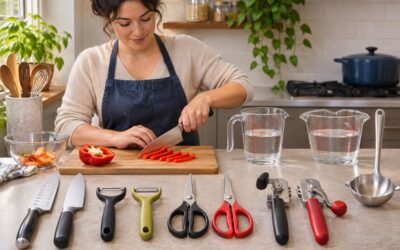
A good cutting board for knives has a surface that gives slightly under the blade, sits steady on the counter and is big enough to work on comfortably. Wood, bamboo and softer plastics are commonly chosen for this reason, while very hard surfaces such as glass and stone tend to dull edges faster. Here is how to compare your options.
Why the Surface Matters
Every cut presses the edge of the blade into the board. A surface that is very hard pushes back, and the fine edge can roll or chip over time. A surface with a little give lets the edge sink in slightly and recover.
This is general kitchen knowledge, not a lab result, and the exact difference varies by knife and by how you use it. Always follow the care advice that comes with your knives.
Common Materials Compared
- Wood: Widely used by cooks who care about their knives. It has some give and can be sanded or oiled according to the maker’s guide.
- Bamboo: A grass that is pressed into boards. It is usually firmer than most woods, so it feels less forgiving.
- Plastic: Light, easy to wash and often gentle on blades. Deep cuts can build up with use, and the board may need replacing.
- Rubber: Soft, grippy and often chosen by professional kitchens. It can be heavy.
- Glass, stone and ceramic: Easy to wipe clean, but very hard on edges. Most cooks avoid cutting on them.
Features Worth Checking
| Factor | Why it matters | What to check |
|---|---|---|
| Surface hardness | Softer surfaces are generally easier on edges | Material type and the maker’s notes |
| Grain direction | Edge grain and end grain wood show cuts less | Look at the cut face of the board |
| Thickness | Thin boards can warp or slide | Listed thickness and weight |
| Grip | A slipping board makes knife work harder to control | Rubber feet or a non-slip base |
| Size | Room to move food away from the blade | Counter space and sink fit |
Habits That Help Your Knives
- Cut on the board, never on a plate or the counter.
- Do not scrape the blade edge-down across the board to move food. Turn the knife over and use the back of the blade.
- Keep the board dry and clean according to the maker’s care guide.
- Keep your knives sharp following the maker’s instructions, since a dull knife slips more easily and is harder to control.
- Keep fingers curled and away from the edge, and follow the knife maker’s safety guidance.
FAQ
Is a wooden board always the best choice?
Not always. Wood needs a little more care, and some people prefer plastic because it is lighter and easier to wash. Choose the material you will look after properly.
Do I need different boards for different foods?
Many cooks keep separate boards for raw meat and for ready-to-eat food. Follow the food safety advice from your local health authority for handling and cleaning.
The Short Version
Choose a board with some give, such as wood, bamboo or a quality plastic or rubber, and avoid glass and stone for cutting. Make sure it is stable and large enough for the job. Care for it as the maker advises.