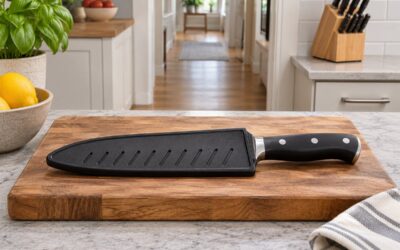
The right knife sharpener depends on your knives, your patience and how much control you want. Pull-through sharpeners are quick and simple, guided systems add consistency and whetstones give the most control but need practice.
Main Types of Sharpeners
- Pull-through sharpeners: you draw the knife through slots with fixed angles. They are easy but remove metal quickly and may not suit every blade.
- Whetstones: flat stones of different grits. They offer control and a fine edge but need technique.
- Guided systems: clamp the knife or guide the stone at a set angle, helping with consistency.
- Electric sharpeners: use motorized wheels for speed, with less control.
- Honing rods: straighten an edge between sharpenings but do not replace it.
Criteria Table
| Factor | Why it matters | What to check |
|---|---|---|
| Skill level | Determines success | Beginners may prefer guided or pull-through |
| Knife type | Edge angle compatibility | Western versus Japanese-style angles |
| Metal removal | Affects knife lifespan | Gentle options protect thin blades |
| Time and effort | Determines regular use | Quick tools get used more often |
| Storage | Counter or drawer space | Stones need a base; pull-through tools are compact |
| Upkeep | Long-term use | Stone flattening, replaceable parts |
Steps to Decide
- Check the edge angle recommended by your knife maker, often listed in the guide.
- Decide how much time you will spend. A quick tool suits busy households, while a hobbyist may enjoy stones.
- Note any special knives, such as thin Japanese blades or toothed blades, and confirm the sharpener supports them.
- Consider storage space and noise, especially with electric models.
- Read the sharpener’s instructions fully before using it.
Safe Use and Care
Sharpening exposes keen edges, so keep your fingers clear, place the tool on a stable surface and work slowly. Clean metal dust from the blade and sharpener after use. Hone often, and sharpen only when needed to preserve the blade. Replace worn parts according to the maker’s guidance. For valuable knives, a professional service is a gentle alternative.
Consider the long game. A tool that sits unused does less than a simple one you use monthly, so choose something you will reach for. If your knives are a mix of types, you may end up with two tools: a quick option for everyday blades and a stone for better ones. Keep the instructions, and ask the maker if you are unsure about compatibility with your knives. Also check how easy the tool is to clean, because metal dust and oil build up over time and can affect how well it works.
Honing Versus Sharpening and When Each Applies
These two terms get mixed up, and the confusion leads to wasted money. Honing realigns an edge that has bent slightly with use. It removes little or no metal and is something you can do often, even before each use. Sharpening grinds away metal to form a new edge, and it is only needed when honing no longer restores cutting performance.
A simple test helps. If a knife tears tomato skin or crushes herbs, try honing first. If it still struggles after honing, the edge is probably dull and needs sharpening. A knife that has lost its edge completely, or has chips, needs more serious work than a quick pass on a rod.
- Honing rods may be steel, ceramic or diamond-coated; ceramic and diamond types can remove a little metal, so use them gently.
- Sharpening tools include stones, guided systems, pull-through units and electric machines.
- Regular honing can stretch the time between sharpenings.
Buying a sharpener without a honing rod is a common oversight. Many cooks do best with both: a rod for weekly upkeep and a sharpening tool for a few times a year.
Grit, Abrasives and What They Do to an Edge
Grit describes how coarse or fine an abrasive is. Lower numbers are coarse and remove metal fast, useful for repairing chips or reshaping a badly dull edge. Middle grits do the regular work of sharpening. Higher numbers are fine and refine the edge for smooth slicing. Many whetstones are double-sided, with a coarser and a finer face.
Abrasive material also varies. Some stones are made from synthetic abrasives, some from natural stone, and some tools use diamond or ceramic surfaces. Diamond stays flat and cuts quickly on hard steels, while other materials may wear and need flattening. Because products are labeled differently, read the maker’s guidance on use and on whether water or oil is needed.
For a typical home kitchen, a medium and a fine surface cover most needs. Only buy a coarse grit if you expect to repair damaged knives. Remember that finer is not always better: a very polished edge slices cleanly but may lose some bite on tough skins or tomatoes, where a slightly toothier edge helps.
Angle Control and Building Reliable Technique
The angle between blade and abrasive shapes how a knife cuts and how long the edge lasts. Many Western-style kitchen knives are made for a wider angle on each side, while many Japanese-style knives use a narrower angle. A narrower angle slices more finely but can be more delicate. The maker’s manual often states the intended angle.
Freehand sharpening on a stone requires a steady hand and practice. Angle guides, clamps and guided systems hold the angle for you, making results more consistent for beginners. Pull-through tools set the angle with fixed slots, which is simple but offers little adjustment.
- Keep the angle consistent through the stroke.
- Use even pressure and let the abrasive do the work.
- Check the edge often by running a thumb across it, never along it, or by slicing paper.
- Look for a burr, a thin ridge along the edge, as a sign that one side is complete.
Practice on an inexpensive knife before working on your best one.
Serrated, Ceramic, Thin and Specialty Blades
Not every knife can use the same tool. Serrated knives need a sharpener designed for their scallops, such as a tapered rod, and a flat stone will not work. Ceramic knives are very hard and often need diamond abrasives; some makers advise sending them for professional sharpening. Thin Japanese-style blades can be chipped by aggressive tools, so gentle methods are safer.
Single-bevel knives, which are ground on only one side, need different technique than double-bevel knives. Scissors, shears and garden tools have their own requirements. If you own a mix, check that a sharpener lists support for each type. Do not assume a tool labeled for kitchen knives suits every blade.
If you are unsure, check with the knife maker or consider a professional sharpening service for your more valuable or delicate blades. Some cooks keep one sharpener for everyday knives and use a service once a year for specialty pieces. That balance can be more economical than buying several tools you rarely use.
Budget Tiers and Long-Term Value
Sharpeners range from basic hand tools to elaborate guided systems. Entry-level options are often small pull-through units or single stones. Mid-range options include dual-grit stones with bases and angle guides. Higher-end options include guided kits with multiple abrasives and electric units with several stages. Spending more does not guarantee better results for you; what counts is whether the tool suits your knives and your habits.
Look at the total cost of ownership. Stones may need a holder, a flattening plate and lubricant. Electric units may need replacement belts or wheels. Pull-through tools may have replaceable inserts, or may be entirely disposable. Check the listing for what is included.
Consider the cost of not sharpening. Dull knives are slow, less safe and tempt people to buy replacements. A modest tool used regularly delivers more value than a sophisticated one that stays in its box. Think about time as well; if you won’t commit to a ritual, a quick, simple tool is a better match, and you can upgrade later if your interest grows.
FAQ
Is a pull-through sharpener bad for knives?
Not necessarily, but it can remove more metal than other methods and may not match every edge angle. Check compatibility first.
How often should I use a sharpener?
Only when honing no longer restores the edge. For many home cooks that means a few times a year.
What is the difference between honing and sharpening?
Honing realigns a bent edge with little or no metal removal, while sharpening grinds metal away to create a new edge. Hone often and sharpen only when honing stops working.
What grit stone should I buy first?
A combination stone with a medium and a fine side suits most home kitchens. Add a coarse stone only if you need to repair damaged edges.
Can I sharpen serrated knives at home?
Yes, with a tool made for serrations, such as a tapered rod. Standard flat stones and many pull-through slots do not work well on them.
Are electric sharpeners safe for good knives?
They remove metal quickly and may not suit thin or delicate blades. Check whether the maker lists compatibility with your knife style.
How do I know the angle of my knife?
The maker's guide or listing often states it. If it does not, ask the maker or choose a sharpener with adjustable settings.
Do I need to wet a sharpening stone?
Some stones need water, some use oil and some need neither. Follow the instructions that came with your stone.
Is it worth hiring a professional to sharpen knives?
It can be worthwhile for valuable or delicate knives, or if you do not want to learn technique. Many cooks use a service now and then and hone at home.
The Short Version
Match the sharpener to your knives, skill and time. Guided and pull-through tools are simple, while whetstones reward practice with control.