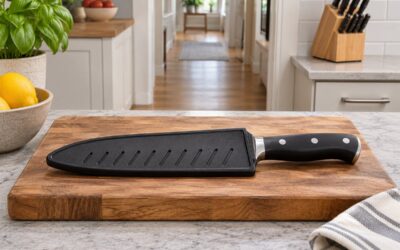
A knife needs sharpening when it slips on food skins, crushes instead of slicing, or needs extra pressure to cut. Simple checks with a tomato or a sheet of paper can confirm it, and honing may be enough if the edge is only slightly off.
Signs You Can Feel
- The blade skates off tomato or pepper skin instead of biting in.
- You press harder than before and the cuts feel ragged.
- Onions or herbs look bruised rather than neatly cut.
- Bread or soft items squash under the knife.
- The edge seems to catch or drag on certain spots.
Simple Checks
- Tomato check: rest the edge on a ripe tomato and add very light pressure with a drawing motion. A keen knife catches the skin; a dull one slips.
- Paper check: hold a sheet of printer paper by the top edge and slice downward with care. A good edge makes a clean cut, and a dull one tears or snags.
- Light check: look at the edge under a bright lamp, pointing it away from you. A bright reflective line along the edge suggests a rolled or worn spot.
- Cutting feel: notice whether pushing through a carrot takes more effort than you remember.
Take care with every check, and keep your fingers clear of the edge. Do not run a finger across the edge to test it.
Honing or Sharpening?
| Situation | Likely need |
|---|---|
| Edge feels slightly off, quick fix | Honing with a rod |
| Fails the tomato and paper checks even after honing | Sharpening on a stone or with a sharpener |
| Chips or damage along the edge | Coarse sharpening or professional service |
| Blade bent or broken tip | Professional help |
Keeping the Edge Longer
Use a wood or plastic cutting board, not glass, stone or ceramic. Hand wash and dry the knife right after use. Store it in a block, on a magnetic strip or in a sheath so the edge does not knock against other items. Avoid cutting through bone or frozen foods unless the knife is made for it.
Follow the maker’s care guide for your knife. Different steels and edge styles behave differently.
Context matters too. A knife used daily for fast prep will dull sooner than one pulled out for weekend baking. Cutting on hard surfaces, banging the edge against pots and washing in the dishwasher all speed up wear. If you notice that you reach for the same knife and avoid the others, the others may simply be dull and deserve a quick check.
Sharpening Tools Compared: Stones, Pull-Throughs and Services
Once you know a knife is dull, the next question is how to restore the edge. Whetstones, also called sharpening stones, are flat abrasive blocks used with water or oil, depending on the type. They give you the most control and can be used on many knives, but they take practice to hold a consistent angle. Stones come in different coarseness grades, with coarse for repairing and finer for finishing. Check the product listing for instructions on soaking and flattening.
Pull-through sharpeners have preset slots with abrasive surfaces that you draw the knife through. They are fast and easy for beginners, but they remove metal quickly and the preset angle may not suit every knife. Some are designed for specific blade types. Electric sharpeners motorize the process, which is convenient, but they can remove a lot of metal and may not suit thin or delicate knives. Guided systems clamp the blade at a fixed angle and let you move the stone along it, giving consistent results at a slower pace.
- Whetstone: most control, steeper learning curve.
- Pull-through: simple and quick, less precise.
- Electric: convenient, check blade compatibility.
- Professional service: good for valuable knives or damage.
Whichever you use, read the knife maker’s guidance, since some blades, especially specialized or very hard ones, need particular methods. If you are unsure, a professional sharpening service is a safe choice.
How Blade Steel and Edge Style Affect Dullness
Not all knives dull at the same rate or need the same care. The steel plays a role. Softer steels tend to dull sooner but are easier to sharpen and respond well to honing. Harder steels hold an edge longer, but can be more brittle and may chip if misused, and they can be harder to sharpen at home. Stainless and carbon steels differ in how they react to moisture, with carbon steel needing prompt drying to prevent rust. Check the knife listing or manual for what steel it uses.
Edge style matters too. Many Western-style knives have a symmetrical, two-sided edge that suits common sharpening methods. Some knives have a single-bevel edge, sharpened on one side, and need different techniques. Serrated knives, such as bread knives, have teeth that need specialized tools and are sharpened differently, though they dull more slowly because only the tips of the teeth contact the board. Ceramic knives hold an edge for long periods but can chip and require specific sharpeners or services.
- Follow the maker’s advice on honing frequency and sharpening angle.
- Do not use a sharpener designed for one type on another without checking.
- Be aware that very thin blades are easily damaged by aggressive sharpeners.
Knowing your knife’s steel and edge style tells you what to expect from it and what care it needs.
Honing Rods, Strops and Daily Edge Care
A honing rod does not sharpen so much as realign. Over normal use, a keen edge can bend microscopically to one side, which makes the knife feel dull even though little metal has been lost. Drawing the blade along a honing rod pushes the edge back into line. Rods come in steel, ceramic and diamond-coated types. Steel is common and gentle, ceramic is slightly abrasive, and diamond-coated rods remove a little metal and act more like sharpeners. Choose one that suits your knife, and check that the rod is longer than the blade and the handle gives a safe grip.
To hone, hold the rod steady, place the blade at the angle the maker advises, and draw it down the rod with light pressure, alternating sides. Many people hone before or after each use, or as often as they notice the edge flagging. Keep fingers behind the guard, and wipe the blade afterward.
- Use light pressure, since force can damage the edge.
- Hone on a stable surface, with the rod tip on a non-slip mat or board.
- Wipe the knife clean before use to remove metal dust.
A strop, which is a piece of leather or similar material, can polish the edge further. It is optional for most home cooks but can extend time between sharpenings. If honing no longer makes a difference, move to sharpening.
Common Habits That Dull Knives Faster
How you use and store a knife affects how long the edge lasts. Cutting on hard surfaces such as glass, stone, ceramic or metal dulls the edge quickly, as does scraping the blade sideways across the board to move food. Use the spine of the knife or a bench scraper for that job. Twisting or prying with the blade can chip the edge, and cutting through bones, frozen foods or hard shells can damage the edge unless the knife is built for it.
Storage is another culprit. Tossing knives in a drawer lets them knock against other utensils. Dishwashers expose knives to heat, harsh detergent and banging against other items, which can dull and damage the edge and handle. Hand wash, dry promptly and store safely. Leaving knives wet or soaking in the sink can cause rust or discoloration, and risks injuring the next person who reaches in.
- Keep a dedicated knife for everyday prep and a different tool for rough jobs, like opening packages.
- Avoid using your good knife to cut on a plate.
- Store in a block, sheath, or on a magnet with care.
Small changes in habit can double the time between sharpenings. Pay attention to how you work, and adjust your routine to protect the edge.
Safe Sharpening and When to Call a Professional
Sharpening is a skill, and safety comes first. Work on a stable, non-slip surface and keep your attention on the task. Position your hands so they stay behind the edge at all times, and never run a finger along the edge to test it. Read the instructions for your sharpening tool, and use light, consistent strokes. Take your time, since rushing leads to uneven edges and slips.
Know your limits. If a knife has chips, a broken tip, a bent blade or significant damage, a professional can often repair it better than a home sharpener. The same is true for valuable or specialty knives where an error would be costly. Ask whether the service uses methods suited to your type of knife, and check how they handle the edge angle. Some local shops and hardware stores offer this service, and some makers provide it directly.
- Test sharpness with the tomato or paper methods after you finish, carefully.
- Wipe the blade and wash it before cooking, to remove metal particles.
- Replace the knife if it is damaged beyond reasonable repair.
Over time, repeated sharpening wears the blade down, so a very old knife may eventually reach the end of its useful life. If the edge keeps failing quickly after sharpening, or the blade is badly worn or loose in the handle, it may be time for a replacement.
FAQ
How often should I check my knife?
A quick tomato or paper check every few weeks of regular cooking works for many households.
Does honing sharpen a knife?
Honing realigns a slightly bent edge. It does not remove much metal, so a worn edge will eventually need real sharpening.
How often should I sharpen my knife?
It depends on use, steel and cutting surface. Many home cooks sharpen once or twice a year and hone more often, but let the checks guide you.
Is a dull knife really more dangerous than a sharp one?
Many cooks find so, because it needs more force and is more likely to slip. Whatever the state of the edge, always handle knives carefully.
What is the right sharpening angle?
It varies by knife style and maker. Check your knife's manual or the maker's website for guidance.
Can I sharpen a serrated knife at home?
Usually it needs a specialized tool or a professional service. Check the maker's guidance, because standard methods can damage the teeth.
Do ceramic knives need sharpening?
They hold an edge for a long time, but they do dull and can chip. Use sharpeners made for ceramic, or a professional service.
How do I know whether my stone is flat?
A worn stone develops a dip. Follow the stone maker's instructions for flattening it, since an uneven stone leads to uneven edges.
Are electric sharpeners safe for all knives?
Not always. Some can remove a lot of metal or suit only certain blade types, so check the sharpener's instructions against your knife.
The Short Version
If the knife slips, crushes or takes extra force, test it carefully with a tomato or paper. Hone for small drifts and sharpen when honing no longer helps.