In a tiny kitchen, every item must earn its place by doing more than one job. Focus on multi-use tools, nesting pieces, and vertical storage. With a short list and a little planning, a small space can handle most everyday cooking.
Choose Tools That Work Twice
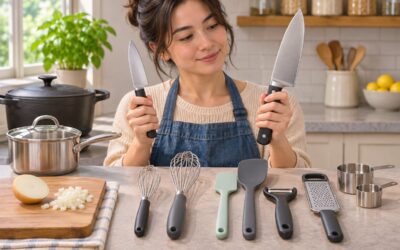
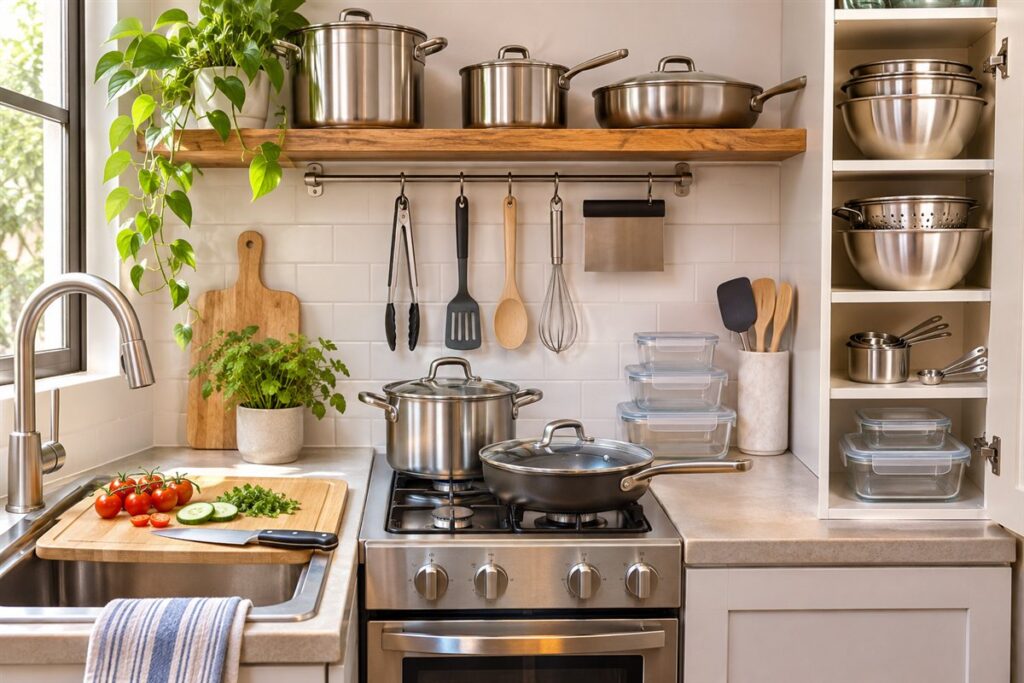
Look for tools that replace others. A single sturdy skillet with a lid can sear, saute, simmer, and bake in the oven if the maker allows it. A cutting board that fits over the sink adds counter space on demand.
- A chef’s knife can replace many small cutters.
- A pot with a steamer insert covers boiling and steaming.
- A bench scraper moves food, cuts dough, and cleans the counter.
- Measuring cups that nest save drawer room.
A Short Essentials List
- One skillet and one saucepan, each with a lid.
- One larger pot for pasta and soup.
- One sheet pan that fits your oven.
- A chef’s knife, a paring knife, and a light board.
- A set of nesting bowls with a colander that fits inside.
- A whisk, tongs, a spatula, and a wooden spoon.
- Stackable storage containers.
Storage Ideas for Small Spaces
Go Vertical
Use wall rails, hooks, and shelves to free up counter and drawer space. Hang lightweight items and keep heavy ones low.
Use Hidden Space
Door-mounted racks, over-sink shelves, and under-shelf baskets turn dead zones into storage. Check weight limits in the maker’s instructions.
Keep Surfaces Clear
Clear counters make cooking easier and cleaning faster. Store small appliances you use rarely elsewhere.
What to Avoid
| Item type | Problem in a tiny kitchen | Alternative |
|---|---|---|
| Single-use gadgets | Takes up space for one task | A knife or whisk |
| Large matched sets | Pieces often go unused | A few chosen pieces |
| Bulky appliances | Eat counter room | Stovetop or oven methods |
Cooking Habits That Help
Small kitchens reward simple routines. Prep ingredients in one bowl at a time, clean a tool as soon as you finish with it, and use one pot meals when you can. Plan a menu for the week so you buy only what fits in your cabinets and fridge. Keep a trash bag or bowl near the board to reduce trips across the room, and use the top of the stove or a tray as extra prep room when no burner is in use.
Sizing Cookware for Limited Burners
Many tiny kitchens come with two burners, a narrow oven, or only a compact cooktop, so cookware size becomes a real constraint. Before you buy anything, measure the width of your cooking surface and note how far apart the burners sit. Two large pans placed side by side may not fit at all, and a pot that overhangs a burner can heat unevenly or crowd the neighboring flame or coil.
Also measure the inside of your oven. A sheet pan that looks standard can still be too wide for a small oven, and a pan that touches the oven walls blocks airflow. Compare the pan dimensions on the product listing with your measurements, and leave a little clearance on each side.
Choose pot and pan diameters that suit one or two people rather than a crowd. A medium skillet and a medium saucepan handle most daily meals, and one tall pot covers soup and pasta. Straight-sided pans use space well because they hold more food for the footprint they take on the stove.
Check that handles work in a tight space. Long handles can bump into walls, so look for pans with removable or short handles if your stove sits in a corner. Make sure the lids fit more than one pan, since a single lid that suits two pans saves a drawer slot. Finally, confirm that the base suits your cooktop type by reading the maker’s notes, because some bases are not intended for certain stovetops.
Stacking and Nesting: What Really Saves Room
Nesting gear is popular in small kitchens, but not every nesting product delivers. The test is simple: does the full set take clearly less room than the same pieces stored separately, and will you actually pull it apart and put it back each time you cook? If the set is awkward to separate, you may leave it out on the counter, which defeats the purpose.
Good candidates for nesting include mixing bowls, measuring cups and spoons, and storage containers with lids that fit inside each other. Bowls with flat rims or silicone grips tend to stack more tightly than those with large pouring spouts, so check the shape on the listing photos. If a bowl set includes lids, count those in your storage plan, because loose lids are easy to lose.
Pots with detachable handles can stack with their lids stored inside, which saves cabinet depth. Collapsible items such as silicone colanders and folding measuring cups can help, but read the maker’s care notes about heat limits and washing before relying on them for hot foods.
- Pick sets where every piece is something you will use weekly.
- Prefer one shape of container so lids and bases are interchangeable.
- Keep the nest near where you use it, so putting it away takes no extra steps.
If a nesting set includes pieces you will never use, buy fewer pieces individually instead of accepting the whole set.
Matching Small Appliances to Your Counter
Appliances are where tiny kitchens most often go wrong. A single appliance can take up a quarter of the available counter, and if it lives in a cabinet it may never get used. Before buying, ask three questions: how often will I use it, can it replace something I already own, and where exactly will it live?
Think about which jobs your stove and oven already do well. A kettle may be unnecessary if you boil water in a pot, and a toaster can be skipped if your oven or skillet makes toast acceptably. On the other hand, a small appliance may be worth the room if it cuts a task you do every day, such as a compact blender for morning drinks or a small rice cooker if you eat rice often.
Look at the footprint and the cord. Short cords can limit where an appliance can be placed, and you will need an outlet that is not behind the stove or sink. Check the maker’s clearance notes, since some appliances need space around vents. Also consider whether parts such as lids, blades, and pitchers need extra storage.
A good rule is to keep only one or two appliances within reach and store the rest. If something has not come out of storage for a couple of months, it probably should be passed on to someone who will use it.
Lighting and Work Zones in a Compact Layout
When space is short, how you arrange it matters as much as what you own. Divide even a small kitchen into three rough zones: a prep zone, a cooking zone, and a cleanup zone. Keep the tools for each within arm’s reach of that zone. Knives, boards, and bowls belong near your prep spot; spatulas, spoons, oil, and pot holders belong near the stove; soap, brush, and towels belong at the sink.
Good light makes a small kitchen easier and safer to use. If the overhead light casts shadows on your cutting area, a small under-cabinet or clip-on light can help. Choose lights that suit your wiring and rental rules, and follow the maker’s installation instructions. Battery or plug-in options can be a better fit if you cannot alter fixtures.
Make a spot for the things that do not fit elsewhere. A rolling cart, a narrow shelf beside the fridge, or a fold-down table can add working or storage room, but check weight limits and be sure they do not block a walkway or an appliance door. In a very narrow galley, keep the floor clear so you can move safely with hot pans.
- Keep the most-used tool in each zone, not every tool.
- Put heavy items at waist height or lower.
- Leave one clear stretch of counter that stays empty for prep.
Buying Slowly and Knowing When to Let Go
A tiny kitchen works best when it grows slowly. Start with the short essentials list, cook with it for a few weeks, and keep a note of moments when you wished you had something specific. A repeated need is a good reason to buy. A one-time recipe is usually not.
Before you buy, look for a tool you already own that can do the job. A rolling pin can be a sturdy bottle, a pastry brush can be a spoon, and a mandoline can be a sharp knife and a steady hand. Only add a specialized tool if it will clearly save time or give a result you cannot get otherwise.
Quality matters more when you own fewer things, because each item gets used often. Look for solid construction, comfortable handles, and parts that can be cleaned easily. Read the product listing for material details and care notes, and do not rely on appearance alone. Budget tiers differ mainly in how long the item holds up and how well it is finished, so spend more on the tools you use daily, such as the knife and skillet, and less on those you use occasionally.
Review your kitchen every few months. Anything cracked, warped, or unused can go. Handing duplicates to a friend or donating gently used items keeps your cabinets from filling back up, and it makes room for the next piece that truly earns its place.
FAQ
Can I cook full meals with so few tools?
Yes. A skillet, a pot, a sheet pan, and a good knife are enough for a wide range of meals. Add pieces only when you notice a real gap.
How do I keep a tiny kitchen from feeling cluttered?
Give each item a home, wash as you go, and look over the space every few months. Remove anything you have not used in that time.
What size skillet is best for a small kitchen?
A medium skillet usually suits one or two people and fits on most small burners. Check the pan diameter on the listing against your burner spacing and oven size. If you cook for more people occasionally, a second pan can be borrowed or added later.
Is it worth buying a multi-cooker for a tiny kitchen?
It can be if it replaces several pots you already use and you will cook with it often. Measure the counter and cabinet space first, and consider where the lid and parts will be stored. If you rarely use it, it is likely to become clutter.
How do I store knives without a countertop block?
A wall-mounted magnetic strip or a slim drawer tray with slots keeps blades safe and out of the way. Sheaths or edge guards also work in a drawer. Follow the maker's instructions and keep blades away from children.
Which pots and pans stack best?
Pans with removable or foldable handles and straight sides tend to stack tightly. Nested sets help only if you will use every piece. Check the product listing for how the set is meant to be stored.
How can I add counter space without a remodel?
A cutting board that sits over the sink, a rolling cart, or a fold-down shelf can create extra prep room. Always check weight limits and make sure the add-on does not block a door or a walkway. Remove it when not in use if it makes the room cramped.
Should I buy a full set of containers or a few different ones?
A few matching containers in two or three sizes usually work better than a large mixed set. Matching lids and bases mean fewer lost parts. Check whether they suit your microwave and freezer by reading the care notes.
The Short Version
Choose multi-use, nesting, and stackable tools, store things vertically, and keep counters clear. A short list of pans, a knife, a board, and bowls handles most meals in a small kitchen.