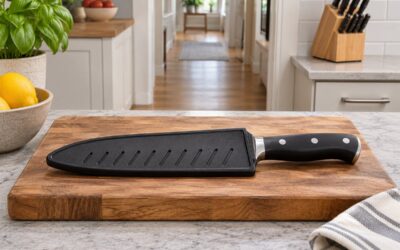
A carving knife is a long, slender blade made for slicing cooked meat in clean, even pieces. Choose by length, blade thickness, flexibility and handle grip, and pair it with a carving fork and a stable board.
What Defines a Carving Knife
Most are 8 to 15 inches long with a narrow blade that moves smoothly through roasts, poultry, ham and large joints. The slim profile creates thin slices and less drag. Some have a pointed tip for working around bones, and some have a rounded tip. A slicing knife is closely related and often longer and more flexible.
Comparison Table
| Factor | Why it matters | What to check |
|---|---|---|
| Length | Allows long, single strokes | 10 to 12 inches suits many roasts |
| Blade width | Reduces drag | Narrow blades slide through meat |
| Flexibility | Follows contours | More flex for poultry, stiffer for dense roasts |
| Edge | Slice quality | Plain edge for clean slices; scalloped or hollow edges to reduce sticking |
| Handle | Grip with greasy hands | Textured, comfortable, with a guard |
| Tip | Access and safety | Pointed or rounded |
Choosing Step by Step
- Think about what you carve most: turkey and chicken, ham, beef roasts or all of them.
- Select a length that fits the largest cut, with room for a full stroke.
- Choose a blade stiffness that suits it. A flexible blade handles curves, while a stiff blade holds a line on dense meat.
- Check the handle for a non-slip texture and a guard that keeps your fingers away from the edge.
- Look at the maker’s notes on care and sharpening.
Carving Tips
- Let the meat rest before carving so juices settle.
- Use a carving board with a groove or a well to catch juices.
- Hold the meat with a fork, keeping your hand behind the guard.
- Use long, smooth strokes instead of sawing.
- Keep the edge sharp, since dull blades need more force and slip more easily.
Handle the knife with care, wash it by hand, dry at once and store it with the edge protected. Follow the maker’s instructions.
Pair the knife with the right accessories. A sturdy carving fork, a stable board and a warm serving platter turn a good knife into a smooth service. Allow time to practice on smaller roasts before a big gathering, and plan where you will stand so you have room to move your arm in long, even strokes.
Carving Knife, Slicing Knife and Their Neighbors
Carving and slicing knives overlap, and sellers use the names loosely. In general, a carving knife is a shorter, slightly wider blade with a pointed tip that works around joints and bones on poultry and roasts. A slicing knife is longer and often narrower, sometimes with a rounded tip, built for long, thin, uninterrupted slices through boneless cuts such as roast beef or ham.
Other knives can do part of the job. A chef knife handles small roasts and chicken breasts. A boning knife separates meat from bone. A bread knife can slice a boneless roast in a pinch, but its serrations tear fibers. Ham slicers and brisket knives have extra length and often a hollow edge for large boneless pieces.
Decide what you cook most often. If whole birds and bone-in joints dominate your table, favor a carving knife with a tip. If you mostly serve boneless roasts and cold cuts, a long slicer may be more useful. Many cooks find that one well-chosen 10 to 12 inch blade covers both, which matches the length range already described in this guide.
Blade Profile, Edge Shape and Slice Quality
Look at the blade from the side and from above. A narrow blade reduces drag and produces cleaner slices. A deep blade provides knuckle clearance but adds weight. A slight curve at the tip helps with starting cuts, while a straight edge delivers uniform slices. Some blades are ground with hollow scallops, called Granton edges, which are meant to release slices; their effect varies by food, and the maker’s claims should be read with some caution.
- A plain edge gives the cleanest cut when kept sharp and is easy to sharpen at home.
- A serrated edge slices crusty skin but can tear tender meat and is harder to sharpen.
- A hollow edge may reduce sticking on moist foods, but it can be slightly harder to maintain.
Thickness at the spine affects how the blade glides. A thin blade slices easily but may flex; a thicker blade feels sturdier but can wedge in dense meat. Look at how the blade tapers toward the edge, because a gradual taper reduces resistance.
Steel, Hardness and Keeping the Edge
Blade steel affects how long the edge lasts and how much upkeep it needs. Stainless steels resist rust and suit most home kitchens. Higher-carbon steels can take a keen edge but require careful drying and attention. Harder steels hold an edge longer but may be more brittle and harder to sharpen; softer steels are tougher and easier to touch up.
The listing may mention a hardness number or steel name, but those details alone do not predict real-world performance, since heat treatment and edge geometry matter as much. Treat claims as a guide, not a guarantee, and read the maker’s care notes.
Plan for maintenance. A carving knife is used for a few big meals each year in many homes, so it may sit idle. Before a holiday meal, check the edge on a piece of paper or a ripe tomato, and hone or sharpen as needed. Wash by hand, dry at once and store with the edge protected in a block, sheath or on a magnetic strip placed so the blade cannot be knocked.
Handles, Guards and Safe Technique
Carving often happens in front of guests, with greasy hands and slippery meat. A safe grip matters. Look for a handle with a texture or contour that stays secure when wet, and a guard or bolster that keeps fingers away from the blade. The handle should fit your hand without cramping; a handle that is too small tires the grip, while one that is too large reduces control.
Balance is a subtle but important feature. A knife that balances near the bolster feels controlled for most cooks. A very blade-heavy knife can be fatiguing, while a handle-heavy one may feel clumsy. If you can, hold it and make slicing motions in the air.
Technique reinforces safety. Keep your guiding hand behind the blade, curl fingers inward, and use long strokes with the full length of the blade rather than short sawing movements. Place a damp cloth under the board so it cannot slide, and give yourself space on the counter. Carve at a table height where your elbow is comfortable.
Board, Fork and Serving Setup
The knife is only part of a good carving setup. A large board with a groove or a well catches juices that would otherwise spill. A fork with long tines and a guard anchors the meat. A warm platter keeps slices from cooling quickly. Choose a board that is bigger than the roast with space to spare, and stable enough that it does not move.
Let the roast rest before carving, as the recipe directs; this helps juices stay in the meat. Identify the direction of the grain, and slice across it for tender pieces. For poultry, remove legs and wings first, then slice the breast, working from the thick end. For a boneless roast, trim any string as you go and keep slices even so they cook and cool uniformly.
If you carve rarely, practice once on a smaller chicken. Familiarity with the joints makes the large meal less stressful. Keep a kitchen towel nearby, a bowl for bones and a clear route to the table.
FAQ
Can I use a chef knife to carve?
You can for small roasts, but a long slender blade gives cleaner slices and easier movement on larger cuts.
Is an electric carving knife better?
It is a different tool. It may suit some cooks, but a good manual knife requires no power and is simple to store.
What length carving knife do I need?
Choose a length that comfortably spans your largest cut with room for a full stroke. Many cooks find a blade in the 10 to 12 inch range versatile.
Should a carving knife be flexible or stiff?
Flexible blades follow contours on poultry, while stiffer blades hold a straight line through dense roasts. Pick based on what you carve most.
Is a serrated carving knife a good idea?
Serrations cut through crisp skin but can tear tender meat. A plain edge generally gives cleaner slices and is easier to sharpen.
What is a Granton edge?
It is a series of scalloped hollows ground into the blade, intended to reduce sticking. Its effect varies by food and knife.
How often should I sharpen a carving knife?
It depends on use, but check it before big meals. If it struggles to slice paper or tomato skin cleanly, it likely needs honing or sharpening.
Do I need a carving fork?
A fork steadies the roast and keeps your hand away from the blade. It is a small addition that improves safety and control.
Can I carve on any cutting board?
A large, stable board works best, ideally with a juice groove. Place a damp cloth underneath to stop it from sliding.
The Short Version
Choose a long, slim blade with a grippy handle and a guard, sized to your usual roasts. Keep it sharp and carve with long, steady strokes.