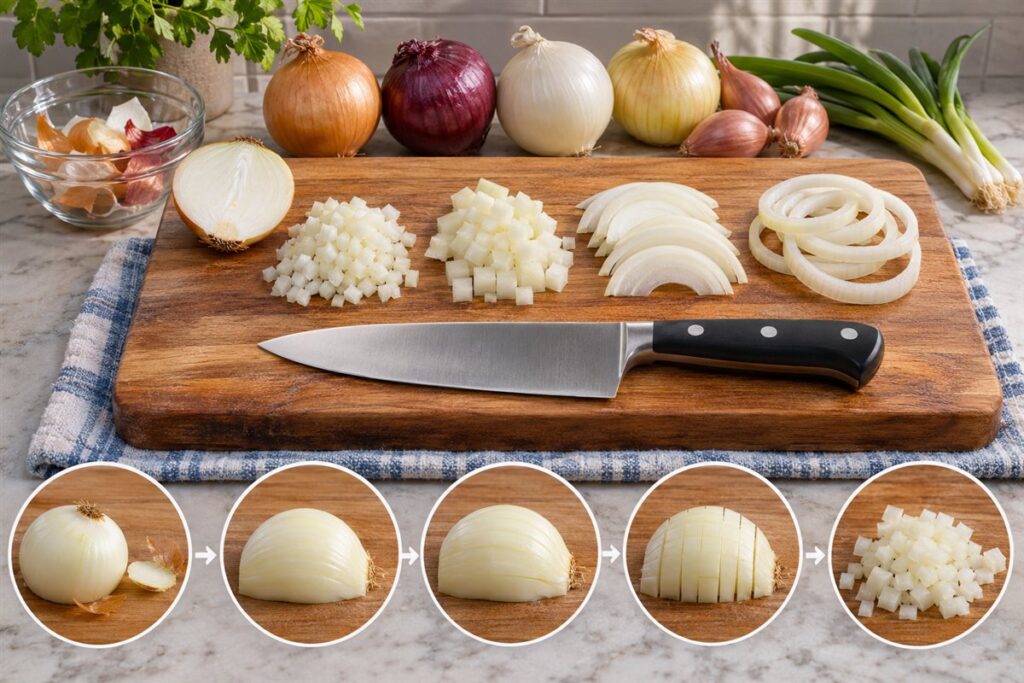
To cut an onion with a chef knife, trim the top, halve it through the root, peel it, make a few cuts toward the root, then slice across. Keep the root end attached until the end because it holds the layers together. A sharp knife and a steady board make the job quick and controlled.
Set Up Your Station
Place a damp towel or non-slip mat under a large cutting board so it cannot slide. Use a sharp chef knife, since a dull one slips and needs more force. Read the knife maker’s care and safety instructions before use, and keep your cutting space clear of clutter.
- Keep a bowl nearby for scraps and skins.
- Stand with the board at a comfortable height.
- Hold the knife with a pinch grip, thumb and forefinger on the blade just ahead of the handle.
Dicing Step by Step
- Cut off the top end, leaving the root end intact.
- Halve the onion from top to root, then peel off the skin.
- Lay one half flat. Curl the fingers of your guiding hand into a claw, with knuckles forward and fingertips tucked back.
- Make several horizontal cuts toward the root, stopping before you reach it.
- Make vertical cuts from the top toward the root, again stopping short.
- Slice across those cuts to release small, even pieces.
- Discard or save the root end for stock.
Slices and Rings
For half-moon slices, cut the peeled half lengthwise from root to top in thin strokes. For rings, cut across the whole onion, then separate the rounds. Keep the board dry and take your time. Small, even pieces cook at the same pace.
Common Cuts Compared
| Cut | Good for |
|---|---|
| Fine dice | Sauces, soups, fillings |
| Medium dice | Stews and salsas |
| Half-moon slices | Stir-fries, sauteing, sandwiches |
| Rings | Roasting and frying |
Reducing Tears
Onions release compounds that irritate eyes when cut. A sharp knife damages fewer cells, and a chilled onion releases less. Good ventilation also helps. Some cooks leave the root end on a bit longer for the same reason.
Storing Cut Onion
Put cut onion in a covered container and keep it in the fridge. Use it within a short time, and follow food-safety guidance for storage. Wash the board and knife after cutting, because onion juice can transfer strong odors to other foods. A quick rinse with hot soapy water usually does the job.
Choosing the Right Onion for the Cut
Not every onion behaves the same way under the knife or in the pan, so it helps to know what you are holding. Yellow onions are the common all-purpose choice. They have a firm texture and a strong flavor raw that mellows and sweetens with cooking, which makes them a sensible default for soups, sauces and long-cooked dishes. Red onions are usually milder and look attractive raw, so many cooks slice them thin for salads, sandwiches and tacos. White onions tend to have a sharper, cleaner bite and are often used in fresh salsas and quick cooked dishes. Sweet onion types are often sold as milder and juicier, which suits raw use but may not hold up as well to long storage.
Shallots are smaller and finer-grained, and they are often minced for dressings and pan sauces. Spring onions and scallions are cut very differently, in thin rounds from white to green, with no root-end trick needed.
When you shop, pick onions that feel firm and heavy for their size, with dry, papery skins and no soft spots or sprouting. A larger onion is easier to hold and cut into even pieces, while a very small one can be awkward under a claw grip. If a recipe names a variety, check whether a swap is fine, because the flavor and moisture can change the result.
Knife and Board Choices That Make Onions Easier
An onion is round, slippery and layered, so your equipment matters more here than with many vegetables. For the knife, look for a chef knife with a blade length that feels controlled in your hand rather than the longest one you can find. Many home cooks are comfortable with a blade that is long enough to pass through a large onion in a single stroke without needing to saw. The blade should have a fairly flat belly near the heel, so the full edge meets the board when you slice across the cuts.
Weight and balance are personal. A knife that feels front-heavy may tire your wrist over a big batch, and one that is very light may feel less stable on a tough outer layer. Handle shape matters too, since wet or onion-slick hands need a handle that gives a positive grip. Check the product listing or manual for care instructions, because some blades should be hand washed only.
The board should be large enough that the onion half and the cut pieces fit without spilling over the edge. A board with a shallow groove can help if you are cutting a juicy onion, but a flat, stable surface is the main requirement. Use a mat or damp towel underneath. Wood and plastic boards are both widely used, and either one needs to be washed promptly because onion juice carries strong odor.
Fixing Common Onion Cutting Mistakes
Most trouble with onions comes from a handful of repeating habits. If your pieces come out ragged or uneven, the usual cause is a dull knife or cuts that are spaced inconsistently. Slow down on the first set of cuts, and keep the spacing the same each time. If the onion slides or spins when you cut, the half is probably not lying flat, so make sure the cut face is down and stable before you start.
- Layers separating and sliding: the root end was trimmed too far, so cut less of it away and let it hold the layers together.
- Crushed, wet pieces: the knife is dull, or you are pressing down instead of drawing the blade forward and through.
- Fingers drifting forward: reset your claw grip and keep your knuckles against the flat of the blade.
- Pieces too big on the outside: the outer layers are wider, so make your vertical cuts a touch closer together near the edges.
- Shrinking pile of tiny scraps: the last section near the root is hard to hold, so lay it flat and slice it straight across.
If you do not feel safe making horizontal cuts, you can skip them and make vertical cuts followed by a crosswise slice. The pieces will be a little less uniform, but the result is still fine for soups and stews where size matters less.
Matching Cut Size to How You Will Cook
The size and shape of your onion pieces change how they cook, so it pays to decide the cut before you start. Fine pieces melt into a dish and disappear into sauces, fillings and dips. Medium pieces hold some shape and give a more noticeable texture in stews, chili and rice dishes. Larger pieces and thick slices stay distinct, which suits roasting, grilling and braising.
Thin slices cooked slowly over gentle heat soften and turn deep golden, which is the basis of many savory dishes. Cooking time depends on the amount of onion, the pan and the heat, so go by your recipe and watch the color. If the pieces start to scorch before they soften, lower the heat and add a splash of water or a little more fat.
- Cut for raw use when you want crunch. Rinsing slices in cold water for a short time can soften the sharp edge for salads and sandwiches.
- Keep sizes consistent within one pan. Mixed sizes mean some pieces burn while others stay firm.
- Use thicker pieces if the dish cooks a long time, since thin pieces break down fully.
If a recipe only says chopped, a medium dice is a reasonable middle choice. When cooking for people who dislike onion texture, a finer cut or a longer cook can help it blend in.
Batch Prep, Leftover Halves and Cleanup
If you cut several onions at once, work in an orderly sequence. Peel and halve all of them first, then cut each half in the same way, and move finished pieces to a bowl as you go so the board stays clear. Doing the same motion repeatedly makes your cuts more even and your pace steadier. A bench scraper is useful for moving piles safely without exposing the blade.
When a recipe needs only part of an onion, wrap the cut half tightly or place it in a covered container in the fridge, cut side protected. Use it soon, and follow food-safety guidance for cut produce. It can also help to cut onions only when you need them, because pre-cut onion loses some freshness. If you want to prep ahead for the week, store the pieces in a sealed container and check them for off smells before use.
For cleanup, wash the knife and board right after cutting. Onion juice clings and can pass odor to the next thing you cut, such as fruit. A soapy scrub with hot water usually does the job, and a wooden board may need extra drying time. Keep the skins and trimmings in your scrap bowl for the compost or the stock pot. If your knife has been used on onions, dry it carefully and store it with the edge protected.
FAQ
Why is the claw grip recommended?
It tucks fingertips behind the knuckles, which guide the blade and keep fingers out of its path.
How do I keep my knife sharp?
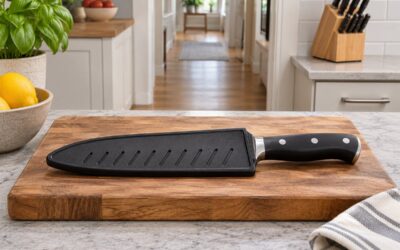
Hone it regularly and sharpen as the maker advises. Store it in a block, sheath or magnetic strip so the edge is protected.
Which onion is best for all-purpose cooking?
Yellow onions are the usual all-purpose choice because they cook down well and develop sweetness. Red and white onions suit raw dishes, while shallots are good for dressings and sauces.
Can I cut an onion without cutting the horizontal slices?
Yes. Make vertical cuts toward the root, then slice across them. The pieces will be a little less even, but this works well for soups, stews and other dishes where size matters less.
What size chef knife is best for onions?
Choose a blade length that feels controlled in your hand, often one that can pass through a large onion in one stroke. Comfort and balance matter more than the longest blade.
Why do my onion pieces fall apart as I cut?
The root end was probably trimmed too far. Leave it on until the end, because it holds the layers together while you make your cuts.
Should I rinse chopped onion?
Rinsing slices in cold water for a short time can soften the sharp bite for raw use. Pat them dry before adding them to salads or sandwiches so they do not water down the dish.
How do I get the smell off my cutting board?
Wash it promptly with hot soapy water and let it dry fully. Following the board maker's care guide is wise, and a separate board for strongly flavored foods helps.
How should I store half an onion?
Wrap it tightly or place it in a covered container in the fridge and use it soon. Follow food-safety guidance for cut produce.
The Short Version
Halve, peel, cut toward the root and slice across. Use a sharp knife, a stable board and a claw grip, and follow the maker’s safety instructions.