Disclosure: topratedkitchenware.com is reader-supported. When you buy through links on our site, we may earn an affiliate commission from Amazon and other retailers, at no extra cost to you.
Where to buy
Every grinder in this guide is sold through Amazon, where you can compare the current configuration, plate sizes, and included attachments before ordering. Bone work is hard on a grinder, so check that the listing you choose includes spare plates and blades — those are the parts that wear first. Start with our top-rated option for bone batches, the VEVOR #12 Electric Meat Grinder — Check on Amazon — or work through the full shortlist below:
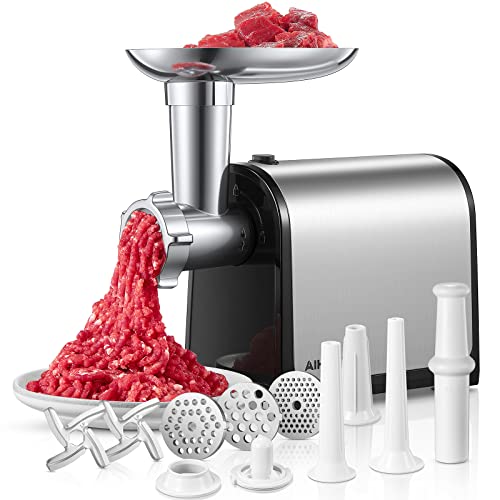
- Aiheal Electric Meat Grinder, 3200W Max
- AAOBOSI Electric Meat Grinder with 3-Speed Touch Screen
- AAOBOSI Multifunctional Digital Meat Grinder
- CHEFFANO Meat Grinder, 2800W Max, ETL Approved
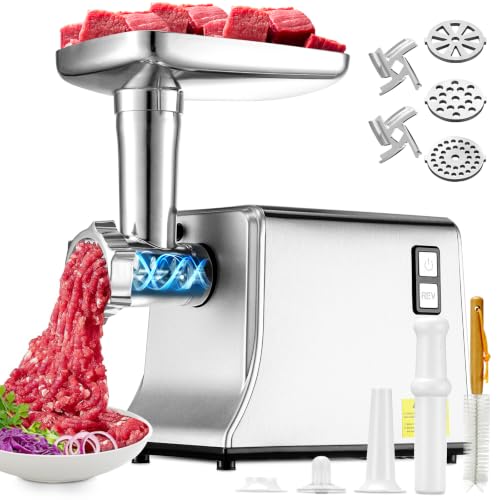
- Sinyder Electric Meat Grinder, 3000W Max, Metal Gears
Read the full guide ↓ for the honest limits of each machine — especially what “bone grinding” can and cannot mean on a home countertop grinder.
Finding the best meat grinders for bones starts with an uncomfortable truth: no countertop home grinder is built to chew through thick, weight-bearing bones like beef femurs or pork leg bones, and any machine you feed those into will eventually strip a gear or burn out a motor. What a strong home grinder can do — and do well, week after week — is grind soft, pliable bones: chicken and turkey frames, necks and wings, rabbit, duck, and whole small fish. That is exactly the job most people searching for the best meat grinders for bones actually have in mind, whether they are making raw pet food, homemade stock mince, or ground poultry with the frame included for minerals. This guide is written for that real job. We picked six heavy-duty electric grinders with the torque, metal drive parts, and plate options that soft-bone work demands, and we are explicit about where each one stops being the right tool.
Bone grinding punishes a grinder in ways that ordinary meat grinding does not. A strip of partially frozen chicken frame does not slice — it resists, twists, and tries to stall the auger, then suddenly gives way. That shock loading is why peak wattage numbers on a box matter less than gear material, motor design, and whether the machine gives you a reverse gear to back out of a jam instead of forcing you to dismantle a loaded grinding head. Throughout this guide we judge every pick against that reality: how it handles resistance, how it clears a stall, how coarse a plate it offers for a first pass, and how completely it comes apart for the deep cleaning that bone and raw poultry work demands. If your interest is more in game processing than bones, our companion guide to the Best Meat Grinders For Deer covers the trimming and batch workflow for venison season in more depth.
Key Takeaways
- Soft bones only: poultry frames, necks, wings, rabbit, and small fish are realistic; thick weight-bearing bones are not, on any machine in this class.
- Metal gears and a copper-wound motor matter more than headline peak wattage when the auger meets resistance.
- A reverse function is the single most useful feature for bone work — it clears jams without a full teardown.
- Grind partially frozen, in small pieces, through a coarse plate first; a second pass through a finer plate gives the finished texture.
- The VEVOR #12 is our top pick for sustained bone batches thanks to its 1 HP motor rating and large #12 head; the Sinyder is the value pick for metal gears and a stainless body.
- Every grinder here also stuffs sausage, so the same machine covers the rest of your grinding once bone batches are done.
In this guide
Quick Picks
| Pick | Badge | Standout detail from the listing | Link |
|---|---|---|---|
| Aiheal Electric Meat Grinder | Best Accessory Bundle | 3200W max, 2 blades, 3 plates, 3 sausage tubes | Check on Amazon |
| AAOBOSI 3-Speed Touch Screen Grinder | Best for Raw Pet Food Batches | 3000W max, 4 lbs/min maker rating, built-in storage | Check on Amazon |
| AAOBOSI Multifunctional Digital Grinder | Best Jam Recovery | 3000W max, 9 touch presets, auto-reverse | Check on Amazon |
| VEVOR #12 Electric Meat Grinder | Best Overall for Bones | 750W / 1 HP motor, 552 lbs/h maker rating, #12 head | Check on Amazon |
| CHEFFANO Meat Grinder | Best Mid-Range Workhorse | 2800W max, ETL approved, 2 blades, 3 plates | Check on Amazon |
| Sinyder Electric Meat Grinder | Best Metal-Gear Build | 3000W max, pure copper motor, metal gears, stainless body | Check on Amazon |
How These Picks Were Chosen
This is a research-led guide, not a lab test. We built the shortlist by comparing manufacturer listings and specifications for the current generation of heavy-duty home grinders, then filtered hard for the traits that bone work actually stresses. Peak wattage claims in this category are marketing numbers — they describe a momentary maximum, not sustained output — so we weighted continuous-style ratings (horsepower, throughput per hour, head size) more heavily where a listing provided them, and we treated listings that only quote a peak figure as unproven on sustained torque until their other specs supported them.
Four filters decided the final six. First, drive construction: metal gearing and copper motor windings survive stall-and-shock loading better than plastic gear trains, so machines that state metal gears earned priority. Second, head size and plate range: a #12 head swallows poultry frame pieces with less pre-cutting, and multiple plates let you take a coarse first pass — the technique that makes bone grinding feasible at all. Third, jam recovery: a reverse or auto-reverse function turns a stall from a twenty-minute teardown into a ten-second fix. Fourth, cleanup: bone and raw poultry demand full disassembly and washing after every session, so designs whose heads, augers, plates, and trays separate completely scored higher than sealed or fiddly ones.
We also excluded two whole categories on purpose. Stand mixer attachments were left out because their drive depends on the mixer’s gearbox, which is rarely rated for bone resistance, and manual grinders were left out because sustained bone work by hand crank is a recipe for a half-finished batch. Readers who mainly grind boneless meat for the family table will find a broader, gentler shortlist in our guide to the Best Meat Grinders For Home Use; this page keeps the stricter bone-first filter. Finally, a note on honesty: no pick below is sold or titled as a dedicated bone crusher. Each is a heavy-duty meat grinder whose construction makes it suitable for soft bones used correctly — small pieces, partially frozen, coarse plate first — and we say plainly in each review where that suitability ends.
The 6 Best Meat Grinders for Bones

Aiheal Electric Meat Grinder, 3200W Max
Badge: Best Accessory Bundle
Strengths
- Two blades and three plates in the box, so you can run a coarse bone pass and a finer finishing pass without buying spares first.
- Three sausage tubes included, which makes the machine earn its counter space on non-bone days too.
- Stainless steel grinding components in a black finish that hides the scuffs bone work leaves behind.
Trade-offs
- The 3200W figure is a maximum rating, not a continuous one — feed it steadily rather than forcing large pieces.
- No reverse function is listed, so a stall means switching off and clearing the head by hand.
- The accessory count means more small parts to wash and keep track of after every raw session.
Mini spec box: Power: 3200W max · Blades: 2 · Plates: 3 · Sausage tubes: 3 · Body/components: stainless steel, black finish · Duty described: heavy duty for home kitchen use.
The Aiheal makes sense as the bone grinder for someone who wants one purchase to cover the whole learning curve. The reason it earns its place here is the plate-and-blade bundle: bone grinding is a two-pass technique, and owning two blades from day one means you can keep one blade paired with your coarse plate as a dedicated bone set — the edge that meets bone first dulls fastest — while the second blade stays sharp for clean meat work. In practice you would run chicken frames, cut down to pieces the feed tube accepts, partially frozen so they shear instead of smearing, through the coarsest plate; the Aiheal’s stated heavy-duty positioning and stainless grinding path handle that soft-bone load in the steady, unhurried rhythm this job rewards.
Who it suits: raw feeders grinding poultry frames for one or two pets, and home cooks who also want sausage capability without a second appliance. The honest limitation is jam recovery. Without a listed reverse, when a piece of frame wedges between auger and plate — and sooner or later one will — you stop, unplug, and back the auger out manually. That is manageable on a small batch and tedious on a big one, which is why high-volume bone grinders should look further down this list, toward the machines with reverse or a #12 head. Treat the Aiheal as a capable, well-equipped starter for soft bones rather than a batch-production machine, and it will not disappoint you.
Best for: first-time raw feeders who want a complete plate and blade kit in one box / Not suited for: large weekly bone batches where jam clearing needs a reverse gear.

AAOBOSI Electric Meat Grinder with 3-Speed Touch Screen
Badge: Best for Raw Pet Food Batches
Strengths
- The listing explicitly covers raw pet food, which is the main reason most people grind soft bones at home.
- A maker-quoted throughput of 4 lbs/min gives a realistic sense of batch pace for weekly pet-food sessions.
- Built-in storage keeps plates and blades inside the machine instead of loose in a drawer, and the design is pitched at easy cleanup.
Trade-offs
- Three speeds are useful, but bone work mostly lives on the lowest, torquiest setting — the extra speeds serve other jobs.
- Touch controls and wet, messy hands are not natural partners; expect to wipe the panel mid-session.
- 3000W is again a maximum figure; the throughput rating is the more honest guide to its pace.
Mini spec box: Power: 3000W max · Throughput: 4 lbs/min (maker rating) · Controls: 3-speed touch screen · Storage: built-in · Roles: 3-in-1 sausage, burger, raw pet food · Certification noted: LFGB approved · Cleanup: designed for easy cleanup.
Most bone grinding in home kitchens is not about the cook’s dinner — it is about the dog’s or cat’s. This AAOBOSI is the one machine in the six whose listing says “raw pet food” out loud, and that focus shows in the details that matter for the job: a stated throughput that lets you plan a Sunday batch session, built-in storage so the coarse plate you reserve for bone is always with the machine, and a cleanup-oriented design, because raw poultry and bone residue is exactly the load you least want lingering in a grinding head overnight.
For bone technique, use the speed range properly: start frames on the lowest speed, where the auger turns slowest and pushes hardest, and let the machine set the pace. Pieces should be small, cold to the point of being firm, and fed one at a time rather than packed. The 4 lbs/min rating is for meat; bone-in frames will move slower, and planning for that keeps you from the classic mistake of leaning on the pusher and stalling the motor. If your pet-food batches are growing — a second dog, a freezer-filling monthly session — the step-up path is the Best Meat Grinders For Dog Food shortlist, where sustained batch volume takes priority over touch controls. Within this guide, though, the AAOBOSI touch model is the pet-food specialist: it is the pick we would hand to someone whose bone grinding is really pet feeding by another name.
Best for: raw pet food makers grinding poultry frames in weekly batches / Not suited for: cooks who dislike touch panels or who grind large game bones (no home grinder is).
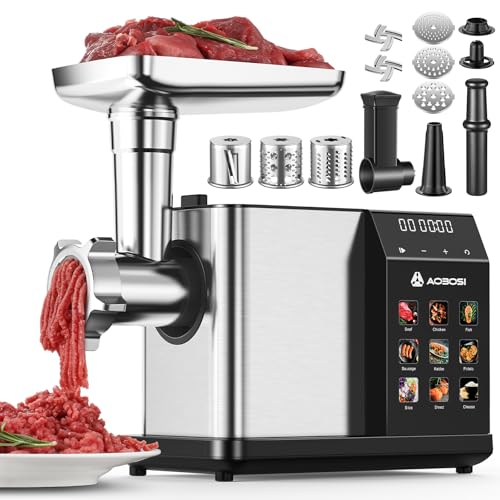
AAOBOSI Multifunctional Digital Meat Grinder
Badge: Best Jam Recovery
Strengths
- Auto-reverse directly answers the number-one bone-grinding frustration: the mid-batch stall.
- Nine touch screen presets give repeatable settings for recurring jobs like frames, mince, and sausage.
- Built-in storage plus kibbe and cheese-grating roles make it a genuine multi-tasker between bone sessions.
Trade-offs
- Presets are convenience, not power — the underlying 3000W max rating is the same class as its sibling.
- More electronics means more to keep dry during the aggressive washing bone work requires.
- Digital controls add cost compared with a simple dial machine of similar grinding capacity.
Mini spec box: Power: 3000W max · Controls: digital touch screen, 9 presets · Reverse: auto-reverse · Storage: built-in · Roles: grinding, sausage, kibbe, cheese grating · Duty described: home use.
Ask anyone who grinds bone-in poultry regularly what actually slows them down and the answer is rarely raw speed — it is the stall. A piece of frame catches, the auger loads up, and on a basic machine the next ten minutes are spent unplugging, unscrewing a loaded head, and digging out a half-ground plug of meat and bone with your fingers. This digital AAOBOSI is built around avoiding that moment: its auto-reverse backs the auger out of a jam so the piece can be re-fed smaller or discarded, and the batch continues. For bone work specifically, that single feature is worth more than a few hundred extra watts of peak rating.
The nine presets are best understood as memory, not magic. Once you find the setting that moves your usual chicken-frame mix comfortably, a preset lets you return to it next week without re-learning the machine’s temperament, and the same applies to the sausage and kibbe work the listing describes. The honest limitation is care: a touch-controlled, electronics-forward grinder asks for a bit more discipline at the sink. Wash the head parts thoroughly — bone work demands it — but keep the body and panel to a wipe-down, and dry everything before reassembly. If your grinding is mostly boneless and you are comparing the wider field, our Best Meat Grinders For High Volume At Home guide weighs throughput more heavily; but for bone specifically, jam recovery is the feature that decides whether a session feels easy or miserable, and this is the machine that has it.
Best for: bone grinders who hate mid-batch teardowns and want a reverse that works automatically / Not suited for: buyers who prefer the simplest possible dial-and-switch machine.

VEVOR Meat Grinder, #12 Electric Meat Mincer, 750W / 1 HP
Badge: Best Overall for Bones
Strengths
- A continuous-style rating — 750W / 1 HP — instead of only a peak number, which is the spec that predicts sustained bone-batch behaviour.
- The #12 head takes larger pieces than the typical home #5 or #8 head, cutting down pre-cutting of frames.
- Throughput quoted at 552 lbs/h and positioned for kitchens or restaurants, with an ETL listing noted.
Trade-offs
- Only two plates included, so your coarse-to-fine range is narrower out of the box than the Aiheal’s three-plate set.
- A #12 machine is bigger and heavier on the counter and in the cupboard than the compact home units here.
- Its restaurant-leaning design is more machine than a once-a-month pet-food maker needs.
Mini spec box: Motor: 750W / 1 HP · Head size: #12 · Throughput: 552 lbs/h (maker rating) · Plates: 2 · Stuffing tubes: 3 · Extras: kibbe kit · Certification noted: ETL listing · Settings: kitchens or restaurants.
The VEVOR is the pick we would buy for bones first, and the reasoning is about how its power is described. Every other machine in this guide leads with a peak wattage; the VEVOR leads with a horsepower figure and an hourly throughput, the language of equipment meant to run for a whole session rather than a short burst. Paired with the #12 head — a size class borrowed from light commercial butchery — that means poultry frames need less breaking down before feeding, the auger has more metal working each piece, and the machine holds its pace when a twenty-pound batch of frames is waiting in the fridge.
Technique still matters. Even a 1 HP #12 grinder should meet bone partially frozen, in pieces, coarse plate first; the difference is that the VEVOR forgives the occasional optimistic piece that would stall a smaller machine, and it clears a full session without the heat build-up that softens fat and smears texture on lesser motors. The honest limitation is scope: this is the largest, most serious machine here, and its two-plate bundle is the slimmest — plan on adding a finer plate if your finished grind needs one. Hunters processing trim alongside bone-in poultry will also want to see our Best Meat Grinders For Hunters guide, where this class of #12 machine is compared on game-day criteria. For bone-first buyers, though, the VEVOR’s combination of honest power rating, head size, and throughput makes it the benchmark the other five are measured against.
Best for: serious raw feeders and batch processors grinding soft bones every week / Not suited for: small kitchens or occasional users who will never use its capacity.
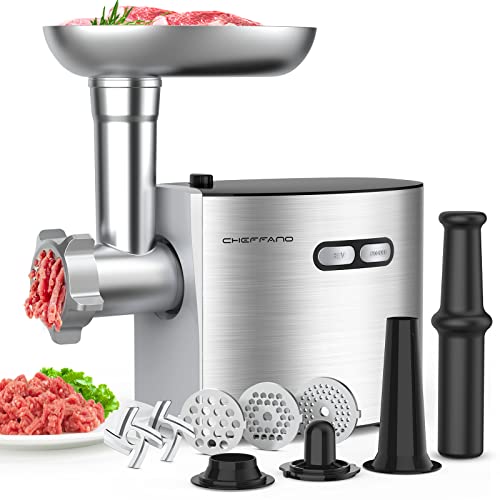
CHEFFANO Meat Grinder, 2800W Max, ETL Approved
Badge: Best Mid-Range Workhorse
Strengths
- ETL approval is stated in the listing — a genuine third-party safety signal in a category full of unverified claims.
- Two blades and three plates support the two-pass bone method without extra purchases.
- Positioned as heavy duty for home kitchen use, with sausage stuffer tubes and a kubbe kit rounding out the box.
Trade-offs
- 2800W max is the lowest peak figure in this six, so disciplined feeding matters more here.
- No reverse function is listed; jams are cleared manually.
- It lacks the storage and control refinements of the AAOBOSI models.
Mini spec box: Power: 2800W max · Certification noted: ETL approved · Blades: 2 · Plates: 3 · Extras: sausage stuffer tubes, kubbe kit · Duty described: heavy duty for home kitchen use.
The CHEFFANO is the straightforward answer in this guide: a heavy-duty home grinder with the right accessory count, a third-party approval in its listing, and no electronic extras competing for your money. For bone work its virtue is the two-blade, three-plate bundle at a mid-range position — the same two-pass capability as the Aiheal — in a machine whose pitch is durability rather than features. Run frames through the coarse plate on the first pass, rest the machine a moment if the session is long, then finish through a finer plate for the texture your recipe or your pet’s bowl needs.
Who it suits: buyers who want bone capability without paying for touch screens they will not use, and who value the ETL mark when an appliance will be working hard with wet ingredients nearby. The honest limitation is headroom. On paper this is the least powerful motor claim in the six, and while peak numbers are unreliable guides, the practical consequence is real: your feeding discipline — smaller pieces, colder meat, no forcing — does more of the work here than on the VEVOR. Feed it the way the how-to section below describes and it will grind soft bones dependably; treat it like a commercial bone mill and you will find its limits. As a balanced middle choice between the bundle-led Aiheal and the feature-led AAOBOSI models, it earns its workhorse badge honestly.
Best for: value-focused buyers who want ETL approval and a full plate set without paying for electronics / Not suited for: the largest batches, or anyone who wants reverse-assisted jam clearing.

Sinyder Electric Meat Grinder, 3000W Max, Stainless Steel
Badge: Best Metal-Gear Build
Strengths
- Metal gears are stated in the listing — the drive component that bone shock-loading destroys first in cheaper machines.
- Pure copper motor and a stainless steel body complete a durability-first specification.
- Two blades and three plates included, with sausage stuffer tubes and a kubbe kit.
Trade-offs
- No reverse function or throughput rating is listed, so batch pace is something you learn by using it.
- Stainless body construction typically means more weight to move and store.
- Fewer convenience features than the AAOBOSI pair — no presets, no built-in storage mentioned.
Mini spec box: Power: 3000W max · Motor: pure copper · Gears: metal · Body: stainless steel · Blades: 2 · Plates: 3 · Extras: sausage stuffer tubes, kubbe kit.
If you read the failure stories of grinders that died on bone, the same obituary appears again and again: the motor still hummed, but the gearbox gave up — a gear lost its teeth under repeated shock loads and the auger stopped turning. The Sinyder is the one machine in this six that answers that failure mode in its own listing: metal gears, turned by a pure copper motor, inside a stainless steel body. For a buyer whose first question is “will it still be grinding frames in three years,” that drivetrain specification is the most relevant paragraph on this page.
In use, the advice is the same as for the others — soft bones, small pieces, partially frozen, coarse plate first — but the Sinyder’s build is the most forgiving of the learning period while your technique develops. Its accessory set matches the Aiheal and CHEFFANO, so two-pass grinding and sausage work are covered from the first day. The honest limitations are the unknowns: with no listed reverse and no stated throughput, you are trading information for construction, and a jam still means a manual clear-out. Buyers cross-shopping for elk season should also compare the Best Meat Grinders For Elk shortlist, where sustained torque over very large animals is the whole question. For bone-first durability per dollar, though, the Sinyder’s metal-gear drivetrain makes it the build-quality pick of this guide.
Best for: durability-first buyers who plan to grind soft bones for years and want metal where it counts / Not suited for: buyers who want published throughput figures or electronic jam recovery.
Comparison Table
| Grinder | Power as listed | Plates / Blades | Jam help | Standout | Link |
|---|---|---|---|---|---|
| Aiheal | 3200W max | 3 / 2 | Manual clear | Fullest accessory bundle | Check on Amazon |
| AAOBOSI Touch | 3000W max, 4 lbs/min | Not stated / not stated | Manual clear | Raw pet food focus, built-in storage | Check on Amazon |
| AAOBOSI Digital | 3000W max | Not stated / not stated | Auto-reverse | 9 presets, auto-reverse | Check on Amazon |
| VEVOR #12 | 750W / 1 HP, 552 lbs/h | 2 / not stated | Manual clear | #12 head, honest power rating | Check on Amazon |
| CHEFFANO | 2800W max | 3 / 2 | Manual clear | ETL approved | Check on Amazon |
| Sinyder | 3000W max | 3 / 2 | Manual clear | Metal gears, copper motor | Check on Amazon |
How to Choose a Meat Grinder for Bones
Start with the bone, not the machine. Write down what you actually plan to grind. Chicken and turkey frames, necks, wings, and backs; rabbit; duck; whole sardines or mackerel — all of these are soft, hollow, or pliable bones that a strong home grinder handles. Beef, pork, lamb, and deer leg bones, knuckles, and any bone you cannot dent or bend are outside this class entirely and belong to a butcher’s band saw and commercial bone mill. If your list is mostly the second group, no pick in this guide is the right purchase, and the honest move is to buy bone meal or pre-ground bone-in product instead.
Read power claims like a skeptic. A “max” wattage describes a momentary peak under stall conditions, not the power the machine sustains. Horsepower ratings and throughput figures (pounds per hour or per minute) are closer to working truth. For bone, sustained torque at low speed is what moves a frame through a plate, so a machine like the VEVOR that quotes 1 HP and 552 lbs/h is telling you more than a bigger peak number does. Where only a peak figure exists, look for supporting evidence: metal gears, copper windings, a larger head size, and a heavy-duty positioning.
Prioritise the drivetrain. Bone fails grinders at the gearbox. Metal gears are the single clearest durability signal a listing can give; after that, a stainless grinding path (auger, blade, plates) resists the corrosion that raw, wet, mineral-rich work invites. Reserve one blade-and-plate pair exclusively for bone if the bundle allows it — bone dulls edges faster than meat, and a dedicated coarse set keeps your fine meat grinding clean and easy.
Decide how you will handle jams before you buy. Every bone grinder stalls eventually. With auto-reverse, recovery is a button press; without it, recovery is a routine you should be willing to perform: switch off, unplug, unscrew the retaining ring, and clear the head. If you know you will grind large batches and hate interruptions, weight reverse heavily in your choice. If your batches are small, a manual-clear machine at a lower tier is a rational saving.
Match head size to batch size. A #12 head suits weekly double-digit-pound sessions and game-season overflow; standard home heads suit a few pounds at a time. Bigger heads also accept bigger pieces, which shortens prep — but they cost more counter and cupboard space. Buy for the batch you actually make monthly, not the biggest batch you can imagine.
How to Grind Bones Safely, Step by Step
Step 1 — Select and portion. Choose soft bones only: poultry frames and necks, wings, rabbit, small whole fish. Break frames down with kitchen shears or a cleaver into pieces that drop freely down the feed tube without forcing. Remove any piece that feels rigid and unbending.
Step 2 — Chill hard. Spread the pieces on a tray and freeze them until firm and frosty at the edges but not rock solid — typically the texture of hard ice cream. Partially frozen bone and meat shear cleanly at the blade instead of smearing, and the cold load keeps the head temperature down through the session.
Step 3 — Set up for the coarse pass. Fit your coarsest plate and the blade you reserve for bone. Assemble the head fully and tighten the retaining ring firmly. Set a chilled bowl under the outlet.
Step 4 — Feed steadily. Add one or two pieces at a time and let the auger take them before adding more. Use the pusher to guide, never to ram, and never use fingers near the tube. Alternate a piece of bone-in frame with a piece of plain meat if your recipe allows — the meat helps carry bone fragments through the plate.
Step 5 — Manage stalls calmly. If the sound labours or output stops: switch off. If your machine has reverse or auto-reverse, use it briefly to back the piece out, then re-feed it smaller or set it aside. Without reverse, unplug, open the head, and clear it by hand. Never reach into an assembled, plugged-in head.
Step 6 — Second pass and finish. For a finer finished grind, chill the coarse output briefly and pass it through a medium or fine plate. Portion, label, and freeze or refrigerate immediately.
Step 7 — Clean like it matters, because it does. Disassemble the head completely. Wash auger, blade, plates, tray, and tubes in hot soapy water, scrub plate holes clear with a brush, dry every part fully before reassembly or storage, and wipe the body down. Bone and raw poultry residue is not a load to leave until morning.
Troubleshooting. Problem: the grind comes out warm and pasty → the meat was too warm or the session too long; re-chill the mix and work in smaller runs. Problem: the motor strains and output slows to a crawl → pieces are too big or fed too fast; stop, clear, cut smaller, and feed one piece at a time. Problem: gritty, coarse fragments in the finished grind → the first pass was too fine a plate for the bone size; regrind through the coarse plate, then step down gradually.
Which Bones Are Safe to Grind — and Which Are Not
This section exists because the most expensive bone-grinding mistake is a category error, not a technique error. Soft bones share a structure: they are hollow, thin-walled, or cartilaginous, and they crush rather than splinter under load. Poultry bones are the textbook case, which is why chicken frames anchor most raw feeding recipes; rabbit and small fish follow the same logic. Cooked bones of any kind are the dangerous exception — cooking makes bone brittle and splinter-prone, and cooked bone should never be ground for pets or people.
Weight-bearing bones from large animals are built to carry hundreds of pounds; their density is precisely what a home grinder’s gearbox cannot survive. Marrow bones, knuckles, and leg bones belong in stockpots whole, not in a feed tube. If a recipe calls for the mineral content those bones provide, the practical home answer is to grind soft bones for the calcium-rich fraction and use stock for flavour, rather than sacrificing a machine to prove a point. Turkey deserves a special note: its bones are poultry bones, but larger and harder than chicken — many owners grind turkey necks and frames successfully in this machine class while treating drumstick bones with suspicion; our dedicated guide to the Best Meat Grinders For Turkey Bones works through that animal piece by piece.
Bone Grinding for Raw Pet Food vs. Bone Grinding for the Kitchen
The same machine serves two different masters, and it helps to know which one you are, because it changes what “good output” means. Raw pet food is the volume job: the grind goes into portioned containers, texture targets are forgiving, and the priorities are throughput, easy cleaning, and a finished grind fine enough that no sharp fragment survives. That is why pet-focused owners gravitate to the AAOBOSI touch model with its pet-food positioning, or to the VEVOR when the weekly volume climbs — and why the Best Meat Grinders For Raw Dog Food guide exists as its own page with its own shortlist tuned to that routine.
Kitchen bone grinding is a smaller, pickier job. A cook grinding chicken frames for a mineral-rich mince, or working bone-in poultry into a sausage blend, cares about texture control and about keeping the meat fraction cold and cleanly cut rather than smeared. Here the two-pass method matters most, plate choice matters more than raw pace, and a mid-range machine like the CHEFFANO or the Sinyder — with three plates and a spare blade in the box — often serves better than a throughput flagship. The cook also tends to grind bone as one ingredient among several, alternating frame pieces with meat and fat so the plate stays clear, rather than running long unbroken stretches of bone.
Both jobs share the same non-negotiables: soft bones only, small pieces, hard-chilled ingredients, a coarse first pass, and a full wash-down afterwards. They also share the same storage logic — grind in a session, portion immediately, freeze flat in labelled packs, and rotate stock so the oldest packs are used first. Decide which master you serve before you buy, and the right pick from the six above usually identifies itself: volume points up the list toward the #12 head, texture points toward the three-plate bundles, and jam tolerance points at auto-reverse.
Common Buying Mistakes
Believing the peak wattage. Shoppers compare 3200W against 2800W and conclude the first machine is stronger. Peak figures are not measured the same way across brands and say little about sustained torque; drivetrain materials, head size, and continuous ratings are the honest comparison points.
Buying for the hardest bone you can imagine. A grinder bought to attempt beef bones will fail at beef bones and be oversized for the chicken frames you actually grind. Buy for your real weekly list.
Skipping the coarse pass. Feeding bone straight through a fine plate is the fastest route to a stall and a smeared, overheated grind. Two passes — coarse, then fine — are not extra work; they are the method.
Grinding at room temperature. Warm meat smears, warm fat coats the plate, and output quality collapses. The freezer is part of the equipment list for bone work.
Neglecting a spare blade. Bone dulls blades faster than meat. A machine bundled with two blades, or a spare bought alongside, prevents the slow decline into tearing instead of cutting that owners often misdiagnose as motor failure.
Final Recommendation
For most people searching for the best meat grinders for bones, the VEVOR #12 Electric Meat Grinder is the first choice: its 1 HP continuous-style rating, #12 head, and 552 lbs/h throughput are the specifications that survive contact with weekly soft-bone batches. If your bone grinding is really raw pet food in moderate weekly amounts, the AAOBOSI touch-screen model is the more tailored buy, and if your priority is a drivetrain that shrugs off years of shock loading, the Sinyder with metal gears and a copper motor is the durability pick. Whichever you choose, keep the bargain every machine in this guide makes with you: soft bones, small pieces, partially frozen, coarse plate first — and it will grind bones dependably for years.
Frequently Asked Questions
Can a home meat grinder really grind bones?
Yes — the soft kind. Heavy-duty home grinders like the six in this guide handle poultry frames, necks and wings, rabbit, and small whole fish when the pieces are small and partially frozen and the first pass uses a coarse plate. They cannot handle thick weight-bearing bones from large animals; attempting those risks the gearbox and the motor.
Which bones should I never put in a home grinder?
Never grind weight-bearing bones (beef, pork, lamb, or deer legs and knuckles), and never grind cooked bones of any species, because cooking makes bone brittle and splinter-prone. When in doubt, apply the bend test: if the bone does not flex or dent at all, it does not go in the grinder.
Why does my grinder keep stalling on chicken frames?
Stalls usually come from pieces that are too large, meat that is too warm, feeding too fast, or a plate that is too fine for a first pass. Cut frames smaller, freeze pieces until firm, feed one at a time, and start coarse. A machine with reverse or auto-reverse, like the digital AAOBOSI in this guide, recovers from the occasional stall without a teardown.
Does grinding bones dull the blade faster?
Yes. Bone is abrasive compared with meat, so the blade and plate that meet bone first wear faster. Many owners keep one blade-and-plate pair reserved for bone work — the multi-blade bundles in this guide make that easy — and keep a second pair sharp for clean meat grinding.
What plate size should I use for bones?
Use the coarsest plate in your set for the first pass; it lets bone fragments through without building pressure at the blade. If the finished texture needs to be finer, chill the coarse grind and pass it through a medium or fine plate second. Stepping down gradually is faster overall than forcing one fine pass, because it avoids stalls.
Is ground bone safe for dogs and cats?
Finely ground raw soft bone is a standard component of raw pet diets and is very different from feeding whole or cooked bones, which carry splinter and obstruction risks. Grind thoroughly, use the two-pass method, and follow your veterinarian’s guidance on proportions for your individual animal — this guide covers the equipment, not the diet formulation.
Should I grind bones and meat together or separately?
Alternating them usually works best. Feeding a piece of bone-in frame, then a piece of plain meat, helps the auger carry fragments through the plate and keeps pressure at the blade steadier than a long run of bone alone. If you need a precise bone-to-meat ratio for a recipe, grind the bone fraction separately through the coarse plate, weigh it, then combine and pass everything together once more so the mix is even.
How do I clean a grinder after grinding bones?
Disassemble the head completely, wash every part that touched food in hot soapy water, brush out the plate holes, rinse, and dry fully before reassembly — raw poultry and bone residue should never sit overnight. Wipe the motor body with a damp cloth rather than washing it, and store plates and blades dry, ideally in the machine’s built-in storage if it has one.